PRRS Vaccines Market Outlook:
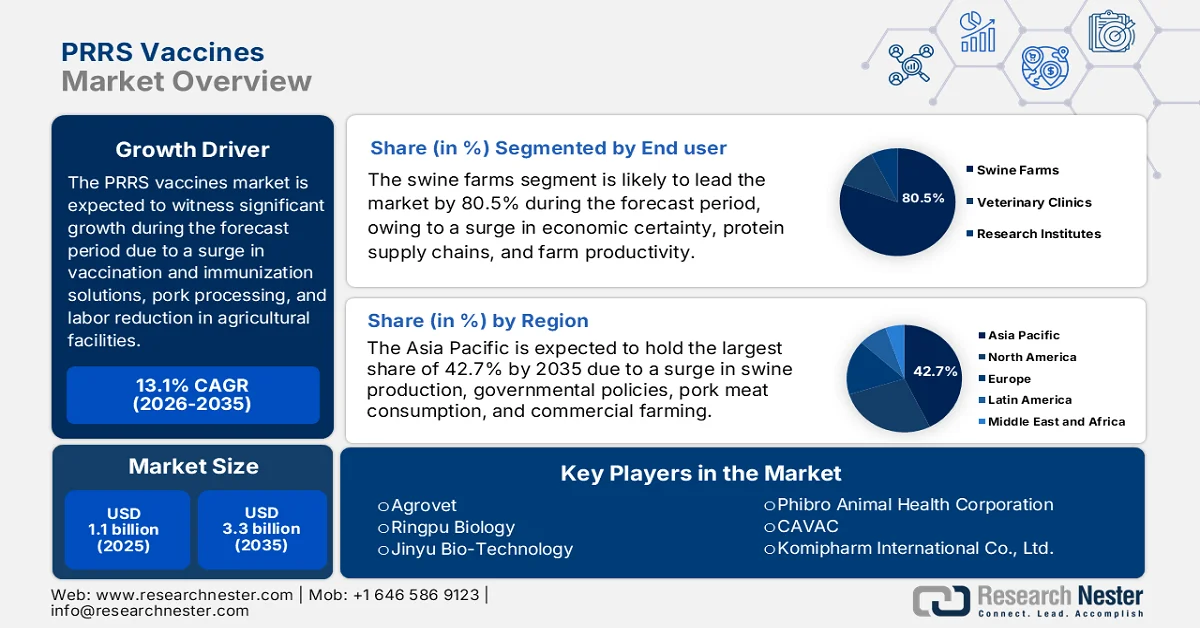
PRRS Vaccines Market size was valued at over USD 1.1 billion in 2025 and is expected to reach USD 3.3 billion by the end of 2035, growing at a CAGR of 13.1% during the forecast period, i.e., 2026-2035. In 2026, the industry size of PRRS vaccines is evaluated at USD 1.2 billion.
The worldwide PRRS vaccines market is significantly shaped by evolutionary industrial dynamics, the sustained demand for vaccination solutions, encompassing technological advancements, labor shortages in agricultural industries, and the increase in consolidating pork processing sectors. According to official statistics published by NLM in November 2023, 34% of pork meat is significantly consumed globally as of 2022, while 40% of poultry and 22% of beef are consumed, respectively. In addition, there has been a continuous increase in pork production by 77% from 63.5 million to 3 million tons as of 2022, while 287% and 49% catered to poultry and beef during the same duration. Meanwhile, besides the continuous growth in pork consumption, the global pig production has also increased by 140%, thereby denoting a huge growth opportunity for the PRRS vaccines market across different regions.
Global Meat Industry Balance Analysis (2018-2023)
|
Items |
2018 |
2021 |
2022 |
2023 |
Change % |
|
Global Production |
- |
356.9 |
362.6 |
363.9 |
0.4 |
|
Bovine+ovine |
86.6 |
91.3 |
93.0 |
92.9 |
-0.2 |
|
Poultry |
123.2 |
138.2 |
140.8 |
142.7 |
1.3 |
|
Pigs |
120.7 |
120.9 |
122.3 |
121.7 |
-0.5 |
|
Trade |
- |
42.0 |
41.8 |
42.1 |
0.6 |
|
Bovine+ovine |
- |
13.2 |
13.7 |
13.9 |
1.2 |
|
Poultry |
- |
15.8 |
16.3 |
16.4 |
1.0 |
|
Pigs |
- |
12.7 |
11.5 |
11.4 |
-1.0 |
|
Per Capita Consumption (kg/year) |
- |
45.0 |
45.2 |
45.0 |
-0.4 |
Source: NLM
Furthermore, the escalated shift towards multivalent vaccine formulations, the emergence of DIVA capability and differentiated vaccine platforms, growing integration of alternative administration routes, geographic expansion of regional manufacturers, and the digitalized health technology implementation are certain trends that are uplifting the PRRS vaccines market globally. As stated in an article published by NLM in April 2024, in terms of health technology, the internet is utilized by almost 4.9 billion individuals worldwide. Therefore, veterinarians constitute an outstanding chance to provide veterinary services through continuous educational services. Moreover, with the incorporation of digital technologies, veterinarian has the capability to analyze medical situations of animals by utilizing robots, electronic stethoscopes, and cameras, thus enhancing the market exposure.
Key PRRS Vaccines Market Insights Summary:
Regional Highlights:
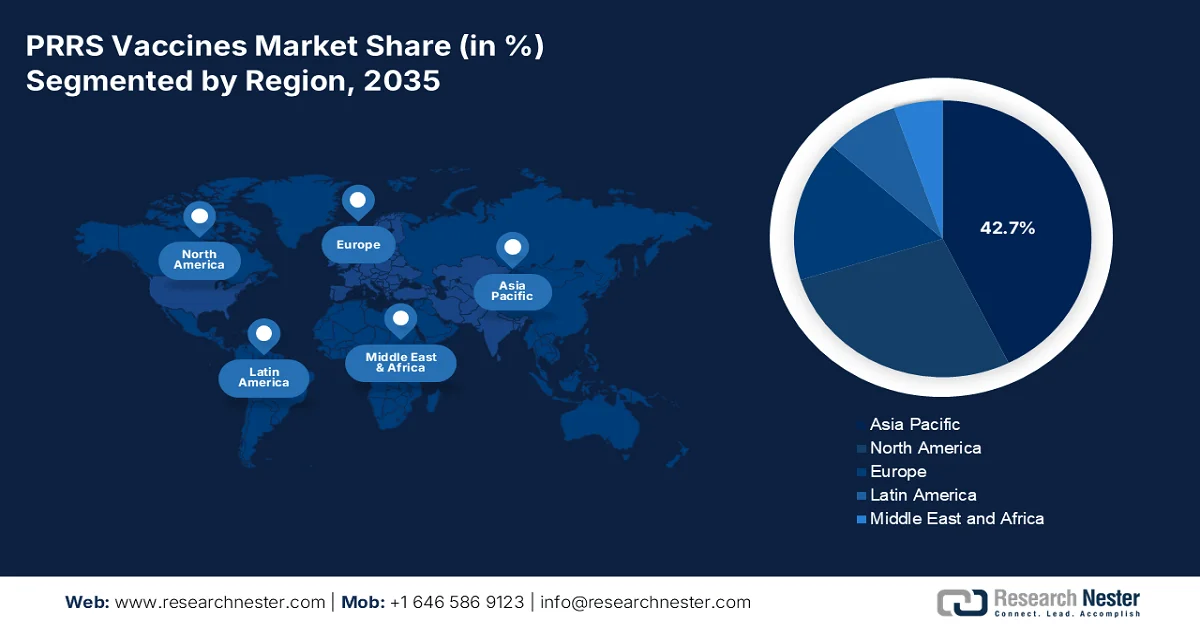
- Asia Pacific in the PRRS vaccines market is projected to hold a dominant 42.7% share by 2035, attributed to the concentration of swine production, rising pork consumption, and expansion of commercial farming operations
- Europe is poised to witness the fastest growth in the market over the forecast period, fueled by stringent regulatory frameworks and increasing commercial swine farming intensity
Segment Insights:
- PRRS vaccines market’s swine farms sub-segment is expected to account for an 80.5% share by 2035, driven by the critical economic role of swine production and the severe financial impact of PRRS on farm profitability
- The intramuscular segment is anticipated to secure the second-largest share in the market during 2026–2035, propelled by its superior absorption efficiency and suitability for delivering high-volume and viscous formulations
Key Growth Trends:
- Expansion in pork trade
- Industrialization of swine production
Major Challenges:
- High genetic variability and antigenic diversity of the PRRS virus
- Safety concerns and risk of reversion to virulence
Key Players: Boehringer Ingelheim (Germany), Merck & Co., Inc. (MSD Animal Health) (U.S.), Zoetis Inc. (U.S.), Ceva Santé Animale (France), Phibro Animal Health Corporation (U.S.), CAVAC (South Korea), Komipharm International Co., Ltd. (South Korea), Bioveta a.s. (Czech Republic), Agrovet (India), Ringpu Biology (China), Jinyu Bio-Technology (China), Sinopharm Animal Health Co., Ltd. (China), Qilu Animal Health (China), Chengdu Tecbond Biological Products Co., Ltd. (China), Guangdong Wens Dahuanong Biotechnology Co., Ltd. (China), Tecon (China), Pulike Biological Engineering, Inc. (China), Guangdong Yongshun Biological Pharmaceutical Co., Ltd. (China), Chopper Biology (China), CAHIC (China Animal Husbandry Industry Co., Ltd.) (China), BioChek (Netherlands), Bio-X (Belgium), Zoetis (U.S.), Ceva Animal Health (France).
Global PRRS Vaccines Market Forecast and Regional Outlook:
Market Size & Growth Projections:
- 2025 Market Size: USD 1.1 billion
- 2026 Market Size: USD 1.2 billion
- Projected Market Size: USD 3.3 billion by 2035
- Growth Forecasts: 13.1% CAGR (2026-2035)
Key Regional Dynamics:
- Largest Region: Asia Pacific (42.7% Share by 2035)
- Fastest Growing Region: Europe
- Dominating Countries: China, United States, Germany, Spain, Brazil
- Emerging Countries: India, Vietnam, Thailand, Philippines, Poland
Last updated on : 30 March, 2026
PRRS Vaccines Market - Growth Drivers and Challenges
Growth Drivers
- Expansion in pork trade: The globalization of pork trade has modified the PRRS control from a localized production into an international industrial accessibility, which is readily driving the PRRS vaccines market worldwide. According to official statistics published by the AHDB Organization in November 2025, there has been an increase in pork supply by 3.5% year-on-year (YoY) in July 2025, which is followed by over 7% in Spain and more than 5% in Poland. Besides, pork exports increased by 3% YoY, which is backed by the latest U.S.-China trade difficulties. Moreover, the government in China has effectively directed producers to reduce the national sow herb by 1 million head, accounting for 2.5% in 2026. This has aimed in supporting expenses, optimize productivity, and ease competition, thus positively fueling the market development.
- Industrialization of swine production: The worldwide transition toward concentrated and intensive swine production systems has fundamentally modified disease dynamics and developed the structural demand for the PRRS vaccines market. As stated in an article published by Theriogenology in March 2025, small-scale farms comprise different herb sizes, ranging from 250 to 2,500 sows, along with established benefits in localized and domestic industries. In addition, the majority of large-scale sow farms are categorized as intensive by utilizing confinement buildings while housing over 1,000 sows. Besides, developing capacities for breeding farms usually range between 1,000 to 10,000 sows, thus positively impacting the market growth.
- Escalation in PRRS: The sustained economic impact of this particular disease demonstrates the most fundamental driver for the PRRS vaccines market globally. As per an article published by NLM in December 2025, the PRRSV virus in China accounts for a 32.1% proportion. Besides, the XJ-Z5 strain is a huge part of the virus that originates from different parental strains, and it is moderate virulent for piglets. Moreover, as per the article published by the MDPI in June 2025, this particular virus has resulted in an approximate yearly economic loss, reaching an estimated USD 664 million, particularly in the U.S., along with roughly USD 300 million in Japan. This economic loss has resulted in causing severe damage to the global swine production, thus creating a huge growth opportunity for the market.
Challenges
- High genetic variability and antigenic diversity of the PRRS virus: The single most formidable scientific challenge confronting the PRRS vaccines market is the extraordinary genetic plasticity of the PRRS virus. As a single-stranded RNA virus, PRRSV exhibits a mutation rate significantly higher than DNA viruses, resulting in the constant emergence of novel field strains across geographies. Vaccines developed against one genotype, such as the North America-specific Type 2 (VR-2332) or the Europe-based Type 1 (Lelystad), often demonstrate limited cross-protection against heterologous strains circulating in different regions or even within neighboring production systems. This genetic drift renders traditional homologous vaccination strategies increasingly ineffective over time, creating a perpetual cycle of vaccine mismatch.
- Safety concerns and risk of reversion to virulence: A persistent and commercially significant roadblock for the PRRS vaccines market is the safety profile of modified live vaccines (MLVs), which currently constitute the largest segment of the industry. While MLVs are effective at inducing robust cellular and humoral immunity, they carry the inherent risk of reversion to virulence, denoting a phenomenon where the attenuated vaccine virus mutates back to a pathogenic state capable of causing clinical disease. Furthermore, the utilization of live vaccines can lead to recombination events between vaccine strains and circulating field strains, potentially generating novel, more virulent recombinants that complicate disease dynamics on farms, thus causing a hindrance to market growth.
PRRS Vaccines Market Size and Forecast:
| Report Attribute | Details |
|---|---|
|
Base Year |
2025 |
|
Forecast Year |
2026-2035 |
|
CAGR |
13.1% |
|
Base Year Market Size (2025) |
USD 1.1 billion |
|
Forecast Year Market Size (2035) |
USD 3.3 billion |
|
Regional Scope |
|
PRRS Vaccines Market Segmentation:
End user Segment Analysis
The swine farms sub-segment, part of the end user segment, is anticipated to account for the highest share of 80.5% in the PRRS vaccines market by the end of 2035. The sub-segment’s upliftment is highly attributed to the economic centrality of swine production to global protein supply chains and the direct, devastating impact of PRRS on farm-level profitability. For commercial swine operations, ranging from farrow-to-finish integrated enterprises to specialized breeding herds, PRRS represents not merely a veterinary challenge but a significant financial liability. The virus induces reproductive failure in sows, manifesting as abortions, stillbirths, and weak litters, while simultaneously causing respiratory distress and stunted growth in nursery and finishing pigs. Therefore, collectively these outcomes translate to increased mortality rates, reduced average daily gain, extended days-to-market, and elevated veterinary intervention costs.
Route of Administration Segment Analysis
Based on the route of administration, the intramuscular segment in the PRRS vaccines market is projected to grab the second-highest share during the forecast period. The segment’s growth is highly driven by its importance to directly deliver medication into muscle tissue, offer increased absorption, owing to vascularity, while ensuring the delivery of massive volumes, viscous medications, and oily solutions. According to official statistics published by the NIH in August 2023, medicated drugs tend to be administered intramuscularly both for curative purposes, accounting for over 95% of intramuscular, and for prophylactic, which is around 5% for immunization. Besides, this particular injection comprises an estimated-sized syringe, ranging between 22 mm and 25 mm for infants, thereby making it suitable for bolstering the sub-segment’s exposure.
Formulation Segment Analysis
By the end of the stipulated timeline, the liquid vaccine segment in formulation is expected to hold the third-highest share in the PRRS vaccines market. The segment’s development is highly propelled by its crucial role in diminishing child mortality for disorders, such as diphtheria, polio, and measles, along with offering direct protection to individuals and the comprehensive community. As stated in an article published by the Gavi Organization in June 2025, the vaccine alliance organization successfully secured over USD 9 billion towards a targeted budget of USD 11.9 billion between 2026 and 2030. Moreover, additional commitments have been made, which include an unprecedented USD 4.5 billion in complementary financing from developmental financial institutions. This has readily escalated accessibility to vaccines, with cost savings of almost USD 200 million from manufacturers, and over USD 149 million in private sector collaborations, thus driving the segment growth.
Commitments Initiated by Manufacturers for Immunization (2025)
|
Company Name |
Vaccine Payer’s Pricing/Cost Savings |
Purpose |
|
GSK and Bharat Biotech |
Cost less than USD 5 |
RTS,S/AS01 malaria vaccine for children in endemic nations |
|
GSK |
Savings of almost USD 23 million |
Enhance the production capacity of the malaria vaccine and reach over 50 million children |
|
Serum Institute of India (SII) |
Cost of USD 2 per dose and USD 4 per dose |
The provision of cost-effective pneumococcal conjugate vaccine for former Gavi-based nations and Gavi-specific MICs |
Source: GAVI Organization
Our in-depth analysis of the PRRS vaccines market includes the following segments:
|
Segment |
Subsegments |
|
End user |
|
|
Route of Administration |
|
|
Formulation |
|
|
Application |
|
|
Vaccine Type |
|
|
Swine Breed |
|

Vishnu Nair
Head - Global Business DevelopmentCustomize this report to your requirements — connect with our consultant for personalized insights and options.
PRRS Vaccines Market - Regional Analysis
APAC Market Insights
The Asia Pacific in the PRRS vaccines market is anticipated to garner the largest share of 42.7% by the end of 2035. The market’s upliftment in the region is primarily attributed to the concentration of swine production, the government-driven procurement facilities, the prevalent of swine diseases, a rise in pork meat consumption, and intensification of commercial farming operations. According to official statistics published by NLM in February 2024, pigs are considered the comprehensive raised animals, accounting for 749.6 million globally, of which the region accounting for 74%. Additionally, pig slaughter in the region also surpassed 850 million every year, with annual pork production increased by 63 million tons. Moreover, after the pandemic, the pig production in the region further exceeded, with s surge in pork production and pig slaughter by 22.7% and 22.4%, respectively, thus driving the market growth.
The PRRS vaccines market in China is growing significantly, owing to government procurement, regulatory vaccine approvals and programs, generous funding opportunities, the existence of national disease eradication strategies, and the sustained vaccine demand. As per an article published by Omega in April 2024, the country is one of the leading pork producers globally, readily covering 97% of its yearly pork consumption. In addition, the country’s National Bureau of Statistics has demonstrated that there has been an increase in pork prices by 159%, especially at the wholesale level. Besides, the country’s government has focused on providing large-scale breeding subsidy, ranging between USD 28,937.4 and USD 115,749.9, effectively depending on the breeding scale, thereby making it suitable for bolstering the PRRS vaccines market exposure in the overall country.
The aspects of aggressive administrative support for intensified research and development, generous investment in next-generation vaccine platforms, the support provision through vaccination programs, suitable technical assistance, and disease surveillance initiatives are certain factors that are boosting the PRRS vaccines market in South Korea. As per an article published by NLM in February 2023, the African swine fever virus emerged in the country, with outbreaks in domestic pig farms accounting for more than 2,600 cases, particularly among wild boar. However, to overcome the cases, the country is regarded to have adopted suitable control policies with a relatively increased level of performance among regional economies, owing to control on the disease in national pig farms, thereby denoting an optimistic outlook for the market growth.
Europe Market Insights
Europe in the PRRS vaccines market is expected to emerge as the fastest-growing region during the forecast period. The market’s development in the region is highly propelled by the strict regulatory oversight from Europe Medicines Agency, the enforcement of efficacy and safety standards for veterinary vaccines, the intensification of commercial swine farming across west Europe, and the persistent of virus strains. According to official statistics published by NLM in April 2024, the pig meat production in the region has reached 23 million tons, which deliberately represented 21% of the overall production globally. Besides, there has been a marginal increase of 0,4%, which was forecasted for 2023, majorly due to the 1.3% upsurge in poultry meat. Moreover, the region remains as the ultimate pig meat consumer with 41.1 kg, along with exports leading by 38%, thus enhancing the market development.
Pork Production (2012-2024) and Swine Stocks (2021-2023) Analysis in Europe
|
Pork |
Swine |
||
|
Year |
Production (Million Tons) |
Year |
Stocks (Million Heads) |
|
2012 |
22.5 |
2021 |
146 |
|
2017 |
23.7 |
2022 |
142 |
|
2021 |
23.6 |
2023 |
134 |
|
2022 |
22.3 |
- |
- |
|
2023 |
21.8 |
- |
- |
|
2024 |
21.1 |
- |
|
Source: NLM
The PRRS vaccines market in Germany is gaining increased traction, owing to the unparalleled concentration of intensive swine production and export-based pork sector, the presence of large-scale operations for necessitating systematic vaccination protocols, and the demand for continuous vaccination. As per an article published by Ecological Economics in July 2023, in terms of domestic farms’ financial success, it has been estimated that farms deliberately belong to the top 25% of the industry. In addition, these industries are part of different governmental schemes that prefer to make expansion rather than exiting. Besides, farmers in the country receive high level of education, which has displayed huge growth probabilities for farm production. Therefore, with the existence of standard policies and educational facilities, there is a huge growth opportunity for the market in the country.
The existence of government-based preventive health strategies, the development of high-density production conditions, escalation in widespread vaccination, a surge in diseases among swine herds, and the allocation of sufficient resources for promoting preventive vaccination are certain trends that are proliferating the PRRS vaccines market in France. As per an article published by the UK Government in February 2024, the World Organization for Animal Health reported the spread of Aujeszky’s disease (AD) on a domestic farm located in North France, readily affecting 23 to 200 animals. Apart from this disease, wind-borne infection has also occurred in this particular location, and it has been estimated that 7 of 11 outbreaks of AD has resulted from airborne spread. Therefore, with an increase in such diseases for swine herds, there is an increase in the market demand in the overall country.
North America Market Insights
North America in the PRRS vaccines market is projected to witness considerable growth by the end of the stipulated timeline. The market’s growth in the region is highly driven by innovative livestock farming practices, an increase in the awareness of swine health, suitable investments in veterinary healthcare infrastructure, stringent regulatory frameworks, and high vaccine efficacy. According to official statistics published by the USDA Government in November 2025, classical swine fever and Africa-based swine fever are extremely contagious and deadly disorders for both feral and domestic swine, which is detected among roughly 76 million domestic pigs, especially in the U.S. Besides, based on the November 2025 Swine Health Information Center data report, more than 95% of the regional livestock and territorial population gained the FMD-free status with and without vaccination, this enhancing the market exposure.
The PRRS vaccines market in the U.S. is gaining increased exposure, owing to the economic burden on its swine industry, the systematic vaccination adoption, expansion in pork meat production, technological advancements, and ensuring safety and efficient profiles for different vaccines. As per an article published by the USDA National Agricultural Statistics Service in March 2026, there has been 74.3 million pigs and hogs on domestic farms, denoting a rise by 1% from March 2025. Additionally, of these, 68.4 million are labelled as 5.8 million market hogs, while 5.8 million are reserved for breeding purpose. Moreover, between December 2025 and February 2026, 33.2 million pigs have weaned on domestic farms, indicating a surge by 1%. Likewise, between the same duration, pig and hog producers in the country weaned an average of 11.9 pigs per litter, thereby making it suitable for the market expansion.
The aspect of major pork meat export facilities, preserving worldwide industrial accessibility, enforcing strict efficiency standards for high-quality vaccination, administrative approval processes, along with suitable government funding for product distribution and swine disease management are certain factors that are fueling the PRRS vaccines market growth in Canada. As stated in a data report published by the USDA Foreign Agricultural Service in September 2025, the country’s overall cattle stocks account for 11,015 based on USDA data and 10,985 in Ottawa as of 2025, and meanwhile it accounted for 10,940 based on USDA and 10,900 in the city as of 2025. Likewise, the overall import catered to 364 as per USDA and 407 in Ottawa in 2024, while 320 and 420 as of 2025. Meanwhile, the continuous export of meat is also enhancing the market exposure in the country.
Meat Supply Estimation Analysis Based on USDA and Ottawa in Canada (2024-2026)
|
Components |
2024 |
2025 |
2026 |
|||
|
USDA Data |
Ottawa Data |
USDA Data |
Ottawa Data |
USDA Data |
Ottawa Data |
|
|
Overall Exports |
797 |
797 |
780 |
780 |
- |
780 |
|
Cow Slaughter |
428 |
428 |
420 |
400 |
- |
380 |
|
Calf Slaughter |
180 |
207 |
170 |
200 |
- |
200 |
|
Other Slaughter |
2,812 |
2,780 |
2,770 |
2,760 |
- |
2,790 |
|
Total Slaughter |
3,420 |
3,415 |
3,360 |
3,360 |
- |
3,370 |
|
Loss |
518 |
512 |
500 |
510 |
- |
510 |
|
Ending Inventories |
10,940 |
10,900 |
10,890 |
10,940 |
- |
10,990 |
|
Overall Distribution |
15,675 |
15,624 |
15,530 |
15,590 |
- |
15,650 |
Source: USDA Foreign Agricultural Service
Key PRRS Vaccines Market Players:
- Boehringer Ingelheim (Germany)
- Merck & Co., Inc. (MSD Animal Health) (U.S.)
- Zoetis Inc. (U.S.)
- Ceva Santé Animale (France)
- Phibro Animal Health Corporation (U.S.)
- CAVAC (South Korea)
- Komipharm International Co., Ltd. (South Korea)
- Bioveta a.s. (Czech Republic)
- Agrovet (India)
- Ringpu Biology (China)
- Jinyu Bio-Technology (China)
- Sinopharm Animal Health Co., Ltd. (China)
- Qilu Animal Health (China)
- Chengdu Tecbond Biological Products Co., Ltd. (China)
- Guangdong Wens Dahuanong Biotechnology Co., Ltd. (China)
- Tecon (China)
- Pulike Biological Engineering, Inc. (China)
- Guangdong Yongshun Biological Pharmaceutical Co., Ltd. (China)
- Chopper Biology (China)
- CAHIC (China Animal Husbandry Industry Co., Ltd.) (China)
- BioChek (Netherlands)
- Bio-X (Belgium)
- Zoetis (U.S.)
- Ceva Animal Health (France)
- Company Overview
- Business Strategy
- Key Product Offerings
- Financial Performance
- Key Performance Indicators
- Risk Analysis
- Recent Development
- Regional Presence
- Boehringer Ingelheim is widely recognized as a global leader in the PRRS vaccines market, leveraging its deep expertise in swine health to offer a comprehensive portfolio that includes both modified-live and innovative vaccine solutions. The company places a strong emphasis on technical services and producer education, providing integrated herd health management programs that extend beyond vaccine administration.
- Merck & Co., Inc. maintains a formidable presence in the PRRS vaccines market through its commitment to scientific innovation and the development of advanced vaccine technologies that address the evolving genetic diversity of the virus. The company’s strategic focus includes expanding its global footprint through partnerships and acquisitions while emphasizing the importance of biosecurity and comprehensive herd health protocols.
- Zoetis Inc. leverages its extensive research and development infrastructure and global commercial reach to offer a diversified portfolio of PRRS vaccines that cater to the varied needs of swine producers. The company differentiates itself through a strong focus on diagnostic capabilities and precision animal health solutions, enabling producers to implement targeted vaccination strategies informed by accurate disease surveillance.
- Ceva Santé Animale has established itself as a key competitor in the PRRS vaccines market through strategic acquisitions and a focused expansion of its swine vaccine portfolio, particularly in high-growth regions across Asia and Latin America. The company emphasizes innovation in vaccine formulation and delivery systems, aiming to offer user-friendly solutions that address the practical challenges faced by commercial swine operations.
- Phibro Animal Health Corporation approaches the PRRS vaccines market with a focus on integrating its vaccine offerings with broader animal health and nutrition solutions, positioning itself as a partner in holistic herd management. The company’s strategy emphasizes regulatory expertise and strategic partnerships to navigate complex market entry requirements, particularly in emerging economies where demand for cost-effective PRRS control measures continues to grow.
Here is a list of key players operating in the global PRRS vaccines market:
The global PRRS vaccines market is characterized by a moderately consolidated competitive landscape, with a strong presence of multinational animal health corporations and a dense network of regional players, particularly in China. Besides, worldwide leaders such as Boehringer Ingelheim and MSD Animal Health command significant market share through their broad product portfolios, strong distribution networks, and continuous investment in R&D for next-generation vaccines. Moreover, in August 2024, BioChek and Bio-X significantly entered into a tactical partnership by combining the strengths of both organizations active in animal health diagnostics. In addition, this partnership has focused on solid strategic benefits, including geographical synergies, along with the combined strength of both organizational R&D departments, thus fueling the PRRS vaccines industry worldwide.
Corporate Landscape of the PRRS Vaccines Market:
Recent Developments
- In March 2025, Zoetis introduced the latest formulation of Vanguard B Intranasal vaccine, which is readily available in a 0.5 mL dosage form to provide protection against Bordetella bronchiseptica, which is also referred to as kennel cough.
- In March 2025, Boehringer Ingelheim unveiled Ingelvac Circoflex AD, which is the first-ever swine vaccine to offer protection against the most prevalent genotypes of porcine circovirus type 2, which is combined with PCV2a and PCV2d antigens within a single dosage.
- In November 2024, Ceva Animal Health launched its newest investment in Europe-based vaccine manufacturing, with the development of the latest facility, particularly in Hungary and further expanding the capacity of Ceva Phylaxia.
- Report ID: 8486
- Published Date: Mar 30, 2026
- Report Format: PDF, PPT
- Explore a preview of key market trends and insights
- Review sample data tables and segment breakdowns
- Experience the quality of our visual data representations
- Evaluate our report structure and research methodology
- Get a glimpse of competitive landscape analysis
- Understand how regional forecasts are presented
- Assess the depth of company profiling and benchmarking
- Preview how actionable insights can support your strategy
Explore real data and analysis
Frequently Asked Questions (FAQ)
About this Report
Connect with our Expert


Report, 2026-2035



Copyright @ 2026 Research Nester. All Rights Reserved.
