Ocean Power Market Outlook:
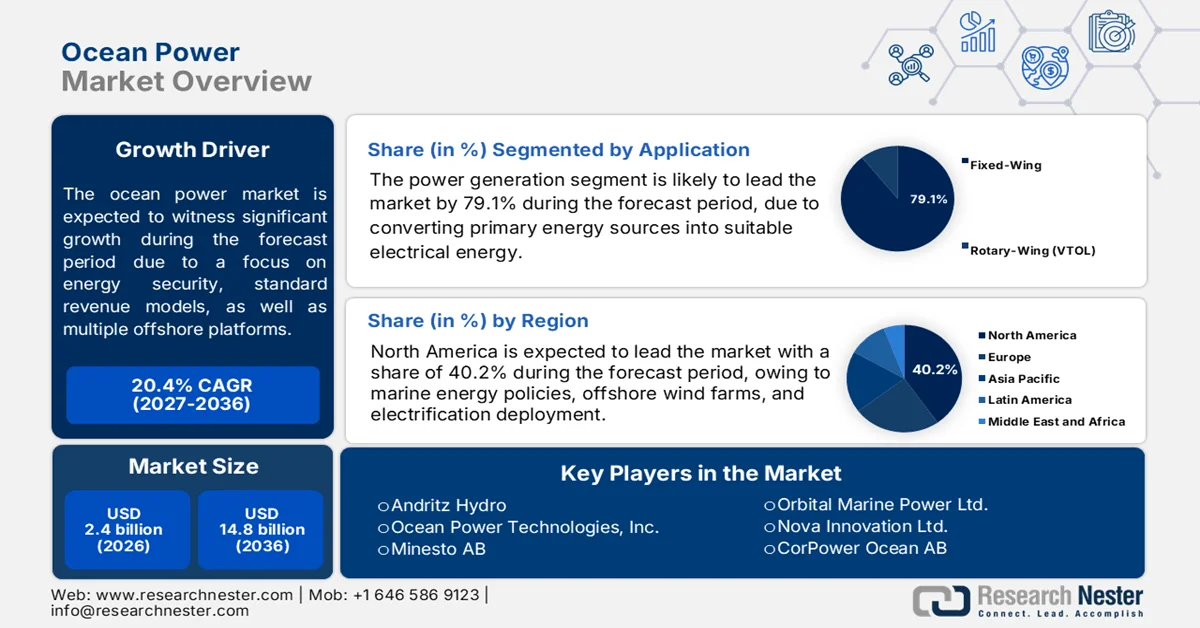
Ocean Power Market size was valued at USD 2.4 billion in 2026 and is expected to cross USD 14.8 billion by the end of 2036, expanding at more than 20.4% CAGR during the forecast period, i.e., between 2027-2036. In 2027, the industry size of ocean power is estimated at USD 2.8 billion.
The global ocean power market is being significantly shaped by a distinct set of foundational drivers, such as energy security, the expansion of revenue models through multi-purpose offshore platforms, and cost-reduction success in energy. According to a data report published by the IEA Organization in 2025, the demand for global energy grew by 2.2% as of 2024, which demonstrated a faster rate than the yearly average of 1.3% as observed in 2023. This was due to the effect of crucial weather, which is estimated to add 0.3 percentage points to the overall growth. Despite this, the energy demand continued to grow, expanding by 3.2% as of 2024. Meanwhile, the ongoing shipment of electrical energy in terms of export and import across different countries is positively impacting the market’s growth and exposure globally.
Global Electrical Energy Export and Import Shipment, 2024
|
Country |
Exports |
Imports |
||
|
Trade Value (USD 1,000) |
Quantity (1,000 kW/h) |
Trade Value (USD 1,000) |
Quantity (1,000 kW/h) |
|
|
European Union |
7,930,263.9 |
107,847,000 |
8,647,514.5 |
91,224,600 |
|
France |
6,398,575.0 |
80,989,600 |
895,371.2 |
10,975,700 |
|
Germany |
4,852,284.9 |
57,365,300 |
6,937,129.0 |
83,393,500 |
|
Switzerland |
4,446,590.0 |
45,236,500 |
2,556,923.2 |
30,827,600 |
|
Austria |
3,085,052.4 |
39,048,900 |
1,459,958.4 |
17,896,600 |
|
Slovak Republic |
2,541,163.2 |
17,408,200 |
1,712,867.9 |
14,457,000 |
Source: WITS
Moreover, the technological diversification beyond tidal dominance, operational evidence, an escalation in technological maturity, and the international standardization for enabling cross-border deployment are certain trends for bolstering the ocean power market globally. As stated in an article published by the Royal Society Publishing Organization in December 2025, the tidal stream energy industry has successfully reached more than 35 MW of overall worldwide cumulative installed capacity from decommissioned and operational turbines, especially 19 MW in the UK and 6.5 MW in France. Based on this, future projects are easily contracted in both these nations, which is predicted to increase global cumulative installed capacity by 440% to 188 MW by the end of 2030. This readily ensures progression in installed capacity, thus proliferating the market exposure.
Key Ocean Power Market Insights Summary:
Regional Highlights:
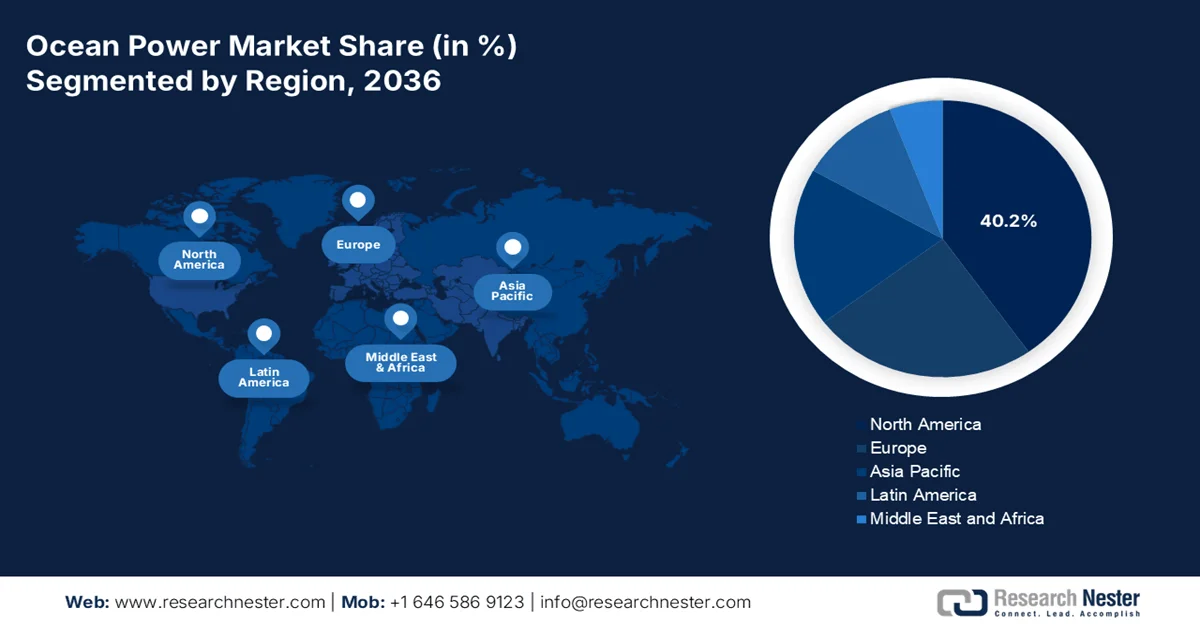
- North America is projected to account for the largest 40.2% share by 2036 in the ocean power market, supported by marine-energy licensing, federal government funding, integration with offshore wind farms, and deployment for coastal community electrification.
- Asia Pacific is poised to be the fastest-growing region during 2027-2036, propelled by generous investment in marine renewables, diverse energy availability, and increasing tidal installations.
Segment Insights:
- Power generation is anticipated to command the highest 79.1% share by 2036 in the ocean power market, with its expansion fueled by its foundational role in converting primary energy sources into electrical energy.
- Utilities and independent power producers (IPP) are projected to secure a 69.5% share by 2036, owing to their critical role in the large-scale deployment and commercialization of marine energy technologies.
Key Growth Trends:
- Expansion in energy security
- Cost-effective commercial viability
Major Challenges:
- Technological immaturity and reliability concerns
- Environmental and regulatory uncertainty
Key Players: CorPower Ocean AB, Eco Wave Power Global AB, Carnegie Clean Energy Limited, Verdant Power, Inc.
Global Ocean Power Market Forecast and Regional Outlook:
Market Size & Growth Projections:
- 2026 Market Size: USD 2.4 billion
- 2027 Market Size: USD 2.8 billion
- Projected Market Size: USD 14.8 billion by 2036
- Growth Forecasts: 20.4% CAGR (2027-2036)
Key Regional Dynamics:
- Largest Region: North America (40.2% Share by 2036)
- Fastest Growing Region: Asia Pacific
- Dominating Countries: United States, China, United Kingdom, Japan, France
- Emerging Countries: South Korea, Australia, Canada, Norway, Spain
Last updated on : 4 September, 2026
Ocean Power Market - Growth Drivers and Challenges
Growth Drivers
- Expansion in energy security: The ocean power market provides a distinctive benefit in a modernized energy system, with a focus on highly predictable generation. According to an article published by the World Economic Forum in June 2026, renewable power capacity is predicted to increase by nearly 4,600 GW by the end of 2030, which would eventually double the deployment of the past 5 years. Meanwhile, the worldwide grid expenditure operates at an estimated USD 400 billion every year, in comparison to USD 1 trillion in terms of generation assets, which is considered a structural imbalance that tends to be achieved by standalone deployment. Therefore, with such energy power systems and abilities, the market is continuously gaining increased exposure.
- Cost-effective commercial viability: The market is effectively charting a cost-reduction course similar to offshore wind's successful trajectory. In this regard, wave and tidal technologies are advancing toward commercial viability by leveraging innovation, industrialization, and larger project scales. As deployment grows, manufacturing efficiencies, improved installation techniques, and enhanced device reliability will collectively drive down costs. Besides, learning from offshore wind's experience, the sector expects significant price reductions as installed capacity expands. Moreover, equipment standardization, supply chain development, and operational optimization will further compress expenses, positioning ocean energy as an increasingly competitive renewable source.
Challenges
- Technological immaturity and reliability concerns: The ocean power market is still grappling with the technical complexities of generating electricity from the sea. Many devices remain at a demonstration or prototype phase, and their long-term reliability has not yet been fully established. Besides, evaluating this technology is exceptionally difficult; unlike solar panels, you cannot simply place a marine energy device in the ocean and hope for the best. The unpredictable nature of waves, powerful currents, and corrosive saltwater creates unforeseen challenges that are nearly impossible to simulate perfectly. This leap of faith from computer models to ocean deployment often results in costly failures and delays, as developers encounter issues that were invisible in simulations, from snapped mooring lines to damaged cables that can take weeks to repair in the harsh ocean environment.
- Environmental and regulatory uncertainty: Projects in the ocean energy market face a complex web of environmental concerns and stringent regulations that can significantly slow down deployment. One of the most pressing issues is the potential impact on marine life, such as the risk of harbour seals colliding with tidal turbines. This consenting risk creates a major uncertainty for developers, as they must navigate a science-led but cautious regulatory process that requires extensive monitoring and collaboration with research institutions, even when studies suggest that such collisions are extremely rare. The high cost and complexity of these environmental impact assessments add to project timelines and financial burdens, often requiring a coordinated, solutions-focused approach from regulators to be resolved.
Ocean Power Market Size and Forecast:
| Report Attribute | Details |
|---|---|
|
Base Year |
2026 |
|
Forecast Year |
2027-2036 |
|
CAGR |
20.4% |
|
Base Year Market Size (2026) |
USD 2.4 billion |
|
Forecast Year Market Size (2036) |
USD 14.8 billion |
|
Regional Scope |
|
Ocean Power Market Segmentation:
Application Segment Analysis
The power generation sub-segment under the application segment is anticipated to have the highest share of 79.1% in the ocean power market by the end of 2036. The sub-segment’s upliftment is highly fueled by its role as the foundational process of readily converting primary energy sources into electrical energy. According to a data report published by the EPA Government in June 2026, the power industry is a significant emissions source, particularly in the U.S., which contributes an estimated 44% of sulphur dioxide, 11% of nitrogen oxides, and 30% of carbon dioxide emissions. Besides, almost 90% of total coal capacity significantly featured more than one technology for controlling pollution in the form of selective catalytic reduction and scrubbers as of 2023. Based on this, there has been a continuous increase in electricity demand, which is positively impacting the sub-segment’s expansion.
Yearly Increased Electric Power Generation Demand, 2013-2023
|
Year |
Growth (TWh) |
|
2013 |
3.9 |
|
2014 |
3.94 |
|
2015 |
3.92 |
|
2016 |
3.92 |
|
2017 |
3.8 |
|
2018 |
4.0 |
|
2019 |
3.9 |
|
2020 |
3.85 |
|
2021 |
3.96 |
|
2022 |
4.07 |
|
2023 |
4.02 |
Source: U.S. EPA
End user Segment Analysis
During the forecast period, the utilities and independent power producers (IPP) sub-segment, which is part of the end user segment, is predicted to account for the second-highest share of 69.5% in the ocean power market. The sub-segment’s growth is primarily driven by forming a critical pillar within the market's end-user landscape. These entities are primarily responsible for the large-scale deployment and commercialization of marine energy technologies. Besides, utilities leverage their extensive infrastructure and grid connectivity to integrate ocean-generated electricity into the broader power supply, while IPPs drive project development through private investment and operational expertise. Together, they bridge the gap between emerging technology and viable energy delivery, thus positively driving the sub-segment’s growth and exposure.
Type Segment Analysis
Based on the type, the wave energy segment is projected to grab the third-highest share of 44.3% in the market by the end of the stipulated timeline. The segment’s development is highly attributed to its crucial role as a renewable and clean power source that is captured from the motion of ocean waves. As per an article published by Tethys Engineering in December 2025, the worldwide tidal and wave energy industry effectively reached USD 983.1 million as of 2024, and is further predicted to reach USD 1,850.9 million, along with an 8.3% growth rate by the end of 2032. Additionally, the industry is gaining increased momentum since developed countries are gradually shifting towards renewable and cleaner energy sources. Moreover, this particular energy tends to capture power from surface ocean waves, thus proliferating the segment’s expansion.
Our in-depth analysis of the market includes the following segments:
|
Segment |
Subsegments |
|
Application |
|
|
End user |
|
|
Type |
|
|
Technology |
|

Vishnu Nair
Head - Global Business DevelopmentCustomize this report to your requirements — connect with our consultant for personalized insights and options.
Ocean Power Market - Regional Analysis
North America Market Insights
North America ocean power market is anticipated to garner the largest share of 40.2% by the end of 2036. The market’s upliftment in the region is primarily driven by marine-energy licensing, federal government funding, the integration with offshore wind farms, and the deployment for coastal community electrification. According to a data report published by the Department of Energy (DOE) in July 2022, the administrative body declared USD 12 million for 12 marine and hydropower energy projects, which is part of the Small Business Technology Transfer (STTR) and Small Business Innovation Research (SBIR) program. Therefore, these particular projects, which are small business-based projects, are focused on driving advancements in water power technologies, thereby bolstering the market in the region.
The ocean power market in the U.S. is growing significantly, owing to strong federal policy, generous funding opportunities, massive energy reliability and potential, along with testing infrastructure and focused research and development. As stated in an article published by the EIA Government in April 2026, electricity consumption in the country has gradually increased by 2.1% every year over the past 5 years. In addition, this particular consumption is further expected to grow from 0.9% to 1.6% by the end of 2050, with data center server energy utilization as the ultimate major factor. Meanwhile, in terms of oil and natural gas, the crude oil production in the country is predicted to hover between 12.4 million barrels per day and 12.7 million barrels per day. Therefore, based on this increase in these sources, the market is continuously expanding in the country.
Natural and Renewable Gas Generation Increase in the U.S. Power Industry, 2013-2023
|
Year |
Renewables (GWh) |
Natural Gas (GWh) |
Coal (GWh) |
Nuclear (GWh) |
Other (GWh) |
|
2013 |
486.5 |
1,029 |
1,567.7 |
789 |
36.2 |
|
2014 |
505.4 |
1,033.2 |
1,568.8 |
797.2 |
38.6 |
|
2015 |
510.9 |
1,238.8 |
1,341 |
797.2 |
37.5 |
|
2016 |
576 |
1,280.3 |
1,229.7 |
805.7 |
33.9 |
|
2017 |
653.2 |
1,198 |
1,197.8 |
805 |
31.2 |
|
2018 |
673.7 |
1,368.5 |
1,142.2 |
807.1 |
35.3 |
|
2019 |
696.7 |
1,479.9 |
958.7 |
809.4 |
29 |
|
2020 |
752 |
1,522.3 |
767.7 |
789.9 |
27.1 |
|
2021 |
785 |
1,476.6 |
892.4 |
779.6 |
28.6 |
|
2022 |
870.3 |
1,582.7 |
826.1 |
771.5 |
29.3 |
|
2023 |
867.1 |
1,699.9 |
670.6 |
774.9 |
22.1 |
Source: EPA Government
The immense resource demand and advantage, as well as the national roadmap and Vision 2050, and the presence of substantial federal government grants, are certain factors that are boosting the ocean power market in Canada. As stated in an article published by IEA in July 2024, the government provided funds for 4 tidal energy projects for USD 6.7 million (CAD 9.4 million). This was readily possible through Natural Resources Canada’s (NRCan) Energy Innovation, Clean Growth, and Emerging Renewables Power programs. Besides, of the total budget, USD 2.8 million (CAD 4 million) has been offered to Nova Innovation for developing a tidal turbine array. Likewise, USD 1.0 million (CAD 1.5 million) to the University of Manitoba by partnering with Sustainable Oceans Applied Research (SOAR), followed by USD 1.4 million (CAD 2 million) each to the Offshore Energy Research Association of Nova Scotia and Fundy Ocean Research Centre for Energy, thus fueling the market expansion.
APAC Market Insights
The Asia Pacific market is expected to emerge as the fastest-growing region during the forecast period. The market’s development in the region is highly propelled by generous investment in marine renewables, a mix of energy availability, and an increase in tidal installations. According to an article published by the IEA Organization in August 2026, Southeast Asia has emerged as an essential part of the worldwide energy system, thus accounting for 9% of the worldwide population and 4% of its gross domestic product (GDP). In this regard, fossil fuel subsidies in the region amount to nearly USD 40 billion, based on which the energy source rose in 2026. Besides, the overall energy demand accounts for about 40% higher, and fossil fuels have been supplying the majority, thereby demonstrating a huge growth opportunity for the market in the region.
The ocean power market in China is gaining increased traction, owing to the unparalleled installed capacity, supply chain benefits, the largest capacity for offshore wind supply chain, standard grid parity, and a suitable manufacturing ecosystem. As stated in an article published by the State Council Information Office in April 2026, the offshore wind project under domestic development is expected to generate 1.6 kWh of yearly clean power and reduce carbon emissions by 1.2 million tons upon completion. Additionally, the deepest operational offshore wind farm in Shandong Province, which is a 504,000-kW project, readily operates in waters ranging between 52 and 56 meters deep across roughly 70 km offshore. Therefore, with the presence of such projects and a focus on offshore wind expansion, the market is continuously expanding in the overall country.
The aspects of marine energy capacity, state-owned electricity division, the escalation of near-zero installation capacity, a surge in electricity demand, and suitable frameworks are a few trends that are responsible for boosting the ocean power market in Indonesia. As per an article published by East Asia Forum in August 2026, the country comprises solar resources, with technological expenses and pumped hydro storage predicted to achieve 100% renewable electricity. Moreover, the country has effectively set a suitable target of renewables, accounting for 17% to 19% of the total energy mix as of 2025. Besides, solar energy also contributed to 1% of overall energy consumption, and meanwhile coal is also continuing to dominate. Therefore, based on these energy sources, there is a huge growth and expansion opportunity for the market in the overall nation.
Europe Market Insights
Europe market is predicted to account for a considerable share by the end of the stipulated timeline. The market’s growth in the region is effectively driven by marine energy resources, net-zero emission commitments, the demand for renewable energy, and generous investment opportunities by the European Green Deal and Horizon Europe. According to the EU Blue Economy 2025 report, the regional offshore wind energy generated over USD 6.1 billion (€5.3 billion) gross value added (GVA) as of 2022, which demonstrated a 42% increase in comparison to the previous year. Besides, the gross profit significantly accounted for USD 4.7 billion (€4.1 billion), while the turnover was valued at USD 29.1 billion (€25 billion). Therefore, with this continuous increase in the offshore wind energy sector, the market is continuing to gain importance in the region.
Offshore Wind Energy Turnover, GVA, and Gross Operating Surplus in Europe, 2013-2023
|
Year |
Turnover (USD Billion) |
GVA (USD Billion) |
Gross Operating Surplus (USD Billion) |
|
2013 |
2.3 |
- |
- |
|
2014 |
3.4 |
1.1 |
- |
|
2015 |
8.1 |
1.1 |
1.1 |
|
2016 |
10.4 |
2.3 |
1.1 |
|
2017 |
13.9 |
2.3 |
1.1 |
|
2018 |
16.3 |
2.3 |
2.3 |
|
2019 |
20.9 |
3.4 |
2.3 |
|
2020 |
23.3 |
3.4 |
2.3 |
|
2021 |
29.1 |
4.6 |
3.4 |
|
2022 |
29.1 |
5.8 |
4.6 |
|
2023 |
30.3 |
6.9 |
4.6 |
Source: EU Blue Economy
The ocean power market in the UK is gaining increased exposure, owing to the existence of the largest installed tidal capacity, innovative commercial tidal array, government-funded de-risking mechanisms, and net-zero support for marine energy. As stated in an article published by NLM in January 2023, the country has readily committed to diminishing economy-wide greenhouse gas emissions by nearly 68% by the end of 2030. Additionally, the domestic net-zero approaches also demonstrated the nation’s vision for a green economy by 2050, which further indicates present commission rates and ensures government strategies to lower emissions by 2035. Based on this, the emission share for buildings and heat accounted for 17%, and the predicted reduction by the end of 203g ranged between 47% and 62%, thus demonstrating suitable growth for the market in the country.
The tidal stream target, advantages from outstanding marine resources, high-capacity generation, the presence of a strong industrial ecosystem, and suitable approaches with renewable energy goals are a few factors for enhancing the market in France. Based on the May 2026 ITA data report, renewable energies in the nation significantly accounted for almost 22.2% of the gross final energy consumption, indicating an increase of 20.5% from 2022. Besides, the nation’s Multiannual Energy Program, since its publication, has effectively outlined a suitable plan for the projection of reducing the nuclear power share in electricity generation from more than 70% to 50% by the end of 2035. Besides, there was the construction of 6 newest EPR2 reactors in February 2022, along with the provision of USD 1.0 billion for supporting the development of small modular reactors, thus proliferating the market exposure.
Key Ocean Power Market Players:
- Andritz Hydro (Austria)
- Ocean Power Technologies, Inc. (U.S.)
- Minesto AB (Sweden)
- Orbital Marine Power Ltd. (UK)
- Nova Innovation Ltd. (UK)
- CorPower Ocean AB (Sweden)
- Eco Wave Power Global AB (Sweden)
- Carnegie Clean Energy Limited (Australia)
- Verdant Power, Inc. (U.S.)
- Company Overview
- Business Strategy
- Key Product Offerings
- Financial Performance
- Key Performance Indicators
- Risk Analysis
- Recent Development
- Regional Presence
- Andritz Hydro is a global leader in hydropower and has extended its expertise into the marine energy sector through tidal and wave power solutions. The company leverages its extensive experience in turbine design and large-scale project execution to deliver reliable ocean energy systems for utility-scale deployments.
- Ocean Power Technologies, Inc. specializes in autonomous wave energy converters that provide remote offshore power and real-time data communications. The company focuses on serving defense, maritime, and oil and gas industries with scalable, modular buoy-based solutions that operate independently of the grid.
- Minesto AB has developed a unique deep-sea tidal kite technology that operates in low-velocity currents, enabling power generation in previously inaccessible tidal sites. The company distinguishes itself through its lightweight, cost-effective design that reduces installation and maintenance complexities compared to traditional tidal turbines.
- Orbital Marine Power Ltd. manufactures floating tidal turbines that are designed for large-scale commercial deployment in deep-water environments. The company's innovative anchoring system allows for easy access and maintenance, positioning it as a key player in advancing tidal stream energy projects.
- Nova Innovation Ltd. specializes in seabed-mounted tidal turbines that deliver predictable and renewable energy for coastal communities and island grids. The company focuses on modular, low-maintenance systems that can be rapidly deployed and scaled to meet local energy demands.
Here is a list of key players operating in the global market:
The global ocean power market features a moderately consolidated competitive landscape, where a handful of established players hold a significant share. Based on this, Europe-based manufacturers, particularly from the UK and Scandinavia, are prominent due to supportive regional policies and advanced marine engineering capabilities. The competitive environment is marked by technological differentiation, with leaders focusing on diverse platforms such as floating tidal turbines, submerged wave energy converters, and autonomous buoy systems. Besides, in October 2024, Eco Wave Power Global AB effectively signed an agreement for the sale of the first wave energy generation unit with I-Ke International Ocean Energy Co. to make the wave energy technology available in Taiwan, thereby making it suitable for bolstering the ocean power industry.
Corporate Landscape of the Market:
Recent Developments
- In June 2026, Ocean Power Technologies, Inc. successfully deployed and commissioned the PowerBuoy® system off the coast of New Jersey, and also received a purchase-based order from Stevens Institute of Technology for maritime drones, known as the WAM-V® unmanned surface vehicle.
- In November 2024, SKF signed a memorandum of understanding with Proteus Marine Renewables and GE Vernova’s Power Conversion business, which set out a suitable framework for supplying tidal turbine generation systems to developers of tidal arrays.
- In January 2023, Minesto and SEV expanded and renewed the collaborative deal by outlining suitable roles and responsibilities that are associated with tidal energy, with the inclusion of continuous electricity production.
- Report ID: 8751
- Published Date: Sep 04, 2026
- Report Format: PDF, PPT
- Explore a preview of key market trends and insights
- Review sample data tables and segment breakdowns
- Experience the quality of our visual data representations
- Evaluate our report structure and research methodology
- Get a glimpse of competitive landscape analysis
- Understand how regional forecasts are presented
- Assess the depth of company profiling and benchmarking
- Preview how actionable insights can support your strategy
Explore real data and analysis
Frequently Asked Questions (FAQ)
About this Report
Connect with our Expert


Report, 2027-2036



Copyright @ 2026 Research Nester. All Rights Reserved.
