Telecom Tower Power System Market Outlook:
Telecom Tower Power System Market size was valued at USD 7.3 billion in 2025 and is projected to reach USD 15.7 billion by the end of 2035, expanding at a CAGR of 8.1% during the forecast period, i.e., 2026-2035. In 2026, the industry size of telecom tower power system is evaluated at USD 7.8 billion.
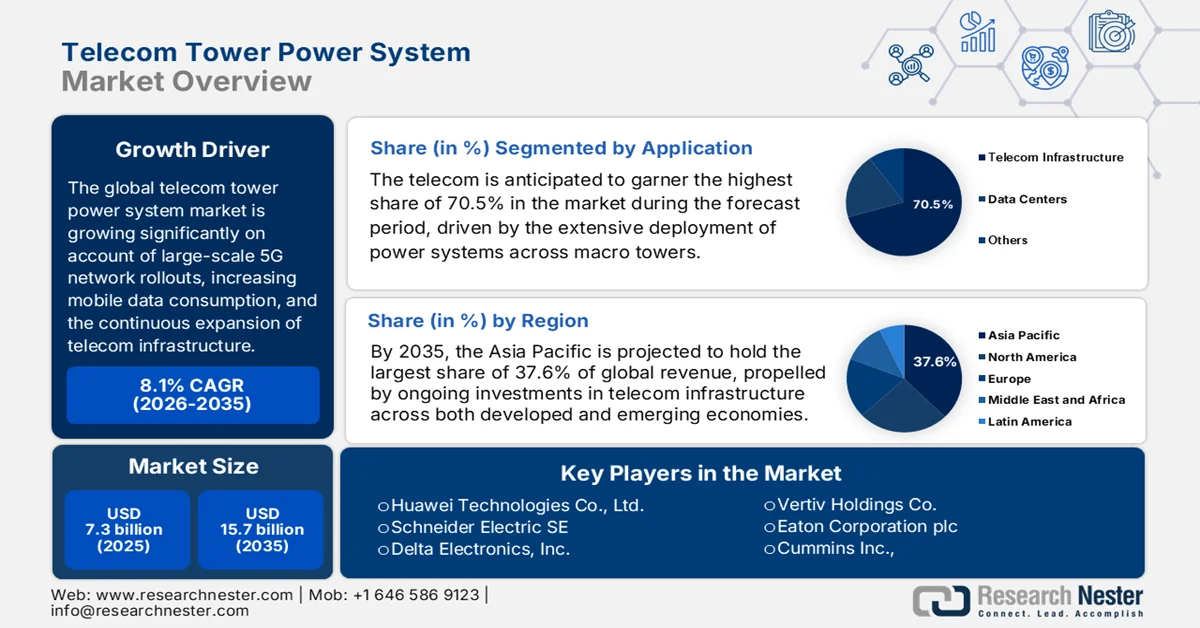
The telecom tower power system market is projected for noteworthy growth, primarily fueled by large-scale 5G network rollouts, increasing mobile data consumption, and the continuous expansion of telecom infrastructure into rural and remote regions. The telecom tower power system market is also being shaped by the extensive need for uninterrupted network uptime, which is encouraging operators to upgrade from conventional diesel-based backup setups to more efficient hybrid, renewable, and smart energy-managed power solutions. In this context, the article published by the International Telecommunication Union reported that in 2025, global internet adoption reached 74% with 6 billion users, whereas the high‑income countries are near universal use at 94%, and low‑income nations were at 23%. Africa averages with almost 36%, and thus underscoring a huge potential for telecom tower power systems.
Global Mobile Network Population Coverage by Technology: 2025 Connectivity Benchmark
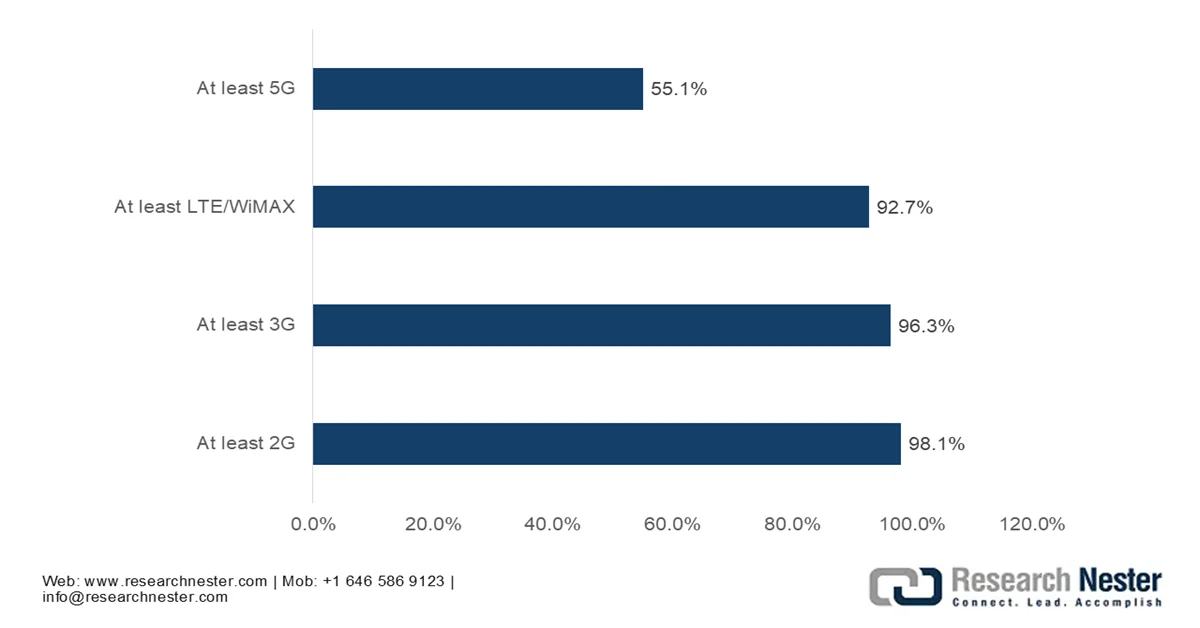
Source: ITU
Furthermore, digital transformation in telecom networks, which includes the integration of AI-based energy optimization and remote monitoring systems, is improving operational efficiency and reducing dependence on traditional fuel-heavy systems. Also, increasing infrastructure sharing among tower companies and rising investments in network densification are also supporting demand for reliable energy systems. In September 2023, the article published by Press Information Bureau (PIB) revealed that India’s rapid digital shift is being driven by 5G rollout, along with enabling technologies such as IoT, AI, and AR/VR, which require coordinated ecosystem development. It noted that the 5G services are expanding through nationwide network deployment supported by government initiatives, policy recommendations, and cross-sector collaboration. It also stressed that effective collaboration between telecom service providers, OEMs, infrastructure players, and government bodies is essential to gain a scalable adoption in industries.
Key Telecom Tower Power System Market Insights Summary:
Regional Highlights:
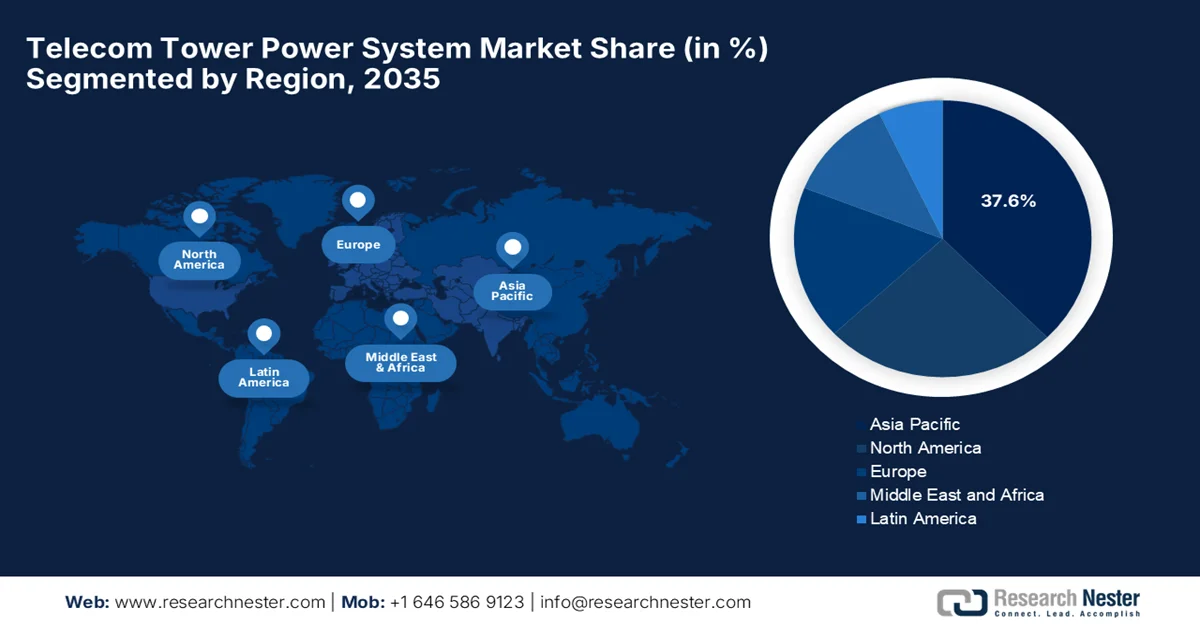
- The telecom tower power system market in Asia Pacific is projected to capture 37.6% share by 2035, bolstered by the extensive rollout of 5G networks and the expansion of mobile coverage across rural and remote territories
- North America is anticipated to witness notable growth throughout 2026-2035, supported by the densification of macro cells and the corporate push for sustainability
Segment Insights:
- The Telecom Infrastructure segment is projected to account for 70.5% share by 2035 in the telecom tower power system market, underpinned by the extensive deployment of power systems across macro towers, rooftop base stations, small cell networks, and distributed antenna systems
- The Off-Grid segment is expected to secure a considerable share during 2026-2035, fueled by the widespread deployment of telecom towers in regions with limited or unreliable grid infrastructure
Key Growth Trends:
- Shift to hybrid green energy
- Widespread lithium-ion battery adoption
Major Challenges:
- Grid instability and geographic isolation
- Remote operation and complex maintenance
Key Players: Huawei Technologies Co., Ltd. (China), Schneider Electric SE (France), Delta Electronics, Inc. (Taiwan), Vertiv Holdings Co. (U.S.), Eaton Corporation plc (Ireland), Cummins Inc. (U.S.), Mitsubishi Electric Corporation (Japan), ZTE Corporation (China), Eltek AS (Norway), Generac Holdings Inc. (U.S.), Alpha Technologies Services, Inc. (U.S.), Comba Telecom Systems Holdings Ltd. (China), Delta Power Solutions India Pvt. Ltd. (India), International Finance Corporation (U.S.).
Global Telecom Tower Power System Market Forecast and Regional Outlook:
Market Size & Growth Projections:
- 2025 Market Size: USD 7.3 billion
- 2026 Market Size: USD 7.8 billion
- Projected Market Size: USD 15.7 billion by 2035
- Growth Forecasts: 8.1% CAGR (2026-2035)
Key Regional Dynamics:
- Largest Region: Asia Pacific (37.6% share by 2035)
- Fastest Growing Region: North America
- Dominating Countries: China, United States, India, Japan, Germany
- Emerging Countries: India, Indonesia, Vietnam, Brazil, Saudi Arabia
Last updated on : 30 June, 2026
Telecom Tower Power System Market - Growth Drivers and Challenges
Growth Drivers
- Shift to hybrid green energy: The continuously escalating operational costs, along with certain stringent government regulations, are encouraging a transition towards renewable-supplemented power systems. Operators are proactively replacing diesel-only setups with hybrid solar-wind-battery configurations, whereas these integrated green solutions successfully cut fuel consumption. In January 2023, the article published by the National Institute of Health (NIH) revealed that telecom towers consume significant electricity and rely on grid power or diesel generators, which are carbon-intensive. Therefore, to reduce emissions, renewable energy options such as solar PV, wind, fuel cells, and hybrid systems are being deployed. Hence, these systems improve the reliability and sustainability of telecom infrastructure, benefiting the overall telecom tower power system market.
- Widespread lithium-ion battery adoption: The modern telecom infrastructure is making a shift from lead-acid batteries to high-capacity lithium-ion storage solutions. Lithium-ion technology provides a three times higher energy density and longer lifecycle, and thereby it lowers the total cost of ownership. For instance, in April 2026, Amara Raja Energy & Mobility crossed 1 GWh of cumulative lithium energy storage deployment across 50,000 telecom sites in India, and it deliberately secured more than 35% market share in the telecom battery segment. Therefore, this transition from diesel and lead‑acid to lithium storage has delivered longer lifecycles, lower maintenance, and superior performance under extreme conditions, thus positively benefiting the telecom tower power system market.
Challenges
- Grid instability and geographic isolation: A significant share of the world’s telecom towers has been operating in rural regions with weak, unreliable, or entirely absent grid connections. In these isolated zones, sudden voltage fluctuations, blackouts, and severe weather conditions present severe threats to network uptime, causing hindrance to adoption in the telecom tower power system market. As steady grid power is unavailable, operators are still dependent on diesel fuel generators to bridge the frequent energy gaps. Therefore, this reliance on fossil fuels exposes tower managers to volatile fuel pricing and complex transportation logistics over rough terrain. Environmental factors such as extreme heat or freezing cold also accelerate the physical degradation of battery backups, whereas this forces providers to prepare durable, outdoor-rated hybrid systems that are capable of surviving harsh local climates.
- Remote operation and complex maintenance: The aspect of managing and maintaining a huge number of decentralized power units across vast, inaccessible geographic areas introduces severe operational hurdles. Apart from this, traditional tower configurations often utilize unlinked electronic components that fail to provide granular visibility into individual power lines or battery health. If a breaker trips or a generator fails, engineers must drive hours to manually reset switches, which in turn inflates operational expenditure. This issue is exacerbated by a global shortage of skilled technical professionals trained to service advanced renewable systems in remote sectors. In addition to shared multi-tenant towers, calculating precise power bills for different network carriers remains incredibly messy.
Telecom Tower Power System Market Size and Forecast:
| Report Attribute | Details |
|---|---|
|
Base Year |
2025 |
|
Forecast Period |
2026-2035 |
|
CAGR |
8.1% |
|
Base Year Market Size (2025) |
USD 7.3 billion |
|
Forecast Year Market Size (2035) |
USD 15.7 billion |
|
Regional Scope |
|
Telecom Tower Power System Market Segmentation:
Application Segment Analysis
The telecom infrastructure in the application category is anticipated to garner the highest share of 70.5% in the telecom tower power system market during the forecast period. The segment’s dominating position is mainly driven by the extensive deployment of power systems across macro towers, rooftop base stations, small cell networks, and distributed antenna systems. In addition, the rising need for reliable backhaul connectivity, including support for maritime VSAT networks, also strengthens demand. For instance, in July 2024, Nokia and Bharti Airtel completed India’s first 5G NSA Cloud RAN trial, thereby showcasing more than 1.2 Gbps throughput using commercial devices. This trial leveraged Nokia’s vDU and vCU software on x86 hardware with L1 acceleration, enabling efficient scaling, automation, and hybrid RAN performance.
Technology Segment Analysis
On the basis of technology, off-grid is expected to attain a considerable share in the telecom tower power system market over the forecasted years. The segment’s growth is effectively attributable to the widespread deployment of telecom towers in regions with limited or unreliable grid infrastructure. These systems have a higher installation value due to their self-sufficient design and advanced power management requirements, especially for supporting energy-intensive 5G equipment. In September 2024, Clear Blue Technologies signed a notice of award with Growth Energy in order to replace diesel-powered telecom towers in Africa with solar solutions. It also mentioned that Phase 1 shipments in 2024 are valued at about USD 772,735, with the full project potentially reaching USD 4 million across three phases, hence denoting a huge opportunity for the segment to grow.
Component Segment Analysis
The batteries segment, which is under component, is forecasted to grow with a notable share in the telecom tower power system market during the discussed timeframe. The subtype’s growth is propelled mainly by the growing demand for reliable energy storage to ensure uninterrupted telecom tower operations, especially in the case of off-grid and hybrid power installations. The segment benefits from both the deployment of batteries at new telecom sites and the ongoing replacement of aging valve-regulated lead-acid batteries across existing tower infrastructure. In June 2024, Vertiv announced the launch of the NetSure IPE outdoor rectifier to support 5G rollout and boost capacity in high-demand areas such as stadiums, airports, and shopping centers. The compact rectifier is available globally with lithium-ion battery backup, and it minimizes power losses while reliably powering radios at the network edge.
Our in-depth analysis of the telecom tower power system market includes the following segments:
|
Segment |
Subsegments |
|
Application |
|
|
Technology |
|
|
Component |
|
|
Power Source |
|

Vishnu Nair
Head - Global Business DevelopmentCustomize this report to your requirements — connect with our consultant for personalized insights and options.
Telecom Tower Power System Market - Regional Analysis
APAC Market Insights
The Asia Pacific telecom tower power system market is expected to hold the highest share of 37.6% during the forecast period. The region benefits from the extensive rollout of 5G networks and the broadening of mobile coverage across rural and remote territories. The regional landscape is also seeing a strong shift toward green energy, wherein the providers are opting for hybrid power systems that integrate solar and wind energy to minimize operational costs and dependence on unstable electrical grids. In this context, JTOWER in April 2024 introduced improved 5G infra-sharing equipment that readily cuts power consumption by around 35% at the same time maintaining strong radio performance for all four mobile operators in Japan. Besides, this compact Sub6-compatible device enhances indoor coverage in facilities such as offices, hospitals, and arenas, supporting sustainable telecom infrastructure.
The state-backed acceleration of its 5G standalone network infrastructure and macro cell deployments is the main factor responsible for uplifting the telecom tower power system market in China. The telecom tower power system market is also being dynamically reshaped by strict national carbon-neutrality mandates, forcing a transition toward green telecom sites that utilize smart hybrid energy, solar integration, and AI-based energy management to optimize efficiency. In February 2024, Huawei introduced its Intelligent VPP and SmartDC innovations to accelerate the ICT industry’s green transition. The Site VPP distributed energy storage system helps operators evolve into energy prosumers by enabling efficient power aggregation, intelligent scheduling, and multi-service convergence. Hence, such instances denote that China’s market is driven by 5G SA expansion and mandated shift toward smart, low-carbon telecom sites.
In India, the telecom tower power system market has gained enhanced exposure owing to the need to manage high energy consumption and frequent grid instability. The domestic telecom operators and tower companies are opting for advanced outdoor power shelves and high-capacity lithium-ion batteries for reliable backup power. In this context, Press Information Bureau (PIB) in June 2026, the country’s telecom sector showed strong growth in the quarter ending March 2026, which is driven by rising internet and mobile adoption, expanding broadband usage, and improving financial performance across operators. Besides, the total internet subscribers reached 1,092.79 million, whereas total telephone subscribers increased to 1,330.58 million, reflecting steady nationwide connectivity expansion. The wireless services are dominating, supported by growing ARPU, traffic (MOU), and strong revenue gains across the sector.
India Telecom Sector Growth 2026: Internet, Broadband, Wireless Subscribers, ARPU & Market Performance
|
Indicator |
Value (Mar 2026) |
Change / Growth |
|
Internet Subscribers |
1,092.79 million |
+6.24% QoQ |
|
Broadband Subscribers |
1,065.88 million |
+5.81% QoQ |
|
Total Telephone Subscribers |
1,330.58 million |
+1.87% QoQ |
|
Wireless Subscribers |
1,282.33 million |
+1.87% QoQ |
|
Wireline Subscribers |
48.25 million |
+1.86% QoQ |
|
Wireless ARPU |
USD 2.36/month |
+0.76% QoQ |
|
AGR (Telecom Sector) |
USD 1.04 billion |
+2.90% QoQ |
|
Tele-density (Overall) |
93.26% |
+1.52 pp QoQ |
Source: PIB
North America Market Insights
The North America telecom tower power system market is witnessing considerable growth over the forecasted years. The region’s leadership is effectively attributable to the densification of macro cells and the corporate push for sustainability, which is driving the integration of smart hybrid energy configurations. In addition, the adoption of cloud-managed power systems and predictive AI maintenance software allows operators to optimize energy consumption and streamline operations across a vast geographic tower network. Based on the government data published in April 2022, the National Telecommunications and Information Administration, which is a part of the U.S. Department of Commerce, plays a central role in spectrum management, broadband deployment, and ICT policy. It also administers major broadband programs, which include the USD 42.45 billion BEAD initiative under the Infrastructure Investment and Jobs Act, aimed at closing the digital divide and promoting digital equity.
The expansion of mid-band spectrum coverage to support surging data traffic is responsibly boosting the overall U.S. telecom tower power system market. The sector is being influenced by a strong shift toward automation, wherein infrastructure operators are integrating cloud-based power management and AI-based predictive maintenance to optimize energy usage and remote monitoring across massive tower portfolios. In October 2024, Ericsson and Telstra introduced the automated energy saver, which is the first 5G Advanced energy management feature in the Southern Hemisphere. The company also mentions that AES uses intent-based automation to optimize resources and dynamically manage NR Massive MIMO Sleep functions, balancing energy savings with seamless customer experiences.
The Canada telecom tower power system market has gained immense exposure owing to the federal initiatives to improve connectivity across sprawling rural and northern territories. The country’s market is being shaped by the remote nature of many tower sites, which accelerates the adoption of satellite-connected remote monitoring systems and AI-based predictive maintenance software. In March 2026, the government of Canada reported that it is advancing wireless connectivity by releasing new mmWave spectrum rules and modernizing tower siting processes to support 5G innovation. The upcoming 2027 auction will make 4.8 GHz of spectrum available in the 26 GHz and 38 GHz bands, with measures to promote competition and access for smaller operators. Along with this, streamlined digital approvals for tower siting will reduce red tape, improve transparency, and accelerate deployment, thus positively benefiting the country’s telecom tower power system market.
Europe Market Insights
The strict directives regarding energy efficiency and carbon neutrality are fueling the growth of the telecom tower power system market in Europe. To cope with skyrocketing energy costs and grid volatility, the country’s operators are making heavy investments in high-efficiency outdoor power shelves, smart rectifiers, and intelligent lithium-ion energy storage systems to guarantee network uptime. In June 2025, ECIPE reported that the regional telecommunications sector is vital for competitiveness, providing the backbone of digital connectivity while driving innovation. The region has been strong on the supply side, with firms leading in R&D and telecom technology development. Furthermore, standard development organizations and standard essential patents are helping smaller companies in the region commercialize innovations globally, sustaining research through licensing revenues.
The telecom tower power system market in Germany is undergoing significant transformations owing to the expansion of independent tower companies and network-sharing models. Simultaneously, priority locations such as transport corridors and industrial zones are seeing faster integration of smarter rectifiers, modular power shelves, and grid-interactive backup systems, while secondary sites are upgraded more gradually. In November 2023, Vodafone Germany activated Ericsson’s 5G radio 6646 technology by combining 900, 800, and 700 MHz bands to deliver fast rural connectivity with 30% to 40% lower energy consumption. It also mentioned trials showed savings of over 2,500 kWh per site on a yearly basis, which is equivalent to powering a two-person household, with nationwide rollout expected to save more than 30 million kWh per year, thus heightening the demand for telecom tower power systems.
The ongoing densification of 4G and 5G networks is reshaping the growth dynamics of the UK telecom tower power system market. The country’s market also benefits from infrastructure sharing and the expansion of independent tower portfolios, which encourages standardized, modular power system deployments across sites. Based on government data published in March 2026, the UK’s telecommunications modernization programme is a once-in-a-generation upgrade that is replacing copper lines with fiber and retiring 2G/3G networks in favor of 4G and 5G. These industry-led changes improve reliability, call quality, and digital inclusion, while boosting productivity and network security. Therefore, such government-backed instances in the country provide encouraging growth opportunities for pioneers operating in the telecom tower power systems industry.
Key Telecom Tower Power System Market Players:
- Huawei Technologies Co., Ltd. (China)
- Schneider Electric SE (France)
- Delta Electronics, Inc. (Taiwan)
- Vertiv Holdings Co. (U.S.)
- Eaton Corporation plc (Ireland)
- Cummins Inc. (U.S.)
- Mitsubishi Electric Corporation (Japan)
- ZTE Corporation (China)
- Eltek AS (Norway)
- Generac Holdings Inc. (U.S.)
- Alpha Technologies Services, Inc. (U.S.)
- Comba Telecom Systems Holdings Ltd. (China)
- Delta Power Solutions India Pvt. Ltd. (India)
- International Finance Corporation (U.S.)
- IPT PowerTech (Lebanon)
- Company Overview
- Business Strategy
- Key Product Offerings
- Financial Performance
- Key Performance Indicators
- Risk Analysis
- Recent Development
- Regional Presence
- SWOT Analysis
- Huawei Technologies Co., Ltd. has registered itself as one of the leading providers of telecom power solutions globally, and it is offering integrated site energy systems for mobile networks, telecom towers, and data communications infrastructure. The company supplies rectifiers, lithium battery systems, hybrid energy solutions, intelligent power management platforms, and renewable-powered telecom site solutions.
- Schneider Electric SE is considered to be a major player, which serves telecom operators through its portfolio of power conversion, backup power, cooling, and energy management solutions. The firm is highly focused on sustainability and digitalization, which helps telecom companies optimize energy consumption, thereby supporting the deployment of high-capacity 4G and 5G networks.
- Delta Electronics, Inc. is a global supplier of power electronics and energy-efficient infrastructure solutions, and the company benefits from a strong presence in the telecom sector. The company has built a significant telecom tower power system market presence by emphasizing high-efficiency power conversion technologies and renewable energy integration.
- Vertiv Holdings Co. is a specialist player in terms of critical digital infrastructure and provides a range of telecom power solutions under its well-known NetSure portfolio. The firm’s solutions are especially designed to support increasing network traffic and 5G deployments by enhancing energy efficiency, power reliability, and operational visibility.
- Eaton Corporation plc is a foundational player that provides telecom operators with backup power systems, power distribution equipment, energy storage solutions, and intelligent power management platforms. The company’s telecom-based solutions help maintain network continuity during grid outages, thereby improving operational efficiency across tower sites and communication networks.
Here is a list of key players operating in the global telecom tower power system market:
The telecom tower power system market is moderately consolidated, which hosts global power infrastructure players competing in terms of technological innovation and integrated power management solutions. Market participants are making heavy investments in hybrid energy systems, lithium-ion battery technologies, AI-based energy management platforms, and renewable energy integration in order to address the growing power demands of 4G and 5G networks. Partnerships with telecom operators, expansion of regional manufacturing capabilities, and investments in smart monitoring solutions have become mostly opted strategies across the industry. For instance, in June 2026, Phoenix Tower Germany commissioned a new 60‑meter mobile tower in Plettenberg‑Selscheid, North Rhine‑Westphalia, which will provide 4G and 5G coverage for Deutsche Telekom, O2 Telefónica, and Vodafone. The project was funded by MIG and supported by state authorities, and closes a major connectivity gap along regional roads.
Corporate Landscape of the Telecom Tower Power System Market:
Recent Developments
- In March 2026, IFC entered into a partnership with IPT PowerTech to modernize and power over 2,200 telecom sites in Ethiopia, Liberia, and Sierra Leone by using solar and battery systems to cut costs, reduce emissions, and improve service reliability. This investment will strengthen digital connectivity and expand economic participation.
- In March 2026, Huawei received Frost & Sullivan’s Global Best Practices Award for its innovative virtual power plant solution, which transforms telecom site batteries from backup to revenue-generating assets. This solution enables large-scale aggregation, rapid response, and precision control.
- Report ID: 8645
- Published Date: Jun 30, 2026
- Report Format: PDF, PPT
- Explore a preview of key market trends and insights
- Review sample data tables and segment breakdowns
- Experience the quality of our visual data representations
- Evaluate our report structure and research methodology
- Get a glimpse of competitive landscape analysis
- Understand how regional forecasts are presented
- Assess the depth of company profiling and benchmarking
- Preview how actionable insights can support your strategy
Explore real data and analysis
Frequently Asked Questions (FAQ)
About this Report
Connect with our Expert


Report, 2026-2035



Copyright @ 2026 Research Nester. All Rights Reserved.
