Nutraceuticals Market Outlook:
Nutraceuticals Market size was valued at USD 480.7 billion in 2025 and is projected to reach USD 805.6 billion by the end of 2035, rising at a CAGR of 5.3% during the forecast period, i.e., 2026-2035. In 2026, the industry size of nutraceuticals is assessed at USD 506.1 billion.
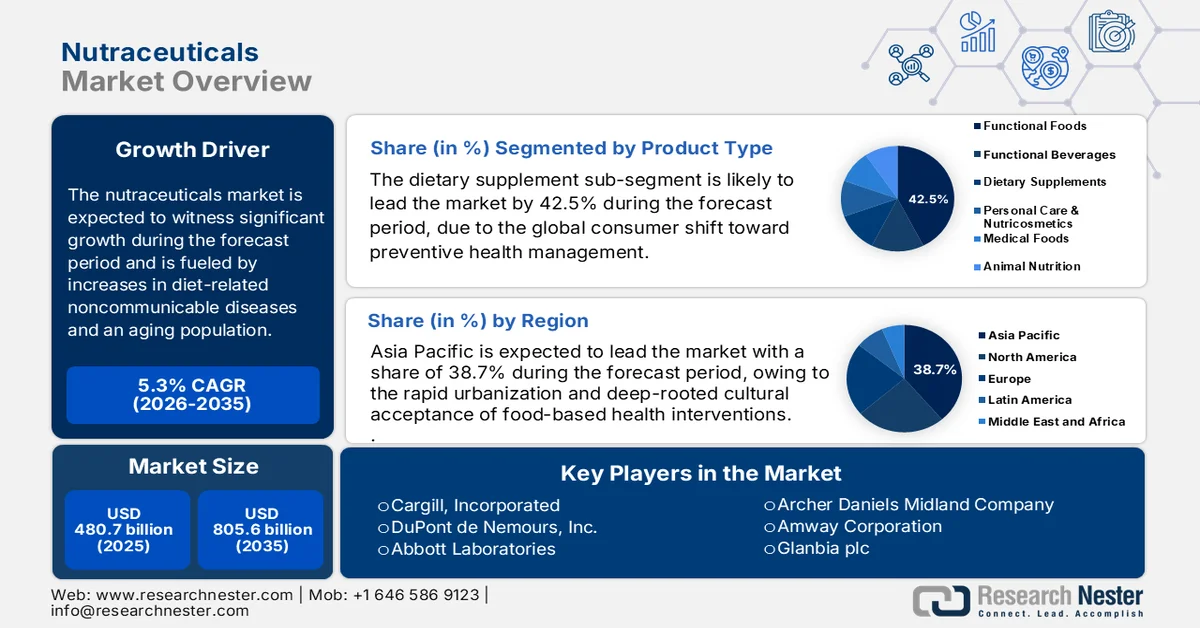
The nutraceuticals market is shaped by the sustained increases in diet-related noncommunicable diseases, an aging population, and rising preventive healthcare expenditure. According to the WHO September 2024 data, noncommunicable diseases account for nearly 74% of the global deaths, with cardiovascular diseases alone responsible for 17.9 million deaths. This growing disease burden is directly influencing the demand for nutrition-based interventions across both developed and emerging economies. The FAO March 2023 data depict that nearly 3.1 billion people globally are unable to afford a healthy diet, highlighting a substantial gap in nutritional intake that supports the expansion of fortified and supplemental nutrition products. The public health initiatives, including the national nutrition mission and dietary guidelines across the countries, are further driving the demand and procurement of nutraceutical ingredients and products.
Moreover, the nutraceuticals market is further influenced by the evolving food safety frameworks, labeling standards, and cross-border trade policies. As per the AMA Journal of Ethics May 2022 article, the FDA regulates dietary supplements under the Dietary Supplement Health and Education Act, with over 90,000 supplement products available in the U.S. market, reflecting a fragmented, high-volume supply base. Similarly, in Europe, the European Food Safety Authority enforces the stringent health claim substantiation, which impacts the product approvals and commercialization timelines. Meanwhile, the government expenditure on preventive healthcare is increasing. These policies, along with the rising public health spending and increased consumer reliance on self-managed health interventions, are reinforcing the long-term demand stability and promoting the investment across several sectors.
Key Nutraceuticals Market Insights Summary:
Regional Highlights:
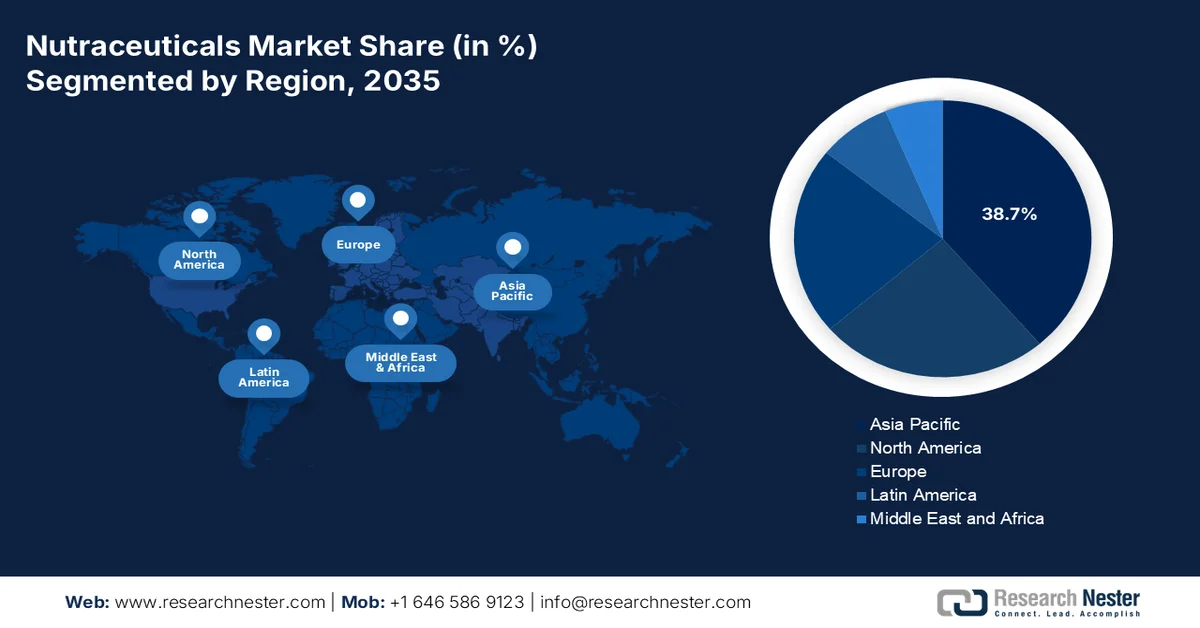
- Asia Pacific nutraceuticals market is projected to dominate with a 38.7% revenue share by 2035, attributed to rapid urbanization, rising disposable incomes, and strong cultural acceptance of food-based health interventions
- North America is anticipated to witness the fastest growth with a CAGR of 7.5% during 2026-2035, bolstered by high consumer penetration, established regulatory frameworks, and robust healthcare infrastructure
Segment Insights:
- Dietary Supplements segment of the nutraceuticals market is anticipated to account for a 42.5% share by 2035, propelled by the global consumer shift toward preventive health management
- Geriatric Population segment is projected to lead by 2035, fueled by the rising inclination of older adults toward nutraceutical consumption to manage age-related physiological decline
Key Growth Trends:
- Expansion of government-funded healthcare programs
- Increased government funding for nutrition research
Major Challenges:
- Consumer trust deficit
- High cost and complexity of clinical validation
Key Players:Cargill Incorporated, DuPont de Nemours Inc., Abbott Laboratories, Archer Daniels Midland Company (ADM), Amway Corporation, Glanbia plc, Royal DSM N.V., Nestlé S.A., BASF SE, Reckitt Benckiser Group plc, Otsuka Holdings Co. Ltd., Ajinomoto Co. Inc., Suntory Holdings Limited, Blackmores Limited, CJ CheilJedang Corporation, Korea Ginseng Corporation, Dabur India Ltd., Ashland Inc., Turnspire Capital Partners, Evonik.
Global Nutraceuticals Market Forecast and Regional Outlook:
Market Size & Growth Projections:
- 2025 Market Size: USD 480.7 billion
- 2026 Market Size: USD 506.1 billion
- Projected Market Size: USD 805.6 billion by 2035
- Growth Forecasts: 5.3 % CAGR (2026-2035)
Key Regional Dynamics:
- Largest Region: Asia Pacific (38.7% Share by 2035)
- Fastest Growing Region: North America
- Dominating Countries: United States, China, Japan, Germany, India
- Emerging Countries: South Korea, Brazil, Mexico, Indonesia, Vietnam
Last updated on : 30 March, 2026
Nutraceuticals Market - Growth Drivers and Challenges
Growth Drivers
- Expansion of government-funded healthcare programs: Rising public healthcare expenditure is directed toward prevention rather than treatment, creating a sustained demand for nutraceuticals market. According to the CMS January 2026 data, USD 15,474 is spent per person on healthcare, which is mainly allocated to preventive services and wellness programs. Similarly, the India’s Union Budget has increased the healthcare spending with continued funding for preventive nutrition initiatives under the POSHAN Abhiyaan. These programs prioritize micronutrient supplementation, functional foods, and fortified products to reduce the long-term disease burden. This shift is prompting the suppliers to align portfolios with government-backed nutrition schemes and public procurement channels.
- Increased government funding for nutrition research: Public sector investment in nutritional science is strengthening the evidence base for nutraceutical market efficacy, supporting the market expansion. The NIH allocates billions annually to nutrition and dietary supplement research, with the Office of Dietary Supplements funding studies on vitamins, botanicals, and functional ingredients. The European Commission funds nutrition research under Horizon Europe, supporting the clinical validation and innovation in functional foods. These investments improve product credibility, facilitate regulatory approvals, and enable health claims substantiation. As governments emphasize evidence-based healthcare, nutraceutical companies are increasingly engaging in clinical trials and academic partnerships. This trend is particularly important in high-value segments such as probiotics, omega-3s, and plant-based bioactives.
- Malnutrition reduction programs: Government-led nutrition missions are significantly driving the demand for fortified foods and dietary supplements. According to the WHO March 2024 data, nearly 149 million children in 2022 were stunted, pushing governments to scale interventions. The total beneficiaries in India’s POSHAN Abhiyaan in Tamil Nadu are 39,76,423, including children and pregnant women, with large-scale distribution of fortified foods, as per PIB March 2023 report. Moreover, governments are increasingly investing in food fortification strategies to address micronutrient deficiencies. These initiatives are supported by the Ministries of Health and Agriculture to focus on vitamin A, iron, and zinc supplementation programs. These interventions create institutional demand pipelines for nutraceutical manufacturers supplying bulk ingredients and finished formulations.
State-wise Coverage of POSHAN Abhiyaan (2023)
|
State |
Districts |
Projects
|
Sectors |
AWCs |
Total Beneficiaries |
|
Tamil Nadu |
38 |
435 |
1,801 |
54,439 |
39,76,423 |
|
Odisha |
30 |
338 |
2,811 |
74,153 |
41,07,868 |
Source: PIB March 2023
Challenges
- Consumer trust deficit: Widespread misleading marketing has eroded consumer confidence. The industry faces a growing disconnect between the promotional narratives and scientific substantiation. Unverified products, mainly those promoted via social media, contribute to skepticism. This trust deficit makes it difficult to legitimize new players in the nutraceuticals market to gain consumer acceptance, mainly when competing against established but poorly validated alternatives. Top companies are maintaining vertically integrated organic farmland, ensuring full traceability from seed to supplement.
- High cost and complexity of clinical validation: Establishing scientific credibility requires substantial investment in clinical trials, which many new players in the nutraceutical market cannot afford. Therapeutic claims for disease prevention or treatment must be supported by robust evidence. Randomized controlled trials are the gold standard, but require significant time, capital, and expertise in study design, endpoint definition, and statistical analysis. Though the industry is set to grow high, there are contaminations found in the online nutraceuticals, underscoring the quality gap that clinical validation helps to address.
Nutraceuticals Market Size and Forecast:
| Report Attribute | Details |
|---|---|
|
Base Year |
2025 |
|
Forecast Year |
2026-2035 |
|
CAGR |
5.3% |
|
Base Year Market Size (2025) |
USD 480.7 billion |
|
Forecast Year Market Size (2035) |
USD 805.6 billion |
|
Regional Scope |
|
Nutraceuticals Market Segmentation:
Product Type Segment Analysis
Within the product type segment, the dietary supplements are leading in the nutraceuticals market and are poised to hold the share value of 42.5% by the end of 2035. The segment is driven by a global consumer shift toward preventive health management. This segment’s dominance is fueled by the aging population seeking to mitigate chronic disease risks and younger demographics adopting supplementation for immunity and cognitive performance. According to the CDC's February 2021 article, nearly 57.6% of the people in the U.S. reported using dietary supplements, with multivitamins and vitamin D remaining the most frequently consumed products. This high penetration rate across all age groups indicates the entrenched consumer reliance on supplements as a first line of defense in personal healthcare.
Consumer Demographics Segment Analysis
The geriatric population is fueling the consumer demographics sub-segment in the nutraceuticals market and is expected to lead by the end of 2035. This age group exhibits the highest propensity for supplement use to manage age-related physiological decline. Older adults consistently utilize nutraceuticals to support bone density, cardiovascular function, joint mobility, and cognitive health, often integrating them into daily medication regimens. According to the United Nations 2025 report, nearly 8.2 billion people are aged above 60. This demographic consistent consumption, coupled with increasing global life expectancy, creates a stable, growing revenue stream as geriatric consumers prioritize quality, clinically validated ingredients to maintain independence and quality of life.
Distribution Channel Segment Analysis
Under the distribution channel segment, the online retail & e-commerce has emerged as the fastest growing and highest sub-segment in the nutraceuticals market, fundamentally reshaping the consumer purchasing behavior. The shift toward digital platforms accelerated significantly, driven by the convenience of home delivery, access to extensive product reviews, and the ability to subscribe to automated refill models. As per the U.S. Census Bureau, March 2026 data, the online sales reached USD 316.1 billion in Q3 2025, which includes health and personal care sales. This channel enables a direct-to-consumer engagement, therefore allowing brands to build loyalty via personalized recommendations and subscription models, thereby capturing a loyal, recurring customer base that values both the transparency and convenience over traditional brick-and-mortar shopping.
Our in-depth analysis of the nutraceuticals market includes the following segments:
|
Segment |
Subsegments |
|
Product Type |
|
|
Source |
|
|
Form |
|
|
Application |
|
|
Distribution Channel |
|
|
Consumer Demographics |
|

Vishnu Nair
Head - Global Business DevelopmentCustomize this report to your requirements — connect with our consultant for personalized insights and options.
Nutraceuticals Market - Regional Analysis
APAC Market Insights
The nutraceuticals market in the Asia Pacific is the largest and is expected to hold the regional revenue share of 38.7% by the end of 2035. The region is driven by rapid urbanization, rising disposable incomes, and deep-rooted cultural acceptance of food-based health interventions. The traditional medicine systems, mainly the traditional Chinese medicine in China, Ayurveda in India, and Kampo in Japan, have created a consumer base highly receptive to functional foods and dietary supplements. The WHO January 2023 data indicates that nearly 70% of people use Koryo traditional medicine, which creates a natural pathway for the nutraceutical adoption. The key drivers include aging population, with Japan having the highest proportion, and increasing healthcare costs that incentivize preventive approaches. On the other hand, the e-commerce expansion, mainly in China and Southeast Asia, has transformed distribution channels with online sales growing annually.
Strong regulatory pipeline and increasing consumption among aging populations are shaping the nutraceuticals market in China. According to the NLM December 2024 study, the approval of 1,142 health food products containing protein-based raw materials highlights the scale of the product development, with a clear emphasis on peptide-based ingredients, which account for the majority share, followed by animal, plant, and microbial proteins. This indicates a growing industry focus on advanced bioavailable nutrition formats. On the other hand, the consumption is being driven by the demographic shifts, with 45.6% of the elderly population in China reported to have used nutritional supplements, reflecting the rising health awareness and preventive care adoption among seniors, based on the NLM March 2022 study. These data show a huge opportunity for the nutraceuticals market in the overall region.
The nutraceuticals market in India is witnessing strong expansion driven by favorable foreign investment policies, increasing domestic demand, and a growing role in the global value chain. According to the NLM June 2023 study, the government’s approval of 100% Foreign Direct Investment (FDI) in nutraceutical and food supplement manufacturing has significantly enhanced investor participation, with inflows rising from USD 131.4 million to USD 584.7 million, enabling companies to scale operations across wholesale, retail, and e-commerce channels. Moreover, the Ministry of Food Processing Industry in August 2025 data depicts that the nutraceuticals industry was valued at USD 30.37 billion in 2024 and is projected to grow at a CAGR of 13.6% from 2025 to 2030, reflecting strong consumption across preventive healthcare, immunity, and lifestyle nutrition segments. Additionally, India accounted for 9.22% of the global nutraceuticals market revenue in 2023, underscoring its increasing global relevance and thus impacting market growth.
India Nutraceuticals Market, Segment-wise Share and Growth (2025 to 2030)
|
Segment Category |
Sub-Segment |
Metric |
Value |
|
Ingredient |
Probiotic Ingredients |
Revenue Share (2024) |
24.66% |
|
Ingredient |
Vitamin Ingredients |
CAGR (2025-2030) |
13.5% |
|
Product Type |
Functional Foods |
Revenue Share (2024) |
37.6% |
|
Product Type |
Dietary Supplements |
CAGR (2025-2030) |
13.9% |
|
Distribution Channel |
Grocery Stores (Functional Foods) |
Revenue Share (2024) |
40.3% |
|
Distribution Channel |
Online Stores (Dietary Supplements) |
CAGR (2025-2030) |
15.0% |
Source: Ministry of Food Processing Industry in August 2025
North America Market Insights
North America is projected to emerge as the fastest-growing region and is poised to expand at a CAGR of 7.5% during the assessed period, 2026 to 2035. The industry is driven by the high consumer penetration rates, established regulatory frameworks, and robust healthcare infrastructure. The mature consumption base drives the consistent demand for vitamins, minerals, and specialty ingredients. The key drivers include aging demographics, rising healthcare costs, incentivizing prioritizing nutrition and chronic disease prevention, and reinforcing the nutraceuticals market fundamentals. In Canada, the Health Canada Natural and Non-prescription Health Products Directorate provides a streamlined regulatory pathway for complementary medicines, facilitating product access. These trends indicate increasing demand for personalized nutrition gut health products and science-backed formulations across both countries.
The sustained federal healthcare spending, high chronic disease prevalence, and widespread dietary supplement usage are driving the nutraceuticals market in the U.S. According to the UCHealth article published in June 2025, U.S. people have spent nearly USD 60 billion per year on nutritional supplements. Moreover, 45 billion people in the country have purchased dietary supplements, and 50 million are using some type of vitamin supplements, indicating strong and sustained consumer adoption, as per the PennState Health March 2024 report. Moreover, the article from the CDC March 2025 data has depicted that 6 in 10 U.S. adults live with at least one chronic disease, and 4 in 10 have two or more, reinforcing the need for nutrition-based interventions across cardiovascular, metabolic, and immune health segments. These data show an active upliftment in the market growth and expansion.
Strong adoption rate performance-oriented supplements, mainly among adolescents and young adults, are fueling the nutraceuticals market in Canada. As per the NLM study published in May 2025, nearly 82.5% of boys reported using whey protein products, highlighting the penetration of protein-based nutraceuticals. Moreover, 50.3% of males and 9.7% of females reported the usage of creatine, indicating diversification in product demand. further the consistent usage among the athletes and non-athletes reinforcing that consumption is no longer limited to professional sports segments. This high and sustained uptake reflects shifting consumer priorities toward physical performance, body composition, and active lifestyles, which is expanding demand for sports nutrition and functional supplementation, thus enabling a positive impact on the market growth.
Prevalence of Muscle-Building Supplement Use (2025)
|
Age |
Male Usage |
Female Usage |
|
Ages 16–30 |
82.5% |
51.9% |
|
Ages 16–30 |
50.3% |
9.7% |
|
Ages 16–30 |
32.3% |
15.0% |
|
Ages 16–30 |
35.7% |
18.4% |
Source: NLM May 2025
Europe Market Insights
The nutraceuticals market in Europe is expanding significantly and is defined by a mature regulatory landscape governed by the European Food Safety Authority, which mandates rigorous scientific substantiation of health claims. This framework ensures that products entering the market possess validated efficacy, creating a high barrier to entry that favors manufacturers with robust clinical research capabilities. The key drivers include an aging population and increasing public health expenditure allocated to preventive nutrition. According to the Federal Ministry of Health 2026 data, the EU4Health program, with a budget of USD 5.8 billion, funds initiatives that integrate nutritional interventions into chronic disease management protocols. Consumer trends indicate rising demand for plant-based functional foods, gut health products, and personalized nutrition solutions. On the other hand, the cross-border e-commerce and harmonized regulatory pathways continue to facilitate market expansion across the region.
The strong consumer demand established herbal traditions, and a well-developed ingredient processing industry is shaping the nutraceuticals market in Germany. According to the Government of the Netherlands, March 2025 data, the sales of over-the-counter herbal and homeopathic medicines reached USD 2.5 billion, accounting for 29% of the total OTC market, reflecting the country’s reliance on plant-based health solutions. The food supplements segment was valued at USD 2.0 billion in 2023, growing 4.8% YoY, and is projected to reach €2.1 billion by 2028, supported by the rising consumer adoption, with usage increasing from 60% in 2021 to 65% in 2023. Moreover, industrial investments such as Südzucker Group’s USD 54 billion pulse processing plant highlight growing capacity in plant-based functional ingredients, reinforcing Germany’s role as a manufacturing and innovation center for nutraceuticals in Europe.
The nutraceuticals market in the UK is experiencing steady growth driven by rising health awareness, aging demographics, and increasing demand for plant-based and clean-label products. As per the Government of the Netherlands, March 2025 data, the food supplements segment was valued at USD 780 million in 2024 and is projected to reach USD 1.7 billion by 2029, expanding at a CAGR of 6.5%, supported by growing adoption among consumers, with nearly two-thirds of the population using supplements to address nutritional deficiencies and manage health conditions. Herbal supplements account for a notable share, contributing 19.6% of total supplement sales, reflecting strong consumer preference for natural products, mainly among middle-aged and higher-income groups. This reliance, combined with a moderately developed extraction and processing sector, positions the UK as a key demand-driven and trade-oriented nutraceuticals market in Europe.
Key Nutraceuticals Market Players:
- Cargill, Incorporated (U.S.)
- DuPont de Nemours, Inc. (U.S.)
- Abbott Laboratories (U.S.)
- Archer Daniels Midland Company (ADM) (U.S.)
- Amway Corporation (U.S.)
- Glanbia plc (Ireland - Europe)
- Royal DSM N.V. (Netherlands)
- Nestlé S.A. (Switzerland
- BASF SE (Germany)
- Reckitt Benckiser Group plc (UK)
- Otsuka Holdings Co., Ltd. (Japan)
- Ajinomoto Co., Inc. (Japan)
- Suntory Holdings Limited (Japan)
- Blackmores Limited (Australia)
- CJ CheilJedang Corporation (South Korea)
- Korea Ginseng Corporation (South Korea)
- Dabur India Ltd. (India)
- Ashland Inc (U.S.)
- Turnspire Capital Partners (U.S.)
- Evonik (Germany)
- Company Overview
- Business Strategy
- Key Product Offerings
- Financial Performance
- Key Performance Indicators
- Risk Analysis
- Recent Development
- Regional Presence
- SWOT Analysis
- Cargill has established itself as a key ingredient supplier in the nutraceuticals market by leveraging its vast agricultural supply chain to produce high-demand functional ingredients such as plant sterols, specialty starches, and Rebaudioside M sweeteners. The company focuses on strategic acquisitions and partnerships to bridge the gap between traditional food processing and preventive health, specializing in metabolic wellness and gut health.
- DuPont de Nemours commands a significant portion of the nutraceuticals market via its industry-leading microbiome science and probiotic portfolios, mainly under the Howaru and Danisco brands. The company’s strategic initiatives focus on clinical validation and proprietary strain development to maintain a competitive edge in digestive and immune health. By integrating its bioscience capabilities with formulation expertise, the company provides end-to-end solutions for dietary supplements.
- Abbott Laboratories maintains a dominant position in the nutraceuticals market by blending the medical device expertise with evidence-based nutrition, most notably via its Ensure and Pediasure lines. The company’s strategic focus lies in targeted medical nutrition utilizing advanced biomarker research to develop the products that support chronic disease management and recovery.
- Archer Daniels Midland Company has transformed its legacy as an agricultural giant into a leadership role in the nutraceuticals market by emphasizing vertical integration from the seed to the shelf. Strategic initiatives include heavy investment in microbiome research, the expansion of its probiotic manufacturing facilities, and the acquisition of specialty ingredient companies to boost its portfolio of antioxidants. In 2024, the company made net earnings of USD 1.8 billion.
- Amway Corporation operates as a leading player in the nutraceuticals market, controlling its supply chain from the organic farmland via its Nutrilite brand to the direct to consumer distribution. The company’s strategic initiatives highlight traceability and sustainability, leveraging its extensive agricultural holdings to guarantee purity and potency in its vitamin, mineral, and botanical supplements. In 2024, the company reported sales of USD 7.4 billion.
Here is a list of key players operating in the global nutraceuticals market:
The global nutraceuticals market is highly fragmented and is dominated by diversified players and specialized ingredient suppliers. The intense competition drives the key players toward strategic vertical integration, securing supply chains for raw materials such as marine oils and botanicals. The leaders are pivoting to personalized nutrition and high-potency formulations to capture premium market segments. Moreover, mergers and acquisitions remain a core strategy to expand the geographic footprints and intellectual property portfolios. For example, in September 2024, Ashland Inc. announced that it had completed the sale of its nutraceuticals business to an affiliate of Turnspire Capital Partners LLC. On the other hand, the significant investment in clinical validation is being used to differentiate products in an increasingly regulation-conscious environment.
Corporate Landscape of the Nutraceuticals Market:
Recent Developments
- In July 2025, Otsuka Pharmaceutical Co., Ltd. has launched sales of POCARI SWEAT in India product that contains a balance of ions (electrolytes) that replenish the fluids your body needs to maintain and promote better health.
- In June 2025, Dabur India Ltd., one of the most trusted names in health and wellness, announced the launch of Siens by Dabur, a premium direct-to-consumer supplement brand that marks the company’s strategic entry into the digitally native wellness space.
- In May 2024, Evonik will be presenting its latest nutraceutical ingredient innovations at Vitafoods Europe 2024 in Geneva, Switzerland. The company provides advanced, evidence-based food ingredients to boost consumer preferences and differentiate functional food and food supplement brands.
- Report ID: 8484
- Published Date: Mar 30, 2026
- Report Format: PDF, PPT
- Explore a preview of key market trends and insights
- Review sample data tables and segment breakdowns
- Experience the quality of our visual data representations
- Evaluate our report structure and research methodology
- Get a glimpse of competitive landscape analysis
- Understand how regional forecasts are presented
- Assess the depth of company profiling and benchmarking
- Preview how actionable insights can support your strategy
Explore real data and analysis
Frequently Asked Questions (FAQ)
About this Report
Connect with our Expert


Report, 2026-2035



Copyright @ 2026 Research Nester. All Rights Reserved.
