Microreactor Technology Market Outlook:
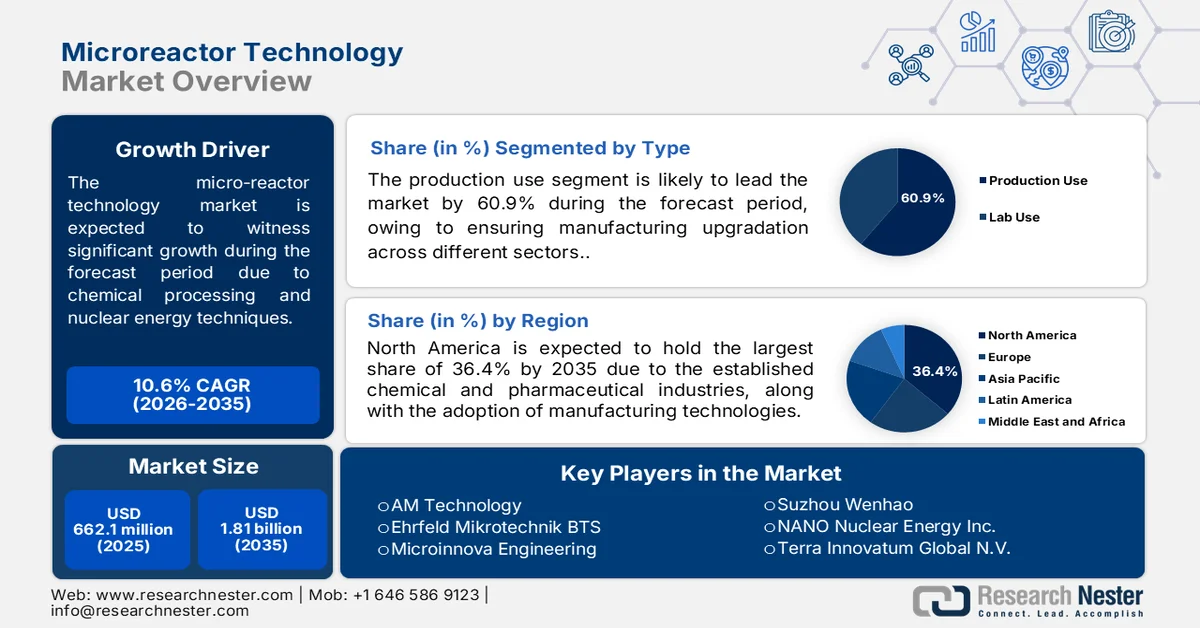
Microreactor Technology Market size was valued at USD 662.1 million in 2025 and is expected to cross USD 1.81 billion by the end of 2035, expanding at more than 10.6% CAGR during the forecast period, i.e., 2026-2035. In 2026, the industry size of microreactor technology is evaluated at USD 732.2 million.
The worldwide microreactor technology market usually operates across two major domains, including nuclear energy and chemical processing, each comprising unique catalysts for suitable growth opportunities. According to an article published by the UNEP Organization in May 2026, the global chemical industry was valued at USD 5 trillion, and is further poised to double by the end of 2030. Besides, as per the November 2025 IAEA Organization article, the global nuclear power capacity is expected to double by the end of 2050, reaching between a low estimate of 561 GW (e) and a high estimate of 992 GW (e). Additionally, there was the provision of 376.3 GW (e) of nuclear capacity by 416 reactors as of November 2025. Likewise, 421 operating reactors, with an overall capacity of 377.0 GW (e), readily generated almost 2,617.3 TWh of electricity. Besides, different nuclear units were connected to the electricity grid between 2024 and 2025, thereby positively impacting the market growth.
|
Nuclear Unit Type |
Power Generation (MW[e]) |
Location |
|
Barakah-4 |
1,310 |
United Arab Emirates |
|
Flamanville-3 |
1,000 |
France |
|
Vogtle-4 |
1,117 |
U.S. |
|
Kakrapar-4 |
630 |
India |
|
Rajasthan-7 |
630 |
|
|
Fangchenggang-4 |
1,000 |
China |
|
Zhangzhou-1 |
1,126 |
Source: IAEA Organization
Furthermore, the demand for artificial intelligence (AI) infrastructure energy and the process intensification in chemicals are other trends that are responsible for fueling the microreactor technology market globally. As stated in an article published by NLM in May 2025, data centers are considered the ultimate backbone of the digital economy, effectively consuming 1.5% of total electricity as of 2024, and are further projected to demonstrate almost 10% of the electricity growth demand by the end of 2030. However, these centers are continuously generating noise pollution, eventually from HVAC systems and diesel generators, with internal noise levels reaching almost 96 A-weighted decibels. For instance, data centers in the U.S. are poised to contribute nearly 1,300 deaths every year by 2030, leading to a public health burden of over USD 20 billion, thereby enhancing the market’s demand.
Key Microreactor Technology Market Insights Summary:
Regional Highlights:
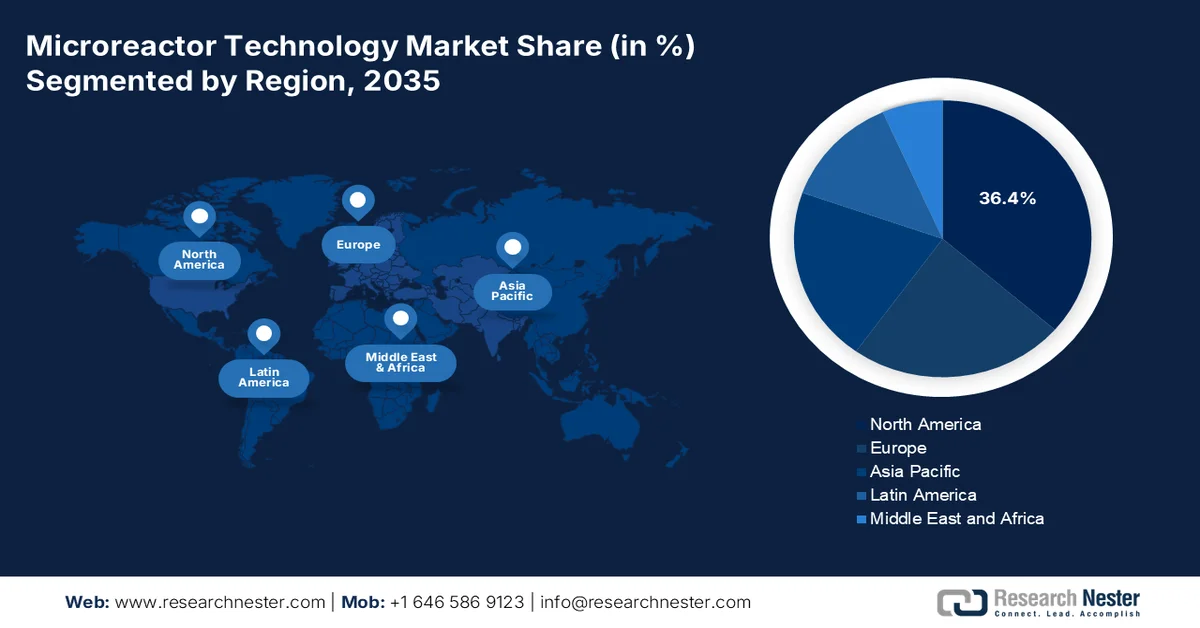
- The microreactor technology market in North America is projected to command a 36.4% share by 2035, underpinned by well-established chemical and pharmaceutical sectors, comprehensive adoption of innovative manufacturing technologies, and strong government initiatives promoting innovation
- Asia Pacific is anticipated to record the fastest expansion in the market throughout 2026-2035, stimulated by rising international investments, increasing demand from chemical and pharmaceutical manufacturing, and rapid industrialization
Segment Insights:
- The production use sub-segment is expected to capture 60.9% of the microreactor technology market by 2035, reinforced by its proven capability to revolutionize industrial-scale manufacturing across multiple sectors
- The pharmaceuticals sub-segment is forecast to secure a 45.7% share by 2035, accelerated by the growing utilization of continuous flow through small channels for efficient chemical production
Key Growth Trends:
- Integration of microreactor battery
- Increase of disposable and 3D-printed platforms
Major Challenges:
- Licensing and regulatory approval bottlenecks
- Fuel supply chain and waste management
Key Players: Corning (U.S.),Chemtrix (Netherlands),Planoptik (Little Things Factory) (Germany),AM Technology (UK),Ehrfeld Mikrotechnik BTS (Germany),Microinnova Engineering (Austria),Syrris (UK),Vapourtec (UK),Uniqsis (UK),Nakamura Choukou (Japan),YMC (Japan),Suzhou Wenhao (China),NANO Nuclear Energy Inc. (U.S.),Terra Innovatum Global N.V. (Italy),X-energy Reactor Company, LLC (U.S.),Shimadzu Corporation (Japan).
Global Microreactor Technology Market Forecast and Regional Outlook:
Market Size & Growth Projections:
- 2025 Market Size: USD 662.1 million
- 2026 Market Size: USD 732.2 million
- Projected Market Size: USD 1.81 billion by 2035
- Growth Forecasts: 10.6% CAGR (2026-2035)
Key Regional Dynamics:
- Largest Region: North America (36.4% Share by 2035)
- Fastest Growing Region: Asia Pacific
- Dominating Countries: United States, Germany, China, Japan, United Kingdom
- Emerging Countries: India, South Korea, Singapore, Saudi Arabia, Brazil
Last updated on : 25 June, 2026
Microreactor Technology Market - Growth Drivers and Challenges
Growth Drivers
- Integration of microreactor battery: The aspect of coupling microreactors with liquid metal batteries results in the consistent optimization of net present value, in comparison to standalone operation, and enhances grid flexibility through energy arbitrage. According to an article published by NLM in July 2024, the transition to the electrified transportation industry has necessitated the production of battery storage capacities from 1,000 GWh to 2,000 GWh. Based on this, the number of Li-ion batteries successfully reached a shipment of nearly 800,000 tons as of 2025. Besides, as per the November 2025 Applied Energy article, there is ongoing exploration for installing small-sized modular reactors, and almost 21 GWe is projected to be deployed globally by the end of 2035, thus enhancing the microreactor technology market growth.
- Increase of disposable and 3D-printed platforms: Based on this growth driver, additive manufacturing tends to enable customized and affordable microreactor designs, while advancements in disposable platforms tend to boost operational flexibility. As per a report published by the UK Government in August 2025, the additive manufacturing industry was worth USD 17.1 billion, which later on recorded a significant turnover of USD 98.8 billion and readily employed 227,000 people as of 2023. In addition, the industry also plays a crucial role in the government’s development mission, accounting for 2% per year as the average organizational growth. Furthermore, the industry, also referred to as 3D printing, increased to more than USD 4.6 billion annually, and created 60,000 employment opportunities as of 2025, thereby making it suitable for fueling the microreactor technology market globally.
Challenges
- Licensing and regulatory approval bottlenecks: Regulatory frameworks for microreactors, particularly nuclear variants, remain underdeveloped, creating significant licensing bottlenecks. Besides, existing regulations were designed for large-scale, permanent facilities and do not adequately address the modular, transportable nature of microreactors. Moreover, for chemical microreactors, regulatory uncertainty persists around validation protocols for pharmaceutical manufacturing, as continuous processing lacks established regulatory pathways compared to conventional batch processing. The absence of harmonized international standards complicates cross-border deployment and creates jurisdictional fragmentation, thus negatively impacting the microreactor technology market globally.
- Fuel supply chain and waste management: For nuclear microreactors, the specialized fuel requirements, including high-assay low-enriched uranium (HALEU), introduce significant supply chain vulnerabilities. The limited number of fuel fabrication facilities and the lack of a mature commercial supply chain for HALEU create potential choke points that could delay deployment. Additionally, the transportable nature of microreactors raises complex logistical questions for nuclear waste management, as spent fuel removal from remote locations presents unique operational hazards. Moreover, security concerns surrounding fuel transport amplify these logistical challenges, thus causing a hindrance in the microreactor technology market expansion.
Microreactor Technology Market Size and Forecast:
| Report Attribute | Details |
|---|---|
|
Base Year |
2025 |
|
Forecast Period |
2026-2035 |
|
CAGR |
10.6% |
|
Base Year Market Size (2025) |
USD 662.1 million |
|
Forecast Year Market Size (2035) |
USD 1.81 billion |
|
Regional Scope |
|
Microreactor Technology Market Segmentation:
Type Segment Analysis
The production use sub-segment under the type segment is anticipated to account for the highest share of 60.9% in the microreactor technology market by the end of 2035. The sub-segment’s upliftment is primarily driven by the technology's proven capability to revolutionize industrial-scale manufacturing across multiple sectors. Chemical manufacturers across pharmaceuticals, specialty chemicals, and petrochemicals have increasingly adopted micro-reactors for commercial production because they offer superior heat and mass transfer characteristics compared to conventional batch reactors, enabling faster reaction kinetics and higher yields in continuous processing environments. The pharmaceutical industry has been particularly instrumental in driving this sub-segment, as micro-reactors enable precise control over reaction parameters.
Application Segment Analysis
During the forecast period, the pharmaceuticals sub-segment, which is part of the application segment, is predicted to grab the second-highest share of 45.7% in the microreactor technology market. The sub-segment’s growth is primarily fueled by the utilization of continuous flow through a small channel for producing chemicals. As stated in an article published by the SCIRP Organization in October 2025, the global pharmaceutical industry was valued between USD 1.6 trillion and USD 1.7 trillion as of 2024, which is anticipated to reach USD 2.3 billion to USD 3.1 billion by the end of 2030 and 2032, indicating a yearly growth rate between 6.1% and 7.5%. Therefore, based on this growth, pharmaceutical organizations are gradually increasing the utilization of microreactors for achieving efficient, greener, and safer drug production, thus proliferating the sub-segment’s growth.
Scale Segment Analysis
The laboratory sub-segment, part of the scale segment, is expected to garner a considerable share in the microreactor technology market by the end of the stipulated timeline. The sub-segment’s development is highly propelled by its role as the primary entry point for technology adoption and the engine of ongoing innovation. Research institutions, academic laboratories, and corporate R&D facilities utilize these systems for fundamental reaction discovery, kinetic studies, and initial process feasibility assessments before scaling to higher-throughput operations. The laboratory segment benefits from the intrinsic advantages of microreactor technology that are particularly valuable in research contexts. These include exceptionally low reagent consumption, rapid thermal response times, and precise parameter control that enables comprehensive reaction screening with minimal material expenditure.
Our in-depth analysis of the microreactor technology market includes the following segments:
|
Segment |
Subsegments |
|
Type |
|
|
Application |
|
|
Scale |
|
|
Material |
|
|
End use |
|

Vishnu Nair
Head - Global Business DevelopmentCustomize this report to your requirements — connect with our consultant for personalized insights and options.
Microreactor Technology Market - Regional Analysis
North America Market Insights
The North America microreactor technology market is anticipated to garner the highest share of 36.4% by the end of 2035. The market’s upliftment in the region is highly attributed to well-established chemical and pharmaceutical sectors, comprehensive adoption of innovative manufacturing technologies, and strong initiatives by the government for promoting innovation. According to a report published by the American Gas Association in March 2024, the pharmaceutical manufacturing industry in the U.S. readily supports 1.8 million employment opportunities, generating a USD 663 billion economic output, along with USD 338 billion in gross domestic product (GDP) and USD 30 million in local and state taxes. Additionally, businesses in the industry’s supply chain effectively consume more than 104 billion cubic feet of natural gas every year. Besides, the continuous export and import facilities of pharmaceutical products are also responsible for bolstering the market’s demand in the region.
North America Pharmaceutical Products Export and Import Analysis, 2024
|
Countries |
Export (USD) |
Import (USD) |
|
U.S. |
96.1 billion |
177.0 billion |
|
Canada |
11.7 billion |
18.0 billion |
|
Mexico |
3.0 billion |
8.2 billion |
|
Costa Rica |
486.0 million |
1.0 billion |
|
Dominican Republic |
484.0 million |
724.0 million |
|
Guatemala |
413.0 million |
1.0 billion |
|
Panama |
190.0 million |
1.2 billion |
|
El Salvador |
207.0 million |
586.0 million |
Source: OEC
The microreactor technology market in the U.S. is growing significantly, owing to the aspect of government supporting suitable innovation of the microreactor technology in providing low-carbon and resilient energy solutions across different industries. In this regard, and as stated in March 2025, the U.S. Department of Energy (DOE) commenced focusing on 3 crucial microreactor experiments in 2026, including the eVinci microreactor, developed by Westinghouse Electric Company, in support of the Advanced Reactor Demonstration Program (ARDP). This is followed by the Kaleidos microreactor produced by Radiant, which is a 1.2 megawatt high-temperature gas-cooled microreactor for replacing diesel generators. Likewise, the R1 microreactor, designed by Antares, is a rapidly deployable microreactor, which is suitable for generating 200 to 300 kilowatts of electricity without the demand for refueling for almost 3 years.
The existence of the most promising and precise economy for the responsible and safe development of the SMR technology, along with emerging as one of the leaders in nuclear safety and energy, along with generous government funding opportunities, denotes a suitable growth for the microreactor technology market in Canada. As per an article published by the Government of Canada in October 2024, the Minister of Energy and Natural Resources notified a funding of USD 13.6 million from Natural Resources Canada’s Enabling Small Modular Reactors (SMR) Program for 9 particular projects. Besides, in terms of developing next-generation nuclear technologies, the domestic nuclear industry is predicted to emerge as the ultimate leader, estimated to be valued at USD 150 billion a year by the end of 2040, thus making it suitable for bolstering the microreactor technology market growth.
Project Funding for Natural Resources Canada’s Enabling SMR Program, 2024
|
Institute/Organization |
Funding Amount |
Reason/Purpose |
|
Queen’s University in Kingston, Ontario |
USD 935,542 |
Studying fuel dry storage capacities and conducting a techno-economic barrier for enabling the SMR deployment |
|
Chemetics in Pickering, Ontario |
USD 2,131,000 |
Supporting the R&D of SMR fabrication for enabling the organization to create, evaluate, and qualify the newest fabrication technologies for SMR components |
|
Prodigy Clean Energy Ltd in Montreal, Quebec |
USD 2,750,000 |
Supporting R&D for ensuring transportable nuclear power facilities as part of the SMR supply chain system |
|
Nuclear Waste Management Organization in Toronto, Ontario |
USD 3,750,000 |
Enhancing the compatibility of the NWMO’s present Adaptive Phased Management program with the potential SMR deployments |
|
Calian Ltd. in Ottawa, Ontario |
USD 261,535 |
Guiding SMR planned owners and vendors, along with operators, for outlining the characterization of radiological hubs in developing construction materials |
|
Organization of Canadian Nuclear Industries in Pickering, Ontario |
USD 543,000 |
Developing a National Ready4SMR program for recognizing procurement challenges, owing to technological barriers, and developing supply approaches for SMR parts |
|
Kinectrics in Etobicoke, Ontario |
USD 126,475 |
Investigating the feasibility for disposing of the isotope carbon-14 by recovering from radioactive wastes and engaging with stakeholders for diverting waste streams from disposal |
|
North Shore Mi’kmaq Tribal Council in Eel Ground, New Brunswick |
USD 2,070,336 |
Studying and developing strong supply chains for SMR-based manufacturing while anchoring elements with ownership |
|
Opportunities New Brunswick in Fredericton, New Brunswick |
USD 1,094,850 |
Providing a R&D life cycle roadmap and framework for manufacturing affordable and modularized SMR technology |
Source: Government of Canada
APAC Market Insights
The Asia Pacific is expected to emerge as the fastest-growing region in the microreactor technology market during the forecast period. The market’s development in the region is highly propelled by a surge in international investments, the increasing demand from chemical and pharmaceutical product manufacturing, and rapid industrialization. According to an article published by Invest India in March 2025, the chemical industry in India was valued at USD 220 billion as of 2024 and is further projected to reach USD 300 billion by the end of 2028, thus deliberately contributing to economic growth. Besides, almost 70% of the domestic chemical production is consumed, and the nation is poised to cater to 20% of the incremental consumption of chemicals in the upcoming decades, thereby making it suitable for boosting the market development in the region.
The microreactor technology market in Japan is gaining increased traction, owing to the existence of a mature pharmaceutical and chemical industry, the presence of standard research institutions, and generous government funding through NEDO. For instance, between 2023 and 2032, NEDO initiated a biomanufacturing promotion project, with a generous funding opportunity of an estimated USD 1.9 billion (300 billion yen). This was successfully established by the Ministry of Economy, Trade and Industry (METI), with a focus on the establishment of a supply chain system for collecting non-utilized resources, the demonstration and development of turning these resources into raw materials, and demonstrating the bio-products collection for uplifting circular bio-manufacturing.
The aspects of rapid modernization, a focus on sustainability, safety, and efficiency, significant investments through administrative entities, and the presence of massive pharmaceutical and chemical manufacturing bases are a few trends that are enhancing the microreactor technology market in China. As per an article published by the State Council Information Office in September 2025, the country aimed to gain an average yearly increase of more than 5% in the added value of the chemical and petrochemical sector in 2026. This was jointly approved by the Ministry of Industry and Information Technology, outlining a rebound in economic returns, measurable reductions in carbon emissions and pollution, and a remarkable boost in technological, scientific, and industrial innovation, thus ensuring a suitable expansion of the microreactor technology market in the nation.
Europe Market Insights
Europe microreactor technology market is projected to witness a considerable share by the end of the stipulated timeline. The market’s growth in the region is driven by a robust emphasis on green chemistry, strict regulatory support, the adoption of continuous-flow processing in the specialty chemicals and pharmaceutical industries, and a focus on low-emission, energy-efficient chemical synthesis. As stated in an article published by the European Commission in September 2024, the regionally funded REACTORS 5.0 project is aimed at developing the newest concepts for microreactors and sustainable reactors by utilizing cutting-edge technologies, such as computational modelling and machine learning. In this regard, the funding contribution amounted to USD 2.8 million (€2,499,988.6), with the timeline ranging from February 2025 to January 2030, thus proliferating the market growth.
The microreactor technology market in the UK is gaining increased exposure, owing to tactical investment, proactive governmental policies, contributions by industrial players, and strong private-public collaboration between sectors and universities. According to the June 2026 UK Government article, the Department for Energy Security and Net Zero has centralized nuclear energy and significantly committed USD 22.4 billion (£17 billion) for revitalizing domestic facilities. For instance, the Sizewell C nuclear power station project in Suffolk is poised to provide 6 million homes, along with 10,000 employment opportunities, and 1,500 apprenticeships, especially to the newly proclaimed Small Modular Reactors at Wylfa on Anglesey, thus positively impacting the microreactor technology market exposure.
The presence of strong innovation centers and industrial bases, as well as specialized government and R&D support, and a focus on sustainability and process safety, are certain factors that are responsible for fueling the microreactor technology market in Germany. In terms of sustainability, TDK Ventures, Inc.’s Fund EX1 collaborated with investors and generously contributed a commitment of USD 129 million in terms of Ineratec’s Series B round as of January 2024. The purpose of this commitment was to propel the organization into its next sustainable mobility phase and escalate the commercialization and production of carbon-neutral e-fuel. Therefore, this denotes a national push for ensuring circular and sustainable production that readily drives the incorporation of microreactors for enabling resource and energy-efficient processes, thus uplifting the market growth.
Key Microreactor Technology Market Players:
- Corning (U.S.)
- Chemtrix (Netherlands)
- Planoptik (Little Things Factory) (Germany)
- AM Technology (UK)
- Ehrfeld Mikrotechnik BTS (Germany)
- Microinnova Engineering (Austria)
- Syrris (UK)
- Vapourtec (UK)
- Uniqsis (UK)
- Nakamura Choukou (Japan)
- YMC (Japan)
- Suzhou Wenhao (China)
- NANO Nuclear Energy Inc. (U.S.)
- Terra Innovatum Global N.V. (Italy)
- X-energy Reactor Company, LLC (U.S.)
- Shimadzu Corporation (Japan)
- Company Overview
- Business Strategy
- Key Product Offerings
- Financial Performance
- Key Performance Indicators
- Risk Analysis
- Recent Development
- Regional Presence
- SWOT Analysis
- Corning is a global leader that leverages its material science expertise to offer a full portfolio of Advanced-Flow™ Reactors. They enable seamless scale-up from laboratory R&D to industrial production, focusing on enhanced mixing and heat transfer for the pharmaceutical and specialty chemical industries.
- Chemtrix specializes in scalable flow chemistry solutions for the pharmaceutical and fine chemical sectors. Their product portfolio includes glass reactors for laboratory use and silicon carbide reactors designed for robust industrial production, ensuring easy scale-up.
- Planoptik (Little Things Factory) is a specialized manufacturer providing high-quality microreactors and microfluidic components. They focus on custom solutions made from glass, quartz, and silicon, serving as a one-stop shop for lab-on-a-chip and flow chemistry applications in life sciences and chemical R&D.
- AM Technology is a key player in the continuous flow chemistry market, recognized for its Coflore range of flow reactors. These are designed to handle heterogeneous and solid-forming reactions efficiently, offering a dynamic mixing technology distinct from standard microchannel designs.
- Ehrfeld Mikrotechnik BTS offers modular micro reaction systems tailored for the pharmaceutical and chemical industries. Their technology facilitates the transition from laboratory development to industrial-scale production, emphasizing flexibility and process intensification with comprehensive system solutions.
Here is a list of key players operating in the global microreactor technology market:
The global microreactor technology market is characterized by a consolidated competitive structure, with leading manufacturers accounting for the majority of the market share. Corning, Chemtrix, Little Things Factory, AM Technology, and Soken Chemical & Engineering constitute the top tier of suppliers, distinguished by extensive product portfolios spanning laboratory to production-scale systems. Likewise, Europe-based manufacturers, particularly German and UK-based firms, demonstrate strength in precision engineering and modular system design. Besides, in January 2026, NANO Nuclear Energy Inc. successfully signed a memorandum of understanding with DS Dansuk Co., Ltd. and cooperated on the creation, localization, and deployment of micro modular reactor systems, particularly in South Korea, thereby making it suitable for bolstering the microreactor technology industry.
Corporate Landscape of the Microreactor Technology Market:
Recent Developments
- In June 2026, Terra Innovatum Global N.V. up-scaled its next-generation reactor platform and unlocked its highest efficiency for cost-effective and large clean energy installations, and further improved power conversion architecture.
- In August 2025, X-energy Reactor Company, LLC signed an agreement with the U.S. Department of the Air Force and developed its commercial microreactor in alignment with the government’s executive approach for deploying innovative nuclear technologies.
- In February 2024, Shimadzu Corporation successfully acquired the catalytic microreactor business for gas chromatography from Activated Research Company, LLC, and effectively expanded its competitiveness.
- Report ID: 6976
- Published Date: Jun 25, 2026
- Report Format: PDF, PPT
- Explore a preview of key market trends and insights
- Review sample data tables and segment breakdowns
- Experience the quality of our visual data representations
- Evaluate our report structure and research methodology
- Get a glimpse of competitive landscape analysis
- Understand how regional forecasts are presented
- Assess the depth of company profiling and benchmarking
- Preview how actionable insights can support your strategy
Explore real data and analysis
Frequently Asked Questions (FAQ)
About this Report
Connect with our Expert


Report, 2026-2035



Copyright @ 2026 Research Nester. All Rights Reserved.
