Membrane Bioreactor Market Outlook:
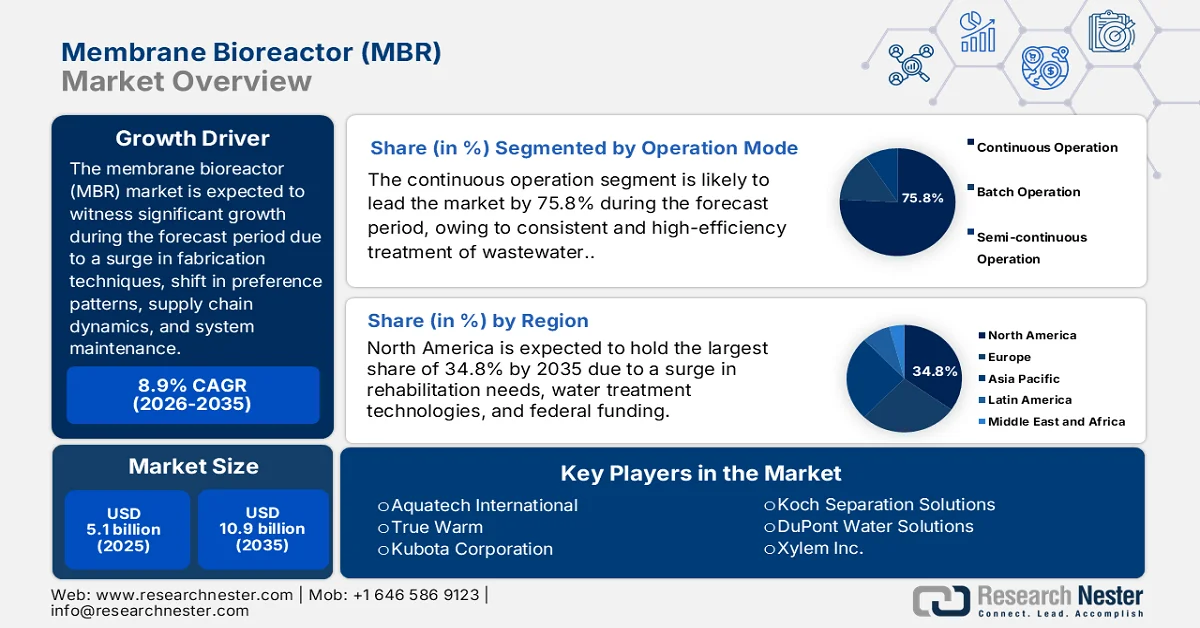
Membrane Bioreactor Market size was valued at over USD 5.1 billion in 2025 and is expected to reach USD 10.9 billion by the end of 2035, growing at a CAGR of 8.9% during the forecast period, i.e., 2026-2035. In 2026, the industry size of membrane bioreactor is assessed at USD 5.5 billion.
The worldwide membrane bioreactor market is effectively shaped by different factors, including membrane fabrication techniques, continuous shifting in end user preference patterns, raw material supply chain dynamics for specialty polymers, competitive pricing for alternative treatment technologies, labor skills availability for system maintenance, and the presence of membrane aerated biofilm reactors. According to official statistics published by the United Nations Organization in 2025, as of 2024, 2.2 billion people lacked safely managed drinking water, 3.4 million people lacked managed sanitation, and 1.7 billion lacked basic hygiene services globally. Therefore, to overcome this, it is essential to manage water sustainability, leading to suitable management of energy and food production, and also contribute to economic growth and decent work capabilities, thus uplifting the membrane bioreactor market growth.
Furthermore, the integration of real-time fouling prediction by utilizing optical sensors, the adoption of air-sparged membrane bioreactors, and the modular containerized MBR units for remote chemical facilities are present trends for boosting the membrane bioreactor market worldwide. As per an article published by NLM in March 2025, the Cintropur NW500 Filter is equipped with a 0-micron cartridge, along with an 18 m3/h maximum flow rate, a 16-bar maximum operating pressure, and a standardized sleeve size of 15 microns. Likewise, the IWAKI EW F Electromagnetic Pump has an accuracy of more than 1% dosing precision, and an adjustable flow rate ranging from o to 10 L/h, with sensor-driven real-time adjustments through cloud monitoring. Therefore, with the presence of such pump type, the market is continuously expanding across different regions.
Key Membrane Bioreactor Market Insights Summary:
Regional Highlights:
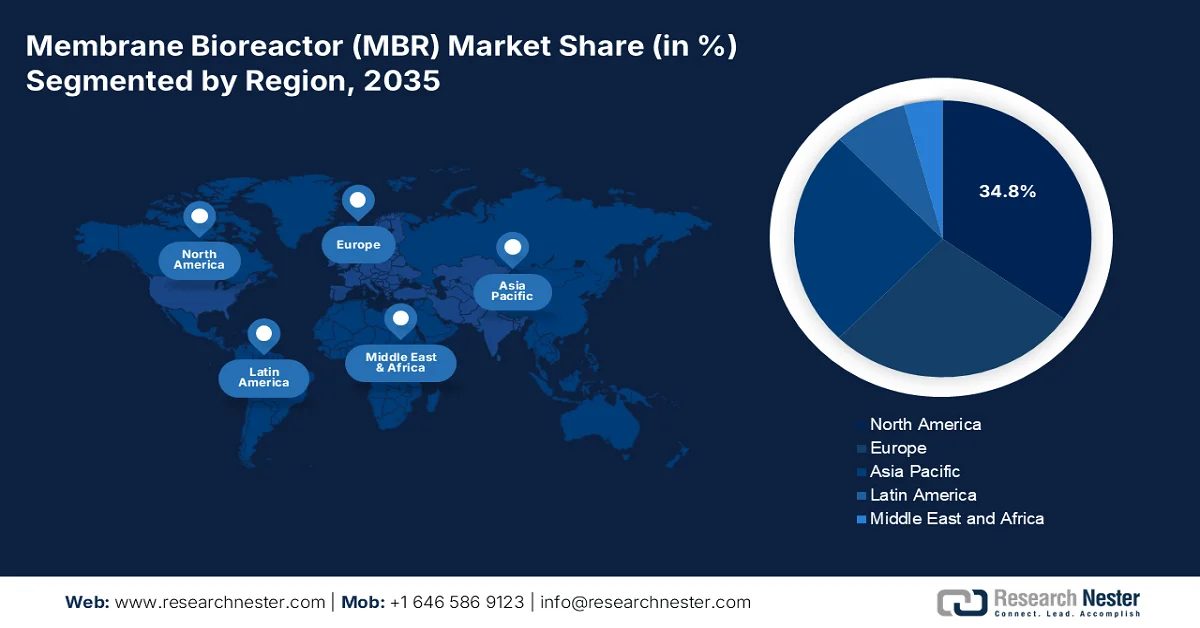
- North America membrane bioreactor market is projected to hold a dominant share of 34.8% by 2035, attributed to stringent effluent regulations and increasing investments in advanced wastewater treatment infrastructure
- Asia Pacific is anticipated to witness the fastest expansion through 2026–2035, propelled by rapid industrialization and rising adoption of advanced membrane technologies
Segment Insights:
- Continuous operation segment in the membrane bioreactor market is estimated to capture 75.8% share by 2035, driven by its ability to deliver consistent and high-efficiency wastewater treatment performance
- Polymeric membrane sub-segment is expected to secure a notable share over 2026–2035, fueled by its cost-effective and highly selective filtration capabilities
Key Growth Trends:
- Expansion of semiconductor-grade water reclamation facilities
- Restriction on contaminants in industrial discharge
Major Challenges:
- Increased manufacturing cost of advanced membrane materials
- Chemical incompatibility and disposal of spent chemicals
Key Players: SUEZ (France), Veolia Environnement SA (France), Kubota Corp. (Japan), Toray Industries Inc. (Japan), Asahi Kasei Corp. (Japan), Mitsubishi Chemical Corp. (Japan), Evoqua Water Technologies LLC (U.S.), Koch Separation Solutions (U.S.), DuPont Water Solutions (U.S.), Xylem Inc. (U.S.), Alfa Laval AB (Sweden), HUBER SE (Germany), Pentair Plc (UK), Memstar Pte Ltd (Singapore), United Envirotech Ltd. (Singapore), OriginWater (Beijing OriginWater Technology) (China), Tianjin MOTIMO Membrane Technology (China), CITIC Envirotech Ltd. (Singapore), Hyflux Ltd (Singapore), Aquatech International (U.S.), True Warm (Australia), Kubota Corporation (Japan), Sun Capital Partners, Inc. (U.S.), VINCI Construction (France).
Global Membrane Bioreactor Market Forecast and Regional Outlook:
Market Size & Growth Projections:
- 2025 Market Size: USD 5.1 billion
- 2026 Market Size: USD 5.5 billion
- Projected Market Size: USD 10.9 billion by 2035
- Growth Forecasts: 8.9% CAGR (2026-2035)
Key Regional Dynamics:
- Largest Region: North America (34.8% Share by 2035)
- Fastest Growing Region: Asia Pacific
- Dominating Countries: United States, China, Japan, Germany, South Korea
- Emerging Countries: India, Brazil, Indonesia, Vietnam, Mexico
Last updated on : 8 April, 2026
Membrane Bioreactor Market - Growth Drivers and Challenges
Growth Drivers
- Expansion of semiconductor-grade water reclamation facilities: This is one of the growth drivers for the membrane bioreactor market, effectively accelerating the need for ultrapure water and associated wastewater reclamation. According to official statistics published by the Taskforce on Nature-Elated Financial Disclosures in February 2026, the semiconductor industry readily consumes nearly 210 trillion liters of water every year, which is nearly half of the consumed areas witnessing increased water scarcity. Besides, 45% of data facilities are located in river basins, which are at high risk of water availability disruptions. Moreover, microchip manufacturing is extremely water-intensive, with a single fab utilizing about 14 billion liters of ultrapure water every year. Simultaneously, the global semiconductor industry consumes water as a city of 7.5 million people, such as Hong Kong, thus fueling the membrane bioreactor market exposure.
- Restriction on contaminants in industrial discharge: This driver significantly tightens the restriction for emerging contaminants, which denotes a huge growth opportunity for the membrane bioreactor market globally. As stated in an article published by the EPA in December 2025, the National Secondary Drinking Water Regulations (NSDWRs) have enforced suitable guidelines for regulating contaminants, particularly for exceeding the fluoride secondary standard of .0 mg/L. Besides, community-based water systems surpassed the fluoride secondary standard of 2 mg/L, and not exceed the primary standard of 4.0 mg/L for fluoride. Therefore, with all these limitations, the market is gaining increased exposure.
- MBR integration with anaerobic digestion for energy-based treatment: This driver is positively coupling the membrane bioreactor market with anaerobic digestion to gain energy-based wastewater treatment. As per an article published by the Journal of Environmental Management in December 2023, the global municipal solid waste (MSW) has been readily increased with population expansion and is projected to reach 3 billion tons by the end of 2050. In addition, the per capita MSW generation rates tend to vary significantly between nations with distinctive levels of economic development, ranging from 0.11 to 4.54 kg·day−1. Besides, high-income nations presently produce the largest quantity of MSW, accounting for 300 to 500 Mt y−1, in comparison to 130 to 330 Mt y−1 for middle and low-income nations, thus driving the market growth.
Challenges
- Increased manufacturing cost of advanced membrane materials: The production of high-performance MBR membranes relies on specialized polymers, precision casting processes, and quality-controlled pore formation techniques, all of which contribute to elevated manufacturing costs. Besides, PVDF membranes require complex phase inversion processes under tightly controlled temperature and humidity conditions, while ceramic membranes demand high-temperature sintering of aluminum oxide or silicon carbide powders, driving up energy and equipment expenses. Additionally, the raw materials themselves, especially high-purity polymers and specialty ceramic precursors, carry significant price volatility linked to petrochemical and mining supply chains, which is negatively impacting the membrane bioreactor market.
- Chemical incompatibility and disposal of spent chemicals: Systems in the membrane bioreactor market require regular chemical cleaning protocols to recover permeability and control biofouling, typically using sodium hypochlorite, citric acid, oxalic acid, or caustic soda. However, from an advanced materials standpoint, repeated chemical exposure accelerates membrane polymer aging, leading to brittleness, loss of mechanical integrity, and irreversible permeability decline. Many polymeric membranes exhibit poor resistance to high concentrations of oxidizing agents or extreme pH conditions, forcing operators to use milder cleaning cycles that are less effective. Additionally, the spent chemical solutions generated during cleaning contain concentrated organic debris, inorganic scale fragments, and biocides, classifying them as hazardous industrial waste.
Membrane Bioreactor Market Size and Forecast:
| Report Attribute | Details |
|---|---|
|
Base Year |
2025 |
|
Forecast Year |
2026-2035 |
|
CAGR |
8.9% |
|
Base Year Market Size (2025) |
USD 5.1 billion |
|
Forecast Year Market Size (2035) |
USD 10.9 billion |
|
Regional Scope |
|
Membrane Bioreactor (MBR) Market Segmentation:
Operation Mode Segment Analysis
The continuous operation segment, part of the operation mode, is anticipated to garner the largest share of 75.8% in the membrane bioreactor market by the end of 2035. The segment’s upliftment is primarily fueled by its capacity to ensure high-efficiency and consistent treatment of wastewater by effectively balancing biological processes with physical filtration. According to official statistics published by NLM in October 2024, 90% of the globally generated wastewater is significantly discharged into the surrounding environment without any suitable treatment strategies. Besides, in Addis Ababa, located in Africa, less than 3% of wastewater has been directed to treatment facilities. Simultaneously, the Kaliti treatment infrastructure was initially designed to serve 50,000 population and catered to only 13,000 people. Therefore, with these limitations in treatment procedures, there is a huge demand for continuous operational activities, which are responsible for uplifting the membrane bioreactor market exposure.
Membrane Material Segment Analysis
During the forecast period, the polymeric membrane sub-segment, which is part of the membrane material segment, is projected to grab the second-largest share in the membrane bioreactor market. The sub-segment’s growth is highly fueled by the aspect of providing an affordable and highly selective filtration method for producing high-quality effluent. As stated in an article published by NLM in December 2025, polymeric membranes usually comprise almost 5 wt% of melanin that tend to demonstrate radical scavenging rates surpassing 80% for ABTS, as well as 60% for DPPH assays. Additionally, these membranes have significantly inhibited notable skin-aging enzymes, including 33% of elastase, 36% of tyrosinase, and 37% of collagenase, respectively, and indicated antibacterial activity against commonly available pathogenic strains, thus positively impacting the sub-segment growth.
System Configuration Segment Analysis
Based on the system configuration, the submerged MBR segment in the membrane bioreactor market is expected to hold the third-largest share by the end of the stipulated timeline. The segment’s development is highly propelled by the direct immersion of membrane modules into the bioreactor tank itself. From a chemicals and advanced materials perspective, this configuration relies on polymeric hollow fiber or flat sheet membranes, typically fabricated from PVDF, PES, or reinforced composite materials, that operate under gentle suction or gravity-driven flow. The key material science distinction of submerged systems lies in their reliance on coarse bubble aeration not only for biological oxygen supply but critically for continuous membrane scouring to control fouling. This integrated design eliminates the need for high-recirculation pumps required in side-stream configurations, substantially reducing both capital equipment costs and operational energy demands.
Our in-depth analysis of the membrane bioreactor market includes the following segments:
|
Segment |
Subsegments |
|
Operation Mode |
|
|
Membrane Material |
|
|
System Configuration |
|
|
Application |
|
|
Membrane Type |
|
|
Flow Rate Capacity |
|

Vishnu Nair
Head - Global Business DevelopmentCustomize this report to your requirements — connect with our consultant for personalized insights and options.
Membrane Bioreactor Market - Regional Analysis
North America Market Insights
North America in the membrane bioreactor market is anticipated to garner the highest share of 34.8% by the end of 2035. Aging infrastructure rehabilitation demands, strict effluent discharge regulations, a sudden shift from conventional wastewater treatment methods to innovative membrane technologies, and federal funding through State Revolving Fund programs largely drive the market’s uplift in the region. According to official statistics published by the Berkeley Lab News Center in June 2025, an estimated 40% of the water supply in the U.S. derives from underground water reserves. Besides, brackish groundwater in the country is over 800 times the amount of fresh groundwater pumped from different sources annually. Therefore, with the presence of sufficient treatment technologies to improve groundwater supply, there is a huge demand for the market in the overall region.
The membrane bioreactor market in the U.S. is significantly growing, owing to strict environmental enforcement and regulations, infrastructure modernization, federal funding, an increase in the demand for water reutilization, circular economy, technological innovation, industrial expansion, high-strength wastewater treatment, and decentralized treatment, along with retrofitting trends. Based on government estimates published by the U.S. Environmental Protection Agency (EPA) in October 2025, more than 500 facilities in the country recycle water to cater to community demands. This is because 48 states in the nation experience drought, based on which water reutilization assists in diminishing the impacts by offering a suitable water supply. Besides, the East Bay Municipal Utility District (EBMUD), which is a California-based utility, provides approximately 7.5 million gallons of recycled water regularly to Chevron's Richmond refinery, thus conserving generous drinking water for more than 83,000 residents.
The presence of Wastewater Systems Effluent Regulations (WSER), infrastructure investment, generous government funding, the renewal of municipal infrastructure, the availability of customized treatment services, focus on sustainability, regulatory pressure, along with smart integration, and technological innovation are certain factors that are responsible for bolstering the membrane bioreactor market in Canada. Based on government estimates published by the British Columbia Government in March 2025, both governments of British Columbia and Canada agreed on a deal under the Canada Housing Infrastructure Fund (CHIF) to provide USD 250 million in federal funding. This funding opportunity caters to a duration of more than 5 years for Phase 1 of the Iona Island Wastewater Treatment Plant projects to improve densification and ensure more homes for residents. Besides, there has been an increase in wastewater systems to serve populations, which is also positively impacting the market growth in the country.
Population Proportion Served by Municipal Wastewater Systems in Canada (2013-2023)
|
Year |
Overall Estimated Population |
No Treatment |
Primary Treatment |
Secondary Treatment |
Tertiary Treatment |
Total |
|
2013 |
34,146,704 |
1.8% |
13.9% |
43.0% |
27.3% |
86.0% |
|
2014 |
34,481,712 |
1.8% |
13.7% |
43.1% |
27.5% |
86.2% |
|
2015 |
34,816,720 |
1.8% |
13.7% |
43.0% |
27.6% |
86.1% |
|
2016 |
35,151,728 |
1.8% |
13.7% |
42.8% |
27.7% |
86.0% |
|
2017 |
35,519,779 |
1.8% |
13.6% |
42.8% |
27.8% |
86.0% |
|
2018 |
35,887,829 |
1.9% |
13.5% |
42.8% |
27.9% |
86.1% |
|
2019 |
36,255,880 |
1.8% |
13.6% |
42.6% |
28.0% |
85.9% |
|
2020 |
36,623,930 |
1.8% |
13.5% |
42.5% |
28.0% |
85.9% |
|
2021 |
36,991,981 |
0.9% |
13.5% |
42.4% |
29.2% |
85.9% |
|
2022 |
37,360,032 |
0.8% |
12.9% |
43.0% |
29.2% |
85.9% |
|
2023 |
37,728,082 |
0.8% |
12.9% |
42.9% |
29.3% |
85.9% |
Source: Government of Canada
APAC Market Insights
The Asia Pacific in the membrane bioreactor market is expected to emerge as the fastest-growing region during the forecast period. The market’s development in the region is highly propelled by an increase in industrialization, urbanization, strict wastewater discharge regulations across major countries, and a surge in adopting hollow fiber membranes. According to official statistics published by the Global Water Partnership (GWP) Organization in 2023, almost 18 million people in Indonesia lack safe water, and 20 million lack accessibility to optimized sanitation. However, to combat this, GWP Southeast Asia formed a collaboration with Water Stewardship Indonesia through the Safe Water Gardens program to install 48 Safe Water Garden units and incorporate 5 water reservoirs, thus denoting an optimistic outlook for the market development.
The membrane bioreactor market in China is gaining increased traction, owing to technological procurement, generous allocation for upgrading water infrastructure, a rise in domestic membrane material self-sufficiency, the presence of mandated advanced treatment, and governmental bonds. Based on government estimates published by the State Council Information Office in September 2025, the country’s overall investment in water conservancy facility construction surpassed USD 759.6 billion during the 14th 5-Year Plan. Besides, in 2024, the country significantly invested a record high of more than USD 196 billion in constructing water conservancy facilities. This is followed by the industry’s outstanding achievement of exceeding USD 145 billion as of 2022, thereby denoting a huge milestone in suitable investments for the market.
The aspects of rapid urbanization, an increase in wastewater generation, a majority of wastewater generators across the textile and pharmaceutical industries, and the adoption of MBR technology to effectively meet zero-liquid discharge mandates are a few factors that are responsible for bolstering the membrane bioreactor market in India. Besides, as per an article published by the PIB Government in January 2026, the country comprises a total network of 43,228 groundwater level monitoring stations, along with 53,264 Atal Jal water Quality Monitoring Stations, and 712 Jal Shakti Kendras. In addition, groundwater readily serves as the ultimate foundation of drinking water supply and agricultural activity, meeting almost 62% of irrigation demands, 50% of urban, and 85% of rural consumption, thereby making it suitable for developing the market exposure in the country.
Europe Market Insights
Europe in the membrane bioreactor market is projected to witness considerable growth by the end of the stipulated timeline. The market’s growth in the region is highly fueled by a robust commitment to water reuse strategies, an increase in the demand for high-quality treated water from food processing and pharmaceutical industries, and the emphasis on sustainable water management. According to official statistics published by the Europe Commission in January 2023, the Drinking Water Directive in the region readily tackles water leaks since presently an average 23% of treated water is lost during distribution. Additionally, the directive also focuses on provisions that demand Member States to optimize and maintain accessibility to drinking water for marginalized, vulnerable, and overall groups, thus driving the market expansion.
The membrane bioreactor market in Germany is gaining increased exposure, owing to the existence of a strong industrial base, strict environmental regulations, sustained government investment in water infrastructure modernization, and suitable funding opportunities for advanced treatment technologies. As per a data report published by the Federal Ministry for the Environment, Nature Conservation, Nuclear Safety, and Consumer Protection in January 2023, the long-lasting renewable water resources in the country account for 176 billion cubic meters. In this regard, water in the nation is withdrawn for 44.2% of the energy supply, along with 26.8% for each of the mining industry and public water supply, and 2.2% of agriculture. Therefore, overall, these user groups have significantly withdrawn nearly 20 billion cubic meters of water from surface waters and groundwater, thereby making it suitable for boosting the market exposure.
The existence of severe water stress conditions, an increase in regional investments for water reutilization, suitable resource allocation to water infrastructure modernization, wastewater treatment upgradation, and sustainable chemical strategies are certain trends that are positively impacting the membrane bioreactor market in Italy. As stated by an article published by Europe Investment Bank in August 2022, the administrative organization made the provision of USD 57.6 million in funding for 4 years to the country’s investment program of Veritas. This is a fully owned company for effectively managing integrated water services in the Venice Lagoon Basin Council area, which covers 29 municipalities in the Venice metropolitan area and 7 in the Treviso province. Therefore, with such funding opportunities and development, the market is expanding in the country.
Key Membrane Bioreactor Market Players:
- SUEZ (France)
- Veolia Environnement SA (France)
- Kubota Corp. (Japan)
- Toray Industries Inc. (Japan)
- Asahi Kasei Corp. (Japan)
- Mitsubishi Chemical Corp. (Japan)
- Evoqua Water Technologies LLC (U.S.)
- Koch Separation Solutions (U.S.)
- DuPont Water Solutions (U.S.)
- Xylem Inc. (U.S.)
- Alfa Laval AB (Sweden)
- HUBER SE (Germany)
- Pentair Plc (UK)
- Memstar Pte Ltd (Singapore)
- United Envirotech Ltd. (Singapore)
- OriginWater (Beijing OriginWater Technology) (China)
- Tianjin MOTIMO Membrane Technology (China)
- CITIC Envirotech Ltd. (Singapore)
- Hyflux Ltd (Singapore)
- Aquatech International (U.S.)
- True Warm (Australia)
- Kubota Corporation (Japan)
- Sun Capital Partners, Inc. (U.S.)
- VINCI Construction (France)
- Company Overview
- Business Strategy
- Key Product Offerings
- Financial Performance
- Key Performance Indicators
- Risk Analysis
- Recent Development
- Regional Presence
- SUEZ leverages its deep expertise in advanced polymer chemistry to manufacture high-durability PVDF membrane modules specifically engineered for submerged MBR configurations. The company focuses on integrating chemical cleaning optimization protocols directly with its membrane materials to extend operational lifespans in municipal wastewater treatment.
- Veolia Environnement SA combines its water engineering heritage with proprietary advanced material formulations, producing reinforced polymeric membranes that exhibit enhanced resistance to chemical degradation from aggressive cleaning agents. The company emphasizes circular economy principles by developing membrane materials designed for end-of-life recyclability within its integrated chemical and material management systems.
- Kubota Corp. specializes in flat-sheet polymeric membranes fabricated from chlorinated polyethylene, a material choice that offers exceptional chemical stability and mechanical strength for submerged MBR applications. The company continuously innovates its membrane surface modification techniques to reduce biofouling propensity without altering the base polymer's chemical resistance profile.
- Toray Industries Inc. applies its foundational expertise in fiber and polymer science to produce high-performance PVDF hollow fiber membranes featuring a unique three-dimensional pore structure that optimizes permeability while maintaining chemical robustness. The company invests significantly in next-generation membrane materials, including hydrophilic grafted polymers that minimize the need for frequent chemical cleaning cycles.
- Asahi Kasei Corp. manufactures reinforced polytetrafluoroethylene (PTFE) based membranes, leveraging PTFE's inherent chemical inertness to deliver superior durability in challenging industrial wastewater environments. The company focuses on advanced material engineering to create membranes that withstand aggressive oxidant exposure while maintaining consistent filtration performance across extended operational periods.
Here is a list of key players operating in the global membrane bioreactor market:
The global membrane bioreactor market is characterized by a moderately consolidated competitive landscape, with Japan and Europe-based manufacturers holding significant technological leadership due to decades of expertise in polymer science and membrane fabrication. Key players are intensely focused on strategic initiatives to strengthen their positions. These include heavy investment in R&D to produce next-generation, low-fouling polymeric and ceramic membranes, as well as geographic expansion into high-growth markets, such as China and India. For instance, in February 2026, Veolia successfully reinforced its presence in India by achieving tactical contracts of unprecedented scale for the two largest water treatment facilities in Mumbai and readily supported the city’s sustainability objectives and water security, thus driving the membrane bioreactor (MBR) industry globally.
Corporate Landscape of the Membrane Bioreactor Market:
Recent Developments
- In December 2024, True Warm and Kubota Corporation enhanced their strategic partnership, which was suitable for approving and licensing the Independent Water Utility in Australia and offering sustainable wastewater solutions for communities of almost 5,000 people.
- In June 2024, SUEZ and VINCI Construction Grand Projects effectively signed a Memorandum of Understanding (MoU) in association with the government of Serbia for the construction of the first-ever wastewater treatment facility in Belgrade.
- In August 2023, Sun Capital Partners, Inc., along with its affiliate, successfully reached a definitive deal to acquire Koch Separation Solutions with different subsidiaries of Koch Engineered Solutions, LLC, to expand membrane filtration and initiate the transformation of separations.
- Report ID: 8505
- Published Date: Apr 08, 2026
- Report Format: PDF, PPT
- Explore a preview of key market trends and insights
- Review sample data tables and segment breakdowns
- Experience the quality of our visual data representations
- Evaluate our report structure and research methodology
- Get a glimpse of competitive landscape analysis
- Understand how regional forecasts are presented
- Assess the depth of company profiling and benchmarking
- Preview how actionable insights can support your strategy
Explore real data and analysis
Frequently Asked Questions (FAQ)
About this Report
Connect with our Expert


Report, 2026-2035



Copyright @ 2026 Research Nester. All Rights Reserved.
