Medical Polyurethane Market Outlook:
Medical Polyurethane Market size was valued at USD 6.9 billion in 2025 and is projected to exceed USD 14.5 billion by the end of 2035, expanding at over 7.8% CAGR during the forecast period i.e., between 2026-2035. In 2026, the industry size of medical polyurethane is assessed at USD 7.4 billion.
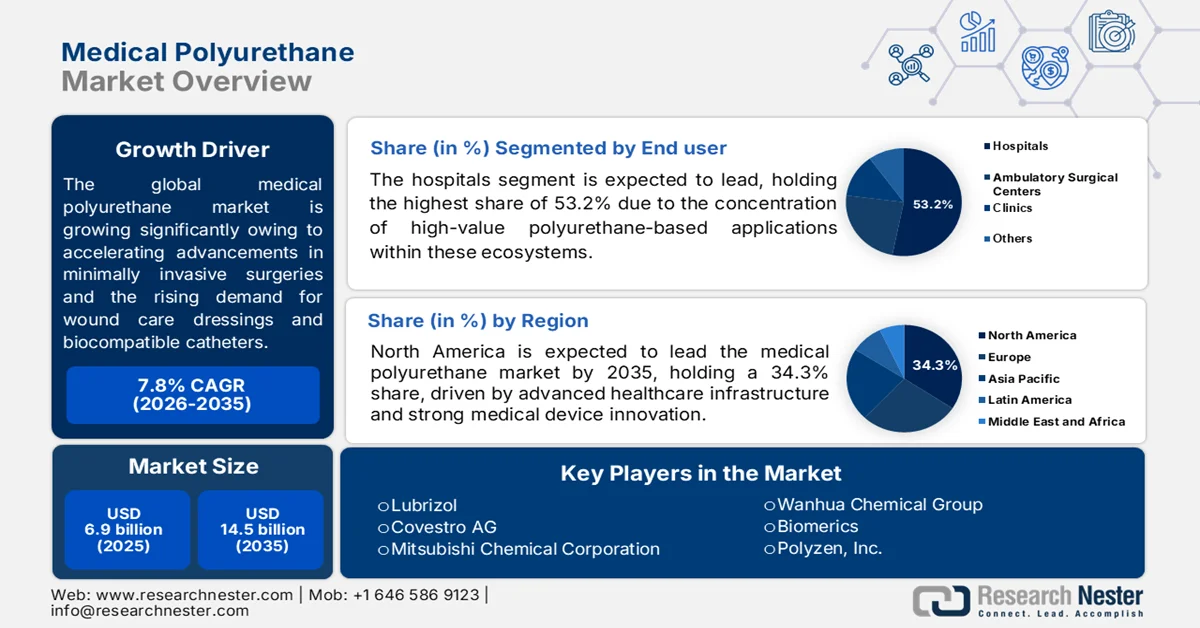
The global medical polyurethane market is witnessing immense growth, which is majorly driven by accelerating advancements in minimally invasive surgeries and the rising demand for wound care dressings and biocompatible catheters. Governments across different nations offer funding for public healthcare infrastructure and fast-track approvals for break-resistant biomaterials, though their tightening quality-control mandates reshape production standards. In November 2023, an article published by the National Institutes of Health announced the development of a multifunctional Janus polyurethane sponge (Janus-PU) dressing with a superhydrophobic F-ZnO@Ag nanoparticle-coated surface to provide antibiofouling, antibacterial, and exudate-management properties. This Janus-PU showcased broad-spectrum antibacterial activity through Ag nanoparticles and enabled near-infrared-controlled unidirectional fluid transport to maintain an optimal wound-healing environment.
Furthermore, the medical polyurethane market is dependent on an extremely integrated global supply chain that requires specialized chemical refiners to secure high-purity medical-grade precursors. In addition, ongoing investments in custom surface-modification technologies and the integration of bio-based materials are creating newer growth opportunities for this medical polymer. In this context, Covestro in June 2026 launched the Bio4PURConti project, which aims to establish the first continuous production process for bio-based aniline, a key precursor for polyurethane manufacturing, using plant-derived biomass instead of fossil resources. This initiative employs microbial fermentation and catalytic conversion to produce a fully bio-based aniline that can directly replace conventional aniline in existing polyurethane value chains, thus positively benefiting industry’s expansion.
Key Medical Polyurethane Market Insights Summary:
Regional Highlights:
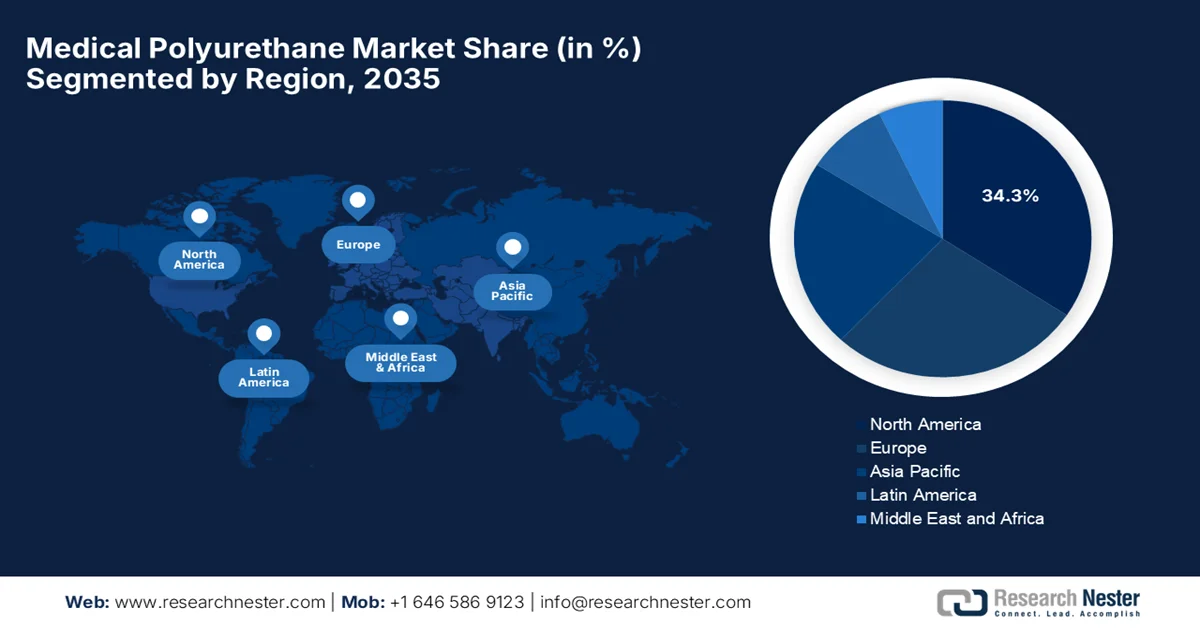
- North America is projected to capture 34.3% of the medical polyurethane market by 2035, reinforced by highly sophisticated healthcare infrastructure and strong medical device innovation
- Asia Pacific is anticipated to witness the fastest growth in the market throughout 2026-2035, spurred by massive government investments in healthcare infrastructure and a booming medical tourism sector
Segment Insights:
- The Hospitals segment is expected to account for 53.2% share of the medical polyurethane market during 2026-2035, supported by the growing adoption of polyurethane-based implantable devices, advanced wound care products, catheters, surgical tubing, and drug delivery systems
- By 2035, the Medical Devices segment is poised to secure a lucrative share, fuelled by increasing integration of polyurethane into advanced medical device designs and rising demand for long-term indwelling devices and patient-specific healthcare solutions
Key Growth Trends:
- Increasing research evidence
- Advancements in chronic wound care management
Major Challenges:
- Material degradation and biocompatibility risks
- Environmental concerns and sustainability barriers
Key Players: Lubrizol (U.S.), Covestro AG (Germany), Mitsubishi Chemical Corporation (Japan), Wanhua Chemical Group (China), Biomerics (U.S.), Polyzen, Inc. (U.S.), AdvanSource Biomaterials (U.S.), DSM Biomedical (Netherlands).
Global Medical Polyurethane Market Forecast and Regional Outlook:
Market Size & Growth Projections:
- 2025 Market Size: USD 6.9 billion
- 2026 Market Size: USD 7.4 billion
- Projected Market Size: USD 14.5 billion by 2035
- Growth Forecasts: 7.8% CAGR (2026-2035)
Key Regional Dynamics:
- Largest Region: North America (34.3% share by 2035)
- Fastest Growing Region: Asia Pacific
- Dominating Countries: United States, Germany, Japan, China, France
- Emerging Countries: India, South Korea, Singapore, Brazil, Mexico
Last updated on : 29 July, 2026
Medical Polyurethane Market - Growth Drivers and Challenges
Growth Drivers
- Increasing research evidence: Studies have demonstrated the complete potential of polyurethane as a prominent biomaterial due to its tunable chemical structure, biocompatibility, mechanical strength, and biodegradability. This factor is attracting both increasing adoption and attracting investment, thereby contributing to the expansion of the medical polyurethane market. In August 2023, IOP Science Organization reviewed the multifunctional biomedical applications of polyurethane, highlighting its adaptability for various medical uses. It also stated that the unique combination of soft and hard segments in PU allows modification of properties such as flexibility, durability, stability, and antibacterial performance, thus making it suitable for tissue engineering, cardiovascular devices, drug delivery, and wound dressings.
- Advancements in chronic wound care management: The rising burden of chronic ulcers and severe burns is fueling adoption of high-performance dressings. Polyurethane films and foams offer exceptional breathability, superior moisture vapor transmission rates, and excellent bacterial barriers, thus driving adoption in the medical polyurethane market globally. NIH study in February 2023 evaluated a five-layer hydrocellular polyurethane foam dressing for chronic wound management across different healthcare settings in southern Europe. This dressing demonstrated effective exudate absorption and retention, reducing dressing changes from 3.6 to 1.8 times per week while improving clinician satisfaction and wear time, thus making it suitable for bolstering the market’s expansion.
Challenges
- Material degradation and biocompatibility risks: This is witnessed especially in long-term in vivo applications, particularly within the demanding cardiovascular and orthopedic implant fields. The long-term exposure to bodily fluids results in this medical-grade polyurethane undergoing environmental stress cracking, hydrolytic degradation, and accelerated aging. This degradation gradually reduces the polymer's mechanical strength, which in turn raises the risk of device failure or structural micro-tears. In addition, the breakdown of these polymers can release chemical byproducts that trigger local tissue inflammation, chronic immune responses, or toxic cellular reactions, thus negatively impacting the adoption rates in the medical polyurethane market globally.
- Environmental concerns and sustainability barriers: Traditional polyurethane production is mostly dependent on fossil-fuel feedstocks and toxic chemical precursors, such as isocyanates, which release certain dangerous air pollutants. Stringent environmental mandates compel manufacturers to re-engineer synthesis methods to minimize harmful emissions and volatile organic compounds. In addition, most of the medical polyurethanes are thermoset polymers or complex composites that are inherently non-biodegradable and highly resistant to mechanical recycling. Therefore, this lack of specialized recycling infrastructure for bio-contaminated medical waste heavily impacts the sustainability profile in the medical polyurethane market.
Medical Polyurethane Market Size and Forecast:
| Report Attribute | Details |
|---|---|
|
Base Year |
2025 |
|
Forecast Period |
2026-2035 |
|
CAGR |
7.8% |
|
Base Year Market Size (2025) |
USD 6.9 billion |
|
Forecast Year Market Size (2035) |
USD 14.5 billion |
|
Regional Scope |
|
Medical Polyurethane Market Segmentation:
End user Segment Analysis
On the basis of end user, the hospitals segment is expected to lead, holding the highest share of 53.2% from 2026 to 2035. The segment’s dominant position in the medical polyurethane market is largely driven by the concentration of high-value polyurethane-based applications within these ecosystems, including implantable devices, advanced wound care products, catheters, surgical tubing, and drug delivery systems. Hospitals are considered to be the primary point of adoption for next-generation medical technologies requiring stringent biocompatibility, sterilization compatibility, and long-term performance. These factors are making them key demand centers for medical-grade polyurethane materials. Furthermore, the increasing shift toward complex surgical interventions and intensive care procedures is expanding the utilization of polyurethane-enabled devices, solidifying hospitals’ role as the largest end user segment.
Application Segment Analysis
By the end of 2035, the medical devices segment will grow with a lucrative share in the medical polyurethane market. The subtype’s growth is largely driven by increasing integration of polyurethane into device designs where material performance directly influences clinical outcomes. In addition, the rising demand for long-term indwelling devices and patient-specific healthcare solutions is encouraging manufacturers to replace conventional materials with polyurethane-based alternatives. As per an article published by NIH in January 2023, the study investigated the use of medical-grade TPU for implantable medical devices manufactured through fused deposition modelling (FDM) 3D printing followed by gamma sterilization. This study concludes that TPU is a suitable material for 3D-printed blood-contacting biomedical devices which is due to its tunable properties and compatibility with sterilization processes.
Product Type Segment Analysis
The foams segment, which is a part of the product type, is forecasted to grow with a notable share in the medical polyurethane market during the assessed timeframe. The expanding demand for advanced wound care solutions requiring superior fluid management, cushioning, and protective barrier properties is driving the sub-segment’s leadership. In addition, the rising adoption of foam-based dressings in hospitals and home-care settings is strengthening demand for medical-grade polyurethane foam products. In January 2023, Convatec introduced ConvaFoam™, which is an advanced foam dressing designed to simplify wound management by providing effective exudate control, adhesion, and protection across various wound types. The dressing incorporates silicone technology, a superabsorbent layer, and a monitoring-friendly film design in order to support longer wear time.
Our in-depth analysis of the medical polyurethane market includes the following segments:
|
Segment |
Subsegments |
|
End user |
|
|
Application |
|
|
Product Type |
|

Vishnu Nair
Head - Global Business DevelopmentCustomize this report to your requirements — connect with our consultant for personalized insights and options.
Medical Polyurethane Market - Regional Analysis
North America Market Insights
North America medical polyurethane market is anticipated to lead with a total share of 34.3% during the discussed timeframe. The region’s leadership is mainly propelled by highly sophisticated healthcare infrastructure and a strong emphasis on medical device innovation. North America boasts an exceptionally high volume of minimally invasive surgeries, which directly accelerates the adoption of premium polyurethane-based catheters, tubing, and interventional cardiovascular devices. In February 2023, the U.S. Food & Drug Administration (FDA) reported that the LimFlow™ System is an approved device designed to treat chronic limb-threatening ischemia by creating an artery-to-vein connection to restore blood flow to the foot in patients unsuitable for surgical bypass. This system uses specialized catheters, a valvulotome, and polymer-covered nitinol stents to establish a new blood flow pathway, bypassing blocked arteries, thus denoting a sustained demand for medical polyurethanes.
The prominent medical device manufacturing sector and extensive domestic healthcare expenditures are driving growth of the U.S. medical polyurethane market. The country’s market progression is sustained by continued R&D efforts, which are centered on advanced, bio-stable polymers that mitigate infection risks and enhance patient safety during prolonged clinical use. In December 2023, Bactiguard and BD expanded their partnership through an exclusive global licensing agreement (excluding China) for Bactiguard-coated Foley catheters to improve availability and continuity of advanced catheter technology. This collaboration supports Bactiguard’s transition toward a licensing-focused business model while allowing BD to provide coated Foley catheters. Hence, such collaborations will benefit the country’s market by improving access to advanced infection-reducing Foley catheter technologies.
In Canada, the medical polyurethane market is utterly backed by a strong emphasis on improving patient outcomes. The country’s growing focus on home-based healthcare and outpatient services significantly boosts the domestic demand for durable, flexible polyurethane consumables, particularly. Canada’s medical device developers proactively collaborate with public research universities to develop and distribute specialized, high-purity polymer formulations that optimize biocompatibility. In June 2025, Lubrizol expanded its partnership with IMCD with a prime focus on strengthening the distribution of its medical-grade TPU solutions across the U.S. and Canada. Through this expanded collaboration, IMCD will help enhance market reach, manage inventory more efficiently, and thus support medical device manufacturers with access to Lubrizol’s enhanced portfolio of medical-grade polymer technologies and development services.
APAC Market Insights
Asia Pacific medical polyurethane market is forecasted to grow at the fastest rate during the stipulated timeframe. The region’s upliftment is majorly propelled by massive government investments in healthcare infrastructure and a booming medical tourism sector. In addition, countries across the region are expanding their domestic medical device manufacturing capabilities, which increases the local consumption of high-purity polymers for producing medical consumables. For instance, in June 2025, Covestro began producing its Desmopan® Rx medical-grade TPU at its Changhua, Taiwan facility, expanding regional manufacturing capacity in Asia Pacific while ensuring compliance with international medical standards. This localized production will allow faster delivery, improved supply reliability, and support the growing demand for high-performance materials used in healthcare applications.
The government's focus on domesticating high-end medical device manufacturing and upgrading national healthcare infrastructure is positioning the medical polyurethane market in China for surging growth. In addition, the country’s market progression is also being propelled by state initiatives that fund local biomaterial research and incentivize domestic firms to develop high-purity polyurethane formulations. In September 2024, Avient announced the expansion of NEUSoft™ TPU and NEU™ custom capabilities manufacturing to its Suzhou, China facility in order to strengthen support for healthcare and medical device customers across China and the Asia Pacific. Besides, this NEUSoft TPU portfolio is especially designed for short-term catheter applications and offers high flexibility, durability, UV stability, and compliance with recognized biocompatibility standards.
In India, the medical polyurethane market is projected to witness strategic growth, which is fueled by the expansion of domestic medical device manufacturing under national industrialization initiatives and substantial investments in private healthcare infrastructure. Besides, a rising middle-class population and the expanding coverage of public health insurance schemes are accelerating the clinical adoption of advanced medical care, including polyurethane-based wound dressings and diagnostic equipment. In this context, the Press Information Bureau (PIB) in December 2024 stated that the Production Linked Incentive (PLI) Scheme for medical devices was launched by the government to promote domestic manufacturing and reduce dependence on imported medical technologies, with a total financial outlay of USD 410 million. This particular scheme has supported 19 greenfield projects and enabled the production of 44 advanced medical devices, i.e., imaging systems, implants, stents, and catheters that were previously imported.
Europe Market Insights
In Europe, the medical polyurethane market is progressing at a steady pace, which is anchored by a mature healthcare ecosystem and a powerful emphasis on medical R&D. Market evolution in this region is highly sustained by deep academic-industrial collaborations, which are focused on developing innovative biomaterials, such as antimicrobial coatings and shape-memory polyurethanes. For instance, Evonik in July 2025 entered into a partnership with IMCD to distribute RESOMER® bioresorbable medical device polymers across Europe, thereby expanding access to advanced biomaterials for implantable healthcare applications. This agreement will support the use of RESOMER® polymers in orthopedic devices, tissue reconstruction, dental meshes, and 3D-printed implantable devices through IMCD’s medical polymer expertise.
The nation’s well-established domestic medical technology sector and high healthcare standards are driving growth of the medical polyurethane market in Germany. The country’s market also benefits from a dense network of research institutes and chemical enterprises that are collaborating to pioneer advanced bio-stable formulations and custom surface coatings that minimize infection risks. For instance, in February 2026, Fraunhofer researchers developed a safer isocyanate-free polyurethane production process by using dicarbamates instead of toxic isocyanates. This approach efficiently improves worker safety, lowers emissions, and supports polyurethane recycling. Furthermore, Fraunhofer also mentions that this technology is being researched for medical catheter tubing and other high-performance applications.
The UK medical polyurethane market is growing steadily, which is supported by a strong domestic life sciences sector and continuous modernization efforts within the National Health Service (NHS). Market growth is largely driven by close collaborations between leading British universities, clinical research networks, and medical device fabricators aimed at developing infection-resistant, bio-stable polymer formulations. In December 2024, the University of East Anglia stated that researchers developed an advanced polyurethane nanofiber wound dressing which is incorporated with heparin-coated silver nanoparticles, combining antimicrobial protection with properties that support faster wound healing. It mentions that this dressing demonstrated strong antibacterial activity against common wound pathogens, sustained silver release for up to seven days, moisture management, and good biocompatibility with skin cells.
Key Medical Polyurethane Market Players:
- Lubrizol (U.S.)
- Covestro AG (Germany)
- Mitsubishi Chemical Corporation (Japan)
- Wanhua Chemical Group (China)
- Biomerics (U.S.)
- Polyzen, Inc. (U.S.)
- AdvanSource Biomaterials (U.S.)
- DSM Biomedical (Netherlands)
- Company Overview
- Business Strategy
- Key Product Offerings
- Financial Performance
- Key Performance Indicators
- Risk Analysis
- Recent Development
- Regional Presence
- SWOT Analysis
- Lubrizol is identified as the supreme manufacturer in this sector, which is offering an extensive portfolio of thermoplastic TPU biomaterials. The company's core strategy is centered on advancing biocompatible materials, maintaining regulatory compliance, and driving continuous innovation in material technologies.
- Covestro AG is yet another foundational and influential player that produces advanced medical-grade thermoplastic polyurethane solutions designed for demanding healthcare applications. The firm strengthens its market position through sustainable product development and collaborations with medical device manufacturers.
- Mitsubishi Chemical Corporation manufactures high-performance medical polyurethane materials that serve medical device applications. In addition, the company’s manufacturing footprint and continuous investment in R&D support its strong presence in this industry.
- Wanhua Chemical Group has emerged as a prominent manufacturer that has been supplying materials for medical tubing, catheters, infusion devices, and other healthcare applications. The firm is highly focused on product quality and cost-efficient manufacturing, which has strengthened its competitiveness in international markets.
- Biomerics is considered to be a specialist in the development and manufacturing of advanced polyurethane biomaterials for minimally invasive and implantable medical devices. The company benefits from strong mastery in terms of biomaterials engineering, contract manufacturing, and medical device design.
Here is a list of key players operating in the global market:
The medical polyurethane market is being supported by a limited number of global manufacturers that lead the production of medical-grade thermoplastic polyurethane (TPU) and polyurethane biomaterials for healthcare applications. Market leaders are intensely competing by offering advanced biocompatible materials, superior durability for long-term implants, and regulatory compliance. On the other hand, North America, Europe, and Japan are leading technological innovation, whereas manufacturers across Asia Pacific are strengthening their production capabilities and expanding their global footprint. In February 2023, Ingevity announced the launch of Capa® LT, which is a new polycaprolactone polyol especially designed to improve polyurethane performance in extremely low-temperature conditions. This product is aimed at applications across industries such as healthcare, transportation, aerospace, footwear, manufacturing, and construction.
Corporate Landscape of the Market:
Recent Developments
- In February 2026, Lubrizol introduced Tolerathane™ TPU, which is an advanced medical-grade thermoplastic polyurethane developed specifically for implantable medical devices. This material is designed to provide strong resistance to biological degradation.
- In January 2026, Covestro announced the launch of Dureflex® MA5000, which is a medical-grade TPU film on a paper carrier especially designed to improve the manufacturing and performance of healthcare products such as IV securement dressings, CGM patches, and wearable medical devices.
- Report ID: 8707
- Published Date: Jul 29, 2026
- Report Format: PDF, PPT
- Explore a preview of key market trends and insights
- Review sample data tables and segment breakdowns
- Experience the quality of our visual data representations
- Evaluate our report structure and research methodology
- Get a glimpse of competitive landscape analysis
- Understand how regional forecasts are presented
- Assess the depth of company profiling and benchmarking
- Preview how actionable insights can support your strategy
Explore real data and analysis
Frequently Asked Questions (FAQ)
About this Report
Connect with our Expert


Report, 2026-2035



Copyright @ 2026 Research Nester. All Rights Reserved.
