Manganese Ore Market Outlook:
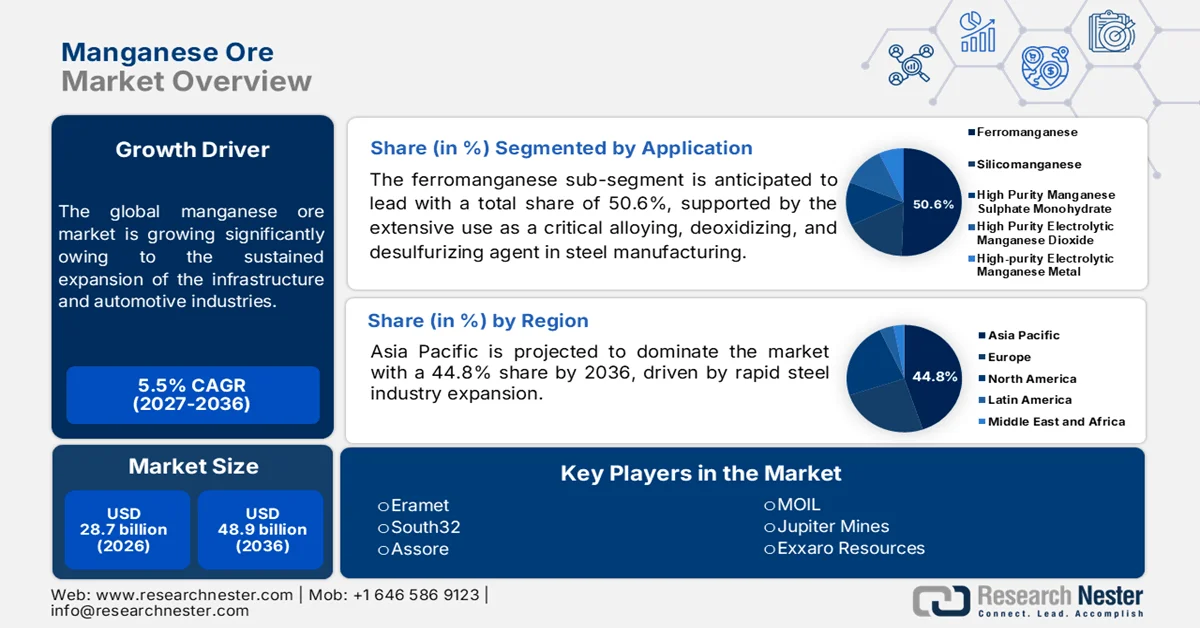
Manganese Ore Market size was valued at USD 28.7 billion in 2026 and is expected to reach USD 48.9 billion by the end of 2036, registering around 5.5% CAGR during the forecast period, i.e., 2027-2036. In 2027, the industry size of manganese ore is estimated at USD 30.2 billion.
The global manganese ore market is experiencing a dynamic shift, which is driven primarily by the sustained expansion of the construction, transportation, energy, and automotive industries. In these sectors, manganese is considered to be an irreplaceable component in steel production and an emerging element in next-generation electric vehicle batteries. In this context, the International Energy Agency (IEA) in 2025 stated that manganese is important across nickel-based batteries, lithium manganese iron phosphate, and emerging sodium-ion battery chemistries. It also mentioned that battery-grade manganese sulphate is a supply concern and projected supply covering only about 55% of demand in 2035 under the IEA’s STEPS scenario. Apart from this, China dominates battery-grade manganese sulphate production, which accounted for around 95% of global supply.
Furthermore, manganese is considered to be a strategically important mineral for the global steel, alloy and battery industries, which makes the availability and movement of manganese ore a key component of the broader critical minerals supply chain in the manganese ore market. Testifying to this, the Observatory of Economic Complexity (OEC) stated that global manganese ore trade reached a substantial USD 6.41 billion in 2024. South Africa was the largest exporter which was, followed by Gabon and Ghana. On the other hand, China led global imports with USD 3.86 billion, and it was followed by India and Norway. Therefore, this indicates that global manganese ore trade flow is extremely concentrated, with a small number of producing countries supplying major consuming markets.
Global Manganese Ore Trade 2024: Top Exporters, Importers & Trade Trends
|
Indicator |
2024 |
|
Global trade value |
USD 6.41 billion |
|
Share of world trade |
0.028% |
|
Global trade ranking |
485 / 1,222 |
|
Product Complexity Index |
-2.81 |
|
Export growth (2023–24) |
-8.42% |
|
5-year annualized trade growth |
-4.96% |
|
Top exporter – South Africa |
USD 3.16 billion |
|
2nd exporter – Gabon |
USD 1.70 billion |
|
3rd exporter – Ghana |
USD 556 million |
|
Top importer – China |
USD 3.86 billion |
|
2nd importer – India |
USD 1.05 billion |
|
3rd importer – Norway |
USD 260 million |
|
Gabon’s share of total exports |
21.1% |
|
Ghana’s share of total exports |
3.47% |
|
South Africa’s share of total exports |
2.09% |
Source: OEC
Key Manganese Ore Market Insights Summary:
Regional Highlights:
- Asia Pacific is anticipated to dominate 44.8% share during the forecast period, reflecting the region’s expanding steel industry and rising manganese production, alongside growing utilization of high-purity manganese in lithium-ion battery chemistries for electric vehicles.
- Middle East & Africa is positioned for substantial growth in the manganese ore market, supported by its strong manganese mining and raw-material supply base, substantial high-grade reserves, and increasing downstream utilization.
Segment Insights:
- The ferromanganese sub-segment is projected to command a 50.6% share during the forecast period, fueled by its extensive application as a critical alloying, deoxidizing, and desulfurizing agent in steel manufacturing and rising production projects from leading pioneers.
- High-grade is forecast to exhibit lucrative growth in the manganese ore market by 2036, driven by increasing preference among manganese alloy producers for higher manganese content that improves metallurgical efficiency, alongside limited high-grade deposits and advances in ore beneficiation and processing.
Key Growth Trends:
- Steel industry expansion
- Growth of ferroalloy production
Major Challenges:
- Indefinite balance between supply and demand
- Growing import prices will affect the supply chain
Key Players: Eramet, South32, Assore, MOIL, Jupiter Mines, Exxaro Resources.
Global Manganese Ore Market Forecast and Regional Outlook:
Market Size & Growth Projections:
- 2026 Market Size: USD 28.7 billion
- 2027 Market Size: USD 30.2 billion
- Projected Market Size: USD 48.9 billion by 2036
- Growth Forecasts: 5.5% CAGR (2027-2036)
Key Regional Dynamics:
- Largest Region: Asia Pacific (44.8% Share by 2035)
- Fastest Growing Region: Middle East & Africa
- Dominating Countries: South Africa, China, Australia, India, Gabon
- Emerging Countries: Indonesia, Botswana, Ghana, Brazil, Canada
Last updated on : 4 September, 2026
Manganese Ore Market - Growth Drivers and Challenges
Growth Drivers
- Steel industry expansion: The unprecedented growth in terms of global infrastructure, urbanization, and automotive manufacturing is considered to be the primary catalyst for the manganese ore market. Manganese is an irreplaceable alloy that efficiently increases strength, toughness, and wear resistance, and thus rising global steel production directly accelerates the raw extraction. In August 2026, the World Steel Organization disclosed that global crude steel production across 70 reporting countries reached 149.2 million tons in July 2026. It also mentions that production increased across several major regions, including Africa, Europe, North America, and South America. For the time frame January to July 2026, cumulative production stood at 1,081.2 Mt.
Regional Crude Steel Production and Growth Trends, July 2026
|
Region |
Jul 2026 Production (Mt) |
YoY Change (%) |
Jan–Jul 2026 Production (Mt) |
YoY Change (%) |
|
Africa |
2.0 |
+6.1% |
14.6 |
+9.5% |
|
Asia & Oceania |
109.4 |
-1.2% |
799.6 |
-0.9% |
|
EU (27) |
10.5 |
+3.8% |
76.0 |
+0.4% |
|
Europe, Other |
3.7 |
+5.8% |
25.7 |
+5.5% |
|
Middle East |
3.8 |
-13.4% |
29.6 |
-8.1% |
|
North America |
9.6 |
+4.9% |
65.9 |
+5.4% |
|
Russia & Other CIS + Ukraine |
6.7 |
+2.2% |
45.5 |
-6.0% |
|
South America |
3.6 |
+2.8% |
24.1 |
- |
|
Total – 70 Countries |
149.2 |
-0.3% |
1,081.2 |
-0.6% |
Source: World Steel Organization
- Growth of ferroalloy production: Manganese ore is a highly important raw material for producing ferroalloys such as ferromanganese and silicomanganese, which are extensively used in steel manufacturing. The rising steelmaking capacity is supporting ferroalloy consumption. As steel producers expand output and adopt stronger grades of steel, demand for manganese-containing ferroalloys provides a major market growth driver. In April 2025, the Press Information Bureau (PIB) stated that MOIL achieved its strongest-ever financial year performance in FY2024–25, which was supported by record manganese ore production of 1.802 million tons, up 2.7% year-on-year. At the same time, manganese ore sales reached 1.587 million tons, whereas ferro-manganese production increased 18% to 12,000 tons, thus benefiting the overall manganese ore market.
Challenges
- Indefinite balance between supply and demand: The balance of supply and demand is one of the most important factors that has been influencing manganese ore pricing. When the demand for a commodity exceeds the supply, the price of the product rises. Therefore, in the case of manganese ore, the iron and steel sector has created major demand for the product. As battery production increases, so does the demand for high-purity manganese ore. However, there is still a limited supply of battery-grade manganese ore available globally, which can impose a huge impact on battery product prices. In addition, supply disruptions from major producing countries can tighten the manganese ore market and create price volatility.
- Growing import prices will affect the supply chain: Increasing import prices can negatively impact the manganese ore supply chain, which raises procurement and transportation costs, ultimately affecting market stability as well as profitability. The existence of these higher import prices can readily increase input costs for steel and ferroalloy manufacturers, especially in regions that are dependent on overseas manganese ore supplies. Apart from this, rising costs may also encourage buyers to opt for alternative suppliers or lower-grade ores in order to manage expenses. Supply chain disruptions and currency fluctuations can amplify the impact of higher import prices across the value chain in the manganese ore market.
Manganese Ore Market Size and Forecast:
| Report Attribute | Details |
|---|---|
|
Base Year |
2026 |
|
Forecast Period |
2027-2036 |
|
CAGR |
5.5% |
|
Base Year Market Size (2026) |
USD 28.7 billion |
|
Forecast Year Market Size (2036) |
USD 48.9 billion |
|
Regional Scope |
|
Manganese Ore Market Segmentation:
Application Segment Analysis
On the basis of application, the ferromanganese sub-segment is anticipated to lead with a total share of 50.6% during the forecast period. This domination in the manganese ore market is supported by the extensive use of ferromanganese as a critical alloying, deoxidizing, and desulfurizing agent in steel manufacturing and rising production projects from leading pioneers. Apart from this, the sustained expansion of carbon steel and alloy steel production, driven by infrastructure development, construction, automotive manufacturing, and transportation, generates consistent demand for ferromanganese. In September 2025, Sakura Ferroalloys inaugurated its new USD 31 million sinter plant in Sarawak and launched Project Salamander, which is a USD 82.5 million refined ferromanganese converter project. This new facility will produce up to 70,000 tons of medium- and low-carbon ferromanganese annually.
Type Segment Analysis
By the end of 2036, high-grade is forecasted to exhibit lucrative growth opportunities in the manganese ore market. The segment’s growth is primarily fueled by the increasing preference for high-grade ores among manganese alloy producers, as their higher manganese content enables greater metallurgical efficiency and reduces the volume of ore required per unit of manganese output. In addition, the limited availability of high-grade deposits and their ability to command a pricing premium are enhancing the commercial attractiveness of this grade. On the other hand, technological advancements in ore beneficiation and processing are also improving the recovery of manganese from high-grade resources. These factors, along with rising investments in mining and processing infrastructure, are likely to strengthen the position of high-grade manganese ores.
End user Segment Analysis
In terms of end user, the steel manufacturers segment is expected to attain a considerable share in the manganese ore market during the stipulated timeframe. Its essential role in steel alloying, deoxidation, desulfurization, and the production of high-strength and wear-resistant grades is driving this leadership. The extensive use of manganese in carbon and alloy steel, combined with continued infrastructure, automotive, and machinery production, will sustain demand throughout the forecast period. Besides, ferroalloy producers are also expected to maintain significant consumption as ferromanganese and silicomanganese are considered to be critical inputs for steel manufacturing, thus denoting a wider segment scope.
Our in-depth analysis of the manganese ore market includes the following segments:
|
Segment |
Subsegments |
|
Application |
|
|
Type |
|
|
End user |
|
|
Form |
|

Vishnu Nair
Head - Global Business DevelopmentCustomize this report to your requirements — connect with our consultant for personalized insights and options.
Manganese Ore Market - Regional Analysis
APAC Market Insights
Asia Pacific manganese ore market is anticipated to lead with the highest share of 44.8% during the assessed timeframe. The region’s leadership is effectively propelled by the rapid expansion of the steel industry and the higher production rates of manganese. Asia Pacific’s market is finding new momentum in the clean energy sector, specifically due to the increasing utilization of high-purity manganese in lithium-ion battery chemistries for electric vehicles. In this context, the Indonesia Mining Association stated that Asia Pacific held 16.5% of global manganese reserves in 2025, whereas China produced 9.8% of global manganese in 2024. It also mentions that India’s manganese production is forecast to remain flat through 2030. Hence, this denotes that the region will be a strategically important manganese industry, supported by strong steel-sector demand and emerging applications.
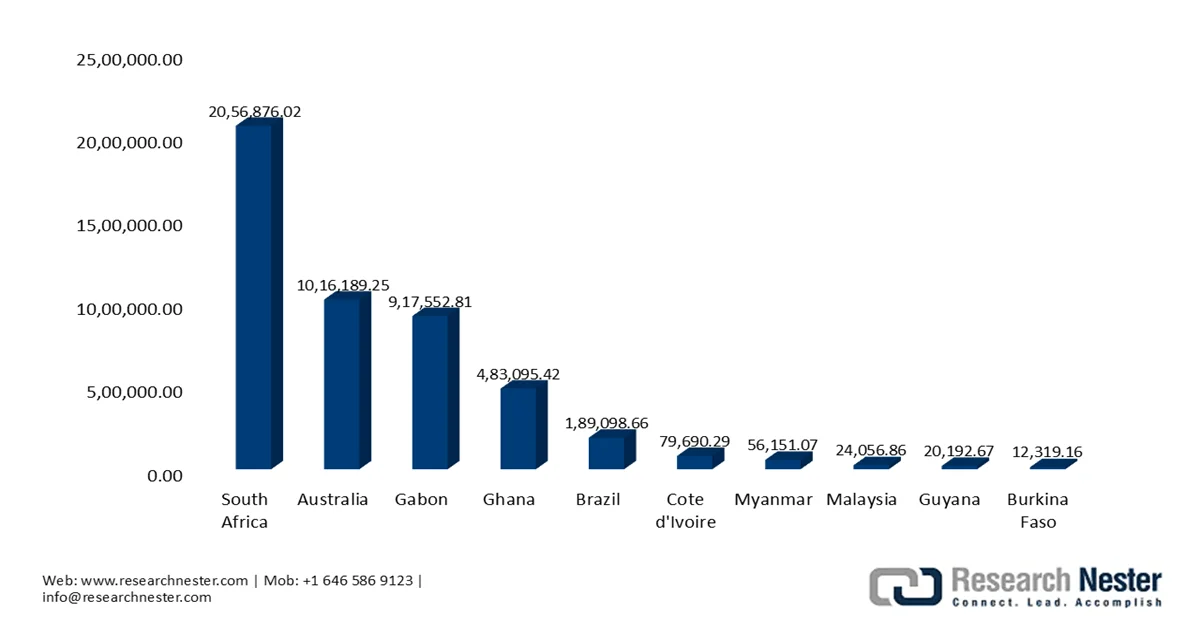
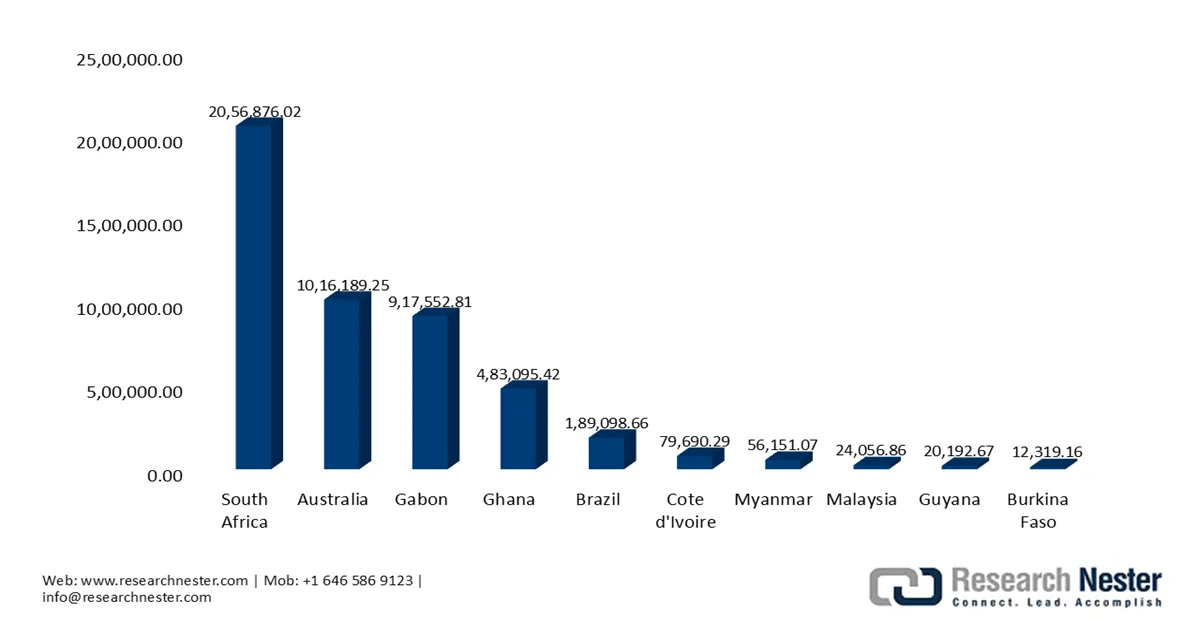
The nation's massive crude steel and ferroalloy production industries, which command the largest share of global consumption, are important driving factors for China manganese ore market. This country's market relies heavily on high-grade imports from major global producers to blend with local supply and optimize smelting efficiency. This can be reflected in the trade data published by World Integrated Trade Solution (WITS), which states that China’s manganese ore supply chain is heavily reliant on overseas sources, wherein South Africa, Australia and Gabon are key suppliers. This concentration highlights China’s exposure to changes in mining output, logistics, trade policies and geopolitical conditions in major producing countries, and it showcases the strategic importance of securing diversified and reliable manganese supply.
China Manganese Ore Imports by Country: Key Suppliers and Trade Overview 2023
Source: WITS
In India, the manganese ore market is projected for noteworthy growth, which is propelled by its domestic steel production targets and expanding infrastructure projects. The country possesses significant domestic reserves, which are managed largely by state-owned and private mining entities. The market is highly driven by the government's focus on self-reliance in manufacturing, which has stimulated local alloy smelting capacity. In July 2025, PIB stated that India’s crude steel capacity increased steadily from 143.91 MnT in 2020-21 to 200.33 MnT in 2024-25, whereas the production reached 152.18 MnT. In addition, secondary steel plants, including MSMEs, accounted for 47% of total crude steel capacity in 2024-25. Government measures are supporting domestic steel production, thereby helping reduce the country’s dependence on imports.
Middle East & Africa Market Insights
The Middle East & Africa manganese ore market plays a pivotal role in the global supply landscape, which is deliberately supported by its strong position in manganese mining and raw-material supply, backed by substantial reserves of high-grade manganese ore. It acts as the world's upstream epicenter for mining and exporting raw ore, and it is rapidly emerging as a major downstream utilization hub. In July 2026, Giyani Metals filed the definitive feasibility study for its K.Hill Battery-Grade Manganese Project in Botswana, which is a key step toward development. This study estimates a post-tax NPV of USD 482 million and an IRR of 20.3%, highlighting the project’s economic and supply potential, thus making it suitable for exponential market growth.
In South Africa, the manganese ore market is considered to be the foundational anchor of global mineral supply, which is uniquely defined by its vast Kalahari Manganese Field holding the world's largest known reserves of high-grade ore. The market is reshaped by a complex interplay of black economic empowerment policies and local mining charters aimed at transforming the industry through inclusive ownership. Based on the government data published in April 2026, South Africa’s Northern Cape is positioning itself as a major supply hub for critical minerals, and it is pursuing manganese beneficiation and value addition with an aim to shift from raw ore exports toward higher-value manganese products and industrial development. This strategy could strengthen the region’s manganese value chain while supporting industrialization, diversification, and long-term economic growth.
The nation’s high-grade ore resources, well-established mining operations, and strong integration with international steel and manganese-alloy supply chains are driving the manganese ore market in Gabon. The country is witnessing exponential growth based on a decisive legislative shift toward a near-term ban on raw, unprocessed mineral exports. This regulatory mandate is compelling major producers to fast-track investments into regional industrialization. In this context, USGS stated that Gabon was the world’s second-largest manganese producer in 2024, and it contributed around 25% of global output, which makes manganese a key component of its mining sector. In addition, Gabon’s strong manganese production and established mining operations solidify its strategic importance in the global manganese supply chain.
North America Market Insights
The demand from the domestic steelmaking and defense manufacturing sectors drives growth in the overall North America manganese ore market. In order to mitigate vulnerabilities associated with zero domestic ore extraction, the market is making a shift toward localized refining, recycling innovations, and the development of alternative synthetic manganese feeds. In this context, NACMA was established by Canadian Manganese, GreenMet, AmForge, and Flash Metals in July 2026 to develop an integrated North America manganese supply chain. This alliance will connect Canada manganese mining and refining with U.S.-based specialty processing and advanced manufacturing, hence strengthening regional supply security for steel, defense, aerospace, energy storage, and other critical industries.
The U.S. manganese ore market is forecasted to witness sustained growth, and it mainly depends on imports. Consumption in this country is primarily led by steel manufacturing and construction sectors, which utilize imported manganese alloys to improve structural integrity. The market is currently undergoing a significant strategic transformation catalyzed by regional efforts to secure critical mineral supply chains and reduce foreign vulnerabilities. In this context, USGS states that U.S. ferromanganese imports in January 2026 totaled a substantial 43,000 metric tons, with a customs value of USD 46 million. It also mentioned that high-carbon ferromanganese accounted for the largest share at 33,500 metric tons, which was mainly supplied by India, Malaysia, and South Africa. India was the leading source overall, which contributed to the majority of imports across low-, medium-, and high-carbon ferromanganese categories.
The Canada manganese ore market is gaining enhanced traction owing to its unique position as a major metallurgical exporter of finished steel and aluminum products. The market's internal consumption is tightly integrated with heavy manufacturing corridors, where imported manganese is utilized as a vital purifying and strengthening agent in metal smelting. In addition, growing investments in terms of advanced steel production and metal processing facilities are further supporting manganese ore demand across the country. The increasing focus on high-strength alloys and energy-efficient manufacturing is encouraging manufacturers to secure reliable supplies of high-grade manganese inputs, thus indicating a positive manganese ore market outlook.
Key Manganese Ore Market Players:
- Eramet (France)
- South32 (Australia)
- Assore (South Africa)
- MOIL (India)
- Jupiter Mines (Australia)
- Exxaro Resources (South Africa)
- Element 25 (Australia)
- Electric Metals (U.S.)
- Frontier Rare Earths (South Africa)
- Industrial Development Corporation (South Africa)
- Euro Manganese (Canada)
- Integrals Power (UK)
- Company Overview
- Business Strategy
- Key Product Offerings
- Financial Performance
- Key Performance Indicators
- Risk Analysis
- Recent Development
- Regional Presence
- SWOT Analysis
- Eramet is a leading global manganese ore producer through Eramet Comilog's Moanda mine, which is situated in Gabon. The company produces high-grade manganese ore in various forms, i.e., lumpy ores, fines, HM products, and sinter.
- South32 is yet another major manganese ore producer which has operations both in Australia and South Africa. Following Cyclone Megan, GEMCO resumed export sales in May 2025, thereby restoring an important supply source for international steel and ferroalloy markets.
- Assore is a significant South Africa-based manganese producer which operates through its Nchwaning and Gloria mines in the Northern Cape. The mines produce various manganese ore grades, including high-grade and medium-grade material.
- Jupiter Mines holds a 49.9% interest in Tshipi é Ntle Manganese Mining, which is the operator of the Tshipi Manganese Mine in South Africa. Besides, the operation produces both lumpy and fines manganese ore and is one of the world's major manganese exporters.
- MOIL is India's largest manganese ore producer which is operating mines across Maharashtra and Madhya Pradesh. It supplies multiple manganese ore grades primarily to India's steel and ferroalloy industries, allowing it to maintain a leading position in this sector.
Here is a list of key players operating in the global manganese ore market:
The global manganese ore market depicts a producer-led and geographically concentrated landscape wherein the major supply originates from South Africa, Gabon, Australia, Brazil, and India. Competition in this sector is primarily shaped by ore grade, resource scale, production costs, mine life, processing capabilities, and export infrastructure. Leading producers have captured strong positions through large-scale mining operations and established customer bases. In this context, Eramet and the Republic of Gabon in July 2026 signed a memorandum of understanding to expand local manganese processing and strengthen Gabon’s industrial value chain. Three scenarios are being assessed to process up to 700,000 tons of manganese ore on a yearly basis by the end of 2031.
Corporate Landscape of the Manganese Ore Market:
Recent Developments
- In August 2026, Electric Metals launched a multi-workstream optimization program at its North Star Manganese Project in Minnesota to enhance recoveries, lower costs, and strengthen project economics. This program covers mine planning, ore sorting, metallurgy, mineral separation, and downstream engineering.
- In February 2026, Frontier Rare Earths signed a strategic technology and offtake agreement with Carester and secured a USD 20 million equity investment from South Africa’s Industrial Development Corporation to advance the Zandkopsdrift project. This definitive feasibility study is now underway to produce magnet rare earths and battery-grade manganese.
- In June 2025, Euro Manganese signed a seven-year offtake term sheet with UK-based Integrals Power for high-purity manganese sulphate from its Chvaletice Project in the Czech Republic. This material will support LMFP cathode production for electric vehicles, grid storage, defense and other battery applications.
- In May 2025, Exxaro diversified into manganese through a major acquisition in South Africa’s Kalahari Manganese Field. This deal provides access to long-life mines, established infrastructure and key export markets, thereby supporting demand from steelmaking and clean-energy technologies.
- Report ID: 5438
- Published Date: Sep 04, 2026
- Report Format: PDF, PPT
- Explore a preview of key market trends and insights
- Review sample data tables and segment breakdowns
- Experience the quality of our visual data representations
- Evaluate our report structure and research methodology
- Get a glimpse of competitive landscape analysis
- Understand how regional forecasts are presented
- Assess the depth of company profiling and benchmarking
- Preview how actionable insights can support your strategy
Explore real data and analysis
Frequently Asked Questions (FAQ)
About this Report
Connect with our Expert


Report, 2027-2036



Copyright @ 2026 Research Nester. All Rights Reserved.
