Logistics Automation Market Outlook:
Logistics Automation Market size was valued at USD 83.3 billion in 2025 and is projected to cross USD 275.1 billion by the end of 2035, expanding at more than 12.7% CAGR during the forecast period, i.e., 2026-2035. In 2026, the industry size of logistics automation is evaluated at USD 93.8 billion.
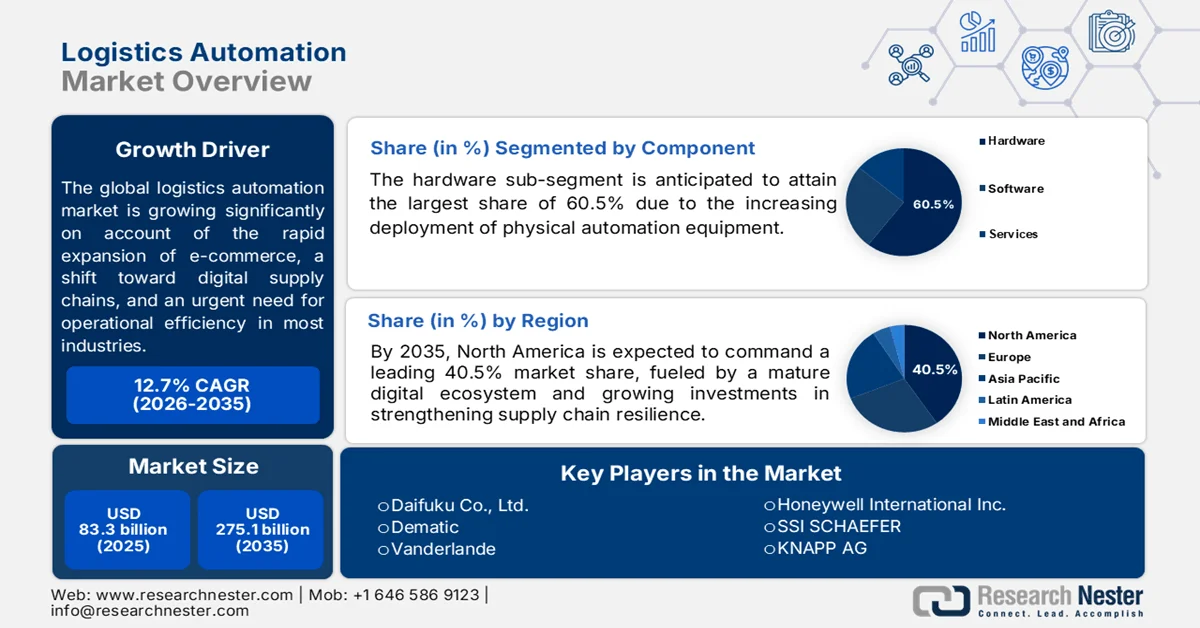
The global logistics automation market is witnessing surging growth, which is driven by the rapid expansion of e-commerce, a shift toward digital supply chains, and an urgent need for operational efficiency in most industries. Companies are making substantial investments in terms of advanced solutions with the main goal of optimizing warehouse management, minimizing human error, and accelerating order fulfillment times. According to the article published by the World Economic Forum (WEF) in May 2024, the global logistics market is expected to exceed USD 18 trillion by 2030. AI-driven logistics is projected to reach a substantial USD 12.87 billion by the end of 2026 as e-commerce pushes companies toward smarter and faster operations, thus elevating the growth potential of the market.
Furthermore, this momentum is propelled by the ongoing integration of the Internet of Things and real-time data analytics, which allow businesses to achieve end-to-end visibility in most of their distribution networks. Industries across the globe prioritize resilience and agility against unpredictable global disruptions, due to which the adoption of automated logistics solutions is evolving from a competitive edge into a fundamental operational necessity. For instance, UPS in November 2023 introduced its supply chain symphony platform, which brings shipping, warehousing, inventory, freight, customs, and other logistics services together through a single cloud-based system, thus positively contributing to the market’s expansion.
Key Logistics Automation Market Insights Summary:
Regional Highlights:
- North America is projected to command a 40.5% share of the logistics automation market during 2026-2035, with its market position reinforced by a sophisticated digital ecosystem and a strong focus on supply chain resilience
- Asia Pacific is poised to register the fastest growth from 2026 to 2035, supported by rapid urbanization, massive e-commerce adoption, and digital transformation across manufacturing hubs
- The logistics automation market in the U.S. accounts for 75.7% of the share in North America, which is driven by the country’s high e-commerce order density and extensive fulfillment and distribution infrastructure
Segment Insights:
- Hardware is anticipated to account for the largest 60.5% share of the component segment in the logistics automation market from 2026 to 2035, as logistics operators increasingly deploy physical automation equipment to enhance throughput, accelerate order processing, optimize labor, and expand warehouse capacity
- Transport management is expected to secure a considerable share by 2035, benefiting from the rising adoption of AI, advanced analytics, and digital platforms for route optimization, fleet management, shipment planning, and transportation visibility
Key Growth Trends:
- E-commerce expansion
- Same-day delivery demands
Major Challenges:
- Cybersecurity and data privacy risks
- High initial implementation costs
Key Players: Daifuku Co., Ltd.,Dematic,Vanderlande,Honeywell International Inc.,SSI SCHAEFER,KNAPP AG,Mecalux S.A.,TGW Logistics.
Global Logistics Automation Market Forecast and Regional Outlook:
Market Size & Growth Projections:
- 2025 Market Size: USD 83.3 billion
- 2026 Market Size: USD 93.8 billion
- Projected Market Size: USD 275.1 billion by 2035
- Growth Forecasts: 12.7% CAGR (2026-2035)
Key Regional Dynamics:
- Largest Region: North America (40.5% Share by 2035)
- Fastest Growing Region: Asia Pacific
- Dominating Countries: United States, China, Germany, Japan, South Korea
- Emerging Countries: India, Singapore, Australia, Mexico, Brazil
Last updated on : 20 August, 2026
Logistics Automation Market - Growth Drivers and Challenges
Growth Drivers
- E-commerce expansion: The explosive rise of online shopping is encouraging retailers to process massive order volumes with perfect accuracy. On the other hand, this e-commerce demands rapid, error-free sorting and multi-item picking, thus encouraging investments in high-speed conveyors and autonomous mobile robots to meet tight delivery schedules. In this context, the International Trade Administration in 2024 stated that global B2C e-commerce revenue is forecast to reach USD 5.5 trillion by 2027, expanding at a 14.4% CAGR, which is led by consumer electronics, fashion, furniture, and other major categories. It also mentions that India is emerging as a major growth market, with retail e-commerce expanding at a 14.1% CAGR from 2023–2027, while global retail e-commerce growth is estimated at 11.16% over the same period.
Global B2B eCommerce Market Growth Forecast: GMV and APAC Market Share, 2022 - 2026
|
Year |
Global B2B eCommerce GMV (USD billion) |
APAC Share |
|
2022 |
21,019 |
78.6% |
|
2023 |
24,453 |
78.9% |
|
2024 |
28,082 |
79.3% |
|
2025 |
32,118 |
79.7% |
|
2026 |
36,163 |
80.0% |
Source: ITA
- Same-day delivery demands: Modern consumers expect instant order fulfillment, which is narrowing traditional processing windows from days to hours. Therefore, to achieve this velocity, companies need to eliminate human latency by deploying automated storage and retrieval systems, thus allowing consistent growth of the market globally. In October 2023, Amazon announced expansion of its warehouse robotics program with Sequoia and Digit, thereby adding to a fleet of more than 750,000 robots working alongside employees. It also mentioned that Sequoia can identify and store incoming inventory up to 75% faster and reduce fulfillment-center order processing time by up to 25%, thus improving delivery speed and accuracy.
Challenges
- Cybersecurity and data privacy risks: Logistics networks have become intensely connected with automation and cloud computing, which is making them a prime target for cybercriminals. Automated warehouses generate as well as transmit huge volumes of data, i.e., proprietary supplier details, inventory values, client addresses, and financial transaction records. Therefore, any type of malware infection or ransomware attack on an interconnected warehouse management system can freeze an entire global supply chain, which in turn causes catastrophic financial losses and severe reputational damage. Also, protecting the decentralized IoT endpoints, robotic sensors, and autonomous delivery fleets leads to complex security vulnerabilities that traditional IT systems cannot easily defend, thus causing hindrance to the market globally.
- High initial implementation costs: The substantial capital which is required for hardware and software installations is considered to be a major barrier for market adoption. Implementing advanced technologies such as automated guided vehicles, automated storage and retrieval systems, and complex warehouse management software poses significant financial risk. For small and medium-sized enterprises, these initial costs can be entirely prohibitive, which limits automation to larger corporations' budgets. Other than purchasing the physical machinery and software licenses, companies need to make investments in terms of upgrading existing facility infrastructure to support these systems.
Logistics Automation Market Size and Forecast:
| Report Attribute | Details |
|---|---|
|
Base Year |
2025 |
|
Forecast Year |
2026-2035 |
|
CAGR |
12.7% |
|
Base Year Market Size (2025) |
USD 83.3 billion |
|
Forecast Year Market Size (2035) |
USD 275.1 billion |
|
Regional Scope |
|
Logistics Automation Market Segmentation:
Component Segment Analysis
The hardware sub-segment is anticipated to attain the largest share of 60.5% in the component segment of the logistics automation market from 2026 to 2035. The sub-type’s growth in this sector is largely attributable to the increasing deployment of physical automation equipment, including autonomous mobile robots, automated storage and retrieval systems, robotic arms, conveyors, and automated sortation systems. These logistics operators prioritize higher throughput, faster order processing, labor optimization, and greater warehouse capacity. In May 2025, DHL Group planned to deploy more than 1,000 additional robots with Boston Dynamics, thereby expanding automation across its logistics operations and building on the Stretch robot’s success in container unloading.
Application Segment Analysis
The transport management sub-segment, which is a part of the application category, is assessed to attain a considerable share in the market by the conclusion of 2035. This growth is largely attributable to the increasing adoption of AI, advanced analytics, and digital platforms for route optimization, fleet management, shipment planning, and transportation visibility. In addition, this enables logistics operators to reduce inefficiencies, optimize vehicle utilization, lower transportation costs, and respond more rapidly, with the main goal of meeting changing delivery requirements. For instance, in June 2026, UPS announced that it is accelerating AI adoption across its logistics network to improve visibility, reliability, customer service, and operational efficiency in the transport sector.
End user Segment Analysis
Manufacturing is forecasted to attain a noteworthy share in the market during the assessment period. The segment’s leadership in this sector is mainly propelled by the increasing adoption of automated material-handling systems, robotics, and intelligent intralogistics solutions. Besides, these solutions streamline the movement of raw materials, components, and finished goods in these production facilities, thereby improving throughput, reducing manual handling, optimizing inventory flow, and thus supporting flexible manufacturing operations. In addition, the growing trend toward smart factories and Industry 4.0 is readily encouraging manufacturers to integrate connected automation technologies across production and warehouse operations.
Our in-depth analysis of the logistics automation includes the following segments:
|
Segment |
Subsegments |
|
Component |
|
|
Application |
|
|
End user |
|
|
Organization Size |
|
|
Type |
|
|
Mode of Freight Transport |
|

Vishnu Nair
Head - Global Business DevelopmentCustomize this report to your requirements — connect with our consultant for personalized insights and options.
Logistics Automation Market - Regional Analysis
North America Market Insights
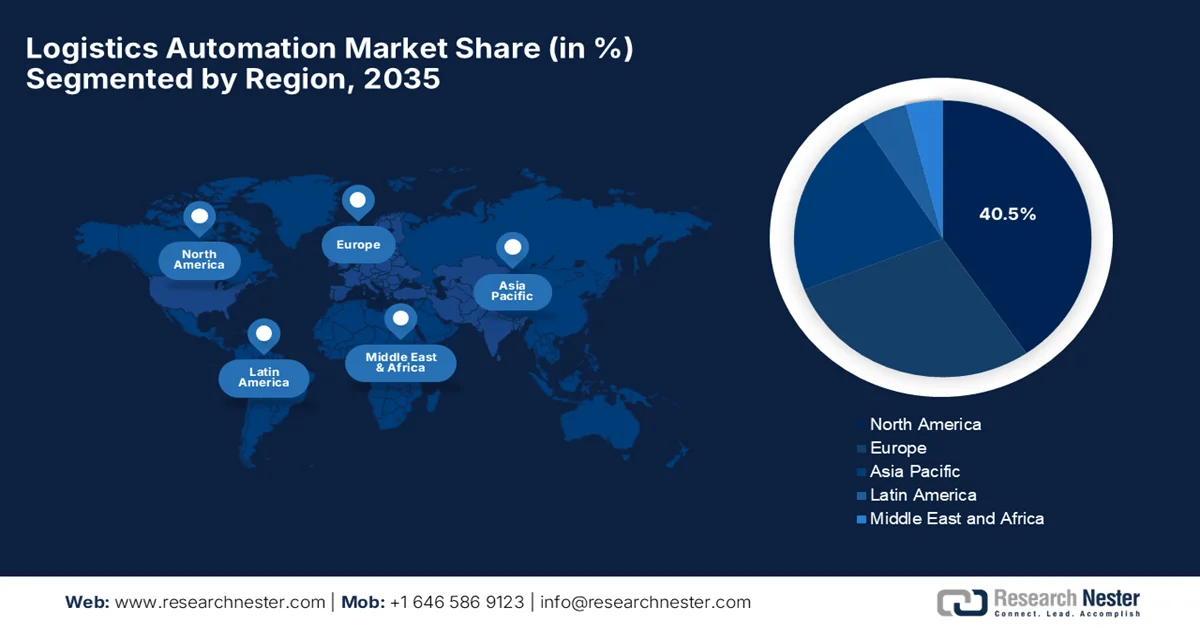
North America logistics automation market is anticipated to lead with a total share of 40.5% during the discussed timeframe. The region’s upliftment in this sector is majorly propelled by a sophisticated digital ecosystem and a strong focus on supply chain resilience. Companies across the region are opting for advanced warehouse robotics, autonomous vehicles, and cloud-based management systems to handle escalating order volumes. In March 2026, the Institute for Supply Management stated that AI is expected to play a larger role in supply chain disruption management, and warehouse automation is also expanding, with around 30% of logistics space now using automation, thus making it suitable for sustained market growth.
The country's prominent e-commerce infrastructure, technological ecosystem, along with a focus on end-to-end supply chain visibility, are some of the important factors driving growth of the U.S. logistics automation market. This country also benefits from domestic innovation in warehouse software, along with the strategic adoption of data analytics to address severe localized labor challenges. In this context, the Information Technology and Innovation Foundation (ITIF) stated that it recommends policy support for robotics in U.S. logistics facilities with the main goal of improving labor productivity, worker safety, and supply-chain resilience as e-commerce demand is growing, as of June 2023 data. In addition, this report proposes a 10-part policy plan, i.e., automation tax incentives, increased robotics research funding, support for smaller logistics firms, and updated safety standards.
U.S. Warehousing and Storage Labor Productivity, Labor Costs, and Employment Statistics, 2024
|
Indicator |
Warehousing and Storage |
|
Employment (thousand) |
1,861.8 |
|
Labor productivity (% change, 2023–2024) |
-0.6% |
|
Unit labor costs (% change) |
9.0% |
|
Output (% change) |
-0.2% |
|
Hours worked (% change) |
0.4% |
|
Labor compensation (% change) |
8.7% |
|
Hourly compensation (% change) |
8.3% |
Source: BLS
The Canada logistics automation market is gaining enhanced momentum, which is driven by expanding urban fulfillment hubs and a strong focus on modernizing traditional supply chain infrastructure. In addition, businesses across the provinces are constantly putting efforts to enhance distribution speed and building agility into their networks. In September 2023, Canada Post inaugurated the Albert Jackson Processing Centre in Scarborough, Ontario, which has doubled parcel-processing capacity in the Greater Toronto Area. This 585,000-square-foot facility can process more than 1 million packages daily and sort over 60,000 packages per hour, supporting Canada’s growing e-commerce industry.
APAC Market Insights
The Asia Pacific market is projected to expand at the fastest rate from 2026 to 2035. The region’s upliftment in this sector is effectively propelled by rapid urbanization, massive e-commerce adoption, and a digital transformation across manufacturing hubs. Countries throughout the region are opting for intelligent warehouse management software to manage soaring parcel volumes and streamline complex domestic and cross-border trade networks. In April 2025, Daifuku opened a new manufacturing plant in Hyderabad, India, to expand its production space by four times to meet rising demand for warehouse and material-handling automation. This facility will manu facture AS/RS, rail-guided pallet sorters, and conveyors for manufacturing, retail, transportation, and warehousing industries.
Massive manufacturing capabilities and a nationwide push toward smart industrial infrastructure are driving growth in China domestic automation market. Significant national policy support for intelligent manufacturing and pioneering breakthroughs in 5G-enabled warehouse connectivity are also positioning the market for sustained growth. In this context, CEVA Logistics in June 2026 opened a 4,300-square-metre automated distribution center in Alashankou, China, to strengthen freight connectivity along the China–Central Asia–Caucasus–Europe corridor. The hub uses electric autonomous forklifts and a centralized digital control platform to automate warehouse flows and provide real-time customs visibility.
The Japan logistics automation market is growing at a notable pace, which is due to an intense focus on becoming a global pioneer in labor-saving technologies. In addition, the market benefits from a strong domestic focus on spatial optimization, driving the adoption of ultra-compact vertical storage systems within densely packed urban distribution centers. In November 2024, WEF stated that Japan’s logistics demand has nearly doubled in 20 years, whereas truck drivers are projected to decline from 980,000 in 1995 to 520,000 by 2030, which creates an estimated 34% logistics gap. In this context, the government plans an automated autoflow road, targeting social trials by FY2027 and aiming to reduce cargo waiting/handling time from 3 to 2 hours and raise truck utilization from 38% to 44% by 2028.
Europe Market Insights
The Europe market is growing at a notable pace, which is due to a strategic focus on strict environmental sustainability goals, multi-modal transport integration, and stringent cross-border regulatory compliance. The regional market is supported by an established network of seasoned industrial engineering conglomerates and pioneering software firms that are developing localized, data-secure automation frameworks. In April 2026, ALICE stated that the region’s logistics is shifting toward large-scale automation across roads, ports, terminals and intermodal hubs, with mounting support from projects such as MODI, AUTOSUP and SEAMLESS. It also mentioned that future deployment will depend on harmonized standards, digitalized processes, 24/7 operations and coordinated cross-border automated logistics networks.
The nation’s pioneering Industry 4.0 initiative, which champions the total digital integration of manufacturing and supply chain ecosystems, is driving growth of the market in Germany. The country’s position as Europe's primary transit crossroads, necessitating highly advanced, automated multi-modal hubs that can transition freight between rail, road, and air, also positions it for extensive market growth. In April 2025, official government data disclosed that the country’s logistics sector is a major industry and it generated approximately USD 378 billion in sales in 2023, employing nearly 3.5 million people, and transporting 4.3 billion tons of goods. Companies are advancing through AI, digital twins, automation, robotics, and logistics-as-a-service, improving warehouse efficiency and supply-chain productivity.
The UK logistics automation market is unfolding remarkable growth opportunities, spurred by the need to navigate post-Brexit customs friction and reshape cross-border trading patterns. Domestic retailers and third-party logistics firms are implementing cloud-based customs-integrated software, automated sorting systems, and autonomous shuttle technologies to accelerate customs clearing processing speeds. Based on the government data published in March 2024, the UK’s Customs Declaration Service (CDS) opened for all export declarations to replace CHIEF. It also mentioned that more than 100 million customs declarations had already been submitted through CDS, including over 30% of export declarations, thus creating a more streamlined and functional customs process.
Key Logistics Automation Market Players:
- Daifuku Co., Ltd. (Japan)
- Dematic (U.S.)
- Vanderlande (Netherlands)
- Honeywell International Inc. (U.S.)
- SSI SCHAEFER (Germany)
- KNAPP AG (Austria)
- Mecalux S.A. (Spain)
- TGW Logistics (Austria)
- BEUMER Group (Germany)
- DSV (Denmark)
- Exotec (France)
- Company Overview
- Business Strategy
- Key Product Offerings
- Financial Performance
- Key Performance Indicators
- Risk Analysis
- Recent Development
- Regional Presence
- SWOT Analysis
- Daifuku Co., Ltd. is a leading logistics automation manufacturer which is offering AS/RS, conveyors, sortation, picking systems, and vehicle systems. Its Unit Load AS/RS supports high-density pallet storage and automated retrieval, allowing it to maintain a strong position in this sector.
- Dematic is a prominent player that provides integrated logistics automation solutions. The company’s Modular Conveyor and other automation technologies support efficient material movement across warehouses and distribution centers.
- Vanderlande is a prominent provider of warehouse automation which is offering goods-to-person systems, AS/RS, robotics, conveyors, and warehouse software. In addition, the firm’s FASTPICK solution and ADAPTO shuttle-based AS/RS address high-throughput fulfillment along with automated storage requirements.
- Honeywell International Inc. offers logistics automation technologies, i.e., AS/RS, conveyors, sortation, robotics, and warehouse software. The company makes a differentiaioon through its combination of automation hardware, software, controls, and robotics for warehouse and distribution applications.
- SSI SCHAEFER provides a broad range of logistics automation products, and its SSI Miniload and other automated systems support high-density storage and efficient handling of containers, cartons, trays, and pallets. The company competes intensely through extensive product capabilities and integrated automation solutions.
Here is a list of key players operating in the global market:
The global logistics automation market is extremely competitive and hosts established manufacturers. These pioneers are competing through broad portfolios of automated storage and retrieval systems, conveyors, sortation systems, shuttle systems, robotics, and warehouse automation platforms. Apart from this, leading companies benefit from extensive manufacturing capabilities, global customer coverage, and integrated hardware-software offerings, with a main goal to strengthen their positions. Ocado Group in July 2026 has agreed to build a new automated Customer Fulfilment Centre for a fast-growing Europe-based retailer. This facility will feature Ocado’s latest automation technologies, i.e., the 600s bot, robotic picking, and a fully automated freezer.
Corporate Landscape of the Market:
Recent Developments
- In June 2026, DSV partnered with warehouse robotics specialist Exotec to deploy the Skypod System at its logistics center in Venlo, Netherlands, using around 100 autonomous robots to manage about 90,000 bins and trays.
- In June 2026, Dematic partnered with Pattison Food Group to automate operations at its 485,000-square-foot grocery distribution center in Langley, British Columbia, improving efficiency and throughput. This facility uses RapidPick and Multishuttle automation, providing nearly 62,000 storage locations.
- Report ID: 8740
- Published Date: Aug 20, 2026
- Report Format: PDF, PPT
- Explore a preview of key market trends and insights
- Review sample data tables and segment breakdowns
- Experience the quality of our visual data representations
- Evaluate our report structure and research methodology
- Get a glimpse of competitive landscape analysis
- Understand how regional forecasts are presented
- Assess the depth of company profiling and benchmarking
- Preview how actionable insights can support your strategy
Explore real data and analysis
Frequently Asked Questions (FAQ)
About this Report
Connect with our Expert


Report, 2026-2035



Copyright @ 2026 Research Nester. All Rights Reserved.
