Blockchain in Logistics Market Outlook:
Blockchain in Logistics Market size was valued at USD 5.2 billion in 2025 and is anticipated to surpass USD 40.7 billion by 2035, growing at a compound annual growth rate (CAGR) of 25.7% throughout the forecast period from 2026 to 2035. In 2026, the industry size of blockchain in logistics is estimated at USD 6.5 billion.
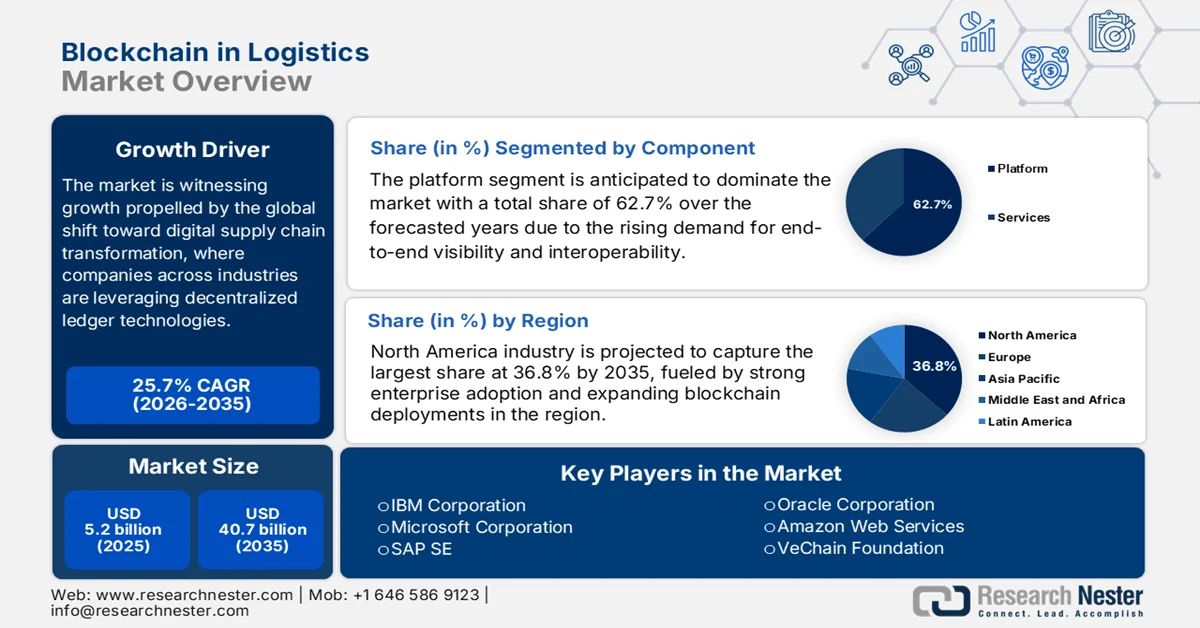
The blockchain in logistics market is witnessing immense growth owing to the global shift toward digital supply chain transformation, where companies across major industries are adopting decentralized ledger technologies to enhance transparency, traceability, and operational coordination across multi-party logistics networks. As stated by the International Trade Council in February 2026, the logistics industry is highly adopting blockchain, wherein FedEx joined the Hedera Council to enable real-time tracking and automate customs documentation, modernizing the USD 10 trillion worth of global supply chain. It also states that the initiatives, such as integrating verifiable legal entity identifiers into AEOTrade’s platform, are strengthening trust and security across supply chains. In addition, supportive frameworks, such as the EU-Singapore Digital Trade Agreement, are facilitating cross-border blockchain adoption in logistics as well as trade operations.
Furthermore, government-led blockchain initiatives across different nations are creating lucrative growth opportunities for innovation, efficiency in digital governance, and the supply chain. In this context, Press Information Bureau (PIB) in October 2025 reported that the National Blockchain Framework (NBF), which was launched in September 2024 by MeitY with a total budget of USD 8.8 million, provides a unified platform for deploying blockchain solutions across sectors of governance, supply chains, and public services. Besides the core components, such as Vishvasya Blockchain Stack, NBFLite, Praamaanik, and the National Blockchain Portal, have enabled highly secure, permissioned blockchain deployments. It also underscored the use cases, which include document verification, logistics tracking, judiciary processes, and property records, hence denoting a positive outlook for blockchain in logistics market.
Government-Backed Blockchain Initiatives in India: Verified Data on Supply Chain and Governance Applications (2024-2025)
|
Component |
Key Data |
|
Total budget |
USD 8.8 million |
|
Documents verified (overall) |
340 million |
|
Document Chain |
48,000 documents |
|
Judiciary Chain |
665 documents |
|
ICJS Documents |
39,000 documents |
|
Logistics Chain (e.g., Aushada system) |
Traceable movement of medicines across the supply chain |
|
Data Centres |
Bhubaneswar, Pune, Hyderabad |
Source: PIB
Key Blockchain in Logistics Market Insights Summary:
Regional Highlights:
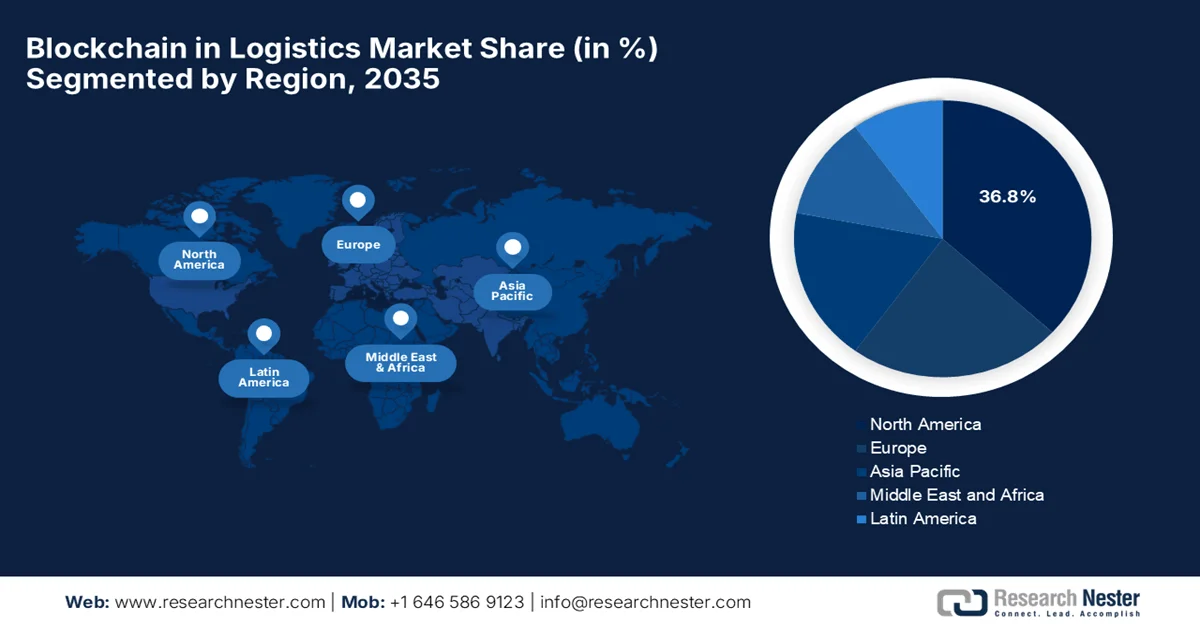
- North America is projected to command a 36.8% share of the blockchain in logistics market by 2035, stimulated by strong enterprise adoption and increasing deployment of blockchain solutions to enhance cross-border trade efficiency and supply chain transparency.
- Asia Pacific is anticipated to witness the fastest expansion during 2026–2035, fueled by accelerating digital transformation initiatives and government-backed programs simplifying cross-border trade complexity.
Segment Insights:
- The platform sub-segment is expected to account for a 62.7% share by 2035 in the blockchain in logistics market, underpinned by rising demand for end-to-end supply chain visibility, interoperability, and smart contract automation.
- Tracking and tracing, under the application segment, is projected to secure a considerable share by 2035, attributed to increasing demand for real-time shipment visibility and authenticity verification across global supply chains.
Key Growth Trends:
- Operational efficiency & cost reduction
- Collaboration across supply chain partners
Major Challenges:
- Lack of standardization
- High implementation costs
Key Players: IBM Corporation (U.S.), Microsoft Corporation (U.S.), SAP SE (Germany), Oracle Corporation (U.S.), Amazon Web Services (AWS) (U.S.), VeChain Foundation (Singapore), OriginTrail d.o.o. (Europe), CargoX (Slovenia), ShipChain, Inc. (U.S.), Blockverify (U.S.), Ambrosus Technologies GmbH (Europe), Modum.io AG (Europe), Everledger Limited (Europe), Chronicled, Inc. (U.S.), Morpheus.Network (Taiwan), Samsung SDS (South Korea)
Global Blockchain in Logistics Market Forecast and Regional Outlook:
Market Size & Growth Projections:
- 2025 Market Size: USD 5.2 billion
- 2026 Market Size: USD 6.5 billion
- Projected Market Size: USD 40.7 billion by 2035
- Growth Forecasts: 25.7% CAGR (2026-2035)
Key Regional Dynamics:
- Largest Region: North America (36.8% Share by 2035)
- Fastest Growing Region: Asia Pacific
- Dominating Countries: United States, China, Germany, Japan, United Kingdom
- Emerging Countries: India, Brazil, Vietnam, Indonesia, Mexico
Last updated on : 9 March, 2026
Blockchain in Logistics Market - Growth Drivers and Challenges
Growth Drivers
- Operational efficiency & cost reduction: Smart contracts have the capacity to automate logistics processes such as freight contracts, payments, and customs documentation by cutting down the paperwork and human errors. Also, automation results in faster clearance times, fewer disputes, and reduced administrative overhead, thereby lowering overall logistics costs. As stated by the United Nations Economic Commission for Europe (UNECE) in December 2024, blockchain increases efficiency and mitigates risks by providing a secure, real-time record of transactions, which are accessible only to involved parties, by eliminating single points of failure and reducing fraud or data manipulation. It enables end-to-end transaction management by consolidating inputs from all stakeholders, building auditable trails, regulating access, and automating workflows such as financing and alerts on important events. Hence, with such evidence-based benefits, organizations can achieve more transparent supply chain processes, denoting a huge opportunity for blockchain in logistics market.
- Collaboration across supply chain partners: Blockchain fosters data sharing among suppliers, carriers, distributors, and regulatory bodies using a common ledger. This improves coordination, especially in complex, multi-tier global supply chains, prompting a profitable business environment for pioneers in the blockchain in logistics market. In November 2025, Banco Inter and Chainlink reported that, in collaboration with the Central Bank of Brazil and the Hong Kong Monetary Authority, they had completed the first blockchain-based cross-border, cross-chain trade finance experiment, thereby allowing small and medium-sized businesses to sell commodities internationally. The platform used smart contracts and tokenized payments to automate delivery-versus-payment and payment-versus-payment processes, securely transferring electronic bills of lading.
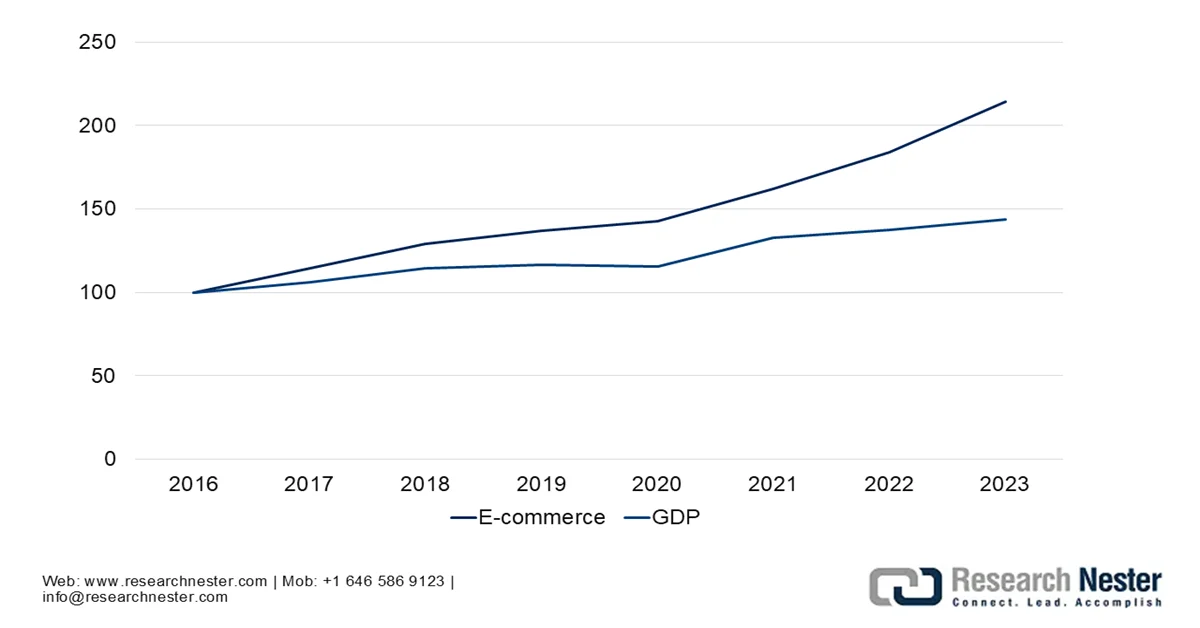
- Rise of e-commerce & global trade complexity: The growth of the e-commerce industry and the rising cross-border logistics have imposed increased pressure on traditional logistics systems. In this context, blockchain helps to manage this pressure by providing shared data for global partners, thereby improving service levels and customer experience. In this regard, the United Nations Conference on Trade and Development (UNCTAD) in December 2025, reported that it has launched the first global e-commerce database, which is consolidating national estimates to provide an understanding into growth of online trade and its impact on the global economy. It also stated that experimental figures indicate that e-commerce sales are expanding significantly faster when compared to GDP, which reflects increasing complexity in cross-border logistics and the need for proper management systems benefiting the overall blockchain in logistics market.
Growth of Business E-Commerce Sales vs. Global GDP (2016-2023)
Source: UNCTAD
Challenges
- Lack of standardization: The absence of globally accepted standards for blockchain implementation in logistics creates interoperability challenges, causing hindrance to the market expansion. Multiple blockchain frameworks operate on different protocols, consensus mechanisms, and governance models. In this context, the absence of standardized data formats and communication protocols makes information sharing across supply chain partners difficult. Logistics networks mostly involve numerous stakeholders, wherein if each participant adopts a different blockchain infrastructure, cross-platform integration becomes costly and inefficient. The presence of this fragmentation limits the scalability of decentralized ecosystems and discourages smaller players from investing in the blockchain in logistics market.
- High implementation costs: This is yet another barrier for the blockchain in logistics market since it requires substantial investment in terms of infrastructure, cybersecurity upgrades, and workforce training. Other than software development, companies need to make investments in terms of cloud resources, node management, and compliance mechanisms. Besides the aspect of smart contract development and auditing adds on to burgeoning expenses to ensure reliability and security. In the case of small and medium-sized enterprises, these financial requirements can be prohibitive, especially when return on investment is uncertain in the early stages. Furthermore, ongoing maintenance costs, which include system updates and technical support, increase the total cost of ownership, making adoption challenging for players from price-sensitive regions.
Blockchain in Logistics Market Size and Forecast:
| Report Attribute | Details |
|---|---|
|
Base Year |
2025 |
|
Forecast Year |
2026-2035 |
|
CAGR |
25.7% |
|
Base Year Market Size (2025) |
USD 5.2 billion |
|
Forecast Year Market Size (2035) |
USD 40.7 billion |
|
Regional Scope |
|
Blockchain in Logistics Market Segmentation:
Component Segment Analysis
The platform sub-segment is anticipated to dominate the entire global dynamics of the blockchain in logistics market with a total share of 62.7% over the forecasted years. The rising demand for end-to-end visibility, interoperability, and smart contract automation is the main factor behind this dominance. In December 2024, the U.S. Department of Transportation (DOT) reported that its freight logistics optimization works program now covers 75% of all U.S. Ocean container imports by improving the overall efficiency and lowering costs for consumers in the country. It also stated that through data-sharing among carriers, ports, importers, and logistics providers, DOT has enhanced supply chain visibility, reduced congestion, and accelerated the movement of goods. The department also outlined a few of the future priorities, which include onshoring critical manufacturing, expanding domestic EV and shipbuilding production, and improving data transparency for a secure and adaptable supply chain.
Application Segment Analysis
In the blockchain in logistics market, tracking and tracing, which is a part of the application segment, is expected to grow with a considerable share by 2035. The growth of the subtype is highly subject to the increasing demand for real-time shipment visibility and authenticity verification across various supply chains. This feature is especially important for the transport of high-value and sensitive goods, as it helps to reduce risks of counterfeiting and theft. Besides, heightened regulatory requirements for traceability in sectors such as food, pharmaceuticals, and luxury products are also efficiently driving adoption. In addition, integrating blockchain with IoT sensors allows automatic updates on location, temperature, and other pivotal parameters, boosting operational efficiency. Furthermore, as supply chains grow more complex and transparency becomes highly critical, thereby positioning tracking and tracing segment at the forefront of revenue contribution in this field.
Deployment Mode Segment Analysis
The cloud-based sub-segment is predicted to garner a significant revenue share in the blockchain in logistics market during the stipulated timeframe. The scalability and reduced infrastructure costs are the main factors boosting the sub-segment’s growth and exposure within this market. In this context, the article from the Cloud Security Alliance, which was published in March 2023, states that blockchain enhances cloud security by providing immutable audit trails, ensuring data integrity through cryptographic verification, and enabling decentralized identity and access management. It also notes that smart contracts can efficiently automate security policies, whereas transparent records of software supply chains help prevent malicious code and maintain trust. Overall, blockchain solidifies cloud environments by increasing transparency, accountability, and protection against any type of unauthorized access, making it a highly essential tool for secure cloud operations, hence denoting a wider segment scope.
Our in-depth analysis of the blockchain in logistics market includes the following segments:
|
Segment |
Subsegments |
|
Component |
|
|
Application |
|
|
Deployment Mode |
|
|
Organization Size |
|
|
End use Industry |
|

Vishnu Nair
Head - Global Business DevelopmentCustomize this report to your requirements — connect with our consultant for personalized insights and options.
Blockchain in Logistics Market - Regional Analysis
North America Market Insights
With strong enterprise adoption and increased deployments, the North America blockchain in logistics market is expected to secure the largest share of 36.8% by the end of 2035. The region has become a hub of innovation in terms of blockchain logistics, where major logistics firms and technology companies are proactively testing and implementing solutions to make cross-border trade smoother and supply chains more connected. In this context, Walmart Inc. reported that it has implemented enhanced food traceability requirements, which are aligned with FSMA Section 204 by mandating all suppliers to provide the essential data elements through advance shipment notifications and label pallets and cases with GS1-compliant barcodes. It also mentioned that these measures were effective for food traceability list products by August 1, 2025, thereby enabling end-to-end supply chain visibility, faster recall response, and improved food safety, hence denoting a positive blockchain in logistics market outlook.
The blockchain in logistics market in the U.S. is growing based on factors such as the need to streamline complex customs procedures and improve multimodal transport coordination. Government agencies and industry alliances in the country are looking for frameworks that enable secure, shared shipment records, whereas the private sector pilots focus on real-time cargo visibility and reduced administrative friction through interoperable distributed ledgers. In August 2024, U.S. Customs and Border Protection (CBP) announced a major trade modernization initiative, which is focused mainly on global interoperability standards testing. It is partnering with organizations such as Global Standards 1, Global Legal Entity Identifier Foundation (GLEIF), Food and Drug Administration (FDA), and it has begun testing new data exchange and credential verification systems to improve transparency in sectors such as e-commerce, food safety, and natural gas. These standards, developed through the World Wide Web Consortium (W3C), enable near real-time, secure data sharing between federal agencies and trade entities worldwide.
The need for enhanced supply chain transparency, efficiency, and security is fueling the growth of blockchain in logistics market in Canada. The country’s logistics sector is experiencing incremental adoption of blockchain for traceability of agricultural, livestock, and pharmaceutical exports, which is also supported by industry innovation hubs and partnerships between logistics firms and tech developers. In May 2025, the Canadian Sheep Federation announced that it had been approved by the Canadian Food Inspection Agency (CFIA) to serve as the responsible administrator for national sheep traceability under Part XV of the Health of Animals Regulations. CSF will implement AgroLedger, which is a digital platform providing secure, real-time data to improve disease response, supply chain coordination, and on-farm practices. From a strategic perspective, such instances will boost the market growth by validating blockchain traceability and encouraging broader adoption across the country’s supply chains.
APAC Market Insights
The digital transformation initiatives and government-backed programs that ease cross-border trade complexity are propelling the growth of blockchain in logistics market in the Asia Pacific. Countries in this region are experimenting with interoperable blockchain platforms that connect e-commerce, customs, and freight documentation processes, reflecting consistent regional efforts to harmonize logistics operations at scale. In January 2025, Sustainable Shared Transport Inc., which is a subsidiary of Yamato Holdings and Fujitsu Limited, announced that it had launched an open joint transportation and delivery platform in Japan to optimize logistics efficiency across industries. The platform is compliant with the government-backed SIP Smart Logistics Service guidelines, uses blockchain technology to ensure secure data sharing, tamper detection, and interoperability between shippers and logistics provider hence making it suitable for standard blockchain in logistics market growth.
China blockchain in logistics market is growing exponentially on account of national efforts to build an infrastructure that supports logistics digitalization, especially through platforms that integrate shipment visibility with e-commerce and manufacturing supply networks. This movement also aligns with the country’s strategy to promote secure digital trade corridors and simplify data workflows across complex freight routes. In October 2023, the Beijing Two-Zone Office and Singapore’s Infocomm Media Development Authority completed the first cross-border paperless trade between China and Singapore by using blockchain-enabled TradeTrust and AEOTradeChain. Besides, this pilot efficiently digitized all trade documents, which also includes an electronic Bill of Lading, enabling secure, decentralized processing and reducing document-handling time by more than 80% and costs by over 30%, hence suitable for bolstering blockchain in logistics market growth in the country.
The government initiatives, such as the national blockchain framework and integration of smart contracts is automating complex workflows are certain factors that are responsible for uplifting blockchain in logistics market in India. The sector is making a transition into a mature ecosystem where decentralized ledgers serve as the foundational architecture for end-to-end supply chain visibility. In February 2025, Sequel Logistics reported that it had inaugurated the country’s largest bullion FTWZ vault at Madras Export Processing Zone, Chennai, marking its third FTWZ facility after GIFT IFSC, Gandhinagar. It is strategically located near Chennai International Airport and Chennai Sea Port. The 37,000 sq. ft. vault ensures secure, rapid connectivity for both air and sea consignments, strengthening bullion logistics. Hence, from a strategic perspective, such instances are expected to drive the adoption of blockchain-enabled solutions for secure and efficient high-value logistics operations.
Europe Market Insights
Europe blockchain in logistics market is primarily shaped by cross-border regulatory collaboration and digital trade modernization efforts that are focused on harmonized data standards and interoperable systems. Regional initiatives are fostering a favourable environment where logistics stakeholders can securely share verified shipment information, thereby encouraging more players to establish their footprint in this field. In May 2025, the Digital Container Shipping Association (DCSA) reported that it had completed the first standards-based, interoperable electronic Bill of Lading transaction, which marks a major step toward secure, scalable, and paperless global trade. Besides, this particular achievement enables multiple eBL platforms to communicate, allowing stakeholders to share title data and trade documentation in real time across different providers, hence contributing to wider blockchain in logistics market expansion.
The strong focus on the automotive and pharmaceutical sectors, where the technology ensures compliance with regulatory frameworks and streamlines documentation, is the factor responsible for uplifting blockchain in logistics market in Germany. The country is prioritizing blockchain solutions that bolster compliance and supply chain governance for manufacturing exports. Fraunhofer Institute for Material Flow and Logistics IML reported that ForestGuard is an open-source platform that was in process from November 2023 to May 2025, with a total funding of USD 1,125,000, and is designed for transparent and tamper-proof tracking of deforestation-free supply chains, using coffee as a pilot example. It integrates geodata, ownership proofs, and supply chain information from smallholder producers, supporting supply chain logistics and compliance with the EU Deforestation Regulation (EUDR). Further, it leverages blockchain and other technologies, and enables multi-stage, cross-border traceability, risk assessment, and due diligence reporting throughout the supply chain.
The UK blockchain in logistics market is undergoing a major transformation driven by initiatives to digitize trade documentation and automate freight and customs workflows. This focus also aligns with broader digital transformation strategies to simplify logistics coordination and increase adaptability to the continuously fluctuating trade conditions. The country’s government reported that the Electronic Trade Documents Act 2023, which received Royal Assent in July 2023, allocates electronic trade documents the same legal status as paper ones, allowing shipping containers and other trade goods for digital transactions. Besides, it also notes that this law is expected to generate a net benefit of more than USD 1.25 billion for the country’s economy in the next decade by reducing costs, paper waste, and inefficiencies in global trade. It modernises trade workflows and accelerates transfer times from days to minutes, supporting businesses of all sizes in cross-border logistics, hence denoting a positive blockchain in logistics market outlook.
Key Blockchain in Logistics Market Players:
- IBM Corporation (U.S.)
- Microsoft Corporation (U.S.)
- SAP SE (Germany)
- Oracle Corporation (U.S.)
- Amazon Web Services (AWS) (U.S.)
- VeChain Foundation (Singapore)
- OriginTrail doo (Europe)
- CargoX (Slovenia)
- ShipChain, Inc. (U.S.)
- Blockverify (U.S.)
- Ambrosus Technologies GmbH (Europe)
- Modum.io AG (Europe)
- Everledger Limited (Europe)
- Chronicled, Inc. (U.S.)
- Morpheus.Network (Taiwan)
- Samsung SDS (South Korea)
- TVS Supply Chain Solutions (India)
- OpenSC Pty Ltd (Australia)
- VerifyMe, Inc. (U.S.)
- Open World Ltd. (U.S.)
- DataVault AI (U.S.)
- Wellgistics Health (U.S.)
- Company Overview
- Business Strategy
- Key Product Offerings
- Financial Performance
- Key Performance Indicators
- Risk Analysis
- Recent Development
- Regional Presence
- SWOT Analysis
- IBM Corporation is considered to be a pioneer in enterprise blockchain solutions, particularly in logistics and supply chain management. IBM is mainly focused on collaborations with retailers, shipping companies, and regulators, with a main aim to digitize trade documents, reduce fraud, and streamline customs procedures.
- Microsoft Corporation leverages its Azure blockchain service to provide scalable blockchain infrastructure for supply chain and logistics operations. The company combines AI, cloud computing, and blockchain, and supports clients in improving operational efficiency and reducing manual paperwork in logistics networks.
- SAP SE is yet another prominent player in this field that delivers blockchain-enabled supply chain management by allowing real-time collaboration among manufacturers, carriers, and suppliers. Besides, the firm integrates blockchain with ERP systems, IoT sensors, and cloud analytics, helping companies manage smart contracts.
- Oracle Corporation provides a suite of blockchain solutions for logistics, trade, and asset management, allowing a secure, decentralized tracking of shipments and documents. The company is mainly focused on enterprise adoption for financial reconciliation, supply chain finance, and anti-counterfeit verification.
- Amazon Web Services enables blockchain adoption for logistics and supply chain management by supporting frameworks such as Hyperledger Fabric and Ethereum. In addition, strategic partnerships with freight operators and tech startups solidify the company’s position as a cloud-based enabler of automation in global supply chains.
Below is the list of some prominent players operating in the global market:
The blockchain in logistics market hosts multinational players such as IBM, Microsoft, SAP, Oracle, AWS, along with specialized blockchain innovators, i.e., VeChain, OriginTrail, CargoX, ShipChain, and Ambrosus, that are mainly focused on traceability, documentation, and smart contracts. Strategic initiatives adopted by the leading pioneers in this field are integrations with IoT, cloud platforms, and cross-partner interoperability efforts to reduce paperwork and scale decentralized logistics networks across borders. Meanwhile, the Europe-specific players are focused on product provenance and compliance, whereas Asia Pacific firms apply blockchain for cold chain, efficiency, and regulatory use cases. For instance, in January 2025, DHL Group announced the inauguration of its expanded Europe Innovation Center in Troisdorf, Germany, to develop and implement technologies such as AI, robotics, and IoT across global logistics operations, hence positively impacting the market’s growth and exposure.
Corporate Landscape of the Blockchain in Logistics Market:
Recent Developments
- In January 2026, VerifyMe, Inc. and Open World Ltd. entered into a strategic merger to create a publicly traded company focused on precision logistics, brand protection, and real-world asset tokenization. The combined entity aims to deliver enterprise-grade blockchain solutions that integrate on-chain security, AI-based frameworks, and verified logistics data.
- In October, 2025, DataVault AI and Wellgistics Health announced that they formed a strategic alliance to implement PharmacyChain, which is a blockchain-enabled smart contract platform, across Wellgistics’ prescription drug distribution network to digitize tracking from manufacturer to patient.
- Report ID: 8428
- Published Date: Mar 09, 2026
- Report Format: PDF, PPT
- Explore a preview of key market trends and insights
- Review sample data tables and segment breakdowns
- Experience the quality of our visual data representations
- Evaluate our report structure and research methodology
- Get a glimpse of competitive landscape analysis
- Understand how regional forecasts are presented
- Assess the depth of company profiling and benchmarking
- Preview how actionable insights can support your strategy
Explore real data and analysis
Frequently Asked Questions (FAQ)
About this Report
Connect with our Expert


Report, 2026-2035



Copyright @ 2026 Research Nester. All Rights Reserved.
