Marketing Automation Market Outlook:
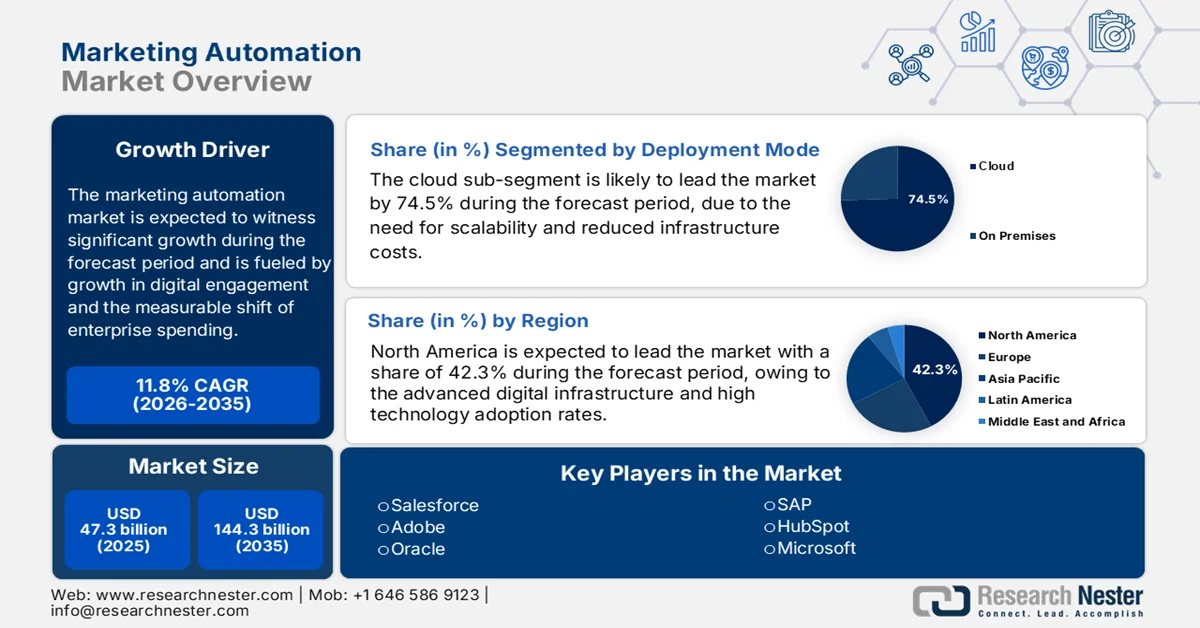
Marketing Automation Market size was valued at USD 47.3 billion in 2025 and is projected to reach USD 144.3 billion by the end of 2035, rising at a CAGR of 11.8% during the forecast period, i.e., 2026-2035. In 2026, the industry size of marketing automation is assessed at USD 52.8 billion.
The marketing automation market is shaped by the sustained growth in digital engagement and the measurable shift of enterprise spending toward data-driven outreach channels. According to the U.S. Census Bureau, March 2026 data, the e-commerce sales reached USD 365.2 billion in Q4 2025, accounting for 16.1% of the total sales in 2024, reflecting a continued transition toward digital customer acquisition and engagement channels that rely on automated campaign execution and tracking systems. Similarly, the employment in advertising promotions and marketing management roles is projected to rise by 6% as per the U.S. BLS August 2025 data, indicating a sustained organizational investment in structured marketing operations supported by the automation platforms. Government-backed digital transformation programs further reinforce this trajectory. This shift increases demand for integrated systems that manage campaign workflows, lead tracking, and customer segmentation across channels.
Besides, the growing emphasis on data governance and consumer privacy is influencing the marketing automation platform’s deployment and scalability. According to the United States Employment Trade Commission, February 2022 data, the enforcement of the General Data Protection Regulation has resulted in cumulative fines exceeding USD 1.19 billion as of recent reporting periods, pushing the enterprises to adopt compliant systems capable of managing consent data access and audit trails within marketing processes. Similarly, the Federal Trade Commission continues to enforce the regulations on digital communication, including the email and messaging practices, under frameworks such as the CAN-SPAM Act, requiring businesses to integrate compliance mechanisms into automated outreach. These factors collectively support the steady adoption of marketing automation systems as organizations align outreach efficiency with regulatory requirements and expand digital user bases.
Key Marketing Automation Market Insights Summary:
Regional Highlights:
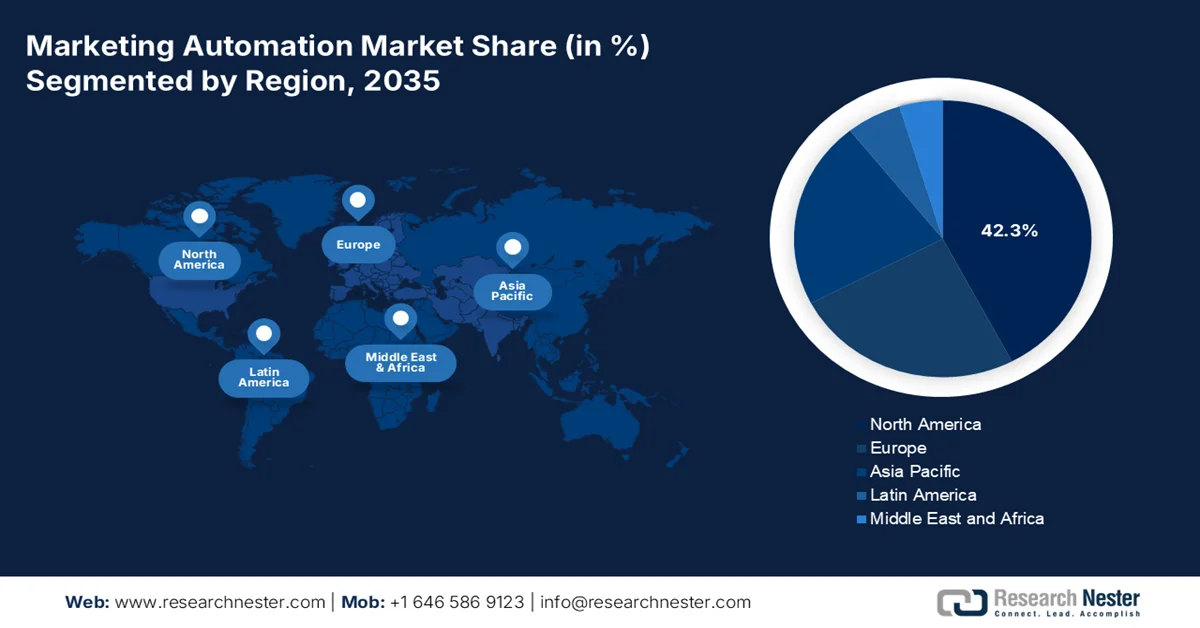
- North America marketing automation market is anticipated to command a 42.3% revenue share by 2035, attributed to advanced digital infrastructure and high technology adoption rates.
- Asia Pacific is projected to witness the fastest growth at a CAGR of 15.9% during 2026–2035, fueled by rapid digital transformation and increasing adoption of AI-powered solutions.
Segment Insights:
- Cloud segment in the marketing automation market is expected to capture a 74.5% share by 2035, propelled by the need for scalability, reduced infrastructure costs, and seamless integration with AI capabilities.
- Software sub-segment is projected to lead within the component category over the forecast period 2026–2035, driven by rising demand for SaaS-based automation platforms and interoperability across enterprise systems.
Key Growth Trends:
- Expansion of government-funded digital transformation programs
- Growth in government-supported SME digitalization
Major Challenges:
- Sales and marketing misalignment
- Data privacy, security, and compliance complexity
Key Players: Salesforce, Adobe, Oracle, SAP, HubSpot, Microsoft, Zoho, ActiveCampaign, Mailchimp, Klaviyo, Acoustic, Teradata, Salesforce-owned, Sitecore, HCL Software, Accenture, Lumery, Mod Op, Phonexa, Xplor.
Global Marketing Automation Market Forecast and Regional Outlook:
Market Size & Growth Projections:
- 2025 Market Size: USD 47.3 billion
- 2026 Market Size: USD 52.8 billion
- Projected Market Size: USD 144.3 billion by 2035
- Growth Forecasts: 11.8% CAGR (2026-2035)
Key Regional Dynamics:
- Largest Region: North America (42.3% Share by 2035)
- Fastest Growing Region: Asia Pacific
- Dominating Countries: United States, China, United Kingdom, Germany, Japan
- Emerging Countries: India, Brazil, South Korea, Singapore, United Arab Emirates
Last updated on : 1 April, 2026
Marketing Automation Market - Growth Drivers and Challenges
Growth Drivers
- Expansion of government-funded digital transformation programs: Public sector investment in digital infrastructure is a primary driver shaping the demand for marketing automation platforms, mainly as enterprises align with the digitally enabled ecosystems. According to the Connecting Women in Digital 2026 data, nearly 75% of businesses adopt advanced digital technologies, including cloud and data analytics, supported by the multi-billion funding instruments such as the Digital Europe Programme. These initiatives directly surge the enterprise adoption of automated outreach, customer lifecycle tracking, and campaign analytics tools. As more government services become digitized, B2B firms are compelled to adopt structured automated engagement models to remain competitive in procurement and service delivery ecosystems. This creates sustained demand for platforms that integrate communication workflows, compliance tracking, and analytics within government-aligned digital environments.
Average Adoption Rates of Digital Technologies Across EU Member States (2023)
|
Technology |
Adoption Rate (%) |
|
Cloud Services |
45.2% |
|
Big Data Analytics |
29.2% |
|
Artificial Intelligence |
8.1% |
Source: Connecting Women in Digital 2026
- Growth in government-supported SME digitalization: Small and medium-sized enterprises are a major adoption segment driven by the targeted government funding and policy frameworks. As per the Eurostat August 2024 data, nearly 90% of the SMEs are expected to reach at least basic digital intensity by 2030, supported by the Digital Innovation Hubs and funding mechanisms. Moreover, the Small Business Administration in the U.S. provides grants and advisory programs promoting digital adoption, including online marketing and customer engagement tools. These initiatives reduce the barrier to entry for SMEs, enabling them to deploy marketing automation platforms for lead management, customer retention, and campaign optimization. Further, the government-backed expansion of SMEs is a key demand driver in the marketing automation market, particularly in emerging markets where public funding bridges capability gaps and accelerates adoption of structured marketing technologies.
- Public sector adoption of digital communication systems: Governments themselves are adopting automated communication systems to improve citizen engagement, indirectly driving the marketing automation market demand and setting adoption benchmarks. The U.S. General Services Administration promotes the use of digital communication tools for federal agencies to streamline outreach and service delivery. Similarly, the UK government digital service highlights automated messaging and user-centric digital communication across public services. These implementations demonstrate the operational efficiency of the automation in managing large-scale communication workflows. As enterprises interact with government systems, they increasingly adopt similar technologies to maintain compatibility and efficiency.
Challenges
- Sales and marketing misalignment: A fundamental disconnect between sales and marketing teams creates significant implementation obstacles in the marketing automation market. When marketing automation platforms fail to bridge departmental silos, leads are lost, response times lag, and the customer journey becomes disjointed. The issue is compounded when sales teams refuse to adopt systems they perceive as complex or irrelevant to their workflows. Moreover, sales and marketing with poor alignment directly correlate with reduced campaign effectiveness and lower conversion rates.
- Data privacy, security, and compliance complexity: Entering the marketing automation market requires navigating increasingly complex global data privacy regulations, including GDPR, CCPA, and emerging cross-border frameworks. Manufacturers must embed robust governance controls, encryption standards ad consent management processes into their platforms while ensuring data residency compliance across multiple jurisdictions. Moreover, the data privacy reflects the heightened regulatory scrutiny facing market entrants.
Marketing Automation Market Size and Forecast:
| Report Attribute | Details |
|---|---|
|
Base Year |
2025 |
|
Forecast Year |
2026-2035 |
|
CAGR |
11.8% |
|
Base Year Market Size (2025) |
USD 47.3 billion |
|
Forecast Year Market Size (2035) |
USD 144.3 billion |
|
Regional Scope |
|
Marketing Automation Market Segmentation:
Deployment Mode Segment Analysis
Within the deployment mode, the cloud is dominating in the marketing automation market and is poised to hold the share value of 74.5% by the end of 2035. The segment is driven by the need for scalability, reduced infrastructure costs, and seamless integration with AI capabilities. Cloud-based platforms enable marketing teams to access real-time customer data from any location, facilitating agile campaign arrangement and remote collaboration. According to the NCSES August 2022 data, nearly 19.5% of the firms are using cloud computing services, reflecting a sustained migration away from on-premises infrastructure. This shift has been stimulated by the expansion of hybrid work models and the demand for automated updates that ensure compliance with evolving data privacy regulations. Further cloud deployment allows organizations to use advanced features without significant capital expenditure, making it a preferred choice for both large enterprises and SMEs.
Component Segment Analysis
Under the component segment, the software sub-segment represents the largest in the marketing automation market as it encompasses the core automation platforms that businesses utilize for campaign management, lead scoring, and customer journey orchestration. The recurring subscription model of SaaS provides vendors with predictable revenue streams while offering clients continuous access to innovation, including generative AI and advanced analytics features. According to the U.S. Census Bureau, September 2025 data, nearly 51.8% of businesses adopt cloud technology, and 49.8% adopt specialized software for their business, underscoring the role of SaaS in digital transformation initiatives. The growth is further fueled by the increasing need for interoperability between marketing automation platforms and adjacent systems such as CRM, e-commerce, and customer service tools.
Enterprise Size Segment Analysis
Large enterprises account for the highest share value in the marketing automation market, owing to their complex operational structures, extensive customer bases, and greater budgetary capacity for comprehensive automation suites. These organizations typically require enterprise-grade platforms that offer advanced security, regulatory compliance, and the ability to manage millions of customer profiles across the global markets. Large enterprises also lead in the adoption of integrated marketing clouds that unify automation with analytics, customer data platforms, and sales enablement tools, enabling them to orchestrate sophisticated omnichannel experiences that drive customer loyalty and revenue growth at scale.
Our in-depth analysis of the marketing automation market includes the following segments:
|
Segment |
Subsegments |
|
Component |
|
|
Deployment Mode |
|
|
Enterprise Size |
|
|
End user |
|
|
Application |
|
|
Marketing Channel |
|
|
Business Function |
|

Vishnu Nair
Head - Global Business DevelopmentCustomize this report to your requirements — connect with our consultant for personalized insights and options.
Marketing Automation Market - Regional Analysis
North America Market Insights
North America dominates the global marketing automation market and is poised to hold the regional revenue share of 42.3% by the end of 2035. The region is driven by the advanced digital infrastructure and high technology adoption rates. The U.S. leads the region with the market shift towards digital omnichannel strategies; moreover, the digital marketing spending is projected to grow. The e-commerce sector is a vital driver with retail sales continuing to shift online. A key trend is the rapid integration of AI to enhance personalization and predictive analytics. Further, the overall AI adoption in the information sector and in professional services, with marketing automation being a primary application. Further, the small businesses are rapidly closing the AI adoption gap, often for automated marketing.
The expanding internet usage, mobile penetration, and federal investment in digital infrastructure are shaping the marketing automation market in the U.S. According to Ofcom's April 2024 data, nearly 84% of U.S. adults engaged in online activities such as communication, shopping, and information access, reinforcing the need for automated systems to manage high-volume digital interactions. The NTIA November 2024 reports that broadband adoption continues to rise, supported by federal programs such as the Infrastructure Investment and Jobs Act, which allocates USD 65 billion to expand high-speed internet access nationwide. This expansion increases the reachable digital audience for enterprises, directly influencing the demand for automated engagement tools. Further, the White House's May 2025 data highlights that there are over 33 million small businesses in the country, many of which are adopting digital tools to improve customer acquisition and retention. As these data show, there is a strong foundation for marketing automation adoption across the U.S.
The strong digital adoption, government-backed connectivity expansion, and widespread SME participation are driving the marketing automation in Canada. According to the Government of Canada, September 2025 data, the retail e-commerce sales increased by 2.2% of total retail trade in recent years, reflecting steady growth in digital transactions and increasing reliance on online customer engagement channels. The Government of Canada's August 2025 data has committed over USD 3.2 billion via the Universal Broadband Fund to expand high-speed internet access, which is increasing the reachable digital population for businesses. Moreover, the Government of Canada's January 2024 data reports that small and medium-sized enterprises represent over 99% of all businesses in the country, many of which are adopting digital tools to enhance marketing efficiency and customer outreach. These factors drive the adoption of marketing automation platforms in Canada as organizations scale digital engagement.
APAC Market Insights
The Asia Pacific is projected to emerge as the fastest-growing region in the marketing automation market and is poised to expand at a CAGR of 15.9% during the assessed period, 2026 to 2035. The market is driven by the rapid digital transformation and increasing adoption of AI-powered solutions. Moreover, the region is witnessing a notable shift toward cloud-based solutions, which offer scalability and accessibility for businesses of all sizes. China holds the largest share in the region, supported by the advanced digital ecosystem and widespread AI integration. India has emerged as an emerging market fueled by the government initiatives promoting the digital infrastructure and AI adoption. The key trends include the integration of advanced analytics, enabling data-driven decision-making, with companies utilizing analytics-driven marketing automation.
The rapid digital expansion, government-led infrastructure development, and increasing participation of small businesses in digital ecosystems are fueling the marketing automation market in India. The nation’s Digital India programme continues to scale digital public infrastructure supporting widespread adoption of online services and business digitization. The IBEF January 2025 data reports that India had over 900 million internet subscribers, with continued growth in broadband and mobile data usage expanding the digital customer base for enterprises. The IFC June 2024 data highlights that India has over 63 million MSMEs, many of which are increasingly adopting digital tools for customer acquisition and engagement. These developments are driving demand for marketing automation platforms as businesses seek to manage large-scale digital interactions.
MSME Economic Contribution and Financing Landscape (2024)
|
Metric |
India |
|
Number of MSMEs/SMEs |
63 million |
|
Contribution to GDP |
~30% |
|
Share of Exports |
Over 40% |
|
Employment Generated |
110 million jobs |
|
Women-led Enterprises |
15 million MSMEs |
|
Financing Gap |
USD 333 billion |
Source: IFC June 2024
The large-scale digital adoption, strong e-commerce penetration, and government-backed digital economy initiatives are driving the marketing automation market in China. According to the People’s Republic of China, January 2025 data, China had over 1.1 billion internet users as of 2024, with an internet penetration rate exceeding 78.6%, providing a vast digital consumer base for automated engagement. The online retail sales reached USD 2.15 trillion in 2024, encouraging the adoption of advanced digital tools for customer management and analytics. Further ongoing efforts to accelerate enterprise digital transformation, particularly among small and medium-sized enterprises. These factors collectively drive demand for marketing automation platforms in China as businesses scale high-volume digital interactions and align with government-supported digital infrastructure and innovation policies.
China Digital Economy and Online Market Indicators (2024)
|
Metric |
Value |
|
Total Internet Users |
1.1 billion |
|
Internet Penetration Rate |
78.6% |
|
Online Payment Users |
Over 1 billion |
|
Online Shopping Users |
974 million |
|
Increase in Online Shoppers (YoY) |
59.5 million |
|
Total Online Retail Sales |
USD 2.15 trillion |
|
Growth in Online Retail Sales |
7.2% YoY |
|
Online Retail (Physical Goods) |
USD 1.83 trillion |
|
Rural Internet Users Shopping Online |
Over 76% |
|
Elderly (60+) Online Shopping Penetration |
70% |
Source: People’s Republic of China, January 2025
Europe Market Insights
The marketing automation market in Europe is defined by advanced digital maturity, robust regulatory frameworks, and a strong emphasis on data privacy and compliance. The market is driven by the integration of AI and machine learning for predictive lead scoring and dynamic content personalization. A key trend is the design of platforms with the privacy by design principles to comply with the General Data Protection Regulation and the upcoming EU AI Act, making consent management and data security core competitive differentiators. Organizations are also focusing on unified multi-channel orchestration to ensure consistent localized customer experiences across the continent’s diverse linguistic and cultural landscape. The competitive landscape features global suite providers competing with agile local specialists on trust, compliance, and ease of use, with increasing adoption among SMEs seeking scalable solutions.
The strong enterprise digitalization, industrial digitization policies, and high adoption of data-driven business practices are driving the marketing automation market in Germany. According to the ITA August 2025 data, USD 1.7 billion is allocated to strengthen the nation’s position in digital and industrial technologies, including customer relationship management and online communication tools, indicating a mature foundation for automated marketing systems. Moreover, the German Federal Ministry for Economic Affairs and Climate Action continues to support digital transformation via initiatives such as the Digital Now funding program, which provides financial assistance to SMEs for adopting digital technologies and improving IT infrastructure. These data show a broader adoption of automation tools to streamline outreach, improve customer lifecycle management, and enhance operational efficiency in an increasingly digital economy.
The strong digital adoption, expanding e-commerce activity, and government-backed business digitalization initiatives are driving the marketing automation market in the UK. According to the UK Parliament, in December 2025, internet retail sales accounted for around 27% of total retail sales, reflecting a highly digital consumer base that requires structured and scalable customer engagement systems. The UK Government provides financial support and guidance to small and medium-sized enterprises to adopt digital technologies, including customer relationship and marketing tools, improving operational efficiency and outreach capabilities. Additionally, data from Ofcom published in December 2025 indicates that over 95% of UK adults are internet users with high smartphone penetration, further enabling mobile-based engagement channels such as email and SMS campaigns. These factors collectively drive demand for marketing automation platforms in the UK.
Key Marketing Automation Market Players:
- Salesforce (U.S.)
- Adobe (U.S.)
- Oracle (U.S.)
- SAP (Germany)
- HubSpot (U.S.)
- Microsoft (U.S.)
- Zoho (India)
- ActiveCampaign (U.S.)
- Mailchimp (Intuit) (U.S.)
- Klaviyo (U.S.)
- Acoustic (U.S.)
- Teradata (U.S.)
- Salesforce-owned (U.S.)
- Sitecore (U.S.)
- HCL Software (India)
- Accenture (U.S.)
- Lumery (Australia)
- Mod Op (U.S.)
- Phonexa (U.S.)
- Xplor (U.S.)
- Company Overview
- Business Strategy
- Key Product Offerings
- Financial Performance
- Key Performance Indicators
- Risk Analysis
- Recent Development
- Regional Presence
- SWOT Analysis
- Salesforce dominates the marketing automation market via its flagship platform marketing cloud which integrates seamlessly with its extensive Customer 360 ecosystem. The company leverages its acquisition of Tableau and Datorama to provide advanced analytics and journey intelligence, enabling hyper-personalization at scale. In 2025, the company made a revenue of USD 35,679 million.
- Adobe leads in the marketing automation market by positioning its Experience Cloud as the premier solution for experience-led growth, distinct from traditional campaign management. The company’s strategic advantage lies in its depth of creative and analytics tools, combining Marketo Engage’s robust automation with Adobe Real Time CDP and Analytics. In 2024, the company made 60% of its revenue in the U.S.
- Oracle maintains a significant presence in the marketing automation market via Oracle Fusion Marketing and its Eloqua platform, which is renowned for complex B2B automation and revenue performance management. The company’s strategy revolves around deep data security and integration with customer data platforms and AI.
- SAP operates in the marketing automation market mainly via SAP Emarsys, a platform acquired to strengthen its customer experience portfolio. The company’s strategic focus is on unifying commerce marketing and customer data within its larger ERP and industry cloud ecosystems. SAP differentiates itself by offering B2B and B2C marketers omnichannel automation powered by built-in AI for predictive analytics.
- HubSpot has redefined accessibility in the marketing automation market by pioneering the inbound marketing methodology and offering a freemium model that scales with business growth. Its strategic initiative centers on creating a connected Smart CRM platform where marketing, sales, and service hubs operate on a single unified data layer.
Here is a list of key players operating in the global marketing automation market:
The marketing automation market is highly competitive, dominated by the U.S.-based giants such as Adobe and Salesforce, who leverage extensive ecosystems for enterprise dominance. Simultaneously, a dynamic tier of specialized innovators from Europe and APAC is gaining ground. Strategic initiatives focus heavily on embedding artificial intelligence for predictive analytics hyper personalization and seamless customer data platform integration. The key players are pursuing aggressive M&A to consolidate functionality, while regional leaders in India, Australia, and Malaysia are differentiating with cost-effective localized solutions customized to mid-market and SMB segments. For example, in March 2024, Accenture acquired Lumery, a Melbourne-based marketing technology (martech) consultancy that helps organizations to deliver seamless customer experiences and transform their marketing services.
Corporate Landscape of the Marketing Automation Market:
Recent Developments
- In October 2025, Mod Op announced its acquisition of Ascend Marketing, a people-first, tech-enabled marketing services company that elevates customer and prospect experiences through advanced data and marketing technology.
- In July 2024, Performance marketing software company Phonexa announced the launch of a new product feature in its email and SMS solution, E-Delivery, giving businesses texting capabilities.
- In February 2024, FieldEdge by Xplor announced a brand-new digital marketing automation tool, MarketingEdge. With audience targeting, lead management, email marketing, and personalized advertising, MarketingEdge is designed to help HVAC, plumbing, electrical, locksmith, and appliance repair businesses.
- Report ID: 8493
- Published Date: Apr 01, 2026
- Report Format: PDF, PPT
- Explore a preview of key market trends and insights
- Review sample data tables and segment breakdowns
- Experience the quality of our visual data representations
- Evaluate our report structure and research methodology
- Get a glimpse of competitive landscape analysis
- Understand how regional forecasts are presented
- Assess the depth of company profiling and benchmarking
- Preview how actionable insights can support your strategy
Explore real data and analysis
Frequently Asked Questions (FAQ)
About this Report
Connect with our Expert


Report, 2026-2035



Copyright @ 2026 Research Nester. All Rights Reserved.
