Hot Sauce Market Outlook:
Hot Sauce Market size was valued at over USD 5.3 billion in 2025 and is expected to reach USD 13.4 billion by the end of 2035, along with growing at a CAGR of 10.9% during the forecast period, i.e., 2026-2035. In 2026, the industry size of hot sauce is evaluated at USD 5.8 billion.
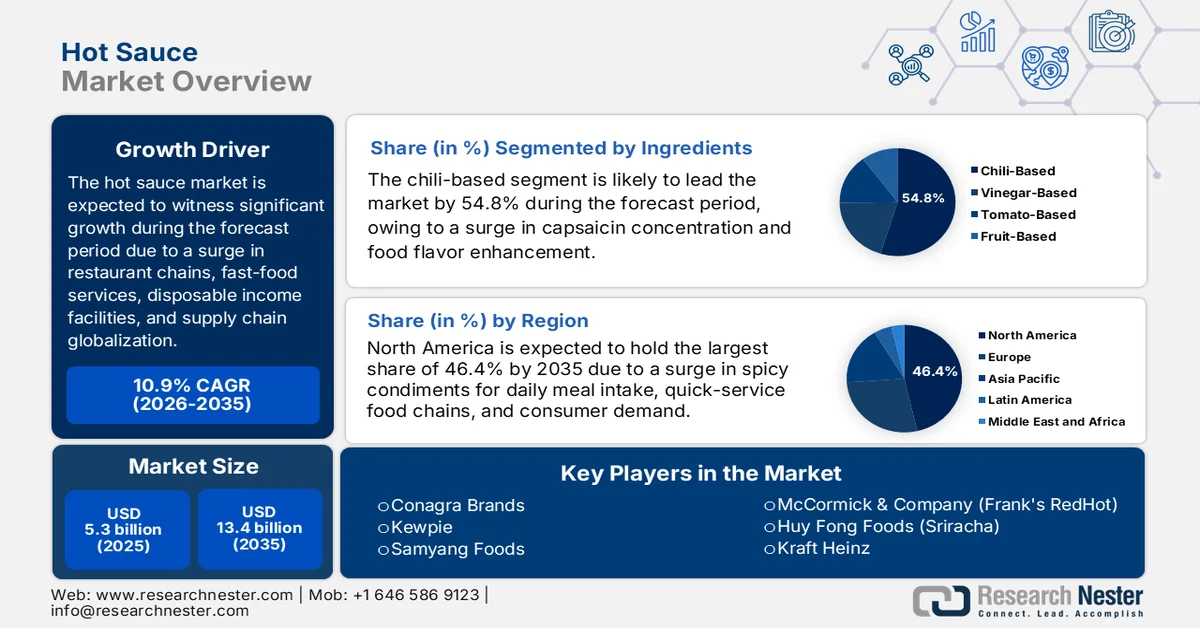
The global hot sauce market is being significantly shaped by different foundational factors, such as the expansion of quick-service restaurant chains, along with fast-food outlets, increased urbanization, a rise in disposable incomes, and the globalization of the supply chain for specialty food products. According to official statistics published by the National Restaurant Association in February 2026, the aspect of customer expenditure is projected to push the restaurant industry sales to an estimated USD 1.5 trillion worldwide, with a real benefit of 1.3% growth. Additionally, the desire to visit restaurants as budgets is expected to drive the industrial growth across different nations. Moreover, with this growth, the supply of sauces and seasonings is also increasingly available across restaurant chains as well as fast-food outlets, which is fueling the market upliftment.
2024 Global Sauces and Seasonings Export/Import Analysis
|
Countries/Components |
Export (USD) |
Import (USD) |
|
U.S. |
2.3 billion |
2.5 billion |
|
Italy |
2.0 billion |
- |
|
Netherlands |
1.4 billion |
- |
|
UK |
- |
1.3 billion |
|
Germany |
- |
1.1 billion |
|
Global Trade Valuation |
20.0 billion |
|
|
Global Trade Share |
0.088% |
|
|
Export Growth |
4.1% |
|
Source: OEC
Furthermore, an increase in fermented and probiotic hot sauces, AI-based personalized flavor recommendations, as well as eco-friendly and sustainable packaging innovations, are certain trends that are responsible for fueling the market globally. According to official statistics published by NLM in December 2023, the worldwide probiotic industry was estimated to be worth USD 47.6 billion. In addition, as of 2022, it accounted for an approximate valuation of USD 11.0 billion in Europe, effectively indicating a growth rate of more than 9%. Based on this growth, the industry further grew at a steady 8.9% rate and successfully reached USD 73.1 billion as of 2024. Therefore, the probiotics addition to hot sauces distinguishes itself from a usual natural ingredient by deliberately focusing on the biological process, thus denoting an optimistic outlook for the market growth.
Key Hot Sauce Market Insights Summary:
Regional Highlights:
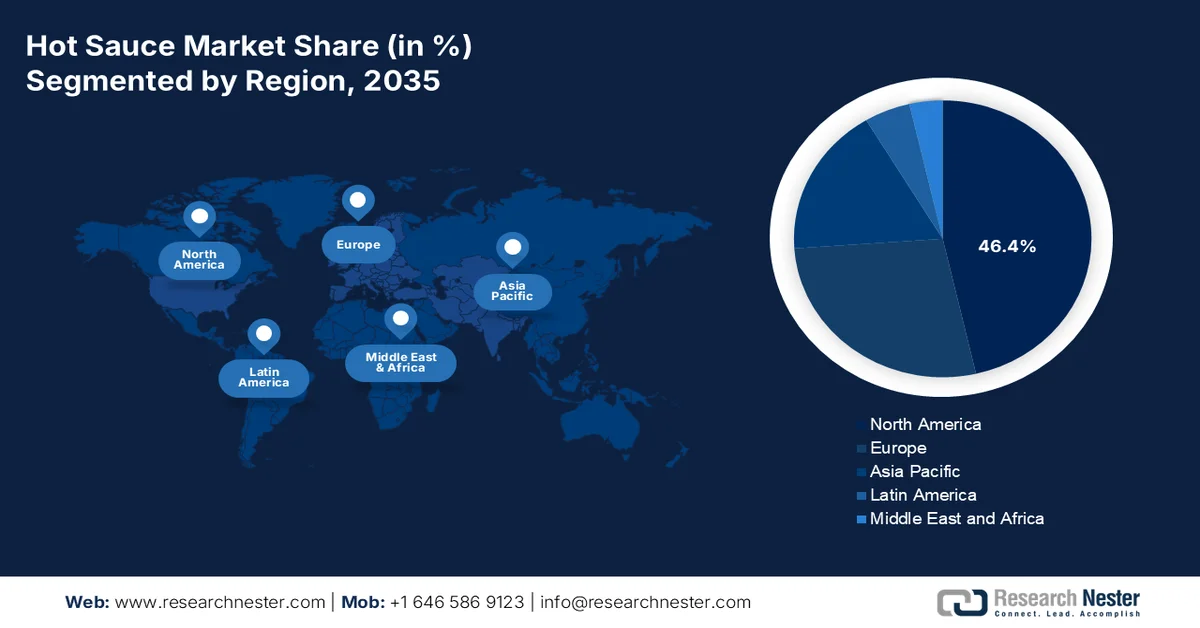
- North America in the hot sauce market is anticipated to command a 46.4% share by 2035, attributed to widespread incorporation of spicy condiments and expansion of quick-service dining
- Asia Pacific is expected to be the fastest-growing region during 2026–2035, fueled by rising urbanization and increasing adoption of packaged sauces
Segment Insights:
- The chili-based sub-segment in the hot sauce market is projected to capture a 54.8% share by 2035, propelled by rising health benefits associated with capsaicin content
- The glass bottles sub-segment is expected to hold the second-largest share during 2026–2035, impelled by its non-porous and inert properties ensuring product safety and preservation
Key Growth Trends:
- Capsaicin recognition as a health advantage
- Product innovation in sauces
Major Challenges:
- Intense competition and market fragmentation
- Regulatory and labeling compliance across borders
Key Players: McIlhenny Company, McCormick & Company, Huy Fong Foods, Kraft Heinz, Unilever, The Clorox Company, Campbell Soup Company, General Mills, Conagra Brands, Kewpie, Samyang Foods, Lao Gan Ma, Lee Kum Kee, Coca-Cola, Dabur India, Capital Foods, Maggi (Nestlé), Sauer Brands, B&G Foods, Marie Sharp's, Masan Group, The Marzetti Company, McIlhenny Company, Highlander Partners, L.P., Tapatio, Taco Bell.
Global Hot Sauce Market Forecast and Regional Outlook:
Market Size & Growth Projections:
- 2025 Market Size: USD 5.3 billion
- 2026 Market Size: USD 5.8 billion
- Projected Market Size: USD 13.4 billion by 2035
- Growth Forecasts: 10.9% CAGR (2026-2035)
Key Regional Dynamics:
- Largest Region: North America (46.4% Share by 2035)
- Fastest Growing Region: Asia Pacific
- Dominating Countries: United States, China, India, Mexico, United Kingdom
- Emerging Countries: Brazil, South Korea, Indonesia, Vietnam, Thailand
Last updated on : 17 April, 2026
Hot Sauce Market - Growth Drivers and Challenges
Growth Drivers
- Capsaicin recognition as a health advantage: The aspect of consumer and scientific awareness of capsaicin, which is the proactive compound in chili peppers responsible for heat, has readily emerged as a substantive growth driver for the market. According to official statistics published by NLM in July 2022, the lipophilic compound is regarded as the ultimate bioactive constituent of peppers and is duly responsible for the characteristic burning and tissue irritation consequences of peppers, accounting for almost 70% of the alkaloid group known as capsaicinoids. In addition, there are other analogs, such as 22% of dihydrocapsaicin, 7% of nordihydrocapsaicin, and compounds, including norcapsaicin, homodihydrocapsaicin, and homocapsaicin, which are produced in low quantities, thus readily bolstering the market exposure.
- Product innovation in sauces: Hot sauces are usually formulated into different product categories, which is driving the market expansion through adjacency. Besides, manufacturers are increasingly introducing hot sauce-flavored snack seasonings, spicy barbecue sauces, hot sauce-infused mayonnaise, and spicy ketchup variants, which are also fueling the market demand. For instance, in January 2026, Highlander Partners, L.P., successfully acquired Tapatio from the Saavedra family. With this acquisition, Tapatio planned to expand its reach into nascent geographies, broaden its distribution channels, boost new product development, and significantly enter complementary new product categories, which are responsible for proliferating the market development.
- Increase of celebrity endorsement culture: The entertainment industry has significantly embraced hot sauce challenges, preferably through the comprehensively viewed Hot Ones on social media series. This has effectively created an unprecedented mainstream cultural validation for extreme heat products, which is fueling the market globally. For instance, in September 2024, Taco Bell teamed with Omar Apollo, a pop singer and songwriter, for a hot sauce collaboration. The purpose of this particular collaboration was the launch of the latest sauce packet, Disha Hot Sauce, which was inspired by Omar’s family recipe. Therefore, with such an organizational partnership with celebrities, there is a huge growth opportunity for the market to grow and expand across nations.
Challenges
- Intense competition and market fragmentation: The hot sauce market is crowded with different active brands globally, ranging from century-old legacy players to thousands of local craft producers and private-label store brands. This extreme fragmentation creates significant consumer choice overload, making brand differentiation and customer loyalty harder to achieve. Besides, shelf space in brick-and-mortar retail is finite, with major grocery chains allocating limited facings to only the top-selling SKUs, effectively locking out small-scale producers from mainstream distribution. Meanwhile, digitally native brands flood social media channels with aggressive performance marketing campaigns, driving up customer acquisition costs across the entire category, which in turn is negatively impacting the market growth.
- Regulatory and labeling compliance across borders: As brands in the market scale internationally, they encounter a complex web of diverging food safety, labeling, and ingredient regulations across different jurisdictions. For instance, certain preservatives permitted in one country may be restricted or banned in another, forcing reformulation for export batches. Ingredient declarations, nutritional panel formats, and allergen warnings vary significantly, with some markets requiring bilingual labels or specific front-of-pack warning symbols. Additionally, capsaicin extract levels are regulated more strictly in certain regions due to health and safety considerations, directly impacting product recipes for extra-hot sauces.
Hot Sauce Market Size and Forecast:
| Report Attribute | Details |
|---|---|
|
Base Year |
2025 |
|
Forecast Year |
2026-2035 |
|
CAGR |
10.9% |
|
Base Year Market Size (2025) |
USD 5.3 billion |
|
Forecast Year Market Size (2035) |
USD 13.4 billion |
|
Regional Scope |
|
Hot Sauce Market Segmentation:
Ingredients Segment Analysis
Based on the ingredients segment, the chili-based sub-segment is anticipated to garner the largest share of 54.8% in the hot sauce market by the end of 2035. The sub-segment’s upliftment is primarily attributed to the increased concentration of capsaicin, which is a compound that provides suitable health benefits. These benefits include food flavor enhancement, offering pain relief, diminishing inflammation, and bolstering metabolism. According to official statistics published by NLM in September 2023, more than 20 to 30 chili pepper species have been recognized, such as C. baccatum, C. frutescens, C. pubescens, C. chinese, and C. annuum. Besides, the pH of Tabasco pepper mash usually ranges from 4.7 to 3.9 and 3.7, eventually depending on the container material. Therefore, these particular chili peppers readily support heart health, comprise antioxidants, such as Vitamin A and C, and aid digestion, thus driving the market growth.
Packaging Segment Analysis
During the forecast period, the glass bottles sub-segment, part of the packaging segment, is projected to account for the second-largest share in the market. The sub-segment’s growth is highly driven by its importance as being non-porous and inert for effectively withstanding high-temperature hot-filling, along with enabling taste preservation, stability, and product safety. As per an article published by the Environmental Engineering Research Organization in 2025, the present global glass production is estimated to be 130 million tons every year. This particular production comprises 48% container glass, 42% of flat glass, 5% of tableware and other glass products each. Besides, roughly 40 million tons of glass products have been estimated to be produced in Europe, while the yearly production from the U.S. accounted for 12.3 million tons, thereby supporting the sub-segment’s growth.
Product Type Segment Analysis
The table hot sauces segment, part of the product type, is expected to grab the third-largest share in the market by the end of the stipulated timeline. The segment’s development is highly propelled by the aspect of being designed for direct consumer application at the point of consumption, typically found on restaurant tables, kitchen counters, and dining tables in households. Its dominance stems from several core advantages, such as providing convenience and immediate usability without requiring cooking or preparation. Secondly, they feature balanced heat profiles that appeal to mainstream consumers rather than only heat-seeking enthusiasts, making them suitable for everyday meals, including eggs, pizza, tacos, sandwiches, and grilled meats. Thirdly, their formulation prioritizes shelf stability and longer preservation, eliminating the need for refrigeration even after opening, thereby bolstering the segment upliftment.
Our in-depth analysis of the hot sauce market includes the following segments:
|
Segment |
Subsegments |
|
Ingredients |
|
|
Packaging |
|
|
Product Type |
|
|
Heat Level |
|
|
Distribution Channel |
|
|
End use |
|

Vishnu Nair
Head - Global Business DevelopmentCustomize this report to your requirements — connect with our consultant for personalized insights and options.
Hot Sauce Market - Regional Analysis
North America Market Insights
North America in the hot sauce market is anticipated to garner the highest share of 46.4% by the end of 2035. The market’s upliftment is primarily attributed to the incorporation of spicy condiments in regular meals, the transition from a niche ethnic product to a mainstream kitchen staple, sustained baseline demand among consumers, an expansion in quick-service restaurants and rapid-casual dining, and the increased focus on the craft sauce movement. According to an article published by the Agriculture and Agri-Food Canada in July 2025, the U.S. in the overall region accounts for the largest economy for sauces and condiments as of 2022, with imports valued at USD 2.2 billion, which is 13.5% of industrial share, and effectively demonstrating one of the largest surges in yearly growth rate of 13.1% from USD 1.2 billion. Simultaneously, Canada is regarded as the largest industry supplier to the U.S. economy, offering USD 511.9 million, which is 23.4% share and 160.9 million kilograms in 2022.
The hot sauce market in the U.S. is growing significantly, owing to the widespread fast food and snack consumption, suitable government export strategies, the growing demand from older adults and millennials, and a rise in GLP-1 and experimental diets. Based on government estimates published by the CDC in June 2025, between August 2021 and 2023, 32.0% of adults aged more than 20 years readily consumed fast food. Likewise, in the case of adults, 11.4% obtained over 0% and less than 25% of their regular calories from fast food, while 12.0% gained 25% to 50% of calories, and 8.6% achieved over 50% of calories from junk food intake. Besides, sauces and condiments have become a huge part of the fast-food chain, with import valuation, as stated in the July 2025 Agriculture and Agri-Food Canada article, worth USD 921.4 million, which is 5.7% of the domestic share, which is positively driving the market growth.
Sauce and Condiment Imports in the U.S. (2017-2022)
|
Year |
Import Value |
|
2017 |
USD 1,181.1 million |
|
2018 |
USD 1,278.6 million |
|
2019 |
USD 1,329.7 million |
|
2020 |
USD 1,564.7 million |
|
2021 |
USD 1,828.4 million |
|
2022 |
USD 2,187.2 million |
|
CAGR |
6.8% |
|
Market Share |
13.5% |
Source: Agriculture and Agri-Food Canada
The presence of substantial condiments, growing demand for diversified international flavors, a sudden shift to health-conscious and natural ingredients, and the increased focus on premium artisanal production with seed-to-bottle traceability are factors that are bolstering the market in Canada. As per an article published by the Agriculture and Agri-Food Canada in July 2025, the country is regarded as the largest supplier of sauce and condiments with natural ingredients, demonstrating a 23.4% share, with imports worth USD 511.9 million as of 2022. In addition, the imports from the country included prepared sauces, which are significantly valued at USD 430.2 million, accounting for an 84.1% of market share, along with 121.8 million kilograms. Simultaneously, the import for tomato sauces and ketchup was worth USD 55.4 million, catering to 10.8% of the market share with 30.6 million kilograms, which is positively impacting the market growth.
Top Sauce and Condiment Imports from Canada (2022)
|
Total Sauce and Condiment |
Import Value (USD) |
Import Volume (Kilograms) |
Market Share Value (%) |
|
Prepared sauces, mixed condiments, and seasonings |
430.2 |
121.8 |
84.1 |
|
Tomato ketchup and other tomato sauces |
55.4 |
30.6 |
10.8 |
|
Mustard flour and meal |
23.0 |
6.8 |
4.5 |
|
Soya sauce |
3.3 |
2.1 |
0.6 |
Source: Agriculture and Agri-Food Canada
APAC Market Insights
The Asia Pacific in the hot sauce market is expected to emerge as the fastest-growing region during the forecast period. The market’s development in the country is highly propelled by a rise in urbanization, an increase in the adoption of branded packaged sauces in place of homemade alternatives, the growing exposure to foreign cuisines, and generous budget allocation by the government to the food industry. According to official statistics published by the VDMA Organization in November 2025, the overall region recorded a steady growth in worldwide sales of packaged food for different years, with India projected to witness a 33% growth by the end of 2029, and emerge as one of the most dynamic economies. Besides, the trade volume for packaging machinery and food processing significantly reached USD 7.7 billion with a 16% growth as of 2024 in China, and overall, USD 11.6 billion, indicating an 18% growth in the region, thus driving the market growth.
The market in China is gaining increased traction, owing to the presence of the massive population, in-depth culinary heritage of fermented soy-based sauces, chili oils, and bean pastes, robust domestic production capacity, extended retail distribution networks, a surge in the middle-class demanding specialty and premium condiments, and the existence of a suitable food processing facility. As stated in an article published by NLM in May 2024, the fermentation process is carried out in saline conditions and at a controlled temperature within an 8 by 20-120 cubic meter tank. Based on this, the fermentation duration for soya sauce usually ranges from 0 to 8 months. Besides, the fermentation process for other sauce types frequently belongs to this particular range, after which they are filtered by utilizing papers and readily stored in glass bottles in refrigerators at -20 degree Celsius, thus bolstering the market development.
The aspects of both young and growing population, an increase in disposable incomes, rapid urbanization for transitioning consumption from homemade sauces to branded and packaged products, robust export-driven sauce production, expansion in the food sector, and the international need for spicy condiments are certain trends that are responsible for fueling the market in the Philippines. As per a data report published by the USDA in April 2026, the food and beverage manufacturing industry is projected to grow by 5% by the end of 2026 in the country. This growth is effectively supported by government measures and continued expansion to fuel expenses and ease logistics. Besides, based on the purchasing managers’ index, 20 notable basic-goods manufacturers significantly committed to holding expenses for 30 to 60 days, which denotes a huge growth opportunity for the market in the country.
Europe Market Insights
Europe in the hot sauce market is projected to witness considerable growth by the end of the stipulated timeline. The market’s growth in the region is highly driven by an increase in spicy and bold flavors, a surge in Mexica and Asia-based cuisines, a rise in health consciousness associated with capsaicin’s metabolism-boosting properties, and the influence of social media platforms in commercializing spicy food culture. According to official statistics published by NLM in July 2024, a clinical study was conducted on 136,125 patients in the region with vascular disorders, as well as 46,689 with ischemic heart disease (IHD), 10,097 with major coronary events, 80,114 with cerebrovascular disease, 56,726 with stroke, and 40,098 with non-stroke cerebrovascular diseases to evaluate the spicy food consumption. Of the total participants, 42.8% regularly consumed spicy food, while 15.2% consumed it for 1-2 days, 13.6% for 3-5 days, and 71.1% for 6-7 days every week, thus enhancing the market exposure in the region.
The hot sauce market in Germany is gaining increased exposure, owing to a substantial consumer base with increased disposable income levels, the stabilized and robust demand for sauces and seasonings, the presence of well-established food processing, and retail infrastructure enabling suitable product and distribution availability. Based on government estimates published by the USDA in March 2026, the food processing industry in the country is regarded as the 4th largest sector, with an estimated production worth USD 270.1 billion in processed food and beverages as of 2024. Besides, citizens in the country spent just 14% of their respective income on food and beverage products as of 2023. Therefore, with this continuous increase in industrial products, there is a huge growth opportunity for the market in the overall country.
The multicultural population, an increase in sauce consumption, the dynamic food service industry, the strong incorporation of sauces in menu offerings, the aggressive resonance with the domestic audience, and a focus on food manufacturers for innovating and expanding product ranges are a few trends that are responsible for fueling the market in the UK. As per an article published by the UK Government in February 2026, the agri-food chain significantly contributed USD 180.7 billion, which is 6.2% of the national gross value added (GVA) as of 2023. In addition, this is equivalent to USD 84.1 for every USD 1,357.7 of value added in the country. Besides, the GVA of the domestic food chain was worth USD 189.4 billion as of 2023, demonstrating an increase by 5.8% since 2022, thereby denoting an optimistic outlook for the market growth.
Key Hot Sauce Market Players:
- McIlhenny Company (Tabasco) (U.S.)
- McCormick & Company (Frank's RedHot) (U.S.)
- Huy Fong Foods (Sriracha) (U.S.)
- Kraft Heinz (U.S.)
- Unilever (UK/Netherlands)
- The Clorox Company (Burman's) (U.S.)
- Campbell Soup Company (Late July) (U.S.)
- General Mills (U.S.)
- Conagra Brands (U.S.)
- Kewpie (Japan)
- Samyang Foods (South Korea)
- Lao Gan Ma (China)
- Lee Kum Kee (Hong Kong SAR)
- Coca-Cola (Australia)
- Dabur India (India)
- Capital Foods (Ching's Secret) (India)
- Maggi (Nestlé) (Switzerland)
- Sauer Brands (Duke's) (U.S.)
- B&G Foods (Crystal) (U.S.)
- Marie Sharp's (Belize)
- Masan Group (Vietnam)
- The Marzetti Company (U.S.)
- McIlhenny Company (U.S.)
- Highlander Partners, L.P. (Texas)
- Tapatio (U.S.)
- Taco Bell (U.S.)
- Company Overview
- Business Strategy
- Key Product Offerings
- Financial Performance
- Key Performance Indicators
- Risk Analysis
- Recent Development
- Regional Presence
- McIlhenny Company (Tabasco) is widely recognized as a pioneer in the hot sauce category, having established a global reputation through its iconic pepper sauce recipe that has remained unchanged for generations. The company continues to drive category growth through product line extensions and by maintaining a strong presence in both household kitchens and foodservice establishments worldwide.
- McCormick & Company (Frank's RedHot) has successfully positioned Frank's RedHot as a dominant force in the buffalo wing sauce segment, capitalizing on the brand's famous tagline and strong association with bar and restaurant culture. The company leverages its extensive distribution network and cross-brand synergies to keep Frank's RedHot visible across retail shelves and commercial foodservice channels.
- Huy Fong Foods (Sriracha) developed a cult-like following around its Sriracha sauce through a simple product lineup and distinctive packaging, becoming a staple in both Asian and mainstream American cuisine. Despite occasional supply disruptions tied to chili sourcing, the brand has maintained fierce consumer loyalty and continues to influence the broader spicy condiment category.
- Kraft Heinz participates in the hot sauce market by leveraging its massive scale and retail relationships to offer competitive condiment lines that appeal to value-conscious households and foodservice operators. The company cross-promotes its hot sauce offerings alongside its other meal solutions, such as ketchup and barbecue sauces, to capture bundled purchasing behavior.
- Unilever addresses the hot sauce market primarily through its diversified condiments portfolio, integrating spicy flavors into established brands to meet evolving consumer taste preferences. The company focuses on regional product variations and strategic brand extensions rather than competing directly with dedicated hot sauce specialists.
Here is a list of key players operating in the global market:
The worldwide hot sauce market remains highly fragmented, with key players pursuing strategic initiatives, such as product innovation for limited-edition heat levels, along with clean-label formulations, and aggressive D2C expansion. Moreover, major manufacturers readily leverage brand heritage, while challenger brands focus on authenticity and social media engagement. Simultaneously, acquisitions and geographic diversification are common to capture emerging market demand. For instance, in November 2025, Masan Group expanded its presence in Costco’s and Woolworths’ global retail network, deliberately reflecting the international appeal of Vietnam-based consumer products. In addition, this expansion also focused on the organization’s growing manufacturing capacity, along with maintaining compliance with global standards, which is effectively responsible for boosting the hot sauce industry in different locations.
Corporate Landscape of the Hot Sauce Market:
Recent Developments
- In August 2025, HEINZ introduced the irresistible latest mayonnaise-based sauces, with the intention of expanding its very own range of delicious condiment options, particularly in Canada. This particular lineup is significantly crafted for sauce lovers and launched to satisfy consumers’ increasing craving for unusual options.
- In July 2025, The Marzetti Company extended its retail portfolio by unveiling 4 newest hot sauces that were made with innovative and bold flavors that consumers usually expect from the Buffalo Wild Wings brand.
- In March 2025, McIlhenny Company, the creator of TABASCO® Brand Pepper Sauce, introduced a bold new flavor to the foodservice sector with the launch of TABASCO® Brand Salsa Picante that readily delivers a thick and rich texture, along with a subtle kick of heat and vibrant spice blend.
- Report ID: 8516
- Published Date: Apr 17, 2026
- Report Format: PDF, PPT
- Explore a preview of key market trends and insights
- Review sample data tables and segment breakdowns
- Experience the quality of our visual data representations
- Evaluate our report structure and research methodology
- Get a glimpse of competitive landscape analysis
- Understand how regional forecasts are presented
- Assess the depth of company profiling and benchmarking
- Preview how actionable insights can support your strategy
Explore real data and analysis
Frequently Asked Questions (FAQ)
About this Report
Connect with our Expert


Report, 2026-2035



Copyright @ 2026 Research Nester. All Rights Reserved.
