High-Speed Interconnects Market Outlook:
High-Speed Interconnects Market size was valued at USD 38.9 billion in 2025 and is projected to reach USD 102.7 billion by 2035, rising at a CAGR of 10.2% during the forecast period, i.e., 2026-2035. In 2026, the industry size of high-speed interconnects is assessed at USD 42.8 billion.
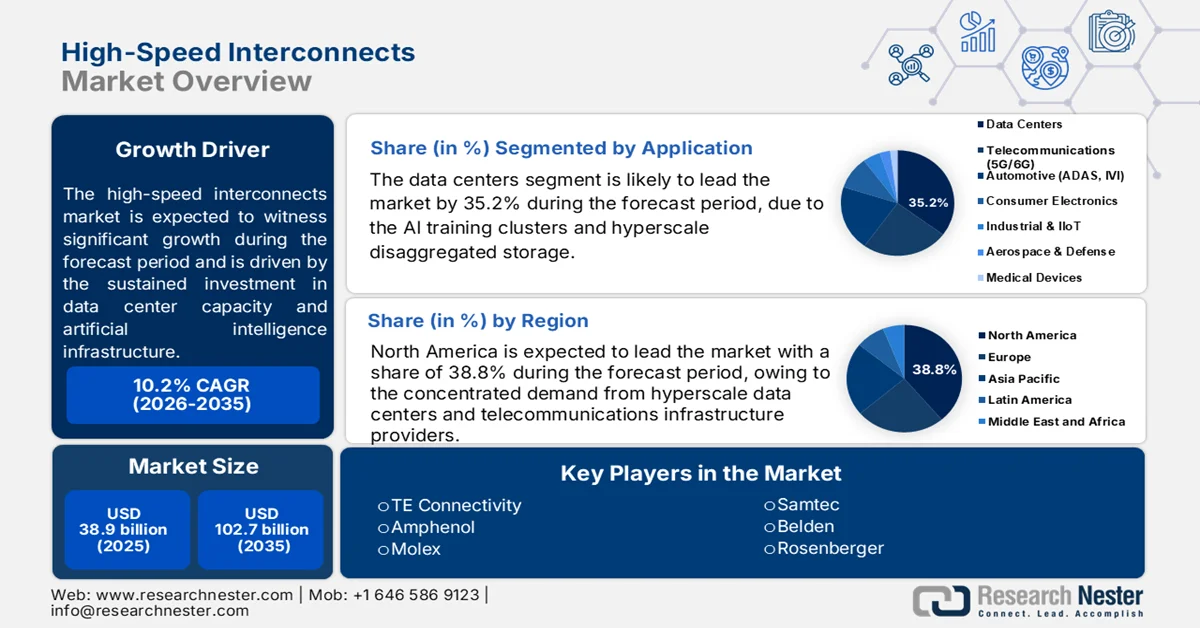
The high-speed interconnects market is being driven by sustained investment in data center capacity, artificial intelligence infrastructure, cloud computing, and high-performance computing environments that require faster movement of data between processors, memory systems, storage platforms, and network equipment. According to the Congress.gov May 2026 data, data centers in the United States consumed approximately 176 terawatt-hours (TWh) of electricity in 2023, representing about 4.4% of total U.S. electricity consumption. The scale of this expansion indicates a growing requirement for advanced interconnect architectures capable of supporting higher bandwidth and lower latency across increasingly dense computing environments.
Key High-Speed Interconnects Market Insights Summary:
Regional Highlights:
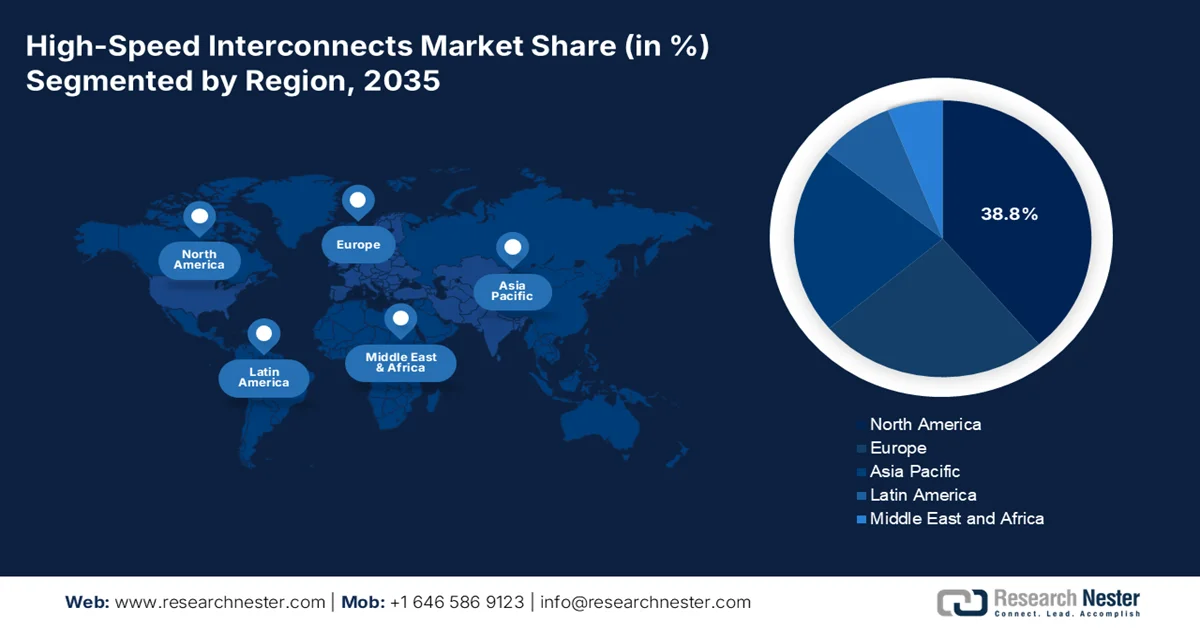
- The high-speed interconnects market in North America is anticipated to command 38.8% of regional revenue share by 2035, underpinned by concentrated investments in hyperscale data centers, advanced telecommunications infrastructure, and secure semiconductor manufacturing initiatives
- Asia Pacific is projected to witness the fastest expansion throughout 2026–2035, fueled by dense electronics manufacturing ecosystems, government-backed semiconductor incentives, and accelerating 5G/6G infrastructure deployment
Segment Insights:
- In the high-speed interconnects market, the Data Centers application segment is forecast to capture 35.2% share by 2035, propelled by AI training clusters and hyperscale disaggregated storage
- The Hyperscale Data Centers end-user segment is expected to retain its leadership position through 2035, bolstered by escalating bandwidth requirements across servers, GPUs, and storage nodes supporting AI training, real-time analytics, and distributed computing workloads
Key Growth Trends:
- Expansion of exascale supercomputing
- Semiconductor manufacturing incentives
Major Challenges:
- Intellectual property and patent thickets
- Supply chain fragmentation and raw material volatility
Key Players: TE Connectivity (U.S.), Amphenol (U.S.), Molex (U.S.), Samtec (U.S.), Belden (U.S.), Rosenberger (Germany), HARTING (Germany), Hirose Electric (Japan), Sumitomo Electric (Japan), JAE (Japan), Kyocera (Japan), Fujitsu (Japan), LS Cable & System (South Korea), Samyoung Electronics (South Korea), Centum Electronics (India), Amphenol Interconnect India (U.S.), Lisconn (U.S.).
Global High-Speed Interconnects Market Forecast and Regional Outlook:
Market Size & Growth Projections:
- 2025 Market Size: USD 38.9 billion
- 2026 Market Size: USD 42.8 billion
- Projected Market Size: USD 102.7 billion by 2035
- Growth Forecasts: 10.2% CAGR (2026-2035)
Key Regional Dynamics:
- Largest Region: North America (38.8% Share by 2035)
- Fastest Growing Region: Asia Pacific
- Dominating Countries: United States, China, Japan, South Korea, Taiwan
- Emerging Countries: India, Malaysia, Vietnam, Singapore, Thailand
Last updated on : 11 June, 2026
High-Speed Interconnects Market - Growth Drivers and Challenges
Growth Drivers
- Expansion of exascale supercomputing: The rapid deployment of exascale supercomputing systems is becoming a significant demand driver for the high-speed interconnects market. Oak Ridge National Laboratory October 2024 data used the Frontier supercomputer to perform the first double-precision quantum chemistry simulation exceeding one exaflop. Frontier incorporates 9,408 compute nodes and over 8 million processing cores, requiring extremely high-bandwidth, low-latency interconnect infrastructure to enable communication among CPUs, GPUs, memory, and storage resources. As governments continue funding exascale computing for drug discovery, materials science, energy research, and national security applications, demand is increasing for advanced interconnect technologies capable of supporting large-scale data movement and synchronized processing across millions of computing elements.
- Semiconductor manufacturing incentives: National semiconductor strategies are strengthening the ecosystem supporting advanced interconnect technologies. The Columbia University November 2025 data, the U.S. CHIPS and Science Act provides more than USD 52 billion in semiconductor manufacturing and research incentives, while similar programs are underway in Europe, Japan, South Korea, and India. Increased semiconductor fabrication capacity supports production of networking chips, high-speed transceivers, processors, and accelerator technologies that rely on advanced interconnect architectures. These investments improve supply availability and accelerate deployment of advanced computing infrastructure. As fabrication facilities become operational, suppliers are expected to expand production of components used in data centers, AI systems, and telecommunications networks, reinforcing long-term demand for high-performance interconnect solutions.
- Defense and national security modernization programs: Defense modernization is creating a strong demand base for advanced computing and networking systems. Military applications increasingly rely on AI, autonomous systems, intelligence processing, cybersecurity operations, and real-time data analytics, all of which require robust interconnect infrastructure. The U.S. Department of Defense (DoD) March 20254 data DOD budget request exceeds USD 849 billion, including substantial allocations for digital modernization, AI deployment, and advanced computing programs. Procurement priorities increasingly emphasize resilient, scalable computing environments capable of processing large data volumes with minimal latency. This trend is expanding opportunities for suppliers of advanced networking components and system-level interconnect technologies.
Challenges
- Intellectual property and patent thickets: Established players hold thousands of patents covering connector geometries, signal integrity techniques, and materials. New entrants risk infringement lawsuits or must license expensive IP, eroding margins. Though the global high-speed interconnects market is expected to grow despite government pricing constraints on critical raw materials like copper and tellurium.
- Supply chain fragmentation and raw material volatility: High-performance interconnects depend on specialty copper alloys, liquid crystal polymer (LCP), and gold plating. Prices fluctuations due to geopolitical tensions and mining export restrictions. With the rising market size the government pricing constraints on imported rare-earth metals used in RF connectors.
High-Speed Interconnects Market Size and Forecast:
| Report Attribute | Details |
|---|---|
|
Base Year |
2025 |
|
Forecast Year |
2026-2035 |
|
CAGR |
10.2% |
|
Base Year Market Size (2025) |
USD 38.9 billion |
|
Forecast Year Market Size (2035) |
USD 102.7 billion |
|
Regional Scope |
|
High-Speed Interconnects Market Segmentation:
Application Segment Analysis
Under the application segment, the data centers are dominating in the high-speed interconnects market and is poised to hold the share value of 35.2% by the end of 2035. The segment is driven by AI training clusters and hyperscale disaggregated storage. According to the Berkeley Lab 2024 data, data centers in the U.S. consumed approximately 1.8% of total national electricity, with networking and interconnect losses. This statistic has accelerated adoption of co‑packaged optics and linear drive pluggables. Generative AI inference and real‑time edge cloud services will require even denser fiber arrays, cementing data centers as the largest application segment. Hyperscalers continue to redesign their fabric architectures, making high‑speed interconnects mission‑critical for throughput and energy efficiency.
End user Industry Segment Analysis
Hyperscale data centers dominate the end user segment of the high-speed interconnects market due to their insatiable demand for bandwidth between thousands of servers, GPUs, and storage nodes. These facilities, operated by global cloud and social media giants, require dense, low-latency interconnects to support AI training, real-time analytics, and distributed computing workloads. Unlike enterprise data centers or telecom central offices, hyperscale environments prioritize active optical cables, co-packaged optics, and high-density backplane connectors that can scale horizontally across entire data center halls. The shift toward disaggregated compute and memory pools further accelerates the need for ultra-fast interconnects. Consequently, hyperscale data centers consistently invest in next-generation cable assemblies and optical transceivers, maintaining their leadership as the most influential end user sub-segment through 2035.
Transmission Technology Segment Analysis
Silicon photonics is the leading transmission technology in the High‑Speed Interconnects market, enabling chip‑to‑chip and board‑to‑board communication with lower power and latency than copper. According to the NLM April 2025 study, a 19-core randomly-coupled multi-core fiber with a standard cladding diameter, achieving a record 1.7 petabit/s data rate. This is more than an order of magnitude higher than currently deployed single-mode fibers, as reported in the study. The design minimizes signal processing complexity while maximizing spatial multiplexing within legacy-compatible cladding dimensions. For the high-speed interconnects market, such SDM fibers directly support the 42% revenue share projected for optical transmission by 2035, particularly in hyperscale data centers and AI clusters where copper interconnects face unrecoverable distance and loss limitations at 224G rates.
Our in-depth analysis of the high-speed interconnects market includes the following segments:
|
Segment |
Subsegments |
|
Type |
|
|
Data Rate |
|
|
Form Factor |
|
|
Application |
|
|
End user Industry |
|
|
Transmission Technology |
|

Vishnu Nair
Head - Global Business DevelopmentCustomize this report to your requirements — connect with our consultant for personalized insights and options.
High-Speed Interconnects Market - Regional Analysis
North America Market Insights
North America is dominating the high-speed interconnects market and is expected to hold the regional revenue share of 38.8% by the end of 2035. The region is characterized by concentrated demand from hyperscale data centers, telecommunications infrastructure providers, and defense contractors. The United States leads in the adoption of advanced optical and copper cable assemblies for artificial intelligence training clusters, while Canada contributes through specialized silicon photonics research and cold-climate data center deployments. Government initiatives to reshore semiconductor advanced packaging and secure trusted microelectronics supply chains have accelerated local manufacturing investments. Key trends include the transition from pluggable optical modules to co-packaged optics, tighter signal integrity requirements for 224G PAM4 links, and increased procurement of ruggedized interconnects for aerospace applications.
The federal investments in semiconductor manufacturing and advanced computing infrastructure is driving the high-speed interconnects market in the U.S. The NIST November 2024 data depicts that the U.S. Department of Commerce announced a proposed up to USD 6.6 billion in direct funding for TSMC Arizona under the CHIPS and Science Act, supporting domestic production of advanced chips used in data centers, AI systems, and networking equipment. Additionally, the Presidency UCSB March 2024 data, the Department of Commerce announced up to USD 8.5 billion in direct funding for Intel, aimed at expanding leading-edge semiconductor manufacturing capacity across multiple states. These investments strengthen the domestic supply chain for processors, accelerators, and networking components, creating sustained demand for high-performance interconnect technologies supporting AI, cloud computing, telecommunications, and enterprise infrastructure.
The growing investments in digital infrastructure, artificial intelligence, and advanced computing is shaping the high-speed interconnects market in Canada. According to the Prime Minister of Canada April 2024 data the Government of Canada announced USD 2.4 billion in Budget 2024 measures to secure Canada’s AI advantage, including investments in AI compute capacity and technological infrastructure that require high-bandwidth networking and data movement capabilities. Additionally, according to ITA March 2026 data, the government has invested USD 1.3 billion to improve cloud infrastructure for public services, reflecting continued expansion of digital infrastructure and data-intensive operations. These investments are driving demand for advanced interconnect solutions across data centers, research institutions, telecommunications networks, and enterprise IT environments as organizations increase computing capacity and deploy AI-enabled applications.
APAC Market Insights
The Asia Pacific is projected to emerge rapidly during the assessed period, 2026 to 2035 in the high-speed interconnects market. The region is driven by dense electronics manufacturing ecosystems, aggressive government semiconductor subsidies, and rapid 5G/6G infrastructure deployment. China, Japan, South Korea, and Taiwan lead in precision connector stamping, optical transceiver assembly, and silicon photonics packaging, while India and Malaysia have emerged as alternative production bases following supply chain diversification trends. Key trends include regional governments mandating locally certified interconnects for public telecom projects, increased investment in co-packaged optics R&D, and a shift toward higher data rate interfaces for artificial intelligence accelerators. Price sensitivity remains high, pushing manufacturers to balance performance with cost-effective materials and automated assembly processes.
The expanding broadband penetration and rising data traffic increase the need for high-capacity networking infrastructure therefore driving the market in India. As per the PIB August 2024 data, under the Ministry of Communications’ Digital India and Universal Connectivity initiatives, India’s internet subscriber base grew from 251.59 million in 2014 to 954.40 million in 2024, while average internet download speeds increased from 4.18 Mbps to 105.85 Mbps, according to government data. Average data consumption also surged from 0.26 GB to 20.27 GB per user, reflecting rapid growth in cloud services, digital platforms, AI applications, and data centers. These trends are driving investments in advanced networking systems and high-speed interconnect technologies across telecom, enterprise IT, and hyperscale infrastructure environments.
The expansion of digital infrastructure, advanced computing, and next-generation telecommunications networks is shaping the high-speed interconnects market in China. According to the ZTE August 2025 data, China had deployed more than 4.39 million 5G base stations by the end of 2024, creating substantial demand for high-capacity networking equipment and data transmission infrastructure. In addition, the Frontiers November 2025 data reported that the country’s number of internet users reached 1.11 billion in 2024, with internet penetration exceeding 78%. The rapid growth of connected users, cloud services, AI workloads, and data-intensive applications is increasing requirements for high-bandwidth, low-latency interconnect solutions across data centers, telecommunications networks, and enterprise computing environments.
Europe Market Insights
The Europe high-speed interconnects market is shaped by stringent environmental regulations, automotive electrification, and government-funded digital infrastructure programs. Germany, France, and the Nordic countries lead in adopting ruggedized interconnects for industrial automation, electric vehicle powertrains, and 5G standalone networks. The market emphasizes compliance with RoHS, REACH, and emerging PFAS restrictions, pushing manufacturers to redesign materials and plating processes. Key trends include increased procurement of single-pair Ethernet (SPE) interconnects for factory IIoT sensors, growing demand for optical backplanes in edge data centers, and consolidation among mid-sized connector suppliers to achieve scale. Unlike North America and Asia Pacific, Europe prioritizes low-power, repairable, and recyclable interconnect designs, driven by circular economy action plans. Automotive OEMs also require interconnects capable of sustaining 112G rates for zonal architecture deployments.
The Germany high-speed interconnects market because nationwide fibre and mobile network expansion increases demand for advanced networking and data transmission infrastructure. According to the European Commission July 2022 data, under Germany’s Gigabit Strategy and Digital Strategy, the government aims to provide fibre connectivity to 50% of all households and businesses by the end of 2025 and achieve nationwide uninterrupted mobile voice and data services by 2026. To support network deployment, the federal government has allocated USD 1.25 billion to expand mobile coverage in underserved areas and offers broadband funding of up to USD 34.2 million per project for gigabit-capable infrastructure. These initiatives are driving investments in high-capacity network equipment, optical connectivity, and high-speed interconnect technologies across telecommunications and data infrastructure projects.
The large-scale broadband infrastructure deployment increases demand for advanced networking and data transmission technologies is shaping the high-speed interconnects market in the UK. According to the Government of UK April 2022 data, through Project Gigabit, the UK government aims to achieve 99% gigabit-capable broadband coverage by 2032, extending high-speed connectivity to hard-to-reach communities and businesses. The program has already signed more than 30 contracts to expand gigabit-capable networks across underserved regions. In addition, the Gigabit Broadband Voucher Scheme provides eligible homes and businesses with vouchers of up to £4,500 (approximately USD 6,100) to support gigabit broadband installation. These initiatives are accelerating fibre-optic deployment, boosting network capacity, and creating demand for high-speed interconnect solutions across telecom and data infrastructure ecosystems.
Key High-Speed Interconnects Market Players:
- TE Connectivity (U.S.)
- Amphenol (U.S.)
- Molex (U.S.)
- Samtec (U.S.)
- Belden (U.S.)
- Rosenberger (Germany)
- HARTING (Germany)
- Hirose Electric (Japan)
- Sumitomo Electric (Japan)
- JAE (Japan)
- Kyocera (Japan)
- Fujitsu (Japan)
- LS Cable & System (South Korea)
- Samyoung Electronics (South Korea)
- Centum Electronics (India)
- Amphenol Interconnect India (U.S.)
- Lisconn (U.S.)
- STL (India)
- Winchester Interconnect (U.S.)
- GIGALIGHT (China)
- Company Overview
- Business Strategy
- Key Product Offerings
- Financial Performance
- Key Performance Indicators
- Risk Analysis
- Recent Development
- Regional Presence
- SWOT Analysis
- TE Connectivity leverages its extensive portfolio of ruggedized, high-bandwidth connectors and cable assemblies for data centers, automotive, and industrial IoT in the high-speed interconnects market. The company focuses on 112G and 224G PAM4 architectures to support next-generation AI clusters and edge computing.
- Amphenol holds a dominant position in the high-speed interconnects market through its decentralized, acquisition-driven growth model, operating over 60 product lines globally. The company specializes in military-grade, automotive Ethernet, and PCIe Gen 6 interconnects for AI servers. In 2025, the company has made a total sale of USD 23.1 billion.
- Molex, a subsidiary of Koch Industries, is a key innovator in the high-speed interconnects market, particularly in optical transceivers, high-density backplane connectors, and board-to-board solutions for autonomous vehicles. The company has pioneered zonal architecture interconnects and co-packaged optics to reduce power consumption.
- Samtec differentiates itself in the market with its Sudden Service model, offering rapid prototyping and off-the-shelf delivery of micro-pitch, high-cycle interconnects for test & measurement, medical imaging, and military avionics.
- Belden focuses on the industrial and broadcast segments of the high-speed interconnects market, offering shielded Ethernet cables, M12 connectors, and hybrid power-data cords for factory automation and pro AV. Its strategic shift toward networked interconnects integrates signal integrity with cybersecurity-ready physical layers. In 2025, the company has made a revenue of USD 2.7 billion.
Here is a list of key players operating in the global high-speed interconnects market:
The high-speed interconnects market is highly competitive, driven by demand for data centers, 5G, and automotive electronics. Key players focus on miniaturization, signal integrity, and higher bandwidth. Strategic initiatives include mergers & acquisitions, R&D in optical/copper hybrid solutions, and regional capacity expansion in Southeast Asia and India. For example, in February 2025, Lisconn announced acquisition of Mcurich to elevate high-speed connectivity solutions. American and Japanese firms lead in advanced materials and precision, while European and South Korean companies excel in automotive and memory interfaces. Partnerships with cloud giants are critical for co-developing next-generation interconnects like PCIe Gen 6 and CXL.
Corporate Landscape of the Market:
Recent Developments
- In March 2026, STL announced a significant breakthrough in optical communication with the launch of India’s first Hollow Core Fibre (HCF) cable. This announcement is designed to meet the low-latency and high-bandwidth requirements of modern Data Centres, Hyperscalers, and High-Frequency transmission networks.
- In December 2025, Winchester Interconnect introduced LiteSPEed™ Cable, a next-generation single-pair Ethernet (SPE) solution that delivers 10-gigabit data rates in a dramatically smaller, lighter design.
- In December 2025, GIGALIGHT announced the launch of its 800G OSFP HYBRID AI & DC optical interconnect product portfolio. The architecture adopts DSP on only half of the channels, significantly reducing power consumption and latency.
- Report ID: 5088
- Published Date: Jun 11, 2026
- Report Format: PDF, PPT
- Explore a preview of key market trends and insights
- Review sample data tables and segment breakdowns
- Experience the quality of our visual data representations
- Evaluate our report structure and research methodology
- Get a glimpse of competitive landscape analysis
- Understand how regional forecasts are presented
- Assess the depth of company profiling and benchmarking
- Preview how actionable insights can support your strategy
Explore real data and analysis
Frequently Asked Questions (FAQ)
About this Report
Connect with our Expert


Report, 2026-2035



Copyright @ 2026 Research Nester. All Rights Reserved.
