High-speed Data Converter Market Outlook:
High-speed Data Converter Market size was over USD 3.7 billion in 2025 and is expected to reach USD 8.6 billion by the end of 2035, growing at around 8.9% CAGR during the forecast period, i.e., between 2026-2035. In 2026, the industry size of high-speed data converter is evaluated at USD 4 billion.
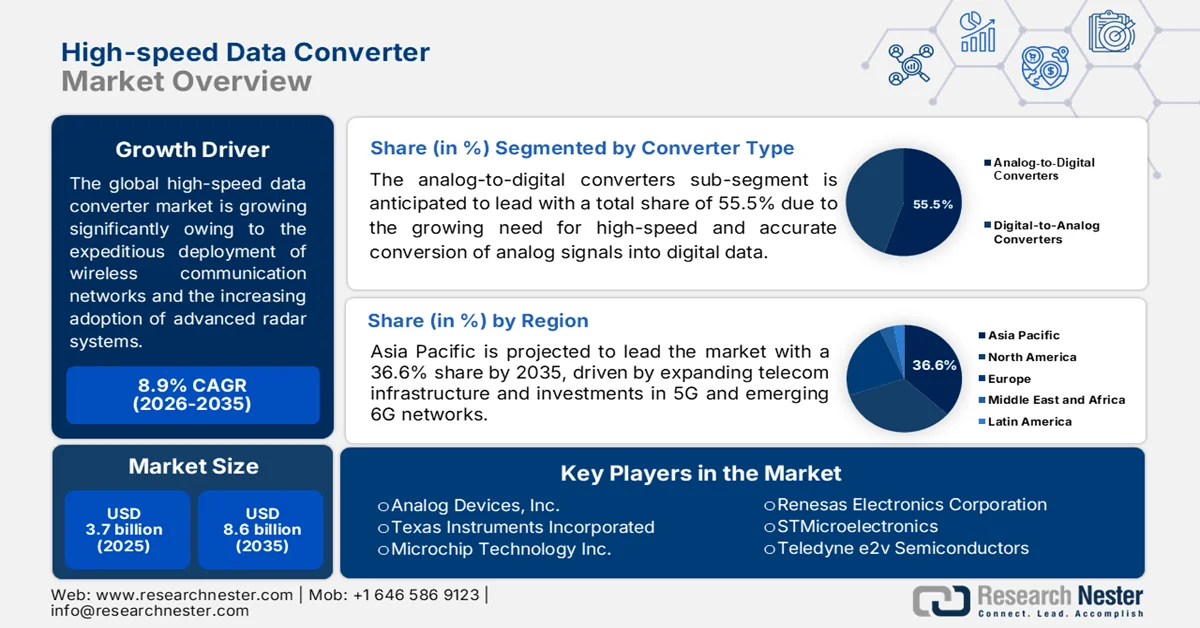
The global high-speed data converter market is poised to experience exceptional growth, which is effectively driven by the expeditious deployment of wireless communication networks and the booming adoption of advanced radar systems. Apart from this, the growth of data center infrastructure and rising high-performance computing requirements are creating heightened demand for advanced components that are capable of handling high-speed data processing. For instance, in January 2026, an article published by UN Trade & Development revealed that data center investments surpassed a total of USD 270 billion in 2025, which is more than one-fifth of global greenfield investment. The sector also contributed to a 14% increase in global FDI to almost USD 1.6 trillion, and greenfield investment in data centers rose by nearly USD 125 billion, thus supporting demand for high-speed data conversion technologies.
Furthermore, the integration of autonomous systems and connected technologies in the automotive and industrial sectors readily accelerates the transition toward high-bandwidth architectures, thereby driving growth in the high-speed data converter market. On the other hand, advances in semiconductor manufacturing are enabling the development of data converter chips with higher sampling speeds and wider dynamic ranges, thereby supporting increasingly demanding real-time signal processing applications. In December 2024, AMD introduced the Versal RF Series by combining direct RF sampling data converters, digital signal processing, AI engines, programmable logic, and Arm processing in a single chip. These devices deliver up to 80 TOPS of DSP performance, with 14-bit, 32 GSPS RF-ADCs supporting signals up to 18 GHz.
Key High-speed Data Converter Market Insights Summary:
Regional Highlights:
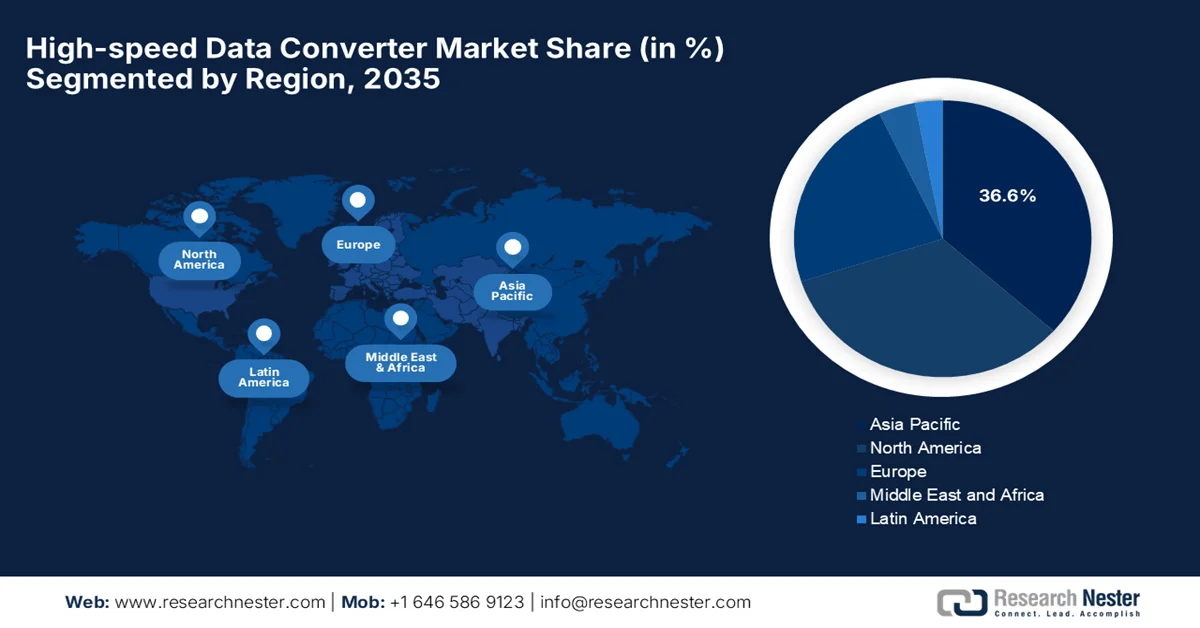
- Asia Pacific is projected to command a 36.6% share of the high-speed data converter market during 2026-2035, with regional leadership fueled by escalating deployment of advanced telecommunications infrastructure and substantial investments in 5G and emerging 6G cellular networks
- North America is anticipated to secure a substantial share during 2026-2035, with market expansion underpinned by a dense concentration of hyperscale data centers and high-performance computing facilities supporting intensive AI and ML workloads
Segment Insights:
- Analog-to-digital converters are anticipated to lead with a 55.5% share of the high-speed data converter market during 2026-2035, with their dominance propelled by the growing need for high-speed and accurate conversion of analog signals into digital data across data-intensive applications
- Standalone data converter ICs are projected to secure a considerable share by 2035, with expansion supported by increasing demand for high-performance, dedicated conversion solutions offering faster signal processing, low latency, design flexibility, and efficient integration
Key Growth Trends:
- Expanding 5G and 6G wireless infrastructure
- Advancing military radar and aerospace systems
Major Challenges:
- Power-induced thermal management
- System integration and signal integrity
Key Players: Analog Devices, Inc.,Texas Instruments Incorporated,Microchip Technology Inc.,Renesas Electronics Corporation,STMicroelectronics,Teledyne e2v Semiconductors,Cirrus Logic.
Global High-speed Data Converter Market Forecast and Regional Outlook:
Market Size & Growth Projections:
- 2025 Market Size: USD 3.7 billion
- 2026 Market Size: USD 4 billion
- Projected Market Size: USD 8.6 billion by 2035
- Growth Forecasts: 8.9% CAGR (2026-2035)
Key Regional Dynamics:
- Largest Region: Asia Pacific (36.6% Share by 2035)
- Fastest Growing Region: Asia Pacific
- Dominating Countries: China, United States, Japan, South Korea, Germany
- Emerging Countries: India, China, South Korea, Japan, Taiwan
Last updated on : 19 August, 2026
High-speed Data Converter Market - Growth Drivers and Challenges
Growth Drivers
- Expanding 5G and 6G wireless infrastructure: The inexorable expansion of 5G networks and ongoing development of 6G technologies is an important growth booster for the high-speed data converter market. These communication systems require massive bandwidth and ultra-low latency to handle skyrocketing mobile data traffic. High-speed data converters are essential to process these wideband signals efficiently. In May 2026, the CSIS Organization disclosed that AI growth and the transition to 6G are increasing demand for fast, reliable, and low-latency wireless connectivity. It also mentions that mid-band spectrum, especially the 4 GHz and 7 GHz bands, will be highly essential for supporting 6G, edge computing, and latency-sensitive AI applications.
- Advancing military radar and aerospace systems: Modern defense applications are shifting toward digital, software-defined radar and electronic warfare systems. These aerospace architectures require real-time signal intelligence, precise target tracking, and high-frequency spectrum analysis. In this context, high-speed data converters provide the extreme sampling rates that are necessary to accurately capture and process complex radio-frequency environments. In July 2024, the U.S. Department of Defense awarded several major contracts covering aircraft, radar technology, force protection, unmanned systems, and military infrastructure. A few of the important awards were USD 251.5 million to Sikorsky for UH-60M helicopters and approximately USD 43 million to Raytheon for advanced radar signal-processing development, which is suitable for bolstering the high-speed data converter market.
Challenges
- Power-induced thermal management: The high-speed data converters face strict limitations in terms of thermal management due to excessive power consumption. As modern applications demand higher sampling rates and expanded bandwidths, these electronic components consume substantial amounts of electrical energy, in turn generating a huge volume of localized heat. The existence of excessive thermal output is considered to be a severe threat to system reliability and performance stability, especially in the case of compact portable devices and dense wireless communication infrastructure. On the other hand, engineering effective heat dissipation mechanisms, such as advanced packaging techniques and active cooling architectures, significantly complicates the overall physical design, negatively impacting the growth of the market.
- System integration and signal integrity: Integrating complex radio-frequency data converters into modern system-on-chip configurations is an immense architectural difficulty. In this context, engineers struggle to merge highly sensitive, ultra-fast analog conversion blocks directly with large-scale digital processing units onto a single silicon die. The existence of this proximity frequently induces severe electromagnetic interference, which degrades signal integrity and compromises overall computational precision across 5G networks and military radar tracking systems. In addition, configuring unified timing synchronization frameworks and mixed-signal verification protocols requires design techniques and proprietary engineering skillsets, thus delaying deployments in the market.
High-speed Data Converter Market Size and Forecast:
| Report Attribute | Details |
|---|---|
|
Base Year |
2025 |
|
Forecast Year |
2026-2035 |
|
CAGR |
8.9% |
|
Base Year Market Size (2025) |
USD 3.7 billion |
|
Forecast Year Market Size (2035) |
USD 8.6 billion |
|
Regional Scope |
|
High-speed Data Converter Market Segmentation:
Converter Type Segment Analysis
The analog-to-digital converters sub-segment is anticipated to lead with a total share of 55.5% in the high-speed data converter market from 2026 to 2035. The sub-segment’s leadership in the converter type segment is majorly propelled by the growing need for high-speed and accurate conversion of analog signals into digital data across telecommunications, industrial, automotive, aerospace, defense, and other data-intensive applications. In June 2023, Analog Devices introduced Apollo MxFE, which is a software-defined RF platform especially designed for radar, electronic surveillance, instrumentation, and 6G communications. This 4T4R version supports 20 GSPS ADCs (analog-to-digital converters), 28 GSPS DACs, up to 18 GHz RF coverage, and 10 GHz instantaneous bandwidth, enabling high-speed signal processing, thus denoting a wider segment scope.
Integration Type Segment Analysis
By the end of the forecast period, the standalone data converter ICs segment is projected to grow with a considerable share. The sub-type’s growth in the market is effectively driven by increasing demand for high-performance, dedicated conversion solutions that offer faster signal processing, low latency, design flexibility, and efficient integration. These ICs are utilized across telecommunications, aerospace and defense, industrial, and other data-intensive applications. In addition, the growing adoption of direct-RF architectures is encouraging system designers to deploy specialized converter ICs that are capable of handling wider bandwidths and increasingly demanding signal environments. Rising data volumes from advanced wireless infrastructure, radar systems, and high-speed instrumentation are further increasing the need for reliable signal conversion at the component level.
Sampling Rate Segment Analysis
On the basis of sampling rate, the 100 MSPS to 500 MSPS segment is expected to grow with a noteworthy share in the market during the stipulated timeframe. This segment is suitable for applications where moderate-to-high sampling performance is required without the complexity associated with ultra-high-speed architectures. The segment is also benefiting from growing use in embedded measurement devices, industrial control systems, medical equipment, wireless networks, and test instrumentation, where dependable sampling capabilities and economical deployment are important considerations in design. In addition, the expanding deployment of edge-based electronic systems is creating opportunities for converters within this sampling range.
Our in-depth analysis of the high-speed data converter includes the following segments:
|
Segment |
Subsegments |
|
Converter Type |
|
|
Integration Type |
|
|
Sampling Rate |
|
|
Resolution |
|
|
End use Industry |
|

Vishnu Nair
Head - Global Business DevelopmentCustomize this report to your requirements — connect with our consultant for personalized insights and options.
High-speed Data Converter Market - Regional Analysis
APAC Market Insights
Asia Pacific high-speed data converter market is anticipated to lead with a total share of 36.6% during the forecast period. The region’s upliftment in this market is majorly propelled by escalating deployment of advanced telecommunications infrastructure and substantial investments in 5G and emerging 6G cellular networks. Asia Pacific’s dominant electronics manufacturing sector, particularly across major semiconductor hubs, fuels the adoption of high-bandwidth components within consumer electronics and industrial automation systems. In October 2025, the Press Information Bureau (PIB) reported that India is progressing toward its 2030 6G vision through indigenous research and development and is supported by 100 5G labs and 104 approved 6G projects and the Bharat 6G Alliance. The country aims to strengthen telecom self-reliance, target 10% of global 6G patents, and develop a 6G ecosystem supporting AI, advanced connectivity, and satellite communications, thus making it suitable for standard market growth.
Heavy state-backed investments in domestic semiconductor self-sufficiency and the massive electronics manufacturing ecosystem are driving the market in China. In addition, the aggressive growth of the country’s domestic electric and autonomous vehicle sectors depends on high-speed converters to process real-time sensor data from LiDAR and radar systems. Based on government data published in February 2025, China’s electronic information manufacturing sector showcased strong growth in 2024, with industrial value added rising 11.8% and integrated-circuit output increasing 22.2%. The article outlined that exports also recovered, while industry revenue reached USD 2.2 trillion and profits grew 3.4%, indicating improving overall performance.
The market in Japan is progressing at a steady pace, driven by the country's advancements in industrial robotics, factory automation, and high-precision manufacturing equipment. In addition, the country's prominent automotive industry accelerates this demand through the deep integration of advanced driver-assistance systems and sensory networks within autonomous and electric vehicles. In April 2025, an article published by the International Trade Administration revealed that Japan offers a substantial robotics opportunity, with 435,300 industrial robots deployed over the past three years, representing 17% growth, whereas a remarkable 38% of the world’s industrial robots originate from Japan. The article also stated that Japan has extensive demand for robotic systems, components, software, and automation solutions across manufacturing, logistics, food, and pharmaceutical industries.
North America Market Insights
The North America market is expected to expand with a substantial share from 2026 to 2035. The region’s progress in this sector is largely propelled by a dense concentration of major hyperscale data centers and high-performance computing facilities that require high-bandwidth components to handle intensive AI and ML workloads. The Progressive Policy Institute in June 2026 stated that the U.S. has 831 data centers under construction, adding to the 4,312 already operating, as investment in AI infrastructure accelerates. This boom, in turn, is driving major demand for Taiwan-based technology, wherein the U.S. imports from Taiwan rose from USD 88 billion in 2023 to a total of USD 201 billion in 2025, and computer-component imports reached USD 85 billion in 2025, thus positively benefiting the market’s expansion.
The presence of leading global fabless semiconductor design firms and major technology innovators is driving growth in the U.S. high-speed data converter market. The country’s aerospace and defense sector is considered to be a primary driver for the market, which is continuously integrating ultra-fast mixed-signal components into next-generation software-defined radar, electronic warfare systems, and military satellite communications. In August 2024, the U.S. Navy awarded USD 587.4 million to L3 Technologies for the next generation jammer low band which covers electronic-warfare prototypes, testing, integration, and support for the EA-18G Growler. Additional contracts included jammer mid-band component repairs and an electronic warfare battalion upgrade. Overall, these awards reflect continued U.S. investment in electronic warfare, radar/signal processing, mission systems, and advanced defense electronics, wherein several programs are extending through 2029 - 2031.
Canada high-speed data converter market is gaining enhanced momentum owing to substantial investments in advanced telecommunications and smart grid infrastructure. In addition, the nation’s thriving technology hubs, especially in artificial intelligence, quantum computing, and cloud services, fuel the demand for high-bandwidth components to support data center processing workloads. Based on government data published in April 2026, Canada launched the AI sovereign compute infrastructure program to develop large-scale, Canada-owned AI supercomputing capacity for research, innovation, and advanced technology development. This initiative aims to provide secure domestic computing resources for sectors including healthcare, energy, advanced manufacturing, and scientific research, thus boosting demand for high-speed data converters.
Europe Market Insights
The Europe market is forecasted to grow with a lucrative share during the assessed time period. The region’s growth in this field is mainly driven by its pioneering automotive sector and its shift toward electric vehicles and advanced driver-assistance systems. In addition, the continent's strict industrial standards and transition toward Industry 4.0 automation architectures need high-bandwidth components for precision manufacturing, robotics, and smart factory applications. Transport and Environment Organization in July 2025 revealed that Europe’s EV transition could significantly boost industrial growth, with policies potentially supporting 15.2 million EVs by 2030 and 16.8 million by 2035, more than 900 GWh of battery capacity, and 100,000 new battery-sector jobs. The article also outlined that planned EV projects could add 2.1 million vehicles of annual capacity and thus positively impact the market’s expansion.
The nation’s commitment to Industry 4.0 and advanced factory automation is creating a strong demand in the market in Germany. The country is witnessing increased demand for high-bandwidth mixed-signal components to support high-precision robotics, machine vision, and smart manufacturing systems. In addition, the country’s highly sophisticated medical imaging equipment sector and its specialized aerospace and defense contractors consistently integrate ultra-fast data converters into high-resolution diagnostic systems. In October 2024, Siemens announced a total investment of USD 576 million in research and infrastructure in Erlangen, including semiconductor production for high-performance frequency converters, thus denoting a positive market outlook.
The France high-speed data converter market is growing exponentially, which is due to the nation's premier aerospace and defense sectors that continuously integrate ultra-fast components. In addition, the country's ongoing rollout of next-generation telecommunications infrastructure and its state-backed digital transition initiatives fuel the adoption of high-bandwidth mixed-signal chips. In May 2026, ITA disclosed that France’s defense spending reached USD 54.5 billion in 2025, which is slightly above 2% of GDP, with a long-term goal of reaching 3.5% of GDP by 2035. It also mentioned the key priorities, which include nuclear deterrence, submarines, cyber and space capabilities, Rafale aircraft, armored vehicles, AI, and advanced munitions, thus making it suitable for standard market growth.
Key High-speed Data Converter Market Players:
- Analog Devices, Inc. (U.S.)
- Texas Instruments Incorporated (U.S.)
- Microchip Technology Inc. (U.S.)
- Renesas Electronics Corporation (Japan)
- STMicroelectronics (Switzerland)
- Teledyne e2v Semiconductors (France)
- Cirrus Logic (U.S.)
- IMEC (Belgium)
- SCALINX (France)
- Company Overview
- Business Strategy
- Key Product Offerings
- Financial Performance
- Key Performance Indicators
- Risk Analysis
- Recent Development
- Regional Presence
- SWOT Analysis
- Analog Devices, Inc. is considered to be a leading high-speed data converter manufacturer, particularly in RF and broadband applications. Besides, the company differentiates through ultra-high sampling rates, low noise, high SFDR, and advanced signal-processing integration in various applications.
- Texas Instruments Incorporated has a strong position in high-speed data converters across RF, communications, industrial, and aerospace applications. Also, the firm’s ADC12DJ5200RF provides 12-bit conversion up to 10.4 GSPS single-channel or 5.2 GSPS dual-channel, with JESD204B/C interfaces.
- Microchip Technology Inc. is a central player in this sector, and it manufactures high-speed ADCs for data acquisition, communications, defense, medical, and instrumentation applications. The company is highly focused on high resolution, multichannel architectures, strong signal performance, and application-specific solutions.
- Renesas Electronics Corporation provides high-speed ADCs for radar, communications, software-defined radio, and data acquisition. The firm’s ISLA212P series provides 12-bit conversion up to 250 MSPS, with 700 MHz bandwidth, low clock jitter, and LVDS/LVCMOS outputs.
- STMicroelectronics is a prominent player that supplies high-performance ADCs emphasizing high speed and low power consumption. The company’s data-converter portfolio is focused mostly on efficient speed-to-power performance and cost-effective integration.
Here is a list of key players operating in the global market:
The global high-speed data converter market is relatively concentrated, and it hosts diversified semiconductor manufacturers that account for most competitive activity. Analog Devices and Texas Instruments hold strong global positions through broad ADC/DAC portfolios and high sampling rates. On the other hand, Renesas, Microchip, and STMicroelectronics compete with broader mixed-signal portfolios and application-specific solutions. The market also includes specialized high-performance suppliers such as Teledyne e2v, which differentiates through ultra-high-speed, microwave-capable converters that are suitable for space and defense. In June 2025, for instance, Microchip expanded its dsPIC33A digital signal controller portfolio with the new dsPIC33AK512MPS and dsPIC33AK512MC families, which are especially designed for high-performance real-time applications such as AI data-center power supplies, motor control, and energy systems. These devices combine fast 40 Msps ADCs, high-resolution PWM, a 200 MHz 32-bit core, DSP, and floating-point capabilities.
Corporate Landscape of the Market:
Recent Developments
- In June 2026, Teledyne e2v showcased its EV12DD700 dual-channel DAC at IMS MTT-S 2026, which offers direct RF conversion from L-band to Ka-band with sampling rates of up to 12 GSPS. This high-speed converter is especially designed for advanced space, defense, communications, radar, and electronic warfare applications.
- In May 2026, Cirrus Logic launched nine new audio converters which are designed to deliver high-quality performance at optimized costs for professional and prosumer applications. These ADCs, DACs, and CODECs support products such as musical instruments, mixers, speakers, podcast equipment, and studio systems.
- In May 2026, SCALINX announced its integration into GlobalFoundries’ GlobalSolutions Ecosystem to strengthen its collaboration on advanced mixed-signal SoCs using high-speed data-converter technologies. The company expanded its FDX IP portfolio with a 14-bit 4 GS/s ADC and 14-bit 8 GS/s DAC.
- In February 2026, imec introduced a 7-bit, 175 GS/s ADC at IEEE ISSCC 2026, and it delivers ultra-high sampling speed in a compact 250 × 250 µm² footprint with low energy consumption.
- Report ID: 8736
- Published Date: Aug 19, 2026
- Report Format: PDF, PPT
- Explore a preview of key market trends and insights
- Review sample data tables and segment breakdowns
- Experience the quality of our visual data representations
- Evaluate our report structure and research methodology
- Get a glimpse of competitive landscape analysis
- Understand how regional forecasts are presented
- Assess the depth of company profiling and benchmarking
- Preview how actionable insights can support your strategy
Explore real data and analysis
Frequently Asked Questions (FAQ)
About this Report
Connect with our Expert


Report, 2026-2035



Copyright @ 2026 Research Nester. All Rights Reserved.
