Stretchable Electronics Market Outlook:
Stretchable Electronics Market size was valued at USD 546.5 million in 2025 and is projected to account for USD 1.87 billion by 2035, rising at a CAGR of 13.1% during the forecast period i.e., 2026-2035. In 2026, the industry size of stretchable electronics is evaluated at USD 618.1 million.
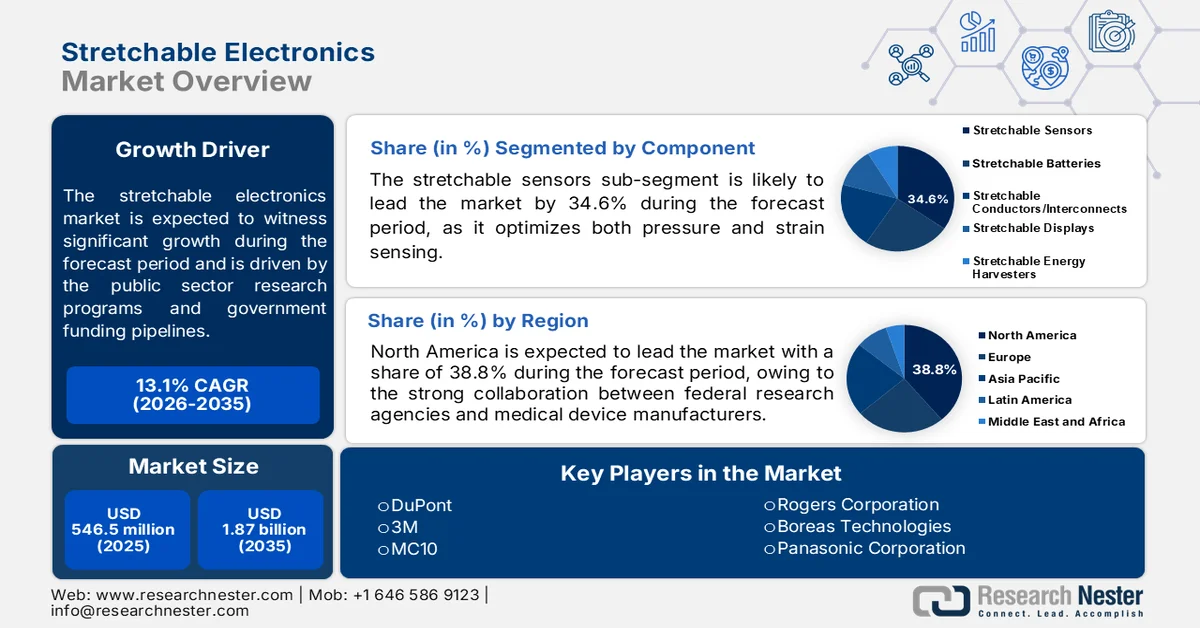
The public sector research programs and funding pipelines indicate a sustained institutional backing for stretchable electronics market, mainly across healthcare, defense, and advanced manufacturing domains. The U.S. National Science Foundation has consistently supported research in soft electronics and advanced materials via programs such as the Division of Materials Research, with a budget exceeding USD 400 million, a portion of which is directed to the mechanically adaptive electronic systems as per the SIA January 2026 data. On the other hand, the NIH April 2025 data highlights that the biointegrated electronics for continuous monitoring allocated over USD 45 billion to medical research, including advanced packaging and test device development. These investments are complemented by defense-led initiatives such as those from the U.S. Department of Defense, where the flexible hybrid electronics are prioritized under the modernization programs, reflecting demand for conformal sensing systems in soldier health monitoring and next-generation communication interfaces.
Manufacturing readiness and commercialization pathways are also being shaped by the government-backed innovation hubs and pilot-scale production initiatives. Moreover, the NLM March 2022 study highlights progress in intrinsically stretchable conductors, addressing key material and performance constraints that have limited large-scale deployment. The integration of liquid metal interconnects with conductivity of 3.8 × 10⁴ S/cm and stretchability up to 400% tensile strain demonstrates significant improvement in maintaining electrical performance under mechanical stress. The ability to sustain over 5,000 deformation cycles under physiological conditions indicates strong durability for long-term medical use. Additionally, the development of conformal electronic patches capable of real-time cardiac monitoring supports the growing demand for implantable healthcare devices. These advancements directly influence supply-side innovation and expand application scope in biomedical electronics, particularly in continuous monitoring, diagnostic systems, and biointegrated therapeutic devices, reinforcing stretchable electronics market growth potential in clinical-grade stretchable systems.
Key Stretchable Electronics Market Insights Summary:
Regional Highlights:
- North America stretchable electronics market is anticipated to capture 38.8% revenue share by 2035, bolstered by strong collaboration between federal research agencies, medical device manufacturers, and defense contractors
- Asia Pacific is forecast to witness a CAGR of 24.3% during 2026–2035, stimulated by aggressive government manufacturing subsidies, consumer electronics integration, and rapid adoption of remote patient monitoring
Segment Insights:
- Stretchable sensors are projected to account for a 34.6% share of the stretchable electronics market by 2035, propelled by increasing commercialization in continuous health monitoring, smart textiles, and human-machine interaction applications
- Healthcare and medical monitoring remains the leading application segment through 2035, reinforced by rising regulatory clearances for stretchable medical devices and advancements in stretchable electrode materials with low-power wireless transmission
Key Growth Trends:
- Defense-led adoption of wearable health monitoring systems
- Translational funding accelerating commercialization of stretchable medical devices
Major Challenges:
- Manufacturing scalability and process control
- High cost of specialized substrates
Key Players: DuPont (U.S.), 3M (U.S.), MC10 (U.S.), Rogers Corporation (U.S.), Boreas Technologies (U.S.), Panasonic Corporation (Japan), Fujikura Ltd. (Japan), Toyobo Co., Ltd. (Japan), Nissha Co., Ltd. (Japan), BASF SE (Germany, Europe), Heraeus Holding (Germany), Imec (Belgium, Europe), PolyIC GmbH (Germany), Samsung Electronics (South Korea), LG Display (South Korea), TDK Corporation (Japan), Jabil Inc. (U.S.), Universal Display Corporation (U.S.), STRL (Japan), FlexEnable (UK).
Global Stretchable Electronics Market Forecast and Regional Outlook:
Market Size & Growth Projections:
- 2025 Market Size: USD 546.5 million
- 2026 Market Size: USD 618.1 million
- Projected Market Size: USD 1.87 billion by 2035
- Growth Forecasts: 13.1% CAGR (2026-2035)
Key Regional Dynamics:
- Largest Region: North America (38.8% Share by 2035)
- Fastest Growing Region: Asia Pacific
- Dominating Countries: China, Japan, South Korea, United States, Germany
- Emerging Countries: India, Canada, France, United Kingdom, Italy
Last updated on : 14 May, 2026
Stretchable Electronics Market - Growth Drivers and Challenges
Growth Drivers
- Defense-led adoption of wearable health monitoring systems: The stretchable electronics market, particularly through defense-backed validation and scaling of wearable technologies, is expanding the adoption. According to the U.S. Department of War, April 2023 data, the RATE program demonstrates institutional demand supported by USD 10 million in additional funding and expansion to 4,500 new users, building on an initial base of 11,000 participants. The program’s AI-enabled wearable systems can detect infections up to 48 hours in advance, with some cases identified up to six days before symptom onset, highlighting real-world performance capabilities. Such deployments validate noninvasive body conformal electronics for continuous monitoring in high-reliability environments. Government-led procurement and pilot-to-program transitions create scalable demand pathways, encouraging suppliers to invest in durable, high-performance stretchable and wearable electronic components for defense and adjacent healthcare applications.
- Translational funding accelerating commercialization of stretchable medical devices: Targeted institutional funding programs are emerging as key enablers in translating the stretchable electronics market from research to market-ready healthcare solutions. According to the OHSU 2023 report, the initiatives, such as the OHSU/OCTRI Device Diagnostic and Software Funding Program, which provides up to USD 40,000 per project for interdisciplinary innovation, support rapid prototyping and validation of medical technologies, including flexible biosensors and wearable diagnostics. These milestone-driven grants help bridge the gap between laboratory research and clinical application, accelerating commercialization pathways. Such funding plays a critical role in strengthening the product pipeline. As more prototypes progress toward regulatory approval and healthcare adoption, these programs indirectly drive stretchable electronics market expansion by ensuring a steady flow of innovative stretchable electronic devices into the global healthcare ecosystem.
- Increasing public funding for soft robotics: Stretchable electronics are critical for soft robotics and advanced human-machine interfaces, both of which receive substantial government funding. These technologies require flexible sensors and actuators that are similar to the human skin and movement. The National Science Foundation (NSF) in the U.S. funds soft robotics research through its Engineering Directorate, with millions allocated annually. In Europe, Horizon Europe supports robotics innovation under its Digital Industry and Space cluster. These programs enable the development of stretchable sensors for prosthetic rehabilitation devices and industrial robotics. Governments are prioritizing automation and assistive technologies to address the labor shortages and aging populations. Further, the stretchable electronics market is becoming a foundational component in next-generation robotics systems, creating strong demand across healthcare, manufacturing, and service industries.
Challenges
- Manufacturing scalability and process control: Transitioning from manual lab fabrication to automated high-volume production is a major roadblock. Many stretchable components rely on manual airbrushing, leading to high variability and low yield. For example, researchers developing automated spray coaters found that while the rougher coating improves the initial yield, they compromise long term reliability. Further achieving fine linewidths in liquid metal deposition causes earlier failure in cycling testing compared to wider lines. This is complicating the scale-up process for wearable sensors.
- High cost of specialized substrates: Stretchable electronics require specialized substrates such as silicones, polyurethanes, or thermoplastic films, which are significantly more expensive than standard rigid PCB materials. Though the company is expanding, the raw material premium erodes profit margins, especially when competing against established rigid electronics. The high entry cost for inventory and specialized supply chains prevents small and medium enterprises from competing with established chemical giants.
Stretchable Electronics Market Size and Forecast:
| Report Attribute | Details |
|---|---|
|
Base Year |
2025 |
|
Forecast Period |
2026-2035 |
|
CAGR |
13.1% |
|
Base Year Market Size (2025) |
USD 546.5 million |
|
Forecast Year Market Size (2035) |
USD 1.87 billion |
|
Regional Scope |
|
Stretchable Electronics Market Segmentation:
Component Segment Analysis
Under the component segment, the stretchable sensors are the leading sub-segment in the stretchable sensors market and are poised to hold the share value of 34.6% by the end of 2035. These sensors are engineered via advanced device architecture designs that optimize both pressure and strain sensing. According to the NLM November 2024 study for pressure sensing, they achieve a high sensitivity of 7.21 kPa⁻¹, a fast response time of 60 ms/30 ms, and excellent operational stability, making them ideal for wearable tactile interfaces and soft robotic skins. As strain sensors, they deliver a gauge factor (GF) of 1.05, a wide detection range from 0 to 300% strain, and robust sensing stability under dynamic deformations such as bending or twisting. These fiber-based sensors accelerate commercialization in continuous health monitoring, smart textiles, and human-machine interaction applications.
Application Segment Analysis
Within the application segment, the healthcare and medical monitoring is the largest sub segment is, leading in the stretchable electronics market. The key products include continuous glucose monitors, EEG/ECG patches, post-operative healing sensors, and smart bandages. The ability to monitor patients wirelessly and comfortably outside clinical settings reduces hospital readmissions and enables early intervention. The Digital Health Innovation Action Plan states that many stretchable or flexible electronic medical devices have received 510(k) clearance. This regulatory momentum directly fuels the demand for stretchable healthcare applications as a primary driver. Further, the ongoing advancements in stretchable electrode materials and low-power wireless transmission are enabling multi-modal sensing (e.g., simultaneous ECG and temperature) on a single conformable patch, which improves diagnostic accuracy and patient compliance.
End user Industry Segment Analysis
The wearable electronics lead the end-user industry segment in the stretchable electronics market. This includes smartwatches with stretchable bands, fitness trackers with conformal sensors, smart clothing with integrated stretchable circuits, and hearables. These products rely on stretchable substrates and interconnects to survive repeated deformation while maintaining electrical performance. According to the NLM February 2025 study, nearly 36.36% of U.S. adults reported using a wearable device to monitor health and/or physical activity. This growing consumer acceptance is pushing the original equipment manufacturers to prioritize comfort and durability, driving further investment in stretchable electronic materials such as thermoplastic polyurethane films and liquid metal interconnects.
Our in-depth analysis of the stretchable electronics market includes the following segments:
|
Segment |
Subsegments |
|
Component |
|
|
Material |
|
|
Application |
|
|
End user Industry |
|
|
Manufacturing Process |
|
|
Substrate |
|
|
Form Factor |
|

Vishnu Nair
Head - Global Business DevelopmentCustomize this report to your requirements — connect with our consultant for personalized insights and options.
Stretchable Electronics Market - Regional Analysis
North America Market Insights
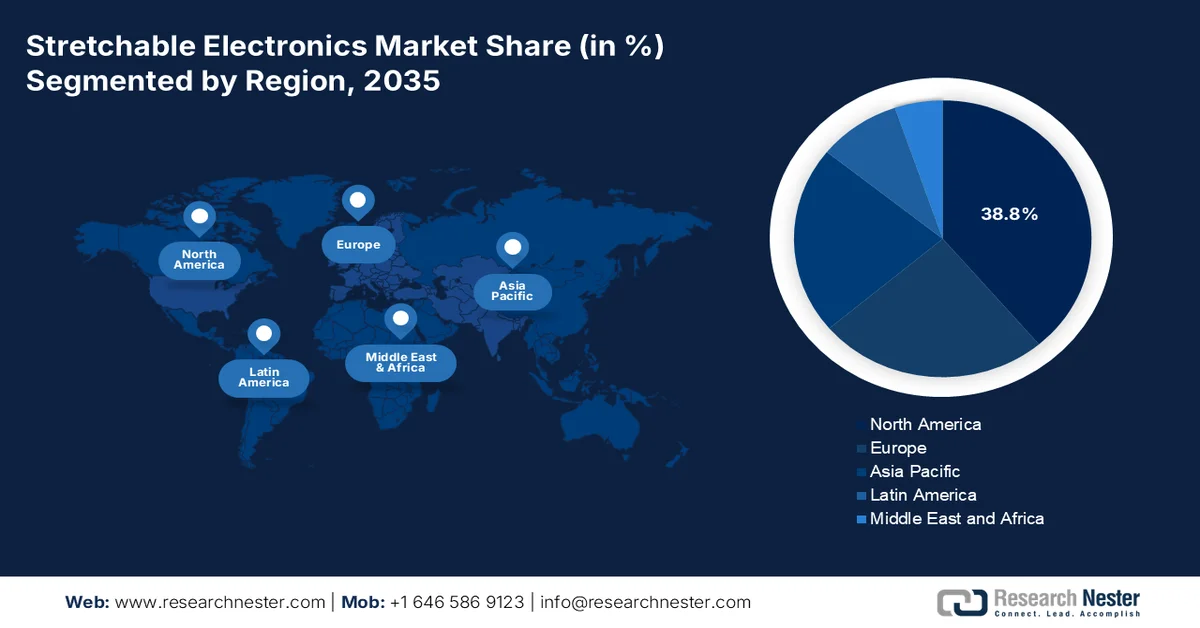
The North America is dominating the stretchable electronics market and is poised to hold the regional revenue share of 38.8% by the end of 2035. The market is defined by the strong collaboration between federal research agencies, medical device manufacturers, and defense contractors. The U.S. leads in material innovation and regulatory pathway development with a mature ecosystem of suppliers offering stretchable conductive inks, elastomeric substrates, and hybrid integration services. Canada complements this landscape with a focus on cold climate reliability engineering and remote healthcare deployment models tailored to northern and indigenous communities. Cross-border supply chains are emerging, particularly for the stretchable medical patches and industrial monitoring sensors. The region benefits from the early adoption of wearable health technologies by both healthcare providers and consumers, creating pull-through demand for component manufacturers. Regulatory harmonization between the FDA and Health Canada is accelerating product launches, thus expanding the regional growth.
The combination of clinical demand and robust federal research funding is driving the stretchable electronics market in the U.S. According to the NIH, October 2023 data, the NHLBI-funded research at Weill Cornell is advancing stretchable cardiac mapping technologies to address atrial fibrillation, a condition requiring intervention in nearly 20,000 high-risk U.S. patients annually. These innovations highlight the rising demand for conformal high-precision biosensors in minimally invasive procedures. On the other hand, federal agencies, including the NIH, NSF, and U.S. Department of Energy, are investing in next-generation materials such as eco-friendly ferroelectric polymers for wearable sensors. Additionally, the advancements, such as Voltera in October 2022, announced the launch of NOVA, which is used by MIT researchers and is accelerating the prototyping of flexible electronics. This integrated ecosystem of healthcare needs, government funding, and rapid innovation is positioning the U.S. as a key growth hub for stretchable electronics.
Strong federal investment in innovation and advanced manufacturing is driving the stretchable electronics market in Canada. According to the Government of Canada, October 2025 data, the Strategic Innovation Fund (SIF) has committed USD 8.2 billion, leveraging nearly USD 72 billion in private sector investments, demonstrating a powerful 9:1 investment multiplier. This funding has supported over 113,000 full-time jobs, strengthening the country’s high-tech workforce. Additionally, Government of Canada August 2024 data, the federal science and technology spending increased to USD 16.4 billion, with R&D expenditures reaching USD 9.7 billion, reflecting a growing emphasis on next-generation materials and electronics. These investments directly benefit the sectors such as flexible and printed electronics, enabling companies to scale innovation. Further, Canada continues to expand its R&D ecosystem and attract private capital, the stretchable electronics market is poised for sustained growth.
APAC Market Insights
The Asia Pacific is projected to emerge as the fastest-growing region in the stretchable electronics market and is expected to expand at a CAGR of 24.3% during the assessed period, 2026 to 2035. The segment is driven by the aggressive government manufacturing subsidies, consumer electronics integration, and rapid adoption of remote patient monitoring. Japan leads in stretchable display and printed sensor technologies supported by the manufacturing initiative. South Korea focuses on stretchable OLED displays and automotive interior sensors under the MOTIE’s program. China emphasizes volume production of stretchable medical patches and smart textiles via provincial-level industrial policies. The region benefits from dense electronics supply chains, lower labor costs, and government export incentives. Cross-border trade agreements facilitate component movement between Japan (substrates), China (assembly), and South Korea (display modules).
The Japan stretchable electronics market is driven by the strong innovation in nanomaterials and flexible energy systems. In 2025, the market reached USD 103.9 million, and by 2035, the market is set to reach USD 571.6 million at a CAGR of 19.5% and the 2026 market value is projected to reach USD 124.2 million. According to the NLM May 2024 study, the developments using single-walled carbon nanotube (SWCNT) based inks have enabled stretchable thermoelectric generators capable of producing 10.4 mV output and 0.21 μW power under the temperature gradients supporting self-powered IoT sensors and wearable devices. These low-cost, flexible generators fabricated on the paper substrates highlight Japan’s leadership in sustainable and comfortable electronics. Additionally, the Science Japan August 2025 indicates that the foldable electronic systems demonstrating over 500 flexible hinges integrated with 145 LEDs showcase practical applications in displays and smart surfaces. Such innovations are critical for the next generation of applications in healthcare, monitoring, robotics, and industrial IoT. Backed by strong R&D capabilities in advanced materials and electronics, Japan is positioning itself as a key innovation hub driving future growth in stretchable electronics.
Government-backed innovation and localization of critical materials are shaping the stretchable electronics market in India. According to the PIB January 2025 data, the Ministry of Electronics and Information Technology supported the development and transfer of the silver nanowire-based conductive ink technology to startups at the IIT Ropar and NIT Warangal, strengthening domestic capabilities in flexible electronics. Moreover, India imports conductive ink worth USD 1.57 million annually, highlighting the opportunity for import substitution and local manufacturing. The global stretchable electronics market for such conductive inks is projected to exceed USD 16.87 billion by 2032, indicating the strong future demand. These inks are essential for applications in wearables, sensors, RFID, and display technologies. By boosting the academic industry collaboration and promoting indigenous production, India is building a robust supply chain and innovation ecosystem, positioning itself as a high-growth market for stretchable electronics.
Europe Market Insights
The stretchable electronics market in Europe is shaped by strong regulatory frameworks, cross-border research collaborations, and a mature healthcare reimbursement environment. Germany leads in industrial automation integration, where stretchable strain sensors are embedded into the automotive assembly lines and robotic systems. France focuses on home healthcare applications with a dense network of research institutions commercializing skin attachable diagnostic patches. The European Medicines Agency provides clear clinical evaluation pathways, reducing time-to-market for manufacturers. Public procurement programs across multiple member states create a predictable demand for stretchable ECG patches, smart bandages, and continuous glucose monitors. Moreover, the cross-border supply chains benefit from harmonized CE marking standards, enabling component suppliers to serve multiple national markets efficiently.
A robust research and development ecosystem and a strong industrial base are shaping the stretchable electronics market in Germany. According to the Belfer Center 2025 data, the country invested 3.13% of GDP in R&D in 2022, with a strategic target to reach 3.5% by 2025, reflecting long-term government commitment to high-tech innovation. Moreover, the total R&D spending rose by 7% in 2022, reaching a record level, while business enterprises contributed USD 88.3 billion, accounting for over two-thirds of total investment. Additionally, Germany has consistently exceeded the EU’s 3% R&D benchmark for six consecutive years, reinforcing its position as a leading innovation hub. These investments are accelerating advancements in advanced materials, flexible electronics, and Industry 4.0 technologies, supporting commercialization and positioning Germany as a key growth stretchable electronics market for stretchable electronics in Europe.
The targeted government investment and a rapidly evolving semiconductor ecosystem are fueling the stretchable electronics market in the UK. According to the UK government's September 2025 data, the UK government announced a USD 12.7 million Innovate UK fund to support nearly 40 companies in advancing semiconductor and flexible electronics technologies, including graphene-based and wearable device innovations. This funding accelerates the transition from lab-scale research to commercial production, mainly in applications such as smart wearables, medical devices, and industrial sensors. Additionally, the UK semiconductor sector is projected to grow by 75% by 2030, reflecting a strong future demand for advanced electronic components. With companies such as Arm and Paragraf leading innovation and increasing access to specialized manufacturing facilities, the UK is strengthening its position as a key hub for stretchable electronics development and commercialization.
Key Stretchable Electronics Market Players:
- DuPont (U.S.)
- 3M (U.S.)
- MC10 (U.S.)
- Rogers Corporation (U.S.)
- Boreas Technologies (U.S.)
- Panasonic Corporation (Japan)
- Fujikura Ltd. (Japan)
- Toyobo Co., Ltd. (Japan)
- Nissha Co., Ltd. (Japan)
- BASF SE (Germany, Europe)
- Heraeus Holding (Germany)
- Imec (Belgium, Europe)
- PolyIC GmbH (Germany)
- Samsung Electronics (South Korea)
- LG Display (South Korea)
- TDK Corporation (Japan)
- Jabil Inc. (U.S.)
- Universal Display Corporation (U.S.)
- STRL (Japan)
- FlexEnable (UK)
- Company Overview
- Business Strategy
- Key Product Offerings
- Financial Performance
- Key Performance Indicators
- Risk Analysis
- Recent Development
- Regional Presence
- SWOT Analysis
- DuPont leverages its advanced materials science to produce stretchable conductive inks and substrates under the DuPont brand. These solutions enable wearable health monitors, smart clothing, and automotive interior sensors. DuPont focuses on strategic partnerships with OEMs and contract manufacturers to integrate the stretchable circuits into mass-produced devices. In 2024, the company made net sales of USD 3.1 billion.
- 3M capitalizes on its expertise in adhesives, dielectric materials, and microreplication technologies to offer stretchable electronic tapes, breathable electrode patches, and conformable circuit laminates. The company targets medical monitoring devices and conformable circuit laminates. The company targets medical monitoring devices, skin attachable sensors, and robotic applications. According to the 2024 annual report, the company has made a net sale of USD 11 billion.
- MC10 is a key innovator in the stretchable electronics market, recognized for its ultrathin conformable sensors enabled by its patented stretchable circuit platform using serpentine metal interconnects encapsulated in soft silicone. The company has shifted from pure hardware manufacturing to licensing its intellectual property and co-developing products with large medical device companies.
- Rogers Corporation provides high-performance silicon elastomers and bonding films that serve as stretchable substrates and dielectric layers for flexible hybrids. These materials support signal integrity in stretchable antennas, EMI shielding, and wearable defibrillator pads. The company prioritizes thermal management solutions, thereby differentiating purely conductive ink-based competitors.
- Boreas Technologies participates in the stretchable electronics market via its ultra-low power haptic actuators and sensor interfaces designed for stretchable skin-worn devices. Boreas’s piezoelectric actuators ICs can be embedded into stretchable textile patches and smart bandages to provide tactile feedback for remote patient monitoring.
Here is a list of key players operating in the global stretchable electronics market:
The stretchable electronics market is highly competitive and is driven by the demand for wearables, medical sensors, and flexible displays. The key players focus on strategic initiatives such as partnerships, novel material development, and capacity expansions. The key players focus on strategic initiatives such as partnerships, novel material development, and capacity expansions. The U.S.-based firms lead in R&D for health monitoring patches, while the Europe and Japan players excel in high-precision printing and stretchable circuits. South Korea and China entities invest heavily in display integration. Startups in India and Malaysia are emerging in low-cost stretchable substrates. Mergers, acquisitions, and government-funded projects are common to accelerate the commercialization and reduce the manufacturing costs. For example, in November 2025, Universal Display Corporation announced that it had entered into a definitive agreement to acquire OLED patent assets from Merck KGaA, Darmstadt, Germany, a leading science and technology company.
Corporate Landscape of the Stretchable Electronics Market:
Recent Developments
- In November 2024, LG Display announced the unveiling of the world’s first Stretchable display capable of expanding up to 50%, the highest rate of elongation in the industry. At LG Science Park in Seoul on Nov. 8, the company demonstrated the panel at a meeting of more than 100 South Korean industry, academia, and research stakeholders involved in a Stretchable display national project.
- In May 2024, STRL has developed a full-color stretchable display with liquid metal stretchable wiring and micro-LEDs on a flexible rubber substrate. If this technology is put into practical use, it will be possible in the future, for example, to create dome-shaped displays that envelop viewers with images, allowing them to enjoy immersive and realistic visual experiences.
- In January 2024, FlexEnable announced the launch of optical evaluation kits for AR and VR devices. The kits include ambient dimming and tunable lens film modules made using FlexEnable’s flexible liquid crystal (LC) technology. These uniquely thin and light active optics bring game-changing optical performance to AR/VR and allow significantly smaller, lighter and curved devices, key factors in achieving the visual and physical comfort necessary for all-day wearability and sustained adoption.
- Report ID: 6879
- Published Date: May 14, 2026
- Report Format: PDF, PPT
- Explore a preview of key market trends and insights
- Review sample data tables and segment breakdowns
- Experience the quality of our visual data representations
- Evaluate our report structure and research methodology
- Get a glimpse of competitive landscape analysis
- Understand how regional forecasts are presented
- Assess the depth of company profiling and benchmarking
- Preview how actionable insights can support your strategy
Explore real data and analysis
Frequently Asked Questions (FAQ)
About this Report
Connect with our Expert


Report, 2026-2035



Copyright @ 2026 Research Nester. All Rights Reserved.
