IoT in Consumer Electronics Market Outlook:
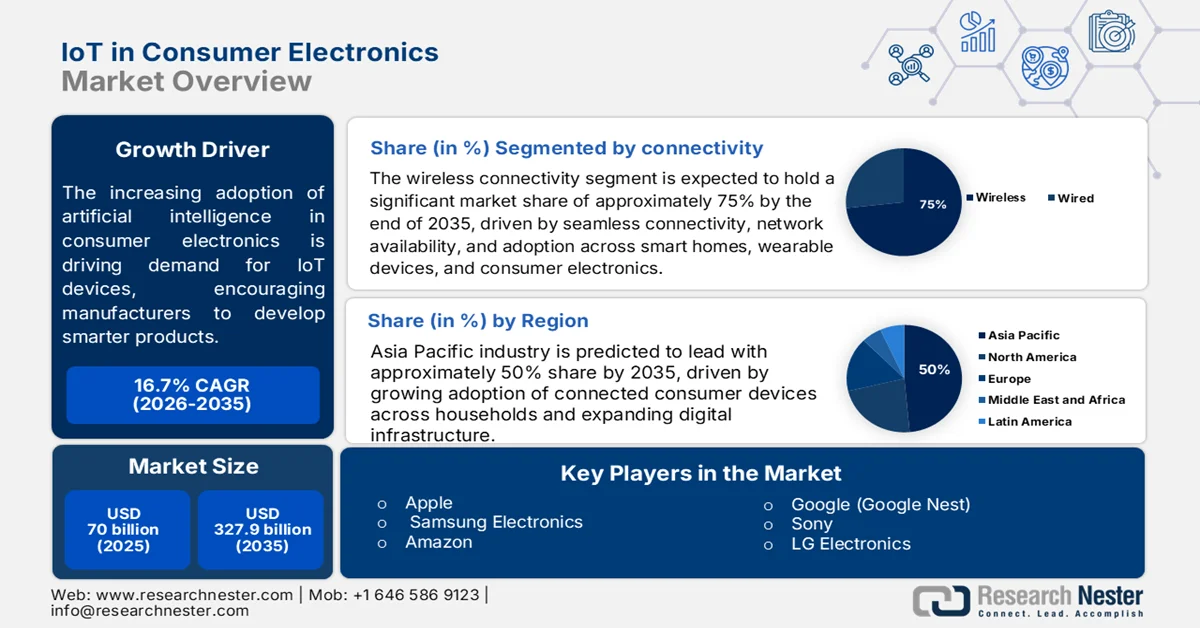
Iot in Consumer Electronics Market size was valued at USD 70 billion in 2025 and is predicted to cross USD 327.9 billion by the end of 2035, expanding at more than 16.7% CAGR during the forecast period, i.e., 2026-2035. In 2026, the industry size of IoT in consumer electronics is estimated at USD 81.7 billion.
The global IoT in consumer electronics market is experiencing steady growth, owing to the increasing adoption of smart home ecosystems and connected consumer devices. The rising number of consumers who are opting for convenience, automation, and seamless connectivity has accelerated the demand for IoT-enabled products such as smart speakers, smart appliances, smart televisions, and home security systems.
The IoT in consumer electronics market is benefiting from the increasing availability of high-speed internet connectivity and advancements in wireless communication technologies such as 5G and Wi-Fi, which make it easier for consumers to connect and manage multiple smart devices. According to the Organisation for Economic Co-operation and Development (OECD), connected home devices are among the major applications of the Internet of Things (IoT), which reflects the increasing use of connected technologies across households. This trend is one of the reasons for the demand for IoT- enabled consumer electronics.
Key IoT in Consumer Electronics Market Insights Summary:
Regional Highlights:
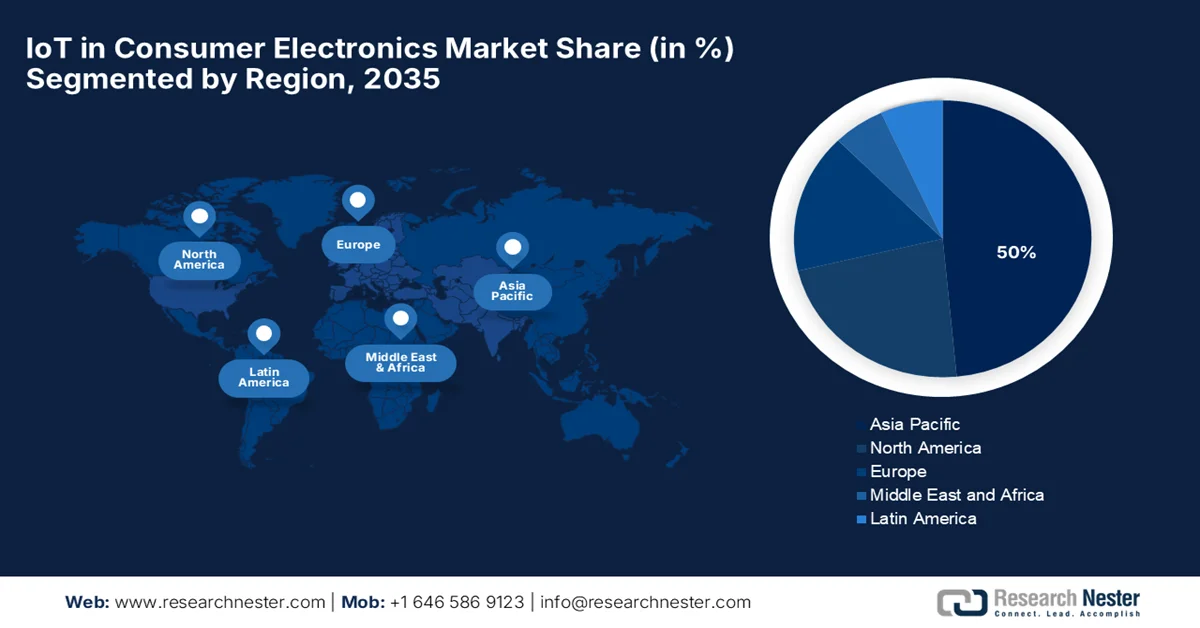
- Asia Pacific is projected to command 50% of the IoT in consumer electronics market by 2035, propelled by the increasing adoption of connected consumer devices, rising demand for smart home technologies, expanding internet connectivity, and the presence of major consumer electronics manufacturers
- North America is expected to register robust growth throughout 2026-2035, supported by the widespread use of connected consumer devices, expanding smart home deployments, advanced digital infrastructure, and the presence of leading technology companies
Segment Insights:
- IoT in consumer electronics market smartphone is anticipated to secure a leading share by 2035, fueled by its role as the primary interface for managing connected consumer electronics and widespread global smartphone adoption
- Wireless is forecast to account for 75% of the market by 2035, reinforced by the growing adoption of wireless communication technologies across IoT-enabled consumer devices
Key Growth Trends:
- Expansion of 5G and high-speed internet connectivity
- Increasing availability of affordable sensors and IoT components
Major Challenges:
- Data privacy and cybersecurity risks
- Lack of common standards across connected devices
Key Players: Apple (U.S.), Samsung Electronics (South Korea), Amazon (U.S.), Google (Google Nest) (U.S.), Sony (Japan), LG Electronics (South Korea), Xiaomi (China), Panasonic (Japan), Bosch (Germany), Haier (China), Hisense (China).
Global IoT in Consumer Electronics Market Forecast and Regional Outlook:
Market Size & Growth Projections:
- 2025 Market Size: USD 70 billion
- 2026 Market Size: USD 81.7 billion
- Projected Market Size: USD 327.9 billion by 2035
- Growth Forecasts: 16.7% CAGR (2026-2035)
Key Regional Dynamics:
- Largest Region: Asia Pacific (50% share by 2035)
- Fastest Growing Region: North America
- Dominating Countries: China, United States, Japan, South Korea, Germany
- Emerging Countries: India, Vietnam, Indonesia, Brazil, Thailand
Last updated on : 23 July, 2026
IoT in Consumer Electronics Market - Growth Drivers and Challenges
Growth Drivers
- Expansion of 5G and high-speed internet connectivity: Connected communication devices’ widespread adoption is one of the prominent reasons for the growth of 5G networks. This has spurred the development and deployment of high-speed broadband infrastructure, which supports the adoption of IoT-enabled consumer electronics by enabling faster, more reliable, and low-latency communication. For overall user experience across smart homes and connected devices, faster and more reliable networks can allow consumers to seamlessly connect and manage multiple smart devices. According to the OECD, 5G is the first mobile communication standard conceived with the Internet of Things (IoT) in mind and is designed to support diverse IoT applications with varying connectivity requirements The continued demand for 5G infrastructure is expected to accelerate the adoption of IoT-enabled consumer electronics. The continued demand for 5G infrastructure is expected to accelerate the adoption of IoT-enabled consumer electronics.
- Increasing availability of affordable sensors and IoT components: One of the favorable factors aiding rampant consumer electronic production is the rising availability of affordable sensors, processors, and communication modules. Continuous use of semiconductor technologies has reduced the cost and size of electronic components, enabling manufacturers to integrate IoT capabilities into a wide range of consumer devices, including wearables, smart appliances, and home automation products. According to the U.S. Government Accountability Office (GAO), electronic processors and sensors have become smaller in size and less costly, which makes it easier to equip everyday products with IoT capabilities and contributes to the rapid proliferation of connected devices. The ongoing advancement of electronic components is expected to support the growth of the IoT in consumer electronics market.
- Growing government support for IoT standards and smart infrastructure: Governments are taking initiatives to promote the development of IoT ecosystems via technical standards, smart infrastructure initiatives, and cybersecurity frameworks. These initiatives are encouraging the use across all different IoT- enabled devices. The U.S. Consumer Product Safety Commission (CPSC) is working with standards organizations to develop and revise voluntary standards for connected consumer products, including software cybersecurity and remote software updates for IoT devices. Such initiatives are supporting the wider adoption of IoT-enabled consumer electronics.
Challenges
- Data privacy and cybersecurity risks: The growing number of connected consumer devices has increased concerns regarding data privacy and cybersecurity.There is continuous data collection and exchange by IoT-enabled devices, which makes them vulnerable to cyberattacks, unauthorized access, and data breaches if appropriate security measures are not implemented. According to the U.S. Cybersecurity and Infrastructure Security Agency (CISA), low-security IoT devices can expose their users and networks to cyber threats and may be exploited to gain unauthorized access to connected systems. These security concerns are one of the reasons that may limit consumer confidence and restrain the adoption of IoT-enabled consumer electronics.
- Lack of common standards across connected devices: The growing use of IoT devices from different manufacturers has created challenges related to device compatibility and interoperability. Because of these differences, it can affect the ability of connected devices to function together efficiently, therefore reducing the overall user experience. According to the National Institute of Standards and Technology (NIST), the absence of common standards and interoperability remains one of the major challenges for IoT systems. These issues may slow the use of IoT-enabled consumer electronics across households.
IoT in Consumer Electronics Market Size and Forecast:
| Report Attribute | Details |
|---|---|
|
Base Year |
2025 |
|
Forecast Period |
2026-2035 |
|
CAGR |
16.7% |
|
Base Year Market Size (2025) |
USD 70 billion |
|
Forecast Year Market Size (2035) |
USD 327.9 billion |
|
Regional Scope |
|
IoT in Consumer Electronics Market Segmentation:
Connectivity Segment Analysis
Based on the connectivity segment, the wireless sub-segment is anticipated to account for approximately 75% of the IoT in consumer electronics market share by the end of 2035. The growth of this sub-segment is mainly supported by the growing adoption of wireless communication technologies across connected consumer electronics. Smartphones, smart TVs, wearable devices, kitchen appliances, printers, security cameras, and other IoT-enabled devices widely use wireless connectivity to enable data transmission, remote control, and smart features. According to the Wi-Fi Alliance, Wi-Fi serves as the primary wireless technology for connecting billions of devices across homes, enterprises, and public environments, that can support a wide range of connected applications. The global availability of Wi-Fi networks and its compatibility with various consumer devices continue to support the dominance of this sub-segment.
Product Type Segment Analysis
Based on the product type segment, the smartphone sub-segment is anticipated to ascribe to a noteworthy share in the forthcoming years. The rise of the segment is mainly because of the global use of smartphones as the primary device for internet access and for managing connected consumer electronics, including home devices, wearable devices, and other IoT-enabled products. According to the World Bank, mobile cellular subscriptions in 2025 exceeded approximately 112 subscriptions per 100 people globally in the latest available data, reflecting the extensive use of mobile communication devices worldwide. Moreover, smartphones continue to serve as the primary interface for controlling and monitoring connected devices, which is expected to support the dominance of this sub-segment throughout the forecast period.
Our in-depth analysis of the IoT in consumer electronics market includes the following segments:
|
Segment |
Sub-segment |
|
Product Type |
|
|
Technology |
|
|
Application |
|
|
Connectivity |
|

Vishnu Nair
Head - Global Business DevelopmentCustomize this report to your requirements — connect with our consultant for personalized insights and options.
IoT in Consumer Electronics Market - Regional Analysis
APAC Market Insights
Asia Pacific witnesses the largest share of the global IoT in consumer electronics market and is anticipated to grow to approximately 50% by the end of 2035. The regional growth is driven by the increasing adoption of connected consumer devices, rising demand for smart home technologies, expanding internet connectivity, and the presence of major consumer electronics manufacturers. There are government initiatives that are supporting digital transformation and the growing use of IoT across households is also contributing to market growth in the region.
In the Asia Pacific IoT in consumer electronics market, Japan is expected to hold a significant share owing to the country's continued focus on digital transformation. According to the Government of Japan, the Society 5.0 initiative promotes the use of IoT and other digital technologies across the market. This is anticipated to encourage the use of connected consumer devices.
China IoT in consumer electronics market is expected to witness steady growth due to the rising use of connected consumer devices. According to the State Council January 2025 data, China had approximately 1.1 billion internet users by the end of 2024. This is contributing to the increasing use of IoT-enabled consumer electronics in the country.
North America Market Insights
North America is expected to account for a significant share in the IoT in consumer electronics market during the forecast period. The regional market is driven by the high use of connected consumer devices, increasing deployment of smart home technologies, and the availability of advanced digital infrastructure. Across the region, the presence of major consumer electronics manufacturers and technology companies is further supporting market growth, along with growing consumer preference for connected lifestyles.
The U.S. is expected to dominate the North America IoT in consumer electronics market owing to the global use of connected consumer devices and advanced digital infrastructure. Smartphones continue to be the primary interface for managing smart home ecosystems, while high broadband availability supports seamless device connectivity. In 2024, the U.S. FCC established the voluntary U.S. Cyber Trust Mark program for wireless consumer IoT products, which includes smart home devices, security cameras, fitness trackers, and connected appliances, this program is designed to help consumers to identify products that meet cybersecurity requirements while encouraging manufacturers to improve the security of connected devices.
Due to the rising adoption of smart home technologies in IoT consumer electronics market, Canada is anticipated to witness gradual growth. According to Statistics Canada, 96.4% of Canadian households had access to unlimited broadband internet services with download speeds of at least 50 Mbps in 2024. This is supporting the use of connected consumer devices and contributing to the growth of the IoT consumer electronics market in the country.
Europe Market Insights
Europe is predicted to account for a prominent revenue share of the IoT in consumer electronics market during the assessment period. According to the Internet Society, IoT includes a wide range of internet-connected consumer products such as smart home devices, wearables, and household appliances that increase convenience and connectivity. The growing use of these connected devices is expected to support the IoT consumer electronics market across the region.
The U.K. is expected to hold a significant share of the Europe IoT in consumer electronics market owing to the increasing adoption of connected technologies. According to the U.K. Government, gigabit-capable broadband coverage passed 152,700 premises during 2024-2025, totaling 1.2 million premises. The improved broader availability of high-speed broadband is supporting the use of connected consumer devices across the country.
Germany is anticipated to witness steady growth in the IoT in consumer electronics market because of the increasing demand for smart living technologies. According to the German Electro and Digital Industry Association (ZVEI), connected home technologies and digital consumer solutions continue to play an important role in the country's electrical and digital industry. This is one of the reasons for the demand of IoT-enabled consumer electronics in Germany.
Key IoT in Consumer Electronics Market Players:
- Apple (U.S.)
- Samsung Electronics (South Korea)
- Amazon (U.S.)
- Google (Google Nest) (U.S.)
- Sony (Japan)
- LG Electronics (South Korea)
- Xiaomi (China)
- Panasonic (Japan)
- Bosch (Germany)
- Haier (China)
- Hisense (China)
- Whirlpool Corporation (U.S.)
- Philips (Netherlands)
- Company Overview
- Business Strategy
- Key Product Offerings
- Financial Performance
- Key Performance Indicators
- Risk Analysis
- Recent Development
- In the IoT consumer electronics market, through its smart devices such as iPhone, Apple Watch, HomePod, Apple TV, and HomeKit-enabled smart home devices, Apple Inc. holds a strong place. The company focuses on seamless device connectivity across devices supported by AI-driven technologies.
- Samsung Electronics Co., Ltd. is a leading provider which has a broad portfolio of consumer electronics, which includes smart TVs, smartphones, home appliances, wearables, and SmartThings-enabled devices. The company highlights AI-powered automation, cross-device interoperability, and increased use of its connected home ecosystem.
- Amazon.com, Inc. shows a promising place in the smart home segment because of its Alexa-enabled Echo devices, Ring security solutions, Blink cameras, and Fire TV products. The company is paying attention on its IoT devices' features by increasing voice-enabled services, home automation capabilities, and connected device integration.
Here is a list of key players operating in the global market:
The IoT in consumer electronics market is highly competitive, and leading companies that includes as Apple, Samsung, Amazon, Google, and Xiaomi, which are competing through integrated smart ecosystems alongside smartphones, smart home devices, wearables, and AI-powered platforms. Competition is primarily driven by ecosystem lock-in strategies that uses platforms such as Alexa, Google Assistant, and Siri, along with rapid growth in markets like Asia Pacific. Market’s known players are also paying attention to technological innovation such as edge AI, 5G connectivity, and smart automation to increase user experience. Moreover, players are investing in partnerships, acquisitions, and supply chain optimization to strengthen their IoT portfolios and maintain cost efficiency in a rapidly growing connected consumer electronics market.
Corporate Landscape of the Market:
Recent Developments
- In April 2026, Amazon announced the addition of Globalstar to strengthen its Amazon Leo satellite network and increase direct-to-device connectivity services, while also going into an agreement with Apple to support satellite features on iPhone and Apple Watch devices.
- In January 2025, Samsung Electronics unveiled its next-generation AI-powered consumer electronics portfolio at CES 2025, which introduces enhanced SmartThings integration and AI-enabled home appliances to strengthen its connected smart home ecosystem.
- In July 2024, LG Electronics acquired Dutch smart home platform Athom B.V. 80% stakes to strengthen LG’s AI-powered smart home ecosystem and expand connectivity across third-party IoT devices through the LG ThinQ platform.
- Report ID: 8691
- Published Date: Jul 23, 2026
- Report Format: PDF, PPT
- Explore a preview of key market trends and insights
- Review sample data tables and segment breakdowns
- Experience the quality of our visual data representations
- Evaluate our report structure and research methodology
- Get a glimpse of competitive landscape analysis
- Understand how regional forecasts are presented
- Assess the depth of company profiling and benchmarking
- Preview how actionable insights can support your strategy
Explore real data and analysis
Frequently Asked Questions (FAQ)
About this Report
Connect with our Expert


Report, 2026-2035



Copyright @ 2026 Research Nester. All Rights Reserved.
