Electromagnetic Compatibility Shielding Market Outlook:
Electromagnetic Compatibility Shielding Market size was valued at USD 9.3 billion in 2025 and is projected to exceed USD 18.3 billion by the end of 2035, rising at a 7% CAGR during the forecast period, i.e., 2026-2035. In 2026, the industry size of electromagnetic compatibility shielding is estimated at USD 9.9 billion.
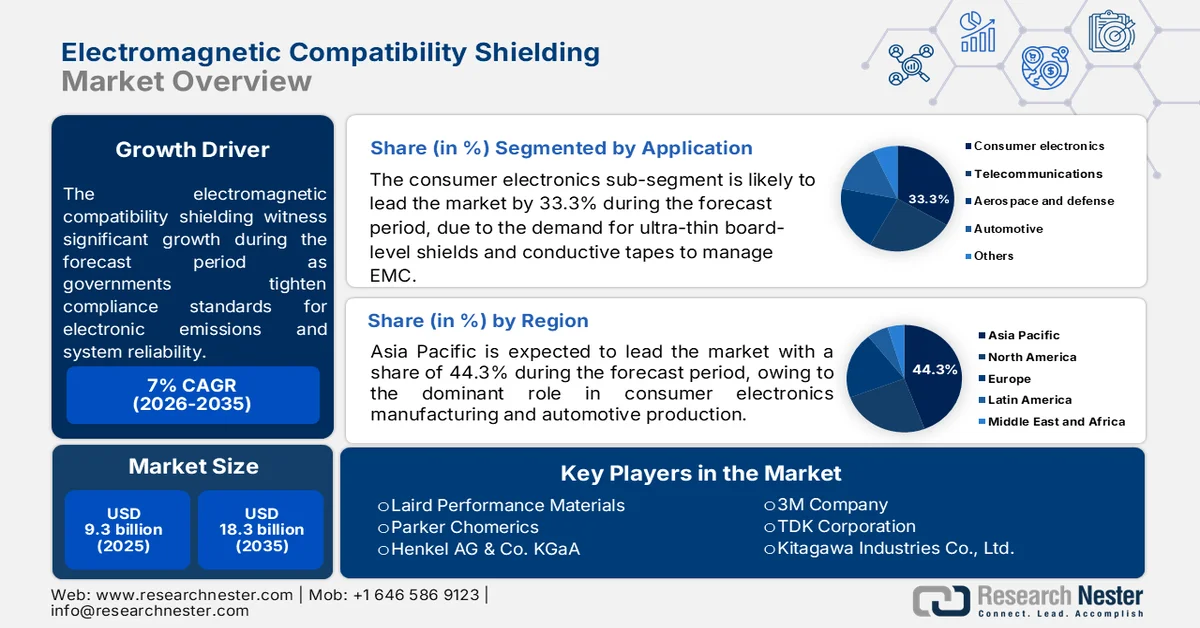
The electromagnetic compatibility shielding market demand is expanding across automotive electronics, aerospace systems, telecommunications infrastructure, and medical equipment manufacturing as governments tighten compliance standards for electronic emissions and system reliability. The U.S. Federal Communications Commission (FCC) continues to enforce equipment authorization requirements for radiofrequency devices under Part 15 regulations, directly influencing shielding material adoption across consumer electronics, industrial automation, and connected devices. According to the International Energy Agency, May 2025 data, global electric car sales exceeded 17 million units in 2024, compared to the previous year, increasing integration of high-voltage battery systems, onboard chargers, sensors, and advanced driver assistance electronics that require robust shielding architectures to prevent electromagnetic interference.
Besides, the International Telecommunication Union (ITU) November 2025 data reported that global internet usage reached approximately 5.8 billion people in 2024, supporting sustained investment in 5G infrastructure, edge computing equipment, and data transmission systems, where EMC performance remains a procurement priority. Aerospace and defense programs are also reinforcing market demand. The U.S. Department of War March 2024 data, the government requested USD 849.8 billion for FY2025 defense spending, supporting procurement of radar systems, avionics, unmanned systems, and electronic warfare platforms that rely heavily on conductive coatings, shielding gaskets, and metal enclosures for operational reliability in high-frequency environments. Supply chain activity is also increasing in Asia-Pacific and North America due to semiconductor investments supported by public-sector funding programs, including the U.S. CHIPS and Science Act, which is encouraging new fabrication capacity and advanced electronics production where EMC compliance remains mandatory across production and end-use environments.
Key Electromagnetic Compatibility Shielding Market Insights Summary:
Regional Highlights:
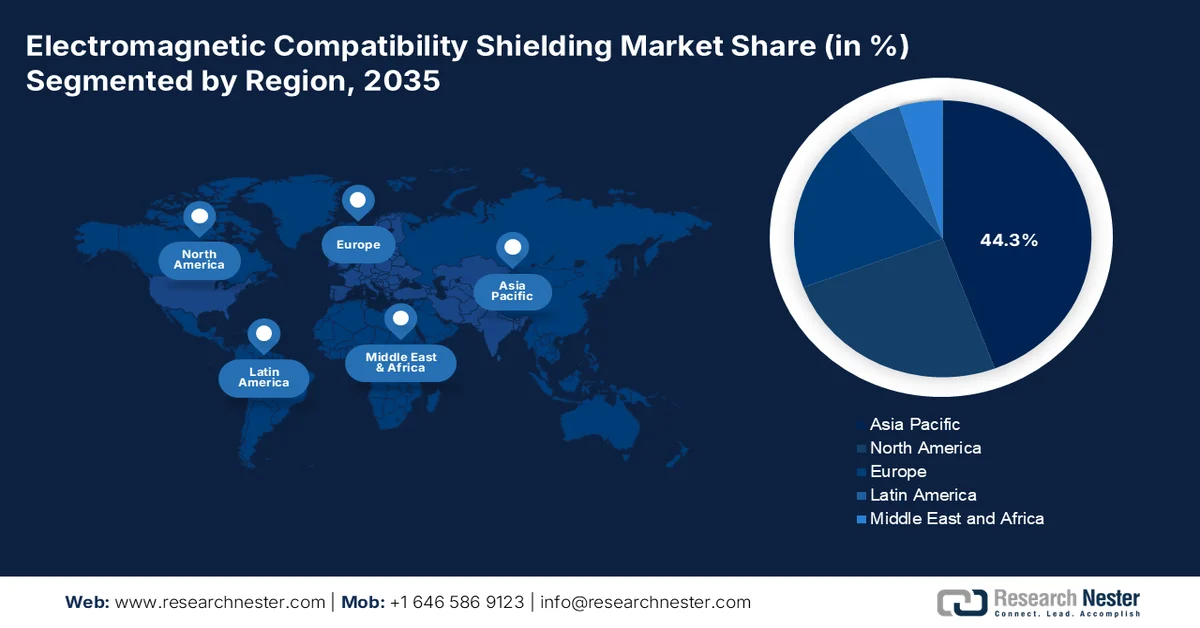
- The Asia Pacific electromagnetic compatibility shielding market is anticipated to secure 44.3% revenue share by 2035, stimulated by strong consumer electronics manufacturing, expanding automotive production, and rapid 5G telecommunications infrastructure deployment
- North America is forecast to witness rapid growth during 2026-2035, attributed to stringent regulatory enforcement and rising demand for shielding solutions across EVs, medical devices, telecommunications, and defense applications
Segment Insights:
- The consumer electronics segment of the electromagnetic compatibility shielding market is projected to capture 33.3% share by 2035, propelled by rising demand for ultra-thin board-level shields and conductive tapes to control EMC issues from 5G antennas, processors, and wireless charging modules
- The automotive and transportation industry segment is anticipated to maintain a dominant position in the electromagnetic compatibility shielding market through 2035, fueled by increasing deployment of conductive gaskets and metal enclosures for EV inverters, radar sensors, battery management systems, and ADAS applications
Key Growth Trends:
- Expansion of space, satellite, and aerospace electronics programs
- Rapid growth in electric vehicle
Major Challenges:
- Miniaturization of electronic devices
- Raw material price volatility
Key Players: Laird Performance Materials, Parker Chomerics, Henkel AG & Co. KGaA, 3M Company, TDK Corporation, Kitagawa Industries Co., Ltd., RTP Company, Schaffner Holding AG, ETS-Lindgren, Tech-Etch, Inc., Orion Industries Inc., W.L. Gore & Associates, PPG Industries, NEC-Tokin, Marian Inc., CGC Precision Technology, Seiren Co., Ltd., Nolato, DuPont, LBA Technology.
Global Electromagnetic Compatibility Shielding Market Forecast and Regional Outlook:
Market Size & Growth Projections:
- 2025 Market Size: USD 9.3 billion
- 2026 Market Size: USD 9.9 billion
- Projected Market Size: USD 18.3 billion by 2035
- Growth Forecasts: 7% CAGR (2026-2035)
Key Regional Dynamics:
- Largest Region: Asia Pacific (44.3% Share by 2035)
- Fastest Growing Region: North America
- Dominating Countries: United States, China, Japan, Germany, South Korea
- • Emerging Countries: India, Brazil, Vietnam, Indonesia, Mexico
Last updated on : 27 May, 2026
Electromagnetic Compatibility Shielding Market - Growth Drivers and Challenges
Growth Drivers
- Expansion of space, satellite, and aerospace electronics programs: Government-funded satellite launches, deep space exploration missions, and commercial aerospace expansion are increasing EMC shielding demand for the communication modules, navigation systems, and onboard electronic assemblies. According to the SEC May 2025 data, NASA’s FY2025 budget request exceeds USD 25 billion, supporting missions involving advanced avionics satellite payloads and space communication systems requiring electromagnetic isolation. Space electronics operate in high radiation and high frequency environments where EMI protection is critical for mission reliability. EMC shielding manufacturers are increasingly developing lightweight composite shielding materials for aerospace and low-earth-orbit satellite applications.
- Rapid growth in electric vehicle: Government-backed electrification policies are increasing the EMC shielding demand across battery systems, power converters, inverters, charging modules, and autonomous driving electronics. The International Energy Agency 2026 data reported that global electric car sales reached 20 million, supported by subsidies, emission reduction programs, and public charging investments across China, Europe, and North America. High-voltage architectures generate electromagnetic interference risks, making conductive foams, shielding tapes, and thermal EMI materials essential in EV manufacturing. China’s Ministry of Industry and Information Technology and the European Commission continue supporting battery localization and EV production expansion, increasing opportunities for shielding component suppliers.
Challenges
- Miniaturization of electronic devices: The global trend toward smaller, more portable electronic devices creates an immense technical pressure on the EMC shielding manufacturers. Traditional shielding materials such as metals are often heavy and rigid, making them less suitable for the modern smartphone, wearables, and IoT devices that demand flexible, lightweight solutions without compromising shielding effectiveness.
- Raw material price volatility: Global supply chain disruptions and material demand shortages are the major challenges in the electromagnetic compatibility shielding market, which directly impact the availability and the cost of raw materials needed for EMI shielding products, including silver, copper, nickel, and conductive polymers. This volatility affects electromagnetic compatibility shielding market growth and profitability, particularly for new players without established supplier relationships or bulk purchasing power
Electromagnetic Compatibility Shielding Market Size and Forecast:
| Report Attribute | Details |
|---|---|
|
Base Year |
2025 |
|
Forecast Year |
2026-2035 |
|
CAGR |
7% |
|
Base Year Market Size (2025) |
USD 9.3 billion |
|
Forecast Year Market Size (2035) |
USD 18.3 billion |
|
Regional Scope |
|
Electromagnetic Compatibility Shielding Market Segmentation:
Application Segment Analysis
The consumer electronics segment in the electromagnetic compatibility shielding market is dominating in the application segment and is poised to hold the share value of 33.3% by the end of 2035. The segment is driven due to the demand for ultra-thin board-level shields and conductive tapes to manage EMC from 5G antennas, processors, and wireless charging modules. According to the FRED May 2026 data, retail sales of electronics and appliance stores reached USD 7,714 million in January 2024, reflecting sustained high-volume production that drives the shielding demand. Manufacturers accelerated the adoption of form-in-place gaskets and sputtered coatings to meet the FCC Part 15 emission limits while maintaining slim profiles. As foldable phones and smartwatches pack more components into smaller chassis, localized shielding solutions become critical. Moreover, the trend toward high-frequency 5G mmWave further intensifies EMI risks, ensuring smartphones and wearables remain the leading sub-segment.
Advance Retail Sales: Electronics and Appliance Stores, 2026
|
Month |
Retail Sales (USD million) |
|
January |
7,857 |
|
February |
7,953 |
|
March |
8,058 |
|
April |
8,174 |
Source: Fred May 2026
Industry Vertical Segment Analysis
Within the industry vertical segment, the automotive and transportation industry is dominating in the electromagnetic compatibility shielding market. Electric vehicles and advanced driver assistance systems requiring robust conductive gaskets and metal enclosures to isolate high voltage inverters and radar sensors are driving the segment demand. The 2026 International Council on Clean Transportation reported that EV sales in the U.S. reached 1.5 million, directly correlating with the increased EMI shielding content per vehicle. Automakers introduced new EV models each requiring custom shielding solutions for the battery management systems and LiDAR modules. Stringent safety standards from the NHTSA and SAE mandate EMI compliance, pushing suppliers to develop lightweight corrosion-resistant shields. This exponential EV adoption ensures that EVs and ADAS remain the highest revenue sub-segment within automotive.
Material Type Segment Analysis
Silver filled epoxy coatings is leading the material type segment due to their electrical conductivity, strong adhesion to the plastic and composite housings, and corrosion resistance. These coatings are applied via spray or brush onto the interior surfaces of the electronic enclosures, forming a lightweight conformal Faraday cage that blocks the electromagnetic interference without adding weight or bulk. Compared to nickel or copper alternatives, silver-filled epoxies offer a lower surface resistivity and superior performance at high frequencies, making them ideal for 5G devices, automotive radar systems, and medical wearables. Their ability to coat complex geometries and irregular shapes reduces the need for the costly metal shielding cans. Additionally, they support automated high-volume manufacturing processes, enabling consistent shielding effectiveness across thousands of units while simplifying assembly and reducing overall production costs.
Our in-depth analysis of the electromagnetic compatibility shielding market includes the following segments:
|
Segment |
Subsegments |
|
Material Type |
|
|
Method |
|
|
Application |
|
|
Industry Vertical |
|
|
Shielding Type |
|
|
Product Form |
|

Vishnu Nair
Head - Global Business DevelopmentCustomize this report to your requirements — connect with our consultant for personalized insights and options.
Electromagnetic Compatibility Shielding Market - Regional Analysis
APAC Market Insights
The Asia Pacific is dominating the global electromagnetic compatibility shielding market and is expected to capture the regional revenue share of 44.3% by the end of 2035. The market is driven by the region's dominant role in consumer electronics manufacturing, automotive production, and telecommunications infrastructure deployment. China, Japan, South Korea, and Taiwan lead in semiconductor and smartphone assembly, where board-level shields and conductive coatings are standard requirements for compliance with FCC and local EMC regulations. India and Southeast Asian nations, including Malaysia, Indonesia, and Vietnam, are expanding their electronics export capabilities, prompting the adoption of international EMC standards. The rapid rollout of 5G networks generates demand for base station shielding and antenna isolation solutions. Electric vehicle production requires robust shielding for powertrains and battery systems. Emerging trends include ultra-thin flexible shields, high-frequency absorbers for mmWave 5G, and cost-optimized conductive elastomers for high-volume manufacturing.
The electromagnetic compatibility shielding market in China is experiencing strong growth due to rapid expansion in electric vehicle manufacturing, telecommunications infrastructure, and electronics production. According to the Climate Action Tracker June 2025 data, China produced more than 12 million new energy vehicles in 2024, reinforcing demand for EMC shielding materials used in battery systems, onboard electronics and charging technologies. Further, the IEEE ComSoc Technology Blog, February 2026, reported that China had deployed over 4.83 million 5G base stations, increasing the need for EMC shielding solutions in telecom equipment antennas and high-frequency communication systems. Growth is further supported by government initiatives focused on semiconductor localization, industrial automation, and smart manufacturing expansion, all of which rely heavily on electromagnetic protection technologies to maintain equipment stability and regulatory compliance across advanced electronic applications.
The Japan electromagnetic compatibility shielding market is estimated to grow from USD 392 million in 2025 to USD 825.6 million by the end of 2035 at a CAGR of 7.7%. In 2026, the market is projected to reach USD 432.6 million. The nation is driven by the rising semiconductor investments, automotive electronics production, and digital infrastructure upgrades. Increasing integration of advanced driver-assistance systems, infotainment displays, and vehicle-to-everything communication technologies is raising the need for reliable electromagnetic protection in automotive components. According to the Japan Automobile Manufacturers Association 2025 data, the motor vehicle production in 2024 reached USD 176.8 billion. The growing electronic content per vehicle is increasing the adoption of conductive coatings, shielding gaskets, and EMI materials to support signal stability, system reliability, and regulatory compliance across the connected and electric vehicle platforms.
North America Market Insights
North America is projected to emerge rapidly during the assessed period, 2026 to 2035, in the electromagnetic compatibility shielding market. The region is driven by stringent regulatory enforcement across defense, automotive, medical, and telecommunications sectors. The Federal Communications Commission and Innovation Science and Economic Development Canada mandate emission limits for all digital devices, requiring manufacturers to integrate shielding solutions at the design stage. Electric vehicle production and charging infrastructure expansion require shielding for the inverters and battery management systems. Medical device regulations demand enhanced protection for the implantables and remote monitors. Emerging trends include the lightweight conductive composites, absorption-dominant materials for high-frequency applications, and integrated shielding thermal management solutions tailored for 5G infrastructure and autonomous vehicle platforms.
The steady growth due to rising investments in advanced electronics manufacturing, aerospace systems, and connected infrastructure is shaping the electromagnetic compatibility shielding market in the U.S. The SIA 2025 data reported that the U.S. semiconductor industry invested USD 62.7 billion in R&D, reflecting continued innovation and expansion in electronics production that requires EMI protection across devices and industrial systems. Additionally, the Federal Aviation Administration stated that the U.S. commercial aircraft fleet is projected to grow, increasing long-term demand for EMC shielding materials in avionics navigation systems and onboard communication equipment. Moreover, the rising growth in EVs is also driving the demand for electromagnetic compatibility shielding market expansion. In 2025, the U.S. reported 1.5 million sales of electric cars, as per the IEA 2025 data. Growth is also supported by rising deployment of data centers, industrial automation systems, and medical electronics, where regulatory compliance and operational reliability continue driving procurement of conductive coatings, shielding tapes, and EMI gaskets.
Electric Car Sales, 2020-2026
|
Year |
Sales in Million |
|
2020 |
0.3 |
|
2021 |
0.6 |
|
2022 |
1.0 |
|
2023 |
1.4 |
|
2024 |
1.5 |
|
2025 |
1.5 |
|
2026 |
1.2 |
Source: IEA 2025
The expanding due to increased investments in telecommunications infrastructure, electric mobility, and advanced manufacturing is shaping the electromagnetic compatibility shielding market in Canada. The Canadian Telecommunications Market Report 2025 data depicted that Canada’s telecommunications service revenues reached approximately USD 59.6 billion, reflecting the continued expansion of 5G networks and connected communication systems that require EMC protection for signal stability and equipment reliability. Besides, the Government of Canada's January 2025 data stated that zero-emission vehicle registrations accounted for 16.5% of all new light-duty vehicle registrations, increasing demand for shielding materials in battery systems, onboard electronics, and charging infrastructure. The market is also benefiting from government-supported aerospace and defense modernization programs, along with increasing deployment of industrial automation technologies across manufacturing facilities and smart infrastructure projects nationwide.
Europe Market Insights
The Europe electromagnetic compatibility shielding market is shaped by the EMC Directive, which mandates compliance for all electronic equipment sold within the European Union. National regulators such as Germany's Bundesnetzagentur and France's ANFR enforce emission limits and the immunity requirements across the automotive, industrial, medical, and telecommunications sectors. The region's strong electric vehicle industry, led by German and French automakers, drives the demand for the shielding in inverter battery management systems and onboard chargers. Defense and aerospace programs require compliance with NATO electromagnetic environmental effects standards. Industrial automation and the smart manufacturing initiatives across the EU promote the adoption of shielded enclosures for robotics and control systems. Emerging trends include halogen-free conductive coatings, recyclable shielding materials, and solutions for the 5G infrastructure and renewable energy inverters.
Strong automotive electronics production, industrial automation deployment, and aerospace technology investments are driving the electromagnetic compatibility shielding market in Germany. According to CBS May 2024 data, battery electric vehicle registrations exceeded 524,000 units, supporting higher demand for EMC shielding in battery management systems, inverters, and advanced driver assistance electronics. Moreover, GTAI 2025 data reported that the information and communication technology sector generated approximately USD 268.7 billion in revenue in 2024, reflecting expansion in connected devices, telecommunications equipment, and industrial digital systems that require electromagnetic interference protection. The country’s manufacturing-focused economy and continued investments in Industry 4.0 infrastructure are also increasing the adoption of conductive coatings, EMI gaskets, and shielding laminates across robotics, factory automation, and high-frequency electronic systems used in industrial and transportation applications.
The increasing investments in defense electronics, electric vehicle infrastructure, and digital connectivity projects are driving the electromagnetic compatibility shielding market in the UK. According to the Global Ardour Recycling Limited February 2026 data, battery electric vehicles accounted for 16.5% of all new car registrations in 2024, supporting a higher demand for EMC shielding materials in the power electronics, onboard communication systems, and charging equipment. Moreover, the Government of the UK's November 2024 data reported that the information and communication sector contributed USD 210.5 billion to the UK economy in 2024, reflecting continued growth in the telecommunications infrastructure, cloud computing, and connected electronic systems that require electromagnetic protection. The market is also benefiting from government-backed aerospace and defense modernization programs, alongside increasing deployment of industrial automation technologies and advanced medical electronics across healthcare and manufacturing environments.
Key Electromagnetic Compatibility Shielding Market Players:
- Laird Performance Materials (U.S.)
- Parker Chomerics (U.S.)
- Henkel AG & Co. KGaA (Germany)
- 3M Company (U.S.)
- TDK Corporation (Japan)
- Kitagawa Industries Co., Ltd. (Japan)
- RTP Company (U.S.)
- Schaffner Holding AG (Switzerland)
- ETS-Lindgren (U.S.)
- Tech-Etch, Inc. (U.S.)
- Orion Industries Inc. (U.S.)
- W.L. Gore & Associates (U.S.)
- PPG Industries (U.S.)
- NEC-Tokin (U.S.)
- Marian Inc. (U.S.)
- CGC Precision Technology (Australia)
- Seiren Co., Ltd. (Japan)
- Nolato (Sweden)
- DuPont (U.S.)
- LBA Technology (U.S.)
- Company Overview
- Business Strategy
- Key Product Offerings
- Financial Performance
- Key Performance Indicators
- Risk Analysis
- Recent Development
- Regional Presence
- SWOT Analysis
- Laird Performance Materials is a dominant force in the electromagnetic compatibility shielding market, offering a comprehensive portfolio including board-level shields, conductive elastomers, and absorbers. The company focuses on miniaturized multi-functional shielding solutions for 5G infrastructure, automotive, ADAS, and consumer electronics.
- Parker Chomerics is a leading innovator in the electromagnetic compatibility shielding market, specializing in conductive silicones, EMI gaskets, and optically clear shielding for displays. The company serves aerospace, defense, medical, and telecommunications sectors with MIL-spec and commercial-grade solutions.
- Henkel AG & Co. KGaA plays a critical role in the electromagnetic compatibility shielding market via its advanced conductive coatings, adhesives, and encapsulants. Leveraging its expertise in material science, Henkel offers silver-filled and nickel graphite-based shielding solutions for printed circuit boards, smartphones, and automotive control units. In 2025, the company made an annual growth of 0.9%.
- 3M Company is a diversified technology leader in the electromagnetic compatibility shielding market, providing EMI shielding tapes, conductive transfer adhesives, and embedded absorber films. 3M’s products are widely used in flexible printed circuits, medical devices, and telecommunications equipment. The company differentiates itself via innovative solutions such as ultra-thin double-coated conductive tapes that offer high adhesion and low electrical resistance.
- TDK Corporation is a key player in the electromagnetic compatibility shielding market, leveraging its expertise in electronic components and magnetic materials. TDK offers flexible absorber sheet type EMI shields and noise suppression films for mobile devices, automotive electronics, and industrial power systems. In 2024, the company made an operating profit margin of 8.2%.
Here is a list of key players operating in the global electromagnetic compatibility shielding market:
The global electromagnetic compatibility shielding market is highly competitive, with key players focusing on product innovation, lightweight materials, and miniaturization to meet demand from 5G automotive electronics and medical devices. Strategic initiatives include mergers & acquisitions, capacity expansions, and development of conductive coatings and EMI gaskets. For example, in June 2024, Nolato acquired UK-based P&P Technology. U.S. and EU firms lead in high-performance solutions while Asia manufacturers excel in cost-efficient high-volume production. Companies are also investing in eco-friendly shielding materials and integrated design services. Moreover, the regional diversification and R&D in flexible and absorptive shields are central to maintaining market share.
Corporate Landscape of the Electromagnetic Compatibility Shielding Market:
Recent Developments
- In October 2025, DuPont announced that it had completed the acquisition of Laird Performance Materials, a world leader in high-performance electromagnetic shielding and thermal management solutions, also the main strategic partner of Euro Technologies.
- In February 2025, Tech Etch announced the launch of a product in the metal shielding category, which is the 2100 Series EMI Shielding Tape. The product is launched to address modern electromagnetic interference challenges. This dual-layered knitted wire mesh tape offers shielding effectiveness, unparalleled flexibility, and ease of application.
- In July 2024, LBA Technology announced the availability of new advanced architectural RF shielding products. This product is mainly designed to enhance radio frequency (RF) protection in emergency environments for architects and construction professionals.
- Report ID: 8587
- Published Date: May 27, 2026
- Report Format: PDF, PPT
- Explore a preview of key market trends and insights
- Review sample data tables and segment breakdowns
- Experience the quality of our visual data representations
- Evaluate our report structure and research methodology
- Get a glimpse of competitive landscape analysis
- Understand how regional forecasts are presented
- Assess the depth of company profiling and benchmarking
- Preview how actionable insights can support your strategy
Explore real data and analysis
Frequently Asked Questions (FAQ)
About this Report
Connect with our Expert


Report, 2026-2035



Copyright @ 2026 Research Nester. All Rights Reserved.
