Printed Electronics Market Outlook:
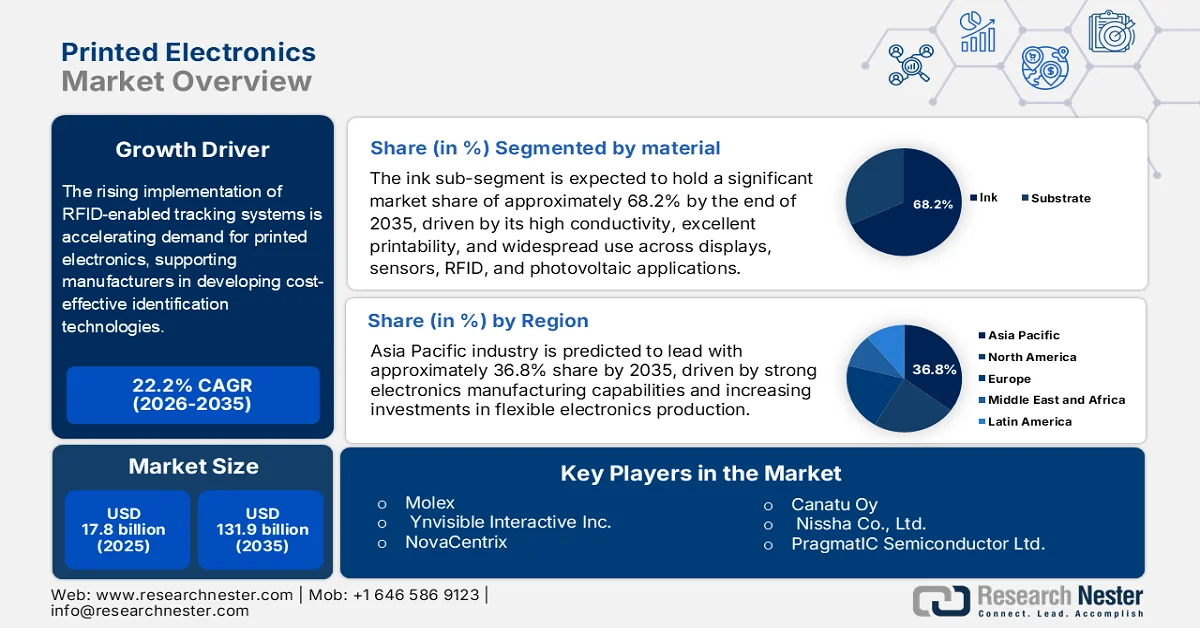
Printed Electronics Market size was over USD 17.8 billion in 2025 and is anticipated to exceed USD 131.9 billion by the end of 2035, growing at over 22.2% CAGR during the forecast period i.e., between 2026-2035. In 2026, the industry size of printed electronics is evaluated at USD 21.7 billion.
The global printed electronics market is readily shaped by different foundational factors, which include the growing demand for flexible electronic systems, rising development of printable materials, expansion of wearable technologies, and growing need for lightweight electronic components. The primary factor which is supporting the market growth is the increasing development of flexible electronic technologies, as these solutions allow manufacturers to combine printed components with flexible substrates to create lightweight and efficient electronic systems for applications which include sensors, wearable devices, and connected technologies. Moreover, according to Manufacturing USA, the U.S. Department of Defense provided a USD 75 million federal investment to establish the NextFlex Flexible Hybrid Electronics Manufacturing Innovation Institute, which is supporting the advancement of flexible hybrid electronics manufacturing in the United States. These initiatives are helping in the development of printed sensors, flexible circuits, and other advanced electronic systems to strengthen the implementation of printed electronics among various industries.
Furthermore, there are constant innovations in printable materials going on, which are creating new opportunities for the printed electronics market by improving the conductivity, durability, and overall performance of electronic components. The development of advanced dielectric materials and other functional materials is allowing manufacturers to overcome limitations associated with traditional electronic fabrication methods and enhance the application scope of printed electronic products. Therefore, it is stated by the National Institute of Standards and Technology (NIST) that ChemCubed LLC has received funding through the Small Business Innovation Research program to develop a printable dielectric material for flexible hybrid electronics. Such material developments are helping to improve the reliability and efficiency of printed electronic structures, which is helping in emerging applications in healthcare, consumer electronics, and industrial sectors.
Key Printed Electronics Market Insights Summary:
Regional Highlights:
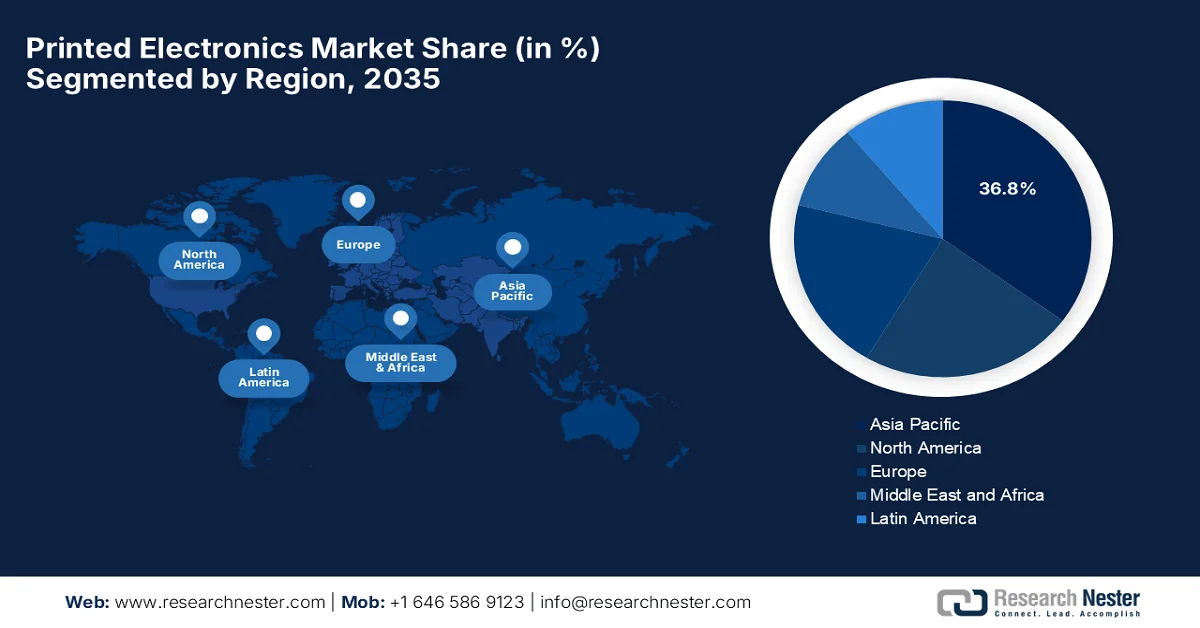
- The Asia Pacific printed electronics market is expected to command 36.8% of global revenue by 2035, bolstered by a robust electronics manufacturing ecosystem and expanding semiconductor and flexible display production
- Europe is poised to secure a significant share of the market through 2035, underpinned by rising investments in advanced electronics manufacturing and supportive initiatives fostering innovation in functional materials
Segment Insights:
- In the printed electronics market, the ink sub-segment is projected to capture 68.2% share by 2035, propelled by the increasing use of conductive, semiconductive, and dielectric inks for manufacturing flexible electronic components
- The screen-printing sub-segment is anticipated to retain its leadership position throughout the forecast period, stimulated by its cost-efficient production capabilities and growing adoption for manufacturing sensors, antennas, and conductive circuits
Key Growth Trends:
- Rising adoption of IoT devices
- Growth in electric vehicle sales
Major Challenges:
- Performance and Durability Constraints
- High Production and Commercialization Costs
Key Players: Molex (U.S.), Ynvisible Interactive Inc. (Canada), NovaCentrix (U.S.), Canatu Oy (Finland), Nissha Co., Ltd. (Japan), PragmatIC Semiconductor Ltd. (U.K).
Global Printed Electronics Market Forecast and Regional Outlook:
Market Size & Growth Projections:
- 2025 Market Size: USD 17.8 billion
- 2026 Market Size: USD 21.7 billion
- Projected Market Size: USD 131.9 billion by 2035
- Growth Forecasts: 22.2% CAGR (2026-2035)
Key Regional Dynamics:
- Largest Region: Asia Pacific (36.8% Share by 2035)
- Fastest Growing Region: Asia Pacific
- Dominating Countries: China, Japan, South Korea, United States, Germany
- Emerging Countries: India, Taiwan, Vietnam, Singapore, France
Last updated on : 29 July, 2026
Printed Electronics Market - Growth Drivers and Challenges
Growth Drivers
- Rising adoption of IoT devices: The growing adoption of Internet of Things (IoT) devices is creating strong demand for printed electronics, as manufacturers increasingly require lightweight and flexible electronic components for connected products. Printed electronics support the development of sensors, antennas, and other compact components that can be easily integrated into IoT devices. Besides this, it is stated by the ITU that approximately 5.5 billion people were using the Internet in 2024. The continued growth in internet connectivity is increasing the adoption of connected devices, which is expected to support the demand for printed electronic components across IoT applications.
- Growth in electric vehicle sales: The increasing production of electric vehicles is encouraging manufacturers to use lightweight and space-efficient electronic technologies that improve vehicle performance and design flexibility. In electric vehicles, printed electronics are widely used in battery management systems, in-mold electronics, touch interfaces, and interior lighting applications. Their ability to reduce factor weight and fit into compact vehicle designs to makes them appropriate for modern electric mobility solutions. Moreover, according to the International Energy Agency, global electric car sales exceeded approximately 17 million units in 2024. The rising adoption of electric vehicles is likely to encourage the wider use of printed electronic technologies in modern automotive systems.
- Increasing use of flexible medical devices: The demand for portable healthcare monitoring and technologies for diagnostic is increasing, supported by the growing implementation of printed electronics in healthcare applications. It enables the development of lightweight, flexible biosensors, smart patches, and disposable diagnostic devices that can help in improving patient monitoring and disease detection. Therefore, according to the WHO, approximately 1.28 billion adults aged 30–79 years worldwide are living with hypertension, which creates a sustained need for continuous health monitoring technologies. The rising need for long-term patient monitoring is anticipated to support the adoption of printed electronic components in medical devices.
Challenges
- Performance and Durability Constraints: Printed electronic components can face complex challenges when exposed to tough conditions, which include high temperatures, moisture, or repeated bending and stretching. While maintaining consistent print quality on different materials and ensuring consistent performance over time can also be one of the technical issues faced by the manufacturers. These challenges can limit the use of printed electronics in applications that require high accuracy, long service life, and dependable performance.
- High Production and Commercialization Costs: Producing printed electronics can be costly because manufacturers need specialized materials, advanced printing equipment, and modern production technologies. Increasing production, while maintaining consistent product quality, also needs an additional investment in manufacturing processes and quality control. These higher costs can make it difficult for small and medium-sized manufacturers to implement printed electronics, especially in cost-sensitive markets.
Printed Electronics Market Size and Forecast:
| Report Attribute | Details |
|---|---|
|
Base Year |
2025 |
|
Forecast Period |
2026-2035 |
|
CAGR |
22.2% |
|
Base Year Market Size (2025) |
USD 17.8 billion |
|
Forecast Year Market Size (2035) |
USD 131.9 billion |
|
Regional Scope |
|
Printed Electronics Market Segmentation:
Material Segment Analysis
By the end of the forecast period, the ink sub-segment under the material segment is anticipated to maintain its dominant position in the printed electronics market. The sub-segment is projected to grow by approximately 68.2% in 2035, owing to the increasing use of conductive, semiconductive, and dielectric inks for manufacturing flexible electronic components. These inks are highly used to print circuits, sensors, antennas, and other electronic structures on different substrates, making them an important part of the printed electronics manufacturing process. Moreover, according to the National Institute of Standards and Technology, printable materials help the development of flexible and printed electronics by enabling low-cost manufacturing and improving the performance of organic semiconductor-based devices for applications such as IoT, healthcare, and Industry 4.0.
Technology Segment Analysis
Under the technology segment, the screen-printing sub-segment is projected to maintain its leading position in the market. The technology is largely used for producing electronic components on flexible and rigid substrates with consistent quality and cost efficiency. It is commonly implemented for manufacturing sensors, antennas, conductive circuits, and other printed electronic components across multiple industries. Therefore, it is stated by the U.S. National Science Foundation that Freescale LLC received a USD 274,972 STTR Phase I award in 2024 to develop functional nanoinks for printed electronics and smart sensors. These developments are expected to help further improvements in printing technologies and strengthen the adoption of screen printing across the printed electronics industry.
Application Segment Analysis
By the end of the stipulated timeline, the display sub-segment under the application segment is anticipated to maintain the largest share of the market, fueled by the growing need for lightweight, flexible, and energy-efficient display technologies across consumer electronics, automotive, and healthcare applications. Where printed display technologies also enable manufacturers to develop thin and flexible electronic products while reducing production complications. Furthermore, it is recorded by the U.S. Department of Energy that solid-state lighting technologies have the potential to reduce U.S. lighting energy use by up to 75% compared with conventional lighting systems. The rising demand for advanced display and lighting technologies is anticipated to support the constant growth of this sub-segment.
Our in-depth analysis of the printed electronics market includes the following segments:
|
Segment |
Subsegments |
|
Material |
|
|
End user |
|
|
Technology |
|
|
Application |
|

Vishnu Nair
Head - Global Business DevelopmentCustomize this report to your requirements — connect with our consultant for personalized insights and options.
Printed Electronics Market - Regional Analysis
APAC Market Insights
The Asia Pacific printed electronics market is projected to account for approximately 36.8% of the global market by 2035. The region's growth is primarily driven by its strong electronics manufacturing ecosystem, increasing production of semiconductors, flexible displays, and printed circuit components, and constant investments in advanced manufacturing technologies. The presence of major electronics manufacturing companies across China, Japan, South Korea, and Taiwan has increased the speed of the commercialization of printed electronic components across multiple end-use industries. Moreover, according to the Organisation for Economic Co-operation and Development, semiconductor production is highly geographically concentrated, with Asia serving as the global center for several important stages of the semiconductor supply chain. This well-established manufacturing ecosystem, combined with continuous technological advancements, is expected to help in the long-term growth of the market across the region.
Japan is expected to witness steady growth in the market owing to its leadership in electronic materials, precision manufacturing, and research-driven innovation. The country needs to invest in advanced technologies that improve the performance of conductive inks, functional materials, and next-generation electronic components used in printed electronics. Besides this, it is stated by Japan's Ministry of Economy, Trade and Industry (METI) that the government has provided approximately JPY 802.5 billion in financial support to Rapidus in 2025 project to strengthen domestic advanced semiconductor manufacturing abilities. The investment is expected to grow Japan’s high- value electronics supply chain while encouraging further innovation in advanced materials and production that will help in printed electronics applications.
China market is showcasing stable progress, due to its large-scale electronics manufacturing industry and constant expansion of high-tech industrial capabilities. The country is improving the production of advanced electronic components through supportive industrial policies and increased investments in smart manufacturing, which creates favorable opportunities for printed electronics across consumer electronics, automotive, healthcare, and industrial applications. Moreover, according to the Ministry of Industry and Information Technology (MIIT), the value-added output of China's electronic information manufacturing industry increased by 11.8% year-on-year in 2024. The continued increase of the country's electronics manufacturing sector is expected to accelerate the implementation of printed electronic technologies and reinforce China's position as a major production market for next-generation electronic devices.
Europe Market Insights
During the forecast period, Europe is anticipated to hold a significant share of the printed electronics market, due to the increasing investments in advanced electronics manufacturing and constant innovation in functional materials. The region is also improving its position through collaborative research programs and supportive government initiatives that promote the development of advanced electronic technologies. Besides this, the European Commission's European Chips Act aims to mobilize more than EUR 43 billion in public and private investments to reinforce Europe's semiconductor ecosystem. These efforts are anticipated to improve the region's electronics manufacturing base and support the large-scale adoption of printed electronics across various industrial applications.
Germany is expected to maintain a leading position in the Europe market owing to its strong electronics manufacturing base and constant investments in advanced semiconductor technologies. Furthermore, it is stated by the German Federal Ministry for Economic Affairs and Energy (BMWK), that Germany is supporting 31 microelectronics projects under the IPCEI on Microelectronics and Communication Technologies. This investment is anticipated to help innovation in electronic components and create favorable opportunities for the growth of printed electronics in the country.
The UK is projected to witness notable growth in the market due to its strong focus on innovation and the development of next-generation electronic technologies. The country continues to help in research and industry collaboration to accelerate the commercialization of advanced electronic materials and flexible electronic solutions. Moreover, according to the UK Government, approximately £200 million will be invested during 2023–2025 to strengthen the UK's semiconductor sector by improving research and development, industry infrastructure, and international collaboration.
North America Market Insights
North America is expected to hold a substantial share of the printed electronics market throughout the forecast period, owing to the strong presence of leading technology companies and continuous advancements in electronic product development. The region is showcasing increasing use of printed electronic solutions across industries, where manufacturers pay attention to improving product performance and developing lightweight, flexible electronic devices. Additionally, according to the U.S. Department of Commerce, the CHIPS and Science Act of 2022 provides approximately USD 52.7 billion to strengthen semiconductor research, manufacturing, and workforce development in the United States. These initiatives are expected to help ongoing innovation in the electronics industry and contribute to the constant growth of the market across the region.
The U.S. is expected to lead the North America market owing to its strong focus on technology innovation and the continuous development of advanced electronic solutions. The country continues to encourage research and product development, which help manufacturers enhance the use of printed electronics across healthcare, automotive, aerospace, and consumer electronics applications. Besides this, it is recorded by the U.S. Department of Commerce that in 2024, the government announced up to USD 8.5 billion in proposed funding for Intel under the CHIPS and Science Act to strengthen domestic semiconductor manufacturing. These investments are one of the reasons for the continued development of printed electronic technologies.
The country continues to strengthen collaboration between industry and research organizations to help the development of next-generation electronic technologies. Canada is projected to register stable progress in the market owing to its growing emphasis on electronics research and advanced manufacturing. Therefore, it is recorded by the Government of Canada announced, in 2022, a CAD 240 million investment to strengthen Canada's semiconductor and photonics industries, which includes help for the Semiconductor Challenge Callout under the Strategic Innovation Fund. These efforts are considered to reinforce the country's electronics ecosystem and funding the continued development of printed electronics.
Key Printed Electronics Market Players:
- Molex (U.S.)
- Ynvisible Interactive Inc. (Canada)
- NovaCentrix (U.S.)
- Canatu Oy (Finland)
- Nissha Co., Ltd. (Japan)
- PragmatIC Semiconductor Ltd. (U.K)
- Company Overview
- Business Strategy
- Key Product Offerings
- Financial Performance
- Key Performance Indicators
- Risk Analysis
- Recent Development
- Regional Presence
- SWOT Analysis
- Molex provides flexible printed circuits, antennas, and medical interconnect solutions for a large range of industries. Its products are used across automotive, healthcare, industrial, and consumer electronics applications, where compact and reliable electronic components are becoming highly important.
- Ynvisible Interactive Inc. is known for its low-power printed display technology. The company develops e-paper displays, smart indicators, and interactive labels that are used in logistics, healthcare, retail, and IoT applications, while helping to reduce power consumption.
- NovaCentrix develops conductive inks and printing technologies for printed electronics. Its systems help in the production of flexible circuits, RFID antennas, and printed sensors for various industrial and commercial applications.
- Built around carbon nanotube technology, Canatu Oy develops transparent conductive films and touch sensor solutions for demanding applications; it is mostly used in automotive displays, semiconductor equipment, and medical devices.
- Nissha Co., Ltd. develops printed electronic products which include membrane switches, touch panels, printed sensors, and In-Mold Electronics (IME) solutions. Its products are used in automotive, healthcare, and consumer electronics applications that need lightweight and compact designs.
- PragmatIC Semiconductor Ltd. gives flexible integrated circuits for smart labels, RFID, connected packaging, and IoT applications. Its product portfolio that includes FlexIC™ integrated circuits for flexible electronic devices.
Here is a list of key players operating in the global printed electronics market:
As the need continues to grow, manufacturers are increasing their attention on developing reliable, lightweight, and cost-effective products for commercial applications. Many companies are also enhancing their manufacturing capabilities and forming collaborations to improve product availability and accelerate innovation. The global market is slightly competitive, with companies introducing new materials and flexible electronic solutions to meet the changing requirements of different industries. Their ongoing efforts are helping to increase the use of printed electronics among industries, which include consumer electronics, healthcare, automotive, industrial equipment, and smart packaging.
Corporate Landscape of the Market:
Recent Developments
- In March 2026, Ynvisible Interactive announced a strategic partnership with Sapphiros to become the exclusive supplier of its printed e-paper displays for selected advanced diagnostic devices, which enhances the commercial use of printed electronics in healthcare applications.
- In June 2026, NovaCentrix launched Metalon® JPT-710UA-P, a platinum conductive ink that is designed for high-performance printed electronics. The new ink is proposed for applications in biomedical devices, aerospace, and high-temperature electronics.
- In December 2025, Molex released its Top 10 Connectivity and Electronics Design Predictions for 2026, which highlight AI-driven connectivity, thermal management, electrification, and high-speed interconnect technologies.
- Report ID: 8710
- Published Date: Jul 29, 2026
- Report Format: PDF, PPT
- Explore a preview of key market trends and insights
- Review sample data tables and segment breakdowns
- Experience the quality of our visual data representations
- Evaluate our report structure and research methodology
- Get a glimpse of competitive landscape analysis
- Understand how regional forecasts are presented
- Assess the depth of company profiling and benchmarking
- Preview how actionable insights can support your strategy
Explore real data and analysis
Frequently Asked Questions (FAQ)
About this Report
Connect with our Expert


Report, 2026-2035



Copyright @ 2026 Research Nester. All Rights Reserved.
