Optoelectronics Market Outlook:
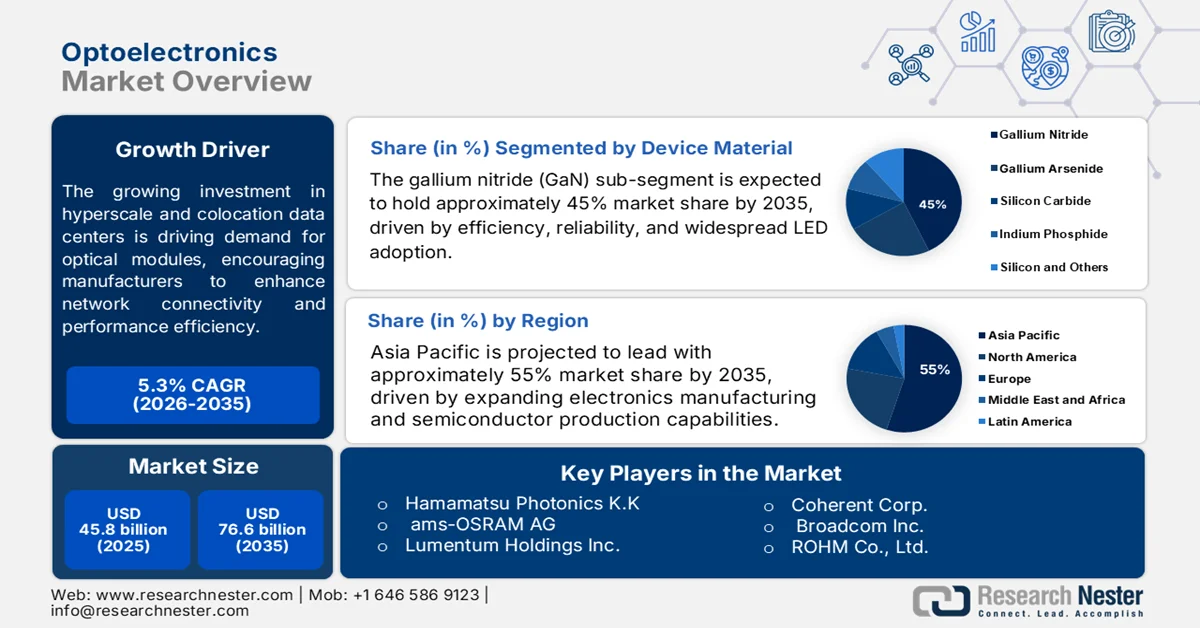
Optoelectronics Market size was valued at USD 45.8 billion in 2025 and is projected to reach USD 76.6 billion by the end of 2035, registering around 5.3% CAGR during the forecast period i.e., between 2026-2035. In 2026, the industry size of optoelectronic is evaluated at USD 48.2 billion.
The global optoelectronics market is primarily driven by the growing implementation of optical technologies across communication, consumer electronics, automotive, and industrial applications. The rising need for high-speed data transmission, advanced sensing systems, and efficient lighting solutions is encouraging manufacturers to increase optoelectronic product development. Additionally, according to the International Telecommunication Union (ITU), 5.5 billion people were using the Internet in 2024, that represent approximately 68% of the global population. The constant expansion of digital connectivity is expected to increase the demand for optical communication components and support the growth of the optoelectronics market during the forecast period.
The development of semiconductor technologies and the increasing use of advanced materials, which include GaN, GaAs, and SiC are supporting the growth of optoelectronic devices. These materials are helping manufacturers improve the efficiency and performance of LEDs, laser diodes, sensors, and other optical components used across multiple industries. Therefore, it is stated by the Semiconductor Industry Association (SIA), global semiconductor sales reached USD 627.6 billion in 2024, highlighting strong industry development and increasing demand for advanced semiconductor components. The continuous progress in semiconductor manufacturing is anticipated to create new opportunities for optoelectronics applications.
Key Optoelectronics Market Insights Summary:
Regional Highlights:
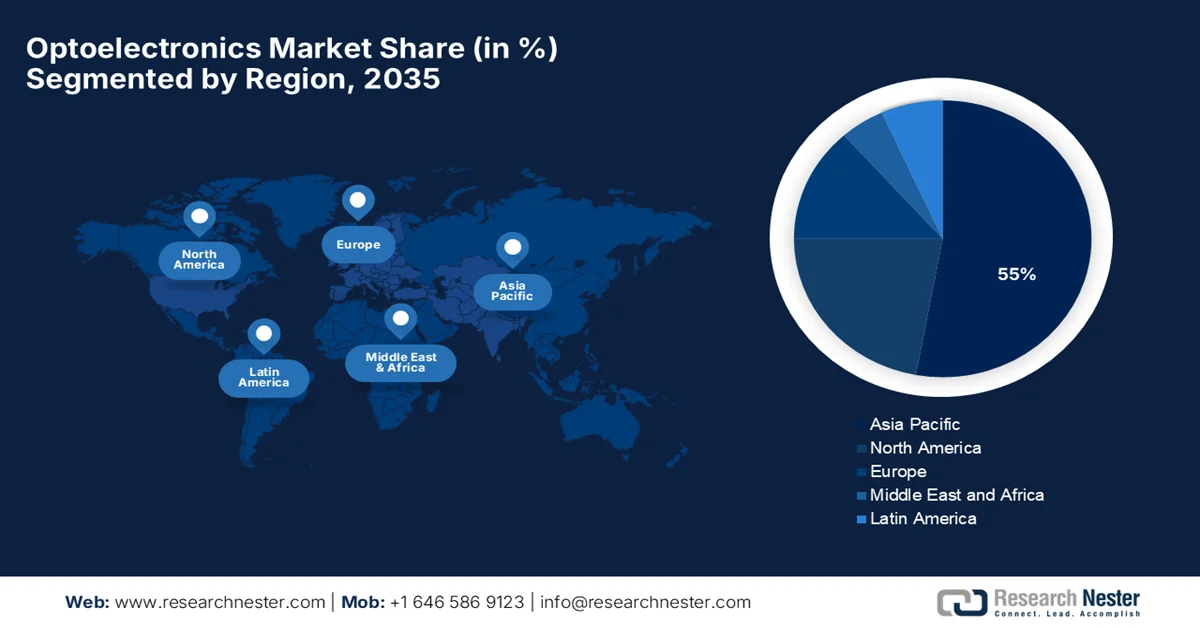
- The Asia Pacific region is anticipated to command approximately 55% of the optoelectronics market by 2035, underpinned by its expanding electronics manufacturing base, growing semiconductor production, and rising investment in advanced optical technologies
- Europe is expected to witness steady growth in the 2026–2035 period, fueled by its strong industrial base and sustained investment in semiconductor and electronics manufacturing
Segment Insights:
- The gallium nitride (GaN) sub-segment is projected to capture approximately 45% of the optoelectronics market by 2035, bolstered by its expanding adoption in LEDs, laser diodes, and high-performance optoelectronic devices for enhanced efficiency and reliability
- The lighting and display sub-segment is poised to secure a significant position during the 2026–2035 forecast period, propelled by the rising demand for advanced displays and energy-efficient lighting across consumer, commercial, and industrial applications
Key Growth Trends:
- Expansion of industrial automation
- Rising demand for medical imaging equipment
Major Challenges:
- Rapid technology changes
- High production and development costs
Key Players: Hamamatsu Photonics K.K, ams-OSRAM AG, Lumentum Holdings Inc., Coherent Corp., Broadcom Inc., ROHM Co., Ltd.
Global Optoelectronics Market Forecast and Regional Outlook:
Market Size & Growth Projections:
- 2025 Market Size: USD 45.8 billion
- 2026 Market Size: USD 48.2 billion
- Projected Market Size: USD 76.6 billion by 2035
- Growth Forecasts: 5.3% CAGR (2026-2035)
Key Regional Dynamics:
- Largest Region: Asia Pacific (55% share by 2035)
- Fastest Growing Region: Asia Pacific
- Dominating Countries: China, United States, Japan, South Korea, Germany
- Emerging Countries: India, Vietnam, Singapore, Malaysia, Mexico
Last updated on : 4 August, 2026
Optoelectronics Market - Growth Drivers and Challenges
Growth Drivers
- Expansion of industrial automation: The optoelectronics market is benefiting from the growing implementation of industrial automation across manufacturing industries. The companies are investing in automated production systems to improve operational efficiency, maintain product consistency, and reduce manual work in manufacturing processes. This transition is inspiring the large use of optical sensors, machine vision systems, and other optoelectronic technologies that help automated equipment. According to the International Federation of Robotics (IFR), 4,281,585 industrial robots were operating in factories worldwide in 2023. The stable development of factory automation is expected to create long-term opportunities for optoelectronics manufacturers as industries continue modernizing production facilities during the forecast period.
- Rising demand for medical imaging equipment: The market is also benefiting from the increasing use of medical imaging and diagnostic equipment across healthcare facilities. Hospitals and diagnostic centers continue investing in advanced imaging technologies that depend on optical sensors, lasers, photodetectors, and image processing systems to improve diagnosis and patient care. This is creating a steady need for optoelectronic components used in healthcare equipment. Additionally, according to the World Health Organization (WHO), approximately 2.4 billion people require rehabilitation services worldwide. The growing need for advanced healthcare technologies is expected to create new opportunities for optoelectronic products during the forecast period.
- Growth in renewable energy installations: The expansion of renewable energy projects is creating new opportunities for the optoelectronics market. Solar power systems need optical components, which include photodetectors, optical sensors, and monitoring devices to improve system performance and operational efficiency. As countries continue enhancing clean energy capacity, the need for these components is also increasing. Furthermore, according to the International Renewable Energy Agency (IRENA), 585 GW of renewable power capacity was added globally in 2024. The constant growth of renewable energy installations is expected to create new opportunities for optoelectronic products during the forecast period.
Challenges
- Rapid technology changes: The optoelectronics market faces challenges as new technologies are introduced more frequently. Manufacturers need to keep improving their products to match the market needs and customer choice. That shows companies often have to replace older products with newer versions in a short period, which increases development and production costs. For small-sized companies, managing these extra expenses can be difficult because they usually have fewer financial resources. They also need to invest in better equipment and keep their manufacturing processes updated on a regular basis. This may affect their ability to compete with larger manufacturers during the forecast period.
- High production and development costs: There is another common challenge in this market due to the manufacturing of advanced optical products, which is expensive. Companies need to spend more on raw materials, production equipment, product testing, and regular improvements to maintain product quality. They also have to invest in new manufacturing technologies to keep up with changing industry needs. These additional costs increase the overall cost of production and can reduce profit margins for manufacturers. Smaller companies often find it more difficult to manage these costs due to their limited financial resources. This can slow product development and make it harder for them to compete with larger companies during the forecast period.
Optoelectronics Market Size and Forecast:
| Report Attribute | Details |
|---|---|
|
Base Year |
2025 |
|
Forecast Year |
2026-2035 |
|
CAGR |
5.3% |
|
Base Year Market Size (2025) |
USD 45.8 billion |
|
Forecast Year Market Size (2035) |
USD 76.6 billion |
|
Regional Scope |
|
Optoelectronics Market Segmentation:
Device Material Segment Analysis
The gallium nitride (GaN) sub-segment under the device material segment is anticipated to account for the largest share of approximately 45% in the optoelectronics market by the end of 2035. The growth of the sub-segment is primarily attributed to its increasing use in LEDs, laser diodes, and other high-performance optoelectronic devices due to its efficiency and reliability. Manufacturers are enhancing the use of GaN-based materials to improve product performance across consumer electronics, automotive, and industrial applications. Additionally, according to the Semiconductor Industry Association (SIA), global semiconductor sales reached USD 627.6 billion in 2024. The constant growth of semiconductor manufacturing is encouraging the use of advanced materials such as gallium nitride across optoelectronic devices.
Application Segment Analysis
The lighting and display sub-segment under the application segment is expected to hold a significant position in the optoelectronics market during the forecast period. Its progress is credited to the rising need for advanced displays and energy-efficient lighting across consumer electronics, commercial buildings, and industrial facilities. Producers are continuously introducing improved lighting and display products to meet changing customer requirements. Besides this, according to the International Energy Agency (IEA), global electricity demand increased by 4.3% in 2024, which reflects the growing need for efficient lighting and display technologies across residential, commercial, and industrial applications.
End-User Industry Segment Analysis
The consumer electronics sub-segment under the end-user industry segment is anticipated to remain a key revenue contributor to the optoelectronics market during the forecast period. The development of the sub-segment is primarily credited to the growing production of smartphones, televisions, laptops, wearable devices, and other electronic products that depend on optical components for improved performance. Producers are enhancing their product portfolios to meet changing consumer needs for advanced electronic devices. Therefore, according to the Consumer Technology Association (CTA), U.S. consumer technology retail revenue is projected to reach USD 537 billion in 2025, which highlights constant demand for consumer electronic products and supports the growth of this sub-segment.
Our in-depth analysis of the optoelectronics market includes the following segments:
|
Segment |
Subsegments |
|
Device Material |
|
|
Application |
|
|
End user |
|
|
Device Type |
|

Vishnu Nair
Head - Global Business DevelopmentCustomize this report to your requirements — connect with our consultant for personalized insights and options.
Optoelectronics Market - Regional Analysis
APAC Market Insights
The Asia Pacific optoelectronics market is anticipated to account for approximately 55% of the global market by the end of 2035. The region's growth is supported by its strong electronics manufacturing base, enhancing semiconductor production, and increasing investment in advanced optical technologies. Countries across the region continue to strengthen manufacturing capabilities to meet the growing need for consumer electronics, automotive components, and communication equipment. Additionally, according to China's Ministry of Industry and Information Technology (MIIT), fixed-asset investment in the electronic information manufacturing industry increased by 12% in 2024, which highlights the region's constant growth of electronics production and helps in the development of the market.
Japan continues to be an important market for optoelectronics due to its strong electronics and manufacturing industry. The country has many companies that produce electronic products, which create a steady need for optical components used in different applications. The growing production of consumer electronics and vehicles is also helping the use of optoelectronic products. Besides this, according to the Japan Automobile Manufacturers Association (JAMA), Japan produced 8,234,681 four-wheeled vehicles in 2024, reflecting the country's large manufacturing base that supports the implementation of optoelectronic technologies across multiple end-use industries.
China is witnessing steady growth in the optoelectronics market due to the continuous development of its consumer electronics industry. The country remains one of the world's largest producers of electronic devices, which creates a consistent need for optical components that are used in displays, cameras, and communication equipment. Therefore, it is stated by the Ministry of Industry and Information Technology (MIIT), China produced 1.67 billion mobile phones, including 1.25 billion smartphones, in 2024. The constant growth of electronics production is expected to help the demand for optoelectronic products during the forecast period.
Europe Market Insights
The Europe optoelectronics market is expected to register steady growth during the forecast period, which is supported by the region's strong industrial base and continued investment in semiconductor and electronics manufacturing. The increasing use of advanced optical technologies across automotive, industrial automation, healthcare, and communication sectors is creating a stable need for optoelectronic products. According to Eurostat, the European Union imported EUR 478 billion worth of high-tech products in 2024, which showcases the region's strong demand for advanced electronic and optical technologies.
Germany continues to strengthen its position in the optoelectronics market through its large automotive and industrial manufacturing sectors. The country's growing use of advanced electronic systems across vehicles and industrial equipment is creating a consistent need for optical components and sensing technologies. Additionally, according to the German Association of the Automotive Industry (VDA), Germany produced 4,069,222 passenger cars in 2024, reflecting the country's strong manufacturing base that helps for optoelectronics products to be in demand.
France is witnessing steady growth in the optoelectronics market due to the increasing use of digital technologies across households and businesses. The rising implementation of connected devices and online services is encouraging the need for advanced display and optical communication technologies. Besides this, it is stated by the French National Institute of Statistics and Economic Studies (INSEE) that 88.7% of people aged 15 years and above used the Internet during the previous three months in 2024. This trend is expected to increase the use of optoelectronic products across different applications during the forecast period.
North America Market Insights
The North America optoelectronics market is projected to account for a significant share during the forecast period, which is helped by increasing investment in semiconductor manufacturing and advanced electronics. The region continues to strengthen its technology ecosystem through public and private investments, which creates opportunities for optical communication, sensing, and display technologies. Therefore, according to the Semiconductor Industry Association (SIA), the U.S. semiconductor industry invested USD 62.7 billion in research and development in 2024, which showcases constant innovation across advanced semiconductor technologies.
The U.S. continues to be an important market for optoelectronics due to increasing investment in semiconductor manufacturing and advanced technologies. Government initiatives and private investments are strengthening domestic chip production, which is supporting industries that depend on optical and electronic components. Besides this, it is stated by the U.S. Department of Commerce that the CHIPS and Science Act of 2022 provides approximately USD 52.7 billion to strengthen semiconductor manufacturing, research, and workforce development in the United States. These investments are expected to help the growth of optoelectronic products during the forecast period.
The optoelectronics market in Canada is growing as the country continues to strengthen its digital economy and technology sector. The country is witnessing growing use of advanced electronic systems across industrial, healthcare, and communication applications, creating opportunities for optoelectronic products. Furthermore, according to Innovation, Science and Economic Development Canada (ISED), the information and communication technologies (ICT) sector contributed CAD 131.6 billion to Canada's GDP in 2024. The constant progress of the technology sector is expected to encourage large-scale implementation of optoelectronic products during the forecast period.
Key Optoelectronics Market Players:
- Hamamatsu Photonics K.K (Japan)
- ams-OSRAM AG (Austria)
- Lumentum Holdings Inc. (U.S.)
- Coherent Corp. (U.S.)
- Broadcom Inc. (U.S.)
- ROHM Co., Ltd. (Japan)
- Company Overview
- Business Strategy
- Key Product Offerings
- Financial Performance
- Key Performance Indicators
- Risk Analysis
- Recent Development
- Regional Presence
- SWOT Analysis
- Hamamatsu Photonics K.K. produces optoelectronic products for healthcare, industrial, and scientific applications. This company's main products are image sensors, photodiodes, laser diodes, and photomultiplier tubes, which are used in imaging and sensing applications
- ams-OSRAM AG manufactures optical semiconductor products for automotive, consumer electronics, healthcare, and industrial markets. The company's portfolio includes LEDs, laser diodes, infrared emitters, optical sensors, and automotive lighting solutions that help applications such as displays, sensing, and illumination.
- Lumentum Holdings Inc. supplies optical and photonic products mainly for communication networks, cloud infrastructure, and industrial applications. Its key offerings include optical transceivers, tunable lasers, optical amplifiers, and 3D sensing components, which help support high-speed optical communication systems.
- The Coherent Corp. supplies optoelectronic products for industrial, healthcare, and electronics applications. Its portfolio has lasers, optical components, and photonic products that are used across different industries.
- Broadcom Inc. offers optical communication solutions for networking and data communication. The company's main products include fiber optic transceivers, optical receivers, and networking components for communication systems.
- ROHM Co., Ltd. manufactures semiconductor and optoelectronic products for automotive, industrial, and consumer electronics applications. Its product portfolio includes LEDs, laser diodes, optical sensors, and infrared devices that are used in a variety of electronic products.
Here is a list of key players operating in the global optoelectronics market:
The global optoelectronics market is moderately competitive, with the presence of well- established manufacturers that supply optical components for consumer electronics, industrial equipment, healthcare, automotive, and communication applications. Key market players such as Hamamatsu Photonics, ams-OSRAM, Lumentum Holdings, Coherent Corp., Broadcom, and ROHM continue to develop their product portfolios by introducing new optical devices that can improve existing technologies. Competition is largely based on product quality, manufacturing capability, and long-term customer relationships across different industries. Additionally, companies are paying attention to research activities, production growth, and product innovation to strengthen their market presence and meet the changing needs of end users.
Corporate Landscape of the Market
Recent Developments
- In March 2026, Hamamatsu Photonics K.K. signed a framework agreement with RIKEN to strengthen collaboration in advanced photonics research and technology development, supporting future innovation in optical technologies.
- In May 2026, ams-OSRAM AG announced that it entered the AI photonics market through a development agreement with a leading AI photonics customer, expanding its optical semiconductor portfolio for next-generation AI infrastructure.
- In October 2025, Coherent Corp. introduced its CPO-enabling photonics portfolio at NVIDIA GTC DC 2025, which includes lasers, optical components, detectors, and thermal Management products.
- Report ID: 8715
- Published Date: Aug 04, 2026
- Report Format: PDF, PPT
- Explore a preview of key market trends and insights
- Review sample data tables and segment breakdowns
- Experience the quality of our visual data representations
- Evaluate our report structure and research methodology
- Get a glimpse of competitive landscape analysis
- Understand how regional forecasts are presented
- Assess the depth of company profiling and benchmarking
- Preview how actionable insights can support your strategy
Explore real data and analysis
Frequently Asked Questions (FAQ)
About this Report
Connect with our Expert


Report, 2026-2035



Copyright @ 2026 Research Nester. All Rights Reserved.
