High Bandwidth Memory (HBM) Market Outlook:
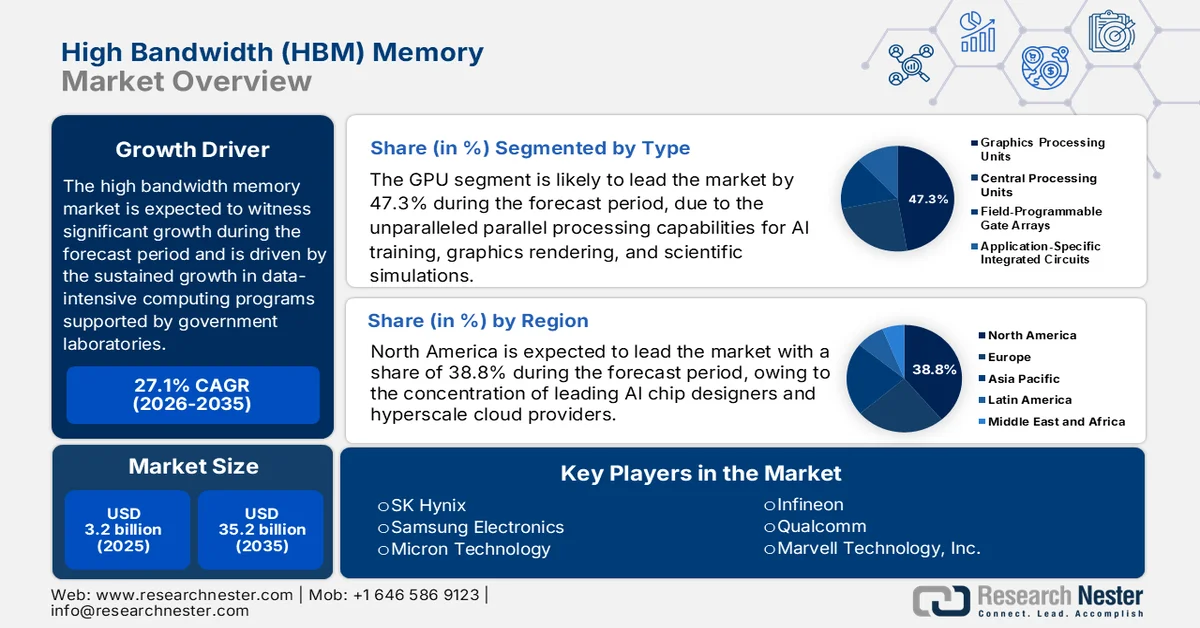
High Bandwidth Memory (HBM) Market size was valued at USD 3.2 billion in 2025 and is projected to cross USD 35.2 billion by the end of 2035, expanding at more than 27.1% CAGR during the forecast period, i.e., 2026-2035. In 2026, the industry size of high bandwidth memory is evaluated at USD 4 billion.
The high bandwidth memory market is benefiting from sustained growth in data-intensive computing programs supported by government laboratories, research institutions, and national digital infrastructure initiatives. Advanced computing systems deployed for artificial intelligence (AI), scientific modeling, defense analytics, weather forecasting, and large-scale simulation increasingly require memory architectures capable of supporting extremely high data throughput. The EurekAlert May 2022 data reported that the Frontier supercomputer at Oak Ridge National Laboratory exceeded 1.1 exaflops of performance, while the Aurora system at Argonne National Laboratory surpassed 2 exaflops in large-scale computing capability. Such deployments increase demand for advanced memory subsystems capable of supporting accelerated processors and large AI workloads.
From a supply and investment perspective, the HBM market is closely linked to broader semiconductor industry expansion. According to the Semiconductor Industry Association (SIA) February 2025 data, global semiconductor sales reached USD 627.6 billion, representing a 19.1% increase compared, reflecting strong demand from AI-focused computing systems and data-center deployments. The Organization for Economic Co-operation and Development (OECD) has highlighted the rapid scaling of AI infrastructure and the increasing computational resources required for modern AI models, factors that directly influence demand for high-performance memory solutions. These factors are expected to sustain capacity expansion, technology development, and long-term procurement opportunities across the HBM ecosystem.
Key High Bandwidth Memory (HBM) Market Insights Summary:
Regional Highlights:
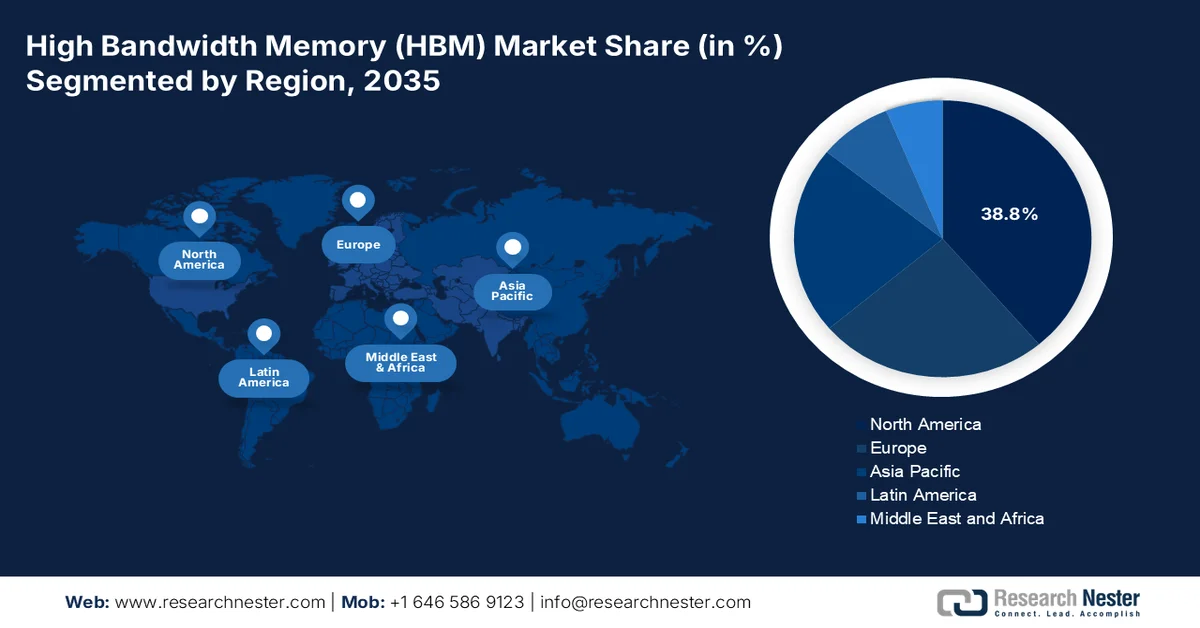
- North America is anticipated to capture 38.8% of the high bandwidth memory (hbm) market by 2035, bolstered by the concentration of leading AI chip designers, hyperscale cloud providers, and government-funded supercomputing laboratories
- Asia Pacific is projected to witness the fastest expansion in the forecast period 2026-2035, supported by its position as the primary manufacturing hub and accelerating government-backed HPC and AI compute capacity
Segment Insights:
- GPUs are projected to account for 47.3% of the high bandwidth memory (hbm) market by 2035, propelled by their unparalleled parallel processing capabilities for AI training, graphics rendering, and scientific simulations.
- High-Performance Computing (HPC) is expected to maintain its leading position throughout 2026-2035, reinforced by the growing deployment of scientific simulations, climate modeling, drug discovery, and AI supercomputing requiring sustained ultra-high memory bandwidth.
Key Growth Trends:
- Semiconductor manufacturing incentive programs
- Expansion of government-funded artificial intelligence infrastructure
Major Challenges:
- High R&D and capital expenditure
- Extreme technical complexity
Key Players: SK Hynix (South Korea),Samsung Electronics (South Korea),Micron Technology (U.S.),Infineon (Germany),Qualcomm (U.S.),Marvell Technology, Inc. (U.S.).
Global High Bandwidth Memory (HBM) Market Forecast and Regional Outlook:
Market Size & Growth Projections:
- 2025 Market Size: USD 3.2 billion
- 2026 Market Size: USD 4 billion
- Projected Market Size: USD 35.2 billion by 2035
- Growth Forecasts: 27.1% CAGR (2026-2035)
Key Regional Dynamics:
- Largest Region: North America (38.8% share by 2035)
- Fastest Growing Region: Asia Pacific
- Dominating Countries: United States, Germany, Japan, China, France
- Emerging Countries: India, Singapore, Vietnam, Malaysia, Saudi Arabia
Last updated on : 7 July, 2026
High Bandwidth Memory (HBM) Market - Growth Drivers and Challenges
Growth Drivers
- Semiconductor manufacturing incentive programs: Government-backed semiconductor manufacturing initiatives are strengthening HBM demand by expanding advanced packaging and memory production ecosystems. In the U.S., the CHIPS and Science Act provides approximately USD 52.7 billion for semiconductor manufacturing, research, and workforce development, as per NIST March 2024 data. Advanced memory technologies require sophisticated packaging and integration capabilities, areas directly targeted by these investments. The resulting manufacturing ecosystem supports larger volumes of AI processors, accelerators, and data-center hardware, all of which require increasingly advanced memory architectures to meet performance requirements.
- Expansion of government-funded artificial intelligence infrastructure: Government investments in artificial intelligence infrastructure are a primary demand driver for High Bandwidth Memory (HBM) because AI training and inference systems require large memory bandwidth to process massive datasets efficiently. The United States has significantly increased AI-related investments through federal research programs. The National Science Foundation (NSF) 2025 announced more than USD 500 million in investments through the National AI Research Institutes program to strengthen AI research capabilities. As national AI computing clusters expand, procurement of advanced processors and memory subsystems rises proportionally, creating sustained demand for HBM suppliers, packaging providers, and semiconductor manufacturers.
Challenges
- High R&D and capital expenditure: Entering the HBM market requires massive investment in advanced DRAM design, 3D stacking, and hybrid bonding technologies. Companies must build dedicated cleanrooms and packaging lines, with costs running into billions of dollars. This prohibitive expense favors established players like SK Hynix, Samsung, and Micron, creating insurmountable barriers for new entrants.
- Extreme technical complexity: HBM manufacturing demands precision in through-silicon vias (TSV), micro-bump alignment, and thermal management across stacked dies. Yield rates remain challenging, especially for 12-layer and 16-layer stacks. New suppliers lack the decades of accumulated process expertise required to achieve commercially viable yields, making technological catch-up extremely difficult without deep partnerships.
High Bandwidth Memory (HBM) Market Size and Forecast:
| Report Attribute | Details |
|---|---|
|
Base Year |
2025 |
|
Forecast Year |
2026-2035 |
|
CAGR |
27.1% |
|
Base Year Market Size (2025) |
USD 3.2 billion |
|
Forecast Year Market Size (2035) |
USD 35.2 billion |
|
Regional Scope |
|
High Bandwidth Memory (HBM) Market Segmentation:
Type Segment Analysis
Under the type, GPUs command the largest share value of 47.3% by the end of 2035. The segment is driven by their unparalleled parallel processing capabilities for AI training, graphics rendering, and scientific simulations. HBM's ultra-wide bus and high bandwidth are intrinsically suited to GPU architectures, making them the primary consumer of advanced memory stacks. This demand is further amplified by national AI initiatives worldwide. For instance, the Government of India launched the IndiaAI Mission with an outlay of Rs. 10,372 crore to democratize AI and expand compute capacity, as per PIB March 2026 data. Under this mission, over 38,000 GPUs have been onboarded through the AI compute portal, provided to Indian start-ups and academia at affordable rates.
Application Segment Analysis
Within the application segment, the high-performance computing (HPC) emerges as the revenue leader, encompassing scientific simulations, climate modeling, drug discovery, and AI supercomputing. HPC workloads demand sustained memory bandwidth exceeding 1 TB/s, a requirement uniquely fulfilled by HBM stacks. The DST February 2022 data depicts that the India's National Supercomputing Mission (NSM) exemplifies this trend, having installed supercomputing infrastructure in 10 premier institutions including IITs, IISc, and C-DACs, with 5 more underway. Param Pravega at IISc Bengaluru delivers 3.3 petaflops of supercomputing power. The mission has trained over 11,000 HPC professionals and is advancing indigenous development with 85% local manufacturing, including the Rudra server platform and Trinetra interconnect. Such large-scale HPC deployments directly drive HBM consumption, cementing HPC's dominant position through 2035.
Generation Segment Analysis
In the high bandwidth memory (HBM) market by generation, HBM3E captures the highest revenue share through 2035, surpassing HBM3 and all earlier iterations. HBM3E improved power efficiency, and backward compatibility, making it the pragmatic upgrade path for existing AI and HPC infrastructure. While HBM4 looms on the horizon with promises of even higher performance, HBM3E benefits from mature manufacturing yields, broad ecosystem support across NVIDIA, AMD, and Intel platforms, and cost-effective scalability. The generation also supports 12-layer and 16-layer stacks, enabling denser memory configurations. With sustained demand from generative AI workloads and national supercomputing initiatives, HBM3E will maintain its revenue leadership well into the next decade.
Our in-depth analysis of the high bandwidth memory market includes the following segments:
|
Segment |
Subsegments |
|
Type |
|
|
Application |
|
|
Generation |
|
|
Stack Layer |
|
|
End user Industry |
|

Vishnu Nair
Head - Global Business DevelopmentCustomize this report to your requirements — connect with our consultant for personalized insights and options.
High Bandwidth Memory (HBM) Market - Regional Analysis
North America Market Insights
North America is dominating the high bandwidth memory market and is expected to hold the regional revenue share of 38.8% by the end of 2035. The region is driven by the concentration of leading AI chip designers, hyperscale cloud providers, and government-funded supercomputing laboratories. The region's demand is fueled by relentless GPU deployments for generative AI training, scientific simulations, and autonomous systems development. Together, the U.S. and Canada form a cohesive market characterized by early adoption of next-generation HBM generations, strong collaboration between memory suppliers and system integrators, and a regulatory environment that prioritizes domestic technology leadership and supply chain resilience.
The artificial intelligence, cloud computing, and advanced semiconductor manufacturing drive demand for high-performance memory solutions is driving the high bandwidth memory market in the U.S. Growing deployment of AI accelerators in hyperscale data centers and federal research facilities is increasing the need for memory architectures capable of supporting large-scale computing workloads. The market is also benefiting from domestic semiconductor investment initiatives aimed at strengthening supply-chain resilience. According to NIST March 2024 data, the CHIPS and Science Act provides up to USD 39 billion in semiconductor manufacturing incentives, supporting advanced chip and packaging capacity that is critical for future HBM adoption and production.
The investments in artificial intelligence research, advanced computing infrastructure, and semiconductor innovation increase across the country is shaping the high bandwidth memory market in the Canada. Demand is being supported by growing adoption of AI-enabled applications in healthcare, scientific research, financial services, and cloud computing environments that require high-performance memory solutions. Canada’s strong ecosystem of AI institutes and supercomputing facilities is further encouraging deployment of advanced processors that rely on HBM technologies. According to the Prime Minister Canada April 2024 data, CAD 2.4 billion is allocated for measures to secure Canada’s AI advantage, including investments in AI computing infrastructure, which is expected to strengthen demand for advanced memory-enabled computing systems.
APAC Market Insights
Asia Pacific is likely to rapidly emerge during the assessed period of 2026 to 2035, in the hand bandwidth memory market. The region is serving as both the primary manufacturing hub and the fastest-growing consumption center. The region hosts the world's leading memory producers—SK Hynix, Samsung, and Micron—with advanced fabrication and packaging facilities concentrated in South Korea, Taiwan, and Japan. Government-backed missions in India, Japan, and China are aggressively scaling domestic HPC and AI compute capacity. The region benefits from integrated supply chains, strong foundry partnerships, and proactive semiconductor policies, positioning it as the undisputed epicenter of HBM production, innovation, and adoption for the foreseeable future.
The semiconductor manufacturing capabilities, AI infrastructure, and high-performance computing deployments is shaping the high bandwidth memory market in India. Demand is being driven by increasing investments in cloud data centers, digital services, and research computing platforms that require advanced memory solutions. Government support for semiconductor ecosystem development is further strengthening the market outlook by encouraging domestic production and technology adoption. According to the PIB March 2025 data, the government has approved a semiconductor unit by Tata Electronics in Dholera, Gujarat, with an investment of ₹91,000 crore (approved in 2024). This investment is expected to enhance India’s advanced semiconductor value chain and create opportunities for future HBM integration in next-generation computing systems.
The investments in artificial intelligence, high-performance computing, and advanced semiconductor manufacturing is driving the high bandwidth memory market in China. Demand is supported by the rapid growth of domestic cloud providers, AI model development, and government-backed digital infrastructure projects that require memory-intensive computing platforms. The market also benefits from national efforts to strengthen semiconductor self-sufficiency and reduce reliance on imported technologies. According to Global Times April 2025 data, the country’s integrated circuit production reached 451.4 billion units, reflecting significant expansion in semiconductor manufacturing activity that supports the broader ecosystem for advanced memory adoption.
Europe Market Insights
Europe represents a growing, yet specialized, segment of the High Bandwidth Memory market, driven by its strong automotive, aerospace, and high-performance computing sectors. The region's demand is fueled by national supercomputing initiatives, research collaborations, and the continent's push for semiconductor sovereignty through the European Chips Act. Leading nations like Germany, France, and the UK are investing heavily in HPC infrastructure, AI research hubs, and advanced packaging R&D. European end-users prioritize energy efficiency and reliability for automotive ADAS, industrial automation, and scientific simulations. While the region lacks domestic HBM production, it hosts critical equipment, material suppliers, and system integrators that form an essential part of the global HBM supply chain, ensuring steady adoption across enterprise and strategic applications.
The strong semiconductor ecosystem, industrial digitalization initiatives, and increasing deployment of AI and high-performance computing infrastructure is driving the high bandwidth memory market in Germany. Demand is growing across automotive engineering, industrial automation, research institutions, and enterprise data centers that require advanced memory performance for data-intensive applications. Germany is also benefiting from public investments aimed at strengthening European semiconductor capabilities and reducing supply-chain dependencies. According to the European Commission August 2024 data, the European Commission approved €5 billion in German state for the establishment of the European Semiconductor Manufacturing Company (ESMC) semiconductor fabrication facility in Dresden. This investment is expected to reinforce Germany’s advanced semiconductor value chain and support future adoption of HBM-enabled computing systems.
The high bandwidth memory market in UK is benefiting from growing investments in artificial intelligence, advanced computing research, and data-center infrastructure. Demand is increasing as universities, research institutions, and enterprises deploy AI and high-performance computing systems that require greater memory bandwidth to process complex workloads efficiently. Government initiatives focused on strengthening the country’s semiconductor and AI capabilities are also supporting market expansion. According to the Government of UK February 2024 data, the government announced up to £1 billion in funding for computing infrastructure through the AI Research Resource and Exascale Programme, aimed at expanding national computing capacity. This investment is expected to accelerate adoption of advanced processors and memory technologies, including HBM, across research and commercial computing environments.
Key High Bandwidth Memory (HBM) Market Players:
- SK Hynix (South Korea)
- Samsung Electronics (South Korea)
- Micron Technology (U.S.)
- Infineon (Germany)
- Qualcomm (U.S.)
- Marvell Technology, Inc. (U.S.)
- Company Overview
- Business Strategy
- Key Product Offerings
- Financial Performance
- Key Performance Indicators
- Risk Analysis
- Recent Development
- Regional Presence
- SWOT Analysis
- SK Hynix leads the high bandwidth memory market through relentless innovation in 3D stacking and thermal management. Its strategy focuses on hybrid bonding, custom co-development with AI giants, and aggressive capacity expansion. By prioritizing power efficiency and early HBM3E qualification, SK Hynix maintains technological supremacy and secures long-term supply partnerships with hyperscalers.
- Samsung competes fiercely in the high bandwidth memory market by leveraging its vertically integrated foundry-memory-package ecosystem. Its strategy emphasizes Processing-In-Memory (PIM), hybrid copper bonding for taller stacks, and cost-competitive mass production. Samsung aims to regain market leadership through rapid node transitions and diversifying its packaging footprint across Korea and the US.
- Micron re-enters the high bandwidth memory market with a focus on lowest-power-per-bit HBM using its advanced 1-beta process. Its strategy includes expanding US and Malaysian packaging facilities, co-engineering custom base dies with TSMC and NVIDIA, and targeting Western cloud providers to capture significant share through superior thermal performance and reliability.
- Infineon enables the high bandwidth memory market through advanced power management ICs and GaN-based voltage regulators that ensure stable, noise-free energy delivery to HBM stacks. Its strategy focuses on developing integrated voltage regulators and thermal sensors for HBM4, partnering with memory makers to standardize power architectures for next-generation AI servers.
- Qualcomm expands the high bandwidth memory market beyond data centers by integrating HBM into edge AI, automotive, and PC chips. Its strategy focuses on low-power memory controllers, UCIe-based chiplet interfaces, and near-memory compute algorithms to enable efficient on-device inference, pushing vendors to develop scalable, cost-effective HBM for high-volume consumer applications.
Here is a list of key players operating in the global high bandwidth memory (HBM) market:
The high bandwidth memory market is a fierce three-horse race due to its early mass production of HBM3E. Strategic initiatives center on extreme vertical stacking, hybrid bonding, and custom co-development with AI fabless giants to secure multi-year supply deals. To mitigate packaging bottlenecks, key players are aggressively expanding domestic and Southeast Asian back-end facilities. Meanwhile, Japanese and European material suppliers are racing to develop advanced underfill and dielectric films, while US equipment makers focus on high-precision TSV etching tools. Partnerships and capacity doublings define this race for AI-driven memory supremacy.
Corporate Landscape of the High Bandwidth Memory (HBM) Market:
Recent Developments
- In June 2026, Qualcomm unveils comprehensive data center roadmap for the agentic AI era with new Qualcomm Dragonfly portfolio. Introducing new data center solutions, including the Qualcomm Dragonfly C1000 CPU, Qualcomm High Bandwidth Compute (HBC), Qualcomm Dragonfly AI300 inference accelerator, and leading connectivity products, together with custom silicon solutions.
- In March 2026, Samsung Electronics announced the comprehensive AI computing technologies it will showcase at NVIDIA GTC 2026. Industry-first commercial HBM4 and its successor HBM4E to be displayed, highlighting maximized performance, reliability and energy efficiency for next-generation datacenters.
- In December 2024, Marvell Technology, Inc. announced that it has pioneered a new custom HBM compute architecture that enables XPUs to achieve greater compute and memory density. The new technology is available to all of its custom silicon customers to improve the performance, efficiency and TCO of their custom XPUs.
- Report ID: 8657
- Published Date: Jul 07, 2026
- Report Format: PDF, PPT
- Explore a preview of key market trends and insights
- Review sample data tables and segment breakdowns
- Experience the quality of our visual data representations
- Evaluate our report structure and research methodology
- Get a glimpse of competitive landscape analysis
- Understand how regional forecasts are presented
- Assess the depth of company profiling and benchmarking
- Preview how actionable insights can support your strategy
Explore real data and analysis
Frequently Asked Questions (FAQ)
About this Report
Connect with our Expert


Report, 2026-2035



Copyright @ 2026 Research Nester. All Rights Reserved.
