Green Coffee Market Outlook:
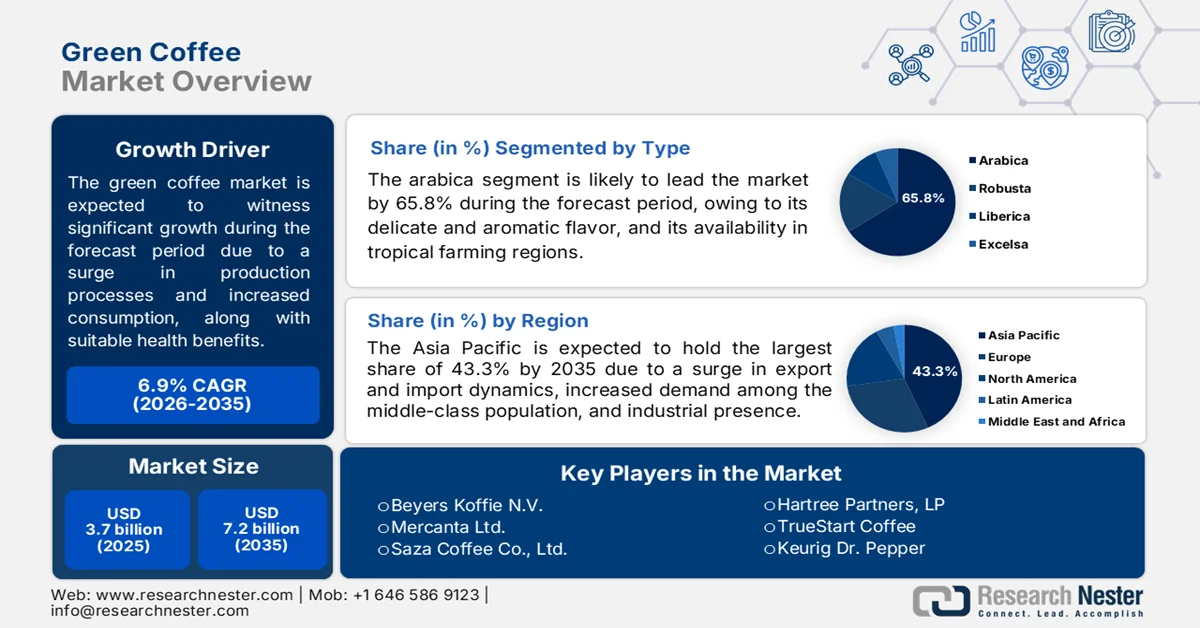
Green Coffee Market size was valued at USD 3.7 billion in 2025 and is expected to be worth USD 7.2 billion by the end of 2035, growing at an 6.9% CAGR during the forecast period 2026 to 2035. In 2026, the industry size of green coffee is estimated at USD 3.9 billion.
The worldwide green coffee market is reshaping based on factors such as a shift in demographic preferences, the increased concentration of coffee cultivation across climate-specific regions, the gradual normalization of remote work, port infrastructures, and suitable health benefits. According to official statistics published by NLM in August 2024, the prevalence of obesity and overweight is gradually increasing, with 61.6% of the population, especially in Spain, presenting these diseases. Therefore, coffee consumption is regarded as a necessary food that is rich in polyphenols. In addition, the chemical composition of coffee comprises more than 1,000 different phytochemicals as well as micro and macronutrients. Besides, the caffeine content in arabica is an estimated 1.5%, while in robusta, it is almost 2.7%, thereby driving the continuous coffee supply across different nations.
2024 Coffee Global Export and Import Analysis
|
Countries/Components |
Export (USD) |
Import (USD) |
|
Brazil |
11.8 billion |
- |
|
Vietnam |
4.1 billion |
- |
|
Switzerland |
3.8 billion |
- |
|
U.S. |
- |
8.6 billion |
|
Germany |
- |
5.2 billion |
|
Italy |
- |
3.0 billion |
|
Global Trade Valuation |
50.3 billion |
|
|
Global Trade Share |
0.2% |
|
|
Export Growth |
17% |
|
Source: OEC
Furthermore, the upcycling of coffee by-products into consumer ingredients, suitable cold chain logistics for frozen green coffee, and the presence of coffee cherry flour as a gluten-free alternative are a few trends that are responsible for fueling the green coffee market globally. As stated in an article published by NLM in February 2022, coffee pulp accounts for the majority of coffee by-products that comprise 50% of carbohydrate, along with 10% of protein, 20% of fiber, 2.5% of fat, and 1.3% of caffeine. Likewise, coffee husk, as a by-product, is also rich in 8% to 85% of carbohydrate, which is followed by 8% to 11% of protein, and 3% to 7% of minerals. Besides, cascara is obtained from pulp or husk that contains natural antioxidants, such as vitamin C, anthocyanin, and polyphenols, thereby making it suitable for enhancing the green coffee market growth globally.
Key Green Coffee Market Insights Summary:
Regional Highlights:
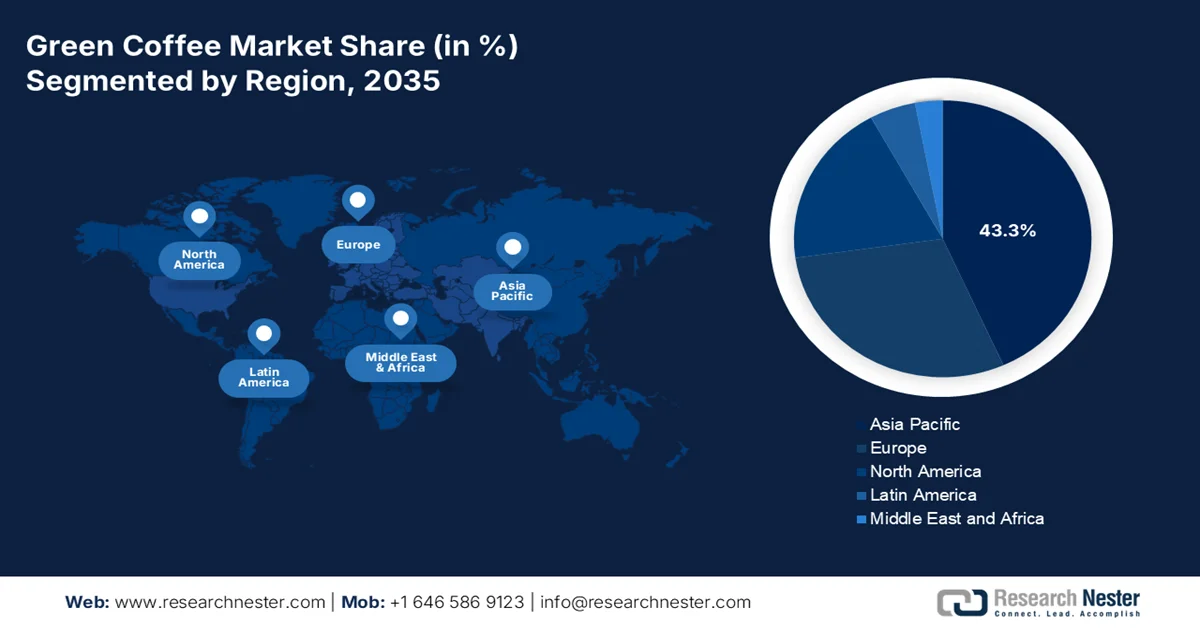
- The green coffee market in Asia Pacific is projected to command a 43.3% share by 2035, stimulated by rising middle-class coffee consumption, expanding domestic roasting industries, and growing demand for sustainable certified products
- North America is anticipated to emerge as the fastest-growing region in the market throughout 2026-2035, propelled by expanding specialty coffee adoption, increasing preference for traceable beans, and advanced logistics infrastructure
Segment Insights:
- The arabica segment is anticipated to hold a dominant 65.8% share of the green coffee market by 2035, driven by increasing specialty coffee demand and the premium pricing advantage of aromatic arabica varieties
- The roasted coffee segment is expected to secure the second-highest share in the market during 2026-2035, fueled by growing consumer preference for antioxidant-rich coffee products and expanding global roasted coffee exports
Key Growth Trends:
- Green coffee as a functional ingredient in pet food
- Roastery installations in airport and transit facilities
Major Challenges:
- Supply chain fragmentation and quality inconsistency
- Climate change disrupting long-term supply planning
Key Players: Olam International (Singapore), Sucafina SA (Switzerland), Volcafe Ltd. (Switzerland), Ecom Agroindustrial Corp. Ltd. (Switzerland), Louis Dreyfus Company B.V. (Netherlands), Nestlé S.A. (Switzerland), JDE Peet's N.V. (Netherlands), Cargill, Incorporated (U.S.), The J.M. Smucker Company (U.S.), UCC Ueshima Coffee Co., Ltd. (Japan), Tata Coffee Limited (India), CCL Products (India) Limited (India), Kimbo S.p.A. (Italy), Mandheling Coffee Pty Ltd. (Australia), Aik Cheong Coffee Roaster Sdn. Bhd. (Malaysia), Beyers Koffie N.V. (Belgium), Mercanta Ltd. .
Global Green Coffee Market Forecast and Regional Outlook:
Market Size & Growth Projections:
- 2025 Market Size: USD 3.7 billion
- 2026 Market Size: USD 3.9 billion
- Projected Market Size: USD 7.2 billion by 2035
- Growth Forecasts: 6.9% CAGR (2026-2035)
Key Regional Dynamics:
- Largest Region: Asia Pacific (43.3% Share by 2035)
- Fastest Growing Region: North America
- Dominating Countries: Brazil, Vietnam, Colombia, Indonesia, United States
- Emerging Countries: India, China, Ethiopia, Mexico, Peru
Last updated on : 19 May, 2026
Green Coffee Market - Growth Drivers and Challenges
Growth Drivers
- Green coffee as a functional ingredient in pet food: Premium pet food manufacturers commenced adopting finely ground and unroasted green coffee into feline and canine nutrition formulas. According to official statistics published by the USDA Foreign Agricultural Service in December 2025, there has been an increase in green coffee exports in Indonesia from 1.7 million bags to 7.8 million in terms of increased supplies. Besides, soluble coffee exports are projected to ship almost 100,000 bags to 1 million, with top economies, such as Russia, Malaysia, and the Philippines. Therefore, the existence of chlorogenic acids in green coffee readily supports weight management and glucose regulation in companion animals, thus enhancing the green coffee market upliftment.
- Roastery installations in airport and transit facilities: The majority of international exports and high-speed rail terminals are increasingly installing on-site and micro-roasteries, which is positively impacting the green coffee market. As per an article published by the IEA Organization in July 2023, the railway network in China has successfully reached 155,000 km as of 2022, of which 42,000 km are categorized as high-speed railways. Besides, the massive high-speed rail system in the world has rapidly grown 100 times in the past 20 years, and further extended to 50,000 km by the end of 2025. Therefore, based on this development, facilities are effectively creating experiential retail attractions for roasted green coffee for travelers, thus denoting an optimistic outlook for the green coffee market growth.
Challenges
- Supply chain fragmentation and quality inconsistency: The journey of green coffee from farm to consumer goods company involves numerous intermediaries, such as local collectors, cooperatives, dry mills, exporters, ocean freight forwarders, customs brokers, and finally the roaster's warehouse. Besides, each handoff introduces risks of quality degradation, contamination, or lot mixing. For consumer brands that market single-origin or specialty-grade coffee, maintaining distinct flavor profiles batch after batch is extraordinarily difficult. Moreover, smallholder farmers producing the majority of the world's green coffee lack standardized post-harvest processing equipment, leading to wide variation in moisture content, bean size, and defect levels even within the same cooperative, which is negatively impacting the green coffee market growth.
- Climate change disrupting long-term supply planning: Consumer goods companies typically plan their green coffee sourcing strategies three to five years ahead, developing product lines, signing packaging contracts, and securing shelf space with retailers. However, climate change is rendering historical production patterns unreliable. Simultaneously, rising temperatures shift suitable growing areas to higher altitudes, changes in rainfall patterns alter flowering and cherry maturation cycles, and increased pest and disease pressure reduce yields unpredictably. Besides, a consumer brand that sources primarily from a specific region expecting consistent arabica quality may find that, within a few years, that region produces less volume, thereby causing a hindrance in the green coffee market growth.
Green Coffee Market Size and Forecast:
| Report Attribute | Details |
|---|---|
|
Base Year |
2025 |
|
Forecast Year |
2026-2035 |
|
CAGR |
6.9% |
|
Base Year Market Size (2025) |
USD 3.7 billion |
|
Forecast Year Market Size (2035) |
USD 7.2 billion |
|
Regional Scope |
|
Green Coffee Market Segmentation:
Type Segment Analysis
By type, the arabica segment is anticipated to capture the largest share, at 65.8%, in the green coffee market by the end of 2035. The segment’s upliftment is primarily attributed to the ultimate foundation of the specialty coffee sector, which is crucial for its aromatic and delicate flavor profiles and its pivotal role as a suitable economic driver for tropical farming regions. According to official statistics published by NLM in August 2024, arabica cultivation demands suitable conditions for thriving, particularly at high altitudes ranging between 600 and 2,000 meters above sea level. Besides, as per the January 2024 U.S. International Trade Commission data report, an estimated 60% to 70% of coffee production is arabica and is increasingly priced higher than robusta. This particular coffee type is extremely resistant to pests and diseases, thus proliferating the segment’s growth and expansion.
Arabica Production and Growth Rate Analysis, 2018-2024
|
Year |
Production (Million 60-kg Bags) |
Growth Rate (YoY %) |
|
2018-2019 |
99.5 |
1.9 |
|
2019-2020 |
96.4 |
-3.2 |
|
2020-2021 |
100.6 |
4.3 |
|
2021-2022 |
92.3 |
-8.2 |
|
2022-2023 |
94.0 |
1.8 |
|
2023-2024 |
102.2 |
8.8 |
Source: International Coffee Organization
End Product Segment Analysis
During the forecast period, the roasted coffee segment, part of the end product, is projected to garner the second-highest share in the green coffee market. The segment’s growth is effectively fueled by its usefulness as one of the best sources of antioxidants, readily assisting in combating free radicals that tend to cause cellular damage and are associated with cancer. As stated in an article published by the International Coffee Organization in November 2022, the constant valuation of roasted coffee accounts for 397.1% globally, along with 577.4% in terms of export. Based on this, roasted coffee successfully diminishes the microglia-mediated inflammatory environment on generative disorders, thus creating a huge growth opportunity for the green coffee market globally.
Form Segment Analysis
The powdered sub-segment, which is part of the form segment, is expected to account for the third-highest share in the green coffee market by the end of the stipulated timeline. The sub-segment’s development is highly propelled by the provision of unparalleled convenience, long-lasting shelf-life, and portability. As per an article published by NLM in August 2025, coffee is one of the most comprehensively consumed beverages worldwide, with more than 60% of the population in America drinking it regularly. Meanwhile, based on the 2026 International Coffee Organization article, the ICO Composite Indicator Price (I-CIP) for instant coffee accounted for 2.3% to USD 273.7 cents/lb as of March 2026. This particular indicator pricing strategy is higher than in January, which amounted to USD 267.5 cents/lb, thus denoting a huge growth opportunity for the green coffee market.
Our in-depth analysis of the green coffee market includes the following segments:
|
Segment |
Subsegments |
|
Type |
|
|
End Product |
|
|
Form |
|
|
Distribution Channel |
|
|
End user |
|
|
Process |
|

Vishnu Nair
Head - Global Business DevelopmentCustomize this report to your requirements — connect with our consultant for personalized insights and options.
Green Coffee Market - Regional Analysis
APAC Market Insights
The Asia Pacific in the green coffee market is anticipated to account for the largest share of 43.3% by the end of 2035. The market’s upliftment in the region is primarily attributed to the undisputed production, with focus on exports, a surge in import prices, a strong regional demand for coffee, a rise in middle-class coffee consumption, expansion in domestic roasting industries, and an increase in consumer preference for sustainable and certified products. According to official statistics published by the Heinrich Boll Stiftung Organization in January 2026, Indonesia is considered the second-largest coffee producer in the overall region, behind Vietnam, constituting an increase in the coffee production by 2,4% to 12 million bags between 2022 and 2023. Additionally, the coffee industry readily employs an estimated 1.7 million people in the country, thus positively driving the market growth in the overall region.
The green coffee market in Japan is growing significantly, owing to increased dependency on coffee beans, suitable support for trade volume, the domestic distribution ecosystem, long-lasting contracts with producing nations, standard processing and manufacturing capacity, and an increase in the total production index. As stated in an article published by the Government of Japan in January 2026, every year, 8 million metric tons of coffee beans are produced, of which the country accounts for 400,000 tons. Besides, in terms of roastery contributions by organizations, YAMAMOTO Kei of Cove Coffee Roasters and AQKI Nozomu employs an outstanding process to reutilize 100% of coffee grounds as fuel for roasting beans. Therefore, with such production and organization contributions, the market is enhancing the market is eventually gaining increased exposure.
The aspects of rapid consumption, a rise in domestic coffee culture, and expansion in the middle-class, the presence of suitable dual-economic dynamics, localized production facilities, the proliferation of coffee shop chains, and young consumers embracing coffee as a lifestyle product are certain factors that positively impact the green coffee market in Indonesia. As per an article published by the Asia Farmers Association for Sustainable Rural Development in February 2026, there has been an upsurge in productivity, market accessibility, optimized post-harvest processing, and farmers’ income by 53.7% or from USD 1,650 to USD 2,540 per hectare. Moreover, the Sridonoretno Farmers Association comprises three villages, including Baturetno, Sukodono, and Srimulyo, located at an altitude of 400 to 900 meters above sea level that positively caters to the green coffee market growth.
North America Market Insights
North America in the green coffee market is expected to emerge as the fastest-growing region during the forecast period. The market’s development in the region is highly propelled by the embedded coffee culture, the expansion of specialty coffee across food service and retail channels, an increase in consumers’ preference for sourced and traceable beans, long-lasting trading agreements, and advanced logistics infrastructure. According to official statistics published by the USDA Government in September 2024, the U.S. is considered the world’s notable importer of coffee, with almost 80% of domestic coffee imports originating from Latin America as of 2023, with a USD 4.8 billion valuation. This is readily followed by 35% from Brazil and 27% from Colombia. Moreover, over 92% of domestic coffee imports were less acidic and constituted a high-quality arabica variety, thus proliferating the market growth in the overall region.
The green coffee market is gaining increased traction in the U.S., owing to direct-to-consumer coffee subscription aggregators, cold brew concentrates manufacturing upscaling, and veteran-based coffee social enterprises. As stated in an article published by NLM in June 2022, the Specialty Coffee Association of America successfully developed the gold standard for hot brew coffee, comprising the total dissolved solids, effectively ranging from 1.1% to 1.3%, along with an outstanding extraction yield between 18% and 22%. Moreover, Thai Blue Mountain coffee beans, worth 10 kg, were increasingly purchased from Linlin Coffee Equipment and packaged into 500 g aluminum laminated bags that are fitted with one-way valves and heat sealed. Therefore, with suitable availability of standards and different coffee brands, there is a huge growth opportunity for the market in the country.
The indigenous-based direct sourcing partnerships, carbon-neutral import logistics mandates, and increased focus on winter cold chain innovation for storage facilities are a few trends that are positively fueling the green coffee market in Canada. As per an article published by Statisque Canada in September 2023, the country imported 15.6 million kilograms of coffee as of July 2023. In addition, more than one-quarter, which is 26.9%, originated from Colombia, followed by 19.4% from Brazil, 16.8% from Honduras, and 11.2% from Guatemala. Simultaneously, the country also imported 5 million kilograms of roasted coffee from a wide variety of countries and U.S.-based states. Besides, the pricing strategy for roasted or ground coffee purchased by the population from stores increased by 20.7% year-over-year (YoY), thereby denoting an optimistic outlook for the market expansion.
Europe Market Insights
Europe in the green coffee market is projected to witness suitable growth by the end of the stipulated timeline. The market’s growth in the region is effectively driven by an increase in coffee consumption, an expansion of artisanal roasting capacity, generous fund allocation by the government, and continuous supply chain dynamics. According to official statistics published by the Europe Commission in October 2024, the region readily imported 2.7 million tons from non-regional nations, amounting to USD 12.3 billion as of 2023. Based on this, the amount effectively retained stabilization from 2.7 million tons, with a significant increase in valuation from 7.3 billion tons. Besides, the majority of coffee imported in the region derives from Brazil, accounting for 921,900 tons of the overall additional regional imports, and 652,000 tons from Vietnam, thereby enhancing the green coffee market.
Europe Coffee Imports Analysis, 2023
|
Components |
Attributes |
|
Imports from Brazil |
34% |
|
Imports from Uganda |
8% or 206,500 tons |
|
Imports from Vietnam |
24% |
|
Import in Germany |
33% or 911,300 tons |
|
Import in Italy |
23% or 624,600 tons |
|
Import in Belgium |
10% or 278,200 tons |
|
Overall Regional Imports |
2.7 million tons |
Source: Europe Commission
The green coffee market in Germany is gaining increased exposure, owing to the existence of a massive concentration of coffee roasters, the primary gateway for green coffee imports, and consumer preferences gradually shifting to sustainable coffee with fair-trade and single-origin products with premium shelf space. As stated in an article published by the CBI in November 2025, the country generously imported 51,000 tons from Uganda as of 2024, and green coffee imports witnessed a 5.7% annual increase. Besides, the national umbrella coffee farmers’ organization, NUCAFE, represents over 213 farmer cooperatives and associations. Moreover, almost 80% of the overall Uganda-based production is robusta coffee, and meanwhile, the nation comprises the largest organic coffee production with 35,000 hectares in 2023, thus boosting the market in Germany.
The presence of a redistribution facility, innovation in coffee distribution and production, the existence of different traders, readily pioneering in digitalized trading platforms, the government’s suitable supportive investments and trade policies are boosting the green coffee market in the Netherlands. As per an article published by the Government of the Netherlands in February 2026, the country has a population of almost 18 million, with Rotterdam the ultimate home to one of the world’s largest ports and trading services readily accounting for 77% of the Dutch economy. In this regard, coffee imports surged by 3.6% annually as of 2024, along with re-exports rising by an average 56.3% in the same year. Meanwhile, green coffee imports in the country successfully reached 222,400 tons, based on which the market is continuously expanding in the country.
Green Coffee Imports and Exports in the Netherlands, 2015-2023
|
Year |
Imports (Thousand Tons) |
Exports (Thousand Tons) |
|
2015 |
163 |
17 |
|
2016 |
184 |
24 |
|
2017 |
190 |
21 |
|
2018 |
203 |
27 |
|
2019 |
206 |
28 |
|
2020 |
189 |
24 |
|
2021 |
193 |
24 |
|
2022 |
240 |
71 |
|
2023 |
215 |
77 |
Source: Government of the Netherlands
Key Green Coffee Market Players:
- Olam International (Singapore)
- Sucafina SA (Switzerland)
- Volcafe Ltd. (Switzerland)
- Ecom Agroindustrial Corp. Ltd. (Switzerland)
- Louis Dreyfus Company B.V. (Netherlands)
- Nestlé S.A. (Switzerland)
- JDE Peet's N.V. (Netherlands)
- Cargill, Incorporated (U.S.)
- The J.M. Smucker Company (U.S.)
- UCC Ueshima Coffee Co., Ltd. (Japan)
- Tata Coffee Limited (India)
- CCL Products (India) Limited (India)
- Kimbo S.p.A. (Italy)
- Mandheling Coffee Pty Ltd. (Australia)
- Aik Cheong Coffee Roaster Sdn. Bhd. (Malaysia)
- Beyers Koffie N.V. (Belgium)
- Mercanta Ltd. (UK)
- Saza Coffee Co., Ltd. (Japan)
- South Korean Green Coffee Co., Ltd. (South Korea)
- Bureau of Standards (Malaysia)
- Hartree Partners, LP (U.S.)
- TrueStart Coffee (UK)
- Keurig Dr. Pepper (U.S.)
- JDE Peet’s (Netherlands)
- Company Overview
- Business Strategy
- Key Product Offerings
- Financial Performance
- Key Performance Indicators
- Risk Analysis
- Recent Development
- Olam International maintains a significant presence across the green coffee supply chain, serving major consumer goods companies that require consistent and traceable raw bean sourcing. The company has invested in sustainability programs and direct partnerships with smallholder farmers to help roasters meet evolving regulatory and ethical standards.
- Sucafina SA operates as a dedicated green coffee merchant, connecting growers in origin countries with consumer brands and roasters worldwide through a network of local sourcing desks. The company has focused on digital traceability platforms and risk management tools to help consumer goods clients navigate price volatility and supply chain transparency demands.
- Volcafe Ltd. provides green coffee sourcing, warehousing, and logistics services tailored to the needs of branded coffee roasters and private label manufacturers. The company works closely with consumer goods firms to ensure consistent quality and volume across different origins, helping to mitigate seasonal and regional supply disruptions.
- Ecom Agroindustrial Corp. Ltd. has built an integrated model that includes farm-level support, milling, export logistics, and direct supply to consumer-packaged goods companies. The company supports roasters by offering tailored blending solutions and long-term contracting to stabilize raw material costs for retail coffee products.
- Louis Dreyfus Company B.V. leverages its global agricultural commodity infrastructure to supply green coffee to large-scale consumer goods manufacturers across Europe, North America, and Asia. The company assists branded coffee producers with supply chain financing and sustainability compliance, particularly regarding deforestation-free sourcing commitments.
Here is a list of key players operating in the global market:
The global green coffee market serving consumer goods companies is moderately fragmented, with a mix of multinational agricultural commodity traders, vertically integrated roasters, and specialized green coffee importers. Key strategic initiatives include direct trade partnerships with farmer cooperatives to ensure traceability and sustainability compliance, forward contracting to hedge against price volatility, and investment in blockchain-enabled supply chain platforms. Leading players are also expanding their decaffeination and warehousing capacities near major consumer markets in Europe and North America. Besides, in April 2026, Hartree Partners, LP successfully acquired Touton SAS based on consultation with the employees’ representative. This particular acquisition extended Hartree’s tactical growth in organization commodities and suitable development based on its own July 2025 acquisition of ED&F Man Commodities in July 2025, thus driving the green coffee industry growth.
Corporate Landscape of the Market:
Recent Developments
- In January 2026, JDE PEET’s introduced its Nature Transition Plan, Grounded in Nature, which is a science-specific roadmap to protect ecosystems, along with strengthening farmer resilience, and effectively securing the long-lasting viability of coffee production.
- In August 2025, Keurig Dr. Pepper and JDE Peet’s entered into a definitive agreement under which KDP acquired JDE Peet’s in an all-cash transaction, which resulted in developing a worldwide coffee champion through the complementary combination of its Keurig®, which is the ultimate single-serve coffee platform in North America.
- In January 2025, TrueStart Coffee expanded its lightly caffeinated as well as decaf coffee range by securing a generous multi-million-dollar investment from Jam Jar Investments and DLF Ventures.
- Report ID: 8572
- Published Date: May 19, 2026
- Report Format: PDF, PPT
- Explore a preview of key market trends and insights
- Review sample data tables and segment breakdowns
- Experience the quality of our visual data representations
- Evaluate our report structure and research methodology
- Get a glimpse of competitive landscape analysis
- Understand how regional forecasts are presented
- Assess the depth of company profiling and benchmarking
- Preview how actionable insights can support your strategy
Explore real data and analysis
Frequently Asked Questions (FAQ)
About this Report
Connect with our Expert


Report, 2026-2035



Copyright @ 2026 Research Nester. All Rights Reserved.
