Feed Enzymes Market Outlook:
Feed Enzymes Market size was valued at USD 1.7 billion in 2025 and is projected to reach USD 2.8 billion by the end of 2035, rising at a CAGR of 5.3% during the forecast period, i.e., 2026-2035. In 2026, the industry size of feed enzymes is estimated at USD 1.8 billion.
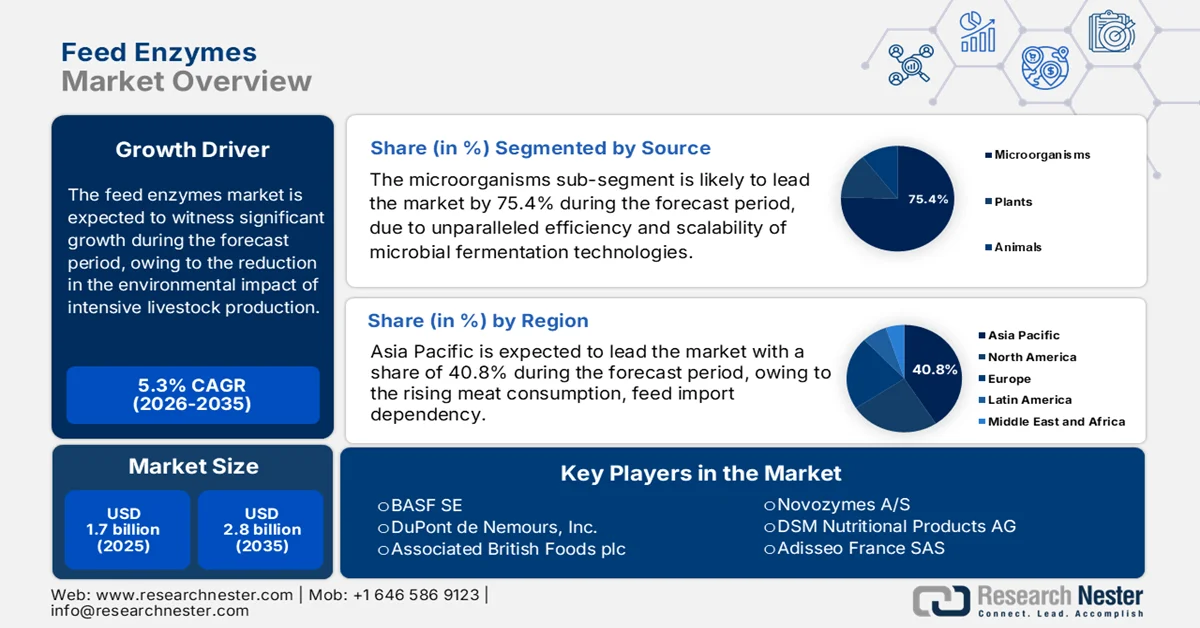
The demand for the feed enzymes market operates within a complex framework of agricultural efficiency targets and environmental regulations. A primary function of these additives is to reduce the environmental impact of intensive livestock production by reducing nutrient excretion. According to the UNEP January 2024 data, the livestock sector contributes to global phosphorus pollution, a problem that is directly addressed by the phytase enzymes, which allow for more efficient nutrient utilization. Moreover, the phosphorus pollution costs farmers and others about USD 265 billion a year. On the other hand, the FAO 2021 notes that improving feed conversion ratios through such biological additives is essential to meeting the rising global demand for animal protein, projected to increase by 14% by 2030 compared to base-year levels, without proportionally expanding the environmental footprint of farming operations.
Moreover, in the U.S., the market is heavily influenced by the regulatory frameworks governing concentrated animal feeding operations. The EPA enforces nutrient management plans that limit the application of phosphorus and nitrogen to land. Further, livestock production has increased nutrient use over the last few decades. The adoption of feed enzymes serves as a mitigation strategy, allowing producers to comply with these nutrient discharge permits by lowering the phosphorus content of manure. As per the USDA June 2025 data, the broiler segment accounted for USD 45.4 billion in the poultry sector. Moreover, the productivity gains in the broiler industry are improved by the feed efficiency, a trend supported by the widespread inclusion of enzyme complexes that unlock energy from feed ingredients, thereby lowering overall production costs for integrators.
Key Feed Enzymes Market Insights Summary:
Regional Highlights:
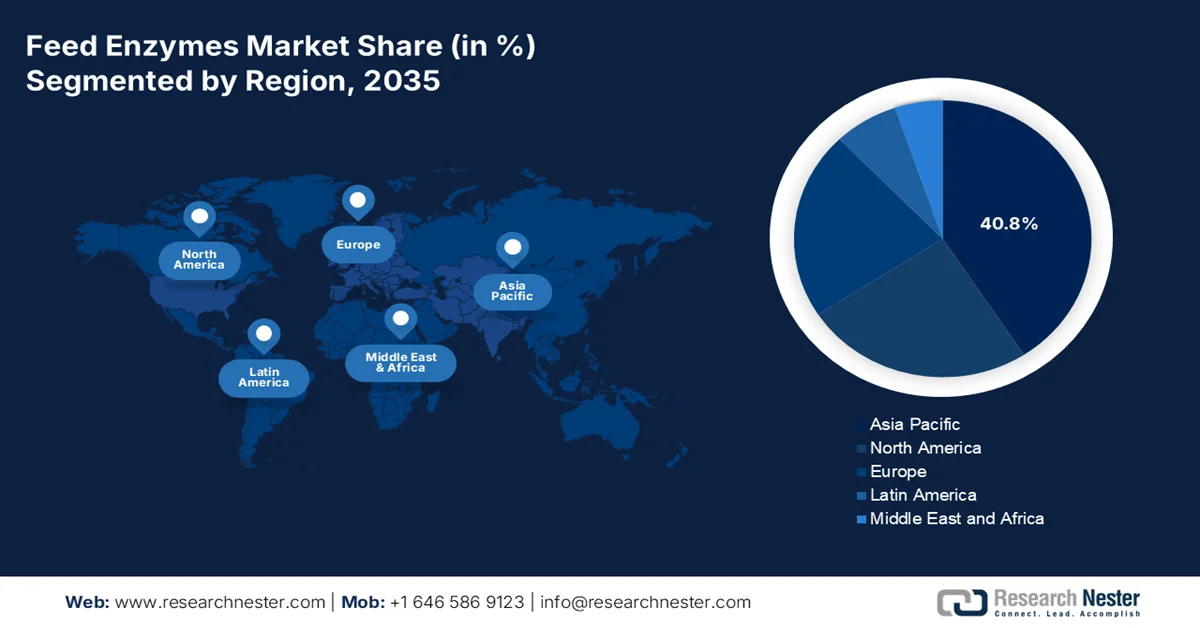
- Asia Pacific feed enzymes market is anticipated to secure 40.8% share by 2035, owing to rising meat consumption and strong government support for livestock modernization
- North America is projected to be the fastest-growing region during 2026–2035, impelled by stringent environmental regulations and increasing adoption of advanced enzyme formulations
Segment Insights:
- Microorganisms sub-segment in the feed enzymes market is forecast to hold 75.4% share by 2035, driven by scalable microbial fermentation and high enzyme efficiency
- Thermostable Enzymes sub-segment is expected to lead by 2035, propelled by their ability to withstand high-temperature feed processing and maintain catalytic activity
Key Growth Trends:
- Government policies for rising feed costs
- Government food security initiatives
Major Challenges:
- Lengthy and complex regulatory approvals
- Thermal instability of enzymes in pelletized feed
Key Players: BASF SE (Germany), DuPont de Nemours, Inc. (U.S.), Associated British Foods plc (UK), Novozymes A/S (Denmark), DSM Nutritional Products AG (Switzerland), Adisseo France SAS (France), AB Vista (UK), Novus International, Inc. (U.S.), Kemin Industries, Inc. (U.S.), Alltech, Inc. (U.S.), Chr. Hansen Holdings A/S (Denmark), Bluestar Adisseo Co. (China), Ajinomoto Co., Inc. (Japan), BioResource International, Inc. (U.S.), Behn Meyer Group (Germany), Advanced Enzymes Technologies Ltd. (India), Rossari Biotech Ltd. (India).
Global Feed Enzymes Market Forecast and Regional Outlook:
Market Size & Growth Projections:
- 2025 Market Size: USD 1.7 billion
- 2026 Market Size: USD 1.8 billion
- Projected Market Size: USD 2.8 billion by 2035
- Growth Forecasts: 5.3% CAGR (2026-2035)
Key Regional Dynamics:
- Largest Region: Asia Pacific (40.8% Share by 2035)
- Fastest Growing Region: North America
- Dominating Countries: U.S., China, Germany, India, Brazil
- Emerging Countries: Vietnam, Indonesia, Thailand, Mexico, Poland
Last updated on : 24 March, 2026
Feed Enzymes Market - Growth Drivers and Challenges
Growth Drivers
- Government policies for rising feed costs: Government agricultural policy increasingly focuses on reducing the livestock production costs, mainly feed expenditures that dominate the operational budgets. According to the Frontiers January 2026 report, the feed represents 60% to 70% of total livestock production costs in many commercial operations. The government frequently responds by funding research programs and extension services aimed at improving the feed efficiency and optimizing the nutrient utilization. For example, the national agricultural research agencies funded via ministries of agriculture support studies on enzyme supplementation to improve the grain digestibility in animal diets. As governments continue supporting cost-reduction strategies in livestock production, feed enzymes are becoming an important nutritional tool for commercial feed manufacturers.
- Government food security initiatives: Growing government focus on food security and domestic protein production is expanding the livestock farming capacity, indirectly increasing the demand for the market. Many national agricultural strategies prioritize increased production of poultry, pork, and dairy products to meet population growth. According to the OECD July 2025, the global poultry consumption is projected to account for 62% by 2034, reflecting a strong growth supported by the national agricultural policies and investment program. Governments often provide subsidies, technical support, and feed efficiency research to ensure a stable protein supply. Feed enzymes are incorporated into the commercial feed rations to improve nutrient utilization and maintain production efficiency as the livestock numbers increase.
- Feed quality and safety standards: National feed safety regulations establish quality parameters that enzyme manufacturers must meet, creating both compliance requirements and market opportunities. The FDA regulates the enzyme additives via the Food Additive Petition process, requiring demonstration of safety and efficacy. Moreover, the international feed standards are adopted by many countries. These standards create predictable market access pathways for compliant manufacturers to meet the documentation and testing requirements. Companies investing in regulatory affairs expertise and quality management systems aligned with international standards gain preferential access to markets adopting Codex-based regulations, particularly in Southeast Asia and Africa, where harmonization efforts are underway.
Challenges
- Lengthy and complex regulatory approvals: One of the most significant barriers to entering the market is the robust and time-consuming regulatory approval process. This process varies significantly by region. Moreover iIn markets such as the EU, manufacturers must submit comprehensive dossiers to the European Food Safety Authority for scientific evaluation before receiving the authorization from the European Commission. This process can take several years and requires a substantial investment in efficacy and safety trials.
- Thermal instability of enzymes in pelletized feed: A persistent technical challenge is the thermal instability of enzymes during the feed pelleting process, which involves high temperatures and pressures. Further, the standard enzymes can denature and lose their efficacy under these conditions, rendering the product ineffective by the time it reaches the animal. This necessitates significant R&D investment to engineer thermostable variants, a barrier in the market for smaller suppliers with limited research budgets.
Feed Enzymes Market Size and Forecast:
| Report Attribute | Details |
|---|---|
|
Base Year |
2025 |
|
Forecast Year |
2026-2035 |
|
CAGR |
5.3% |
|
Base Year Market Size (2025) |
USD 1.7 billion |
|
Forecast Year Market Size (2035) |
USD 2.8 billion |
|
Regional Scope |
|
Feed Enzymes Market Segmentation:
Source Segment Analysis
Under the source segment, the microorganisms sub-segment dominated the feed enzymes market in 2025 and is expected to hold the share value of 75.4% by the end of 2035. The segment is fueled by the unparalleled efficiency and scalability of microbial fermentation technologies. Bacteria and fungi are the preferred workhorses for enzyme production because they can be genetically optimized to yield the concentrations of specific active proteins at a low cost. According to the September 2023 USDA data FDA approved 118 enzymes, many from microbial sources, with 14 GRAS notifications pending. Moreover, microbial enzymes demonstrate high activity and stability across diverse feed processing conditions, improving nutrient digestibility in livestock diets. Their scalable fermentation-based production also enables consistent supply and cost-efficient commercialization for the global feed manufacturers.
Formulation Segment Analysis
The thermostable enzymes represent the leading formulation sub-segment in the market due to their being engineered to survive the extreme heat of the feed pelleting process. According to the NLM study published in March 2023, the thermostable enzymes can resist high temperatures ranging from 45 °C to 120 °C. Standard enzymes often denature and lose their efficacy during this thermal processing, rendering them useless by the time the feed reaches the animal. Thermostable variants often developed via protein engineering or directed evolution retain their catalytic activity post pelleting, ensuring that the nutritional and economic benefits are delivered to the livestock producers. The push for pelleted feeds, which improve feed handling and animal performance, directly drives the demand for these robust formulations.
Composition Segment Analysis
Multi activity enzymes complexes are the leading composition sub-segment as modern animal diets are complex mixtures of ingredients containing various anti-nutritional factors. A single enzyme, such as a phytase, addresses only one specific problem, whereas the multi-activity complex containing a blend of xylanases beta glucanases proteases, and cellulases provides a synergistic breakdown of the cell wall matrix. This broad-spectrum approach releases more trapped energy and improves overall nutrient digestibility, which is mainly for the industry's move towards more sustainable high fiber diets that include by-products such as distiller’s dried grains. Moreover, the shipments of multi-enzyme formulations to major livestock-producing regions increased, outpacing single-enzyme products, as feed mills seek comprehensive solutions to maximize feed flexibility and minimize production costs.
Our in-depth analysis of the feed enzymes market includes the following segments:
|
Segment |
Subsegments |
|
Type |
|
|
Form |
|
|
Livestock |
|
|
Source |
|
|
Composition |
|
|
Formulation |
|

Vishnu Nair
Head - Global Business DevelopmentCustomize this report to your requirements — connect with our consultant for personalized insights and options.
Feed Enzymes Market - Regional Analysis
APAC Market Insights
The Asia Pacific dominates the global feed enzymes market and is expected to hold a revenue share value of 40.8% by the end of 2035. The market is driven by the rising meat consumption, feed import dependency, and government modernization programs. According to the United Nations July 2025 data, India and Southeast Asia are projected to account for 39% of the global meat consumption by 2034, followed by the sustained demand for efficiency-enhancing technologies. Key drivers include government initiatives to reduce the soybean import reliance, environmental regulations on livestock waste, and consolidation of the smallholder farms into industrial production systems. The region’s diverse feed ingredients, such as rice bran, cassava, and wheat, require customized enzyme solutions. Government spending on agricultural research accelerates enzyme adoption, with public-private partnerships driving innovation in enzyme formulations suited to local feedstuffs.
Feed production industries, along with their strong position in global enzyme manufacturing and exports is driving the market in China. According to the OEC 2024 data, China has exported USD 689 million worth of enzymes under HS Code 3507, which includes prepared enzymes used across sectors such as animal feed, food processing, and pharmaceuticals. Within the livestock sector, China remains one of the world’s largest producers of pork and poultry, creating substantial demand for compound feed and feed additives that improve nutrient utilization. Moreover, the feed formulations in China commonly rely on plant-based ingredients, which contain complex compounds like phytates and non-starch polysaccharides that reduce nutrient availability in livestock diets. As livestock production continues to expand and feed efficiency becomes a priority, enzyme-based feed additives are expected to remain an important component of China’s commercial feed manufacturing sector.
The feed enzymes market in India is expanding in line with the country’s growing livestock, poultry, and aquaculture industries, which rely heavily on compound feed formulated with cereal grains and oilseed meals. According to the PIB November 2023 data, the country produced approximately 230.58 million tons of milk in 2022 to 2023, reflecting the scale of its dairy sector and the increasing demand for nutritionally balanced feed inputs. On the other hand, the poultry production is also rising, with the Consulate General of India's May 2024 report indicating that India produced over 138 billion eggs in 2023, highlighting strong growth in the layer and broiler industries. With rising livestock productivity targets and increasing adoption of commercial feed, enzyme-based feed additives are gaining importance in India’s animal nutrition industry.
North America Market Insights
North America is the fastest-growing market and is expected to register a noteworthy CAGR during the forecast period of 2026 to 2035. The market in North America is driven by the consolidated livestock production and stringent environmental regulations. The U.S. dominates the region, with Canada contributing via specialized enzyme applications in the dairy and aquaculture. The primary drivers include EPA nutrient management requirements for CAFOs, USDA efficiency programs, and consumer pressure for antibiotic-free production. The region leads in the adoption of multi-enzyme complexes and thermostable formulations. Government research funding via USDA ARS and Agriculture and Agri-Food Canada supports innovation in the enzyme efficacy and alternative feed ingredient utilization. The market growth is steady but moderate compared to developing regions, with a focus shifting to precision enzyme delivery and sustainability metrics verification.
Enzymes Export Trade Data, 2024
|
Country |
Value (USD billion) |
|
India |
82.8 |
|
Denmark |
51.3 |
|
Russia |
32.7 |
|
U.S. |
67.7 |
|
Brazil |
49.2 |
|
Australia |
5.47 |
Source: OEC 2024
The scale of the country’s livestock and feed production systems alongside government programs focused on improving feed efficiency and the environmental management in agriculture is shaping the growth in the feed enzymes market in U.S. According to the National Chicken Council 2021 data, the U.S. produced over 9 billion broiler chickens making poultry the largest consumer of compound feed where enzymes are widely incorporated to improve nutrient utilization. Besides, the USDA January 2023 report suggested that the U.S. livestock, poultry, and products sector generated USD 195.8 billion in cash receipts, highlighting the economic importance of efficient feed management across the commercial operations. Further, the regulatory focus on nutrient management and water quality from agencies continues to encourage feed optimization strategies that reduce the phosphorus and nitrogen excretion from livestock. These data support the growth of the market in the U.S.
U.S. Animal and Animal Product Cash Receipts by Category
|
Livestock/Product Category |
Cash Receipts (USD Billion) |
|
Cattle and Calves |
72.9 |
|
Poultry and Eggs |
46.1 |
|
Dairy |
41.8 |
|
Hogs |
28.0 |
|
Other Animals/Products |
7.0 |
|
Total Receipts |
195.8 |
Source: USDA January 2023
The strong growth in the country’s livestock sector, which drives demand for nutritionally optimized feed enzymes in Canada. According to the Government of Canada, February 2026 data, total livestock receipts increased by 13.2% to USD 45.3 billion in 2025, reflecting higher prices and continued production activity across major livestock industries. Moreover, the cattle and hog sectors were key contributors to this growth, with cattle receipts rising by USD 3.1 billion and hog receipts increasing by USD 880.8 million in 2025, together accounting for more than 75% of the total increase in livestock receipts. The expansion of these livestock industries increases demand for compound feed formulations designed to improve feed conversion efficiency and nutrient absorption. Feed enzymes are widely incorporated into livestock diets to enhance the digestibility of grain-based feed ingredients, support productivity, and manage feed costs.
Europe Market Insights
The feed enzymes market in Europe is mature and heavily regulated, shaped by the European Union’s Farm to Fork Strategy and stringent environmental directives. The primary drivers include the Nitrates Directive, which limits phosphorus application from manure, and the ban on antibiotic growth promoters, which creates the demand for gut health alternatives. The European Food Safety Authority evaluates all enzyme products before market authorization, a process that ensures safety but extends time to market. Member states implement Common Agricultural Policy strategic plans that fund precision feeding technology, including enzyme adoption. Sustainability verification and carbon footprint reduction are emerging as key purchasing criteria among large integrators.
The increasing use of plant based feed ingredients in poultry and livestock production and the need to improve nutrient utilization from grain-based diets are shaping the market in UK. As per the University of Liverpool's June 2024 data, cereals, oilseeds, and legumes widely used in animal feed contain significant levels of phytate phosphorus, with studies indicating that around 80% of the phosphorus in plant-based feed ingredients is present in phytate form, which is poorly digested by animals due to limited natural phytase activity. This is especially relevant in the UK, where wheat and other cereal grains are common feed ingredients, and research shows that phytate phosphorus accounts for nearly 78% to 79% of the total phosphorus content in wheat and corn, major components of livestock feed rations. Feed enzyme supplementation, particularly phytase, helps improve phosphorus digestibility and enhances overall feed efficiency in livestock production.
The feed enzymes market in Germany is supported by the country’s well-established livestock and poultry production systems and the increasing reliance on plant-based feed ingredients. According to Eurostat December 2025, Germany produced around 1.5 million tonnes of poultry meat in 2024. The country also exported about USD 679 million worth of poultry products, highlighting the scale of its poultry supply chain, based on OEC 2024 data. Moreover, the feed enzymes such as phytases, proteases, and carbohydrases are commonly incorporated into grain-based diets to improve phosphorus availability, enhance nutrient absorption, and reduce nutrient waste. As Germany continues to maintain strong poultry output and export activity while emphasizing sustainable livestock production practices, the use of enzyme-based feed additives is expected to remain an important component of commercial feed formulations.
Key Feed Enzymes Market Players:
- BASF SE (Germany)
- DuPont de Nemours, Inc. (U.S.)
- Associated British Foods plc (UK)
- Novozymes A/S (Denmark)
- DSM Nutritional Products AG (Switzerland)
- Adisseo France SAS (France)
- AB Vista (UK)
- Novus International, Inc. (U.S.)
- Kemin Industries, Inc. (U.S.)
- Alltech, Inc. (U.S.)
- Chr. Hansen Holdings A/S (Denmark)
- Bluestar Adisseo Co. (China)
- Ajinomoto Co., Inc. (Japan)
- BioResource International, Inc. (U.S.)
- Behn Meyer Group (Germany)
- Advanced Enzymes Technologies Ltd. (India)
- Rossari Biotech Ltd. (India)
- SunHY (South Korea)
- Biocatalysts Ltd (UK)
- EW Nutrition (Germany)
- Company Overview
- Business Strategy
- Key Product Offerings
- Financial Performance
- Key Performance Indicators
- Risk Analysis
- Recent Development
- Regional Presence
- SWOT Analysis
- BASF SE operates as a dominant player in the market by leveraging its extensive background in chemistry and biotechnology to produce the high performance enzyme solutions. The company focuses on developing phytases and carbohydrates that enhance the digestibility of phosphorus and energy in animal feed, directly improving the sustainability and livestock production. In 2024, the company invested USD 2.29 billion in R&D.
- DuPont de Nemours Inc holds a formidable position in the feed enzymes market via its extensive Danisco portfolio, which includes a wide array of xylanases beta glucanases and proteases. The company is renowned for its robust research capabilities and its commitment to precision nutrition, offering enzyme solutions that are customized to specific grain-based diets across the regions. In 2024, the company made a net sales of USD 3.1 billion.
- Associated British Food plc, primarily its subsidiary AB Vista, is a major innovator in the market, renowned for introducing disruptive technologies such as thermotolerant phytases. AB Vista has carved out a niche by focusing on the fiber-degrading enzymes that unlock otherwise unavailable energy from complex feed ingredients, offering significant value to poultry and swine producers.
- Novozymes A/S drives significant growth in the market by harnessing the power of microbes to create efficient and sustainable enzyme proteins. Their extensive product line targets a variety of anti-nutritional factors, helping animals absorb more nutrients from their feed, which translates to lower feed costs and reduced waste for farmers.
- DSM Nutritional Products AG is a formidable contender in the market, combining its deep expertise in vitamins, carotenoids, and eubiotics with advanced enzyme technologies to offer integrated animal health and nutrition packages. Their approach to the market is holistic, focusing on precision services that combine analytical tools with enzyme solutions to optimize feed formulation.
Here is a list of key players operating in the global market:
The global feed enzymes market is highly competitive and consolidated, with the key players focusing on research and development to introduce innovative multi-enzyme products that cater to specific animal diets and improve feed efficiency. Strategic initiatives such as the mergers and acquisitions with the local distributors and geographic expansion into the emerging economies, such as the Asia Pacific and Latin America. For example, in June 2025, DSM Firmenich completes the sale of its stake in the Feed Enzymes Alliance to Novonesis for USD 1.63 billion. Moreover, the companies are also investing in advanced production technologies to reduce costs and enhance the product efficacy while navigating the stringent regulatory frameworks to secure the approvals for the new enzyme strains.
Corporate Landscape of the Feed Enzymes Market:
Recent Developments
- In April 2025, NOVUS officially announced the India launch of CIBENZA XCEL Xylanase Enzyme Feed Additive, a scientifically optimized enzyme solution designed to enhance nutrient utilization in poultry diets.
- In November 2024, Biocatalysts Ltd, a leading provider of enzyme solutions for the food industry, introduced PlantPro, an innovative enzyme range crafted to tackle the pressing challenges facing plant-based food manufacturers.
- In March 2024, EW Nutrition, a leading innovator in the animal nutrition industry, officially launched its newest product, Axxess XY, at VICTAM 2024, at the BITEC Exhibition Center in Bangkok.
- Report ID: 8468
- Published Date: Mar 24, 2026
- Report Format: PDF, PPT
- Explore a preview of key market trends and insights
- Review sample data tables and segment breakdowns
- Experience the quality of our visual data representations
- Evaluate our report structure and research methodology
- Get a glimpse of competitive landscape analysis
- Understand how regional forecasts are presented
- Assess the depth of company profiling and benchmarking
- Preview how actionable insights can support your strategy
Explore real data and analysis
Frequently Asked Questions (FAQ)
About this Report
Connect with our Expert


Report, 2026-2035



Copyright @ 2026 Research Nester. All Rights Reserved.
