Earthworm Farming Market Outlook:
Earthworm Farming Market size was valued at USD 233.3 million in 2025 and is projected to reach USD 1047.4 million by the end of 2035, rising at a CAGR of 16.2% during the forecast period, i.e., 2026-2035. In 2026, the industry size of earthworm farming is estimated at USD 271.2 million.
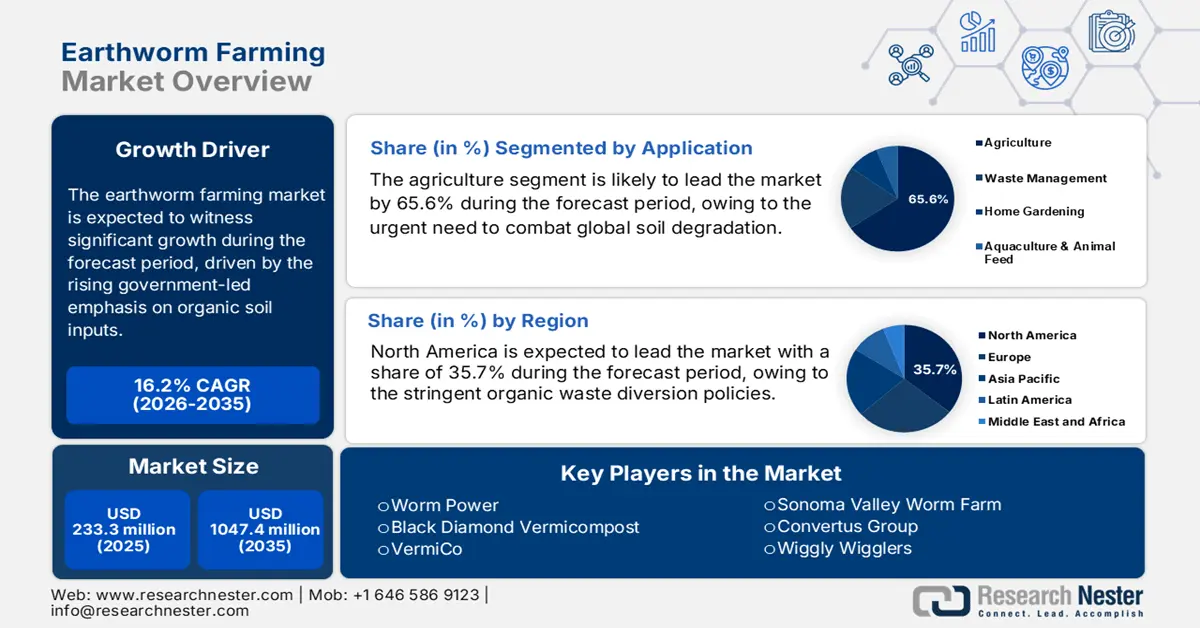
The earthworm farming market is growing rapidly and is fueled due to the rising government-led emphasis on organic soil inputs, supported by the verified increases in the demand for natural soil conditioners. The report from the FiBL & IFOAM - Organics International in 2025 has stated that the global organic agriculture is in steady progress and the organic farmland has expanded to nearly 99 million hectares with a notable surge in regions such as Europe, Africa, North America, Latin America, and Oceania. The number of organic producers has decreased by 4% due to the reductions in Thailand and India. This expansion of the certified organic farmland directly corresponds to a larger addressable market for the compliant soil inputs, such as vermicompost. The consolidation of producers decreases in their total number indicates a trend toward larger, more commercially oriented organic operations.
On the trade front, the total organic exports to the U.S. surged while the imports declined. Despite the economic pressures and challenges, the global retail sales of organic products increased to over 136 billion euros, based on the FiBL & IFOAM - Organics International in 2025 data. Further, the World Bank data in January 2025 depicts that the cumulative fertilizer exports from China in August 2024 reached 2.87 million metric tons. This figure highlights the competitive landscape and volume of the broader soil amendment market in which earthworm-based products operate. This competitive pressure necessitates that earthworm farming operations demonstrate a clear cost-benefit advantage over the conventional alternatives to gain earthworm farming market share. Strategic focus on local and regional supply chains can reduce the challenges while capitalizing on the demand for specialized, high-efficacy organic inputs.
Key Earthworm Farming Market Insights Summary:
Regional Highlights:
- By 2035, North America is anticipated to secure 35.7% share of the earthworm farming market as policies tightening organic-waste diversion and strong backing for sustainable agriculture accelerate adoption.
- Across 2026–2035, Asia Pacific is projected to remain the fastest-expanding region as escalating organic-waste volumes and food-security needs spur large-scale vermicomposting integration.
Segment Insights:
- By 2035, the agriculture segment is positioned to capture 65.6% share of the earthworm farming market as momentum builds around sustainable soil-restoration practices and food-system resilience.
- By 2035, the commercial and industrial segment is expected to lead the end-user category as scalability and regulatory pressure to divert organic waste bolster vermicomposting adoption.
Key Growth Trends:
- The shift for organic waste diversion
- Restriction on synthetic agrochemicals
Major Challenges:
- Lack of standardization and quality control
- Composition from substitutes and price sensitivity
Key Players: Worm Power (U.S.), Black Diamond Vermicompost (U.S.), VermiCo (U.S.), Sonoma Valley Worm Farm (U.S.), Convertus Group (Canada/Switzerland), Wiggly Wigglers (UK), Biological Home & Garden (UK), Wurm Paradise (Germany), Green Worm Japan (Japan), My NOKE (South Korea), Bharat Wormy Compost (India), Agrilife (India), Earthworm Organic Fertilizer Sdn. Bhd. (Malaysia), Guangzhou Erui Organic Fertilizer Co., Ltd. (China), J.R. & G.R. Anderson Pty Ltd (Worm Factories) (Australia), Kahariam Farms (Philippines), Wormawy (Egypt), WormsRUs (South Africa), Hazera Seeds Ltd. (Part of Limagrain) (France/Israel), Uncle Jim's Worm Farm (U.S.).
Global Earthworm Farming Market Forecast and Regional Outlook:
Market Size & Growth Projections:
- 2025 Market Size: USD 233.3 million
- 2026 Market Size: USD 271.2 million
- Projected Market Size: USD 1047.4 million by 2035
- Growth Forecasts: 16.2% CAGR (2026-2035)
Key Regional Dynamics:
- Largest Region: North America (35.7% Share by 2035)
- Fastest Growing Region: Asia Pacific
- Dominating Countries: United States, China, India, Japan, Germany
- Emerging Countries: Vietnam, Malaysia, South Korea, Brazil, Australia
Last updated on : 1 December, 2025
Earthworm Farming Market - Growth Drivers and Challenges
Growth Drivers
- The shift for organic waste diversion: The government directives are the primary demand drivers of the earthworm farming market. The U.S. Environmental Protection Agency data in August 2025 reports that the national goal of the U.S. government is to cut food loss and waste by 50% by 2030, directly incentivizing vermiculture as a processing solution. These regulations push the municipalities and food processors to seek efficient organic waste disposal methods, creating a stable, low-cost feedstock supply for the earthworm farms and simultaneously driving the demand for the resulting compost. This policy framework transfers waste management from the cost center into a resource opportunity, fundamentally expanding the market’s foundation.
- Restriction on synthetic agrochemicals: Regulatory agencies are increasingly avoiding synthetic fertilizers and pesticides due to environmental concerns. The European Chemical Agency, as a part of the EU’s Farm to Fork Strategy, is advancing the measures to halve nutrient losses and the use and risk of chemical pesticides by 2030. This creates a direct substitution effect, boosting the demand for the biological soil amendments such as vermicompost. The manufacturers of the conventional agrochemicals face increased compliance costs and market challenges. The earthworm farming manufacturers benefit from this regulatory pivot toward sustainable inputs. This regulatory pressure minimizes the earthworm farming market entry barriers effectively for vermicompost producers while simultaneously expanding their potential customer base among conventional farmers seeking compliant alternatives.
- Fertilizer trade fueling the demand for the localized vermicompost: The volatility and geopolitical instability within the global synthetic fertilizer trade are the significant drivers for the earthworm farming market. For example, despite the cumulative fertilizer export of 9.3 million metric tons in December 2023, subsequent export restrictions have contributed to price spikes and supply disruptions, increasing geopolitical conflicts creating an immense financial uncertainty for farmers. This volatility makes the locally produced vermicompost a strategically attractive and economically resilient alternative. By providing a stable onshore source of soil nutrients, earthworm farming directly reduces the risk associated with the import-dependent conventional fertilizer market. This driver is forcing the agricultural stakeholders to diversify their input sources, thereby surging the adoption of the vermiculture as a risk management strategy.
Challenges
- Lack of standardization and quality control: As there are no universal industry standards for vermicompost maturity, nutrient component, and pathogen levels and this leads to inconsistent product quality, which is eroding the buyer trust. The Worm Power company addresses this issue by implementing a proprietary 21-point quality assurance protocol by providing a certified analysis with each batch. This builds credibility with the large agricultural buyers who require guaranteed inputs. The USDA’s National Organic Program sets baseline requirements, but the lack of finer standards remains a hurdle for widespread commercial adoption, necessitating individual company initiatives to ensure the quality.
- Composition from substitutes and price sensitivity: Vermicompost competes with the cheaper, less effective alternatives such as raw manure, inorganic fertilizers, and other composts. The price sensitivity, especially among the small-scale farmers, is high. To compete with the top leading companies, such as the Kahariam Farms, that focus on premium markets such as organic horticulture and cannabis, where product efficacy justifies a higher price point. They differentiate based on the superior microbial life and specific crop results, rather than competing on price alone in the crowded soil amendment market.
Earthworm Farming Market Size and Forecast:
| Report Attribute | Details |
|---|---|
|
Base Year |
2025 |
|
Forecast Year |
2026-2035 |
|
CAGR |
16.2% |
|
Base Year Market Size (2025) |
USD 233.3 million |
|
Forecast Year Market Size (2035) |
USD 1047.4 million |
|
Regional Scope |
|
Earthworm Farming Market Segmentation:
Application Segment Analysis
By 2035, the agriculture segment is expected to dominate the application segment and is poised to hold the earthworm farming market share value of 65.6%. The segment is driven by the urgent need to combat global soil degradation and ensure food security. This is vital as sustainable soil management practices are needed to aid the global food systems. Vermicompost directly addresses soil infertility by restoring microbial life and structure. The international organizations, such as the FAO, highlight the productive and resilient farming systems, creating a massive demand for organic amendments such as vermicompost. The report from the EPA data in August 2025 states that 5% of the food waste is composted, and they are used as a valuable source in agricultural systems to improve fertility and enhance crop yields.
End user Segment Analysis
The commercial and industrial sector is leading the end user segment and comprises large-scale farms, landscapers, and organic waste processors. This segment uses earthworm farming for its scalability and cost-effectiveness in waste diversion and input production. The EPA report in September 2025 states that nearly 25 million tons of solid waste are generated annually, with vermicomposting capturing a growing portion of this stream to serve commercial agriculture. This growth is fueled by the corporate sustainability goals and regulatory pressures to divert the organic waste from landfills, making earthworm farming a central technology in the circular bioeconomy for its dual waste management and soil health benefits.
Product Type Segment Analysis
Under the product segment, the vermicompost leads the segment and is expected to hold a considerable share during the forecast period. The segment is fueled by the global shift towards sustainable agriculture. Vermicompost is valued for its ability to improve the soil structure and fertility. The market for organic soil modification is significant, with the U.S. organic food market reaching USD 61.7 billion in consumer sales in 2022, according to the USDA October 2023 data, hence increasing the demand from both commercial and amateur producers for certified organic inputs like vermicompost It lessens the need for artificial fertilizers and pesticides and improves soil health, water retention, and plant disease suppression. The governmental bodies, such as the USDA, actively promote the soil health management practices that align perfectly with the vermicompost use, framing it as a core tool for building organic matter and long-term farm productivity.
Our in-depth analysis of the earthworm farming market includes the following segments:
|
Segment |
Subsegments |
|
Product Type |
|
|
Application |
|
|
End user |
|

Vishnu Nair
Head - Global Business DevelopmentCustomize this report to your requirements — connect with our consultant for personalized insights and options.
Earthworm Farming Market - Regional Analysis
North America Market Insights
North America is dominating the earthworm farming market and is expected to hold the market share of 35.7% by 2035. The market is driven by the stringent organic waste diversion policies and robust support for sustainable agriculture. Various organizations are focusing on food waste reduction, compelling vermicomposting adoption to surge the market growth. The USDA NRCS programs provide financial assistance for soil health practices, including vermicompost use, creating farmers demand. The earthworm farming market exhibits a trend towards the industrial scale, technology-integrated operations, which are capable of processing significant organic waste volumes from the municipalities and agribusiness. Consumer demand for organic food further propels the market growth and establishes a stable end market for high-quality vermicompost.
The U.S. market is defined by the policy-driven demand and technological scaling. The goal for food waste reduction is the vital driver mandating the alternatives to landfilling and creating feedstock for vermifarming. Further, the USDA Natural Resources Conservation Service promotes the vermicompost via its Environmental Quality Incentives Program, offering cost-share funding to farmers for adopting soil health practices. This creates a powerful push-pull effect; waste policy ensures a low-cost input supply, while agricultural subsidies stimulate the demand. On the other hand, the funding for soil amendments is the crucial demand driver of the market. The production of the organic soil amendments improves soil health, structure, and fertility. The USDA data in April 2023 states that it has invested USD 40 million to develop innovative approaches to climate-smart agriculture.
Key R&D Funding Initiatives for Soil Amendments in the U.S.
|
Grant/Program |
Year(s) |
Funding Amount |
Focus Areas |
Agency |
|
Conservation Innovation Grants (CIG) |
2023 |
USD 40 million |
Climate-smart agriculture, soil health, amendments innovation |
USDA |
|
NIFA Soil Health Research |
2024 |
USD 7.9 million |
Scientific advancement of soil physical/chemical processes |
USDA NIFA |
|
Partnerships for Climate-Smart Commodities (PCSC) |
2022–2025 |
Up to USD 2.8 billion |
Market development and implementation of climate-smart practices |
USDA |
Source: USDA April 2023, ECALS June 2024, USD May 2025
The earthworm farming market in Canada is forecasted to grow due to the national strategy for a circular economy and provincial organic waste bans. The federal Healthy Environment and a Healthy Economy plan emphasizes waste reduction and soil organic carbon enhancement, aligning perfectly with the vermiculture benefits. The bans on the landfilling of organic waste, such as those in Ontario and British Columbia, create a demand for processing solutions such as large-scale vermicomposting. The Canadian Council of the Ministers of the Environment aids this via its commitment to reduce organic waste. According to the Government of Canada data in the September 2025 report, the Minister of Environment and Climate Change has funded more than USD 640,000 to support local government research and capacity-building initiatives to minimize the food and other organic waste that is sent to landfills. This reduction effectively protects the environment and surges the demand for the market.
APAC Market Insights
Asia Pacific’s earthworm farming market is the world’s fastest-growing and is driven by the urgent need to manage the escalating organic waste and enhance food security. India and China are the key players in the earthworm farming market and are propelled by the massive agricultural sectors and government initiatives promoting organic alternatives to chemical fertilizers. For example, India’s National Mission for Sustainable Agriculture actively aids in organic farming practices, creating a direct demand for vermicompost. A key regional trend is the incorporation of small-scale decentralized worm farms into agricultural cooperatives, allowing for the collective waste processing and input production. This model is vital in countries such as Vietnam and Malaysia. Further, technologically advanced operations are emerging in South Korea and Japan, aiming for the high-value vermicompost for specialty crops and exporting premium breeding stock.
China’s earthworm farming market is defined by its integration into large-scale, state supported circular economy and rural revitalization initiatives. The Double Carbon goal provides a policy framework that incentivizes organic waste valorization where vermicomposting plays a key role. The Ministry of Agriculture and Rural affairs promotes the recycling of livestock manure as a fertilizer substitute. According to the report from the Food and Agriculture Organizations of the United Nations data in 2020 to 2026 depicts that Shandong, Jiangsu, Jiangxi, and Guizhou have collectively designated over 450,000 hectares of land for adopting improved agricultural practices, which includes the use of organic amendments like vermicompost, alongside 80,000 hectares for restoration projects. This creates a massive structured demand for the vermiculture process organic waste into standardized soil amendments.
Provincial Agricultural Improvement and Restoration Targets
|
Province / County |
Core Indicator 4 Target Area – Improved Practices (Hectares) |
Core Indicator 3 Target Area – Restoration (Hectares) |
Locations |
|
Shandong |
145,000 |
20,000 |
1. Qihe City |
|
Jiangsu |
115,000 |
20,000 |
5. Taicang City |
|
Jiangxi |
80,000 |
20,000 |
9. Fenyi County |
|
Guizhou |
110,000 |
20,000 |
11. Liping County |
Source: FAO 2020-2026
India’s is leading the APAC earthworm farming market and is driven by the federal and state government policies promoting sustainable agricultre and waste management. The National Mission for the Sustainable Agriculture under the Ministry of Agriculture actively promotes for organic farming practices directly creating demand for vermicompost as a key input. A significant push comes from the broader Paramparagat Krishi Vikas Yojona that aims to support organic farmers. The PIB data in December 2024 states that under the MOVCDNER scheme, an assistance of Rs. 46,500 per hectare for 3 years is provided to support farmers for organic inputs, quality seeds or planting material and training. This data directly drives demand for earthworm farming outputs, because organic cultivation requires continuous use of certified biological soil amendments.
State Wise Details of Fund Allocation during 2023-24 to 2024-25 for Promoting Organic Farming
|
S.No |
Name of the State |
2023-2024 |
2024-2025 |
|
1 |
Assam |
3717.98 |
4062.50 |
|
2 |
Manipur |
2805.38 |
3941.35 |
|
3 |
Meghalaya |
2465.40 |
4096.00 |
|
4 |
Nagaland |
2346.10 |
4250.00 |
|
5 |
Mizoram |
2336.16 |
4187.00 |
|
6 |
Arunachal Pradesh |
2574.75 |
6250.00 |
|
7 |
Sikkim |
3260.69 |
1949.58 |
|
8 |
Tripura |
3370.04 |
3625.00 |
|
|
Total |
22876.50 |
32361.43 |
Source: PIB December 2024
Europe Market Insights
The European Union’s stringent regulatory framework mainly the Farm to Fork strategy and the Circular Economy Action plan, is the key driver driving the demand for the earthworm farming market in Europe. The key trend is the integration of vermicomposting into municipal organic waste management systems to comply with the landfill diversion mandates. This is supported by the funding mechanisms, such as the EU Cohesion Fund, which finances the waste management infrastructure. For example, the European Union’s Horizon Europe program has allocated significant funding for research into soil health, indirectly benefiting the vermiculture sector. The earthworm farming market is defined by the high degree of standardization and a growing network of industrial-scale facilities that process urban bio-waste into high-value agricultural inputs, positioning Europe as a leader in the high-quality certified vermicompost production.
Germany is projected to hold the highest revenue share in Europe by 2035, and is driven by its strong industrial base and stringent environmental regulations. The country’s Düngeverordnung strictly limits the application of phosphorus and nitrogen to combat water pollution, forcing the farmers to seek highly efficient, low-leaching alternatives such as vermicompost. This regulatory pressure is a primary growth factor. The trend is towards the large-scale, technology-driven vermicomposting facilities that partner with the waste management companies. According to the Destatis data in September 2022, the generation of bio-waste in Germany households was over 2.6 million tons, representing a vast, untapped feedstock potential for the earthworm farming industry to capitalize on.
France will be a dominant player in the earthworm farming market, and the growth is based on the aggressive national policy against agricultural chemicals and a strong organic food sector. The French government’s Ecophyto plan aims to drastically reduce pesticide use, while local ordinances have banned their use in public spaces. This creates a powerful policy-driven earthworm farming market for the bio-based solutions. The trend involves integrating vermiculture into the viticulture and horiculture sectors where product quality is paramount. The support from the French Agency for Ecological Transition, which actively funds the recovery of the organic waste. The Organic targets data in May 2025 provides evidence stating that the development of organic farmlands in France in 2022 was 2,876,052 hectares, illustrating the extensive and growing end-market for vermicompost.

Key Earthworm Farming Market Players:
- Worm Power (U.S.)
- Company Overview
- Business Strategy
- Key Product Offerings
- Financial Performance
- Key Performance Indicators
- Risk Analysis
- Recent Development
- Regional Presence
- SWOT Analysis
- Black Diamond Vermicompost (U.S.)
- VermiCo (U.S.)
- Sonoma Valley Worm Farm (U.S.)
- Convertus Group (Canada/Switzerland)
- Wiggly Wigglers (UK)
- Biological Home & Garden (UK)
- Wurm Paradise (Germany)
- Green Worm Japan (Japan)
- My NOKE (South Korea)
- Bharat Wormy Compost (India)
- Agrilife (India)
- Earthworm Organic Fertilizer Sdn. Bhd. (Malaysia)
- Guangzhou Erui Organic Fertilizer Co., Ltd. (China)
- J.R. & G.R. Anderson Pty Ltd (Worm Factories) (Australia)
- Kahariam Farms (Philippines)
- Wormawy (Egypt)
- WormsRUs (South Africa)
- Hazera Seeds Ltd. (Part of Limagrain) (France/Israel)
- Uncle Jim's Worm Farm (U.S.)
- Worm Power is pioneering in the earthworm farming market. Their strategic advancements are based on the implementation of proprietary bio-assay testing and genetic strain selection for their earthworm populations. This scientific approach ensures the consistent microbial compositions and efficacy of their vermicompost, allowing them to offer performance-guaranteed products to large-scale agriculture clients.
- Black Diamond Vermicompost has significantly advanced its position by vertically integrating into the organic waste logistics sector of the earthworm farming market. Their strategy involves forming exclusive partnerships with municipal and commercial food waste generators by creating a closed-loop system that secures their raw material supply while providing a valuable waste diversion service.
- VermiCo has carved a niche in the earthworm farming market as it focuses on education and technology transfer as a core business strategy. They have developed an advanced, scalable, modular vermiculture system and offer comprehensive consultancy services. This initiative allows a network of franchisees and licensees to establish their own profitable worm farms.
- Sonoma Valley Worm Farm is capitalizing on the premium consumer-facing segment of the earthworm farming market. Their key advancement is the development of the grower in California. By marketing their product as a terroir-enhancing soil amendment with verifiable results, they have created a high-margin direct-to-grower brand that distinguishes itself from bulk commodity producers.
- Convertus Group is industrializing the earthworm farming market via technological integration and large-scale infrastructure. Their strategic initiative involves the deployment of automated in-vessel vermicomposting systems integrated directly into municipal organic waste processing facilities.
Here is a list of key players operating in the global earthworm farming market:
The global earthworm farming market is highly competitive and is further fragmented, defined by the mix of specialized vermiculture pioneers and large agricultural corporations entering the space. The key players are aggressively pursuing the strategic initiatives to consolidate the market share and drive growth. These strategies include vertical integration to control the supply chain from waste processing to product distribution and technological adoption of IoT for optimizing worm bed conditions. Further, the strategic partnerships and acquisitions are prevalent, as seen with the large agribusinesses acquiring established worm farms to gain the expertise and product lines instantly. The focus is shifting from merely producing casting to offering integrated organic waste management solutions and branded, high-efficacy biological inputs for commercial agriculture, pushing the industry toward greater professionalism and scalability.
Corporate Landscape of the Earthworm Farming Market:
Recent Developments
- In December 2024, AgroLiquid, a leader in high-efficiency crop liquid fertilizer solutions, announced the acquisition of Monty’s Plant Food Company, a Louisville-based specialist in soil health and plant nutrition technology.
- In September 2024, Apical and Earthworm Foundation partnered with East Kutai District Government to expand the Sustainable Living Village Programme. This partnership is set to drive positive environmental and social change in the East Kutai region.
- Report ID: 3158
- Published Date: Dec 01, 2025
- Report Format: PDF, PPT
- Explore a preview of key market trends and insights
- Review sample data tables and segment breakdowns
- Experience the quality of our visual data representations
- Evaluate our report structure and research methodology
- Get a glimpse of competitive landscape analysis
- Understand how regional forecasts are presented
- Assess the depth of company profiling and benchmarking
- Preview how actionable insights can support your strategy
Explore real data and analysis
Frequently Asked Questions (FAQ)
About this Report
Connect with our Expert


Report, 2026-2035



Copyright @ 2026 Research Nester. All Rights Reserved.
