Extended Reality (XR) Hardware Market Outlook:
Extended Reality (XR) Hardware Market size was valued at USD 16.1 billion in 2025 and is poised to reach USD 118.2 billion by the end of 2035, expanding at around 22.1% CAGR during the forecast period, i.e., 2026-2035. In 2026, the industry size of extended reality hardware is assessed at USD 19.6 billion.
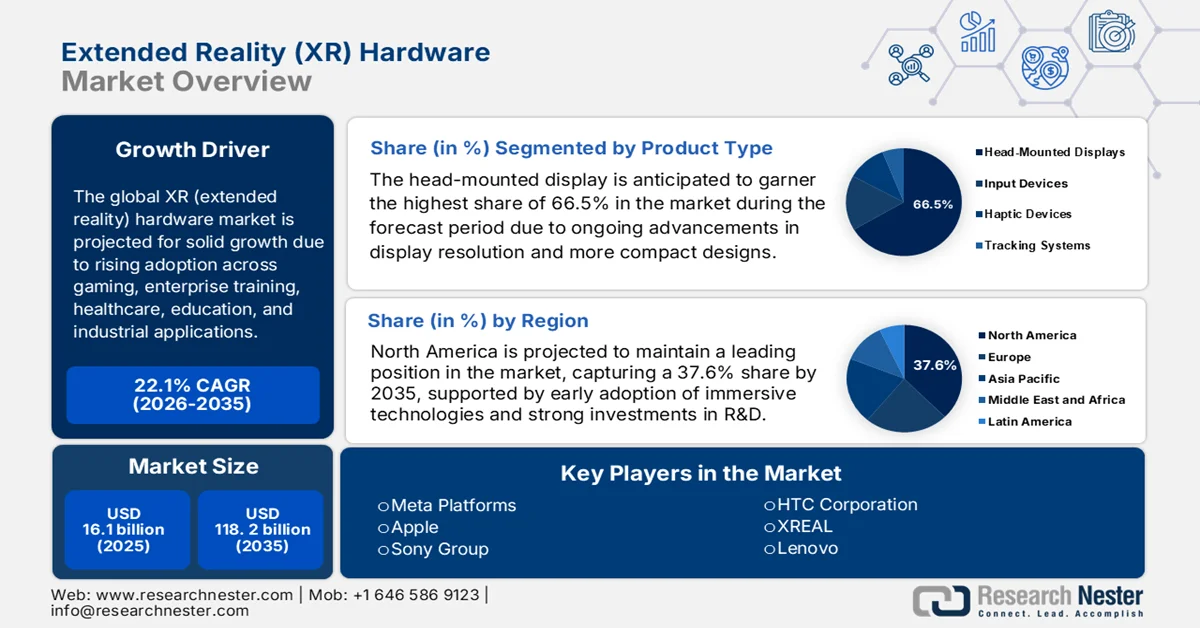
The extended reality hardware market is projected for explosive growth, positively impacted by rising adoption across gaming, enterprise training, healthcare, education, and industrial applications. Most of the immersive technologies, such as virtual reality headsets, augmented reality smart glasses, and mixed reality devices, are improving visual quality, making XR hardware more practical for everyday use. In January 2022, the U.S. Government Accountability Office stated that XR blends digital and real environments to enable new forms of training, education, collaboration, and therapy. Also, XR offers opportunities in healthcare, workplace collaboration, data analysis, and treatments, and it mentions that future growth depends on enabling technologies such as artificial intelligence and 5G networks, which could make XR more interactive, reliable, and widely accessible. Market forecasts reported AR/VR headset shipments to grow from 9.7 million in 2021, thus elevating the growth potential of the market.
Furthermore, the worldwide technology companies are making heavy investments in devices that combine lightweight design with higher processing power and improved spatial computing features. Continued innovation in terms of optics, display technologies, and sensor systems is making XR devices more accessible, thereby supporting broader extended reality (XR) hardware market penetration across both developed and emerging regions. For instance, in June 2023, Apple introduced Apple Vision Pro as its first spatial computer, which is especially designed to blend digital content with the real world through a 3D interface controlled by eyes, hands, and voice. Besides, it runs on visionOS, a new spatial operating system built from macOS, iOS, and iPadOS foundations, thereby enabling apps to exist in an infinite virtual canvas around the user. The device consists of ultra-high-resolution dual displays with 23 million pixels and a dual-chip Apple silicon design, with a collective goal to deliver real-time immersive experiences that feel physically present in the user’s space.
Key Extended Reality (XR) Hardware Market Insights Summary:
Regional Highlights:
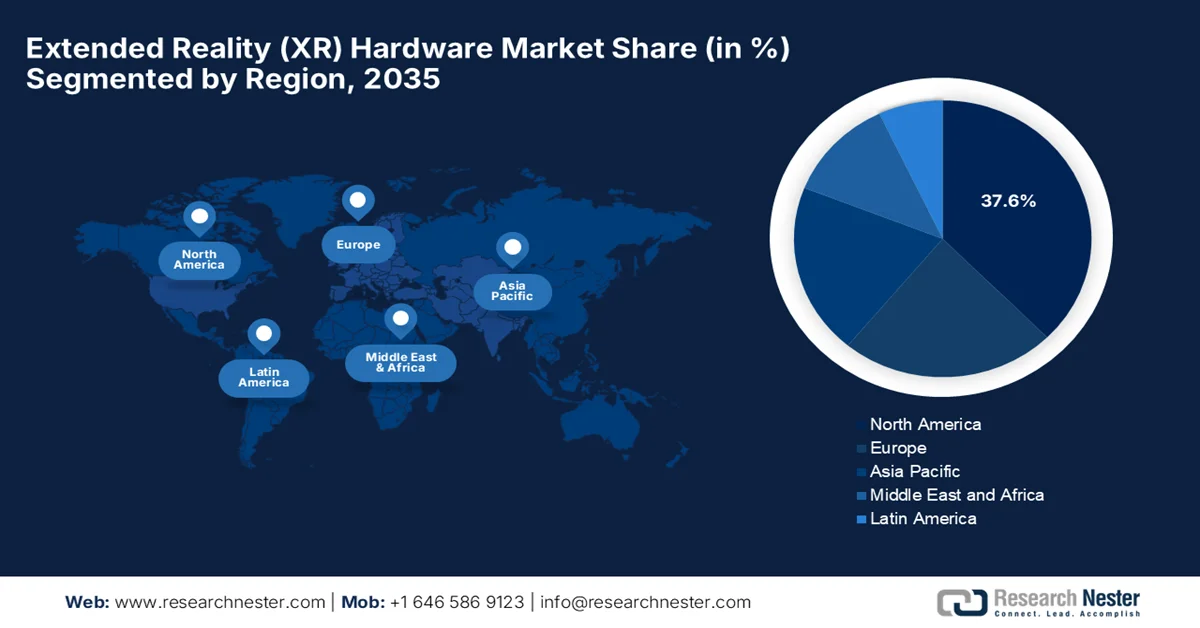
- North America is expected to capture 37.6% share by 2035 in the extended reality (xr) hardware market, underpinned by early adoption of immersive technologies and significant investment in research and development
- Asia Pacific is poised to register the fastest growth during 2026-2035, supported by massive consumer adoption and dominant manufacturing infrastructure
Segment Insights:
- The head-mounted displays segment is projected to account for 66.5% share by 2035 in the extended reality (xr) hardware market, bolstered by ongoing advancements in display resolution, more compact designs, and improved ergonomic comfort for prolonged usage
- The gaming & entertainment segment is anticipated to secure a considerable share of the market by 2035, fueled by continuous advancements in hardware that improve graphics quality, reduce latency, and enhance comfort for long gaming sessions
Key Growth Trends:
- Rising demand for immersive gaming and entertainment
- Enterprise adoption for training and collaboration
Major Challenges:
- High hardware costs and limited mass-market affordability
- Technical limitations, user comfort, and battery performance
Key Players: Meta Platforms, Apple, Sony Group, HTC Corporation, XREAL, Lenovo, Pico, Varjo, Magic Leap, Vuzix, Lynx Mixed Reality.
Global Extended Reality (XR) Hardware Market Forecast and Regional Outlook:
Market Size & Growth Projections:
- 2025 Market Size: USD 16.1 billion
- 2026 Market Size: USD 19.6 billion
- Projected Market Size: USD 118.2 billion by 2035
- Growth Forecasts: 22.1% CAGR (2026-2035)
Key Regional Dynamics:
- Largest Region: North America (37.6% share by 2035)
- Fastest Growing Region: Asia Pacific
- Dominating Countries: United States, China, Japan, South Korea, Germany
- Emerging Countries: India, Taiwan, Singapore, United Arab Emirates, Canada
Last updated on : 30 June, 2026
Extended Reality (XR) Hardware Market - Growth Drivers and Challenges
Growth Drivers
- Rising demand for immersive gaming and entertainment: The consumer demand for immersive gaming and interactive media experiences is booming, propelling surging growth in the extended reality hardware market. Devices such as headsets and motion controllers enhance realism, which in turn makes gaming more engaging. In this context, in February 2026, the article published by the Organization for Economic Co-operation and Development revealed that governments worldwide are proactively promoting immersive technologies through certain targeted funding programs that support R&D, sector-specific applications, and talent development. These policies aim to strengthen early market positioning in areas such as gaming, healthcare, and education. Most of the countries use non-targeted funding mechanisms that integrate XR within broader digital transformation and innovation agendas and thus positively contribute to the market’s expansion.
- Enterprise adoption for training and collaboration: Businesses across most nations are opting for XR hardware for employee training, product design, and virtual collaboration. Industries such as manufacturing, retail, and aerospace use XR to simulate real-world environments safely and cost-effectively, thus enhancing uptake in the extended reality hardware market. In November 2024, Accenture, Microsoft, and Avanade together announced an expanded enterprise transformation initiative that has been built around Microsoft Copilot and generative AI technologies, including large-scale client training and workforce enablement programs. This particular collaboration integrates immersive and AI-enabled collaboration tools to help organizations redesign business functions, improve productivity, and accelerate the adoption of advanced digital workflows in different industries such as manufacturing, retail, and energy.
Challenges
- High hardware costs and limited mass-market affordability: One of the primary challenges in the extended reality hardware market is the high cost associated with advanced headsets, smart glasses, and mixed reality devices. Premium XR products include components such as micro-OLED displays, depth sensors, eye-tracking cameras, custom processors, and advanced optics, which increase both manufacturing costs and retail prices. Therefore, most of the consumer-grade devices are beyond the budget of mainstream users, which in turn limits large-scale adoption. On the other hand, enterprises also face substantial upfront investments while deploying XR hardware across multiple employees, including costs associated with software integration, maintenance, and employee training, thus negatively impacting the market’s growth.
- Technical limitations, user comfort, and battery performance: There has been observable technological progress, but still, XR hardware faces limitations associated with device comfort, battery life, processing power, and overall user experience. Most headsets are bulky and heavy, which makes prolonged use uncomfortable and contributes to user fatigue. Battery capacity often restricts continuous operation, especially for standalone devices running graphics-intensive applications or AI-based workloads. On the other hand, heat generation, display resolution, motion latency, and occasional tracking inaccuracies can affect immersion and user satisfaction. In addition, compatibility challenges between different hardware platforms and software ecosystems create fragmented user experiences, thus causing a hindrance to the extended reality hardware market’s expansion.
Extended Reality (XR) Hardware Market Size and Forecast:
| Report Attribute | Details |
|---|---|
|
Base Year |
2025 |
|
Forecast Year |
2026-2035 |
|
CAGR |
22.1% |
|
Base Year Market Size (2025) |
USD 16.1 billion |
|
Forecast Year Market Size (2035) |
USD 118.2 billion |
|
Regional Scope |
|
Extended Reality (XR) Hardware Market Segmentation:
Product Type Segment Analysis
The head-mounted displays segment, which is a part of the product type, is anticipated to garner the highest share of 66.5% in the extended reality (XR) hardware market during the forecast period. The segment's dominance is effectively propelled by ongoing advancements in display resolution, more compact designs, and improved ergonomic comfort for prolonged usage. Leading technology firms are making heavy investments in terms of lightweight, high-resolution HMDs that provide highly immersive experiences while reducing user fatigue. For instance, in June 2023, Meta announced the launch of the Meta Quest 3, which is its next-generation virtual and mixed reality head-mounted display. The device consists of upgraded optics and a next-generation Snapdragon chipset, thereby enabling more immersive and responsive XR experiences compared to earlier models.
Application Segment Analysis
By the end of 2035, the gaming & entertainment industry is expected to grow with a considerable share of the extended reality hardware market. The segment is positively impacted by continuous advancements in hardware, which have also improved graphics quality, reduced latency, and enhanced comfort for long gaming sessions. For instance, in February 2023, Sony Interactive Entertainment announced the launch of PlayStation VR2, which is a next-generation virtual reality head-mounted display especially designed for the PlayStation 5 ecosystem. Besides, the device introduced high-fidelity 4K HDR visuals, advanced eye tracking, 3D audio, and haptic feedback through its Sense controllers, thereby enhancing immersion and realism in gaming experiences. Hence, such instances denote lucrative growth opportunities for the segment in the next decade.
End use Segment Analysis
In the extended reality hardware market, the consumer category is projected to hold a noteworthy share over the forecasted years. The segment is mainly driven by falling hardware prices, expanding XR content ecosystems, and continuous improvements in user experience that have lowered adoption barriers for mainstream users. Apart from this, consumer use cases such as entertainment, social interaction, fitness, and productivity have been expanding, and manufacturers prioritize user-friendly designs and aesthetically appealing, lightweight devices to drive mass-market adoption. In addition, the rising adoption of standalone headsets and cross-platform compatibility is making XR devices more accessible to everyday users. Strong ecosystem support from gaming and social platforms is further accelerating consumer engagement, thus denoting a wider segment scope.
Our in-depth analysis of the extended reality hardware market includes the following segments:
|
Segment |
Subsegments |
|
Product Type |
|
|
Application |
|
|
End use |
|

Vishnu Nair
Head - Global Business DevelopmentCustomize this report to your requirements — connect with our consultant for personalized insights and options.
Extended Reality (XR) Hardware Market - Regional Analysis
North America Market Insights
North America extended reality (XR) hardware market is projected to dominate with a total share of 37.6% during the forecast period. The region’s leadership is mainly propelled by early adoption of immersive technologies and significant investment in research and development. The region hosts a strong concentration of technology firms, robust venture capital activity, and ongoing enterprise digital transformation efforts that support XR adoption. Based on the government data published in November 2025, the Army’s integrated visual augmentation system is an XR headset-based platform that was originally developed with Microsoft to enhance soldier awareness, targeting, and training through real-time sensor fusion, navigation, and virtual training tools. The program is currently making a transition toward a follow-on effort called Soldier-Borne Mission Command that involves new contractors and a shift to modular, AI-based sensor systems under continual prototyping and competition.
The surging domestic investments in spatial computing infrastructure and specialized military training programs are responsibly driving the U.S. extended reality hardware market. Besides, Silicon Valley tech giants and aerospace contractors dominate the landscape, which is encouraging the rapid development of localized supply chains for advanced optics and secure microprocessors. In this context, the International Trade Administration revealed that the U.S. video game industry is a major economic driver, and it contributed nearly USD 66 billion to GDP in 2023, with more than 3.2 billion gamers worldwide. It also mentioned that gaming consumption is highly digital, with 95% of games purchased online, and mobile gaming leading the market at 49%, followed by console at 28% and PC at 23%, reflecting a mobile-first trend.
Canada extended reality hardware market is expected to progress with remarkable growth, propelled by a thriving local technology sector and widespread deployment of high-speed 5G infrastructure. Major technology hubs benefit from a strong network of innovative startups and academic institutions that are fueling specialized advancements in head-mounted devices. For instance, in November 2025, Victrix announced a tactical partnership with Canada based Auger Groupe Conseil (AGC) in order to expand into extended reality and aim to deliver advanced immersive technologies for training, communication, and industrial performance improvement. Through this partnership, Victrix and AGC plan to strengthen innovation in XR by deploying immersive solutions that improve workplace efficiency, safety, and collaboration across different industries.
APAC Market Insights
The Asia Pacific extended reality hardware market is anticipated to witness the fastest growth from 2026 to 2035. The region’s upliftment in this field is mainly driven by massive consumer adoption and dominant manufacturing infrastructure. Countries such as China, Japan, Taiwan, and South Korea command the upstream supply chain, housing the world's leading display foundries, optical component factories, and assembly lines. In January 2024, Sony announced the development of an advanced XR spatial content creation system, which possesses a 4K OLED head-mounted display, intuitive ring and pointing controllers, and Qualcomm’s Snapdragon XR2+ Gen 2 platform to support immersive 3D content creation. This system is especially designed for creators in entertainment and industrial design, which enables real-time modeling, collaboration, and high-quality rendering through integration with third-party 3D software, with Siemens as its launch partner.
In China, the extended reality hardware market is growing at a remarkable pace of progress, largely driven by the intense domestic competition and aggressive state-backed industrial modernization policies. Domestic technology firms are utilizing localized, end-to-end supply chains that house world-class micro-display foundries and optical component factories so that they can rapidly iterate and mass-produce affordable smart glasses and standalone headsets. Based on the government data published in February 2025, the country’s immersive VR industry is rapidly expanding, wherein XR experiences at cultural sites such as the Qin Shihuang Mausoleum and virtual recreations of Notre-Dame are attracting visitors and enhancing cultural tourism through advanced technologies such as VR, 3D modeling, and multisensory effects. The immersive industry reached a substantial USD 13.6 billion by the end of 2023, thus reflecting strong commercial potential and growing consumer demand for interactive cultural experiences.
The booming digital economy, the rise of 5G, and a large community of software developers are the visible trends reshaping the growth dynamics of the extended reality hardware market in India. The country’s market is making a shift to domestic assembly and localized product design, supported by national manufacturing incentives that are aimed at building electronic ecosystems. Press Information Bureau (PIB) in April 2026 stated that India’s Promotion and Regulation of Online Gaming Rules, 2026, which came into force on 1 May 2026, establish a proper framework to promote safe online gaming, support e-sports and social games, and prohibit all forms of online money gaming to protect users from financial and social harm. Besides these rules, the Online Gaming Authority of India introduces game classification, registration, user safety measures, grievance redressal mechanisms, and strict enforcement provisions, providing greater regulatory clarity and accountability for the industry, thus elevating the growth potential of the market.
Europe Market Insights
Europe extended reality hardware market is predicted to account for a remarkable share during the forecast period. The region’s growth in this sector is largely propelled through industrial and enterprise workflows, driven by the strong automotive, aerospace, and medical engineering sectors. The market benefits from highly specialized deep-tech research hubs and a sophisticated ecosystem of optical component developers who are advancing waveguide technologies. As of July 2025, XR has become mainstream across industries such as education, healthcare, manufacturing, tourism, entertainment, and industrial processes, supported by advances in AI, 5G/6G, cloud computing, and edge technologies. The region is fostering a strong XR ecosystem by supporting research, innovation, and SMEs, which make up around 90% of Europe’s XR companies, thus positively impacting the market’s expansion.
Industry 4.0 strategy, heavily driven by deep integration within the automotive, aerospace, and advanced manufacturing sectors, is boosting the overall extended reality hardware market in Germany. In addition, strict national data privacy mandates and corporate compliance standards are also shaping the market, encouraging manufacturers to prioritize secure, enterprise-grade hardware architectures suitable for the country’s industrial workforce. The country’s industrial players are deploying XR head-mounted displays for real-time product design, simulation, and digital twin visualization across factory environments. On the other hand, automotive and aerospace manufacturers are using immersive tools to reduce prototyping time and improve engineering accuracy. Apart from this, research institutions and technology partners are also supporting XR innovation by developing high-precision optics, tracking systems, and secure industrial platforms.
In the UK, the extended reality hardware market is poised for exponential growth owing to a strong focus on high-value creative industries, specialized medical training, and defense engineering. Besides, the country’s market leads in terms of implementing mixed-reality headsets within aerospace modeling, remote surgical education, and experiential consumer entertainment, whereas public-private partnerships drive technology adoption across the nation's digital infrastructure. Based on the government data published in November 2024, Innovate UK launched a funding competition by offering up to USD 4.7 million in grants to support the development of extended XR-based digital therapeutics for mental health, with individual projects eligible for USD 255,000 to USD 382,000. This competition targeted UK-registered businesses that are developing scalable XR mental healthcare solutions that could be designed, tested, and trialed within a 12- to 18-month R&D cycle for potential integration into the UK's formal healthcare system.
Key Extended Reality (XR) Hardware Market Players:
- Meta Platforms (U.S.)
- Apple (U.S.)
- Sony Group (Japan)
- HTC Corporation (Taiwan)
- XREAL (China)
- Lenovo (China)
- Pico (China)
- Varjo (Finland)
- Magic Leap (U.S.)
- Vuzix (U.S.)
- Lynx Mixed Reality (France)
- Company Overview
- Business Strategy
- Key Product Offerings
- Financial Performance
- Key Performance Indicators
- Risk Analysis
- Recent Development
- Regional Presence
- SWOT Analysis
- Meta Platforms is a global leader in the market through its Meta Quest portfolio of virtual and mixed reality headsets. Besides, the company benefits from a strong consumer presence by combining advanced standalone hardware with the Horizon OS ecosystem and AI capabilities.
- Apple readily emerged as a predominant leader in the extended reality hardware market with the introduction of Apple Vision Pro, which is a high-end spatial computing headset that integrates with the Apple ecosystem. The company differentiates itself through proprietary silicon, micro-OLED displays, and certain intuitive spatial user interfaces.
- Sony Group is a prominent manufacturer of XR hardware. The company benefits from its expertise in gaming consoles, image sensors, display technologies, and interactive entertainment. In addition, Sony delivers tightly integrated VR solutions for PlayStation users.
- HTC Corporation is yet another dominant force in this sector, which is well recognized for its VIVE portfolio of virtual reality and mixed reality headsets. The firm serves different industries, which include healthcare, manufacturing, education, defense, and training through premium standalone and PC-connected XR devices.
- XREAL has become one of the fastest-growing manufacturers in the market by specializing in lightweight augmented reality smart glasses for both consumers and enterprise users. The company’s strategic collaborations with Google and Qualcomm have further strengthened XREAL's position, enabling the company to expand globally.
Here is a list of key players operating in the global extended reality hardware market:
The extended reality hardware market is witnessing intense competition with the presence of global technology manufacturers that lead in terms of premium VR, AR, and mixed reality headset shipments. On the other hand, the nice vendors are highly focused on enterprise, industrial, healthcare, and defense applications. Competition in this field is highly driven by advancements in display technology, spatial computing, and software ecosystem compatibility. Market participants benefit from strong R&D capabilities and developer ecosystems, whereas specialized companies differentiate through enterprise-grade visualization and industrial applications. For instance, in May 2026, XREAL and Google showcased Project Aura at Google I/O 2026, which are lightweight wired XR glasses powered by Android XR, Gemini AI, and Qualcomm Snapdragon processors. It possesses immersive applications, including Google Maps, YouTube VR, WebXR, and AI-based spatial computing experiences.
Corporate Landscape of the Extended Reality (XR) Hardware Market:
Recent Developments
- In February 2026, Varjo announced the launch of its new Integrated XR Systems, which are a complete, ready-to-deploy solution designed specifically for secure and air-gapped environments. This particular system combines the XR-4 Series headsets, pre-installed XR software, and bundled licenses.
- In October 2025, Samsung announced the launch of Galaxy XR, which is its first AI-native XR device built on the new Android XR platform co-developed with Google and Qualcomm.
- Report ID: 8646
- Published Date: Jun 30, 2026
- Report Format: PDF, PPT
- Explore a preview of key market trends and insights
- Review sample data tables and segment breakdowns
- Experience the quality of our visual data representations
- Evaluate our report structure and research methodology
- Get a glimpse of competitive landscape analysis
- Understand how regional forecasts are presented
- Assess the depth of company profiling and benchmarking
- Preview how actionable insights can support your strategy
Explore real data and analysis
Frequently Asked Questions (FAQ)
About this Report
Connect with our Expert


Report, 2026-2035



Copyright @ 2026 Research Nester. All Rights Reserved.
