Energy Efficient Lighting Technology Market Outlook:
Energy Efficient Lighting Technology Market size was valued at USD 278.6 billion in 2026 and is projected to reach USD 647.5 billion by the end of 2036, registering around 8.8% CAGR during the forecast period, i.e., between 2027-2036. In 2027, the industry size of energy efficient lighting technology is estimated at USD 303.1 billion.
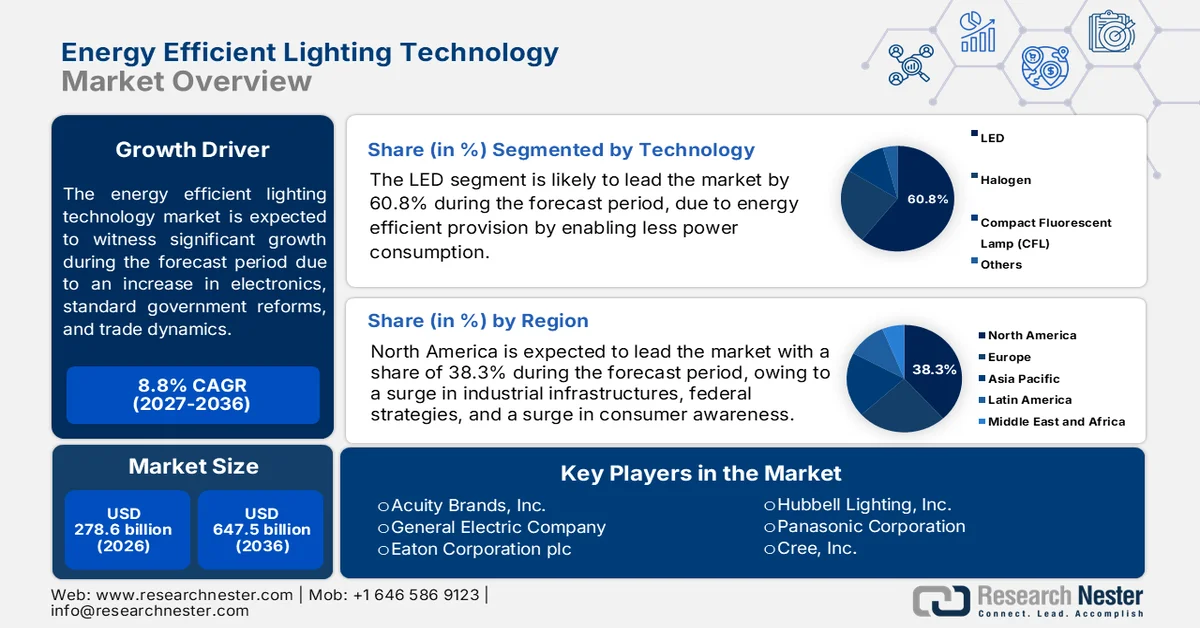
The global energy efficient lighting technology market is profoundly shaped by supply chain resilience, standard trade policies, the presence of manufacturing centers, fluctuations in raw material expenses, and an increase in electronics. According to a data report published by the IEA Organization in March 2026, nearly 8% of the worldwide electricity requirement, which is almost 2,200 TWh, was readily attributed to lighting in outdoor applications and buildings as of 2024. Besides, estimates from experts and industry significantly placed the electricity consumption for lighting, such as industrial lighting, between 2,500 and 3,500 TWh in recent years. Meanwhile, this has eventually led to continuous shipment of electric lamps and lighting fittings, which are positively impacting the market’s demand globally.
Global Electric Lamps and Lighting Fittings Shipment-Based Exports, 2021
|
Country |
Trade Value (USD 1,000) |
Quantity (Kilograms) |
|
China |
21,791,647.7 |
1,874,840,000 |
|
European Union |
1,946,640.7 |
49,656,000 |
|
Germany |
1,484,616.6 |
38,964,600 |
|
Italy |
704,182.6 |
22,221,100 |
|
Poland |
694,616.6 |
26,884,400 |
|
Netherlands |
677,767.6 |
31,880,300 |
|
U.S. |
649,516.4 |
15,478,200 |
|
Mexico |
613,059.2 |
18,796,600 |
Source: WITS
Moreover, the Internet of Things (IoT) and smart lighting integration, along with the existence of human-centric lighting (HCL) design, and the emergence of light fidelity, are other trends that are also responsible for bolstering the energy efficient lighting technology market globally. Based on the March 2026 IEA Organization article, 30% of lighting products, such as lamps, have witnessed upgradation, especially in the residential industry. In addition, this has eventually led to the opportunity of advancing to high-efficiency LED technologies. Besides, in terms of end-of-life replacement for early-generation lighting products, almost 15% of residential lamps readily fall under this category. This created a suitable opportunity for replacing these lamps with more potential and efficient smart systems, thereby making it suitable for enhancing the market’s expansion.
Key Energy Efficient Lighting Technology Market Insights Summary:
Regional Highlights:
- North America is projected to command a 38.3% share of the energy efficient lighting technology market by 2036, supported by rising consumer awareness, federal efficiency approaches, industrial activity, and growing emphasis on energy conservation
- Asia Pacific is poised to register the fastest growth during the forecast period, owing to strong government efficiency policies, rapid urbanization, infrastructure development, and large-scale public lighting programs
Segment Insights:
- The light emitting diode (LED) sub-segment is forecast to capture the largest 60.8% share of the energy efficient lighting technology market by 2036, propelled by superior energy efficiency, lower operating expenses, longer lifetimes, and continued technological advancements
- The households sub-segment is expected to secure the second-highest 45.2% share by 2036, owing to strong demand for lower electricity bills, enhanced living comfort, ease of installation, and broad retail accessibility
Key Growth Trends:
- Strict Government policies
- Corporate sustainability commitments and ESG mandates
Major Challenges:
- Technological compatibility and integration issues
- Consumer awareness and behavioral inertia
Key Players: Signify N.V. (Netherlands),OSRAM Licht AG (Germany),Acuity Brands, Inc. (U.S.),General Electric Company (U.S.),Eaton Corporation plc (Ireland),Zumtobel Group (Austria),Hubbell Lighting, Inc. (U.S.),Panasonic Corporation (Japan),Cree, Inc. (U.S.).
Global Energy Efficient Lighting Technology Market Forecast and Regional Outlook:
Market Size & Growth Projections:
- 2026 Market Size: USD 278.6 billion
- 2027 Market Size: USD 303.1 billion
- Projected Market Size: USD 647.5 billion by 2036
- Growth Forecasts: 8.8% CAGR (2027-2036)
Key Regional Dynamics:
- Largest Region: North America (38.3% share by 2036)
- Fastest Growing Region: Asia Pacific
- Dominating Countries: United States, Germany, China, Japan, France
- Emerging Countries: South Korea, Australia, Singapore, Brazil, Mexico
Last updated on : 4 September, 2026
Energy Efficient Lighting Technology Market - Growth Drivers and Challenges
Growth Drivers
- Strict Government policies: The presence of mandatory energy efficiency standards and a ban on inefficient lighting technologies is primarily driving the energy efficient lighting technology market globally. According to an article published by the Department of Energy in January 2024, the aspect of upgraded energy efficiency standards for residential-based cooking products is poised to reduce utility bills by USD 1.6 billion, eventually delivering savings to households as directed by Congress and suggested by oven and stove manufacturers. These particular standards significantly reflected a joint recommendation for a comprehensive range of stakeholders, such as energy-efficient advocates, Consumer Federation of America, and the Association of Home Appliance Manufacturers, thus positively contributing to the market’s upliftment.
- Corporate sustainability commitments and ESG mandates: These are powerfully accelerating the energy efficient lighting technology market expansion, as businesses aggressively pursue carbon reduction targets. Besides, lighting retrofits offer one of the most cost-effective and visibly impactful pathways for companies to demonstrate environmental stewardship, directly lowering emissions while generating operational savings. Moreover, publicly traded firms face increasing investor scrutiny, while consumer brands leverage green certifications to enhance brand equity. Meanwhile, supply chain partners now audit each other's sustainability credentials, compelling smaller enterprises to adopt efficient lighting to retain major contracts. This self-reinforcing driver transforms energy-efficient lighting from an optional upgrade into a competitive necessity, as early adopters' success stories encourage widespread follow-on adoption across industries.
Challenges
- Technological compatibility and integration issues: The aspect of integrating modern energy-efficient lighting with legacy electrical systems, dimming controls, and building management platforms presents formidable technical hurdles. Older infrastructures were not designed to accommodate the electronic drivers, communication protocols, and low-voltage requirements of contemporary LED and smart lighting solutions. Besides, Retrofitting often demands extensive rewiring, control panel upgrades, and software reconfiguration, which introduces project complexity and disruption to daily operations. Furthermore, interoperability between different manufacturers' products remains inconsistent, leading to performance mismatches and system instability. These integration difficulties deter facility owners, fearing operational downtime, thus limiting the energy efficient lighting technology market.
- Consumer awareness and behavioral inertia: A persistent lack of understanding regarding the full benefits of energy-efficient lighting continues to hinder the energy efficient lighting technology market growth. Many consumers and business operators remain uninformed about the total cost of ownership, maintenance reduction, and enhanced lighting quality that modern technologies offer. Habitual purchasing patterns and reliance on familiar conventional alternatives create strong behavioral resistance to change. Educational campaigns often fail to penetrate deeply, as perceived complexity and contradictory product claims generate confusion rather than clarity. Without hands-on demonstrations or trusted third-party endorsements, end users default to cheaper upfront options, overlooking lifecycle advantages.
Energy Efficient Lighting Technology Market Size and Forecast:
| Report Attribute | Details |
|---|---|
|
Base Year |
2026 |
|
Forecast Year |
2027-2036 |
|
CAGR |
8.8% |
|
Base Year Market Size (2026) |
USD 278.6 billion |
|
Forecast Year Market Size (2036) |
USD 647.5 billion |
|
Regional Scope |
|
Energy Efficient Lighting Technology Market Segmentation:
Technology Segment Analysis
Based on the technology segment, the light emitting diode (LED) sub-segment is anticipated to grab the highest share of 60.8% in the energy efficient lighting technology market by the end of 2036. The sub-segment’s upliftment is primarily fueled by its importance for providing unmatched energy efficiency by consuming the majority of less power in comparison to old incandescent bulbs. According to an article published by the IEA Organization in March 2026, LEDs effectively average 100 lm/W, with a few professional and premium LEDs surpassing 200 lm/W. This growth is highly driven by robust policies and advancements, based on which LEDs have emerged as one of the biggest energy efficiency successes. This is also associated with reduced expenses and long-term lifetimes, thus positively enhancing the sub-segment’s growth and exposure.
End user Segment Analysis
The households sub-segment, which is registered under the end user segment, is expected to account for the second-highest share of 45.2% in the energy efficient lighting technology market by the end of the stipulated timeline. The sub-segment’s development is highly propelled by representing a massive and fragmented consumer base, driven primarily by the desire for reduced electricity bills and enhanced living comfort. This sub-segment ranges from urban apartment dwellers to rural homeowners, each presenting distinct usage patterns and budget sensitivities. Besides, decision-making within households often involves multiple stakeholders, balancing aesthetic preferences against functional performance. Meanwhile, the adoption is heavily influenced by word-of-mouth recommendations, retail visibility, and ease of installation, thus boosting the sub-segment.
Application Segment Analysis
During the forecast period, the residential sub-segment under the application segment is predicted to garner the third-highest share of 37.6% in the energy efficient lighting technology market. The sub-segment’s growth is effectively driven by encompassing lighting that is deployed within living spaces, including single-family homes, apartment complexes, and multi-dwelling units. This application prioritizes ambiance, color temperature, and dimmability alongside energy savings, distinguishing it from purely functional commercial settings. Moreover, retrofitting existing residential structures poses unique obstacles, as older wiring and non-standardized fixtures complicate simple replacements. Simultaneously, new construction, however, offers seamless integration opportunities for developers seeking green building certifications.
Our in-depth analysis of the energy efficient lighting technology market includes the following segments:
|
Segment |
Subsegments |
|
Technology |
|
|
End user |
|
|
Application |
|

Vishnu Nair
Head - Global Business DevelopmentCustomize this report to your requirements — connect with our consultant for personalized insights and options.
Energy Efficient Lighting Technology Market - Regional Analysis
North America Market Insights
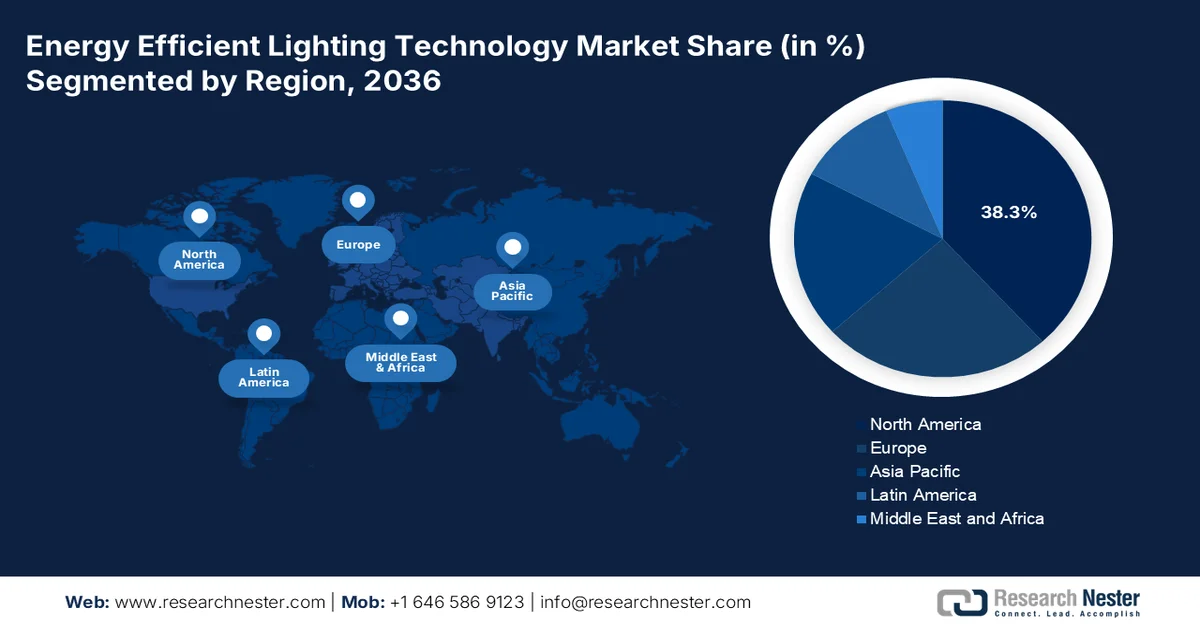
North America energy efficient lighting technology market is anticipated to garner the largest share of 38.3% by the end of 2036. The market’s upliftment is primarily attributed to the presence of industrial facilities, an increase in consumer awareness, federal approaches, and a surge in energy conservation. According to an article published by the Environmental and Energy Study Institute in April 2025, energy productivity, particularly in the U.S., increased by 2.3%, based on which the economy also strengthened by 28%. In addition, the energy demand in the country increased by 0.5%, which denotes an indication that the economy became more energy-efficient. Besides, corporate buyers significantly contracted 28 GW of renewable energy as of 2024, indicating a 34% upsurge from 20.9 GW in 2022, thereby positively driving the market’s growth and exposure in the region.
The energy efficient lighting technology market in the U.S. is growing significantly, owing to compulsory energy and phase-out codes, along with state and federal financial incentives, and retrofit and research and development grant funding. Based on an article published by the Department of Energy in August 2026, the country comprises more than 350 solid-state lighting research and development projects that are significantly funded, resulting in over 480 patents and a massive industrial footprint. Besides, more than 360 products are directly traced to DOE-based SSL research and development, which are estimated to account for 300 billion kWh savings, which is further equivalent to USD 37 billion in terms of energy expenses as of 2025, thus proliferating the market’s expansion in the nation.
The industrial transformation through ENERGY STAR, infrastructure modernization, public sector investment, as well as federal investment in decarbonization are certain factors that are responsible for boosting the energy efficient lighting technology market in Canada. As per an article published by NLM in April 2026, over 8% of domestic households have poor energy efficiency, spending almost 10% of household income to cover energy expenses, with an increase in costs surpassing 30% across rural and indigenous communities. Therefore, achieving a cost-effective and equitable decarbonization approach demands a quantitative understanding of different policy instruments. Based on this, thermal energy storage yields up to USD 7,000 in yearly homeowner cost savings and more than 100 tons of carbon dioxide emission reductions per building, thus boosting the market’s demand and growth in the country.
APAC Market Insights
The Asia Pacific energy efficient lighting technology market is expected to emerge as the fastest-growing region during the forecast period. The market’s development is highly propelled by strong government efficiency policies, infrastructure development, rapid urbanization, and the existence of large-scale governmental programs. Besides, China and India function as primary growth anchors, benefiting from production-linked incentives and ambitious public sector deployment programs. Moreover, the region's market dominance is reinforced by continuous technological advancement, declining component costs, and widespread adoption of smart lighting solutions across residential, commercial, and industrial applications, ensuring its preeminent position throughout the forecast period.
The energy efficient lighting technology market in China is gaining increased traction, owing to the presence of the largest urban infrastructure build-out, strict domestic efficiency standards, and the massive manufacturing capacity, along with fleet electrification. As stated in an article published by the International Council on Clean Transportation in August 2026, the country accounted for almost 90% of worldwide electric truck and bus sales, which registered outstanding growth in heavy and medium truck segments, wherein sales have more than quintupled over 2 years. Besides, about 30% of heavy truck sales in the country were completely electric as of 2025, while robust local supportive policies and reduced battery expenses have assisted in making innovations in segment electrification, thus demonstrating an optimistic outlook for the market’s development.
The aspects of shortened supply chains, low component expenses, government LED production-linked incentives, an expansion in online education, and rapid digitalization are a few trends that are responsible for enhancing the energy efficient lighting technology market in India. As per a data report published by the PIB Government in June 2026, the Digital India Program, since its launch, has laid a suitable foundation for the country’s emerging technological ecosystem. This includes an upsurge in optical fiber coverage from 1.9 million route kilometers to 4.2 million kilometers as of 2025. Meanwhile, there was an increase in internet connections from 251.5 billion to 102.8 billion in 2026, and an expansion in internet penetration also expanded broadband accessibility, eventually rising from 61 billion to 99.5 billion as of December 2025, thus positively driving the market development in the country.
Europe Market Insights
Europe energy efficient lighting technology market is predicted to account for a considerable share by the end of the stipulated timeline. The market’s growth in the region is effectively fueled by strict regulations, standards for LED lamps, reduction of energy consumption, and an increase in demand from public facilities, hospitals, retail spaces, and office buildings. According to an article published by the Copenhagen Center on Energy Efficiency in 2026, the phase-out of D-Class halogens in the region tends to limit the uptake of LED lamps, which eventually results in 33 TWh of lost electricity savings for a 10-year period throughout 2026. Additionally, these savings are estimated at USD 7.6 billion (€6.6 billion) in increased electricity bills. This also assists in identifying the light quality, size, and shape of LED lamps in comparison to inefficient lighting products for replacing, thus proliferating the market growth.
The energy efficient lighting technology market in Germany is gaining increased exposure, owing to the presence of strong government subsidy programs, a dominant industrial base, and an escalation from the logistics and e-commerce industries. As stated in an article published by the Clean Energy Wire Organization in June 2026, the logistics industry in the country is predicted to require 186 TWh of electricity every year by the end of 2045. Moreover, the industry is also poised to consume almost 110 TWh of electricity by 2035, which is 4 times the requirement from the steel sector and 60% above the chemicals sector. Besides, this particular demand is highly driven by the electrification of road freight, thereby making it suitable for enhancing the market’s growth and exposure in the overall nation.
The robust energy-saving certificate-based programs, generous government funding, the presence of energy transitions, upgrades for public lighting, optimized system performance, and higher quality installations are a few factors that are fueling the energy efficient lighting technology market in France. As per a data report published by ITA in May 2026, renewable energy effectively accounted for almost 22% of the national gross final energy consumption in 2023, demonstrating a surge of 20.5% as of 2022. Besides, the country is readily committed to successfully phasing out coal-fired electricity generation. In this regard, Cordemais, which is a major coal facility, is expected to shut down by March 2027, thus focusing on the shift towards green energy. This is considered a centralized aspect in government decarbonization and recovery policies through measures under France Relance, thus positively contributing to the market’s upliftment.
Key Energy Efficient Lighting Technology Market Players:
- Signify N.V. (Netherlands)
- OSRAM Licht AG (Germany)
- Acuity Brands, Inc. (U.S.)
- General Electric Company (U.S.)
- Eaton Corporation plc (Ireland)
- Zumtobel Group (Austria)
- Hubbell Lighting, Inc. (U.S.)
- Panasonic Corporation (Japan)
- Cree, Inc. (U.S.)
- Company Overview
- Business Strategy
- Key Product Offerings
- Financial Performance
- Key Performance Indicators
- Risk Analysis
- Recent Development
- Regional Presence
- Signify N.V. holds a dominant leadership position in the global energy efficient lighting technology market, leveraging its strong brand heritage under the Philips name to command significant mindshare across professional and consumer channels. The company differentiates itself through continuous innovation in connected lighting systems and human-centric solutions, integrating IoT capabilities into its broad portfolio of LED fixtures and controls.
- OSRAM Licht AG is a formidable global player, competing aggressively through its deep technological expertise in optoelectronics and its comprehensive product range spanning automotive, industrial, and general lighting applications. The company's strategic pivot toward high-margin, application-specific lighting solutions reinforces its competitive position against both established rivals and emerging regional manufacturers.
- Acuity Brands, Inc. has established itself as a leading North American lighting manufacturer, recognized for its advanced LED lighting systems integrated with sophisticated controls and building automation technologies. The company's competitive edge lies in its proprietary software platforms and data-driven solutions, positioning it as a preferred partner for large-scale commercial and institutional projects seeking intelligent lighting infrastructure.
- General Electric Company remains a historically significant player in the lighting industry, offering a diversified portfolio of energy-efficient solutions across residential, commercial, and industrial segments through its established global distribution networks. The company's longevity and brand recognition provide a competitive foundation, even as it navigates intense market pressures from more specialized and agile lighting manufacturers.
- Eaton Corporation plc competes effectively in the energy efficient lighting technology market by combining its robust electrical engineering heritage with a comprehensive suite of lighting controls and energy management solutions. The company's integrated approach, offering both fixtures and advanced control systems, appeals to clients seeking cohesive, turnkey installations for commercial and industrial facilities.
Here is a list of key players operating in the global market:
The global energy efficient lighting technology market is highly consolidated, with a handful of multinational corporations commanding the majority of market share. In this regard, Signify N.V. (Philips), OSRAM Licht AG, and Acuity Brands, Inc. are established leaders, competing on smart, IoT-integrated, and sustainable lighting platforms. The market is characterized by intense competition in innovation, particularly around human-centric and connected lighting solutions. Besides, in September 2025, Signify introduced 4 new products, including Signify Actistar, Signify GreenVision Xceed Pro, SunStay Pro gen2 mini, and Signify SunStay Pro gen2. These products highlighted the organization’s innovations in modular and solar street lighting and performance lighting for stadiums, thus proliferating the energy efficient lighting technology industry.
Corporate Landscape of the Market:
Recent Developments
- In May 2026, SKYX Platforms Corp. signed a license-based agreement with Canada, the U.S., and Eurofase for validating B2B go-to-market opportunities, such as residential, hotel, and builder segments.
- In January 2026, Crompton Greaves Consumer Electricals Limited unveiled 70W and 80W Dynaray LED lamps, especially for the B2C lighting sector, readily disposed under the SBI Regulation 30.
- In December 2025, GE Lighting launched two newest LED bulb additions to its evolving and expanding lineup of elevated and high-definition GE lighting solutions, including a refreshed reveal® and Light + Form series.
- Report ID: 8752
- Published Date: Sep 04, 2026
- Report Format: PDF, PPT
- Explore a preview of key market trends and insights
- Review sample data tables and segment breakdowns
- Experience the quality of our visual data representations
- Evaluate our report structure and research methodology
- Get a glimpse of competitive landscape analysis
- Understand how regional forecasts are presented
- Assess the depth of company profiling and benchmarking
- Preview how actionable insights can support your strategy
Explore real data and analysis
Frequently Asked Questions (FAQ)
About this Report
Connect with our Expert


Report, 2027-2036



Copyright @ 2026 Research Nester. All Rights Reserved.
