Electronics & Smart Devices Market Outlook:
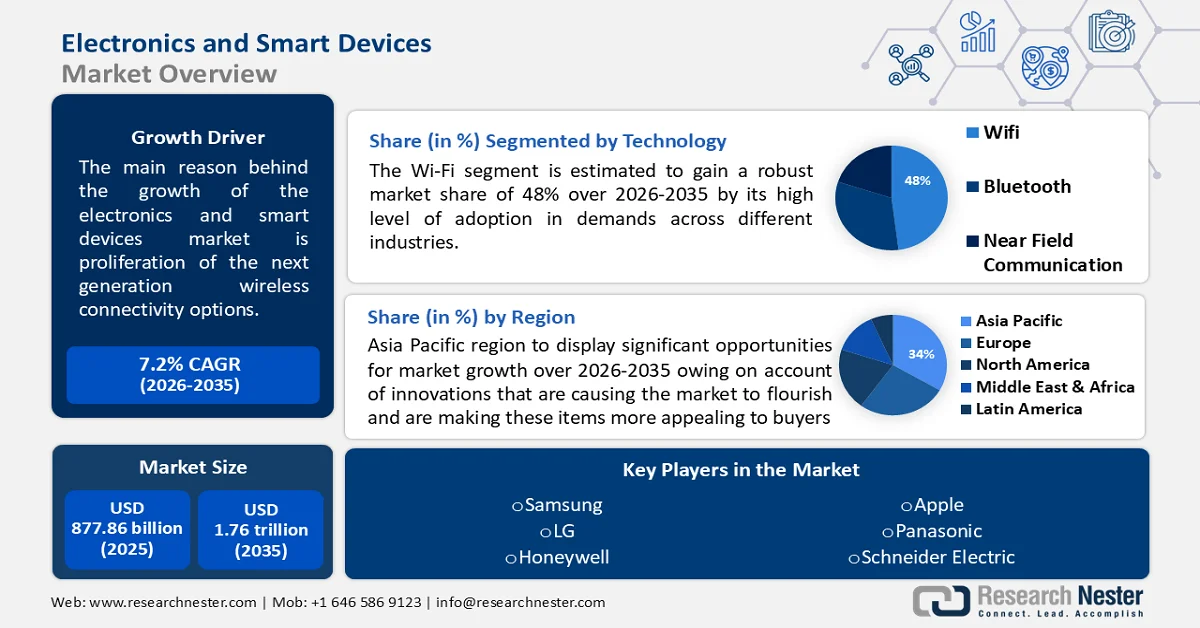
Electronics & Smart Devices Market size was over USD 877.86 billion in 2025 and is anticipated to cross USD 1.76 trillion by 2035, growing at more than 7.2% CAGR during the forecast period i.e., between 2026-2035. In the year 2026, the industry size of electronics & smart devices is assessed at USD 934.75 billion.
Factor that fuels the market is advancement of technology which is also accessible to the mass population.
Key Electronics & Smart Devices Market Insights Summary:
Regional Highlights:
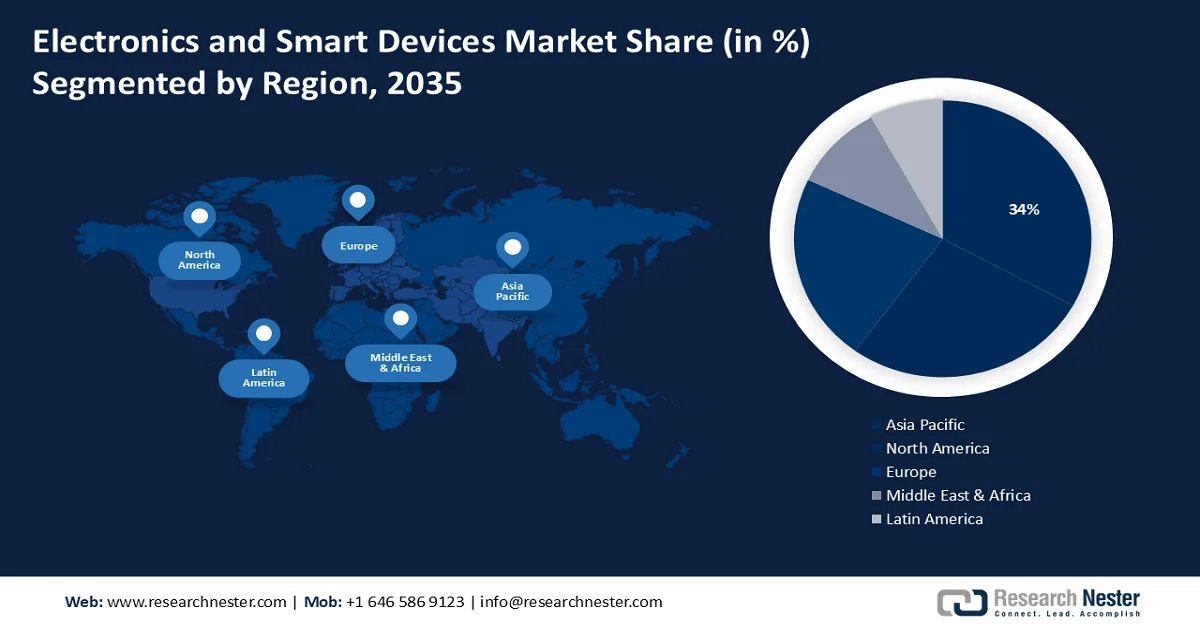
- Asia Pacific is forecast to secure 34% revenue share by 2035, in the electronics & smart devices market propelled by the strong presence of leading manufacturers and rapid advancements in wearable technology innovations.
- North America is anticipated to capture 29% of the market share by 2035 driven by early 5G deployment and rising demand for energy-efficient smart devices.
Segment Insights:
- The electronic devices segment is projected to account for over 56% share of the electronics & smart devices market by 2035, propelled by rising disposable income, rapid digitization, and increasing adoption of IoT-enabled smart technologies.
- The Wi-Fi segment is anticipated to capture around 48% revenue share by 2035 owing to its widespread adoption across industries and accelerating demand for scalable IoT-enabled connectivity solutions.
Key Growth Trends:
- Offering A Range of Wireless Connectivity Choices
- Expansion of Residential Landscape Boosting Demand for Products
Major Challenges:
- Major privacy concern
- Higher-rates of smart devices
Key Players: Panasonic Holdings Corporation, Rohm Semiconductor, Maxim Integrated, Melexis NV, Xilinx Inc., Elmos Semiconductor SE, Analog Devices, Vector Informatik GmbH, Intel Corporation.
Global Electronics & Smart Devices Market Forecast and Regional Outlook:
Market Size & Growth Projections:
- 2025 Market Size: USD 877.86 billion
- 2026 Market Size: USD 934.75 billion
- Projected Market Size: USD 1.76 trillion by 2035
- Growth Forecasts: 7.2% CAGR (2026-2035)
Key Regional Dynamics:
- Largest Region: Asia Pacific (34% Share by 2035)
- Fastest Growing Region: Asia Pacific
- Dominating Countries: China, United States, South Korea, Japan, Germany
- Emerging Countries: China, India, Japan, South Korea, United States
Last updated on : 25 February, 2026
Electronics & Smart Devices Market - Growth Drivers and Challenges
Growth Drivers
-
Offering A Range of Wireless Connectivity Choices - The proliferation of the next generation wireless network and connectivity options is also the one of the main driving forces of the electronics and smart devices market. As the reports suggest, wireless connectivity sector generated revenue of 55 billion in 2020 globally. The wireless connection gives users the ability to access internet and communicate without being tied up to a physical location. Thus, these connectivity options allow for more convenience and mobility. The wireless connection minimizes expenses also as it lessens the need for cables or infrastructure required by both the consumer and corporation. Additionally, the spiraling demand of the general public for smart device like smart TVs, smart speakers and smart thermostats has led to the increase in wireless data connectivity technologies which include Wi-Fi and Bluetooth.
-
Expansion of Residential Landscape Boosting Demand for Products - A rapid rise in the number of the new residential buildings had led the market to view smart home devices, namely entertainment systems. Some reports suggest, average revenue generated by the smart devices is about USD 370 Billion. HVAC systems, lighting controls and security systems as necessary. It has thus brought about a huge wave in the smart technologies for home use, and the swelling residential sector is one of the critical market expansion drivers in terms of the electronic and smart devices. Smart homes are being embraced by the general public due to the change in lifestyle and the tendency of many to build connected and efficient living spaces. A practical reason for homeowners to prefer installing smart home devices is the convenience and ease of installation. This is a paramount in new construction projects where devices can be seamlessly integrated as part of the building process.
- Advancement In Technology – The technology innovation is highly influential on customer’s perception of his preference. Global spent on the digital technology about USD 1.50 Trillion in 2021. They anticipate the development of more new smart technologies which subsequently will become a part of their everyday life as they enjoy higher living standards. Manufacturers seek to make investment in breakthrough technologies and creation of revolutionary products, which sets them apart from competitors and aims to have a spot in consumers’ market.
Challenges
-
Major privacy concern - Privacy infringement have been complained by internet and smartphone users who think that their credit card numbers, dates of birth, home address, email addresses, and names. Also, majority of the smart appliances are controlled by the mobile apps that the companies have created for smart phone users. These apps let the companies obtain customer data, and with the use of such information, customers’ privacy concerns grow.
-
Higher-rates of smart devices – The most evident problem or the setback of smart devices is the cost. There are many companies who offer smart devices, but they are pricey. This is something very few people can realistically access.
Electronics & Smart Devices Market Size and Forecast:
| Report Attribute | Details |
|---|---|
|
Base Year |
2025 |
|
Forecast Year |
2026-2035 |
|
CAGR |
7.2% |
|
Base Year Market Size (2025) |
USD 877.86 billion |
|
Forecast Year Market Size (2035) |
USD 1.76 trillion |
|
Regional Scope |
|
Electronics & Smart Devices Market Segmentation:
By Product Segment Analysis
Electronic devices segment is expected to hold electronics & smart devices market share of more than 56% by 2035. In 2023, global electronic market observed a surge of USD 610 billion in revenue, projected 7.16% of growth in electronic device sales. Electronic devices are obvious market leaders, thanks to the fact that they are present in nearly every household. The market is on the move with enhancing technologies such as wearables, smart devices and products based on the IoT. This dynamic is propelled by a numerous elements like disposable income growing, digitization, and automation, as well as the rising number of identity devices which are used.
By Technology Segment Analysis
In electronics & smart devices market, Wi-Fi segment is set to dominate revenue share of around 48% by the end of 2035 because of its high level of adoption in demands across different industries. 2023 has marked the bench of USD 5 Billion revenue in internet usage. Asia Pacific is perceived to have the biggest market share, this due to the presence of the market pacesetters in the region. IoT in areas such as smart homes, healthcare and education among others, is driving the adoption of advanced Wi-Fi technology which is scalable and strong on the global level. This dramatic increase in demand for Wi-Fi has particularly benefitted small and medium enterprises, fostering the industry growth.
By Distribution Segment Analysis
By 2035, offline segment is set to account for electronics & smart devices market share of around 53% as specialty electronic shops where the product you are buying can be tested before you make a purchase provide customers with the opportunity to understanding the device features in these shops. Our research has observed, The percentage of offline retail in the smartphone sales went up to 61% in the three months ending March 31, as compared to 56% in the December quarter. This aspect allows customers to select and compare among many brands in the market that resulted to the high footfalls in these shops. In face of the newly emerged online market, offline segment is though holding strong and that is particularly true in the Asia Pacific, where Sony ad Samsung are the main players.
Our in-depth analysis of the electronics & smart devices market includes the following segments:
|
By Product |
|
|
By Technology |
|
|
By Distribution |
|

Vishnu Nair
Head - Global Business DevelopmentCustomize this report to your requirements — connect with our consultant for personalized insights and options.
Electronics & Smart Devices Market - Regional Analysis
Asia Pacific Market Insights
Asia Pacific industry is predicted to hold largest revenue share of 34% by 2035. The Asia-Pacific region boasts of various prominent electronics and smart device manufacturers such as Samsung, LG and Huawei, hence, the East has a lead. Our reports suggests that the electronic market in this region accounted revenue of USD 473 Billion in first quarter of 2024. The region is enjoying the quickest thrives of wearable technology that have better sensors extended batteries, and more detailed features. These innovations are causing the market to flourish and are making these items more appealing to buyers.
China, being the innovative hub of Asia, strolls this market with a level ahead. Chinese electronic market is expecting to touch the mark of USD 115.7 Billion of revenue in 2024. The market of a Smart Home in China is associated with the factors including elevated internet penetration rate, growth in education of the population and supportive policies of the government.
North America Market Insights
The North America region will also encounter huge growth for the electronics & smart devices market during the forecast period and will hold the second position with 29% of market share. Front runners of this region are renowned tech giants like Google, Apple, Amazon and Samsung who work on technology and automated home device innovations. Electronic market in this region estimated the revenue of USD 113 billion in 2023. Major companies are diversifying their market share through product differentiation of their portfolios via mergers, acquisitions and technological investments in the cutting-edge technologies. Smart device adoption across North America is being championed by factors, such as early 5G networks as well as growing desire for energy-efficient devices.
Smart device technology has become a trend in the U.S. and it has been found to be a factor that increases the value and the attractiveness of a house, especially for the younger generation of buyers. A survey shows that around 70 million households in the U.S. have opted for smart home devices in 2024 which is certainly 11% higher than that of 2023. Besides, the deployment of voice-enabled smart assistants is helping consumers to control their systems with voice commands that suggests that technology and convenience are the top priorities in the U.S. market.
Key Electronics & Smart Devices Market Players:
- Samsung
- Company Overview
- Business Strategy
- Key Product Offerings
- Financial Performance
- Key Performance Indicators
- Risk Analysis
- Recent Development
- Regional Presence
- SWOT Analysis
- LG
- Honeywell
- Apple
- Xiaomi Corporation
- Schneider Electric
- ABB Group
- Electrolux
- Haier
- Philips
Recent Developments
- Samsung- The company generated USD 52 billion in consolidated revenue driven by robust sales of the Galaxy Note 54 series and higher memory chip prices.
- Honeywell- Honeywell announced first quarter organic sales growth of 3% fueled by Aerospace Technologies with an 18% organic growth rate and Energy and Sustainability Solutions with 5% growth.
- Report ID: 6097
- Published Date: Feb 25, 2026
- Report Format: PDF, PPT
- Explore a preview of key market trends and insights
- Review sample data tables and segment breakdowns
- Experience the quality of our visual data representations
- Evaluate our report structure and research methodology
- Get a glimpse of competitive landscape analysis
- Understand how regional forecasts are presented
- Assess the depth of company profiling and benchmarking
- Preview how actionable insights can support your strategy
Explore real data and analysis
Frequently Asked Questions (FAQ)
About this Report
Connect with our Expert


Report, 2026-2035



Copyright @ 2026 Research Nester. All Rights Reserved.
