Electronics Access Control System Market Outlook:
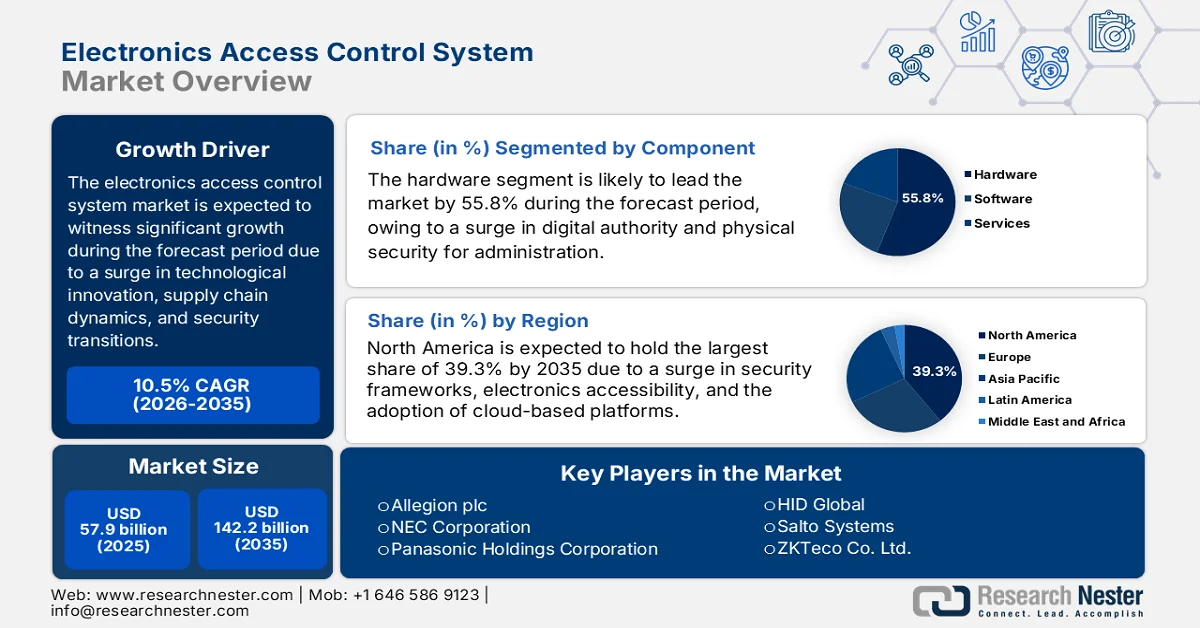
Electronics Access Control System Market size was valued at USD 57.9 billion in 2025 and is projected to reach USD 142.2 billion at the end of 2035, gradually mounting at a 10.5% CAGR during the forecast period, 2026-2035. In 2026, the industry size of electronics access control system is estimated at USD 63.9 billion.
The global electronics access control system market is being significantly reshaped by security-perception shifts, technological advancements, regulatory mandates, insurance underwriting standards, workforce demographics, supply chain regionalization, and retrofitting incentives. According to official statistics published by the World Economic Forum in June 2025, the aspect of artificial intelligence (AI) is expected to contribute an additional USD 13 trillion to the worldwide economy by the end of 2030. Therefore, this denotes technological progress, which has been transformative in recent years, with breakthroughs in information and communication technologies. Hence, solutions such as AI, along with digital transformation and advanced robotics, are deliberately shaping the electronics industry, which in turn, is responsible for fueling the electronics access control system market growth.
Furthermore, the aspect of decentralized edge processing for access decisions, as well as hands-free and voice-activated credentialing, and the presence of predictive maintenance and self-healing networks, are a few trends that are responsible for proliferating the electronics access control system market globally. As stated in an article published by NLM in May 2022, there has been a massive adoption of voice assistants, with 4.2 billion implementations, which further increased to 8.4 billion by the end of 2024. In addition, the popularity of these assistants has resulted in increased research attention due to their user experience and usability aspects. Moreover, these are considered intelligent personal assistants, based on computer programs that are readily capable of responding and understanding to consumers utilizing synthetic voices, thus driving the market exposure.
Key Electronics Access Control System Market Insights Summary:
Regional Highlights:
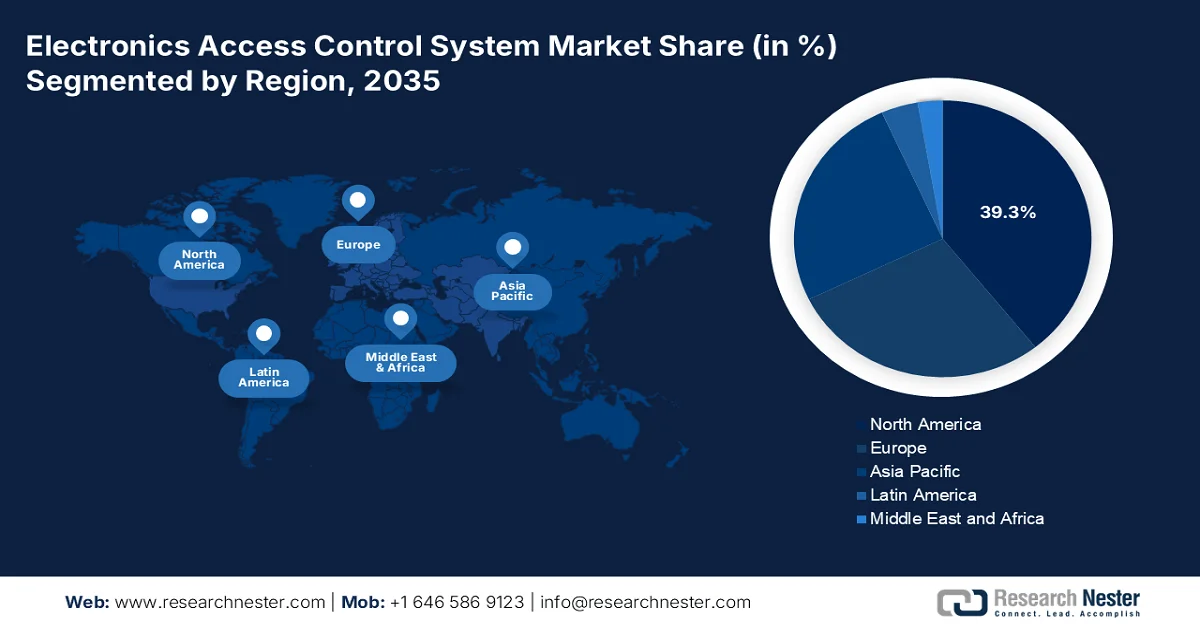
- By 2035, North America is projected to capture a dominant 39.3% share in the electronics access control system market, attributed to rising replacement of magnetic stripe systems and growing adoption of cloud-based access control services
- Across the forecast period 2026-2035, Asia Pacific is poised to register the fastest growth, propelled by rapid urbanization and increasing infrastructure investments
Segment Insights:
- By 2035, the hardware sub-segment is expected to command a leading 55.8% share in the electronics access control system market, driven by its essential role in enabling secure physical access through controllers, readers, and locking mechanisms
- During 2026–2035, the card-based systems sub-segment is anticipated to hold the second-highest share, owing to expanding digital banking adoption and increasing reliance on secure cashless transactions
Key Growth Trends:
- Mandatory access logging for insurance reduction
- Integration with payroll systems and workforce attendance
Major Challenges:
- Power reliability and energy management
- Privacy and regulatory compliance burden
Key Players: ASSA ABLOY (Sweden), Johnson Controls (Ireland), dormakaba Group (Switzerland), Honeywell International Inc. (U.S.), Robert Bosch GmbH (Germany), Siemens AG (Germany), Allegion plc (Ireland), NEC Corporation (Japan), Panasonic Holdings Corporation (Japan), Suprema Inc. (South Korea), HID Global (U.S.), Salto Systems (Spain), ZKTeco Co. Ltd. (China), Hikvision (China), Dahua Technology Co. Ltd. (China), Axis Communications AB (Sweden), Gallagher Security (New Zealand), Nedap N.V. (Netherlands), IDEMIA (France), Aiphone Co. Ltd. (Japan).
Global Electronics Access Control System Market Forecast and Regional Outlook:
Market Size & Growth Projections:
- 2025 Market Size: USD 57.9 billion
- 2026 Market Size: USD 63.9 billion
- Projected Market Size: USD 142.2 billion by 2035
- Growth Forecasts: 10.5% CAGR (2026-2035)
Key Regional Dynamics:
- Largest Region: North America (39.3% Share by 2035)
- Fastest Growing Region: Asia Pacific
- Dominating Countries: United States, China, Germany, Japan, United Kingdom
- Emerging Countries: India, South Korea, Brazil, Indonesia, Mexico
Last updated on : 4 May, 2026
Electronics Access Control System Market - Growth Drivers and Challenges
Growth Drivers
- Mandatory access logging for insurance reduction: Liability and commercial property insurers have commenced providing measurable premium discounts to businesses for deploying control systems with audit trails, which is fueling the electronics access control system market globally. According to official statistics published by NLM in September 2022, digital technology is suitable for the insurance industry, wherein digitalization permits reducing different transaction expenses and also diminishing commission fees to insurance agents, reaching almost 70% to 90% of collected insurance premiums. Therefore, the demand and interest for digitalization across insurance organizations are economically justified, this denoting an optimistic outlook for the market growth.
- Integration with payroll systems and workforce attendance: Organizations are gradually merging physical data accessibility with payroll platforms and human resources to automate attendance tracking, which is responsible for driving the electronics access control system market. As stated in an article published by the Department of Energy in December 2024, data centers significantly consumed almost 4.4% of overall electricity in the U.S., as of 2023, and are projected to consume an estimated 6.7% to 12% by the end of 2028. Besides, there has been an upsurge in data center electricity utilization from 58 TWh to 176 TWh as of 2023, and it is further estimated to increase between 325 TWh and 580 TWh by the end of 2028. Therefore, with this increased utilization, there is a huge demand for electronic control systems to protect data, which is positively impacting the electronics access control system market.
- Increase in vandalism and copper theft: Railway operators, utilities, and telecom providers experience increasing losses from vandalism and metal theft at remote facilities, due to which the electronics access control system market is expanding. As per a data report published by the Protect CCI Organization in October 2025, over 5,770 incidents of sabotage and intentional theft were reported for targeting communication networks between June and December 2024. In addition, these incidents surged to 9,770 between January and June 2025, which further totaled more than 15,540 incidents that underscored the scale and escalated the pace of the threat. Therefore, with an increase in such incidents, there is a huge demand for the market to overcome them and ensure data protection.
Challenges
- Power reliability and energy management: All electronic access control systems depend on uninterrupted electrical power to function correctly. In regions with unstable grid infrastructure or during natural disasters, prolonged outages can render smart locks inoperable, effectively locking occupants out or, worse, failing to secure a perimeter. While battery backups exist, their maintenance cycles are frequently neglected, leading to unexpected failures. Besides, large installations with different locks impose substantial ongoing costs for battery inspection, replacement, and disposal. Moreover, extreme temperatures degrade battery performance, causing premature failure in outdoor or unheated entryways. The promise of energy harvesting has not yet reached mature reliability for high-security applications, thereby negatively impacting the electronics access control system market.
- Privacy and regulatory compliance burden: Biometric access systems, especially facial recognition and iris scanning, trigger stringent privacy regulations across multiple jurisdictions. Laws such as GDPR in Europe, BIPA in the U.S., and various Asia Pacific data protection acts impose severe restrictions on collecting, storing, and processing biological identifiers. Organizations must obtain explicit informed consent from every employee and visitor, maintain detailed audit trails, and offer alternative non-biometric access methods. Moreover, a single compliance failure can result in statutory damages per violation, often reaching millions. This legal exposure deters many enterprises from deploying advanced biometrics despite its superior security, thereby causing a hindrance in the electronics access control system market globally.
Electronics Access Control System Market Size and Forecast:
| Report Attribute | Details |
|---|---|
|
Base Year |
2025 |
|
Forecast Year |
2026-2035 |
|
CAGR |
10.5% |
|
Base Year Market Size (2025) |
USD 57.9 billion |
|
Forecast Year Market Size (2035) |
USD 142.2 billion |
|
Regional Scope |
|
Electronics Access Control System Market Segmentation:
Component Segment Analysis
The hardware sub-segment, part of the component, is anticipated to account for the highest share of 55.8% in the electronics access control system market by the end of 2035. The sub-segment’s upliftment is primarily attributed to its crucial role as a critical physical layer for translating digitalized authorization into physical security by administering entry through controllers, readers, and locks. According to official statistics published by NLM in May 2022, engineers readily dominate the utilization of open-electronics boards, accounting for 36.1%, which is followed by 26.4% of computer science. Besides, hardware-specific components enable only authorized personnel to enter, offer audit trails for compliance, and ensure safety through fail-safe and string locking mechanisms, thereby making it extremely suitable for fueling the sub-segment’s growth.
Type Segment Analysis
Based on the type segment, the card-based systems sub-segment is projected to grab the second-highest share in the electronics access control system market during the forecast period. The sub-segment’s growth is highly driven by its importance for driving the modernized cashless economy by providing instantaneous, convenient, and secure financial transactions. As stated in an article published by Computers in Human Behavior Reports in March 2024, 2.4 billion people utilize digital banking globally, which increased to 3.6 billion as of 2024. This escalated growth of digitalized banking worldwide is attributed to the extension in mobile phone utilization and the tremendous growth of the Internet. In this regard, presently, there are 5.1 billion internet consumers, indicating 64.4% of the overall population, thus positively contributing to the sub-segment’s development.
Application Segment Analysis
By the end of the stipulated timeline, the commercial sub-segment, which is part of the application segment, is expected to cater to the third-highest share in the electronics access control system market. The sub-segment’s development is highly propelled by encompassing corporate offices, retail chains, hospitality venues, data centers, and co-working spaces. Unlike residential or single-purpose industrial sites, commercial environments require dynamic access management that accommodates fluctuating employee populations, temporary contractors, cleaning staff, delivery personnel, and visitors. A mid-sized office building may issue over a hundred distinct credential profiles per week while revoking just as many. The challenge intensifies in leased or multi-tenant commercial real estate, where landlords must provide secure base building access while allowing individual tenants to manage their own internal zone permissions.
Our in-depth analysis of the electronics access control system market includes the following segments:
|
Segment |
Subsegments |
|
Component |
|
|
Type |
|
|
Application |
|
|
Deployment |
|
|
Technology |
|
|
End user |
|

Vishnu Nair
Head - Global Business DevelopmentCustomize this report to your requirements — connect with our consultant for personalized insights and options.
Electronics Access Control System Market - Regional Analysis
North America Market Insights
North America in the electronics access control system market is anticipated to garner the largest share of 39.3% by the end of 2035. The market’s upliftment in the region is highly driven by an increase in replacement rates of magnetic stripe systems, strict cyber-physical security frameworks, electronic accessibility logs, and the growing trend towards cloud-based access control as a service (ACaaS). According to official statistics published by the America Clean Power Association in March 2025, the U.S. is poised to achieve net additions of 60 GW and 100 GW of gas, along with more than 900 GW of batteries and renewables by the end of 2040. This is possible while continuing to support energy efficiency savings that remain crucial to maintain reliability. Besides, a diversified portfolio of generation technologies is in huge demand to enable reserve margins and expand the need for on-grid electricity, which is positively impacting the electronics access control system market growth in the overall region.
On-Grid Electricity Demand in the U.S., 2010-2040
|
Year |
Electricity Demand (TWh) |
|
2010 |
3,887 |
|
2015 |
3,902 |
|
2020 |
3,859 |
|
2024 |
4,170 |
|
2030 |
4,734-4,970 |
|
2035 |
5,139-5,573 |
|
2040 |
5,591-6,127 |
Source: The America Clean Power Association
The electronics access control system market in the U.S. is growing significantly, owing to physical access controls, the implementation of the federal zero-trust mandate for critical infrastructure, advisory guidelines, and a focus on multi-factor authentication, driven by increased biometric applications. As stated in an article published by the Federal Register Government in November 2025, the U.S. Department of Homeland Security (DHS) has estimated that almost 1.1 million biometric submissions are collected every year, and based on this, the resulting biometric-submission population is expected to increase from a present baseline of 2 million to 3.1 million. In addition, the DHS further proclaimed that the yearly expenses for individuals submitting biometrics under the established rule are predicted to amount to USD 231.5 million, thus bolstering the market demand in the country.
The massive natural resource economy, increased focus on federal building compliance, the reliance on mechanical locks or passive surveillance, continuous internet or cellular connectivity, indigenous land claims, procurement volume for satellite connections, and the availability of solar-powered smart locks on pump stations. As per an article published by the Innovation, Science, and Economic Development Canada in March 2026, the Government of Canada is projected to connect 98% of the population to high-speed Internet by the end of 2026, as well as 100% by 2030. Besides, 90% of domestic households are presently connected to high-speed Internet, which is extremely suitable for operating a business, accessing vital services, including education and healthcare, and working remotely, thus denoting an optimistic outlook for the electronics access control system market growth in the country.
Progress in Canada Towards High-Speed Internet Facilities, 2014-2030
|
Year |
Progress (Amount/%) |
Description |
|
2014 |
79% |
Population access to high-speed Internet |
|
2016 |
USD 585 million |
Launched the Connect to Innovate program |
|
2019 |
100% |
Connectivity achievement |
|
2020 |
USD 3.2 billion |
Universal Broadband introduced |
|
2022 |
93.5% |
Population access to high-speed Internet |
|
2026 |
98% |
Population expected to have high-speed Internet |
|
2030 |
100% |
Population projected to constitute high-speed Internet services |
Source: Innovation, Science, and Economic Development Canada
APAC Market Insights
The Asia Pacific in the electronics access control system market is expected to emerge as the fastest-growing region during the forecast period. The market’s development in the region is highly propelled by massive infrastructure development, an increase in security investments, rapid urbanization, the modernization of legacy access systems, manufacturing growth across the automotive and electronics industries, and a rise in foreign direct investment flows. According to official statistics published by Transnational Corporations Review in December 2025, the electrical and electronic industry in the region accounts for an estimated 8.4% of the regional GDP, which is readily supported by industrialization trajectory, sustained foreign investments, export-driven manufacturing policies, and the eventual expansion of regional production capabilities, thus creating a huge growth opportunity for the electronics access control system market.
The electronics access control system market in China is gaining increased traction, owing to the presence of a huge industrial base, rapid smart city deployment, strict government mandates for critical infrastructure protection, and the Manufacturing 2025 approach. As stated in an article published by the China Organization in April 2026, there has been an increase in the majority of industrial firms by 15.5% year-on-year within the first quarter of 2026, since the government’s proactive macro strategies assisted in cushioning the impact of the complicated economic environment. This surge amounted to USD 247.3 billion between January and March, indicating an escalation by 0.3 percentage points from the previous quarter. Besides, profits at major industrial organizations upsurged by 15.8% in March, which was in line with the accelerated growth by 0.6 percentage points between January and February, thus catering to the market upliftment.
The aspects of transformation into a worldwide manufacturing facility, driving the latest industrial facility construction, the presence of the massive greenfield infrastructure, the need for sophisticated access management for sensitive research and development, along with production areas, and urban modernizations are a few factors for fueling the electronics access control system market in India. Based on government estimates published by the PIB in April 2026, there has been an expansion in public capital spending from roughly USD 2 trillion to USD 12.2 trillion, which significantly supports infrastructure creation. Besides, the manufacturing industry in the country contributed almost 16% to 17% of the domestic GDP and employs more than 27 million workers. Therefore, with such developments in the country, there is a huge growth opportunity for the market in terms of employment and public expenditure.
Europe Market Insights
Europe in the electronics access control system market is projected to experience considerable growth by the end of the stipulated timeline. The market’s growth in the region is highly driven by strict data protection regulations, the adoption of mobile access solutions and cloud-based platforms, retrofitting public facilities, and the enhancement of interoperability across borders. According to official statistics published by Connect Europe in January 2025, the regional connectivity ecosystem represents 4.7% of the gross domestic product (GDP), which is driving societal growth and competitiveness. Besides, the digital communication industry, comprising content and applications, network equipment, and telecom services, was worth USD 1.2 trillion as of 2023, which demonstrated nearly 4.7% of the regional GDP. Moreover, the overall investment in the industry amounts to USD 135 billion with telecom operators representing 60% of the overall investment, followed by 30% of content and application providers and 10% of equipment manufacturers, thus enhancing the market demand in the country.
The electronics access control system market in Germany is gaining increased exposure, owing to the dense concentration of industrial manufacturing facilities, the growth of chemical production and automotive facilities, physical access security, upgraded legacy systems, robust engineering tradition, and the existence of major vendors. As stated in an article published by the ITA in August 2025, there has been a surge in advanced manufacturing exports from USD 955 billion as of 2022 to more than USD 1 trillion in 2023. In addition, the 2024 U.S.-based advanced manufacturing exports to the country amounted to USD 37 billion, and based on regional statistics, the U.S. exports to the country were USD 43 billion. Therefore, the aspect of innovations in the country’s innovative manufacturing industry is highly responsible for fueling the electronics access control system market growth.
The provision of generous funding for digital infrastructure and public building modernization, the rapid expansion of logistics and warehousing, an increase in foreign direct investment, and suitable tax incentives for integrators and manufacturers are certain factors that are proliferating the electronics access control system market in Poland. As per an article published by the ITA in April 2026, the digital economy industry in the country is estimated to be worth USD 44 billion, representing suitable potential for global suppliers. Additionally, the valuation of digital economic activity in the nation is predicted to increase to USD 123 billion by the end of 2030, which is effectively responsible for 9% of the domestic GDP. Therefore, based on the continuous growth and projected upliftment of the digital industry, there is a huge demand for the market in the overall country.
Key Electronics Access Control System Market Players:
- ASSA ABLOY (Sweden)
- Johnson Controls (Ireland)
- dormakaba Group (Switzerland)
- Honeywell International Inc. (U.S.)
- Robert Bosch GmbH (Germany)
- Siemens AG (Germany)
- Allegion plc (Ireland)
- NEC Corporation (Japan)
- Panasonic Holdings Corporation (Japan)
- Suprema Inc. (South Korea)
- HID Global (U.S.)
- Salto Systems (Spain)
- ZKTeco Co. Ltd. (China)
- Hikvision (China)
- Dahua Technology Co. Ltd. (China)
- Axis Communications AB (Sweden)
- Gallagher Security (New Zealand)
- Nedap N.V. (Netherlands)
- IDEMIA (France)
- Aiphone Co. Ltd. (Japan)
- Company Overview
- Business Strategy
- Key Product Offerings
- Financial Performance
- Key Performance Indicators
- Risk Analysis
- Recent Development
- ASSA ABLOY leads the market through its comprehensive portfolio of mechanical and electronic locks, including its acclaimed SMARTair and Aperio wireless access control lines. The company focuses heavily on mobile access and Bluetooth-enabled credentials, continuously acquiring specialized startups to expand its open-architecture ecosystem.
- Johnson Controls integrates its access control hardware with the C·CURE 9000 security management platform, providing seamless connectivity for enterprise-scale facilities. The company prioritizes cybersecurity resilience, embedding encrypted reader-controller communication compliant with the latest OSDP standards across its product range.
- dormakaba Group specializes in modular access solutions that serve both high-security data centers and luxury hospitality environments, emphasizing mechanical-electronic hybrid systems. The company has made strategic moves toward cloud-based access management and biometric terminal integration to address post-pandemic contactless entry demands.
- Honeywell International Inc. differentiates itself by pairing its Pro-Watch and NetAXS access control panels with advanced video surveillance and fire alarm systems under a single software dashboard. The company targets critical infrastructure clients, embedding multi-factor authentication and tamper-detection features specifically designed for power plants and government facilities.
- Robert Bosch GmbH leverages its deep expertise in sensors and embedded systems to manufacture highly reliable card readers and IP-based access controllers for industrial environments. The company emphasizes backward compatibility, ensuring its new access hardware integrates with legacy systems commonly found in European manufacturing and logistics centers.
Here is a list of key players operating in the global electronics access control system market:
The electronics access control system market is characterized by intense competition among established multinational conglomerates and specialized security solution providers. Strategic initiatives focus heavily on cloud-based platforms, mobile credential integrations, and AI-driven biometric technologies. Moreover, leading players are pursuing acquisitions to expand product portfolios and geographic reach, while also investing in energy-harvesting solutions to address power management challenges. For instance, in August 2025, Allegion plc acquired Brisant Secure Limited to strengthen the company’s presence in the region and also readily complement the non-residential portfolio in the UK, along with the recent acquisition of UAP Limited. Therefore, with this acquisition, there is a huge growth and expansion opportunity for the electronics access control system industry globally.
Corporate Landscape of the Electronics Access Control System Market:
Recent Developments
- In March 2026, Johnson Controls introduced a series of innovations across its accessibility-based control and video security portfolio that reinforced its leadership in future-ready, scalable, and open security platforms.
- In October 2025, ASSA ABLOY successfully acquired Kentix GmbH, as a suitable strategy to add complementary products and solutions to core business and access control products for data centers to effectively align with the digital and access solution segment vision.
- In June 2025, Suprema unveiled a new 2-door access controller, namely CoreStation 20(CS-20), and Door Interface (DI-24) module for 2-door and 4-reader for expanding its Access Control Unit (ACU) portfolio and enhancing the portfolio’s security, scalability, and flexibility.
- Report ID: 8553
- Published Date: May 04, 2026
- Report Format: PDF, PPT
- Explore a preview of key market trends and insights
- Review sample data tables and segment breakdowns
- Experience the quality of our visual data representations
- Evaluate our report structure and research methodology
- Get a glimpse of competitive landscape analysis
- Understand how regional forecasts are presented
- Assess the depth of company profiling and benchmarking
- Preview how actionable insights can support your strategy
Explore real data and analysis
Frequently Asked Questions (FAQ)
About this Report
Connect with our Expert


Report, 2026-2035



Copyright @ 2026 Research Nester. All Rights Reserved.
