Counter UAS Market Outlook:
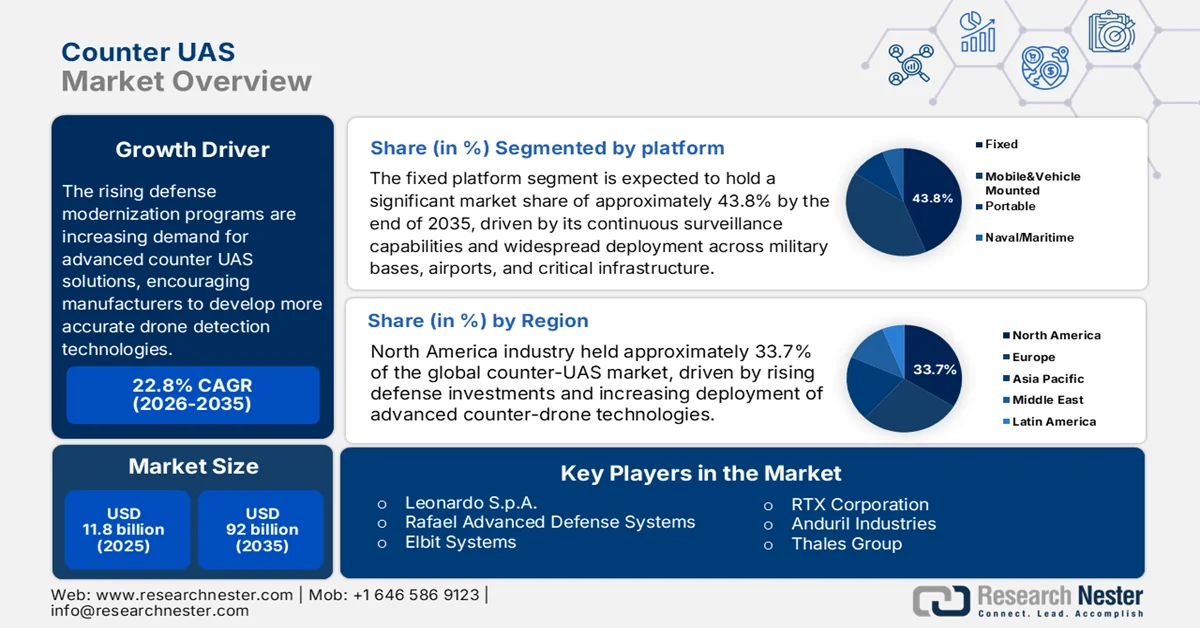
Counter UAS Market size was valued at USD 11.8 billion in 2025 and is expected to reach USD 92 billion by the end of 2035, growing at around 22.8% CAGR during the forecast period, i.e., 2026-2035. In 2026, the industry size of counter UAS is evaluated at USD 14.5 billion.
The global counter UAS market is influenced by the increasing use of unauthorized drones and the growing need for airspace security solutions. The rising deployment of unmanned aerial systems across defense, commercial, and public sectors has increased concerns related to surveillance, security risks, and unauthorized access, which encourages organizations to adopt counter-drone technologies for threat detection and monitoring. Moreover, it is said by the Federal Aviation Administration (FAA) that more than 800,000 drones have been registered in the United States, which reflects the widespread positioning of unmanned aircraft systems and the rising importance of controlled airspace management. This growing drone network is expected to support the adoption of counter UAS platforms during the forecast period.
Furthermore, increasing dependency on drones for military operations and tactical missions is creating demand for stronger defense capabilities against intimidating unmanned platforms. Armed forces are paying attention on improving battlefield awareness through surveillance systems, electronic warfare, and rapid-response mechanisms to address evolving aerial challenges. Besides this, it is stated that the U.S FY 2024 defense allocation includes approximately USD 100 million to accelerate the sourcing of C-sUAS capabilities, which highlights constant investment in drone defense technologies. These defense modernization efforts are helping the development of radar, radio frequency, and artificial intelligence-based counter UAS solutions.
Manufacturers are developing automated systems with enhanced detection accuracy, real-time analysis, and improved response capabilities through radar, radio frequency, electro-optical, and software-based technologies. Moreover, progress in artificial intelligence, machine learning, and sensor technologies is improving the performance of counter UAS solutions. Therefore, published by the U.S. Department of Homeland Security (DHS), improving detection and identification capabilities remains important for managing unmanned aircraft system activities. These technological developments are encouraging organizations to adopt advanced counter UAS platforms during the forecast period.
Key Counter UAS Market Insights Summary:
Regional Highlights:
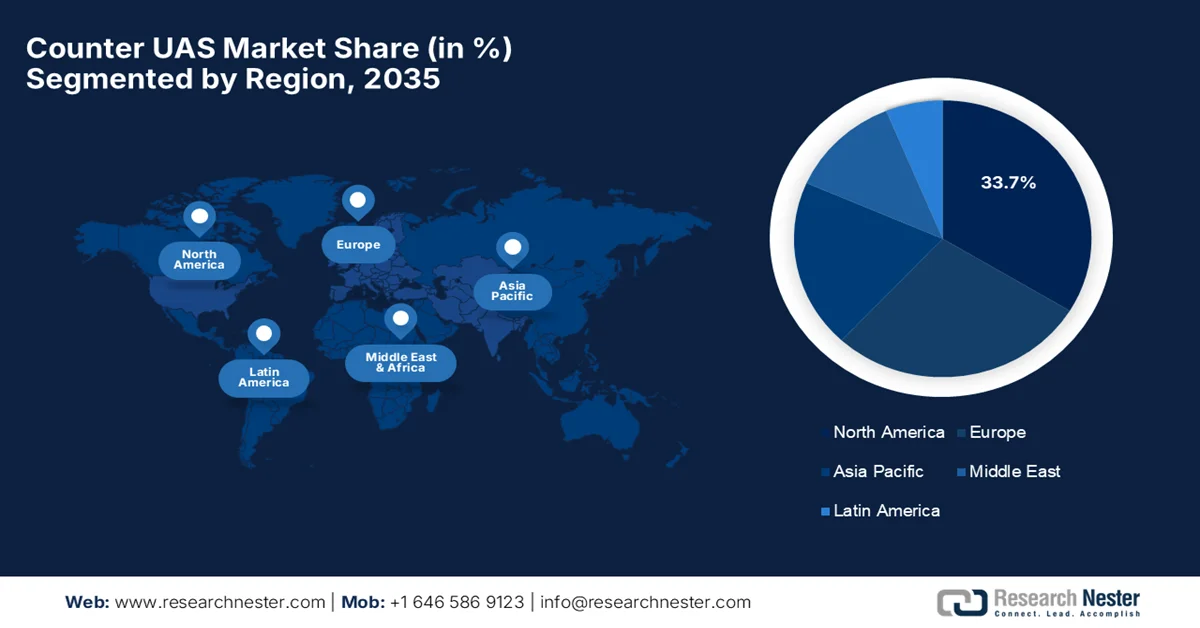
- North America is anticipated to dominate the counter UAS market with a 33.7% revenue share by 2035, attributable to escalating investments in defense modernization, homeland security initiatives, and the deployment of AI-enabled counter-drone technologies across strategic assets
- Asia Pacific is projected to witness the fastest expansion in the market through 2035, fueled by increasing defense upgrades, rising commercial drone adoption, and substantial investments in critical infrastructure development
Segment Insights:
- The fixed platform sub-segment is projected to capture a leading 43.8% share of the counter UAS market by 2035, underpinned by the growing installation of permanent counter-drone systems across military bases, airports, and critical infrastructure requiring continuous aerial surveillance
- The detection and tracking sub-segment is expected to secure a significant share of the market by 2035, propelled by the increasing demand for early drone identification and continuous monitoring capabilities enabled by advanced radar, RF sensors, electro-optical technologies, and AI-based analytics
Key Growth Trends:
- Increasing defense modernization programs
- Growing adoption of commercial drones across industries
Major Challenges:
- Evolving Drone Technologies and Detection Complexity
- High Cost of Counter UAS Systems
Key Players: Leonardo S.p.A. (Italy), Rafael Advanced Defense Systems (Israel), Elbit Systems (Israel), RTX Corporation (U.S.), Anduril Industries (U.S.), Thales Group (France).
Global Counter UAS Market Forecast and Regional Outlook:
Market Size & Growth Projections:
- 2025 Market Size: USD 11.8 billion
- 2026 Market Size: USD 14.5 billion
- Projected Market Size: USD 92 billion by 2035
- Growth Forecasts: 22.8% CAGR (2026-2035)
Key Regional Dynamics:
- Largest Region: North America (33.7% share by 2035)
- Fastest Growing Region: Asia Pacific
- Dominating Countries: United States, China, Israel, United Kingdom, Germany
- Emerging Countries: India, Japan, South Korea, Australia, Saudi Arabia
Last updated on : 22 July, 2026
Counter UAS Market - Growth Drivers and Challenges
Growth Drivers
- Increasing defense modernization programs: Where governments are increasing investments in defense modernization programs to strengthen surveillance, air defense, and battlefield awareness capabilities. Counter UAS systems are becoming an important part of these initiatives as armed forces implement advanced technologies to detect and neutralize defensive drones. Moreover, it is said by the Stockholm International Peace Research Institute (SIPRI) that the global military expenditure reached USD 2.72 trillion in 2024, which is increasing by 9.4% compared to 2023. As countries continue upgrading their defense infrastructure, the need for counter UAS solutions is expected to increase throughout the forecast period.
- Growing adoption of commercial drones across industries: As drone operations continue to raise across industries, organizations are investing in technologies that help monitor airspace and manage unauthorized drone activities more effectively. The increasing use of commercial drones across logistics, agriculture, construction, energy, and infrastructure inspection is helping the need for counter UAS solutions. Which is stated by the Federal Aviation Administration (FAA), the U.S. commercial drone fleet is projected to grow from approximately 1 million in 2024 to more than 1.1 million by 2028. This increasing commercial drone activity is anticipated to help the demand for counter UAS systems over the forecast period.
- Advancements in AI-enabled Drone Detection Technologies: Manufacturers are integrating AI-enabled analytics, radar, radio frequency sensors, and electro-optical systems to enhance drone detection accuracy and reduce response time. Constant progress in artificial intelligence, machine learning, and sensor technologies are improving the performance of counter UAS platforms. Therefore, it is said by the European Union Aviation Safety Agency (EASA) that the growing implementation of advanced unmanned aircraft operations is increasing the need for improved monitoring and detection technologies. These technological developments are predicted to accelerate the adoption of next-generation counter UAS solutions during the forecast period.
Challenges
- Evolving Drone Technologies and Detection Complexity: Commercial drones are becoming smaller, faster, and capable of autonomous navigation, which allow them to operate with lower radar signs which is why their flight patterns is complex to detect. At the same time, new communication methods and artificial intelligence enabled capabilities create drone detection more challenging for predictable security systems. The rapid progress of drone technologies is making it highly difficult for counter-UAS systems to identify and alleviate unauthorized aerial threats. As drone technology continues to evolve, manufacturers of counter UAS market must constantly update their detection, tracking, and mitigation capabilities.
- High Cost of Counter UAS Systems: Modern defense systems needed multiple technologies, including radar, radio frequency sensors, artificial intelligence-based detection platforms, and electronic detector, which increase overall investment requirements. The high cost allied with installing and maintaining advanced counter UAS solutions is a major challenge for market growth. Where small organizations and developing regions can find it difficulty in adopting these solutions due to limited security budgets and high operational expenses.
Counter UAS Market Size and Forecast:
| Report Attribute | Details |
|---|---|
|
Base Year |
2025 |
|
Forecast Period |
2026-2035 |
|
CAGR |
22.8% |
|
Base Year Market Size (2025) |
USD 11.8 billion |
|
Forecast Year Market Size (2035) |
USD 92 billion |
|
Regional Scope |
|
Counter UAS Market Segmentation:
Platform Segment Analysis
For the end of forecast period, the fixed platform sub-segment, which is part of the platform segment, is expected to hold a leading share of approximately 43.8% in the counter UAS market. The sub-segment’s growth is largely supported by the increasing deployment of permanent counter-drone systems across military bases, airports, government facilities, and other critical infrastructure requiring continuous aerial threat monitoring. Fixed counter UAS platforms contain long-range detection, tracking, and mitigation capabilities through integrated radar, radio frequency, and command-and-control technologies. Furthermore, by the U.S. department of defense, the FY 2024 defense adoptions that include approximately USD 100 million to accelerate the procurement of counter-small unmanned aircraft systems (C-sUAS) capabilities, which support the deployment of advanced counter-drone infrastructure. These investments are expected to strengthen the adoption of fixed counter UAS platforms during the forecast period.
Component Segment Analysis
By the end of the forecast period, the detection and tracking sub-segment, which is part of the component segment, is anticipated to account for a significant share of the counter UAS market. Its development is highly influenced by the growing need for early identification and continuous monitoring of unauthorized drones across defense, commercial, and public environments. Advanced detection solutions that combine radar, radio frequency sensors, electro-optical systems, and artificial intelligence-based analytics are improving threat identification accuracy and response capabilities. Beside this, stated by the NATO, that during the counter unmanned aircraft system technical interoperability exercise (C-UAS TIE23), around 70 systems and technologies, which include sensors, effectors, and jammers, were tested live to improve capabilities for detecting, identifying, and neutralizing drone threats.
End-user Segment Analysis
The defense and military forces sub-segment, which is part of the end user segment, is projected to maintain a leading position in the counter UAS market, by the end of the forecast period. It is showing growth which is mainly supported by increasing drone-based threats in battlefield environments, border areas, and military installations, encouraging armed forces to invest in advanced counter-drone capabilities. Defense organizations are paying attention on electronic warfare, surveillance systems, and integrated solutions to detect, track, and neutralize hostile unmanned aircraft. Likewise, it is stated by the NATO, that the counter unmanned aircraft system technical interoperability exercise (C-UAS TIE 24), involved more than 450 participants from 19 Allied nations and 3 partner nations, that highlight the growing focus on strengthening military capabilities against drone threats. These defense modernization efforts are expected to support the adoption of counter UAS solutions among military forces during the forecast period.
Our in-depth analysis of the counter UAS market includes the following segments:
|
Segment |
Subsegments |
|
Platform |
|
|
End user |
|
|
Neutralization Technology
|
|
|
Application |
|
|
Component |
|
|
Threat Class |
|

Vishnu Nair
Head - Global Business DevelopmentCustomize this report to your requirements — connect with our consultant for personalized insights and options.
Counter UAS Market - Regional Analysis
North America Market Insights
North America is expected to account for the largest share of the counter UAS market approximately 33.7% during the forecast period, which is supported by rising investments in defense modernization, native land security, and critical infrastructure protection. The increasing use of unmanned aerial systems across commercial and military applications has strengthened the need for advanced drone detection and mitigation technologies. Besides this, by the commander of the north American aerospace defense command (NORAD), that around 350 drone detections were stated approximately 100 military installations in 2024, that highlights the increasing need for advanced counter UAS solutions across North America. Where governments are investing in radar, radio frequency, electro-optical/infrared, and AI-enabled counter-drone systems to protect airports, military bases, public venues, and other strategic assets.
The U.S. counter UAS market is anticipated to dominate the regional market due to increasing efforts to protect critical infrastructure and public gatherings from unauthorized drone activities. Where government agencies are increasing their counter-drone programs through operational testing, interagency coordination, and security deployments across airports, military installations, and other high-risk locations. Besides this, stated by the U.S. government accountability office (GAO), that more than 2,000 drone detections have been reported near U.S. airports since 2021, that highlights the growing need for advanced counter UAS technologies across the country.
Canada is anticipated to witness a stable growth in the counter UAS market due to the rising use of drones across commercial and public sector applications, where the government is paying attention on maintaining safe and secure airspace. The authorities are keeping focus on drone regulations to make it stronger and improving oversight to support the safe integration of unmanned aircraft while addressing risks associated with unauthorized operations. Moreover this, by the transport of Canada it is stated that more than 108,000 registered drones and over 100,000 certified drone pilots are in the country as of 2024, that showcase the continued expansion of drone operations and the growing need for counter UAS technologies.
Europe Market Insights
The Europe counter UAS market is projected to hold a significant share by the end of 2035. Across the region, the governments are expanding their counter-drone capabilities along with introducing policies to support the safe integration of unmanned aircraft into European airspace. Due to the increasing efforts to strengthen border security, protect critical infrastructure, and improve airspace flexibility against unauthorized drone activities, there is a rise in the counter UAS market. As reported by the European Commission, the commercial drone market in Europe is anticipated to reach approximately EUR 14.5 billion by 2030, which highlights the rapid need for drone operations and the growing demand for counter UAS solutions.
Government authorities are increasing investments in surveillance systems and enhancing security measures around critical assets to improve airspace protection. Where Germany's counter UAS market is projected to cater for a major share, due to its constant focus on protecting industrial facilities, transportation infrastructure, and public events from unauthorized drone activities. Therefore, according to the German Aerospace Center (DLR), 118 drone-related incidents were reported at German airports in 2024, highlighting the growing need for effective counter UAS solutions across the country.
Due to the rising efforts to strengthen aviation security and protect public infrastructure, the U.K. counter UAS market is anticipated to register a stable growth. Authorities are expanding the use of counter-drone measures around airports, government facilities, and large public gatherings while supporting the safe adoption of drone technologies. Moreover, according to the UK Civil Aviation Authority (CAA), over 500,000 people have registered or completed drone operator and flyer training since the UK's drone registration scheme was introduced, supporting the growing need for effective drone monitoring and mitigation technologies.
APAC Market Insights
The Asia Pacific counter UAS market is projected to register the fastest growth by the end of 2035, driven by increasing defense upgrade, rising commercial drone implementation, and growing investments in critical infrastructure across the region. Countries are increasing surveillance capabilities and introducing guidelines to support the safe integration of drones while addressing unauthorized aerial activities. Likewise, it is stated by the Asian development bank (ADB), that region needed approximately USD 1.7 trillion in infrastructure investment annually through 2030 to maintain economic growth and improve regional connectivity. This constant expansion of critical infrastructure is expected to support the demand for counter UAS technologies across the region.
Authorities are strengthening drone regulations and increasing airspace management measures to support the safe use of unmanned aircraft. For Asia Pacific, Japan counter USA market is witnessing a significant share due to its increasing focus on securing airports, urban infrastructure, and major public events from unauthorized drone operations. Furthermore, by the Japan’s ministry of land, infrastructure, transport and tourism (MILIT), it is mandatory for all unmanned aircraft weighing 100 grams or more for registration under the Civil Aeronautics Act, that reflects the country's continued focus on regulating drone operations and supporting the adoption of counter UAS technologies.
Australia counter UAS market is anticipated to register steady growth, due to growing drone implementation across infrastructure inspection, agriculture, mining, and emergency response applications. Government agencies are strengthening drone safety regulations while improving the oversight of unmanned aircraft operations. Moreover, by the civil aviation safety authority (CASA), it is stated that Australia had 27,584 commercially registered drones as of 30 June 2021, which showcase the constant increase of drone activities and is supporting the need for counter UAS technologies.
Key Counter UAS Market Players:
- Leonardo S.p.A. (Italy)
- Rafael Advanced Defense Systems (Israel)
- Elbit Systems (Israel)
- RTX Corporation (U.S.)
- Anduril Industries (U.S.)
- Thales Group (France)
- Company Overview
- Business Strategy
- Key Product Offerings
- Financial Performance
- Key Performance Indicators
- Risk Analysis
- Recent Development
- Regional Presence
- SWOT Analysis
- RTX Corporation has increased its counter UAS capabilities through advanced drone detection that is designed for defense and security operations. Its results help the military in identifying and responding to new aerial threats.
- Rafael Advanced Defense Systems delivers integrated counter-drone solutions that combine detection, electronic warfare, and neutralization abilities. The company works on protecting sensitive locations from unauthorized drone activities.
- Leonardo supports counter UAS acts with electronic and surveillance technologies that can improve airspace monitoring capabilities.
- Elbit Systems’ counter UAS portfolio that includes technologies for drone identification, tracking, and threat response. These results are used by defense and security organizations to improve protection across critical areas.
- Through its artificial intelligence-driven platforms, Anduril Industries has both autonomous systems, sensors, and command technologies to support faster drone threat detection and response. The company highlights real-time awareness for modern security environments.
- The Thales Group provides solutions that help in detection and response functions for various security applications. The company serves needs across airports, defense facilities, and critical infrastructure.
Here is a list of key players operating in the global counter UAS market:
The counter UAS market includes a combination of global defense companies and specialized technology providers that are competing to develop consistent drone detection and moderation solutions. Some major players that include RTX, Rafael Advanced Defense Systems, Elbit Systems, and Anduril Industries are strengthening their capabilities through radar systems, electronic detectors, AI-based monitoring, and integrated command platforms. As drone-related security concerns increase, manufacturers are giving more attention to improving detection range, response accuracy, and system flexibility for different operational environments. In the counter UAS market, more competition among companies is caused by product enhancements, technology partnerships, and customized solutions.
Corporate Landscape of the Counter UAS Market:
Recent Developments
- In January 2025, Elbit Systems Ltd. announced the increase of its ReDrone counter UAS solution, which incorporates radar, signal intelligence, and electronic warfare, to improve drone detection, tracking, and neutralization capabilities.
- In February 2026, RTX’s Raytheon business demonstrated developments in its Coyote counter UAS system, that strengthen its ability to address growing drone threats through improved detection and defeat technologies.
- Report ID: 8678
- Published Date: Jul 22, 2026
- Report Format: PDF, PPT
- Explore a preview of key market trends and insights
- Review sample data tables and segment breakdowns
- Experience the quality of our visual data representations
- Evaluate our report structure and research methodology
- Get a glimpse of competitive landscape analysis
- Understand how regional forecasts are presented
- Assess the depth of company profiling and benchmarking
- Preview how actionable insights can support your strategy
Explore real data and analysis
Frequently Asked Questions (FAQ)
About this Report
Connect with our Expert




Copyright @ 2026 Research Nester. All Rights Reserved.
