Electronically Scanned Arrays (AESA) Market Outlook:
Electronically Scanned Arrays (AESA) Market size was valued at USD 9.9 billion in 2025 and is poised to reach USD 21.5 billion by the end of 2035, expanding at around 8.1% CAGR during the forecast period, i.e., 2026-2035. In 2026, the industry size of electronically scanned arrays is evaluated at USD 10.7 billion.
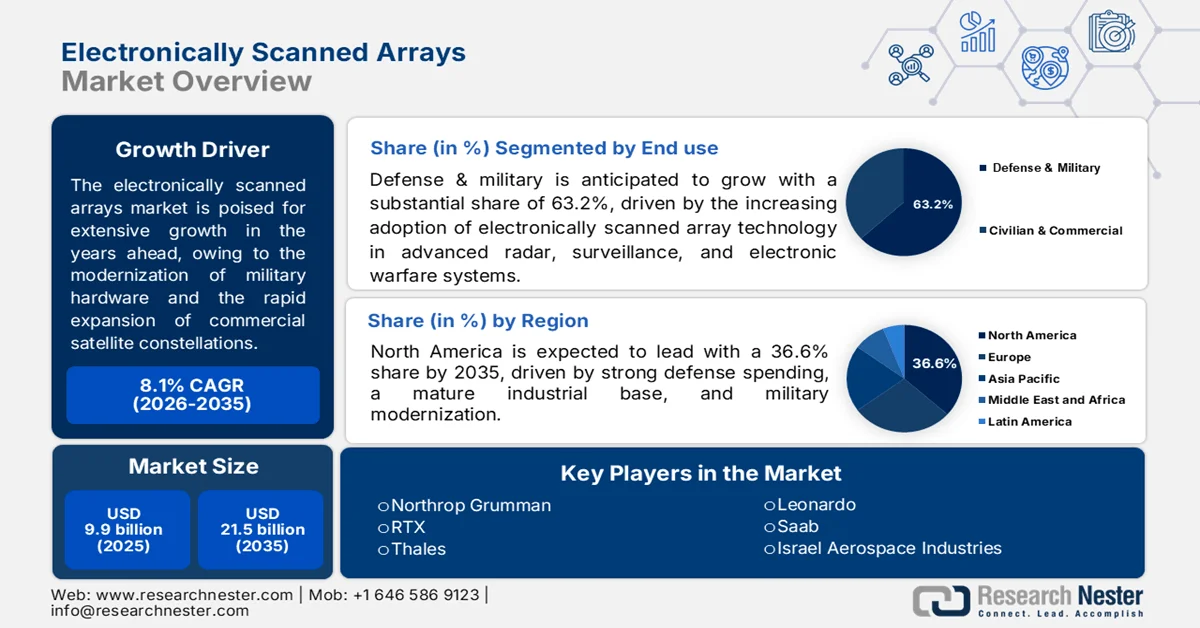
The global electronically scanned arrays market is projected for sustained and strategic expansion, positively influenced by modernization of military hardware and the rapid growth of commercial satellite constellations. On the other hand, defense forces worldwide are replacing aging mechanical radars with advanced active and passive arrays to counter electronic warfare and hypersonic threats on land, air, and sea platforms. In March 2025, the U.S. Department of War stated that the U.S. Air Force awarded Northrop Grumman a USD 14.2 million modification for AESA radars supporting F-16 aircraft, bringing the contract’s cumulative value to a significant value of USD 1.69 billion, thus elevating the growth potential of the market.
Furthermore, technological shifts toward gallium nitride semiconductors are accelerating electronically scanned arrays market growth by enabling smaller, lighter, and more power-efficient designs. This is positioning ESAs as an indispensable asset for future multi-domain operations, autonomous aviation, and global connectivity. For instance, in May 2025, Raytheon, an RTX business, completed the first flight test of its PhantomStrike radar in Ontario, California, thereby demonstrating its ability to track airborne targets and map terrain. This fully air-cooled, gallium nitride-powered fire-control radar is especially designed to deliver long-range detection, tracking, and targeting, thus denoting a positive market outlook.
Key Electronically Scanned Arrays (AESA) Market Insights Summary:
Regional Highlights:
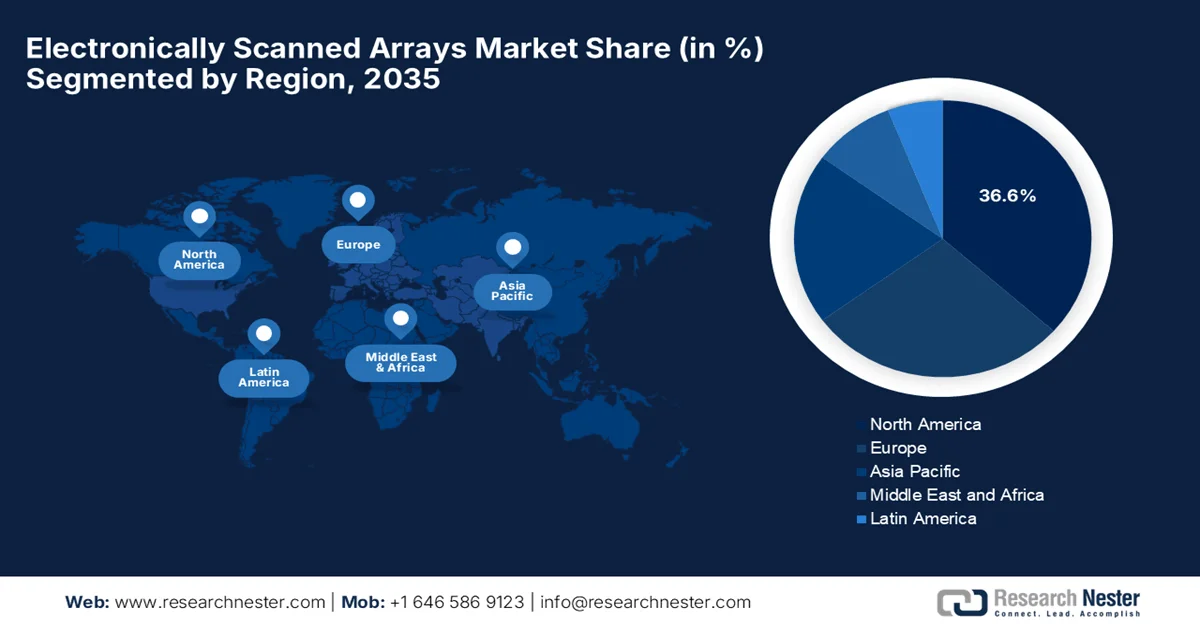
- North America is projected to lead the electronically scanned arrays market with a 36.6% share from 2026 to 2035, supported by the world’s largest defense budget, a mature industrial base, and aggressive military modernization initiatives
- Asia Pacific is poised to register the fastest growth during 2026-2035, propelled by escalating geopolitical tensions, maritime border disputes, and the modernization of indigenous fighter jets, naval platforms, and ground-based missile defense systems
Segment Insights:
- Defense & military is projected to command a 63.2% share by 2035 in the electronically scanned arrays market, owing to increasing adoption of electronically scanned array technology across advanced radar, surveillance, electronic warfare, missile defense, and fire-control systems
- Active electronically scanned arrays is anticipated to secure a considerable share by 2035, propelled by superior multi-target detection and tracking capabilities, rapid electronic beam steering, and multifunction operation
Key Growth Trends:
- Growing drone and hypersonic threats
- Expansion of space and satellite applications
Major Challenges:
- High development and manufacturing costs
- Thermal management and power consumption
Key Players: Northrop Grumman,RTX,Thales,Leonardo,Saab,Israel Aerospace Industries,HENSOLDT.
Global Electronically Scanned Arrays (AESA) Market Forecast and Regional Outlook:
Market Size & Growth Projections:
- 2025 Market Size: USD 9.9 billion
- 2026 Market Size: USD 10.7 billion
- Projected Market Size: USD 21.5 billion by 2035
- Growth Forecasts: 8.1% CAGR (2026-2035)
Key Regional Dynamics:
- Largest Region: North America (36.6% Share by 2035)
- Fastest Growing Region: Asia Pacific
- Dominating Countries: United States, China, Japan, India, South Korea
- Emerging Countries: Germany, France, United Kingdom, Australia, Italy
Last updated on : 20 August, 2026
Electronically Scanned Arrays (AESA) Market - Growth Drivers and Challenges
Growth Drivers
- Growing drone and hypersonic threats: The proliferation of drones, hypersonic missiles, and other maneuvering threats is heightening demand for radar systems that are capable of detecting and classifying fast-moving targets in complex environments. On the other hand, electronically scanned arrays provide rapid beam repositioning, multi-target engagement, and enhanced resolution, which makes them important for modern threat detection. In June 2026, the Atlantic Council revealed that the growing use of drones is increasing risks to airports, military bases, borders, infrastructure, and public events across the U.S. The country’s federal authorities have expanded counter-UAS programs, but gaps remain in detection, tracking, training, funding, and coordination, thus reflecting a presence of sustained demand for the electronically scanned arrays market.
- Expansion of space and satellite applications: Growing satellite broadband deployment and space-based sensing programs are creating new encouraging opportunities for electronically steered arrays in communications, Earth observation, and space surveillance. Also, their ability to steer beams electronically without mechanical movement supports compact architectures, rapid pointing, and reliable operation in difficult orbital environments. In September 2024, NASA-supported FIGARO demonstrated full-duplex Ka-band communications from a high-altitude balloon at 98,000 feet by connecting stationary and moving ground stations to simulate lunar relay operations. This system uses commercial 5G phased-array technology to provide high-bandwidth communications without mechanical pointing systems, reducing size, weight, and power requirements, thus benefiting the overall electronically scanned arrays market.
Challenges
- High development and manufacturing costs: The production of ESAs, especially those AESAs, causes extreme financial hurdles. These systems need substantial individual Transmit/Receive (T/R) modules, which depend on highly expensive semiconductor materials such as gallium nitride or gallium arsenide. Meanwhile, the fabrication processes for these materials demand high-precision cleanrooms and advanced lithography tools, driving up initial capital expenditures. Other than hardware, the integration of complex digital beamforming algorithms requires extensive software development and rigorous testing cycles. These systems are mostly suitable for military hardware or specialized satellite constellations; therefore, manufacturers in the electronically scanned arrays market cannot easily leverage mass production.
- Thermal management and power consumption: ESAs face severe operational challenges regarding power density and heat dissipation. An array packs thousands of active semiconductor elements into a tight physical space, due to which it generates massive amounts of thermal energy during continuous operation. In this context, traditional air-cooling methods are entirely inadequate for handling these extreme thermal loads, which in turn forces engineers to design complex liquid-cooling systems or advanced phase-change thermal planes. These cooling mechanisms add unwanted weight, bulk, and complexity to the overall system design, which is highly problematic for aerospace and airborne applications, thus negatively impacting the growth of the electronically scanned arrays market globally.
Electronically Scanned Arrays (AESA) Market Size and Forecast:
| Report Attribute | Details |
|---|---|
|
Base Year |
2025 |
|
Forecast Year |
2026-2035 |
|
CAGR |
8.1% |
|
Base Year Market Size (2025) |
USD 9.9 billion |
|
Forecast Year Market Size (2035) |
USD 21.5 billion |
|
Regional Scope |
|
Electronically Scanned Arrays (AESA) Market Segmentation:
End use Segment Analysis
Defense & military in the electronically scanned arrays market is anticipated to grow with a substantial share of 63.2% in the end use segment throughout the forecast period. The sub-segment’s dominating position is majorly driven by the increasing adoption of electronically scanned array technology in advanced radar, surveillance, electronic warfare, missile defense, and fire-control systems. Growing investments in multi-domain warfare capabilities and the replacement of conventional mechanically scanned radar systems with AESA and PESA technologies are further supporting the segment’s growth. In December 2025, a U.S. Air Force B-52 Stratofortress arrived at Edwards Air Force Base after receiving a new AESA radar at Boeing’s San Antonio facility, which marks a key step in the bomber’s modernization. This upgraded radar is designed to improve all-weather navigation, targeting, reliability, and maintainability.
Type Segment Analysis
In terms of type category, the active electronically scanned arrays segment is forecasted to grow with a considerable share by the conclusion of 2035. The sub-segment’s prominent position in the electronically scanned arrays (AESA) market is supported by its superior multi-target detection and tracking capabilities, rapid electronic beam steering, and multifunction operation. In addition, the growing integration into advanced fighter aircraft, bombers, naval platforms, and air-defense systems is also strengthening demand. In May 2023, the U.S. Air Force began upgrading the B-52 fleet with AESA radar, thereby replacing its decades-old radar technology to improve navigation, targeting, and situational awareness. This program was led by the Air Force Life Cycle Management Center with Boeing and Raytheon and is designed to support future upgrades through software-based enhancements.
Frequency Band Segment Analysis
The single frequency, which is a part of the frequency band segment, is forecasted to grow with a lucrative revenue share in the electronically scanned arrays market during the stipulated timeframe. Its reliable high-power performance, relatively straightforward system architecture, and extensive deployment across established radar and surveillance applications support this growth. Single-frequency electronically scanned arrays are suitable for applications requiring consistent long-range detection and tracking, i.e., ground-based surveillance, naval radar, early-warning systems, and air-defense networks. In addition, the large installed base of single-frequency radar systems and ongoing modernization of existing defense and surveillance infrastructure will sustain demand for the segment throughout the forecast period.
Our in-depth analysis of the electronically scanned arrays market includes the following segments:
|
Segment |
Subsegments |
|
End use |
|
|
Type |
|
|
Frequency Band |
|
|
Arrays Geometry |
|
|
Range |
|
|
Platform |
|
|
Application |
|

Vishnu Nair
Head - Global Business DevelopmentCustomize this report to your requirements — connect with our consultant for personalized insights and options.
Electronically Scanned Arrays (AESA) Market - Regional Analysis
North America Market Insights
North America electronically scanned arrays market is anticipated to lead and dominate with a total share of 36.6% from 2026 to 2035. The region’s leadership in this sector is largely driven by the world's largest defense budget, a mature industrial base, and aggressive military modernization initiatives. In addition, North America’s market is also bolstered by substantial private sector investments in commercial low-Earth orbit satellite constellations for broadband connectivity. In August 2024, Amazon’s Project Kuiper made an additional investment of USD 19.5 million to expand its satellite operations at Kennedy Space Center, bringing its total investment there to nearly USD 140 million. This new 42,000-square-foot facility will process, store, and maintain satellite hardware, supporting the deployment of Kuiper’s 3,232-satellite constellation and increasing launch operations.
The world's highest defense spending, retrofitting tactical fighter fleets, unmanned aerial vehicles, and surface combatants with advanced AESA to secure air and maritime dominance, drives growth in the electronically scanned arrays market in the U.S. This defense-led demand, coupled with massive domestic investments in commercial telecommunications infrastructure requiring digital beamforming, positions the industry for solid growth. In April 2024, General Atomics Aeronautical Systems reported that it is upgrading its EagleEye multi-mode radar with an AESA antenna and new software, with the company expecting the enhancement to more than double the radar’s range. The drop-in AESA upgrade will improve reliability, repairability, target detection, and multi-mode performance, thus making it suitable for standard market growth.
The Canada electronically scanned arrays market has a strong opportunity to grow in the upcoming years, which is due to the nation's vast geography and its strategic defense partnerships. With a collective goal to protect its expansive Arctic borders and maritime approaches, the country is prioritizing the adoption of advanced AESA for the modernization of its tactical fighter fleet. Based on government data that was published in January 2023, Canada finalized an agreement with the U.S. and Lockheed Martin to acquire 88 F-35 fighter jets for the Royal Canadian Air Force. This is a USD 19 billion program that includes aircraft, equipment, sustainment, and infrastructure, thereby supporting Canada’s Arctic security, national sovereignty, and NATO and NORAD commitments.
APAC Market Insights
Asia Pacific electronically scanned arrays market is anticipated to grow at the quickest rate during the stipulated timeframe. The region’s prominence in this sector is fueled primarily by escalating geopolitical tensions and maritime border disputes. Major defense spenders, i.e., China, India, Japan, and South Korea, are proactively upgrading their domestic military hardware by integrating active and passive arrays into indigenous fighter jet programs, naval destroyers, and ground-based missile defense systems. In this context, India’s Ministry of Defense reported major progress in December 2023, wherein defense production exceeded USD 12 billion, and exports reached a record of USD 1.9 billion. The government expanded indigenous procurement and advanced platforms such as Tejas and C-295 while strengthening domestic manufacturing through HAL and private-sector partnerships, thus denoting an optimistic market opportunity.
The country’s continued emphasis on indigenous advanced radar and sensor development across air, naval, and integrated air-defense platforms is responsible for driving the electronically scanned arrays market in China. In addition, the country’s development and deployment of advanced phased-array radar systems for air and missile-defense applications is strengthening domestic demand for electronically scanned array technologies. In September 2025, Observer Research Foundation revealed that AESA radars are fitted on China’s J-10C, J-16 and J-20A fighter aircraft. The systems are described as being less vulnerable to jamming countermeasures, strengthening the aircraft’s radar capabilities in contested environments. AESA technology is integrated into the PL-15 missile’s terminal-stage active radar seeker, working along with inertial navigation, BeiDou satellite positioning, and a bidirectional data link to support guidance.
The Japan electronically scanned arrays market is undergoing remarkable transformations largely propelled by its shifting defense posture and a strong emphasis on maintaining a qualitative technological edge. In addition, the country’s mature commercial electronics and space sectors further boost the market through the development of precise Earth observation satellites and high-frequency communication terminals. In August 2024, JAXA explored sonification by converting EarthCARE (Hakuryu) satellite observation data into sound, making complex atmospheric information easier to experience audibly. Using the cloud profiling radar, the project transformed radar reflectivity into koto-inspired tones, with stronger reflections represented by louder and higher-pitched sounds, thus positively benefiting the market’s expansion.
Europe Market Insights
The Europe electronically scanned arrays (AESA) market is expected to expand at a considerable rate during the discussed timeframe. The regional market is defined by a strong focus on strategic autonomy, multinational defense collaborations, and advanced aerospace engineering. Apart from this Europe market benefits from a heightened threat landscape and the urgent need to upgrade continental defense networks. In February 2024, the CROWN project, which was funded by the European Commission, developed a compact AESA-based multifunction RF system by combining radar, electronic warfare, and communications for future aerial platforms. After 32 months of research, the consortium demonstrated the system’s key building blocks and prototype performance in a controlled testing environment, reflecting its technological potential.
The country’s move toward networked, multifunctional sensing and air-defense architectures is powering Germany electronically scanned arrays market. The transition from aged mechanically steered antennas to agile AESA systems featuring Gallium Nitride (GaN) components is positioning the market for extensive growth in the upcoming years. In June 2024, the ECRS Mk1, which is a next-generation AESA radar developed by HENSOLDT and Indra for Germany and Spain-based Eurofighter aircraft, entered live operational testing with advanced hardware and software. Early results indicate improved radar robustness and performance, which in turn supports the transition from ground testing toward airborne trials and strengthens confidence in the system’s development.
The UK electronically scanned arrays market is being reshaped by rising demand for advanced radar, electronic warfare, surveillance, and multi-function sensing across different platforms. Recent investments in terms of next-generation radar are also supporting local engineering, manufacturing, and integration knowledge. In this context, in September 2024, Europe’s Common Radar System (ECRS) Mk2, developed for the UK’s Eurofighter Typhoon, completed its first flight on a test aircraft, marking a major step in its development. The advanced radar is especially designed to strengthen the RAF’s ability to detect, identify, locate, and suppress enemy air-defense systems while improving Typhoon’s control of the airspace.
Key Electronically Scanned Arrays (AESA) Market Players:
- Northrop Grumman (U.S.)
- RTX (U.S.)
- Thales (France)
- Leonardo (Italy)
- Saab (Sweden)
- Israel Aerospace Industries (Israel)
- HENSOLDT (Germany)
- Hanwha Systems (South Korea)
- Mitsubishi Electric (Japan)
- Company Overview
- Business Strategy
- Key Product Offerings
- Financial Performance
- Key Performance Indicators
- Risk Analysis
- Recent Development
- Regional Presence
- SWOT Analysis
- Northrop Grumman is identified as a leading AESA radar manufacturer which is offering systems such as AN/APG-81, AN/APG-77, AN/APG-83 SABR, and AN/ZPY-1 STARLite. Its competitive strength arises from advanced radar technology, broad platform integration, and established defense relationships.
- RTX through Raytheon, provides advanced AESA fire-control radars including APG-82(V)X, APG-82(V)1, and APG-79. The company’s latest systems combine GaN technology, advanced signal processing, electronic warfare, and multifunction capabilities.
- Thales is a prominent player in this sector that offers AESA radar solutions, including the ground master 200 multi-mission compact, which consists of 4D AESA technology for simultaneous detection, tracking, and classification of threats. The firm’s strengths include software-defined architecture, multifunction capabilities, and strong defense-market presence.
- Leonardo manufactures AESA systems such as PicoSAR, which are especially designed for SAR/GMTI applications on uncrewed, fixed-wing, and rotary-wing platforms. The company’s competitive advantages include flexible antenna configurations, solid-state technology, reliability, and extensive aerospace and defense electronics expertise.
- Saab deliberately integrates advanced AESA technology into platforms such as Gripen E, supported by the Raven ES-05 radar. The company’s strengths include sensor fusion, electronic warfare integration, modular architecture, and GaN-based technology, thereby enabling flexible and upgradeable radar capabilities.
Here is a list of key players operating in the global market:
The electronically scanned arrays market represents an intensely competitive structure with the presence of leading defense and aerospace manufacturers. These pioneers are maintaining strong positions through proprietary AESA radar technologies, platform integration capabilities, and well-established relationships with military end users. Competition in this sector is centered among major players in the U.S., Europe, Israel, South Korea, Japan, and Türkiye. Apart from this, pioneers are differentiating with radar detection performance, multifunction capabilities, electronic warfare integration, and GaN-based architectures. For instance, in June 2026, Saab launched Giraffe AMB D, which is the latest version of its Giraffe AMB radar and possesses a new AESA array, advanced processing, and software-defined architecture for improved detection and tracking.
Corporate Landscape of the Electronically Scanned Arrays (AESA) Market:
Recent Developments
- In February 2026, Northrop Grumman introduced Valen, which is a compact multifunction AESA combining radar, electronic warfare, and communications for crewed and uncrewed platforms. Its 3D-printed, open-architecture design and advanced semiconductor technology aim to reduce production time, power use, and size.
- In February 2026, HENSOLDT secured contracts worth around USD 118 million to supply additional TRML-4D air defense radars to Europe countries under the Europe Sky Shield Initiative. Based on AESA technology, this radar can detect and track up to 1,500 aerial targets within 250 km.
- Report ID: 8742
- Published Date: Aug 20, 2026
- Report Format: PDF, PPT
- Explore a preview of key market trends and insights
- Review sample data tables and segment breakdowns
- Experience the quality of our visual data representations
- Evaluate our report structure and research methodology
- Get a glimpse of competitive landscape analysis
- Understand how regional forecasts are presented
- Assess the depth of company profiling and benchmarking
- Preview how actionable insights can support your strategy
Explore real data and analysis
Frequently Asked Questions (FAQ)
About this Report
Connect with our Expert


Report, 2026-2035



Copyright @ 2026 Research Nester. All Rights Reserved.
