Electronically Scanned Array Radar Market Outlook:
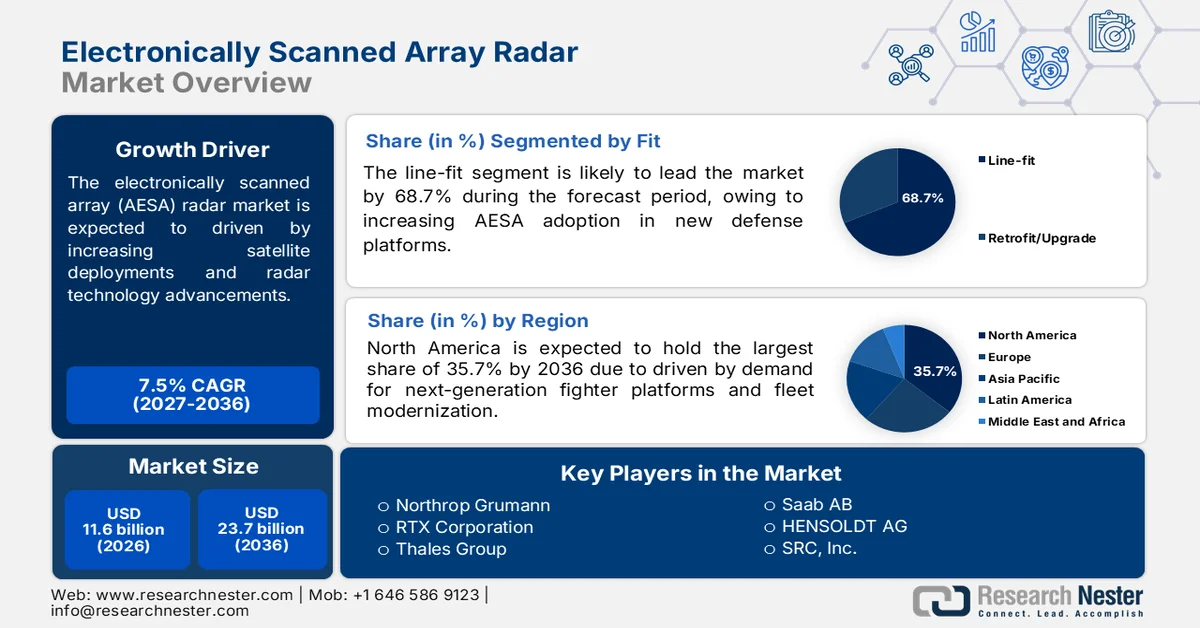
Electronically Scanned Array Radar Market size was valued at USD 11.6 billion in 2026 and is projected to cross USD 23.7 billion by the end of 2036, expanding at more than 7.5% CAGR during the forecast period, i.e., 2027-2036. In 2027, the industry size of electronically scanned array radar is evaluated at USD 12.4 billion.
The worldwide electronically scanned array radar market is readily shaped by a convergence of industrial forces, high expenses of integration and development, an increase in procurement and supplier accessibility, along with controlled regime exports and thermal management requirements. According to an article published by the OECD in February 2026, the U.S. Geological Survey identified 472 earth observation satellites in orbit as of 2024, of which 270 are operated by private operators and the remaining 202 by governments globally. Besides, the highest-resolution commercial synthetic aperture radar image was released in 2023, which effectively captured the Earth’s 16 cm detail. In this regard, a 10 cm commercial sensor was successfully launched into orbit as of March 2025, which is likely to continue due to miniaturization innovation. Therefore, based on such launches and observations, there is a continuous export of radar apparatus across nations, thus positively impacting the market’s growth.
Country-Wise Radar Apparatus Export-Based Shipment, 2024
|
Country |
Trade Value (USD 1,000) |
Quantity (Item) |
|
U.S. |
1,275,747.5 |
2,670,130 |
|
Singapore |
664,180.9 |
13,558,300 |
|
China |
359,783.3 |
6,877,570 |
|
Mexico |
325,151.1 |
10,535,100 |
|
Japan |
206,982.7 |
1,627,440 |
|
Hong Kong |
31,463.7 |
278,708 |
|
Malaysia |
26,206.4 |
16,857 |
|
Switzerland |
22,233.0 |
141,083 |
|
India |
18,073.9 |
2,303 |
|
South Africa |
14,832.7 |
33,512 |
Source: WITS
Furthermore, the rise of reconfigurable and software-based architectures, along with an expansion in radars into counter-hypersonic missions, the convergence of radar with networked multi-domain operations, and the adoption of innovative digital signal processing and artificial intelligence. In terms of digital signal processing, Besides, modern processors handle massive data volumes in real time, improving clutter suppression and track correlation in contested environments. The integration of AI and machine learning further enhances adaptive waveform selection and anomaly detection, allowing radars to distinguish genuine threats from false alarms. This shift from raw detection to decision-ready intelligence means operators receive classified, prioritized threat information rather than uncorrelated data.
Key Electronically Scanned Array Radar Market Insights Summary:
Regional Highlights:
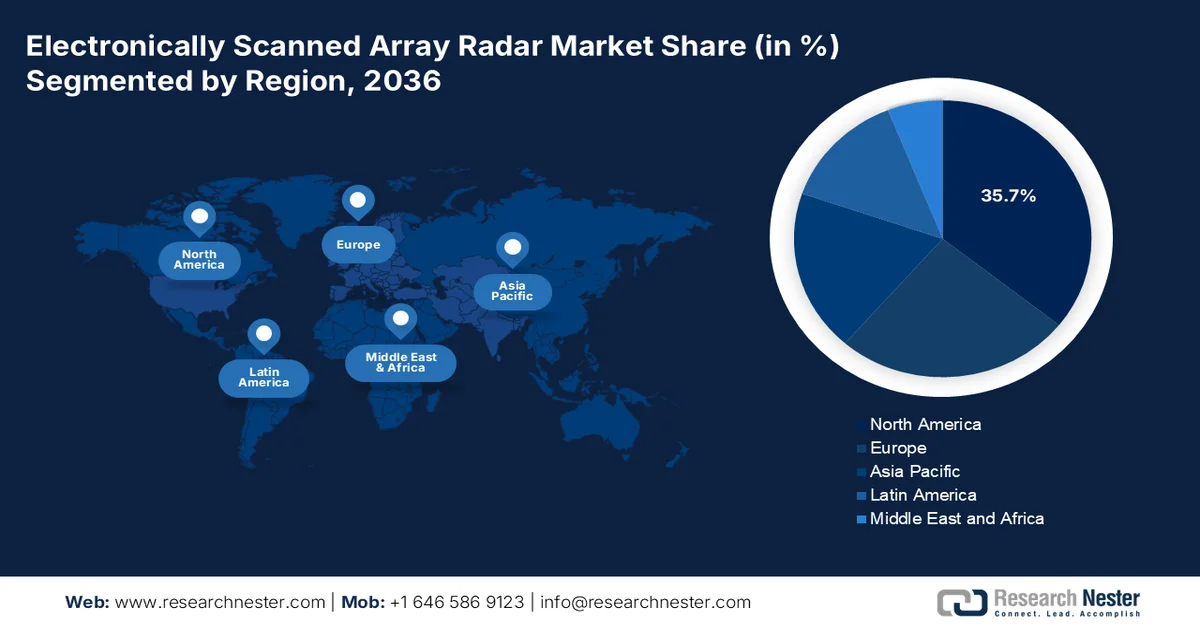
- North America is projected to command a 35.7% share of the electronically scanned array radar market by 2036, underpinned by demand for next-generation fighter platforms, rapid retrofits, and fleet modernization
- Asia Pacific is poised to be the fastest-growing region during the forecast period, propelled by indigenous radar programs, naval modernization, self-reliant defense technologies, and expanding maritime surveillance needs
Segment Insights:
- The line-fit sub-segment of the electronically scanned array radar market is projected to account for 68.7% share by 2036, supported by fifth-generation fighter production, frigate construction, and next-generation air defense programs creating sustained demand tied to platform production schedules
- The AESA systems sub-segment is anticipated to hold a 63.3% share by 2036, propelled by its computer-controlled electronic beam steering capabilities and growing deployment across electronic defense and high-speed tracking applications
Key Growth Trends:
- Rising fighter aircraft procurement
- Deployment of naval air
Major Challenges:
- Supply chain vulnerabilities and component scarcity
- Rapid technological obsolescence
Key Players: Northrop Grumman, RTX Corporation, Thales Group, Saab AB, HENSOLDT AG, Leonardo S.p.A., Lockheed Martin Corporation, Israel Aerospace Industries / ELTA Systems, Hanwha Systems, Mitsubishi Electric Corporation, L3Harris Technologies, SRC Inc., Telephonics Corporation.
Global Electronically Scanned Array Radar Market Forecast and Regional Outlook:
Market Size & Growth Projections:
- 2026 Market Size: USD 11.6 billion
- 2027 Market Size: USD 12.4 billion
- Projected Market Size: USD 23.7 billion by 2036
- Growth Forecasts: 7.5% CAGR (2027-2036)
Key Regional Dynamics:
- Largest Region: North America (35.7% Share by 2036)
- Fastest Growing Region: Asia Pacific
- Dominating Countries: United States, China, Japan, South Korea, India
- Emerging Countries: India, South Korea, Japan, Australia, Israel
Last updated on : 25 September, 2026
Electronically Scanned Array Radar Market - Growth Drivers and Challenges
Growth Drivers
- Rising fighter aircraft procurement: The effective acquisition of innovative combat aircraft platforms is considered the most influential growth driver for the electronically scanned array radar market globally. According to a data report published by the ITA in January 2026, the civil aerospace sector’s turnover, especially in the UK, totaled an estimated USD 38 billion, of which USD 25 billion was exported as of 2023. Likewise, the defense industry’s turnover in the nation totaled roughly USD 35 billion, of which USD 12 billion was exported in the same year. Simultaneously, the space sector’s turnover in the country amounted to roughly USD 22 billion, of which USD 7 billion was exported. Therefore, based on the turnover of the different segments of the aviation sector and turnover range, the market is continuously gaining increased importance and demand.
- Deployment of naval air: Naval platforms are continuously emerging as one of the main drivers for the market adoption. As stated in an article published by the OECD in 2026, shipbuilding production is effectively increasing, which rapidly grew by more than 25% as of 2025. This is further predicted to continuously rise, which is fueled by a robust orderbook standing at 169 million in the same year, which is equivalent to 16% of the present fleet. Based on this, China has significantly accounted for nearly half of worldwide deliveries and held almost 60% of the orderbook as of 2025. Meanwhile, shipbuilding has underpinned maritime transport and also supports wide-ranging manufacturing capabilities, thus bolstering the market’s upliftment.
Challenges
- Supply chain vulnerabilities and component scarcity: The electronically scanned array radar market production depends on specialized components including gallium nitride semiconductors, advanced processors, and precision-manufactured modules. Thereby, supply chains for these critical inputs are concentrated among a small number of suppliers, creating vulnerability to disruption. Besides, geopolitical tensions, trade restrictions, and natural disasters can interrupt component availability, delaying production and delivery schedules. The limited number of qualified suppliers for certain high-performance components means manufacturers have few alternatives when shortages occur. Building redundancy into supply chains requires significant investment and long-term supplier relationships.
- Rapid technological obsolescence: The pace of technological advancement in the market creates a persistent obsolescence challenge for both manufacturers and end-users. Besides, new semiconductor materials, processing architectures, and software capabilities emerge continuously, rendering existing systems less competitive. Defense organizations face pressure to upgrade or replace radars before their expected service life ends to maintain operational relevance. Therefore, manufacturers must balance investment in current production with research into next-generation capabilities, often with uncertain return timelines. This cycle of rapid obsolescence complicates long-term procurement planning, increases lifecycle costs, and creates risk for nations that commit to large fleets of systems that may require premature replacement.
Electronically Scanned Array Radar Market Size and Forecast:
| Report Attribute | Details |
|---|---|
|
Base Year |
2026 |
|
Forecast Year |
2027-2036 |
|
CAGR |
7.5% |
|
Base Year Market Size (2026) |
USD 11.6 billion |
|
Forecast Year Market Size (2036) |
USD 23.7 billion |
|
Regional Scope |
|
Electronically Scanned Array Radar Market Segmentation:
Fit Segment Analysis
The line-fit sub-segment is anticipated to garner the largest share of 68.7% in the electronically scanned array radar market by the end of 2036. The sub-segment’s upliftment is primarily fueled by the aspect that procurement programs increasingly specify AESA radar as standard equipment rather than an optional upgrade. Additionally, line-fit deliveries benefit from optimized integration, factory-level testing, and full lifecycle support from the manufacturer. Defense organizations acquiring new platforms automatically generate AESA demand without separate radar procurement decisions. This sub-segment is driven by fifth-generation fighter production, frigate construction, and next-generation air defense programs, creating predictable and sustained demand tied directly to platform production schedules.
Type Segment Analysis
During the forecast period, the AESA systems sub-segment under the type segment is predicted to account for the second-largest share of 63.3% in the electronically scanned array radar market. The sub-segment’s growth is effectively driven by its role as a computer-controlled antenna type that eventually steers radio waves electronically without moving parts, making it crucial for electronic defense and high-speed tracking. According to an article published by Gross World Organization in February 2026, the IRIS-T SLM’s almost 90% intercept rate can track, guide, and kill by Hensoldt's TRML-4D. Based on this, more than 20 countries have recently signed up through the European Sky Shield approach, with over 8 nations comprising IRIS-T SLM. Therefore, this combined IRIS-T SLM pipeline is estimated to amount to USD 5.7 billion (€5 billion), thereby demonstrating an optimistic outlook for the sub-segment’s upliftment.
Frequency Band Segment Analysis
The C and X frequency band segment is expected to grab the third-largest share of 55.5% in the market by the end of the stipulated timeline. The segment’s development is highly propelled by serving distinct operational requirements across multiple platforms. Besides, X-band radars are predominantly used for airborne fire-control and targeting applications due to their ability to provide high-resolution tracking of fast-moving threats at extended ranges. Meanwhile, C-band systems are increasingly adopted for air surveillance, weather monitoring, and air traffic control, offering a balance between range resolution and atmospheric penetration. Both bands benefit from AESA technology, enabling faster beam steering, multiple target tracking, and enhanced resistance to electronic countermeasures, thus proliferating the segment’s exposure.
Our in-depth analysis of the electronically scanned array radar includes the following segments:
|
Segment |
Subsegments |
|
Fit |
|
|
Type |
|
|
Frequency Band |
|
|
Platform |
|
|
Application |
|
|
End user |
|
|
Component |
|

Vishnu Nair
Head - Global Business DevelopmentCustomize this report to your requirements — connect with our consultant for personalized insights and options.
Electronically Scanned Array Radar Market - Regional Analysis
North America Market Insights
North America electronically scanned array radar market is anticipated to grab the highest share of 35.7% by the end of 2036. The market’s upliftment in the region is primarily driven by the demand for next-generation platforms for fighter jets, rapid growth in retrofits, and an expansion in fleet modernization. According to an article published by the ALPA Organization in May 2024, flight carriers in the region witnessed profitability as of 2022 and also collected nearly USD 14.3 billion in net profits in 2023. In addition, the regional airline industry’s increased return to profitability is considered a testament to its adaptability and resilience. Besides, there was an increase in the gross domestic product (GDP) by 2.5% as of 2023, which was higher than the 1.9% surge as of 2022. Moreover, this GDP further upsurged to 2.7% in 2024, followed by 1.9% as of 2025, thereby making it suitable for bolstering the market in the region.
The electronically scanned array radar market in the U.S. is growing significantly, owing to power competition, contract upgradation in radar, and generous funding provision for defense modernization. As stated in an article published by the U.S. Department of War in April 2026, the USD 1.5 trillion 2027 budget has been effectively declared by the government. This particular budget provision is aimed at supporting service members and their families, along with securing the regional homeland, ensuring equipment modernization, and rebuilding the defense industrial base. Besides, this is regarded as an increase of 42%, which is poised to supercharge the national defense industrial base by extending the production of weapon systems and strengthening supply chain systems, as well as small and medium-sized businesses. Therefore, with such funding opportunities and objectives, the market is continuously expanding in the country.
The focus on sovereignty and modernization, along with defense leadership and national industrial incentives, are certain factors for positively impacting the market in Canada. As per an article published by the Government of Canada in February 2026, the country’s government readily pledged USD 81.8 billion in the 2025 Budget and increased investments in defense. Additionally, the government also offered USD 6.6 billion of this particular funding to the Defense Industrial Strategy and ensured that domestic industry plays a centralized role in this generational strategy to rebuild the military. Meanwhile, the national defense industry is considered a crucial pillar of the economy that comprises almost 600 defense organizations and contributes more than USD 9.6 billion in GDP, along with 81,200 employment opportunities to the economy, thus positively contributing to the market’s upliftment.
Canada-Based Investment for Sovereignty and Security, 2026
|
Investment Amount |
Purpose |
Year to be Achieved |
|
USD 125 billion |
Downstream the economic advantage from defense procurement. |
By the end of 2035 |
|
USD 290 billion |
Overall investment in defense-based infrastructure. |
|
|
USD 180 billion |
Overall investment in defense-specific procurement. |
Source: Government of Canada
APAC Market Insights
The Asia Pacific electronically scanned array radar market is expected to emerge as the fastest-growing region during the forecast period. The market’s development in the region is highly propelled by the presence of indigenous radar programs and modernization in the naval sector. Besides, countries across the region are investing heavily in self-reliant defense technologies, reducing dependence on foreign suppliers. For instance, India's Uttam radar, South Korea's KF-21 program, and Japan's naval upgrades exemplify this trend. Meanwhile, rising geopolitical tensions, expanding maritime surveillance needs, and growing defense budgets further accelerate demand. The region's emphasis on technological sovereignty and local manufacturing capabilities positions the region as the most dynamic and rapidly expanding market through the forecast period.
The electronically scanned array radar market in China is gaining increased traction, owing to the large-scale domestic production and modernization approaches in the military, along with an increase in radar technology and the sustained demand for AESA systems. According to an article published by the CSIS Organization in September 2025, the country’s budget for defense effectively reached almost USD 247 billion as of 2025. Meanwhile, the Stockholm International Peace Research Institute (SIPRI) estimated that the national defense expenditure amounted to nearly USD 318 billion in 2024. Besides, the PLA Air Force and Navy yielded a suitably large fleet of combat aircraft in comparison to previous years. Moreover, the country has 100% of coastal patrol and amphibious assault ships, along with 88% of medium landing ships, followed by 80% of corvettes, 73% of frigates, 71% of destroyers, 50% of cruisers, and 33% of aircraft carriers, thus proliferating the market development.
Defense Spending in China, 2014-2024
|
Year |
Spending Amount (USD Billion) |
|
2014 |
184.7 |
|
2015 |
199.2 |
|
2016 |
210.6 |
|
2017 |
223.6 |
|
2018 |
236.7 |
|
2019 |
248.2 |
|
2020 |
259.9 |
|
2021 |
266.7 |
|
2022 |
278.5 |
|
2023 |
296.8 |
|
2024 |
317.6 |
Source: CSIS Organization
The aspects of radar technologies, defense investment, and an increase in production and deployment are certain trends that are responsible for boosting the market in South Korea. The country's indigenous fighter program has accelerated domestic AESA radar capabilities, while consistent increases in defense budgets enable large-scale procurement. Moreover, naval and airborne platform modernization further fuels demand, with local manufacturers ramping up production to meet both domestic and export requirements. This particular combination of technological self-reliance, strong government commitment, and growing deployment across multiple platforms positions South Korea as a rapidly expanding and strategically important market.
Europe Market Insights
Europe market is predicted to account for steady growth by the end of the stipulated timeline. The market’s growth in the region is effectively driven by defense capabilities, technological sovereignty, suitable operations across different frequency bands, and the presence of radar integration, along with communications and electronic warfare. According to an article published by the European Commission in September 2026, the Innovation Radar in the region is focused on identifying notable innovators and potential advancements in region-based research projects. In addition, this methodology is extremely suitable for categorizing domestic innovations, which is based on indicator systems that are developed by the Joint Research Centre of the European Commission. This eventually supports innovators by recommended targeted actions through assistance, thus proliferating market expansion in the region.
The electronically scanned array radar market in the UK is gaining exposure, owing to frigate programs that incorporate radar systems and a generous budget for equipment procurement. As stated in an article published by the House of Commons Library in July 2026, the government has announced an additional USD 20.2 billion (£15 billion) in defense spending over the next 4 years. In addition, this totaled the overall planned spending, amounting to USD 401.9 billion (£298 billion) between 2026 and 2030. Moreover, the defense secretary secured another USD 2.0 billion (£1.5 billion) in funding for a 4-year period. Besides, the Ministry of Defense (MOD) set out a defense investment plan, which is projected to reach USD 106.6 billion (£79.1 billion) by the end of 2030. This demonstrated USD 22.7 billion (£16.9 billion) higher than in 2025 and 2026, wherein the MOD spent USD 83.8 billion (£62.2 billion), thereby positively impacting the market’s growth in the country.
The presence of the defense modernization fund for upgrading radar networks and systems is the ultimate factor that is responsible for enhancing the market in Germany. Besides, the F-126 frigate program, which is readily equipped with Hensoldt's TRS-4D AESA radar, represents a major procurement commitment. Meanwhile, the country’s Eurofighter fleet is increasingly receiving E-Scan radar upgrades, while the Future Combat Air System (FCAS) is significantly poised to integrate next-generation AESA sensors. In addition, Hensoldt's expanding radar production capacity, along with the Bundeswehr's naval and airborne modernization programs, positions Germany as Europe's most dynamic AESA growth market.
Key Electronically Scanned Array Radar Market Players:
- Northrop Grumman (U.S.)
- RTX Corporation (U.S.)
- Thales Group (France)
- Saab AB (Sweden)
- HENSOLDT AG (Germany)
- Leonardo S.p.A. (Italy)
- Lockheed Martin Corporation (U.S.)
- Israel Aerospace Industries / ELTA Systems (Israel)
- Hanwha Systems (South Korea)
- Mitsubishi Electric Corporation (Japan)
- L3Harris Technologies (U.S.)
- SRC, Inc. (U.S.)
- Telephonics Corporation (U.S.)
- Company Overview
- Business Strategy
- Key Product Offerings
- Financial Performance
- Key Performance Indicators
- Risk Analysis
- Recent Development
- Regional Presence
- Northrop Grumman is a pioneer in AESA radar technology, manufacturing airborne fire control radars for fifth-generation fighter platforms. The company's AESA systems are widely deployed across U.S. and allied military fleets, reinforcing its global leadership position.
- RTX Corporation produces advanced AESA radar solutions for both airborne and naval defense applications. Its portfolio spans fighter aircraft radars and shipboard multifunction radar systems, serving domestic and international customers.
- Thales Group manufactures AESA radars for European fighter aircraft and naval platforms. The company is a key supplier to French defense programs and maintains a strong presence across NATO markets.
- Saab AB develops AESA radar systems for airborne surveillance and fighter applications. Its Erieye platform is recognized globally for airborne early warning capabilities.
- HENSOLDT AG produces AESA radar systems for air surveillance and naval defense applications. The company serves as a primary radar supplier to the German Bundeswehr and other European armed forces.
Here is a list of key players operating in the global market:
The electronically scanned array radar market is concentrated, with the top five manufacturers, including Northrop Grumman, RTX, Thales, Saab, and HENSOLDT, capturing the majority of the global market in 2025. Competition centers on GaN semiconductor technology, software-defined architectures, and AI-enabled signal processing. Northrop Grumman leads with a considerable share, dominating airborne fire control radars for fifth-generation fighters. Besides, in September 2025, Northrop Grumman Systems, operating under Northrop Grumman Corp.’s business unit, grabbed a USD 97.5 million advanced acquisition deal and produced the F-35 combat aircraft's APG-85 radar system. Therefore, the aspect of funding and investment plays a major role, which assists organization to develop newest products, thus proliferating the AESA radar industry’s growth.
Corporate Landscape of the Market:
Recent Developments
- In June 2026, Indra Group effectively signed an agreement with Rheinmetall for integrating its AESA NEMUS radar into the modular architecture of the StrikeShield Active Protection System (APS) for enhancing protection capabilities of cutting-edge armored vehicles.
- In February 2026, Centum Electronics significantly received an order for designing and developing an AESA radar system for the Utility Helicopter – Maritime (UH-M) program from Hindustan Aeronautics.
- In July 2024, Hanwha Systems Co. signed a memorandum of understanding with Leonardo S.p.A. for exporting air-cooled AESA radars to Italy and other countries in Europe.
- Report ID: 8763
- Published Date: Sep 25, 2026
- Report Format: PDF, PPT
- Explore a preview of key market trends and insights
- Review sample data tables and segment breakdowns
- Experience the quality of our visual data representations
- Evaluate our report structure and research methodology
- Get a glimpse of competitive landscape analysis
- Understand how regional forecasts are presented
- Assess the depth of company profiling and benchmarking
- Preview how actionable insights can support your strategy
Explore real data and analysis
Frequently Asked Questions (FAQ)
About this Report
Connect with our Expert


Report, 2027-2036



Copyright @ 2026 Research Nester. All Rights Reserved.
