Coal Bed Methane Market Outlook:
Coal Bed Methane Market size was valued at USD 14.8 billion in 2026 and is poised to reach USD 23 billion by the end of 2036, expanding at around 4.6% CAGR during the forecast period, i.e., between 2027-2036. In 2027, the industry size of coal bed methane is assessed at USD 15.4 billion.
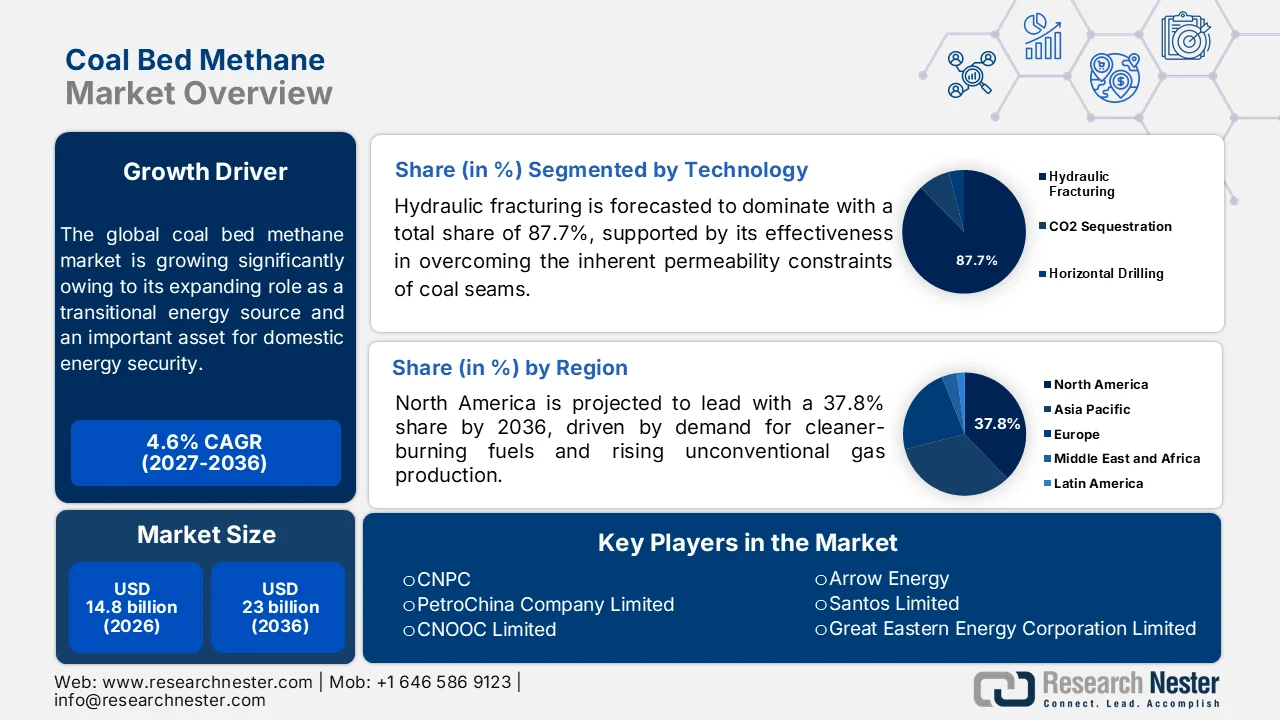
The global coal bed methane market is growing, propelled by its expanding role as a transitional energy source and an important asset for domestic energy security. As nations are focused on reducing carbon footprints without compromising grid stability, this resource is integrated into power generation, heavy industrial manufacturing, and residential city gas networks. As per the July 2024 National Institutes of Health (NIH) article, the study developed a 3D reservoir model and fuzzy evaluation method to identify CBM sweet spots in the Dahebian block, Guizhou, China. It also stated that coal seams 1, 7 and 11 showed very strong CBM potential, wherein seam 11 offered particularly favorable permeability and gas concentration. This south-central area, especially the combined 1+7+11 seam development zone, was identified as the reliable target for future CBM development.
Furthermore, technological advancements, such as multi-lateral drilling and enhanced gas recovery techniques, transform technically challenging reservoirs into most viable commercial assets. This technological progress, along with proactive government strategies to monetize domestic energy reserves, positions the market for steady geographic expansion. PPAC in February 2024 stated that India has almost 91.8 TCF of prognosticated CBM resources, of which 10.4 TCF are established, across 33 CBM blocks. The country has 32,760 sq. km of coal-bearing areas, wherein 21,177 sq. km have been awarded and exploration initiated across 10,670 sq. km. This article also outlined that CBM development has progressed across 39 awarded blocks, thus positively benefiting the market’s expansion.
Key Coal Bed Methane Market Insights Summary:
Regional Highlights:
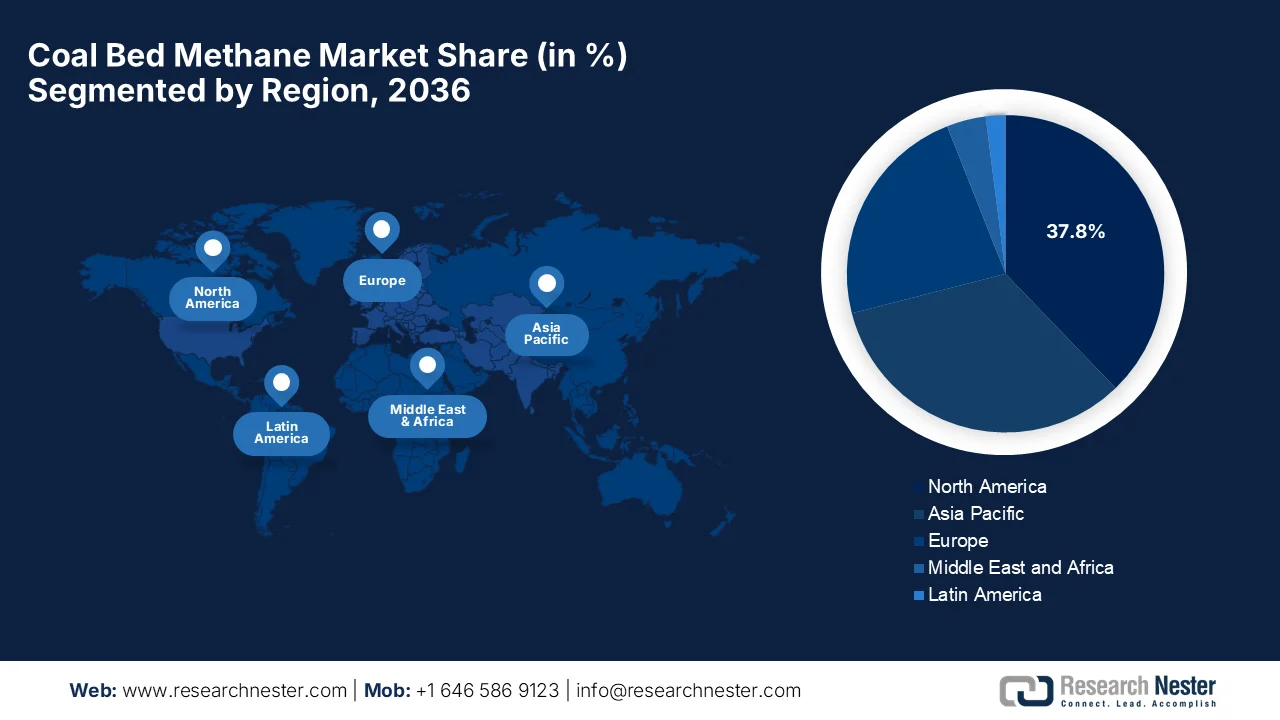
- North America is projected to maintain its leadership in the coal bed methane market with a 37.8% share through 2036, supported by the growing focus on cleaner-burning transitional fuels and technological advancements in drilling and hydraulic fracturing that improve recovery from deep coal seams
- Asia Pacific is poised to register the fastest growth during the forecast period, propelled by energy-mix diversification, supportive extraction policies, and expanding CBM infrastructure across resource-rich economies
Segment Insights:
- In the coal bed methane market, hydraulic fracturing is projected to command an 87.7% share of the technology segment through 2036, owing to its ability to overcome coal-seam permeability constraints and enhance methane flow toward production wells
- The industrial segment is anticipated to capture a considerable share by 2036, supported by rising methane use as a reliable fuel and feedstock across manufacturing, power generation, and chemical processing
Key Growth Trends:
- Rising demand for natural gas
- Industrial feedstock demand
Major Challenges:
- Water management and environmental degradation
- Highly Flammable and Hazardous to Climate
Key Players: China National Petroleum Corporation (CNPC), PetroChina Company Limited, CNOOC Limited, Arrow Energy, Santos Limited, Great Eastern Energy Corporation Limited, Essar Oil and Gas Exploration & Production Limited (EOGEPL), South West Pinnacle Exploration
Global Coal Bed Methane Market Forecast and Regional Outlook:
Market Size & Growth Projections:
- 2026 Market Size: USD 14.8 billion
- 2027 Market Size: USD 15.4 billion
- Projected Market Size: USD 23 billion by 2036
- Growth Forecasts: 4.6% CAGR (2027-2036)
Key Regional Dynamics:
- Largest Region: North America (37.8% Share by 2036)
- Fastest Growing Region: Asia Pacific
- Dominating Countries: United States, Canada, Australia, China, India
- Emerging Countries: India, China, Australia, Poland, Indonesia
Last updated on : 4 September, 2026
Coal Bed Methane Market - Growth Drivers and Challenges
Growth Drivers
- Rising demand for natural gas: The rising global energy consumption is increasing demand for reliable natural gas supplies in power generation, industrial, residential, and commercial applications. Coal bed methane provides an unconventional domestic source of natural gas, which helps countries to diversify their energy mix and meet rising gas requirements. In 2025, the International Energy Agency stated that global natural gas demand rose 2.7% (115 bcm) in 2024, which is a record high, with emerging markets and developing economies contributing more than three-quarters of the increase. It also mentioned that the power and industrial sectors drove around 75% of additional consumption, whereas extreme heat contributed one-fifth of worldwide demand growth, thus positively benefiting the market.
- Industrial feedstock demand: Heavy industries, i.e., chemical and fertilizer manufacturing, depend on this gas as a vital raw material. In addition, expanding city gas distribution networks utilize it for residential heating and cooking. This broad industrial integration provides producers with a stable, long-term demand pipeline in developing economies, driving growth in the market. In March 2026, the Press Information Bureau stated that the country’s government placed fertilizer plants under priority sector-2 for natural gas supply, which ensures at least 70% of their average six-month gas consumption. This move is aimed at protecting domestic fertilizer production from LNG supply disruptions, which are linked to geopolitical tensions, and ensuring timely availability for farmers.
Challenges
- Water management and environmental degradation: Extracting methane needs the continuous pumping of massive groundwater volumes to depressurize coal beds. This produced water is highly saline and contaminated with heavy metals, naturally occurring chemicals, as well as radionuclides. Therefore, disposing of this toxic wastewater disturbs freshwater ecosystems, pollutes localized soil, and presents huge infrastructure treatment costs. Apart from this, large-scale dewatering depresses local aquifers, depleting groundwater vital for regional agriculture and community drinking water supplies. On a global climate scale, CBM extraction risks leaking fugitive methane, thus causing restrictions to widespread adoption in the coal bed methane market.
- High capital intensity and weak economic viability: This is yet another major burden for the market as it requires immense upfront capital investments for specialized drilling technology, exploration, and extensive wastewater management networks. CBM wells experience a unique production curve which is characterized by high initial costs paired with lower early gas outputs, resulting in long payback timelines. This heavy capital strain blocks profit margins and deters private investment, a dynamic intensified when global natural gas prices remain low or volatile. High operational costs make CBM projects less competitive when compared to conventional gas or rapidly scaling renewables, thus causing obstacles to the market’s expansion.
Coal Bed Methane Market Size and Forecast:
| Report Attribute | Details |
|---|---|
|
Base Year |
2026 |
|
Forecast Period |
2027-2036 |
|
CAGR |
4.6% |
|
Base Year Market Size (2026) |
USD 14.8 billion |
|
Forecast Year Market Size (2036) |
USD 23 billion |
|
Regional Scope |
|
Coal Bed Methane Market Segmentation:
Technology Segment Analysis
Hydraulic fracturing is forecasted to dominate with a total share of 87.7% in the technology segment during the assessed time period. The sub-segment’s leading position in the coal bed methane market is supported by its effectiveness in overcoming the inherent permeability constraints of coal seams and improving the movement of methane toward production wells. By stimulating the reservoir and establishing additional flow channels, this hydraulic fracturing can enhance well productivity and also support higher recovery from CBM formations. In this context, NIH in January 2024 stated that hydraulic fracturing alters coal’s molecular structure by removing some aliphatic chains and oxygen-containing groups, and it increases the relative aromatic carbon content. It also mentions that these structural changes may influence CBM adsorption, diffusion, and migration, thereby affecting methane recovery.
End user Segment Analysis
On the basis of end user, industrial is anticipated to capture a considerable share in the market by the end of 2036. The growing use of methane as a reliable fuel and feedstock across manufacturing, power generation, chemical processing, and other energy-intensive industries is positioning the segment at the forefront of growth in this sector. The increasing emphasis on substituting higher-emission fuels with natural gas is also supporting demand, whereas the expansion of CBM production and pipeline infrastructure is improving access to gas supplies for industrial consumers. Furthermore, the need for cost-efficient and dependable energy sources among industrial operators is encouraging strong adoption of CBM, thus denoting a wider segment scope.
Fracturing Fluids Segment Analysis
The water requirement, which is a part of the fracturing fluids segment, is expected to hold a notable share in the market from 2027 to 2036. Its growth in this sector is effectively propelled by extensive use of water-based fracturing systems, which offer operational simplicity, cost advantages, and compatibility with large-scale stimulation programs. In addition, advances in water management, recycling, and treatment technologies are also helping operators to address fluid-handling challenges and improve the overall efficiency of CBM well stimulation. Apart from this, the availability of well-established water sourcing and handling infrastructure in major CBM-producing regions supports the continued deployment of water-intensive stimulation activities.
Our in-depth analysis of the coal bed methane includes the following segments:
|
Segment |
Subsegments |
|
Technology |
|
|
End user |
|
|
Fracturing Fluids |
|

Vishnu Nair
Head - Global Business DevelopmentCustomize this report to your requirements — connect with our consultant for personalized insights and options.
Coal Bed Methane Market - Regional Analysis
North America Market Insights
North America coal bed methane market is anticipated to lead with a total share of 37.8% during the forecast period. The region’s dominance in this sector is largely attributable to the push for cleaner-burning transitional fossil fuels and the extraction of unconventional natural gas resources. North America benefits from technological advancements in drilling techniques, such as horizontal drilling and advanced hydraulic fracturing, which continue to enhance recovery rates from deep coal seams. In this context, USGS in August 2023 revealed that the Cherokee coal bed in south-central Wyoming is a thick, laterally continuous coal resource associated with coalbed methane wells and suitable for surface and underground mining. It estimates the in-place coal resource at 15.261 ± 0.464 billion short tons, with a 90% probability, thus making it suitable for standard market growth.
The continued availability of coal-seam resources and a well-established pipeline network is driving growth of the U.S. coal bed methane market. The federal and state environmental policies aimed at reducing venting and flaring incentivize operators to capture coal bed methane before mining, effectively transforming a safety hazard and greenhouse gas into an energy resource. In this context, the U.S. Energy Information Administration stated that U.S. natural gas exports remained strong during the period December 2025 to May 2026. Besides, Mexico was the largest pipeline destination, while LNG was exported to numerous international markets, demonstrating a huge potential for coal bed methane.
U.S. Natural Gas Exports Surge in 2026: Monthly LNG and Pipeline Export Data Analysis Dec 2025-May 2026
|
Month |
Total Exports (MMcf) |
Pipeline Exports (MMcf) |
LNG Exports (MMcf) |
|
December-25 |
880,710 |
311,443 |
569,267 |
|
January-26 |
833,493 |
294,289 |
539,203 |
|
February-26 |
783,700 |
290,083 |
493,617 |
|
March-26 |
890,275 |
317,185 |
573,089 |
|
April-26 |
807,548 |
269,612 |
537,936 |
|
May-26 |
816,601 |
313,788 |
502,812 |
Source: EIA
The Canada coal bed methane market is projected for solid growth, which is propelled by the country's extensive natural gas infrastructure that integrates coal bed methane into provincial grids for residential heating, power generation, and industrial fueling. At the same time, advanced horizontal drilling and multi-stage fracturing technologies, which are suitable for low-permeability coal seams, continue to enhance resource recovery. The aspect of strict provincial environmental regulations targeting greenhouse gas reductions drives the market forward by encouraging operators to capture methane from underground coal deposits before and during mining operations to lower the energy sector's carbon footprint. Hence, the presence of all of these factors positions the market for extensive growth in the upcoming years.
APAC Market Insights
The Asia Pacific market is expected to expand at the fastest rate, which is propelled by major manufacturing economies diversifying their energy mixes and securing cleaner-burning alternatives to traditional coal. In addition, development is highly structured in resource-rich nations such as China, Australia, and India, where governments actively support unconventional gas extraction with the amendment of favorable extraction policies, price deregulation, and infrastructure subsidies. In August 2024, Arrow Energy stated that its Surat Gas Project North (SGP North) in Queensland’s Surat Basin is planned to add 130 terajoules of gas per day. This expansion includes up to 450 production wells, a 121 TJ/d compression station, and 27 km of pipeline, supporting long-term gas supply.
The China coal bed methane market is growing exponentially as the country aims to bolster domestic energy security and transition toward lower-carbon fuel sources. Main production activities are supported by dedicated pipeline networks that connect extraction fields directly to major industrial and urban economic zones. Based on the government data published in August 2026, China plans to establish a modern coal industry by 2030, with a high focus on efficient, intelligent, and cleaner coal production while maintaining energy security. This plan targets 26 billion m³ of coalbed methane production and 6.5 billion m³ of coal mine gas utilization by 2030, thus denoting an optimistic market opportunity.
The continued government support and efforts to reduce its dependence on energy imports are propelling the market in India. The country’s government drives market development through supportive policy frameworks which offer marketing and pricing freedom alongside single-license exploration rights. In December 2025, the Press Information Bureau stated that India is expanding the National Gas Grid, LNG infrastructure, and domestic gas production to improve natural gas availability for power generation. It has also introduced measures supporting coal bed methane development, including the policy framework for early CBM monetization and greater marketing and pricing flexibility.
Europe Market Insights
The Europe market is predicted to grow at a notable pace with an extensive focus on energy transition, domestic supply security, and emission reduction goals. Market activity in this region is primarily driven by the existence of stringent climate policies and safety regulations that impose certain mandates on the mitigation of coal mine methane emissions, thereby transforming hazardous underground gases into useful heat and power. Apart from this, to optimize extraction from deep and geologically complex coal seams, operators are using advanced techniques such as guided horizontal drilling and targeted pre-drainage systems. This commercialization of coal bed methane serves a dual purpose, supporting regional decarbonization targets and also providing a localized, lower-emission alternative to imported fossil fuels.
The stringent regulatory compliance frameworks that mandate rigorous tracking, reporting, and mitigation of greenhouse gas leaks from both active and closed coal mines are an important factor driving the growth of Germany coal bed methane market. Therefore, to overcome complex geological structures and enhance recovery from unmined deep coal seams, operators in this country deploy advanced technologies, i.e., hydraulic fracturing, digital twin reservoir modeling, and automated monitoring systems. In April 2024, EMBER stated that Germany reported only 1.39 thousand tons of coal mine methane emissions in 2022, despite producing 44% of the EU’s lignite. Therefore, the report recommends direct methane measurement, improved MRV methods, and implementing mitigation measures at active and closed mines.
The UK market is growing on account of the country’s well-established coalfield infrastructure and regulatory framework, which allows operators to obtain access agreements for methane extraction from unworked coal seams and abandoned mine workings. In addition, the rising attention to methane abatement and the management of legacy mining sites is also creating encouraging growth opportunities for methane recovery and utilization. Based on the government data published in October 2025, the UK’s methane emissions declined by 62% from 1990 to 2023, with agriculture, waste, and fuel supply together accounting for 87% of territorial methane emissions. This supports the global methane pledge goal of a 30% global reduction by 2030, thus indicating a positive market outlook.
Key Coal Bed Methane Market Players:
- China National Petroleum Corporation (CNPC) (China)
- PetroChina Company Limited (China)
- CNOOC Limited (China)
- Arrow Energy (Australia)
- Santos Limited (Australia)
- Great Eastern Energy Corporation Limited (India)
- Essar Oil and Gas Exploration & Production Limited (EOGEPL)(India)
- South West Pinnacle Exploration (India)
- Company Overview
- Business Strategy
- Key Product Offerings
- Financial Performance
- Key Performance Indicators
- Risk Analysis
- Recent Development
- Regional Presence
- SWOT Analysis
- China National Petroleum Corporation is a major global CBM producer. In 2024, CNPC reported 6.03 billion cubic meters of CBM production, which also includes 2.3 billion cubic meters of deep CBM. The company develops conventional and deep CBM resources in China basins.
- CNOOC Limited is expanding its presence in China's deep CBM sector, and it maintains a strong position in the global landscape. The firm’s activities include deep-CBM exploration, reservoir evaluation and production technology development.
- Arrow Energy is a major coal seam gas producer which is operating in Queensland's Surat and Bowen basins. Its Surat Gas Project is planned to include around 2,500 wells and supply up to 700 TJ/day of gas when fully developed.
- Santos Limited is yet another prominent player which operates substantial CSG resources in Queensland. Its project uses gas from the Bowen and Surat basins to produce LNG, thereby integrating upstream CSG production with LNG infrastructure.
- Origin Energy operates CSG production assets in Queensland as upstream operator of Australia Pacific LNG. In addition, the company’s Surat and Bowen basin operations supply gas for LNG production and contribute significantly to Australia's east-coast domestic gas supply.
Here is a list of key players operating in the global market:
Competition in the global coal bed methane market is being led by large energy companies and specialized gas producers which are operating across major CBM basins in China, Australia, Canada, India, and other resource-rich regions. Competitive positioning in this sector depends on recoverable CBM reserves, reservoir-management capabilities, production infrastructure, and access to domestic gas and LNG markets. China emerged as a particularly important production center, whereas Australia has a mature coal seam gas industry supplying both domestic customers and LNG projects. In this context, CNOOC in October 2023 discovered the Shenfu deep CBM field in China’s Shaanxi Province, in which the proved gas in-place exceeds 110 billion cubic meters. The discovery well, drilled to around 2,011 meters, produced 19,000 cubic meters of gas per day after fracturing.
Corporate Landscape of the Market:
Recent Developments
- In July 2026, South West Pinnacle Exploration received a USD 17.4 million contract extension from Reliance Industries for CBM production drilling in Madhya Pradesh. The order takes SWPEL’s order book and is expected to support revenue visibility for the next two to three years.
- In January 2026, EOGEPL plans to invest USD 100 million in a new drilling programme at its Raniganj East CBM block in West Bengal. The company aims to raise natural gas production from around 1 MMSCMD to 5 MMSCMD by 2028 through new wells and improved recovery techniques.
- Report ID: 4966
- Published Date: Sep 04, 2026
- Report Format: PDF, PPT
- Explore a preview of key market trends and insights
- Review sample data tables and segment breakdowns
- Experience the quality of our visual data representations
- Evaluate our report structure and research methodology
- Get a glimpse of competitive landscape analysis
- Understand how regional forecasts are presented
- Assess the depth of company profiling and benchmarking
- Preview how actionable insights can support your strategy
Explore real data and analysis
Frequently Asked Questions (FAQ)
About this Report
Connect with our Expert


Report, 2027-2036



Copyright @ 2026 Research Nester. All Rights Reserved.
