Cellulose Acetate Market Outlook:
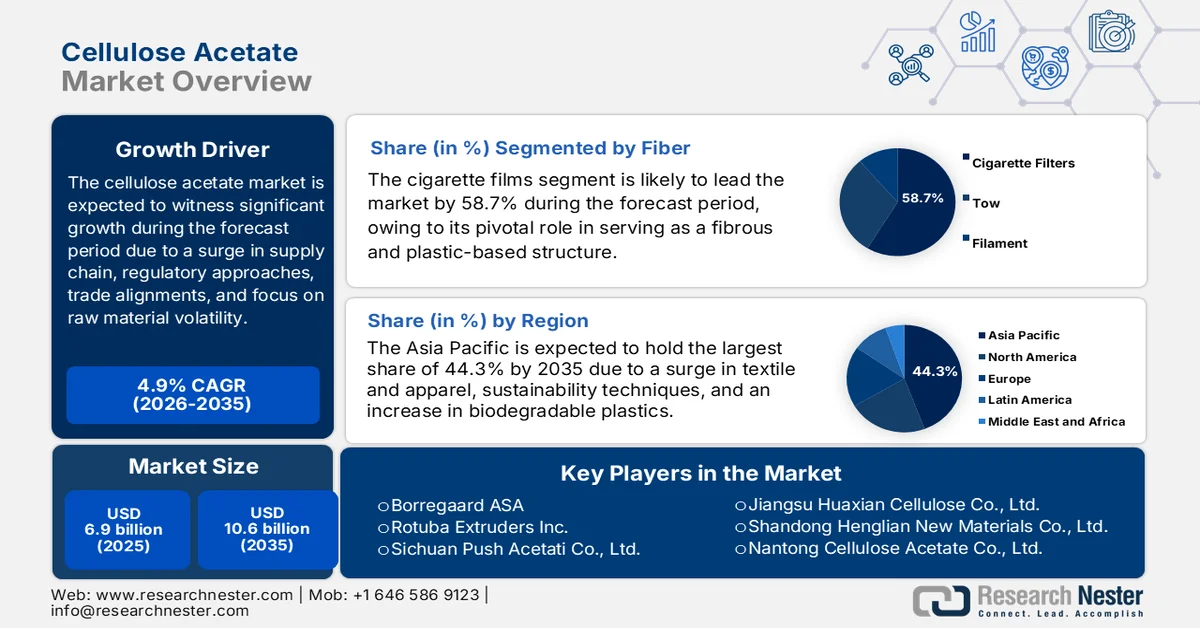
Cellulose Acetate Market size was over USD 6.9 billion in 2025 and is expected to reach USD 10.6 billion by the end of 2035, growing at a CAGR of 4.9% during the forecast timeline, i.e., 2026-2035. In 2026, the cellulose acetate industry is estimated at USD 7.2 billion.
The worldwide cellulose acetate market is significantly shaped by a complex interplay of macroeconomic factors, including supply chain dynamics and regulatory transitions. The market is also increasingly influenced by global raw material volatility and trade realignments. According to official statistics published by the IEA Organization in 2026, direct carbon dioxide emissions from primary chemical production have remained relatively constant at nearly 935 million tons as of 2022 due to stagnation in production. This is effectively in tandem with a relatively stable primary chemicals carbon dioxide intensity in recent years, at almost 1.3 tCO2 per ton of primary chemicals. Besides, in the Net Zero emissions by 2050 approach, carbon dioxide emissions commenced to decouple from production in the upcoming years, successfully reaching 18% of carbon dioxide emission reduction in comparison to 2022 by the end of 2030, thereby making it suitable for uplifting the cellulose acetate market globally.
Furthermore, the personal care industry integration, 5G technology application, controlled-release pharmaceutical innovations, biologics manufacturing support, eyewear customization technologies, and an increase in organizational product prices are a few trends that are bolstering the cellulose acetate market globally. For instance, in May 2025, Celanese Corporation has increased prices for a range of products and desires to provide consumers with suitable notice and decision for planning purposes. This price increase is readily associated with heightened expenses of product movement and inventory repositioning, modified trade regulations, plant operational costs, and raw materials. Besides, there has been an increase in prices for different products, which has created an optimistic outlook for the market’s growth and expansion across different nations.
Increase in Prices for Individual Grades (2025)
|
Base Resin |
Brand Type |
Price Increase |
||
|
Asia (USD/kg) |
America (USD/kg) |
EMEA (USD/kg) |
||
|
LCP/PCT |
Vectra, Zenite, and Thermx |
0.25 |
0.25 |
0.22 |
|
PPS |
Fortron |
0.40 |
0.40 |
0.35 |
|
LCPA |
Zytel |
- |
0.65 |
0.57 |
|
HTN |
Selar Zytel HTN |
1.00 |
0.40 |
0.35 |
|
PA 6,66 |
Zytel, Frianyl, Celanyl and Minlon PA6 and PA66 compounded products |
0.10 |
0.15 |
0.09 |
|
TPV |
Santoprene |
0.20 |
0.20 |
0.18 |
|
TPV |
Santo prene halogenated FR products |
1.25 |
1.25 |
1.10 |
|
TPC |
Hytrel, Neolast, and Bexloy |
0.40 |
0.30 |
0.10 |
|
PP/PA/PBT |
Celstran |
- |
0.22 |
- |
|
POM |
Hostaform and Celcon |
0.10 |
0.10 |
- |
|
UHMW-PE |
GUR |
0.10 |
- |
- |
Source: Celanese Corporation
Key Cellulose Acetate Market Insights Summary:
Regional Highlights:
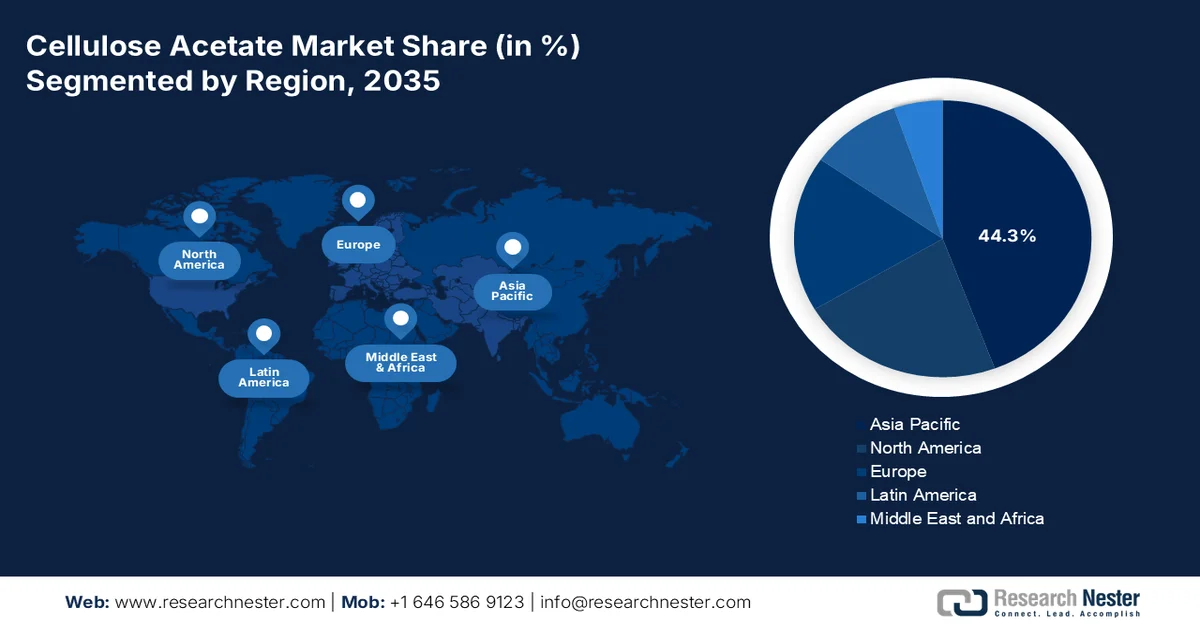
- Asia Pacific is projected to command a 44.3% share of the cellulose acetate market by 2035, propelled by expanding textile demand, sustainability initiatives, and growing adoption of biodegradable plastic alternatives.
- Europe is anticipated to register the fastest growth in the forecast period 2026–2035, stimulated by strict environmental regulations, ambitious circular economy targets, and increasing demand from packaging and consumer goods industries.
Segment Insights:
- The cigarette films sub-segment, under the fiber segment, is anticipated to capture a 58.7% share of the cellulose acetate market by 2035, driven by its extensive application in cigarette filters that trap tar, particulate matter, and other toxicants from smoke.
- The apparel sub-segment within the textiles and apparel segment is projected to secure the second-largest share during 2026–2035, fueled by increasing demand for lightweight, breathable, and sustainable fabrics.
Key Growth Trends:
- Emerging industry consumption
- Investment in sustainable manufacturing
Major Challenges:
- Regulatory pressure on cigarette filters
- Raw material supply chain volatility
Key Players: Celanese Corporation, Eastman Chemical Company, Daicel Corporation, Mitsubishi Chemical Corporation, Cerdia International GmbH, Borregaard ASA, Rotuba Extruders Inc., Sichuan Push Acetati Co., Ltd., Rayonier Advanced Materials (RYAM), Solvay SA, China National Tobacco Corporation (CNTC), Jiangsu Huaxian Cellulose Co., Ltd., Shandong Henglian New Materials Co., Ltd., Nantong Cellulose Acetate Co., Ltd., Vistech Materials, Acetati S.p.A., Samyang Corporation, Reliance Industries Limited, Petronas Chemicals Group Berhad, Australian Cellulose Acetate Pty Ltd.
Global Cellulose Acetate Market Forecast and Regional Outlook:
Market Size & Growth Projections:
- 2025 Market Size: USD 6.9 billion
- 2026 Market Size: USD 7.2 billion
- Projected Market Size: USD 10.6 billion by 2035
- Growth Forecasts: 4.9%CAGR (2026-2035)
Key Regional Dynamics:
- Largest Region: Asia Pacific (44.3% Share by 2035)
- Fastest Growing Region: Europe
- Dominating Countries: United States, China, Japan, Germany, South Korea
- Emerging Countries: India, Brazil, Mexico, Indonesia, Vietnam
Last updated on : 5 March, 2026
Cellulose Acetate Market - Growth Drivers and Challenges
Growth Drivers
- Emerging industry consumption: The sustained cigarette consumption across emerging economies in Africa, the Middle East, and the Asia Pacific is positively impacting the cellulose acetate market demand globally. According to official statistics published by the World Health Organization (WHO) in June 2025, tobacco consumption kills over 7 million people every year, including an approximate 1.6 million non-smokers readily exposed to second-hand smoke. In addition, almost 80% of the world’s 1.3 billion tobacco users reside across low- and middle-income nations. Besides, to address the tobacco epidemic, WHO member states have significantly adopted the WHO Framework Convention on Tobacco Control (WHO FCTC), constituting 183 nations as parties associated with this treaty, thus driving the market's growth.
- Investment in sustainable manufacturing: The aspect of an increase in investments in sustainable manufacturing processes as well as bio-based material development, is also bolstering the cellulose acetate market worldwide. Based on government estimates published by the PIB Government in February 2026, the 2026-2027 Union Budget declared a scheme for supporting states by establishing 3 suitable chemical parks through a challenge-specific route. Regarding this, USD 65.5 million has been generously allocated for supporting the establishment of these chemical parks. In addition, USD 2.4 billion has also been declared to support the deployment and development of carbon capture, utilization and storage, thereby making it suitable for boosting the market growth.
- Expansion in eco-friendly packaging: The increased demand for sustainable packaging films, coatings, labels, and wraps requires durability, grease resistance, and transparency, along with composability benefits, which is also fueling the cellulose acetate market expansion. As stated in an article published by Packnode Organization in October 2025, the worldwide eco-friendly packaging industry is projected to experience significant growth in the upcoming years, with its size expected to reach USD 498.2 billion by the end of 2034, growing at a 7.6% growth. This upsurge is primarily fueled by an increase in consumer awareness regarding government regulations and sustainability, which has banned single-use plastics, and an increase in prioritizing environmental sustainability, thus driving the cellulose acetate market evolution.
Challenges
- Regulatory pressure on cigarette filters: The largest application of the cellulose acetate market is in cigarette filters, accounting for more than half of global demand. However, increasing government regulations on tobacco consumption and environmental concerns about filter waste pose a significant challenge. Europe’s Tobacco Products Directive (TPD) and similar frameworks in North America are pushing for stricter controls on cigarette production and disposal. Since cellulose acetate filters are non-biodegradable under natural conditions, they contribute to plastic pollution, leading to bans or restrictions in several regions. This regulatory environment threatens the stability of the largest revenue-generating segment, thus negatively impacting the market growth.
- Raw material supply chain volatility: The production aspect in the cellulose acetate market relies on wood pulp and acetic acid, both of which are subject to supply chain disruptions. Global pulp supply is concentrated in regions such as North America, Scandinavia, and the Asia Pacific, making the industry vulnerable to geopolitical tensions, trade restrictions, and environmental regulations on forestry. Rising demand for sustainable pulp in packaging and bio-based materials further intensifies competition. Additionally, fluctuations in acetic acid prices, driven by petrochemical market volatility, directly impact production costs. For instance, spikes in crude oil prices increase acetic acid costs, squeezing margins for cellulose acetate producers, and in return causing a hindrance in the cellulose acetate market development.
Cellulose Acetate Market Size and Forecast:
| Report Attribute | Details |
|---|---|
|
Base Year |
2025 |
|
Forecast Year |
2026-2035 |
|
CAGR |
4.9% |
|
Base Year Market Size (2025) |
USD 6.9 billion |
|
Forecast Year Market Size (2035) |
USD 10.6 billion |
|
Regional Scope |
|
Cellulose Acetate Market Segmentation:
Fiber Segment Analysis
The cigarette films sub-segment, which is part of the fiber segment, is anticipated to garner the largest share of 58.7% in the cellulose acetate market by the end of 2035. The sub-segment’s upliftment is highly driven by its role in serving as a plastic-based and fibrous structure that acts as a physical barrier to trap tar, particulate matter, and other toxicants from smoke. According to official statistics published by the Tobacco Tactics Organization in April 2025, over 90% of cigarettes that are readily sold globally contain a filter. Additionally, these filters are usually made of a plastic known as cellulose acetate, that are not biodegradable. Besides, the industrial size of capsule-based cigarettes was greatest in Chile, accounting for 36%, which is followed by 34% in Peru, 32% in Guatemala, 22% in Mexico, and 17% in Argentina. Therefore, based on this growth, the segment is gaining increased exposure in the overall cellulose acetate market.
Textiles and Apparel Segment Analysis
Based on the textiles and apparel segment, the apparel sub-segment in the cellulose acetate market is projected to hold the second-largest share during the forecast period. The sub-segment’s growth is highly driven by the rising demand for lightweight, breathable, and sustainable fabrics. Cellulose acetate fibers are valued for their silk-like appearance, softness, and ability to blend with other fibers, making them popular in high-end fashion and industrial textiles. Increasing consumer preference for eco-friendly clothing is a major driver, as cellulose acetate offers a lower environmental footprint compared to synthetic fibers like polyester. Regulatory frameworks in Europe and North America promoting sustainable textiles further support this growth. For instance, the OECD’s sustainable materials guidelines highlight cellulose-based fibers as viable alternatives to petroleum-derived textiles.
Plastics Segment Analysis
By the end of the stipulated timeline, the films sub-segment, part of the plastics segment, is expected to hold the third-largest share in the cellulose acetate market. The sub-segment’s development is highly propelled by its importance in packaging, electronics, and specialty applications. Besides, cellulose acetate films are prized for their transparency, toughness, and biodegradability, making them suitable for eco-friendly packaging solutions. With global regulations restricting single-use plastics, cellulose acetate films are emerging as a sustainable alternative in food packaging, tapes, and labels. In electronics, cellulose acetate films are used in LCDs and specialty coatings, benefiting from growth in consumer electronics across the Asia Pacific. The DOE’s funding for advanced manufacturing technologies under the Inflation Reduction Act also supports innovation in bio-based films, enhancing their competitiveness against synthetic polymers.
Our in-depth analysis of the cellulose acetate market includes the following segments:
|
Segment |
Subsegments |
|
Fiber |
|
|
Textiles and Apparel |
|
|
Plastics |
|
|
Photographic Films |
|
|
Tapes and Labels |
|
|
Eyewear Frames |
|

Vishnu Nair
Head - Global Business DevelopmentCustomize this report to your requirements — connect with our consultant for personalized insights and options.
Cellulose Acetate Market - Regional Analysis
APAC Market Insights
The Asia Pacific in the cellulose acetate market is anticipated to garner the highest share of 44.3% by the end of 2035. The market’s upliftment in the region is highly fueled by an increase in textile demand, sustainability approaches, focus on biodegradable plastics as alternative options, and manufacturing expansions. According to official statistics published by the Plastics Engineering Organization in December 2024, the region deliberately raised its share from 20.0% to 21.25, which is effectively fueled by government support and industrialization. Besides, as per the October 2025 Osaka Blue Ocean Vision article, the irrational utilization of disposable plastic products has been reduced, and the application scale of recyclable express packaging has successfully reached 10 million, thereby making it suitable for bolstering the market’s growth in the overall country.
The cellulose acetate market in China is growing significantly, owing to the largest production capacity, sustainable chemical technologies, and an expansion in production. As stated in an article published by NLM in March 2024, there has been an increase in the number of chemicals registered to 204 million yearly in the country as of June 2023, and it has been growing at a rate of more than 10 million annually presently. Besides, controlled materials, particularly persistent organic pollutants (POPs) has been consistently expanding under the purview of the Convention. In addition, this particular chemical category has significantly reached 34 classes, encompassing a transition from chlorinated POPs to include fluoride and bromine POPs. Besides, innovations in analytical techniques have successfully enabled the discovery of different new pollutants and enhanced the depth of knowledge, thus proliferating the market growth in the overall country.
The growth in the textile industry, generous funding allocation to sustainable chemical technologies, government investment, and business incorporated sustainable chemical processes are certain trends that are fueling the cellulose acetate market in India. As per an article published by the IBEF Organization in November 2025, the textile industry in the country significantly employs over 45 million people, which underlines its role as one of the nation’s largest livelihood generation. Besides, the domestic textile and apparel industry reached USD 225 billion by the end of 2025, increasing at 10% to 12% yearly. Moreover, the industry is expected to account for a 10% growth and successfully reach USD 2.3 billion by the end of 2030. In addition, the country ranks among the top 5 international exporters of several textile categories, with exports projected to reach USD 100 billion, thus boosting the market exposure.
Textile and Apparel Exports from India (2018-2030)
|
Year |
Exports Growth (USD) |
|
2018 |
37 billion |
|
2019 |
36 billion |
|
2020 |
34 billion |
|
2021 |
30 billion |
|
2022 |
44 billion |
|
2023 |
37 billion |
|
2024 |
36 billion |
|
2025 |
37 billion |
|
2026 |
9 billion |
|
2030 |
100 billion |
Source: IBEF Organization
Europe Market Insights
Europe in the cellulose acetate market is expected to emerge as the fastest-growing region during the forecast period. The market’s development in the region is highly propelled by the presence of strict environmental regulations, regional ambitious circular economy objectives, as well as a surge in the need for packaging and consumer goods industries. According to official statistics published by the Europe Commission in March 2025, the highest yearly inflation rates among regional member states accounted for 5.8% in Romania, 4.3% in Belgium, and 4.0% in Croatia. Besides, the highest price increase in the overall region has been recorded for tobacco and alcoholic beverages, accounting for 5.6%, which is highly driven by a rise in 10.6% of tobacco products, 8.0% of tobacco, and 7.6% of cigarettes, thereby making it suitable for uplifting the market.
Yearly Average Inflation Rates Development in Europe (2015-2024)
|
Year |
Inflation Rate |
|
2015 |
0.1% |
|
2016 |
0.2% |
|
2017 |
1.7% |
|
2018 |
1.9% |
|
2019 |
1.5% |
|
2020 |
0.7% |
|
2021 |
2.9% |
|
2022 |
9.2% |
|
2023 |
6.4% |
|
2024 |
2.6% |
Source: Europe Commission
The cellulose acetate market in the UK is gaining increased traction, owing to generous budget allocation, the government’s priority on sustainable chemical development through research and funding programs, the existence of a biodegradability profile, and the pharmaceutical industry's administrative initiatives. As stated by the August 2023 UK Parliament data report, the chemicals industry in the country significantly contributes more than USD 40 billion to the economy. Besides, the industry offers highly productive, well-paid employment opportunities, which are targeted for growth across Scotland, Humber Bank, the North East, the North West, and South Wales, with nearly 15% of the overall domestic business research and development spending. Moreover, 45% of England’s chemical sector waste is being readily sent for recovery, which is also positively impacting the market development.
The presence of robust environmental policies, advanced manufacturing capabilities, an increase in research and development, and sustainable chemistry gaining generous budget allocation are responsible for boosting the cellulose acetate market in Germany. As per an article published by Statistisches Bundesamt (Destatis) in February 2026, the overall manufacturing industry’s worth amounts to USD 25.4 billion, along with 7.5 million employed people, with 20.8% staff spending. Based on this growth, the real stock of orders in the industry has been boosted by 1.2% in December 2025, in comparison to November 2025. Besides, the Federal Statistical Office noted that there has been an increase by 7.0% in December 2024. Therefore, with this continuous upgradation in the overall sector, the market in the country is gaining increased importance gradually.
North America Market Insights
North America in the cellulose acetate market is projected to witness considerable growth by the end of the stipulated timeline. The market’s growth in the region is highly fueled by sustainable packaging films, textiles, and cigarette filters, along with the U.S. government’s emphasis on advanced manufacturing and green chemistry. According to official statistics published by the America Lung Association in February 2026, the 5 largest cigarette manufacturers in the region spent an overall USD 8.0 billion, which is close to USD 22 million per day for promoting and advertising their products. As per an article published by the EPA in May 2025, the enacted budget, which amounted to USD 9,559,485,000 as of 2022, has escalated the implementation of sustainable chemical processes. Therefore, based on these developments, the market is gradually expanding in the overall region.
EPA Budget and Expenditure on Chemical Processes in North America (2023-2025)
|
Year |
Budget for Chemical Processes |
|
2023 |
USD 10,135,433,000 |
|
2024 |
USD 9,158,894,000 |
|
2025 |
USD 9,135,171,000 |
Source: EPA
The cellulose acetate market in the U.S. is gaining increased exposure, owing to an increase in the demand for the apparel sector, dominant textile, robust sustainability and regulatory mandates, investment in domestic circular manufacturing, as well as sustained demand in the cigarette filter production. As stated in an article published by NLM in March 2025, there has been a decrease in the number of adults smoking cigarettes in 2023 by an estimated 6.8-million. In addition, this has been offset by a roughly 7.2 million increase in the number of people readily utilizing e-cigarettes. Moreover, the cigarette smoking aspect among adults in the country declined from 42.4% to 11.6% as of 2022; however, the utilization of cellulose acetate is significantly growing, which is positively impacting the market’s growth and expansion in the overall country.
The aspects of trade flows, import-dependent industry, end use applications, and an increased focus on biodegradable and sustainable materials are certain factors that are bolstering the cellulose acetate market in Canada. For instance, as stated in an article published by the Government of Canada in October 2025, the Canada Plastics Innovation Challenges (CPIC) has significantly committed USD 26.8 million across 18 risks to support small and medium domestic businesses. This particular project has aimed to diminish plastic waste and provide the population with increased options to select sustainable systems and products that support a healthier and cleaner environment. Besides, there has been the provision of USD 150,000 for developing a proof of concept, and additionally up to USD 1 million to create a prototype, thus proliferating the market growth in the overall country.
Key Cellulose Acetate Market Players:
- Celanese Corporation (U.S.)
- Eastman Chemical Company (U.S.)
- Daicel Corporation (Japan)
- Mitsubishi Chemical Corporation (Japan)
- Cerdia International GmbH (Germany)
- Borregaard ASA (Norway)
- Rotuba Extruders Inc. (U.S.)
- Sichuan Push Acetati Co., Ltd. (China)
- Rayonier Advanced Materials (RYAM) (U.S.)
- Solvay SA (Belgium)
- China National Tobacco Corporation (CNTC) (China)
- Jiangsu Huaxian Cellulose Co., Ltd. (China)
- Shandong Henglian New Materials Co., Ltd. (China)
- Nantong Cellulose Acetate Co., Ltd. (China)
- Vistech Materials (UK)
- Acetati S.p.A. (Italy)
- Samyang Corporation (South Korea)
- Reliance Industries Limited (India)
- Petronas Chemicals Group Berhad (Malaysia)
- Australian Cellulose Acetate Pty Ltd. (Australia)
- Company Overview
- Business Strategy
- Key Product Offerings
- Financial Performance
- Key Performance Indicators
- Risk Analysis
- Recent Development
- Regional Presence
- Celanese Corporation is one of the world’s largest producers of acetyl products, including cellulose acetate, with strong integration across North America, Europe, and Asia. The company has invested heavily in R&D and expanded its Michigan Technology Center to accelerate innovation in engineered materials.
- Eastman Chemical Company is a pioneer in cellulose acetate production, with a legacy of supplying cigarette filters and textile fibers globally. The company emphasizes sustainable innovation, focusing on biodegradable plastics and eco-friendly packaging solutions.
- Daicel Corporation has a long history in cellulose acetate, dating back to Japan’s early celluloid production. The company continues to lead in cigarette filter tow production, serving the Asia Pacific’s dominant tobacco industry. Daicel is also investing in bio-based alternatives and sustainable innovation to adapt to regulatory pressures.
- Mitsubishi Chemical Corporation is a diversified chemical leader, with cellulose acetate integrated into its advanced materials portfolio. The company leverages its global footprint to serve the textile, packaging, and electronics industries. Strategic initiatives include expanding sustainable cellulose acetate films and strengthening R&D in eco-friendly applications.
- Cerdia International GmbH specializes in cellulose acetate tow, primarily for cigarette filters, and is recognized for its sustainability-driven production. The company sources raw materials from sustainably managed forests, aligning with Europe-based environmental mandates.
Here is a list of key players operating in the global cellulose acetate market:
The international cellulose acetate market is moderately consolidated, with leading players such as Celanese, Eastman, Daicel, and Mitsubishi Chemical dominating through scale, innovation, and global distribution networks. Strategic initiatives include sustainability-driven R&D, expansion into biodegradable packaging films, and partnerships with textile and electronics manufacturers. Moreover, Asia-based producers, particularly in China, are expanding aggressively to capture cigarette filter demand, while Europe-specific firms emphasize eco-friendly applications aligned with regulatory mandates. Besides, in September 2025, ATP Adhesives declared the introduction of ATP North America by establishing a dedicated business to serve Canada and U.S.-based manufacturers with solvent-free adhesives technologies and localized product development, thereby making it suitable for boosting the cellulose acetate industry globally.
Corporate Landscape of the Cellulose Acetate Market:
Recent Developments
- In February 2026, Siemens and CAPHENIA significantly partnered to upscale the production of sustainable aviation fuel, which is a synthetic kerosene that is made from renewable feedstocks for diminishing carbon dioxide emissions by almost 80%, in comparison to fossil kerosene.
- In August 2025, Eastman notified the formal tactical partnership with Huafon Chemical to establish a joint infrastructure for producing cellulose acetate yarn. This particular infrastructure is dedicated to localizing the production innovation and production of Eastman Naia cellulose acetate filament yarns in China.
- In May 2025, Celanese Corporation announced its objective to divest its Micromax portfolio products by advancing electronic inks and pastes that are designed for high-performance electronics, and generated more than USD 300 million in revenue as of 2025.
- Report ID: 8413
- Published Date: Mar 05, 2026
- Report Format: PDF, PPT
- Explore a preview of key market trends and insights
- Review sample data tables and segment breakdowns
- Experience the quality of our visual data representations
- Evaluate our report structure and research methodology
- Get a glimpse of competitive landscape analysis
- Understand how regional forecasts are presented
- Assess the depth of company profiling and benchmarking
- Preview how actionable insights can support your strategy
Explore real data and analysis
Frequently Asked Questions (FAQ)
About this Report
Connect with our Expert


Report, 2026-2035



Copyright @ 2026 Research Nester. All Rights Reserved.
