Carbon Credit Trading Platform Market Outlook:
Carbon Credit Trading Platform Market size was valued at USD 168.6 million in 2025 and is projected to reach USD 817.3 million by the end of 2035, registering around 17.1% CAGR during the forecast period, i.e., 2026-2035. In 2026, the industry size of carbon credit trading platform is evaluated at USD 197.4 million.
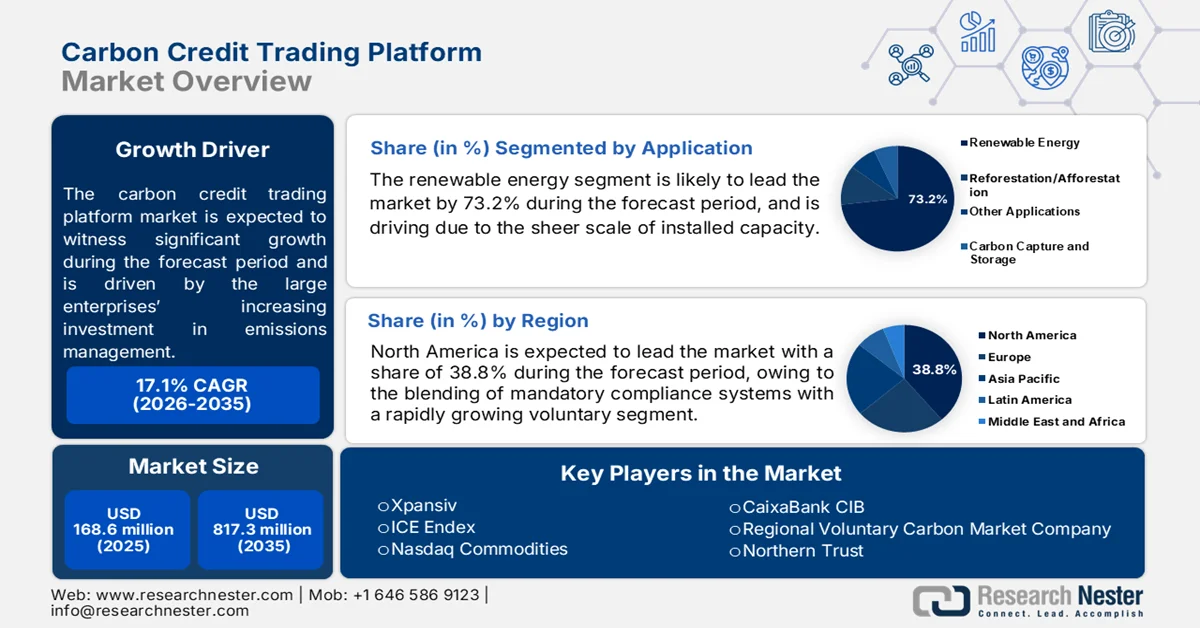
Carbon credit trading platforms market is driven by the steady expansion of regulated and voluntary carbon markets as governments and large enterprises increase investment in emissions management and compliance programs. According to the World Bank 2024 data, carbon pricing instruments generated more than USD 100 billion in revenue for the second consecutive year. These instruments covered approximately 24% of global greenhouse gas emissions, as per the EPA December 2025 data, creating a larger pool of compliance entities, financial institutions, project developers, and intermediaries that require digital trading, settlement, registry connectivity, and reporting capabilities.
The World Bank May 2024 data also reported that the value of carbon pricing revenues exceeded USD 104 billion, reflecting continued market activity across regulated programs. From a business perspective, platform demand is being supported by increasing participation from energy producers, manufacturing companies, transportation operators, and utilities that must manage allowance purchases, offset procurement, and emissions reporting obligations. Carbon market expansion across North America, Europe, China, and several emerging economies is increasing transaction volumes and creating requirements for secure trading infrastructure, audit trails, and cross-market data management. As governments continue to strengthen climate targets and reporting frameworks, organizations are seeking integrated systems that support compliance execution, portfolio management, and access to multiple carbon credit sources through a centralized trading environment.
Key Carbon Credit Trading Platform Market Insights Summary:
Regional Highlights:
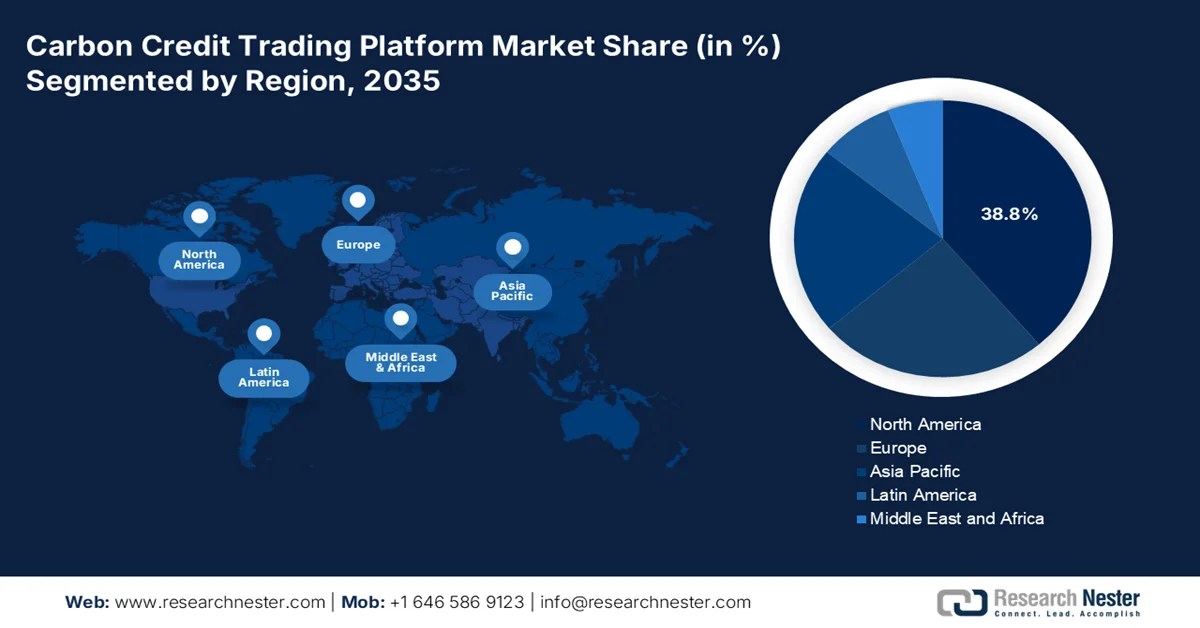
- North America is anticipated to command 38.8% of the carbon credit trading platform market by 2035, supported by its mature compliance ecosystem, advanced financial infrastructure, and expanding interoperability between U.S. and Canadian carbon registries
- Asia Pacific is projected to witness the fastest expansion in the market during 2026–2035, fueled by diverse national carbon trading frameworks, growing blockchain adoption, and increasing cross-border credit transactions
Segment Insights:
- The renewable energy application segment is projected to account for 73.2% of the carbon credit trading platform market by 2035, underpinned by the expanding installed renewable energy capacity and increasing issuance of tradable carbon credits
- The energy & utilities end-user segment is expected to maintain its leading position throughout 2026–2035, propelled by utilities' growing adoption of platform-based carbon portfolio management and algorithmic emissions trading
Key Growth Trends:
- Increasing government support for carbon removal
- Expansion of government carbon pricing programs
Major Challenges:
- Regulatory fragmentation
- High technology integration costs
Key Players: Xpansiv (U.S.), ICE Endex (U.S.), Nasdaq Commodities (U.S.), CaixaBank CIB (Spain), Regional Voluntary Carbon Market Company (Saudi Arabia), Northern Trust (U.S.).
Global Carbon Credit Trading Platform Market Forecast and Regional Outlook:
Market Size & Growth Projections:
- 2025 Market Size: USD 168.6 million
- 2026 Market Size: USD 197.4 million
- Projected Market Size: USD 817.3 million by 2035
- Growth Forecasts: 17.1% CAGR (2026-2035)
Key Regional Dynamics:
- Largest Region: North America (38.8% share by 2035)
- Fastest Growing Region: Asia Pacific
- Dominating Countries: United States, China, Germany, United Kingdom, Japan
- Emerging Countries: India, Indonesia, South Korea, Australia, Malaysia
Last updated on : 29 June, 2026
Carbon Credit Trading Platform Market - Growth Drivers and Challenges
Growth Drivers
- Increasing government support for carbon removal: Governments are allocating substantial funding to carbon sequestration and removal projects, increasing the supply of carbon credits and expanding marketplace activity. The IEA April 2024 data reported that USD 1.2 billion for direct air capture hubs through the Bipartisan Infrastructure Law. These projects are expected to generate measurable carbon removals that can eventually support carbon credit transactions. As project pipelines expand, trading platforms are becoming essential for connecting project developers with corporate buyers. Businesses increasingly require systems capable of evaluating project quality, tracking issuance, and facilitating transparent transactions. Growth in government-backed carbon removal initiatives is therefore strengthening both supply-side and demand-side activity across carbon credit markets.
- Expansion of government carbon pricing programs: Government-led emissions trading systems (ETSs) remain the strongest demand driver for carbon credit trading platforms because every new compliance market increases the number of regulated entities that must buy, sell, monitor, and retire carbon allowances. According to the World Bank May 2024 data, State and Trends of Carbon Pricing, there are 75 carbon pricing instruments worldwide. These revenues are often reinvested into climate transition programs, creating additional market participation. As jurisdictions expand compliance obligations, companies require digital trading infrastructure for transaction execution, registry integration, and audit reporting. Trading platforms are increasingly being adopted by utilities, industrial manufacturers, airlines, and energy firms that need efficient access to carbon markets.
Challenges
- Regulatory fragmentation: Suppliers face divergent compliance rules across regions, each imposing unique verification protocols, reporting cycles, and eligible project criteria. Navigating this patchwork requires dedicated legal and compliance teams, increasing operational costs. Smaller entrants struggle to keep pace with evolving mandates, often delaying platform launches. The lack of global harmonization forces suppliers to build region-specific modules, complicating product development.
- High technology integration costs: Developing robust trading infrastructure, matching engines, registry synchronization, and surveillance systems, demands significant upfront capital. Smaller suppliers struggle to compete with established exchanges that have perfected their platforms over decades. Maintenance and upgrade cycles further strain budgets. Many entrants opt for white-labeled solutions, but these limit customization and differentiation potential in a crowded marketplace.
Carbon Credit Trading Platform Market Size and Forecast:
| Report Attribute | Details |
|---|---|
|
Base Year |
2025 |
|
Forecast Year |
2026-2035 |
|
CAGR |
17.1% |
|
Base Year Market Size (2025) |
USD 168.6 million |
|
Forecast Year Market Size (2035) |
USD 817.3 million |
|
Regional Scope |
|
Carbon Credit Trading Platform Market Segmentation:
Application Segment Analysis
Under the application segment, the renewables energy led the segment and is poised to hold the share value of 73.2% by the end of 2035. The segment is driven by the sheer scale of installed capacity. Cumulative U.S. wind capacity grew to more than 144 gigawatts (GW), according to the DOE 2023 data. This GW expansion directly translates into additional credit issuance, as each MWh of wind-generated electricity displaces fossil-fuel-based power. Trading platforms have responded by launching wind-dedicated futures contracts and real-time production-linked settlement mechanisms. The growing standardization of renewable energy attributes across registries has further simplified the verification process, encouraging broader participation from corporate buyers and financial intermediaries.
End user Segment Analysis
Within the market, the energy & utilities sector is the dominant end user. This leadership stems from the sector's dual role as both a major emitter and a primary developer of renewable projects that generate tradable credits. Utilities increasingly use trading platforms to hedge compliance obligations under cap-and-trade systems while simultaneously monetizing surplus offsets from their wind and solar fleets. According to the U.S. Energy Information Administration October 2025 data, U.S. utility-scale renewable generation surpassed 900 million MWh in 2024, representing a year-over-year growth. This generation surge has compelled utilities to adopt sophisticated platform-based portfolio management tools to balance physical deliveries against retirement schedules. Furthermore, vertically integrated utilities are forming dedicated carbon trading desks, integrating real-time emissions data with exchange APIs to execute algorithmic trades.
Platform Type Segment Analysis
Exchange-traded platforms dominate the market as the preferred infrastructure for standardized, transparent, and regulated carbon contract trading. These venues offer centralized order books, real-time price discovery, and robust clearinghouse mechanisms that mitigate counterparty riska critical advantage over fragmented over-the-counter desks. Their leading position is reinforced by deep liquidity pools that attract institutional investors, hedge funds, and compliance entities seeking efficient execution. Moreover, exchanges continuously innovate by introducing contract variations tied to different vintages, geographies, and project types, while integrating advanced surveillance tools to detect market manipulation. The interoperability between exchanges and registry systems further streamlines post-trade settlement, making these platforms indispensable for large-scale carbon portfolio management and risk hedging strategies.
Our in-depth analysis of the carbon credit trading platform includes the following segments:
|
Segment |
Subsegments |
|
Application |
|
|
End user |
|
|
Platform Type |
|
|
Trading Venue |
|
|
Settlement Mechanism |
|

Vishnu Nair
Head - Global Business DevelopmentCustomize this report to your requirements — connect with our consultant for personalized insights and options.
Carbon Credit Trading Platform Market - Regional Analysis
North America Market Insights
North America is dominating the carbon credit trading platform market and is projected to hold the regional revenue share of 38.8% by the end of 2035. The region is driven by the maturely evolving ecosystem, blending mandatory compliance systems with a rapidly growing voluntary segment. The region benefits from deep financial infrastructure, with established exchanges offering liquid futures and options contracts that attract institutional participation. Technological innovation is a hallmark, with platforms integrating advanced MRV tools, blockchain-based traceability, and AI-driven pricing models. Corporate ESG commitments continue to expand the buyer base, while project developers increasingly seek platform access for efficient monetization. The market is gradually shifting toward interoperability between U.S. and Canadian registries, facilitating cross-border credit flows and enhancing overall liquidity for all participants.
The expanding as federal climate investments and emissions reporting requirements increase participation in carbon markets is shaping the carbon credit trading platform market in the U.S. A key driver is the U.S. EPA September 2025 data Greenhouse Gas Reduction Fund, which received USD 27 billion in funding to support clean energy deployment and greenhouse gas reduction projects, creating additional demand for carbon accounting and credit-trading infrastructure. In addition, the EPA’s October 2025 data Greenhouse Gas Reporting Program collected emissions data from more than 8,000 large facilities and suppliers in 2023, reinforcing the need for transparent emissions tracking and offset management systems. As corporations and public entities strengthen decarbonization efforts, demand for digital platforms that facilitate carbon credit transactions, reporting, and compliance management continues to rise across the U.S.
The increasingly stringent carbon pricing framework and ongoing emissions reduction efforts is shaping the carbon credit trading platform market in Canada. According to Government of Canada March 2026 data, Canada’s greenhouse gas emissions declined to 694 Mt CO₂ equivalent in 2023, down 8.5% from 2005 levels, while per-capita emissions fell from 24 tons to 17 tons CO₂ equivalent between 2005 and 2023, a reduction of 29.2%. To accelerate adoption of low-carbon technologies and practices, the Government of Canada June 2026 data proposed annual increases in the carbon pollution price of CAD 15 per ton from 2023 through 2030. These measures are increasing demand for carbon credits, emissions management systems, and digital trading platforms that help businesses meet compliance obligations and support corporate decarbonization strategies.
APAC Market Insights
The Asia Pacific is projected to emerge rapidly during the assessed period, 2026 to 2035 in the carbon credit trading platform market. The Asia Pacific market is the fastest-evolving region, driven by diverse national approaches ranging from mandatory compliance systems in China, South Korea, and Japan to emerging voluntary frameworks in India, Indonesia, Malaysia, and Australia. Platforms are increasingly adopting mobile-first interfaces and blockchain verification to serve fragmented local project developers. Cross-border credit flows between developed Asian economies and project-rich Southeast Asian nations are gaining traction. Government-backed exchanges are proliferating, while private platforms focus on tokenization and AI-driven project scoring.
The government expands its carbon market framework and clean energy investments is shaping the market in India. According to the Ministry of Power, the Carbon Credit Trading Scheme was officially notified to establish a national carbon market and support India's decarbonization objectives. In addition, the PIB December 2025 data reported that India’s installed renewable energy capacity exceeded 253.96 GW, making it one of the world’s largest renewable energy markets and creating a substantial pipeline of potential carbon credit-generating projects. These developments are increasing demand for digital platforms that facilitate carbon credit issuance, trading, monitoring, and compliance management for corporations, project developers, and government stakeholders.
The national emissions trading system (ETS) and pursues its dual-carbon goals is driving the carbon credit trading platform market in China. According to the IETA July 2025 data, the national ETS covered more than 2,200 key power-sector enterprises, making it the world’s largest carbon market by covered emissions. In addition, the Frontiers December 2025 data reported that non-fossil energy accounted for approximately 19.7% of total energy consumption in 2023, reflecting continued investment in low-carbon development and emissions reduction initiatives. These developments are increasing demand for carbon credit trading platforms that support allowance transactions, emissions reporting, registry management, and compliance activities. As China broadens carbon market participation and strengthens monitoring requirements, digital trading infrastructure is becoming increasingly important for regulated enterprises.
Europe Market Insights
The Europe market is the most mature and regulated globally, anchored by the EU Emissions Trading System the world's largest compliance carbon market. The region benefits from deep liquidity, robust clearing infrastructure, and decades of regulatory refinement across exchanges like EEX and ICE Endex. Voluntary carbon trading is also expanding, driven by corporate net-zero pledges and the EU's Carbon Border Adjustment Mechanism, which incentivizes transparent offset sourcing. Platform innovation focuses on integrating real-time industrial emissions data, automating compliance reporting, and offering hybrid contracts that blend compliance and voluntary credits. Interoperability with international registries is advancing under Article 6 frameworks. Financial institutions actively participate, providing hedging and structured products, while regulators emphasize market integrity, surveillance, and prevention of greenwashing through standardized disclosure requirements.
The expanding carbon pricing framework and ongoing emissions reductions is driving the carbon credit trading platform market in Germany. According to the Umweltbundesamt March 2026 data, Germany’s greenhouse gas emissions fell to approximately 649 million tonnes of CO₂-equivalent in 2024. In addition, the Umweltbundesamt January 2025 data reported that the national emissions trading system (nEHS) generated approximately EUR 13.6 billion in revenue from the sale of fuel emission allowances. These developments are increasing demand for carbon trading and compliance management platforms as energy suppliers, industrial companies, and other regulated entities require efficient systems for allowance procurement, emissions tracking, and regulatory reporting within Germany’s evolving carbon market landscape.
The carbon credit trading platform market in the UK is growing as emissions trading and decarbonization policies continue to mature. According to the Government of UK February 2025 data, territorial greenhouse gas emissions were estimated at 385 million tonnes of CO₂ equivalent, representing a continued decline from historical levels and reinforcing the need for emissions management solutions. These developments are encouraging utilities, manufacturers, financial institutions, and other regulated entities to adopt carbon trading platforms for allowance transactions, emissions reporting, compliance management, and portfolio monitoring as participation in the UK carbon market expands.
Key Carbon Credit Trading Platform Market Players:
- Xpansiv (U.S.)
- ICE Endex (U.S.)
- Nasdaq Commodities (U.S.)
- CaixaBank CIB (Spain)
- Regional Voluntary Carbon Market Company (Saudi Arabia)
- Northern Trust (U.S.)
- Company Overview
- Business Strategy
- Key Product Offerings
- Financial Performance
- Key Performance Indicators
- Risk Analysis
- Recent Development
- Regional Presence
- SWOT Analysis
- Xpansiv is a dominant technology-led infrastructure provider in the market, operating the CBL exchange—one of the world’s largest spot marketplaces for voluntary and compliance carbon credits.
- ICE Endex, the European arm of Intercontinental Exchange, is a formidable incumbent in the market, leveraging its deep liquidity in EU Allowances (EUAs) and UK Emissions Trading Scheme futures.
- Nasdaq Commodities brings a fintech-oriented approach to the market, operating a regulated exchange for carbon futures and options across both European and North American jurisdictions.
- CaixaBank CIB, the corporate and investment banking division of Spain’s leading financial group, has entered the market not as an exchange operator, but as a liquidity provider, market maker, and structuring agent for carbon derivatives.
- RVCMC is a state-backed entrant reshaping the market in the Middle East and Global South, established by Saudi Arabia’s Public Investment Fund and Tadawul Group.
Here is a list of key players operating in the global market:
The carbon credit trading platform market is highly fragmented, blending traditional commodity exchanges with fintech startups. Key players compete on liquidity, verifiable additionality, and integration with Article 6 mechanisms. U.S. and Europe exchanges dominate voluntary and compliance futures, while Asia entrants focus on nature-based offsets and blockchain traceability. Strategic initiatives include AI-driven price discovery, tokenization of credits, and partnerships with registries to enhance integrity. Major firms are acquiring niche tech providers to offer end-to-end ESG reporting, while regional exchanges are launching domestic offset products to reduce import dependence and attract local corporates.
Corporate Landscape of the Market:
Recent Developments
- In May 2026, CaixaBank CIB has announced the launch of a carbon credit trading platform, a tool, which is designed to make it easier for corporate clients and businesses to voluntarily offset CO2 emissions.
- In November 2024, the Regional Voluntary Carbon Market Company (RVCMC) has announced the launch of its voluntary carbon market exchange platform, bringing 23 Saudi and international companies on board on its first day of trading.
- In September 2024, Northern Trust launched the Northern Trust Carbon Ecosystem™ with the first live transactions on the blockchain-based platform that enables institutional buyers to digitally access carbon credits from leading project developers.
- Report ID: 8640
- Published Date: Jun 29, 2026
- Report Format: PDF, PPT
- Explore a preview of key market trends and insights
- Review sample data tables and segment breakdowns
- Experience the quality of our visual data representations
- Evaluate our report structure and research methodology
- Get a glimpse of competitive landscape analysis
- Understand how regional forecasts are presented
- Assess the depth of company profiling and benchmarking
- Preview how actionable insights can support your strategy
Explore real data and analysis
Frequently Asked Questions (FAQ)
About this Report
Connect with our Expert


Report, 2026-2035



Copyright @ 2026 Research Nester. All Rights Reserved.
