Global Biomass Furan Dicarboxylic Acid (FDCA) Market
- An Outline of the Global Biomass Furan Dicarboxylic Acid (FDCA) Market
- Market Definition and Segmentation
- Study Assumptions and Abbreviations
- Research Methodology & Approach
- Primary Research
- Secondary Research
- Data Triangulation
- SPSS Methodology
- Executive Summary
- Growth Drivers
- Major Roadblocks
- Opportunities
- Prevalent Trends
- Government Regulation
- Growth Outlook
- Competitive White Space Analysis – Identifying Untapped Market Gaps
- Risk Overview
- SWOT
- Technological Advancement
- Technology Maturity Matrix for Biomass Furan Dicarboxylic Acid (FDCA) Market Recent News
- Regional Demand
- Global Biomass Furan Dicarboxylic Acid (FDCA) by Geography – Strategic Comparative Analysis
- Strategic Segment Analysis: Biomass Furan Dicarboxylic Acid (FDCA) Demand Landscape
- Biomass Furan Dicarboxylic Acid (FDCA) Demand Trends Driven by Sustainability, Strategic Collaborations, and Regulatory Compliance (2026-2036)
- Root Cause Analysis (RCA) for discovering problems of the Biomass Furan Dicarboxylic Acid (FDCA) Market
- Porter Five Forces
- PESTLE
- Comparative Positioning
- Global Biomass Furan Dicarboxylic Acid (FDCA) – Key Player Analysis (2036)
- Competitive Landscape: Key Suppliers/Players
- Competitive Model: A Detailed Inside View for Investors
- Company Market Share, 2036 (%)
- Avantium
- AVA Biochem AG
- Biosynth
- FUJIFILM Wako Pure Chemical Corporation
- Leaf Biotech
- Selleck Chemicals
- Longchang chemical Co., Ltd.
- Merck KGaA
- Origin Materials
- ReSource Chemical Corp.
- Selleck Chemicals
- Tokyo Chemical Industry Co., Ltd.
- Zhejiang Sugar Energy Technology Co., Ltd.
- Global Biomass Furan Dicarboxylic Acid (FDCA) Market Outlook
- Market Overview
- Market Revenue by Value (USD Thousand), Volume (Thousand Tons), and Compound Annual Growth Rate (CAGR)
- Biomass Furan Dicarboxylic Acid (FDCA) Market Segmentation Analysis (2026-2036)
- By Process Technology
- Chemical Pathway, Market Value (USD Thousand) and CAGR & Y-o-Y Growth Trend, 2026-2036F
- Enzymatic Pathway, Market Value (USD Thousand) and CAGR & Y-o-Y Growth Trend, 2026-2036F
- By Raw Material
- Lignocellulosic Biomass, Market Value (USD Thousand) and CAGR & Y-o-Y Growth Trend, 2026-2036F
- Starch-Based Biomass, Market Value (USD Thousand) and CAGR & Y-o-Y Growth Trend, 2026-2036F
- By Application
- Polyethylene furanoate (PEF), Market Value (USD Thousand), and CAGR, 2026-2036F
- Coating and adhesives, Market Value (USD Thousand), and CAGR, 2026-2036F
- Polyamide, Market Value (USD Thousand), and CAGR, 2026-2036F
- Others, Market Value (USD Thousand), and CAGR, 2026-2036F
- By End User
- Packaging Industry, Market Value (USD Thousand), and CAGR, 2026-2036F
- Textile Industry, Market Value (USD Thousand), and CAGR, 2026-2036F
- Automotive and Electronics Industry, Market Value (USD Thousand), and CAGR, 2026-2036F
- Others, Market Value (USD Thousand), and CAGR, 2026-2036F
- Regional Synopsis, Value (USD Thousand), 2026-2036
- North America Market Value (USD Thousand) and CAGR & Y-o-Y Growth Trend, 2026-2036F
- Europe Market Value (USD Thousand) and CAGR & Y-o-Y Growth Trend, 2026-2036F
- Asia Pacific Market Value (USD Thousand) and CAGR & Y-o-Y Growth Trend, 2026-2036F
- Latin America Market Value (USD Thousand) and CAGR & Y-o-Y Growth Trend, 2026-2036F
- Middle East and Africa Market Value (USD Thousand) and CAGR & Y-o-Y Growth Trend, 2026-2036F
- By Process Technology
- Market Overview
- North America Market
- Overview
- Market Value (USD Thousand), Current and Future Projections, 2026-2036
- Increment $ Opportunity Assessment, 2026-2036
- Segmentation (USD Thousand), 2026-2036, By
- By Process Technology
- Chemical Pathway, Market Value (USD Thousand) and CAGR & Y-o-Y Growth Trend, 2026-2036F
- Enzymatic Pathway, Market Value (USD Thousand) and CAGR & Y-o-Y Growth Trend, 2026-2036F
- By Raw Material
- Lignocellulosic Biomass, Market Value (USD Thousand) and CAGR & Y-o-Y Growth Trend, 2026-2036F
- Starch-Based Biomass, Market Value (USD Thousand) and CAGR & Y-o-Y Growth Trend, 2026-2036F
- By Application
- Polyethylene furanoate (PEF), Market Value (USD Thousand), and CAGR, 2026-2036F
- Coating and adhesives, Market Value (USD Thousand), and CAGR, 2026-2036F
- Polyamide, Market Value (USD Thousand), and CAGR, 2026-2036F
- Others, Market Value (USD Thousand), and CAGR, 2026-2036F
- By End User
- Packaging Industry, Market Value (USD Thousand), and CAGR, 2026-2036F
- Textile Industry, Market Value (USD Thousand), and CAGR, 2026-2036F
- Automotive and Electronics Industry, Market Value (USD Thousand), and CAGR, 2026-2036F
- Others, Market Value (USD Thousand), and CAGR, 2026-2036F
- Country Level Analysis, Value (USD Thousand)
- U.S. Market Value (USD Thousand) and CAGR & Y-o-Y Growth Trend, 2026-2036F
- Canada Market Value (USD Thousand) and CAGR & Y-o-Y Growth Trend, 2026-2036F
- By Process Technology
- Overview
- Europe Market
- Overview
- Market Value (USD Thousand), Current and Future Projections, 2026-2036
- Increment $ Opportunity Assessment, 2026-2036
- Segmentation (USD Thousand), 2026-2036, By
- By Process Technology
- Chemical Pathway, Market Value (USD Thousand) and CAGR & Y-o-Y Growth Trend, 2026-2036F
- Enzymatic Pathway, Market Value (USD Thousand) and CAGR & Y-o-Y Growth Trend, 2026-2036F
- By Raw Material
- Lignocellulosic Biomass, Market Value (USD Thousand) and CAGR & Y-o-Y Growth Trend, 2026-2036F
- Starch-Based Biomass, Market Value (USD Thousand) and CAGR & Y-o-Y Growth Trend, 2026-2036F
- By Application
- Polyethylene furanoate (PEF), Market Value (USD Thousand), and CAGR, 2026-2036F
- Coating and adhesives, Market Value (USD Thousand), and CAGR, 2026-2036F
- Polyamide, Market Value (USD Thousand), and CAGR, 2026-2036F
- Others, Market Value (USD Thousand), and CAGR, 2026-2036F
- By End User
- Packaging Industry, Market Value (USD Thousand), and CAGR, 2026-2036F
- Textile Industry, Market Value (USD Thousand), and CAGR, 2026-2036F
- Automotive and Electronics Industry, Market Value (USD Thousand), and CAGR, 2026-2036F
- Others, Market Value (USD Thousand), and CAGR, 2026-2036F
- Country Level Analysis, Value (USD Thousand)
- UK Market Value (USD Thousand) and CAGR & Y-o-Y Growth Trend, 2026-2036F
- Germany Market Value (USD Thousand) and CAGR & Y-o-Y Growth Trend, 2026-2036F
- France Market Value (USD Thousand) and CAGR & Y-o-Y Growth Trend, 2026-2036F
- Italy Market Value (USD Thousand) and CAGR & Y-o-Y Growth Trend, 2026-2036F
- Spain Market Value (USD Thousand) and CAGR & Y-o-Y Growth Trend, 2026-2036F
- Netherlands Market Value (USD Thousand) and CAGR & Y-o-Y Growth Trend, 2026-2036F
- Russia Market Value (USD Thousand) and CAGR & Y-o-Y Growth Trend, 2026-2036F
- Switzerland Market Value (USD Thousand) and CAGR & Y-o-Y Growth Trend, 2026-2036F
- Poland Market Value (USD Thousand) and CAGR & Y-o-Y Growth Trend, 2026-2036F
- Belgium Market Value (USD Thousand) and CAGR & Y-o-Y Growth Trend, 2026-2036F
- Rest of Europe Market Value (USD Thousand) and CAGR & Y-o-Y Growth Trend, 2026-2036F
- By Process Technology
- Overview
- Asia Pacific Market Excluding Japan
- Overview
- Market Value (USD Thousand), Current and Future Projections, 2026-2036
- Increment $ Opportunity Assessment, 2026-2036
- Segmentation (USD Thousand), 2026-2036, By
- By Process Technology
- Chemical Pathway, Market Value (USD Thousand) and CAGR & Y-o-Y Growth Trend, 2026-2036F
- Enzymatic Pathway, Market Value (USD Thousand) and CAGR & Y-o-Y Growth Trend, 2026-2036F
- By Raw Material
- Lignocellulosic Biomass, Market Value (USD Thousand) and CAGR & Y-o-Y Growth Trend, 2026-2036F
- Starch-Based Biomass, Market Value (USD Thousand) and CAGR & Y-o-Y Growth Trend, 2026-2036F
- By Application
- Polyethylene furanoate (PEF), Market Value (USD Thousand), and CAGR, 2026-2036F
- Coating and adhesives, Market Value (USD Thousand), and CAGR, 2026-2036F
- Polyamide, Market Value (USD Thousand), and CAGR, 2026-2036F
- Others, Market Value (USD Thousand), and CAGR, 2026-2036F
- By End User
- Packaging Industry, Market Value (USD Thousand), and CAGR, 2026-2036F
- Textile Industry, Market Value (USD Thousand), and CAGR, 2026-2036F
- Automotive and Electronics Industry, Market Value (USD Thousand), and CAGR, 2026-2036F
- Others, Market Value (USD Thousand), and CAGR, 2026-2036F
- Country Level Analysis, Value (USD Thousand)
- China Market Value (USD Thousand) and CAGR & Y-o-Y Growth Trend, 2026-2036F
- India Market Value (USD Thousand) and CAGR & Y-o-Y Growth Trend, 2026-2036F
- South Korea Market Value (USD Thousand) and CAGR & Y-o-Y Growth Trend, 2026-2036F
- Australia Market Value (USD Thousand) and CAGR & Y-o-Y Growth Trend, 2026-2036F
- Indonesia Market Value (USD Thousand) and CAGR & Y-o-Y Growth Trend, 2026-2036F
- Malaysia Market Value (USD Thousand) and CAGR & Y-o-Y Growth Trend, 2026-2036F
- Vietnam Market Value (USD Thousand) and CAGR & Y-o-Y Growth Trend, 2026-2036F
- Thailand Market Value (USD Thousand) and CAGR & Y-o-Y Growth Trend, 2026-2036F
- Singapore Market Value (USD Thousand) and CAGR & Y-o-Y Growth Trend, 2026-2036F
- New Zealand Market Value (USD Thousand) and CAGR & Y-o-Y Growth Trend, 2026-2036F
- Rest of Asia Pacific Excluding Japan Market Value (USD Thousand) and CAGR & Y-o-Y Growth Trend, 2026-2036F
- By Process Technology
- Overview
- Japan Market
- Overview
- Market Value (USD Thousand), Current and Future Projections, 2026-2036
- Increment $ Opportunity Assessment, 2026-2036
- Segmentation (USD Thousand), 2026-2036, By
- By Process Technology
- Chemical Pathway, Market Value (USD Thousand) and CAGR & Y-o-Y Growth Trend, 2026-2036F
- Enzymatic Pathway, Market Value (USD Thousand) and CAGR & Y-o-Y Growth Trend, 2026-2036F
- By Raw Material
- Lignocellulosic Biomass, Market Value (USD Thousand) and CAGR & Y-o-Y Growth Trend, 2026-2036F
- Starch-Based Biomass, Market Value (USD Thousand) and CAGR & Y-o-Y Growth Trend, 2026-2036F
- By Application
- Polyethylene furanoate (PEF), Market Value (USD Thousand), and CAGR, 2026-2036F
- Coating and adhesives, Market Value (USD Thousand), and CAGR, 2026-2036F
- Polyamide, Market Value (USD Thousand), and CAGR, 2026-2036F
- Others, Market Value (USD Thousand), and CAGR, 2026-2036F
- By End User
- Packaging Industry, Market Value (USD Thousand), and CAGR, 2026-2036F
- Textile Industry, Market Value (USD Thousand), and CAGR, 2026-2036F
- Automotive and Electronics Industry, Market Value (USD Thousand), and CAGR, 2026-2036F
- Others, Market Value (USD Thousand), and CAGR, 2026-2036F
- By Process Technology
- Overview
- Latin America Market
- Overview
- Market Value (USD Thousand), Current and Future Projections, 2026-2036
- Increment $ Opportunity Assessment, 2026-2036
- Year-on-Year Growth Forecast (%)
- Segmentation (USD Thousand), 2026-2036, By
- By Process Technology
- Chemical Pathway, Market Value (USD Thousand) and CAGR & Y-o-Y Growth Trend, 2026-2036F
- Enzymatic Pathway, Market Value (USD Thousand) and CAGR & Y-o-Y Growth Trend, 2026-2036F
- By Raw Material
- Lignocellulosic Biomass, Market Value (USD Thousand) and CAGR & Y-o-Y Growth Trend, 2026-2036F
- Starch-Based Biomass, Market Value (USD Thousand) and CAGR & Y-o-Y Growth Trend, 2026-2036F
- By Application
- Polyethylene furanoate (PEF), Market Value (USD Thousand), and CAGR, 2026-2036F
- Coating and adhesives, Market Value (USD Thousand), and CAGR, 2026-2036F
- Polyamide, Market Value (USD Thousand), and CAGR, 2026-2036F
- Others, Market Value (USD Thousand), and CAGR, 2026-2036F
- By End User
- Packaging Industry, Market Value (USD Thousand), and CAGR, 2026-2036F
- Textile Industry, Market Value (USD Thousand), and CAGR, 2026-2036F
- Automotive and Electronics Industry, Market Value (USD Thousand), and CAGR, 2026-2036F
- Others, Market Value (USD Thousand), and CAGR, 2026-2036F
- Country Level Analysis, Value (USD Thousand)
- Brazil Market Value (USD Thousand) and CAGR & Y-o-Y Growth Trend, 2026-2036F
- Argentina Market Value (USD Thousand) and CAGR & Y-o-Y Growth Trend, 2026-2036F
- Mexico Market Value (USD Thousand) and CAGR & Y-o-Y Growth Trend, 2026-2036F
- Rest of Latin America Market Value (USD Thousand) and CAGR & Y-o-Y Growth Trend, 2026-2036F
- By Process Technology
- Overview
- Middle East & Africa Market
- Overview
- Market Value (USD Thousand), Current and Future Projections, 2026-2036
- Increment $ Opportunity Assessment, 2026-2036
- Year-on-Year Growth Forecast (%)
- Segmentation (USD Thousand), 2026-2036, By
- By Process Technology
- Chemical Pathway, Market Value (USD Thousand) and CAGR & Y-o-Y Growth Trend, 2026-2036F
- Enzymatic Pathway, Market Value (USD Thousand) and CAGR & Y-o-Y Growth Trend, 2026-2036F
- By Raw Material
- Lignocellulosic Biomass, Market Value (USD Thousand) and CAGR & Y-o-Y Growth Trend, 2026-2036F
- Starch-Based Biomass, Market Value (USD Thousand) and CAGR & Y-o-Y Growth Trend, 2026-2036F
- By Application
- Polyethylene furanoate (PEF), Market Value (USD Thousand), and CAGR, 2026-2036F
- Coating and adhesives, Market Value (USD Thousand), and CAGR, 2026-2036F
- Polyamide, Market Value (USD Thousand), and CAGR, 2026-2036F
- Others, Market Value (USD Thousand), and CAGR, 2026-2036F
- By End User
- Packaging Industry, Market Value (USD Thousand), and CAGR, 2026-2036F
- Textile Industry, Market Value (USD Thousand), and CAGR, 2026-2036F
- Automotive and Electronics Industry, Market Value (USD Thousand), and CAGR, 2026-2036F
- Others, Market Value (USD Thousand), and CAGR, 2026-2036F
- Country Level Analysis, Value (USD Thousand)
- Saudi Arabia Market Value (USD Thousand) and CAGR & Y-o-Y Growth Trend, 2026-2036F
- UAE Market Value (USD Thousand) and CAGR & Y-o-Y Growth Trend, 2026-2036F
- Israel Market Value (USD Thousand) and CAGR & Y-o-Y Growth Trend, 2026-2036F
- Qatar Market Value (USD Thousand) and CAGR & Y-o-Y Growth Trend, 2026-2036F
- Kuwait Market Value (USD Thousand) and CAGR & Y-o-Y Growth Trend, 2026-2036F
- Oman Market Value (USD Thousand) and CAGR & Y-o-Y Growth Trend, 2026-2036F
- South Africa Market Value (USD Thousand) and CAGR & Y-o-Y Growth Trend, 2026-2036F
- Rest of Middle East & Africa Market Value (USD Thousand) and CAGR & Y-o-Y Growth Trend, 2026-2036F
- By Process Technology
- Overview
- Global Economic Scenario
- World Economic Outlook
- About Research Nester
- Our Global Clientele
- We Serve Clients Across World
Biomass Furan Dicarboxylic Acid (FDCA) Market Outlook:
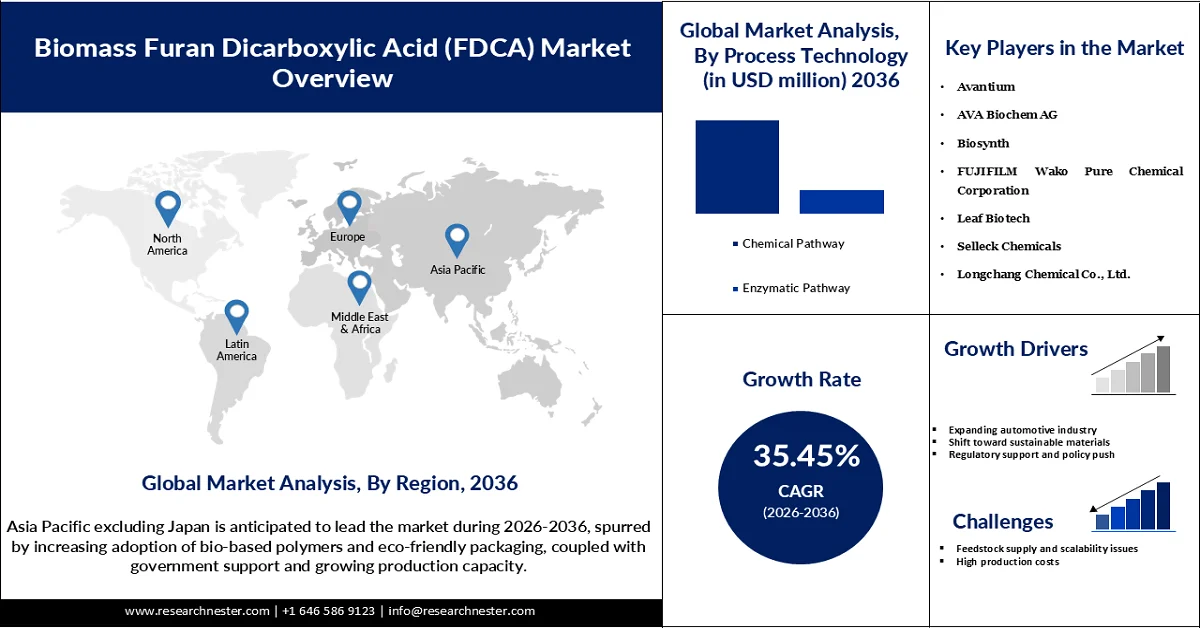
Biomass Furan Dicarboxylic Acid Market size was valued at USD 25.21 million in 2025 and is anticipated to surpass USD 1.98 billion by 2036, expanding at a CAGR of 35.45% during the forecast period, i.e., 2026 to 2036. In 2026, the industry size of biomass furan dicarboxylic acid (FDCA) is assessed at USD 95.64 million.
The growing use of environmentally friendly and renewable materials across various industries is a major factor supporting the expansion of the global biomass furan dicarboxylic acid market. FDCA is considered an important raw material for producing bio-based polymers, especially polyethylene furanoate (PEF), which is being explored as an alternative to traditional plastics made from petroleum. Industries, including food and beverage packaging, are increasingly exploring FDCA-based materials due to their ability to provide strong protection against gas and moisture transfer, which helps preserve product freshness and improve storage life. In parallel, a stronger focus on environmental responsibility and the need to curb carbon emissions from industrial operations is encouraging manufacturers to gradually replace petroleum-derived chemicals with alternatives produced from renewable biomass sources. As a result, companies are increasing their efforts in sustainable chemistry research and working on the development of innovative bio-based polymer materials.
A key trend affecting the biomass furan dicarboxylic acid market is the growing focus on regulatory measures that support eco-friendly materials and sustainable packaging practices. Governments and regional bodies are rolling out measures to increase the adoption of renewable and recyclable resources in manufacturing processes. Initiatives such as the EU Packaging and Packaging Waste Regulation (PPWR) are prompting manufacturers to boost the amount of bio-based or recycled content in packaging. For instance, the European Union’s Packaging and PPWR, which took effect in February 2025, seeks to reduce packaging waste and promote a circular, sustainable economy through strict rules on packaging design and recycling, thereby driving demand for bio-based plastics. These developments are increasing the role of FDCA as a sustainable chemical building block for producing advanced polymer materials. As environmental regulations grow more stringent, manufacturers are adopting FDCA-based solutions to achieve sustainability targets while ensuring consistent product quality. At the same time, these policies are encouraging closer collaboration among chemical producers, packaging firms, and consumer goods companies, which is accelerating the commercialization of FDCA-derived products.
Global Production Capacities of Bio-based Plastics (2024-2030) (in thousand tons)
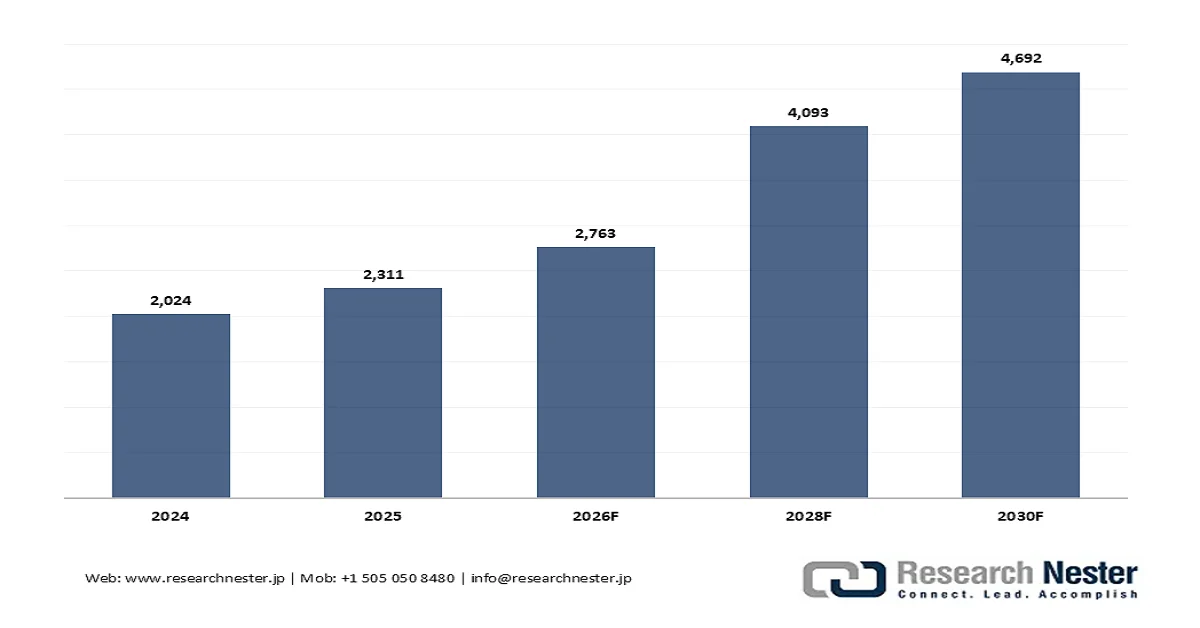
Source: European Bioplastics, Nova-Institute (2025)
Key Biomass Furan Dicarboxylic Acid Market Insights Summary:
Regional Highlights:
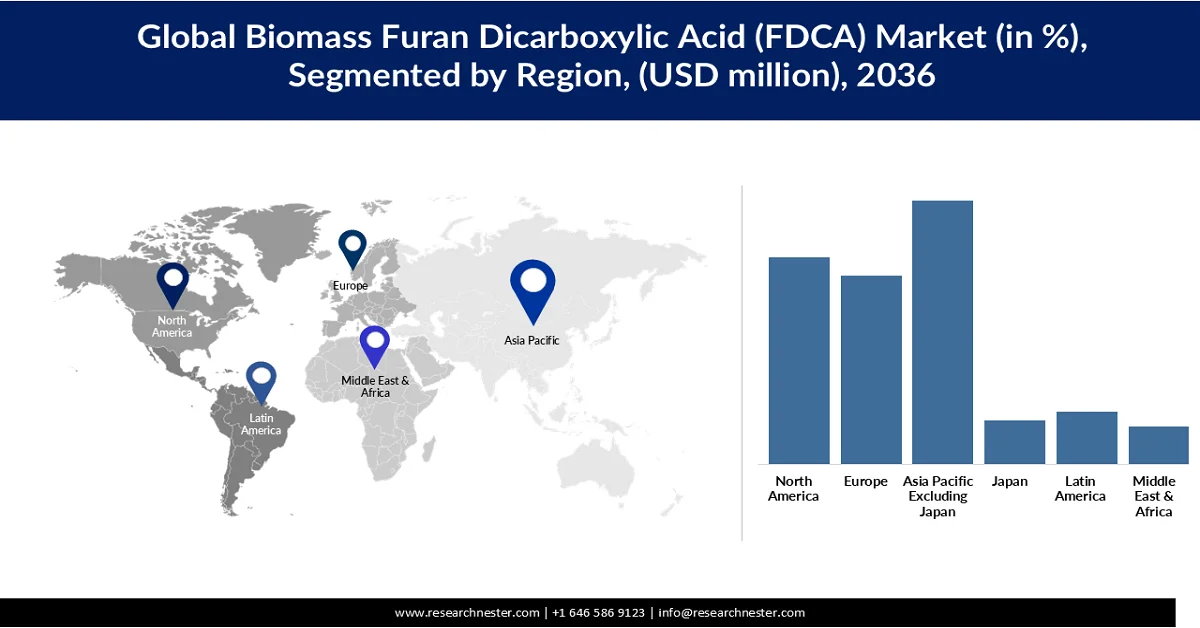
- Asia Pacific excluding Japan in the biomass furan dicarboxylic acid market is projected to capture 33.17% share by 2036, fueled by rising adoption of bio-based polymers and eco-friendly packaging alongside supportive government initiatives
- North America is anticipated to hold a 26.04% share by 2036, attributed to stringent sustainability standards and increasing corporate adoption of bio-based materials
Segment Insights:
- Chemical pathway segment in the biomass furan dicarboxylic acid market is expected to account for 78.68% share by 2036, propelled by established commercial viability and scalability advantages
- Starch-based biomass segment is forecast to hold 69.51% share by 2036, driven by abundant availability and cost-efficient conversion into key precursors
Key Growth Trends:
- Expanding automotive industry
- Shift toward sustainable materials
Major Challenges:
- High production costs
- Feedstock supply and scalability issues
Key Players: Avantium (Netherlands), AVA Biochem AG (Switzerland), Biosynth (Switzerland), FUJIFILM Wako Pure Chemical Corporation (Japan), Leaf Biotech (China), Selleck Chemicals (U.S.), Longchang Chemical Co., Ltd. (China), Merck KGaA (Germany), Origin Materials (U.S.), ReSource Chemical Corp. (U.S.), Tokyo Chemical Industry Co., Ltd. (Japan), Zhejiang Sugar Energy Technology Co., Ltd. (China).
Global Biomass Furan Dicarboxylic Acid Market Forecast and Regional Outlook:
Market Size & Growth Projections:
- 2025 Market Size: USD 25.21 million
- 2026 Market Size: USD 95.64 million
- Projected Market Size: USD 1.98 billion by 2036
- Growth Forecasts: 35.45% CAGR (2026-2036)
Key Regional Dynamics:
- Largest Region: Asia Pacific excluding Japan (33.17% Share by 2036)
- Fastest Growing Region: Asia Pacific excluding Japan
- Dominating Countries: United States, China, Germany, Japan, India
- Emerging Countries: South Korea, Brazil, Mexico, Indonesia, Vietnam
Last updated on : 20 March, 2026
Biomass Furan Dicarboxylic Acid (FDCA) Market - Growth Drivers and Challenges
Growth Drivers
- Expanding automotive industry: The automotive industry is increasingly relying on lightweight, high-strength materials to make vehicles more efficient and environmentally friendly. FDCA-based polymers are being considered for interior fittings, composite elements, and structural parts because of their strength, durability, and renewable origin. As sustainability and circular design gain importance in the automotive sector, demand for these bio-derived materials is expected to rise. Renewable polymers enable automakers to meet environmental regulations while attracting consumers who value sustainable choices.
Global Sales of Passenger Vehicles (2020-2024)
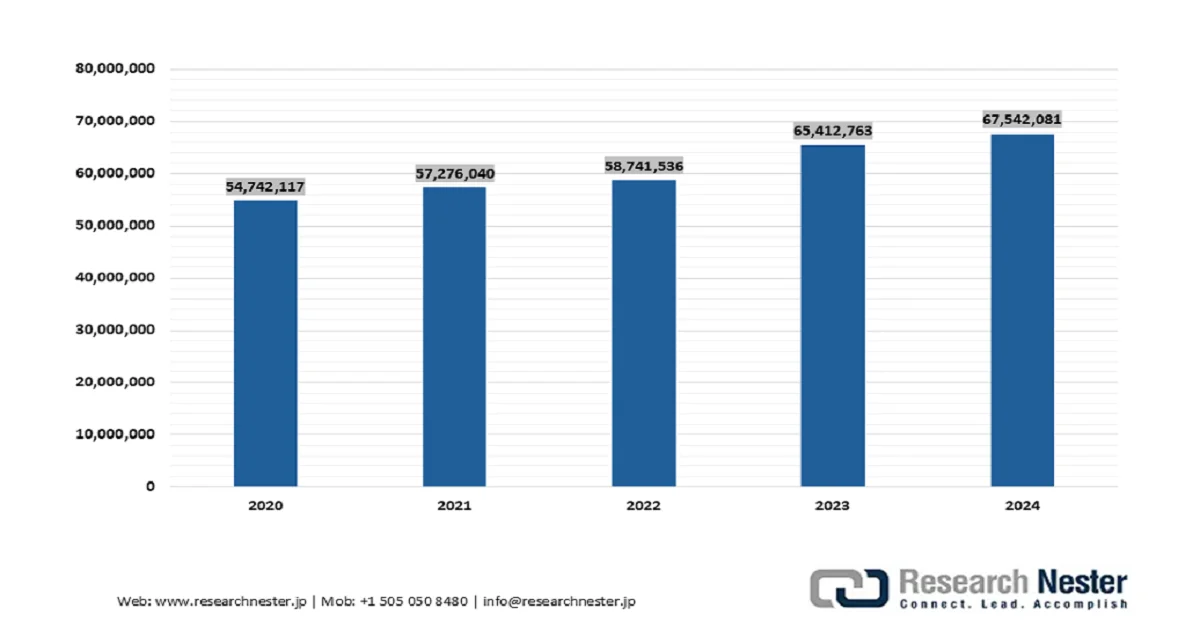
Source: OICA
- Shift toward sustainable materials: The global focus on sustainability is driving expansion in the biomass furan dicarboxylic acid market. Industries are exploring renewable alternatives to petroleum chemicals to cut emissions and foster circular economy solutions. Derived from renewable biomass, FDCA functions as a versatile bio-based building block, replacing conventional petroleum-derived monomers in polymer production. In line with this, in October 2024, Avantium launched the world’s first commercial-scale FDCA facility in Delfzijl, Netherlands, producing furandicarboxylic acid from renewable biomass. FDCA is being adopted by companies to satisfy environmental regulations and meet growing consumer interest in sustainable products. At the same time, investment in the research, production, and market introduction of FDCA-based polymers continues to expand, positioning it as a key material for green applications across packaging, textiles, coatings, and more.
- Regulatory support and policy push: Clearer regulations and regional approvals are helping the biomass furan dicarboxylic acid market grow. Well-defined rules strengthen investor trust, prove the scalability of biomass-based FDCA, and enhance market reliability, driving global strategic expansion. As a result, FDCA is emerging as a high-potential segment in sustainable materials, attracting rising industrial investment. In the fragrance and consumer goods sectors, companies are launching products more frequently, using smaller packaging formats, and incorporating FDCA-derived polymers to meet sustainability goals. Building on this, in July 2025, Japan introduced its Food-Contact Materials Positive List under the Food Sanitation Law, officially authorizing the use of 2,5-Furandicarboxylic Acid (FDCA) in food-contact applications. By reducing regulatory uncertainty and demonstrating scalability at commercial levels, these developments accelerate adoption and strengthen collaboration between chemical producers, packaging manufacturers, and consumer goods companies.
Challenges
- High production costs: The higher production cost of FDCA compared with traditional petroleum-based chemicals continues to pose a major obstacle to its wider adoption. Implementing advanced catalytic, enzymatic, and fermentation processes requires considerable spending on technology, equipment, and skilled staff. The expense of procuring sustainable biomass feedstock, along with the need to optimize processes for large-scale production, adds further to costs. For example, Avantium postponed the launch of its FDCA flagship facility in Delfzijl, the Netherlands, after construction-related issues were discovered during commissioning, particularly involving piping and titanium welds. Resolving these problems required additional corrective work, increasing capital costs by roughly USD 7.6 million and delaying the planned start-up to mid-2026.
These higher expenses can make FDCA-based polymers less competitive in price-sensitive markets, restricting broader industrial use. While ongoing innovations are gradually lowering production costs, manufacturers continue to face the challenge of balancing environmental benefits with affordability, particularly in sectors like packaging and consumer goods, where price is a key consideration.
- Feedstock supply and scalability issues: The availability of feedstock and the ability to scale production remain key challenges for the biomass furan dicarboxylic acid market. Sourcing enough biomass from agricultural residues, non-food crops, or other renewable resources can be unpredictable because of regional production differences, seasonal changes, and competition from other industries. Scaling up to meet global demand requires major investments in infrastructure and supply chain management. Manufacturers face the dual challenge of securing a continuous, sustainable feedstock supply and maintaining product quality, which can slow adoption and create uncertainty for scaling FDCA polymer production.
Biomass Furan Dicarboxylic Acid (FDCA) Market Size and Forecast:
| Report Attribute | Details |
|---|---|
|
Base Year |
2025 |
|
Forecast Year |
2026-2036 |
|
CAGR |
35.45% |
|
Base Year Market Size (2025) |
USD 25.21 million |
|
Forecast Year Market Size (2036) |
USD 1.98 billion |
|
Regional Scope |
|
Biomass Furan Dicarboxylic Acid (FDCA) Market Segmentation:
Process Technology Segment Analysis
The chemical pathway segment is expected to hold 78.68% of the biomass furan dicarboxylic acid market share. FDCA production via the chemical pathway is widely favored because it is well-established and commercially viable. In February 2025, Avantium reported the successful unloading of its first high-fructose syrup feedstock at the FDCA Flagship Plant in Delfzijl, marking an important milestone toward commercial FDCA production via its catalytic YXY chemical pathway and paving the way for the launch of plant-based PEF polymer manufacturing. It delivers consistent yields and can be scaled up more easily than enzymatic processes. The method is flexible enough to process various biomass feedstocks, and existing equipment and technology reduce production costs. With existing infrastructure and cost advantages at scale, along with strong industry investment, this route has become the preferred choice for large-scale FDCA manufacturing.
Raw Material Segment Analysis
The starch-based biomass segment is expected to hold a 69.51% market share by 2036, due to its abundant supply, economic efficiency, and suitability for conversion into sustainable fuels and high-value biochemicals. Crops such as corn, wheat, and cassava provide a dependable feedstock, making starch-derived materials easier to obtain than lignocellulosic alternatives. These feedstocks can be processed into HMF, the main precursor for FDCA, with lower complexity and faster production times. Additionally, existing industrial facilities for starch biomass facilitate large-scale manufacturing, reinforcing its dominance in FDCA production. Along with lower processing expenses and broad industry acceptance, these advantages make starch-derived feedstocks the preferred choice for FDCA production worldwide.
Application Segment Analysis
The polyethylene furanoate (PEF) segment is expected to grow at a biomass furan dicarboxylic acid market share of 66.02% by 2036, owing to its superior properties and increasing acceptance in the industrial sector. In May 2025, Avantium entered into a capacity reservation agreement with BIOVOX to provide plant-based PEF for pharmaceutical applications from upcoming industrial facilities, highlighting the polymer’s increasing commercial adoption. Partnerships and supply contracts with firms such as Avantium and BIOVOX demonstrate trust in its production at scale. Transitioning from pilot operations to full industrial facilities allows the polymer to reach a wider range of applications in food, beverage, and pharmaceutical packaging. Continued funding from venture capital and strategic partners, alongside regulatory support for bio-based polymers, is establishing PEF as the top FDCA-based polymer across the globe.
Our in-depth analysis of the biomass furan dicarboxylic acid (FDCA) includes the following segments:
|
Segments |
Subsegments |
|
Process Technology |
|
|
Raw Material |
|
|
End-User |
|
|
Application |
|

Vishnu Nair
Head - Global Business DevelopmentCustomize this report to your requirements — connect with our consultant for personalized insights and options.
Biomass Furan Dicarboxylic Acid (FDCA) Market - Regional Analysis
Asia Pacific Excluding Japan Market Insights
Asia Pacific excluding Japan is expected to dominate the market, accounting for 33.17% of the total share by 2036, driven by increasing adoption of bio-based polymers and eco-friendly packaging, coupled with government support and growing production capacity. For instance, in October 2024, Avantium and SCG Chemicals strengthened their partnership to boost the adoption of FDCA and PEF in Asia, concentrating on market validation and increasing commercial production to meet rising demand for sustainable plastics. The Asia-Pacific region, particularly China, India, Japan, and South Korea, is leading the way owing to plentiful biomass resources and strong policy backing. Investment in advanced production technologies and biorefinery infrastructure is further boosting adoption across the packaging, textile, and automotive sectors, positioning the region as the fastest-growing market worldwide.
The FDCA market in China is expanding rapidly, fueled by abundant starch-based feedstocks such as corn and wheat, which provide a dependable and low-cost supply of raw materials. In line with this, in September 2024, a groundbreaking ceremony marked the launch of a new FDCA production line in Tongling City, Anhui Province, China, backed by an investment of around USD 0.14 billion. The facility is expected to start operations by late 2025 and will have an annual production capacity of up to 15,000 tons of FDCA. Utilizing low-cost sugars and non-food biomass feedstocks, along with continuous-flow reactors, advanced catalysts, and fixed-bed oxidation systems, the plant aims to enable efficient, large-scale, and cost-effective production of FDCA for downstream bio-based polymer applications. Strong demand for sustainable polymers across packaging, textiles, and consumer goods supports this growth. Supportive government regulations and incentives encourage the use of bio-based chemicals, and established chemical manufacturing infrastructure, combined with investment in advanced fermentation and catalytic technologies, ensures efficient large-scale production.
The biomass furan dicarboxylic acid market in South Korea is growing, supported by strong government initiatives promoting sustainable and bio-based materials. Growing demand from the packaging and consumer goods sectors, particularly in food, beverage, and cosmetics, is driving the use of FDCA-based polymers such as PEF. The automotive industry is likewise exploring these polymers for lightweight, durable parts that improve fuel efficiency and reduce emissions. Investments in local research, development, and production technologies are improving yields, scalability, and cost efficiency. In addition, rising consumer interest in environmentally friendly products, combined with strategic partnerships among chemical manufacturers, packaging companies, and research organizations, is further intensifying FDCA commercialization in the country.
North America Market Insights
The biomass furan dicarboxylic acid market in North America is expected to hold a share of 26.04% by 2036. The market is driven by strict sustainability standards, active research initiatives, and rising corporate adoption. In line with this, in February 2024, Origin Materials and Sustainea Bioglycols formed a strategic partnership to manufacture fully bio-based PET and polyesters. The collaboration integrates Origin’s forest-sourced FDCA and bio-PTA with Sustainea’s renewable bio-MEG, creating a sustainable, low-carbon polymer supply chain. Widely used in PEF packaging and high-performance polymers, FDCA delivers superior gas barrier properties and better recyclability than PET. Despite challenges from production costs and feedstock limitations, improvements in technology are accelerating commercialization, setting the stage for robust double-digit growth.
The U.S. biomass furan dicarboxylic acid market is experiencing continued growth, propelled by government efforts to promote bio-based and sustainable materials. Progress in chemical and biotechnology research is improving production methods and expanding the potential applications of FDCA. Rising corporate focus on sustainable packaging and high-performance polymers, combined with stronger consumer preference for green products, is accelerating market adoption. In March 2025, Mitsubishi Gas Chemical partnered with U.S.-based ReSource Chemical to expand FDCA production using woody biomass, supporting pilot-scale projects and bolstering North America’s FDCA supply for eco-friendly polymer and packaging applications. Together, these factors make the U.S. a significant player in the global market.
The biomass furan dicarboxylic acid market in Canada is growing, supported by government programs that encourage the use of sustainable and bio-based materials. Increasing demand from the packaging, automotive, and specialty chemical industries is motivating manufacturers to use FDCA-based polymers. Investments in modern production technologies, combined with rising consumer interest in environmentally friendly products, are further boosting market growth and enabling large-scale production of FDCA across the country.
Europe Market Insights
Europe's biomass furan dicarboxylic acid market will grow with a market share of 23.76% by 2036, propelled by strict sustainability regulations, strong interest in bio-based polymers, and active research and development. Greater emphasis on circular economy practices by companies, along with rising consumer interest in sustainable products, is further driving adoption. Investments in updated manufacturing processes and pilot-scale operations are enhancing production efficiency and scalability, allowing the creation of high-performance, recyclable polymers for packaging, automotive, textiles, and specialty chemical sectors. For instance, in September 2025, Avantium partnered with Tereos and LVMH GAÏA to scale up FDCA and PEF production across Europe. By combining Tereos’ biomass resources, Avantium’s YXY Technology, and LVMH’s sustainability requirements, the alliance aims to deliver high-performance, renewable polymers for packaging, textiles, and industrial applications, accelerating the commercial use of bio-based FDCA. Furthermore, government backing and financial incentives for green technologies are reinforcing Europe’s position as a major player in the global market.
The FDCA market in Germany is gradually growing, led by stringent environmental standards and government programs promoting bio-based and recyclable materials. Strong chemical and biotechnology industries are improving production efficiency and scaling up operations. Rising corporate adoption of sustainable practices, coupled with growing consumer demand for environmentally responsible products, is further encouraging market expansion. Availability of biomass feedstocks and state-of-the-art production facilities, along with investments in pilot and commercial-scale plants, is expanding the use of FDCA-based polymers across packaging, automotive, and specialty chemical sectors.
The BENELUX biomass furan dicarboxylic acid market is steadily advancing, supported by strong regulatory frameworks for sustainable packaging and bio-based materials, including EU-wide policies encouraging circular economy practices. The adoption of FDCA-based polymers is being driven by rising demand from food and beverage packaging, automotive, and specialty chemical industries. Enhanced investment in R&D, production methods, and partnerships is increasing scalability and reducing costs, while heightened consumer awareness of eco-friendly products continues to fuel market development.
Key Biomass Furan Dicarboxylic Acid (FDCA) Market Players:
- Avantium (Netherlands)
- AVA Biochem AG (Switzerland)
- Biosynth (Switzerland)
- FUJIFILM Wako Pure Chemical Corporation (Japan)
- Leaf Biotech (China)
- Selleck Chemicals (U.S.)
- Longchang Chemical Co., Ltd. (China)
- Merck KGaA (Germany)
- Origin Materials (U.S.)
- ReSource Chemical Corp. (U.S.)
- Tokyo Chemical Industry Co., Ltd. (Japan)
- Zhejiang Sugar Energy Technology Co., Ltd. (China)
- Company Overview
- Business Strategy
- Key Product Offerings
- Financial Performance
- Key Performance Indicators
- Risk Analysis
- Recent Development
- Regional Presence
- SWOT Analysis
- Avantium is one of the leading producers of Biomass Furan Dicarboxylic Acid (FDCA) globally due to its early investment and pioneering work in bio-based chemical technologies. The company has developed proprietary catalytic and production processes that enable scalable and efficient FDCA manufacturing from renewable biomass. Avantium has also established strong partnerships with major polymer and packaging companies, supporting commercial adoption of FDCA-derived polymers such as polyethylene furanoate (PEF). Their focus on innovation, sustainability, and large-scale production capabilities has positioned them as a global leader in the FDCA market.
- AVA Biochem AG is a major player in the biomass furan dicarboxylic acid market because of its expertise in producing high-purity bio-based chemicals from renewable feedstocks. The company focuses on sustainable FDCA production using advanced catalytic and fermentation technologies, ensuring both quality and scalability. AVA Biochem AG has established strategic partnerships with polymer manufacturers and research institutions to accelerate commercialization of FDCA-derived materials. Its strong emphasis on innovation, sustainability, and reliable supply chains has solidified its position as a key global supplier in the growing FDCA market.
- Biosynth has established a strong presence in the Biomass Furan Dicarboxylic Acid market through its expertise in producing high-purity specialty chemicals and bio-based intermediates. The company focuses on advanced chemical synthesis and biotechnology processes to supply FDCA for research, pharmaceutical, and industrial applications. Its well-developed global distribution network and strong relationships with research institutions and chemical manufacturers support consistent product availability. In addition, Biosynth’s emphasis on quality control, innovation, and customized chemical solutions has helped strengthen its position in the expanding FDCA market.
- Tokyo Chemical Industry Co., Ltd. is a key player in the global Biomass Furan Dicarboxylic Acid market due to its strong expertise in manufacturing high-purity specialty chemicals used in research and industrial applications. The company maintains a large and diverse chemical portfolio, including bio-based intermediates such as FDCA, which supports polymer and materials research. Its extensive global distribution network enables reliable supply to laboratories, universities, and chemical manufacturers worldwide. In addition, the company’s focus on product quality, continuous innovation, and strong relationships with research institutions helps accelerate the development and application of FDCA-based materials in emerging bio-polymer markets.
Below is the list of the key players operating in the global biomass furan dicarboxylic acid market:
Companies leading the biomass FDCA market are promoting growth by investing in research and development to refine production methods and explore additional applications. Increasing production capacity through pilot and commercial facilities meets rising industry demand from packaging, textiles, automotive, and specialty chemicals. Collaborative ventures and strategic alliances support technology exchange and faster market entry, while emphasizing sustainable, bio-based polymers that satisfy regulatory and consumer expectations.
Corporate Landscape of the Global Biomass Furan Dicarboxylic Acid Market:
Recent Developments
- In June 2023, Leaf Biotech secured about USD 28.94 million (200 million yuan) through a Series B funding round to expand its FDCA production capacity and support the development of bio-based materials. The investment is being used to build the world’s first 10,000-ton FDCA production facility, improve manufacturing processes, and support international market expansion. Through this funding, the company is strengthening its presence in FDCA, HMF, and PEF, with a focus on large-scale sustainable plastic applications in packaging, textiles, and advanced material sectors.
- In June 2023, Origin Materials launched operations at its first commercial-scale CMF facility in Ontario, Canada, focused on producing biomass-derived PET intermediates using non-food feedstocks. The plant helps lower the carbon footprint compared with conventional and recycled PET production, supporting more sustainable packaging solutions. It also lays the groundwork for the future development of FDCA-based polymers designed for high-performance and recyclable material applications.
- Report ID: 8455
- Published Date: Mar 20, 2026
- Report Format: PDF, PPT
- Explore a preview of key market trends and insights
- Review sample data tables and segment breakdowns
- Experience the quality of our visual data representations
- Evaluate our report structure and research methodology
- Get a glimpse of competitive landscape analysis
- Understand how regional forecasts are presented
- Assess the depth of company profiling and benchmarking
- Preview how actionable insights can support your strategy
Explore real data and analysis
Frequently Asked Questions (FAQ)
About this Report
Connect with our Expert


Report, 2026-2036



Copyright @ 2026 Research Nester. All Rights Reserved.
