Basketball Equipment Market Outlook:
Basketball Equipment Market size was over USD 933.5 million in 2025 and is projected to exceed USD 2.12 billion by the end of 2035, witnessing over 7.9% CAGR during the forecast period, i.e., 2026-2035. In 2026, the industry size of basketball equipment is estimated at USD 1.07 billion.
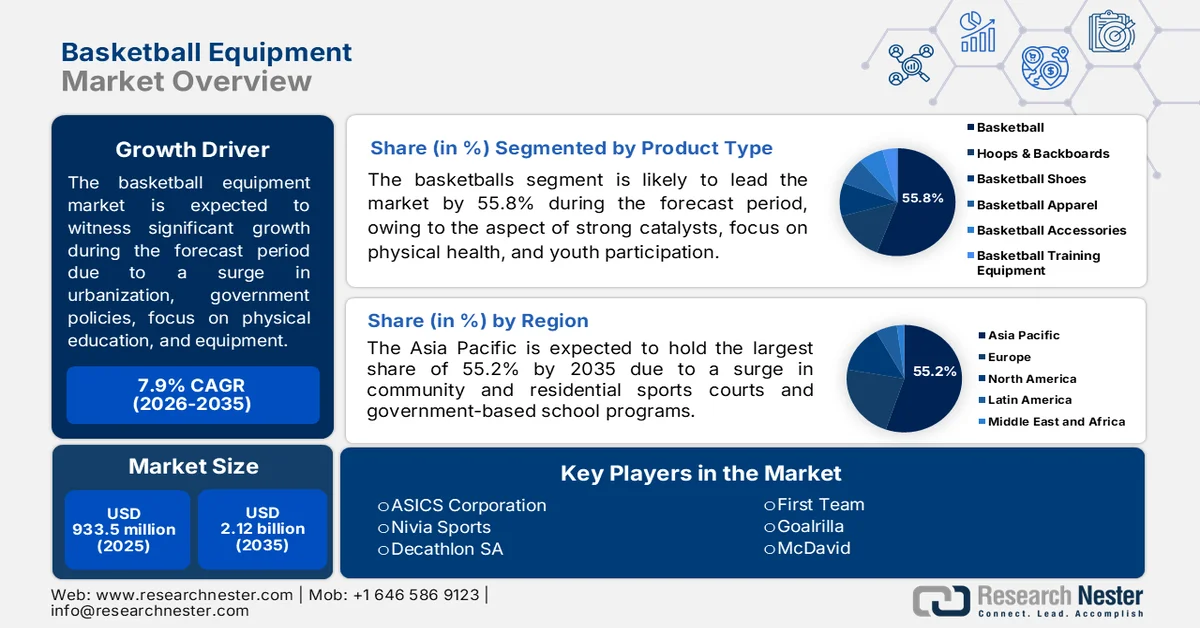
The global basketball equipment market is continuously expanding, based on increased urbanization, government-based initiatives for promoting physical education in different educational institutions, the rise of basketballs, climate resilience, and growth in the equipment industry. According to official statistics published by the World Health Organization (WHO) in June 2024, 80% of adolescents and 31% of adults fail to meet the recommended levels of physical activity. In this regard, the worldwide target was set to reduce physical inactivity levels in the population by 10% as of 2025, with a further reduction of 15% by the end of 2030. Besides, the estimated spending of such inactivity amounts to almost USD 300 billion, which is roughly USD 27 billion every year. Therefore, based on this, there is a huge focus on physical activities, which has resulted in suitable trade facilities for sports equipment, thereby enhancing the basketball equipment market demand.
2024 Sports Equipment Global Export and Import Analysis
|
Countries/Components |
Export (USD) |
Import (USD) |
|
China |
16.5 billion |
- |
|
Taipei |
1.8 billion |
- |
|
U.S. |
1.7 billion |
8.3 billion |
|
Germany |
- |
1.7 billion |
|
France |
- |
1.5 billion |
|
Global Trade Valuation |
33.4 billion |
|
|
Global Trade Share |
0.1% |
|
|
Product Complexity |
0.5 |
|
|
Export Growth |
5.6% |
|
Source: OEC
Furthermore, the presence of customizable and modular systems, smart equipment integration, the existence of recycled and sustainable materials, the adoption of outdoor, indoor, and hybrid equipment, and direct-to-institution digitalized procurement platforms are a few trends that are responsible for fueling the basketball equipment market globally. In terms of smart equipment, Sports 5.0 focuses on integrating standard support structures to fund sport psychologists for enabling mental health education in training programs. As stated in an article published by NLM in December 2025, the America Psychological Association noted that nearly 35% of elite sports personnel reported mental health issues in comparison to the general population. Therefore, the purpose of implementing Sports 5.0 is to combat stigma and develop resilience to ensure smooth sports management in the future.
Key Basketball Equipment Market Insights Summary:
Regional Highlights:
- The asia pacific basketball equipment market is projected to capture 55.2% share by 2035, bolstered by rapid urbanization, rising disposable incomes, expansion of sports infrastructure, and government-backed school sports initiatives
- North America is poised to emerge as the fastest-growing region throughout 2026-2035, fueled by rising participation in school basketball, surging women’s basketball popularity, and expanding indoor and outdoor court networks
Segment Insights:
- The basketballs segment in the basketball equipment market is expected to dominate with a 55.8% share by 2035, propelled by growing global fan engagement and the sport’s expanding influence on youth development, social cohesion, and physical fitness
- The offline segment is likely to secure the second-largest share during the forecast period, supported by consumer preference for physical product inspection and expert in-store purchasing assistance
Key Growth Trends:
- Rise in women sports professionals
- Cross-training adoption in non-basketball sports
Major Challenges:
- Seasonal demand and weather dependency
- Intense competition from multi-sport equipment brands
Key Players: Spalding (U.S.), Wilson Sporting Goods (U.S.), Nike (U.S.), Adidas (Germany), Under Armour (U.S.), Rawlings Sporting Goods (U.S.), Amer Sports (U.S.), Lifetime Products (U.S.), Bison (U.S.), Gared (U.S.), Goalsetter (U.S.), Barbarian Basketball Systems (U.S.), First Team (U.S.), Goalrilla (U.S.), McDavid (U.S.), Molten Corporation (Japan), ASICS Corporation (Japan), Nivia Sports (India), Decathlon SA (France), Freewill Sports Pvt Ltd (India), ABEO (France), Euroleague Basketball (Spain), The Basketball League (U.S.).
Global Basketball Equipment Market Forecast and Regional Outlook:
Market Size & Growth Projections:
- 2025 Market Size: USD 933.5 million
- 2026 Market Size: USD 1.07 billion
- Projected Market Size: USD 2.12 billion by 2035
- Growth Forecasts: 7.9% CAGR (2026-2035)
Key Regional Dynamics:
- Largest Region: Asia Pacific (55.2% Share by 2035)
- Fastest Growing Region: North America
- Dominating Countries: United States, Germany, Japan, China, United Kingdom
- Emerging Countries: India, South Korea, Brazil, Mexico, Saudi Arabia
Last updated on : 19 May, 2026
Basketball Equipment Market - Growth Drivers and Challenges
Growth Drivers
- Rise in women sports professionals: The increasing growth of women professionals globally has led to a surge in the demand for distinct equipment, which is highly responsible for driving the basketball equipment market. According to official statistics published by the UN Women Organization in July 2024, 80% of female CEOs under the Fortune 500 have played sports in their formative years. Besides, 92% of global audiences agree that it is essential for women to play sports, with 61% considering this as very essential. Moreover, an estimated 35 female commentators were hired by the Olympic Broadcasting Services, especially for Paris 2024, thereby ensuring an increase to almost 40%. Simultaneously, the social media conversion around women's sports surged to 18.5% as of 2022, demonstrating a 2.5% average yearly increase.
- Cross-training adoption in non-basketball sports: The presence of athletes from other sports, such as tennis, football, soccer, and volleyball, is also increasingly utilizing basketball drills, especially for cardiovascular conditioning, hand and eye coordination, vertical leap, and agility. This has deliberately fueled the sales of portable hoops and training basketballs for different sports facilities, which is positively uplifting the basketball equipment market globally. As per an article published by NLM in January 2024, by using basketball, male adults make 450 lateral movements by covering a distance between 203 and 269 meters. Meanwhile, the number of movements for adult women is 450 laterals for an overall distance of 125 meters, thereby denoting a huge growth opportunity for the market.
Challenges
- Seasonal demand and weather dependency: The basketball equipment market faces a significant challenge due to the seasonal nature of outdoor sports participation. Besides, unlike indoor fitness equipment, basketball hoops, backboards, and portable systems are heavily used in spring and summer months, with demand dropping sharply during colder seasons in temperate climates. This seasonality creates inventory management headaches for manufacturers and retailers, who must forecast accurately to avoid overstocking or stockouts. Additionally, outdoor equipment is subject to weather-related wear and tear, such as UV degradation, rusting, and warping of backboards, which can shorten product lifespans and lead to negative consumer reviews.
- Intense competition from multi-sport equipment brands: The basketball equipment market is crowded not only with specialized players but also with large-scale sporting goods conglomerates that provide basketball gear as one category among many. These multi-sport brands, ranging from global giants to mass-market retailers' private labels, leverage economies of scale in production, marketing, and distribution to undercut specialized basketball equipment manufacturers on price. They also bundle basketball hoops with other sports equipment in seasonal promotions, making it difficult for niche brands to stand out. Furthermore, these large competitors invest heavily in celebrity endorsements, NBA partnerships, and youth league sponsorships, capturing mindshare and shelf space.
Basketball Equipment Market Size and Forecast:
| Report Attribute | Details |
|---|---|
|
Base Year |
2025 |
|
Forecast Year |
2026-2035 |
|
CAGR |
7.9% |
|
Base Year Market Size (2025) |
USD 933.5 million |
|
Forecast Year Market Size (2035) |
USD 2.12 billion |
|
Regional Scope |
|
Basketball Equipment Market Segmentation:
Product Type Segment Analysis
The basketballs segment, part of the product type, is anticipated to account for the largest share of 55.8% in the basketball equipment market by the end of 2035. The segment’s upliftment is primarily attributed to its role as the most powerful catalyst for social cohesion, youth development, and physical health. According to official statistics published by FIFA Basketball in June 2024, there are over 3.3 billion basketball fans globally. In addition, with nearly 3 out of 4 people increasingly interested in the sport across different territories, this effectively makes it the second-most famous sport worldwide behind football. Moreover, this has also increased from 68% to 74% as of 2023, thereby denoting a huge growth opportunity for the basketball equipment market across different regions.
Distribution Channel Segment Analysis
Based on the distribution channel, the offline segment is projected to grab the second-largest share in the basketball equipment market during the forecast period. The segment’s growth is effectively driven by the tangible, high-consideration nature of these products. Based on this aspect, consumers purchasing items such as backboards, portable hoops, or basketballs strongly prefer physical inspection before purchase, as factors, including grip, rebound feel, backboard thickness, and rim spring tension, cannot be adequately assessed online. Besides, specialty sporting goods stores offer the distinct advantage of expert staff who can guide first-time buyers, youth league organizers, and institutional purchasers toward appropriate equipment based on skill level, age, and installation requirements.
End user Segment Analysis
By the end of the stipulated timeline, the men sub-segment, which is part of the end user segment, is expected to account for the third-largest share in the basketball equipment market. The sub-segment’s development is highly propelled by its crucial role in offering power, high-intensity athleticism, and the vital interior presence for defense and rebounding. Besides, the sub-segment’s expansion also stems from lifelong participation patterns, as men who play basketball during school and college years frequently continue the sport into adulthood through recreational leagues, corporate tournaments, and informal pickup games. Men also exhibit higher purchase frequency for performance-oriented equipment, including premium basketballs, durable outdoor shoes, and portable or in-ground hoop systems for residential driveways.
Our in-depth analysis of the basketball equipment market includes the following segments:
|
Segment |
Subsegments |
|
Product Type |
|
|
Distribution Channel |
|
|
End user |
|
|
Performance Level |
|
|
Material |
|
|
System Type |
|

Vishnu Nair
Head - Global Business DevelopmentCustomize this report to your requirements — connect with our consultant for personalized insights and options.
Basketball Equipment Market - Regional Analysis
APAC Market Insights
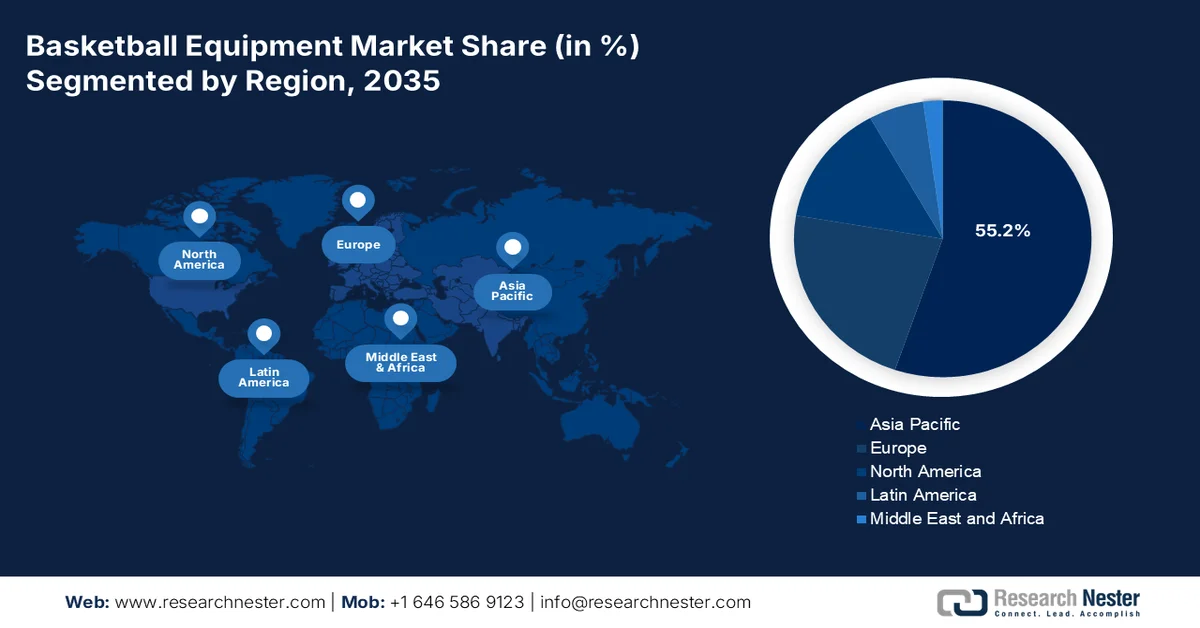
The Asia Pacific in the basketball equipment market is anticipated to grab the highest share of 55.2% by the end of 2035. The market’s upliftment in the region is primarily attributed to rapid urbanization, an escalation in the construction of community and residential sports courts, a rise in middle-class disposable incomes, government-based school sports programs, the adoption of smart technology, and sustainability attributes. According to official statistics published by the Beltway Grid Organization in October 2024, Southeast Asia, for instance, is home to more than 676 million people, with an average age of 29 years, effectively making it a suitable demographic for sports development. Besides, as per the 2026 Khelo India Government data report, the grant provision for a multipurpose community hall, sized 40M x 20M x 9.0M, with facilities for basketball, volleyball, and badminton, amounted to USD 1.2 million, thus uplifting the market growth.
The basketball equipment market in China is growing significantly, owing to the rapid growth in participation rates, sports partnerships, the manufacturing ecosystem, the supply of raw materials for basketball production, and the increasing prioritization of synthetic and polymer innovations. As stated in an article published by the State Council Office in September 2025, sports venues in the country comprise an overall floor area of 4.2 billion square meters, along with 1,547 newest sports parks. Besides, the industrial valuation of the domestic outdoor sports sector surpassed USD 422 billion by the end of 2025. Moreover, the country also has more than 63,000 sports equipment manufacturing organizations, denoting a rise in the output valuation of USD 165 billion to USD 221 billion, indicating a 34% increase, thereby denoting an optimistic outlook for the market.
The aspects of increased popularity among the student population, a surge in initiatives for physical activities, the government’s approaches to encourage youth participation, the trading ecosystem, rapid urbanization, and the growing consumer demands are certain factors that are enhancing the basketball equipment market in Japan. The country’s industrial size was valued at USD 300 million as of 2025, which is further predicted to be worth USD 319.2 million by 2026, and additionally USD 557 million, along with a 6.4% growth rate by the end of 2035. Based on this growth and as per an article published by the Sasakawa Sports Foundation in June 2023, 72.9% of people in the country readily participated in sports and physical activities as of 2022. In addition, this has remained unchanged since 2020, thereby denoting a huge growth opportunity for the basketball equipment market.
Yearly Changes in Sports and Physical Activities in Japan, 2012-2022
|
Year |
Once a Year |
Once a Week |
Twice a Week |
Active Participation |
|
2012 |
74.4% |
59.1% |
49.3% |
20.0% |
|
2014 |
73.7% |
57.2% |
47.5% |
18.7% |
|
2016 |
72.4% |
56.0% |
45.1% |
19.6% |
|
2018 |
74.0% |
57.9% |
47.8% |
20.7% |
|
2020 |
73.3% |
59.5% |
49.9% |
22.1% |
|
2022 |
72.9% |
58.5% |
49.1% |
20.2% |
Source: Sasakawa Sports Foundation
North America Market Insights
North America in the basketball equipment market is expected to emerge as the fastest-growing region during the forecast period. The market’s development is highly propelled by an increase in participation rates, product advancements, popularity among young professionals, rapid growth in women’s basketball, and the network of both outdoor and indoor courts. According to official statistics published by the Census Government in December 2024, basketball has gained increased popularity in high school sports, particularly in the U.S., with almost 900,000 of the country’s 72,325,602 school children participating in school teams. Besides, the NBA witnessed a record of USD 13 billion during the 2023 and 2024 basketball season in terms of league-based revenue. This significantly bolstered the Golden State Warriors basketball team’s valuation to USD 8.8 billion, thus enhancing the market development in the overall region.
The basketball equipment market is gaining increased traction in the U.S., owing to the collegiate athletic infrastructure, the presence of privately funded community center leagues, homeowners' association amenity competition, juvenile recreational, and welfare programs. As stated in an article published by the Congress Government in January 2024, sports in the country effectively generated suitable revenues, with the combined franchise valuation in the National Football League, amounting to USD 163 billion as of 2023. In addition, the league also generated USD 11.9 billion as revenue in 2022, demonstrating a new record high and a 7% surge from 2021. This was followed by Major League Baseball (MLB) franchises, resulting in a record revenue of USD 10.8 billion in 2022. Besides, the agreement between the National Hockey League’s Washington Capitals and the National Basketball Association’s Washington Wizards generated a combined USD 12 billion as an economic impact, especially for the Commonwealth and City of Alexandria, and further created roughly 30,000 employment opportunities.
The presence of indigenous community court construction programs, winter indoor activity substitution, newcomers integration, polarized basketball goal line conversions, and equipment subsidies are a few trends that are responsible for fueling the basketball equipment market in Canada. As per an article published by the Government of Canada in August 2025, approximately 55% of people aged more than 15 years participated in sports activities, with a rise in men's participation by 62%, in comparison to 49% of women. Based on this, 80% of sports are played in the form of recreation, either outside of a league or club, and at times in the form of recreational programs, including sport clubs or group fitness. Moreover, the Canada Fitness and Lifestyle Research Institute’s Physical Activity and Sport Survey indicated that 27% of adults aged over 18 years participate in organized sport, thus enhancing the market demand.
Europe Market Insights
Europe in the basketball equipment market is projected to witness suitable expansion by the end of the stipulated timeline. The market’s growth in the region is effectively driven by an expansion in grassroots sports programs, the increasing popularity among the population, upgradation in professional league infrastructure, the replacement of game-standard equipment, sustainability in product development, and a rise in multi-sport communities. According to official statistics published by Europe Olympic Committees in 2026, the share of sport-based gross domestic product (GDP) in the region is 2.1% and amounts to USD 325.6 billion. In addition, the share of sports-driven employment accounts for 2.7% of the overall regional employment, which is readily equivalent to 5,666,195 persons. Therefore, with such share, employment, and expense analysis, the market is continuously expanding in the region.
The basketball equipment market is gaining increased exposure in Germany, owing to the large facility for club sports, an increase in disposable income levels, suitable manufacturing leadership in benefiting equipment, and logistic dynamics. As stated in an article published by the ITA in August 2025, there was a rise in the domestic manufacturing exports from USD 955 billion as of 2022 to more than USD 1 trillion in 2023. Besides, in terms of the U.S. Department of Commerce-furnished database, the 2024 U.S. Advanced Manufacturing exports to the country amounted to USD 37 billion. Simultaneously, Europe’s statistics demonstrated roughly USD 43 billion in U.S.-based manufacturing exports to the country. Moreover, the nation’s overall imports amounted to USD 722 billion as of 2024, which is substantially smaller than its exports, thereby making it suitable for driving the market growth.
Germany’s Advanced Manufacturing Analysis, 2022-2024
|
Components (USD Million) |
2022 |
2023 |
2024 |
|
Total Exports |
955,316 |
1,026,836 |
991,050 |
|
Total Imports |
753,557 |
764,300 |
721,621 |
|
Imports from the U.S. |
35,978 |
38,998 |
36,753 |
|
Trade Surplus/Deficit |
201,759 |
262,536 |
269,429 |
|
EUR-USD Exchange Rate |
1.05 |
1.08 |
1.08 |
Source: ITA
The existence of a massive youth population, an increase in sports participation rates, rapid expansion in the middle class, an upsurge in disposable income for consumer products, generous funding for sports infrastructure, and a focus on goods manufacturing are certain trends that are enhancing the basketball equipment market in Poland. As per an article published by the National Policies Platform in December 2025, the Central Statistical Office stated that the country comprised 5,751 400 inhabitants aged between 15 and 29 years, of which 2,935,300 were categorized as men and 2,816,100 as females as of December 2024. Besides, the country’s youth population caters to 1,990,300 15 to 19 years old, which is further followed by 1,763,300 20 to 24 years old, and 1,997,800 25 to 29 years old. Therefore, with this huge youth population, there is a huge demand for the market in the overall nation.
Key Basketball Equipment Market Players:
- Spalding (U.S.)
- Wilson Sporting Goods (U.S.)
- Nike (U.S.)
- Adidas (Germany)
- Under Armour (U.S.)
- Rawlings Sporting Goods (U.S.)
- Amer Sports (U.S.)
- Lifetime Products (U.S.)
- Bison (U.S.)
- Gared (U.S.)
- Goalsetter (U.S.)
- Barbarian Basketball Systems (U.S.)
- First Team (U.S.)
- Goalrilla (U.S.)
- McDavid (U.S.)
- Molten Corporation (Japan)
- ASICS Corporation (Japan)
- Nivia Sports (India)
- Decathlon SA (France)
- Freewill Sports Pvt Ltd (India)
- ABEO (France)
- Euroleague Basketball (Spain)
- The Basketball League (U.S.)
- Company Overview
- Business Strategy
- Key Product Offerings
- Financial Performance
- Key Performance Indicators
- Risk Analysis
- Recent Development
- Spalding maintains a historic and deeply rooted association with professional basketball through long-standing league partnerships. The brand continues to be a household name for indoor and outdoor basketballs as well as backboard systems.
- Wilson Sporting Goods has strengthened its position in the basketball equipment market by securing official partnerships with major professional leagues. The company offers a comprehensive range of basketballs, portable hoops, and training gear for competitive and recreational players.
- Nike leverages its vast athlete endorsement network to drive visibility and demand for its basketball footwear and apparel lines. The brand consistently integrates performance technology into its basketball shoes to appeal to serious players.
- Adidas competes strongly in the basketball footwear and lifestyle segment by blending retro designs with modern performance features. The company also produces co-branded basketball apparel and accessories through collaborations with professional athletes.
- Under Armour focuses on basketball performance apparel and footwear engineered for moisture management and mobility. The brand has invested in signature athlete partnerships to gain credibility within the competitive basketball equipment landscape.
Here is a list of key players operating in the global basketball equipment market:
The global basketball equipment market is highly competitive, dominated by established U.S. brands with strong historical ties to the sport, alongside major Europe-based sportswear conglomerates. Key strategic initiatives include heavy investment in athlete endorsements and league sponsorships to drive brand loyalty. A significant trend is the shift toward direct-to-consumer (D2C) e-commerce models, allowing manufacturers to capture higher margins and control brand presentation. Besides, in May 2025, ABEO successfully acquired a total of 70% stake in Sodex, with the intention of continuing its foreign developmental strategy and also strengthening its sports segment globally, thereby making it suitable for boosting the basketball equipment industry.
Corporate Landscape of the Market:
Recent Developments
- In July 2025, Under Armour partnered with the Asian University Basketball League (AUBL), with the objective of outfitting all teams with training apparel and performance uniforms, with a focus on customized and unique visuals.
- In May 2024, Euroleague Basketball and Spalding expanded their long-lasting cooperation through 2027, with the intention of continuing to effectively elevate the game and increasingly offer the best experience for both fans and players.
- In October 2023, The Basketball League (TBL) and Baden Sports, along with the Basketball Super League (BSL), partnered with the aim to grow the basketball community, while continuing to inspire the newest generation of athletes.
- Report ID: 8571
- Published Date: May 19, 2026
- Report Format: PDF, PPT
- Explore a preview of key market trends and insights
- Review sample data tables and segment breakdowns
- Experience the quality of our visual data representations
- Evaluate our report structure and research methodology
- Get a glimpse of competitive landscape analysis
- Understand how regional forecasts are presented
- Assess the depth of company profiling and benchmarking
- Preview how actionable insights can support your strategy
Explore real data and analysis
Frequently Asked Questions (FAQ)
About this Report
Connect with our Expert


Report, 2026-2035



Copyright @ 2026 Research Nester. All Rights Reserved.
