Automotive Image Sensor Market Outlook:
Automotive Image Sensor Market size was valued at USD 4.2 billion in 2025 and is predicted to exceed USD 13 billion by the end of 2035, registering over 11.8% CAGR during the forecast period i.e., between 2026-2035. In 2026, the industry size of automotive image sensor is evaluated at USD 4.7 billion.
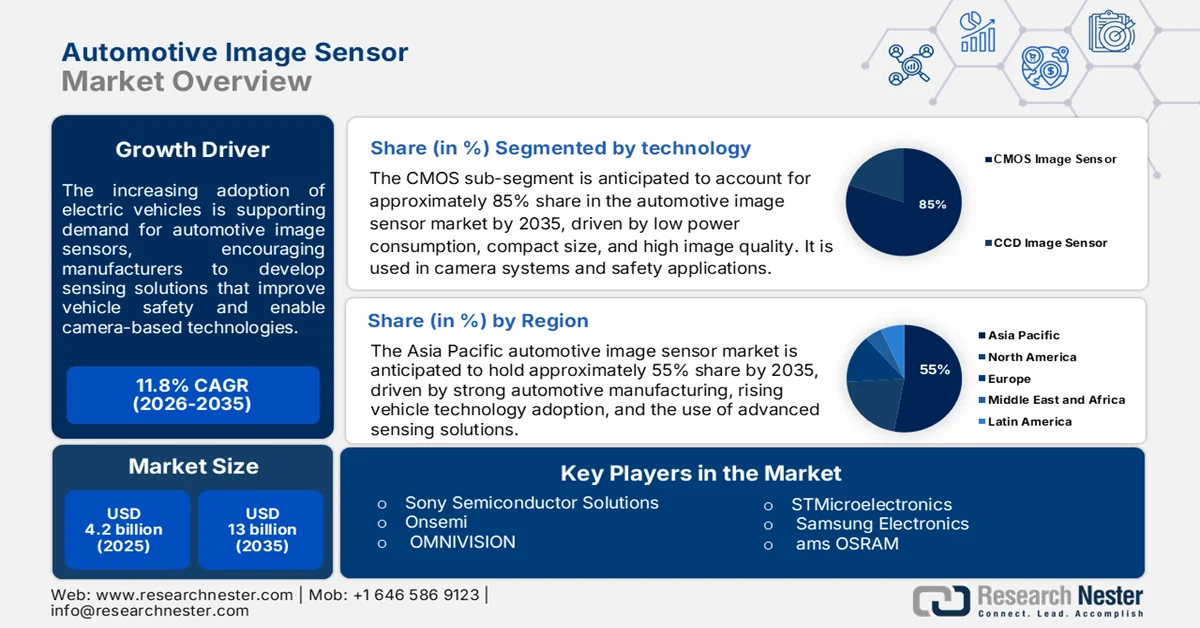
The automotive image sensor market is advancing due to increasing need for vehicle safety features, autonomous driving capabilities, and connected mobility solutions. Besides this, it is stated by the National Highway Traffic Safety Administration (NHTSA), that 40,901 people were killed in motor vehicle crashes across the United States in 2023. This growing concern regarding road safety is encouraging automakers to incorporate advanced driver assistance systems (ADAS), which include camera-based solutions for lane detection, collision prevention, and driver monitoring. These technologies use image sensors to capture and analyze visual information, which helps in incorporating advanced camera systems across passenger and commercial vehicles.
Furthermore, the rising implementation of electric vehicles is creating opportunities for automotive image sensor applications, as these vehicles highly rely on advanced sensing technologies for safety and automation. As per the International Energy Agency (IEA), electric car sales exceeded 17 million units worldwide in 2024. The increasing production of electric vehicles is encouraging automakers to develop more sophisticated vehicle architectures that include advanced sensing components for various applications. This shift toward electric mobility is expected to create additional need for automotive image sensors as manufacturers continue to enhance vehicle technologies during the forecast period.
Key Automotive Image Sensor Market Insights Summary:
Regional Highlights:
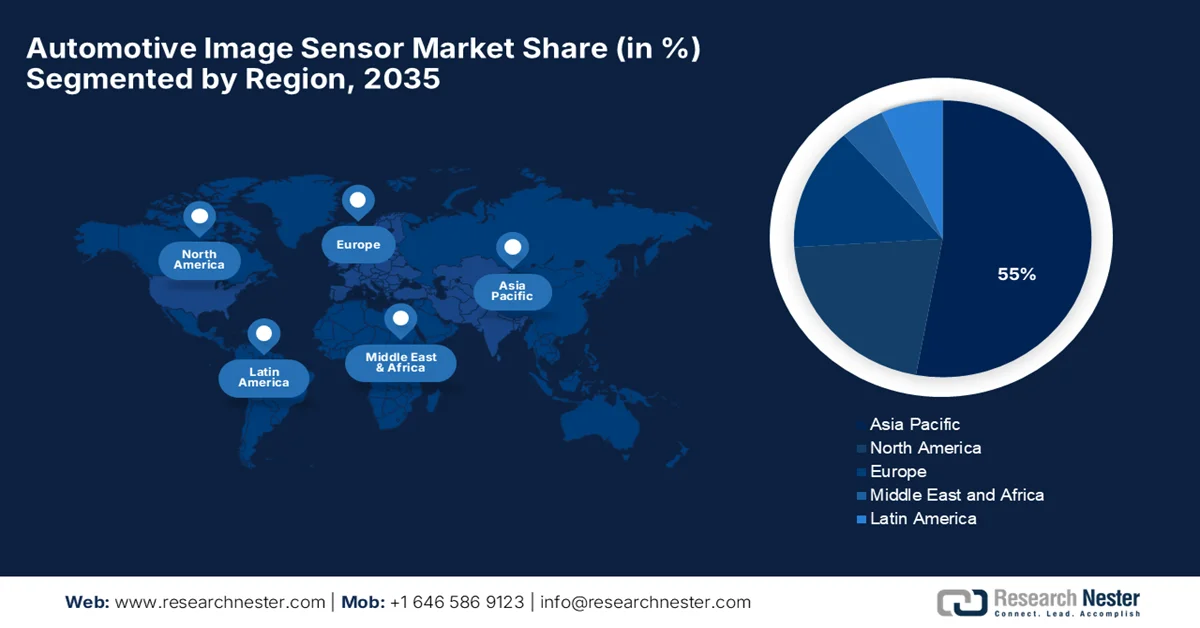
- The Asia Pacific region is anticipated to command over 55% share by 2035 in the automotive image sensor market, bolstered by the strong presence of automotive manufacturers and increasing implementation of advanced vehicle systems across the region
- North America is expected to account for a significant share throughout 2026-2035, driven by the increasing adoption of advanced driver assistance systems (ADAS) and growing investment in vehicle safety technologies
Segment Insights:
- The CMOS sub-segment is projected to capture approximately 85% share by 2035 in the automotive image sensor market, fueled by its low power consumption, compact size, and ability to deliver high-quality images for modern automotive camera systems
- The passenger vehicles sub-segment is expected to secure a significant share during 2026-2035, propelled by the increasing production of passenger vehicles equipped with camera-based technologies and electronic components that improve driving convenience and vehicle functionality
Key Growth Trends:
- Increased EV adoption and the development of fast charging stations
- Smartphone and consumer electronics boom
Major Challenges:
- Supply chain volatility and component lead time
- Regulatory complexity and integration barriers
Key Players: Sony Semiconductor Solutions, Onsemi, OMNIVISION, STMicroelectronics, Samsung Electronics, ams OSRAM.
Global Automotive Image Sensor Market Forecast and Regional Outlook:
Market Size & Growth Projections:
- 2025 Market Size: USD 4.2 billion
- 2026 Market Size: USD 4.7 billion
- Projected Market Size: USD 13 billion by 2035
- Growth Forecasts: 11.8% CAGR (2026-2035)
Key Regional Dynamics:
- Largest Region: Asia Pacific (55% share by 2035)
- Fastest Growing Region: North America
- Dominating Countries: China, Japan, United States, Germany, South Korea
- Emerging Countries: India, Mexico, Vietnam, Thailand, Brazil
Last updated on : 30 July, 2026
Automotive Image Sensor Market - Growth Drivers and Challenges
Growth Drivers
- Increasing semiconductor investment: Image sensors are an important part of automotive camera modules, which makes the development of semiconductor manufacturing an important factor for market growth. As countries continue to grow domestic chip production and strengthen semiconductor supply chains, manufacturers are expected to benefit from a more stable supply of automotive-grade image sensors. Besides this, according to the U.S. Department of Commerce, the CHIPS and Science Act of 2022 provides USD 52.7 billion to strengthen semiconductor manufacturing, research, and workforce development in the United States. Higher semiconductor production capacity is expected to improve the supply of automotive-grade image sensors and encourage manufacturers to enhance production of camera-enabled vehicle systems during the forecast period.
- Rising demand for in-cabin monitoring systems: Vehicle manufacturers are incorporating interior camera systems to monitor driver alertness and improve vehicle safety functions. The increasing implementation of in-cabin monitoring technologies is supporting the market. Additionally, according to the European Commission, from 7 July 2024, all new cars sold in the European Union are needed to include driver drowsiness and attention warning systems under the general safety guidelines. This regulatory requirement is driving the use of camera-based monitoring technologies, which is creating an additional need for automotive image sensors across new vehicle models.
- Investment in smart transportation infrastructure: The expansion of intelligent transportation infrastructure is contributing to the automotive image sensor market as governments continue to invest in digital mobility technologies. Connected transportation projects need advanced imaging solutions to help with traffic monitoring, vehicle communication, and infrastructure management. Besides this, according to the U.S. Department of Transportation, USD 85 million was awarded under the SMART Stage 2 Implementation Grants in 2024 to support smart transportation projects across the United States. The growing positioning of intelligent transportation systems is expected to encourage large use of imaging technologies in future vehicle platforms, which will help meet the need for automotive image sensors during the forecast period.
Challenges
- High development and manufacturing costs: The automotive image sensor market witnesses’ challenges due to developing and producing image sensors requiring a high investment. Manufacturers need to spend a significant amount on research, testing, and production before getting the new products to the market. This increases the overall cost of manufacturing and makes it difficult for small and medium-sized companies to compete with established players. At the same time, increasing raw material prices and higher manufacturing costs can also put pressure on business operations. These factors can slow down production plans and limit the ability of companies to develop their product portfolio, which will affect the overall growth of the market during the forecast period.
- Rapid technological changes: There is another challenge which is faced by the automotive image sensor market, which is due to changes in vehicle technologies. Manufacturers need to update their image sensor products regularly to match new vehicle designs and customer requirements. This increases the time and cost needed to keep products updated. Companies that cannot adapt to changing technologies may lose business opportunities and fall behind competitors. Additionally, automakers expect image sensors to deliver better image quality and support more vehicle functions, which is why it is difficult for manufacturers to keep pace with changing market needs. These factors can slow market development during the forecast period.
Automotive Image Sensor Market Size and Forecast:
| Report Attribute | Details |
|---|---|
|
Base Year |
2025 |
|
Forecast Year |
2026-2035 |
|
CAGR |
11.8% |
|
Base Year Market Size (2025) |
USD 4.2 billion |
|
Forecast Year Market Size (2035) |
USD 13 billion |
|
Regional Scope |
|
Automotive Image Sensor Market Segmentation:
Technology Segment Analysis
The CMOS sub-segment under the technology segment is anticipated to account for the largest share of approximately 85% in the automotive image sensor market by the end of 2035. The growth of the sub-segment is attributed to its low power consumption, compact size, and ability to deliver high-quality images, which make it suitable for modern automotive camera systems. Additionally, CMOS sensors can be easily integrated into applications that include surround-view cameras, driver monitoring systems, and parking assistance. Therefore, according to the International Energy Agency (IEA), more than 20% of all cars sold globally in 2024 were electric, which reflects the increasing use of electronically advanced vehicles that require image sensing technologies.
Vehicle Type Segment Analysis
The passenger vehicles sub-segment is expected to hold a significant share of the automotive image sensor market during the forecast period. The progress of the sub-segment is credited to the increasing production of passenger vehicles equipped with camera-based technologies and electronic components that improve driving convenience and vehicle functionality. Automakers are progressively incorporating image sensors into passenger vehicles for applications such as parking assistance, driver monitoring, and surround-view systems. Besides this, according to the European Automobile Manufacturers' Association (ACEA), there were 248.8 million passenger cars on European Union roads in 2023. The large passenger car fleet is encouraging manufacturers to increase the use of imaging technologies in new vehicle models. As consumer need for vehicles with improved comfort and convenience features continues to enhance, the implementation of automotive image sensors is expected to grow throughout the forecast period.
Our in-depth analysis of the automotive image sensor market includes the following segments:
|
Segment |
Subsegments |
|
Technology |
|
|
Vehicle Type |
|

Vishnu Nair
Head - Global Business DevelopmentCustomize this report to your requirements — connect with our consultant for personalized insights and options.
Automotive Image Sensor Market - Regional Analysis
APAC Market Insights
The Asia Pacific automotive image sensor market is anticipated to hold the largest share of over 55% by the end of 2035, which is supported by the strong presence of automotive manufacturers and increasing implementation of advanced vehicle systems across the region. There are some countries like China, Japan, and South Korea, which are contributing to market development through their established automotive industries and constant focus on vehicle technology improvements. The growing need for enhanced vehicle capabilities is encouraging manufacturers to implement image-based sensing solutions. These developments are expected to help the expansion of automotive image sensor suppliers across Asia Pacific during the forecast period.
The China automotive image sensor market is expanding due to the country’s large-scale vehicle production and strong presence of domestic and international automobile manufacturers. Furthermore, according to China’s government data, the country’s automobile production reached approximately 31.28 million units in 2024, which highlights its significant role in the global automotive industry. The growing development of smart vehicles and increasing investment in automotive electronics are encouraging manufacturers to implement advanced sensing components. Moreover, the growing development of electric and intelligent vehicles in China is helping the implementation of automotive image sensor technologies across the country.
The Japan automotive image sensor market is gaining momentum due to the country’s advanced automotive ecosystem and strong capabilities in vehicle technology development. Japanese manufacturers are continuously improving vehicle systems by integrating advanced electronic components into new vehicle models. According to the Japan Automobile Manufacturers Association (JAMA), Japan produced 8.235 million four-wheeled vehicles in 2024, highlighting its important position in global vehicle production. In this country, the presence of established automobile manufacturers and constant development in vehicle electronics are helping the use of image sensors across vehicles.
North America Market Insights
The North America automotive image sensor market is anticipated to account for a significant share during the forecast period, due to the increasing adoption of advanced driver assistance systems (ADAS) and growing investment in vehicle safety technologies. Automakers across the region are integrating more camera-based systems to improve driver awareness and comply with evolving safety guidelines. Therefore, according to the National Highway Traffic Safety Administration (NHTSA), approximately 39,254 people were killed in motor vehicle crashes in the United States in 2024, which highlights the constant focus on vehicle safety. These developments are supporting the need for automotive image sensors across North America.
The automotive image sensor market in the U.S. continues to hold a significant share in North America due to the increasing development of connected and software-defined vehicles. Besides this, it is stated by the U.S. Department of Transportation that the United States had more than 284.6 million registered vehicles in 2023. A large vehicle base, along with increasing use of electronic components in automobiles, is creating a large application scope for image sensors. The presence of established automotive companies and technology providers is further helping the development of sensing solutions across passenger and commercial vehicles.
The expansion of vehicle electronics, growing focus on connected mobility solutions, increasing adoption of advanced automotive components, and constant improvements in vehicle technologies are some of the factors that are helping the development of the automotive image sensor market in Canada. Additionally, according to Statistics Canada, Canada recorded 26.8 million registered road motor vehicles in 2024, which reflects the large vehicle base present in the country. The increasing use of electronic systems in automobiles and advancements in vehicle technology are encouraging the incorporation of image sensors across passenger and commercial vehicles. Meanwhile, the presence of automotive manufacturing facilities is contributing to the broader application of image sensor solutions in this country.
Europe Market Insights
The Europe automotive image sensor market is supported by the region’s strong vehicle manufacturing base, increasing focus on vehicle technology development, and growing use of electronic components in automobiles. Automakers across Europe are improving vehicle systems by adding advanced technologies that need better sensing capabilities. Besides this, it is stated by the European Automobile Manufacturers’ Association (ACEA) that approximately 14.8 million vehicles are manufactured annually in the European Union in 2023, highlighting the region’s large automotive production capacity. The constant expansion of connected and technology-based vehicles is creating further opportunities for automotive image sensor suppliers across Europe.
The presence of a well-established automotive industry and ongoing advancements in vehicle technologies are strengthening the automotive image sensor market in Germany. The growing use of electronic components in automobiles is creating opportunities for image sensor implementation across different vehicle applications. Therefore, according to the German Federal Statistical Office (Destatis), Germany produced approximately 4,069 passenger cars in 2024, which reflects its important position in European vehicle manufacturing. The country’s attention is on improving vehicle technologies and developing next-generation mobility solutions, which is further helping the use of automotive image sensors.
France is strengthening its position in the European automotive image sensor market as the country continues to increase next-generation mobility and vehicle electrification initiatives. Automakers are placing greater emphasis on improving vehicle electronics to help meet changing mobility requirements. Additionally, according to the German Association of the Automotive Industry (VDA), France produced 910,243 passenger cars in 2024, which showcases its constant contribution to Europe's automotive sector. Across the country, the increasing use of cameras and electronics features in vehicles is creating the need for automotive image sensors.
Key Automotive Image Sensor Market Players:
- Sony Semiconductor Solutions (Japan)
- Onsemi (U.S.)
- OMNIVISION (U.S.)
- STMicroelectronics (Switzerland)
- Samsung Electronics (South Korea)
- ams OSRAM (Austria)
- Company Overview
- Business Strategy
- Key Product Offerings
- Financial Performance
- Key Performance Indicators
- Risk Analysis
- Recent Development
- Regional Presence
- SWOT Analysis
- Sony Semiconductor Solutions Corporation develops image sensor technologies for automotive applications, which help in vehicle camera systems and sensing requirements. This company focuses on developing solutions that can help vehicle camera systems and improve sensing capabilities.
- Onsemi develops semiconductor solutions for automotive applications. Its Hyperlux™ and AR series image sensors help vehicle cameras, surround-view systems, and driver monitoring applications, which help improve vehicle safety.
- OMNIVISION focuses on image sensor solutions for automotive camera systems. Its portfolio includes automotive image sensor solutions that help applications such as ADAS and vehicle camera systems.
- STMicroelectronics provides semiconductor solutions that help in automotive electronics and imaging applications. They develop image sensor technologies that are designed for vehicle camera systems, which helps manufacturers in improving visual sensing and support advanced vehicle functions.
- Samsung Electronics develops image sensor technologies through its semiconductor division; they pay attention to solutions for automotive and mobility applications. They also provide imaging solutions that help in vehicle cameras and contribute to the development of safer and more connected vehicles.
- ams OSRAM pays attention to sensor and optical technologies for automotive and industrial applications. The company develops sensing solutions that support vehicle imaging needs and help enable camera-based systems used in modern mobility applications.
Here is a list of key players operating in the global automotive image sensor market:
The global automotive image sensor market is moderately consolidated, with the presence of major semiconductor manufacturers and specialized imaging technology companies that are competing through advanced sensing solutions for modern vehicles. The leading players such as Sony Semiconductor Solutions, onsemi, and OMNIVISION hold a strong position in the market through their automotive CMOS image sensor portfolios, which are used in applications that include ADAS, surround-view cameras, and driver monitoring systems. Moreover, competitive differentiation in the market is paying attention on improving image quality, low-light performance, processing capabilities, and integration with advanced vehicle platforms. Besides, companies are constantly developing their automotive sensing technologies to support the growing implementation of connected and automated vehicles. Additionally, manufacturers are focusing on developing compact and efficient image sensor solutions to meet the changing requirements of automotive OEMs. STMicroelectronics, Samsung Electronics, and ams OSRAM are also strengthening their presence by introducing imaging technologies designed for next-generation mobility applications.
Corporate Landscape of the Market
Recent Developments
- In February 2026, STMicroelectronics completed the acquisition of NXP Semiconductors’ MEMS sensors business to increase its sensor capabilities and strengthen its position in automotive safety and other sensing applications.
- In May 2026, Sony Semiconductor Solutions Corporation and TSMC announced a preliminary agreement to form a strategic partnership for the development and manufacturing of next-generation image sensors.
- In April 2025, OMNIVISION launched the OX01N1B automotive image sensor for driver monitoring systems, supporting in-cabin monitoring applications and camera-based safety features in modern vehicles.
- Report ID: 8711
- Published Date: Jul 30, 2026
- Report Format: PDF, PPT
- Explore a preview of key market trends and insights
- Review sample data tables and segment breakdowns
- Experience the quality of our visual data representations
- Evaluate our report structure and research methodology
- Get a glimpse of competitive landscape analysis
- Understand how regional forecasts are presented
- Assess the depth of company profiling and benchmarking
- Preview how actionable insights can support your strategy
Explore real data and analysis
Frequently Asked Questions (FAQ)
About this Report
Connect with our Expert


Report, 2026-2035



Copyright @ 2026 Research Nester. All Rights Reserved.
