Aerosol Propellant Market Outlook:
Aerosol Propellant Market size was over USD 11.9 billion in 2025 and is expected to reach USD 22.6 billion by the end of 2035, growing at a CAGR of 7.4% during the forecast timeline, i.e., 2026-2035. In 2026, the industry size of aerosol propellant is assessed at USD 12.7 billion.
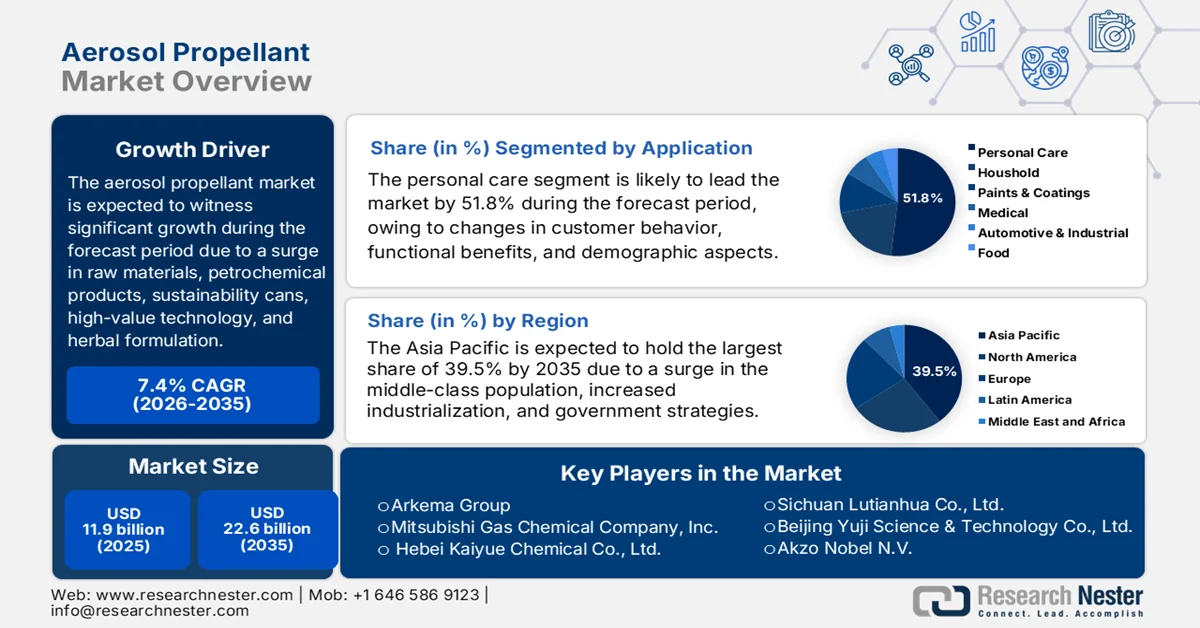
The worldwide aerosol propellant market is readily shaped by different factors, including supply chain dynamics, raw material availability, regional tariff policies, increase in sales volumes, and increase in petrochemical feedstock. According to official statistics published by Energy Research & Social Science in December 2024, utilizing nearly 16% of international oil and almost 8% of fossil fuel gas production, the petrochemical industry comprises the highest energy demand of overall industrial sectors. Additionally, the expansion of the petrochemical production has been spectacular, with capacity additions of 12 to 16 megatons every year. Moreover, by the end of 2023, the demand for oil as feedstock increased by 100%, going from 2.8 million to 5.6 million barrels every day. Therefore, with this continuous increase in the industry, there is a huge growth opportunity for the aerosol propellant market globally.
Furthermore, an expansion in the bag-on-valve technology, aluminum can light weighting and sustainability, focus on connected and smart aerosol packaging, as well as the shift towards herbal and organic formulation, are certain trends that are proliferating the aerosol propellant market globally. As per an article published by NLM in March 2022, the international natural and organic personal care products industry is valued at an estimated USD 11 billion and further reached USD 22 billion by the end of 2022. In addition, natural and organic skincare significantly maintains top billing in the worldwide organic beauty industry and emerged as the most attractive sector with a 30.9% share by the end of 2024. Besides, essential oils are highly volatile, concentrated, and constitute hydrophobic mixtures of chemicals extracted from plants, thereby proliferating the market expansion.
Key Aerosol Propellant Market Insights Summary:
Regional Highlights:
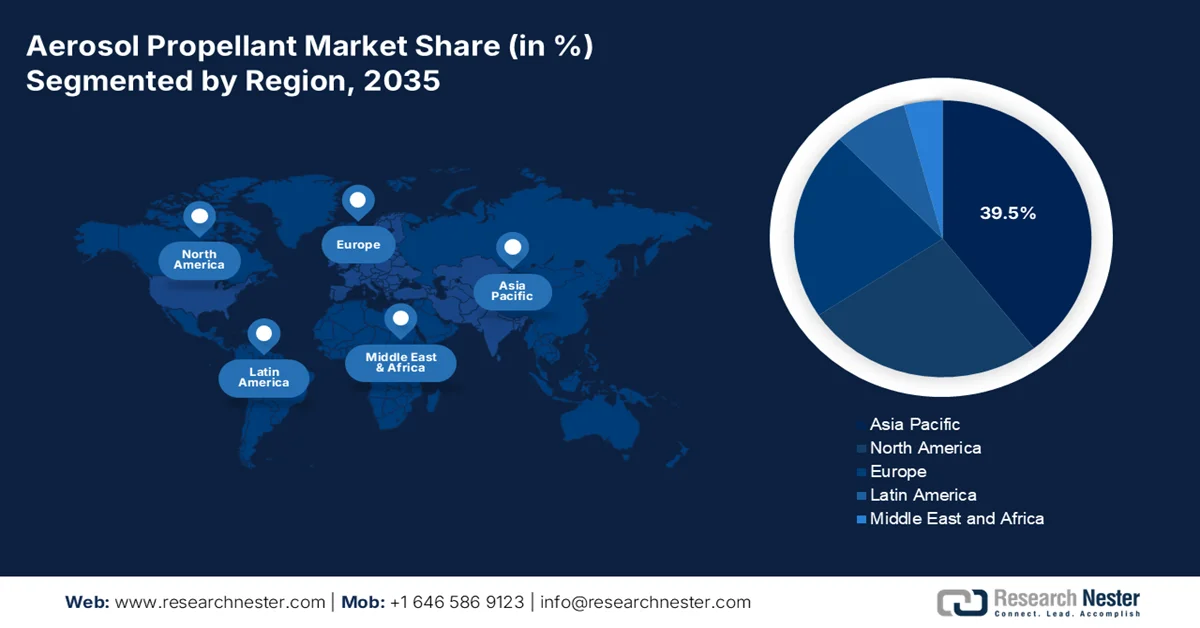
- Asia Pacific is projected to capture a 39.5% share of the aerosol propellant market by 2035, propelled by rapid urbanization, expanding middle-class populations, and increasing disposable incomes across developing economies.
- Europe is expected to witness the fastest growth during 2026–2035 in the market, stimulated by technological innovation and a strong regulatory push toward sustainable and low-GWP propellant alternatives.
Segment Insights:
- The personal care sub-segment in the aerosol propellant market is anticipated to hold a 51.8% share by 2035, attributed to the global integration of grooming and hygiene into daily routines and the functional advantages of aerosol-based personal care products.
- The metal cans segment is projected to secure the second-largest share during 2026–2035, supported by its structural strength, superior barrier properties, and recyclability benefits that enhance packaging reliability.
Key Growth Trends:
- Increased demand for dry shampoo
- Expansion in industrial maintenance
Major Challenges:
- Regulatory compliance and environmental mandates
- Volatile raw material prices and supply chain disruptions
Key Players: Honeywell International Inc. (U.S.), Aeropres Corporation (U.S.), Diversified CPC International (U.S.), Royal Dutch Shell Plc (Netherlands), Repsol S.A. (Spain), Linde Plc (UK), Nouryon (Netherlands), Evonik Industries AG (Germany), Grillo Werke AG (Germany), Arkema Group (France), Mitsubishi Gas Chemical Company, Inc. (Japan), Hebei Kaiyue Chemical Co., Ltd. (China), Henan Xinlianxin Chemical Group Co., Ltd. (China), Hebei Jichun Chemical Co., Ltd. (China), Sichuan Lutianhua Co., Ltd. (China), Beijing Yuji Science & Technology Co., Ltd. (China), Akzo Nobel N.V. (Netherlands)
Global Aerosol Propellant Market Forecast and Regional Outlook:
Market Size & Growth Projections:
- 2025 Market Size: USD 11.9 billion
- 2026 Market Size: USD 12.7 billion
- Projected Market Size: USD 22.6 billion by 2035
- Growth Forecasts: 7.4% CAGR (2026-2035)
Key Regional Dynamics:
- Largest Region: Asia Pacific (39.5% Share by 2035)
- Fastest Growing Region: Europe
- Dominating Countries: United States, China, Germany, Japan, France
- Emerging Countries: India, Brazil, Vietnam, Indonesia, Mexico
Last updated on : 9 March, 2026
Aerosol Propellant Market - Growth Drivers and Challenges
Growth Drivers
- Increased demand for dry shampoo: The aerosol propellant market is continuously growing, owing to the explosive need for wide-ranging personal care spray and dry shampoo. According to official statistics published by Environmental Research in March 2022, shampoo with water spray gained increased aerosol concentrations, with a geometric mean of 2,249 μg m to 5,779 μg m, in comparison to water aerosols, constituting 476 μg m to 927 μg m. Besides, shampoo aerosol particles with an aerodynamic diameter of 2.5 μm can significantly penetrate the alveoli when inhaled, comprising 2,000 μg m. Moreover, the volatile organic compounds present in shampoo aerosols are attached to tetradecane and dodecane backbones, thus making it suitable for bolstering the market growth.
- Expansion in industrial maintenance: The expanding scope of industrial and automotive maintenance applications demonstrates another substantial growth driver for the aerosol propellant market. Based on the PIB Government article published in April 2025, the capital goods industry in India contributes to almost 1.9% of the gross domestic product (GDP). Besides, owing to the catalytic effect of the Ministry of Heavy Industries intervention, there has been an increase in the production of the capital goods industry from USD 25.1 billion to USD 46.7 billion by the end of 2024. Moreover, the 2025-2026 Union Budget effectively proposed to add 35 additional capital products for the electric vehicle battery manufacturing, along with 28 capital goods for mobile phone battery manufacturing, thus uplifting the market exposure globally.
Capital Goods Industrial Growth Analysis in India (2019-2024)
|
Capital Goods |
2019-2020 (USD) |
2020-2021 (USD) |
2021-2022 (USD) |
2022-2023 (USD) |
2023-2024 (USD) |
|
Machine Tools |
677 million |
792 million |
1,117 million |
1,435 million |
1,628 million |
|
Dies, Moulds, and Press Tools |
1,642 million |
1,475 million |
1,575 million |
1,670 million |
1,872 million |
|
Textile Machinery |
642 million |
611 million |
1,399 million |
1,684 million |
1,757 million |
|
Printing Machinery |
1,521 million |
1,207 million |
1,586 million |
1,933 million |
2,817 million |
|
Earthmoving and Mining Machinery |
3,722 million |
3,482 million |
3,441 million |
4,506 million |
8,760 million |
|
Plastic Processing Machinery |
282 million |
445 million |
462 million |
469 million |
517 million |
|
Food Processing Machinery |
906 million |
1,230 million |
1,465 million |
1,584 million |
1,664 million |
|
Process Plant Equipment |
3,510 million |
2,633 million |
2,880 million |
2,810 million |
3,288 million |
Source: PIB Government
- Growth of the household segment: The household industry is presently experiencing structural and elevated growth, primarily attributed to sustained and heightened consumer demand, with a focus on cleanliness and hygiene, which is positively impacting the aerosol propellant market. As stated in an article published by NLM in June 2022, over 80% of human illnesses can be significantly transmitted by hands. This has readily paved the way for fueling the utilization of disinfectants globally. Besides, every year, almost 2 million people acquire nosocomial infections across different nations, and almost 90,000 deaths take place due to increased infections, especially in households. Therefore, based on the growth of infections, there is a huge growth opportunity for the market worldwide.
Challenges
- Regulatory compliance and environmental mandates: The most pervasive and structurally significant challenge confronting the aerosol propellant market is the increasingly stringent and complex web of environmental regulations. Governments and international bodies worldwide are enforcing aggressive policies to mitigate climate change and protect the ozone layer, directly targeting the chemical composition of propellants. This regulatory pressure is not a static hurdle but a dynamic and escalating force that fundamentally reshapes product portfolios, research and development priorities, and market access strategies. The core of this challenge lies in the mandated phase-out of traditional, high-performing propellants. Historically, the industry transitioned away from chlorofluorocarbons (CFCs) due to the Montreal Protocol, which is also negatively impacting the aerosol propellant market growth.
- Volatile raw material prices and supply chain disruptions: A second critical roadblock is the inherent volatility in the pricing and availability of key raw materials used in the production process. The aerosol propellant market is heavily dependent on feedstocks derived from the fossil fuel industry, such as liquefied petroleum gas (LPG), including propane and butane, as well as dimethyl ether (DME). This dependency exposes propellant manufacturers to the cyclical and often unpredictable fluctuations of the global energy and petrochemical markets. Geopolitical tensions, changes in OPEC+ production quotas, natural disasters affecting refining capacity, and shifts in global energy demand can all trigger sudden and significant price spikes for these base commodities.
Aerosol Propellant Market Size and Forecast:
| Report Attribute | Details |
|---|---|
|
Base Year |
2025 |
|
Forecast Year |
2026-2035 |
|
CAGR |
7.4% |
|
Base Year Market Size (2025) |
USD 11.9 billion |
|
Forecast Year Market Size (2035) |
USD 22.6 billion |
|
Regional Scope |
|
Aerosol Propellant Market Segmentation:
Application Segment Analysis
The personal care sub-segment, which is part of the application segment, is anticipated to garner the largest share of 51.8% in the aerosol propellant market by the end of 2035. The sub-segment’s upliftment is highly driven by the reflection of deep-seated consumer behavior patterns, demographic shifts, and the unique functional advantages that aerosol formats offer for personal hygiene and grooming products. The segment encompasses a wide array of products, including deodorants and antiperspirants, hairsprays and styling mousses, shaving foams and gels, body sprays, and sun care products, each contributing to the robust and sustained demand for propellants. The primary driver underpinning this sub- segment's leadership is the global integration of grooming and hygiene into daily, non-discretionary routines, thus boosting the aerosol propellant market exposure.
Packaging Type Segment Analysis
The metal cans segment in the aerosol propellant market is projected to account for the second-largest share during the forecast period. The segment’s growth is highly fueled by the provision of crucial structural strength to readily withstand high internal pressure, offer suitable barrier properties, and maintain a hermetic seal to combat leakage. According to official statistics published by the Aluminum Association in December 2024, 43% of aluminum cans that are significantly shipped in the U.S. as of 2023 have ultimately been recycled. This comfortably exceeds the recycling rate for glass, accounting for 39.6% and 20.0% for plastic bottles. Besides, the association’s present approach focuses on recycling over 46 billion cans as of 2023, and successfully gotten rid of almost 61 billion cans, which is nearly 15 twelve-packs of cans for every person in the country. This is equivalent to about USD 1.2 billion of aluminum that ends up in a landfill every year, thereby making it suitable for bolstering the segment’s growth.
Type Segment Analysis
By the end of the stipulated timeline, the dimethyl ether segment, part of the type, is expected to hold the third-largest share in the aerosol propellant market. The segment’s development is highly propelled by its increased utilization in personal care, including deodorants and hair spray, as well as technical products that serve as a low-toxicity and superior replacement for ozone-depleting CFCs. As per an article published by Fuel in January 2024, this particular fuel is highly utilized as an alternative option, with emission characteristics of a state-of-the-art heavy-duty compression ignition engine accounting for 11 litre displacement, which is optimized particularly for DME combustion. Besides, DME operation effectively retains the performance of the base diesel engine, catering to 338kW peak power, thereby proliferating the segment’s increasing exposure.
Our in-depth analysis of the aerosol propellant market includes the following segments:
|
Segment |
Subsegments |
|
Application |
|
|
Packaging Type |
|
|
Type |
|
|
End user |
|
|
Distribution Channel |
|
|
Formulation |
|

Vishnu Nair
Head - Global Business DevelopmentCustomize this report to your requirements — connect with our consultant for personalized insights and options.
Aerosol Propellant Market - Regional Analysis
APAC Market Insights
The Asia Pacific in the aerosol propellant market is anticipated to garner the highest share of 39.5% by the end of 2035. The market’s upliftment in the region is highly attributed to increased urbanization, expansion in middle-class populations, rapid industrialization, rise in disposable incomes, and government approaches for supporting domestic manufacturing. According to official statistics published by the State Council in March 2025, the weighted real GDP successfully reached 4.5% as of 2025, denoting an increase from 4.4% in 2024. In addition, at the purchasing power parity, the ratio of the regional GDP among the worldwide total also rose to 48.6% in 2025, denoting a surge from 48.1% as of 2024. Besides, the global dependence on China for intermediate goods stood at 16% as of 2023, which is also positively impacting the aerosol propellant market growth.
The aerosol propellant market in China is growing significantly, owing to its unparalleled manufacturing scale, an upsurge in the need for personal care, air freshener, automotive sprays, and domestic organizations upscaling butane scaling. Based on government estimates published by the ITA in June 2023, the automotive lubricants industry in the country is projected to reach 5.1 billion liters by the end of 2026, denoting a 5.4% growth rate. Besides, the overall vehicle sales for both commercial and passenger vehicles in the country increased from 26.2 million to 26.8 million as of 2022, denoting a 2.1% increase. Moreover, the overall NEV sales accounted for 8.9 million, demonstrating a 93.4% year-on-year (YoY) increase. Therefore, with this increase in automotive, the market is gradually experiencing growth and expansion in the overall country.
The expansion of the cosmetic industry, rise in the demand for automotive and household aerosol products, expansion in e-commerce, improved product accessibility, infrastructure development, and a transition toward eco-friendly formulations are bolstering the aerosol propellant market in India. According to official statistics published by the IBEF Organization in February 2025, the country is regarded as the world’s fastest-growing online industry for beauty products, with quick commerce and beauty e-commerce sales increasing by 39% in valuation between June and November 2024. Besides, the sudden transition towards online shopping reflects a structural modification in consumer behavior, especially among young demographics, with 17% of consumers purchasing beauty products online as of 2024, denoting a 13% rise from 2023, thus fueling the market demand.
Europe Market Insights
Europe in the aerosol propellant market is expected to emerge as the fastest-growing region during the forecast period. The market’s development in the region is highly propelled by value expansion through technological innovation, regulatory landscape, and a strong environmental agenda for mandating the phase-out of high-GWP propellants in favor of sustainable alternatives. According to official statistics published by the Europe Environment Agency in March 2023, 84% of the population are readily concerned about chemicals in regular products that impact their health, and 90% are focused on the impact on the environment. Besides, the chemical production in the region has hit 271 million tons, and the consumption accounted for 289 million tons. Additionally, the overall regional chemical sales enhanced 38% from USD 42.3 billion to USD 582 billion, thus driving the aerosol propellant market development.
The aerosol propellant market in the UK is gaining increasing traction, owing to an increase in cosmetic aerosols, household disinfectants, generous government fund allocation for chemical industrial strategies, and commitment towards sustainable chemistry. Based on government estimates published by the UK Government in April 2023, the country made successful progress in decarbonizing its economy by reducing emissions by 48% and enhancing it by 65%. Besides, sustainable ambitions and policies have leveraged USD 133 million as private investment for developing the latest industries and advanced low-carbon technologies that are projected to support nearly 480,000 employment opportunities by the end of 2030. Therefore, with such progression, there is a huge opportunity for the market to develop and expand in the overall country.
The increased expenditure on sustainable chemical strategies, huge demand for green chemical solutions, shift towards climate neutrality through the Chemical Industry Decarbonization program, and commitment towards low-carbon chemical processes are factors boosting the aerosol propellant market in Germany. As per an article published by the Carbon Brief Organization in February 2025, the country’s greenhouse gas emissions accounted for 672.8 million tons of carbon dioxide equivalent as of 2023. However, to combat this, the country’s target is net-zero for overall greenhouse gases by the end of 2045. This accounts for to reduce 65% emissions by the end of 2030 and 88% by the end of 2040. Therefore, with such futuristic projections, the market is gradually gaining increased traction in the overall country.
North America Market Insights
North America in the aerosol propellant market is projected to witness considerable growth by the end of the stipulated timeline. The market’s growth is highly driven by the presence of strict regulatory frameworks, focus on low-emission alternatives, and generous investments by manufacturers for research and development. According to official statistics published by the EIA Government in May 2025, energy-based carbon dioxide emissions declined in the U.S. by less than 1%, which is 23 million metric tons as of 2024. Besides, there has been an increase in the total electricity generation by 3% or 122 terawatt-hours (TWh) in 2024, denoting modifications in generation sources leading to sectoral carbon dioxide emissions. Moreover, carbon dioxide emissions gradually decreased by 3% from coal-based generation, thus boosting the market in the overall region.
Sector-Wise Total Energy-Based Carbon Dioxide Emissions in the U.S. (2020-2024)
|
Different Sector |
2020 (Million metric tons) |
2021 (Million metric tons) |
2022 (Million metric tons) |
2023 (Million metric tons) |
2024 (Million metric tons) |
|
Residential |
319 |
325 |
340 |
313 |
303 |
|
Commercial |
233 |
245 |
260 |
249 |
247 |
|
Industrial |
953 |
977 |
960 |
962 |
947 |
|
Transportation |
1,630 |
1,807 |
1,842 |
1,851 |
1,848 |
|
Electric Power |
1,450 |
1,553 |
1,539 |
1,421 |
1,427 |
Source: EIA Government
The aerosol propellant market in the U.S. is gaining increased exposure, owing to an increase in consumer demand for convenience products, a state-driven and complex regulatory environment, the existence of regulatory frameworks, along with a surge in household and personal care products. Based on government estimates published by Congress in September 2024, the Department of Defense (DOD) has readily increased the production of propellant charges for the 155 mm from 14,494 per month in September 2024 in comparison to 18,000 per month as of 2022. Moreover, additional projects have escalated the production of artillery ammunition, including GOGO facilities for producing 155 mm ammunition, such as Radford Army Ammunition Plant and Holston Army Ammunition Plant, thus creating an optimistic outlook for the market’s growth.
The aspects of federal sustainability policy, targeted industrial support, chemical management solutions, as well as the growth of advanced manufacturing and niche applications are certain factors that are fueling the aerosol propellant market in Canada. As stated in an article published by the Canada Manufacturing Technology Show in 2026, the advanced manufacturing industry readily adds USD 185 billion to the country’s GDP, has developed 1.7 million employment opportunities, and is significantly responsible for USD 360 billion in yearly exports. Besides, certain approaches have received funding from the government, such as USD 177 million to Next Generation Manufacturing Canada (NGen). This particular organization is readily behind the country’s Global Innovation Cluster for Advanced Manufacturing, thus proliferating the market expansion.
Key Aerosol Propellant Market Players:
- Honeywell International Inc. (U.S.)
- Aeropres Corporation (U.S.)
- Diversified CPC International (U.S.)
- Royal Dutch Shell Plc (Netherlands)
- Repsol S.A. (Spain)
- Linde Plc (UK)
- Nouryon (Netherlands)
- Evonik Industries AG (Germany)
- Grillo Werke AG (Germany)
- Arkema Group (France)
- Mitsubishi Gas Chemical Company, Inc. (Japan)
- Hebei Kaiyue Chemical Co., Ltd. (China)
- Henan Xinlianxin Chemical Group Co., Ltd. (China)
- Hebei Jichun Chemical Co., Ltd. (China)
- Sichuan Lutianhua Co., Ltd. (China)
- Beijing Yuji Science & Technology Co., Ltd. (China)
- Akzo Nobel N.V. (Netherlands)
- BOC Limited (UK)
- Kem One (France)
- Samnar Specialty Chemicals (India)
- Company Overview
- Business Strategy
- Key Product Offerings
- Financial Performance
- Key Performance Indicators
- Risk Analysis
- Recent Development
- Regional Presence
- Honeywell International Inc. is a key innovator in the shift toward low GWP propellants, having launched its Solstice brand of HFOs, which are non-flammable and offer zero ozone depletion potential. The company's technological expertise enables it to command a significant share of the premium market, serving customers who must comply with stringent EPA regulations.
- Aeropres Corporation is a long-standing, vertically integrated manufacturer specializing in high-purity hydrocarbon propellants and custom gas blends for the aerosol industry. As one of the key players in the U.S., its focus on operational excellence and reliable supply chain management helps it maintain a strong position in the competitive North American market.
- Diversified CPC International recently reinforced its commitment to innovation and customer partnership by opening The Power of Purity Innovation Center to develop custom, sustainable formulations. As a Sumitomo Corporation portfolio company, it leverages advanced analytical technology to ensure product purity for critical applications across the aerosol and other industries.
- Royal Dutch Shell Plc is a significant global supplier of hydrocarbon propellants like propane and butane, leveraging its vast petrochemical infrastructure to serve the aerosol market. The company's expansive reach and focus on portfolio expansion make it a reliable partner for manufacturers worldwide seeking cost-effective propellant solutions.
- Repsol S.A. is a prominent Europe-based energy player that supplies hydrocarbon propellants to the regional aerosol market, benefiting from its integrated refining operations and established distribution networks. The company is listed among the global top five players, which collectively held the majority of the revenue share in 2024, underscoring its influence in the industry.
Here is a list of key players operating in the global aerosol propellant market:
The global aerosol propellant market is characterized by a blend of large-scale integrated energy conglomerates and specialized chemical manufacturers, resulting in a moderately fragmented competitive landscape. Strategic initiatives are heavily influenced by the dual pressures of regulatory compliance and sustainability demands. Notable players are increasingly investing in the research and development of low-global-warming-potential (GWP) propellants, such as Hydrofluoroolefins (HFOs) and advanced Dimethyl Ether (DME) blends, to align with phase-downs mandated by international agreements, such as the Kigali Amendment. Besides, in April 2025, Nouryon introduced Demeon ReNu100 propellant, which is suitable for aerosol applications. This particular product readily features dimethyl ether (DME) with a natural origin index of 1 and is also made from 100% bio-based methanol, based on the mass balance strategy, thus uplifting the aerosol propellant industry.
Corporate Landscape of the Aerosol Propellant Market:
Recent Developments
- In August 2025, Salvalco expanded its production unit by establishing a brand-new manufacturing infrastructure in Thailand, with the intention to upscale production and drive advancement in the upcoming years.
- In May 2025, AstraZeneca unveiled Trixeo Aerosphere, which has been approved in the UK as the first-ever inhaled respiratory medicine by utilizing next-generation propellant, comprising 99.9% lower GWP, with near-zero global warming potential.
- In September 2023, Mentholatum collaborated with Salvalco to introduce Deep Heat and Deep Freeze sprays in the UK by utilizing the Eco-Valve technology. These brands have launched across different stores in the UK, which is followed by a rollout in overall Europe.
- Report ID: 8429
- Published Date: Mar 09, 2026
- Report Format: PDF, PPT
- Explore a preview of key market trends and insights
- Review sample data tables and segment breakdowns
- Experience the quality of our visual data representations
- Evaluate our report structure and research methodology
- Get a glimpse of competitive landscape analysis
- Understand how regional forecasts are presented
- Assess the depth of company profiling and benchmarking
- Preview how actionable insights can support your strategy
Explore real data and analysis
Frequently Asked Questions (FAQ)
About this Report
Connect with our Expert


Report, 2026-2035



Copyright @ 2026 Research Nester. All Rights Reserved.
