3D CAD Software Market Outlook:
3D CAD Software Market size was over USD 12.8 billion in 2025 and is estimated to reach USD 23.3 billion by the end of 2035, expanding at a CAGR of 6.9% during the forecast timeline, i.e., 2026-2035. In 2026, the industry size of 3D CAD software is assessed at USD 13.6 billion.
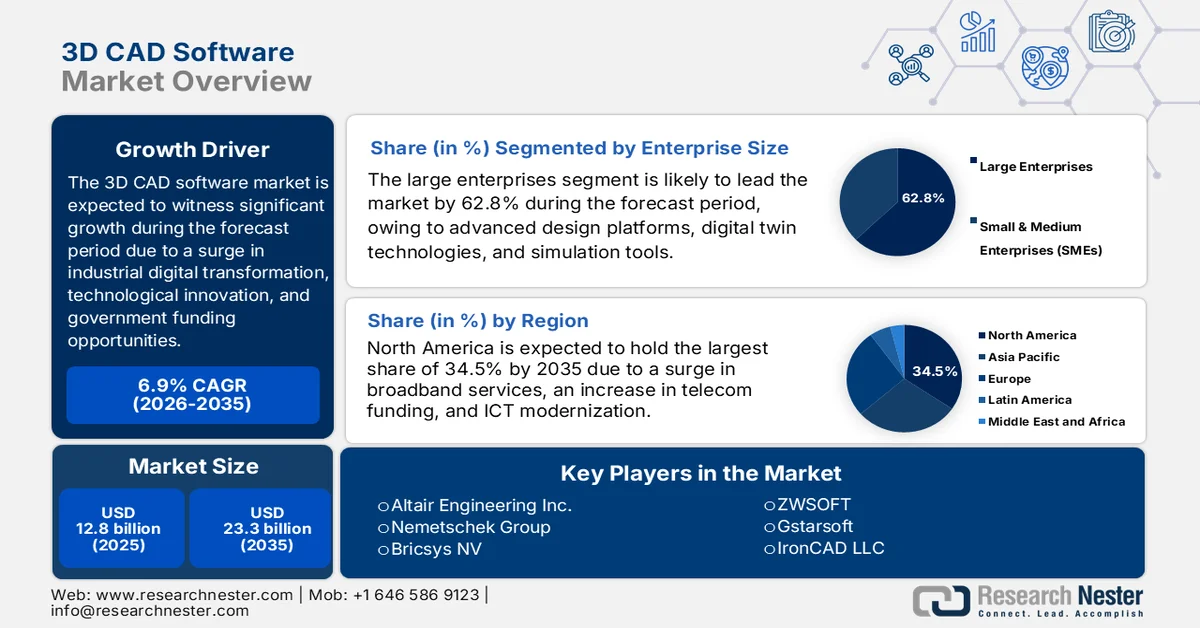
The international 3D CAD software market is rapidly expanding, highly influenced by technological advancements, government-funded strategies, and industrial digital transformation programs. Additionally, cloud computing, Industry 4.0, cross-industry collaboration, immersive design technologies, and sustainability mandates are also boosting the market’s exposure. According to official statistics published by the Digital Regulation Platform in July 2023, while digital transformation is a worldwide trend and the surrounding environment is becoming increasingly digitalized, there has been an estimation that 70% of the latest economic value is projected to be developed on digitally-enabled platforms in the upcoming years. Besides, 5% of global countries are presently equipped with mature national frameworks for digital sectors, deliberately geared at the transformational development of digital societies and economies.
Furthermore, the integration with green design and sustainability, the aspect of immersive collaboration, and an increase in the adoption of AI-driven generative design are certain trends that are bolstering the 3D CAD software market globally. As per a data report published by the UN Organization in May 2022, based on digital sustainability innovation facilities and accelerators, there has been an increase in public digital innovation support with increased focus on nature and climate impact by 30% as of 2025. Additionally, there has been a 10% increase in public digital innovation support, particularly across developing nations. Besides, as per the October 2022 Journal of Cleaner Production article, data centers significantly consume nearly 1% of international electricity power consumption, which accounts for almost 205 TWh, along with computing power of 43%, and power providing systems for another 11%, thereby making it suitable for uplifting the market’s development.
Key 3D CAD Software Market Insights Summary:
Regional Highlights:
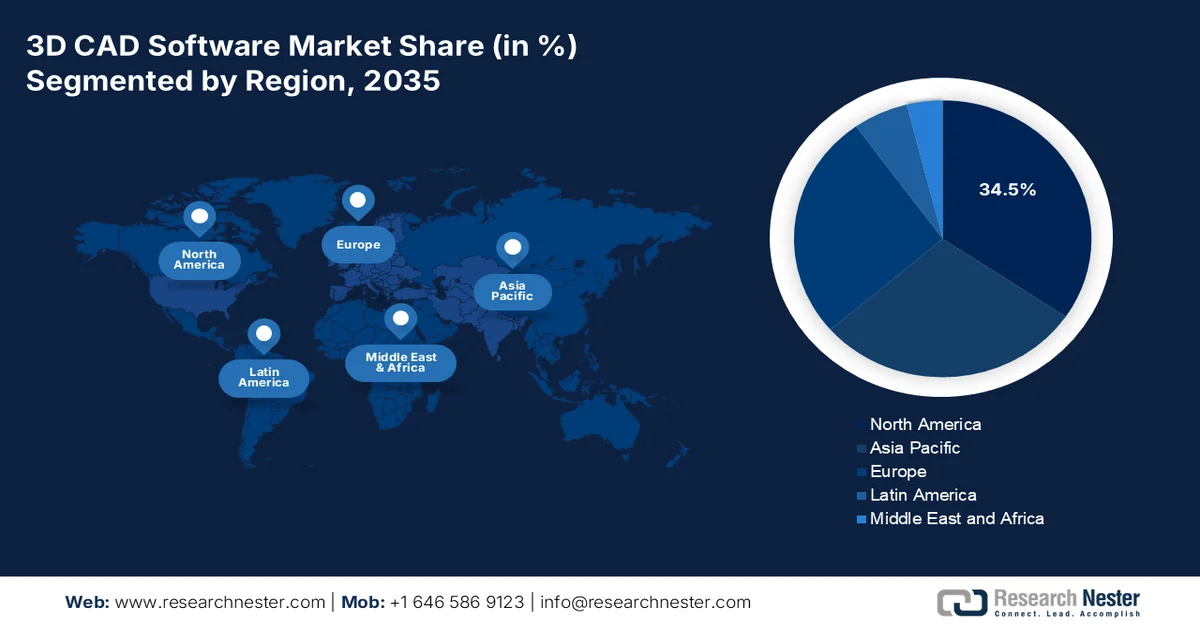
- North America in the 3d cad software market is projected to hold a dominant 34.5% share by 2035, driven by generous budget allocation for ICT modernization, broadband expansion, and rising telecom funding
- Europe is anticipated to register the fastest growth during 2026–2035, impelled by strong digital transformation initiatives, robust adoption across industrial and aerospace manufacturing, and sustainability mandates
Segment Insights:
- The large enterprises segment of the 3d cad software market is projected to capture 62.8% share by 2035, propelled by its capacity to invest in advanced design platforms, simulation tools, and digital twin technologies
- The cloud-based sub-segment is expected to secure the second-largest share during 2026–2035, driven by its ability to deliver scalable, remote, and instant access to applications through internet-enabled infrastructure
Key Growth Trends:
- Increase in government ICT investments
- Surge in healthcare device innovation
Major Challenges:
- High licensing and subscription expenses
- Data security and privacy concerns
Key Players: Autodesk Inc., Dassault Systèmes, Siemens Digital Industries Software, PTC Inc., Bentley Systems, Hexagon AB, ANSYS Inc., Trimble Inc., Altair Engineering Inc., Nemetschek Group, Bricsys NV, ZWSOFT, Gstarsoft, IronCAD LLC, CAXA Technology, Graphisoft, TopSolid (Missler Software), Kubotek3D, VariCAD, SolidCAM Ltd.
Global 3D CAD Software Market Forecast and Regional Outlook:
Market Size & Growth Projections:
- 2025 Market Size: USD 12.8 billion
- 2026 Market Size: USD 13.6 billion
- Projected Market Size: USD 23.3 billion by 2035
- Growth Forecasts: 6.9% CAGR (2026-2035)
Key Regional Dynamics:
- Largest Region: North America (34.5% Share by 2035)
- Fastest Growing Region: Europe
- Dominating Countries: - United States, Germany, Japan, China, United Kingdom
- Emerging Countries: - India, South Korea, Canada, France, Italy
Last updated on : 23 February, 2026
3D CAD Software Market - Growth Drivers and Challenges
Growth Drivers
- Increase in government ICT investments: There has been an expansion of regional and federal programs for broadband services, digital equity initiatives, and 5G deployment that are enabling comprehensive CAD integration. In addition, enhanced connectivity ensures remote industries and SMEs gain accessibility to innovative CAD platforms that are positively impacting the 3D CAD software market. Based on government estimates published by the Government of Canada in July 2025, the Digital Literacy Exchange Program (DLEP) generously invested a total of USD 29.5 million for more than 5 years, along with an additional funding of USD 17.6 million between 2022 and 2025. The ultimate purpose was to support strategies that are aimed at teaching digital literacy skills to the population in Canada, witnessing gaps to be a part of the digital economy, thus positively impacting the 3D CAD software market’s growth.
- Surge in healthcare device innovation: The healthcare industry is significantly driving the 3D CAD software market demand through personalized medical devices, surgical planning, and prosthetics. Besides, regulatory compliance and precision design requirements are also fueling CAD adoption in medical technology development. As stated in an article published by NLM in April 2023, the international digital health industry is valued at an estimated USD 211 billion as of 2022, and is further projected to grow at 18.6% on a yearly basis by the end of 2030 globally. Meanwhile, in India, the industry is valued at USD 12.2 billion as of 2023, and is further expected to reach USD 25.6 billion by the end of 2027, along with a 20.4% growth rate, thereby denoting a huge growth opportunity for the 3D CAD software market.
- Focus on cross-industry digital twin adoption: Digital twins are extending beyond manufacturing into aerospace, healthcare, and construction. Therefore, the 3D CAD software market effectively serves as the foundation for developing standard digital replicas, thus driving the need across different sectors. As stated in an article published by Decision Analytics Journal in March 2023, it has predicted that 75% of Internet of Things (IoT) organizations are also utilizing digital twin technology. In addition, by the end of 2027, more than 40% of large-scale organizations internationally are poised to utilize digital twins in their projects to bolster revenue. Besides, the digital twin industry size has been estimated to be worth USD 8 billion and is projected to grow at almost 25% by the end of 2032, thus denoting an optimistic outlook for the market’s growth.
Challenges
- High licensing and subscription expenses: The cost aspect of the 3D CAD software market remains a significant barrier, particularly for small and medium-sized enterprises (SMEs). Leading platforms such as Autodesk, Dassault Systèmes, and Siemens charge premium licensing fees, often exceeding thousands of dollars annually per user. While subscription-based SaaS models have lowered upfront costs, recurring expenses still strain budgets for smaller firms. This pricing structure limits adoption in emerging markets where cost sensitivity is high. Additionally, the need for specialized hardware to run advanced CAD applications adds to the total cost of ownership. Besides, SMEs often struggle to justify these investments against limited project budgets, slowing the overall market penetration.
- Data security and privacy concerns: With the rise of cloud-based CAD platforms, data security has become a pressing challenge in the 3D CAD software market globally. CAD files often contain proprietary product designs, intellectual property, and sensitive engineering data. Storing and sharing these files on cloud servers exposes them to risks of cyberattacks, unauthorized access, and data breaches. Industries such as aerospace, defense, and healthcare face heightened concerns due to strict compliance requirements. For instance, defense contractors must adhere to ITAR and other regulatory frameworks, making cloud adoption complex. Even with advanced encryption and multi-factor authentication, vulnerabilities persist in global data transfer and third-party integrations. The increasing reliance on collaborative design across geographies further complicates security management, thus negatively impacting the market growth.
3D CAD Software Market Size and Forecast:
| Report Attribute | Details |
|---|---|
|
Base Year |
2025 |
|
Forecast Year |
2026-2035 |
|
CAGR |
6.9% |
|
Base Year Market Size (2025) |
USD 12.8 billion |
|
Forecast Year Market Size (2035) |
USD 23.3 billion |
|
Regional Scope |
|
3D CAD Software Market Segmentation:
Enterprise Size Segment Analysis
The large enterprises segment, which is part of the enterprise size, is anticipated to garner the largest share of 62.8% in the 3D CAD software market by the end of 2035. The segment’s upliftment is highly propelled by its ability to invest in advanced design platforms, simulation tools, and digital twin technologies. These organizations typically operate across multiple geographies and industries, requiring scalable solutions that integrate seamlessly with enterprise resource planning (ERP), product lifecycle management (PLM), and manufacturing execution systems (MES). Large enterprises benefit from economies of scale, enabling them to deploy CAD solutions across thousands of engineers and designers simultaneously. Its demand is driven by complex product development cycles in automotive, aerospace, healthcare, and industrial manufacturing, where precision and compliance are critical.
Deployment Segment Analysis
The cloud-based sub-segment in the 3D CAD software market is projected to account for the second-largest share during the forecast period. The sub-segment’s growth is highly propelled by its importance for modernized business, providing scalable, remote, and instant accessibility to applications through the internet. According to official statistics published by NLM in July 2022, a data center, which is regarded as the physical repository of the cloud, significantly contributes nearly 0.3% of overall international carbon emissions, in comparison to the ICT industry accounting for over 2% of international emissions. In addition, this has been projected to increase to 20% by the end of 2030, thereby offering instant access to digital services and cloud applications with unlimited network, data, and compute scalability and storage facilities, thus boosting the sub-segment’s growth.
Price Range Segment Analysis
By the end of the stipulated timeline, the mid-priced (USD 1,000 to USD 10,000) segment, part of the price range, is expected to account for the third-largest share in the 3D CAD software market. The segment’s development is highly attributed to the aspect of balancing affordability with advanced functionality, making it attractive to both SMEs and mid-sized enterprises. Mid-priced solutions often include robust 3D modeling, simulation, and rendering capabilities, while offering flexible licensing models such as annual subscriptions or pay-per-use. Vendors, such as Autodesk’s Fusion 360, Siemens’ Solid Edge, and Dassault Systèmes’ CATIA mid-tier packages, target this segment by providing scalable solutions that can grow with business needs. The segment benefits from increasing demand in emerging markets, where cost-sensitive firms seek enterprise-grade features without premium pricing.
Our in-depth analysis of the 3D CAD software market includes the following segments:
|
Segment |
Subsegments |
|
Enterprise Size |
|
|
Deployment |
|
|
Price Range |
|
|
Application |
|
|
Functionality |
|
|
Industry Vertical |
|

Vishnu Nair
Head - Global Business DevelopmentCustomize this report to your requirements — connect with our consultant for personalized insights and options.
3D CAD Software Market - Regional Analysis
North America Market Insights
North America in the 3D CAD software market is anticipated to garner the highest share of 34.5% by the end of 2035. The market’s upliftment in the region is highly driven by generous budget provision for ICT modernization, broadband expansion, a rise in telecom funding, and the presence of wireless mobile and fixed internet services. According to official statistics published by the National Academics Organization in 2026, the telecommunications sector is gradually expanding, with the U.S. Census Bureau estimating that more than 3% of the U.S. gross domestic income (GDI) is derived from 2.6% of communication services and 0.4% from communication hardware. In addition, at 3%, telecommunications accounted for over a third of the overall fraction of the GDI spending on information technology, accounting for 7.9% of GDI, thus bolstering the market exposure in the region.
The 3D CAD software market in the U.S. is growing significantly, owing to advanced manufacturing adoption, healthcare advancement, the provision of federal ICT investments, and the allocation of generous funds towards digital infrastructure and broadband extension. As per an article published by NLM in December 2022, there have been almost 268,600 new cases of invasive breast cancer among the female population in the country, along with 62,930 non-invasive cases and nearly 41,760 deaths from breast cancer. Therefore, to combat this, CAD systems are readily being employed in the form of different imaging modalities, including histological imaging, ultrasound, magnetic resonance imaging, computerized tomography, and mammography. Besides, the aspect of domestic trade in ICT and digitally deliverable services to different countries is boosting the 3D CAD software market’s growth in the country.
U.S. Export Trade Facilities for ICT and Digital Deliverable Services by Country (2025)
|
Countries |
ICT Services Exports (USD Million) |
Digital Deliverable Services Exports (USD Million) |
||||
|
2022 |
2023 |
2024 |
2022 |
2023 |
2024 |
|
|
Overall nations |
100,758 |
103,658 |
124,435 |
641,503 |
659,675 |
729,646 |
|
Canada |
9,522 |
9,783 |
10,357 |
48,561 |
51,568 |
55,311 |
|
Austria |
46,237 |
47,354 |
58,972 |
316,812 |
322,296 |
360,970 |
|
Belgium |
- |
266 |
332 |
- |
1,264 |
1,484 |
|
Croatia |
22 |
27 |
- |
- |
142 |
143 |
|
Denmark |
531 |
546 |
637 |
- |
- |
- |
Source: U.S. Bureau of Economic Analysis
U.S. Import Trade Facilities for ICT and Digital Deliverable Services by Country (2025)
|
Countries |
ICT Services Exports (USD Million) |
Digital Deliverable Services Exports (USD Million) |
||||
|
2022 |
2023 |
2024 |
2022 |
2023 |
2024 |
|
|
Overall nations |
68,703 |
73,642 |
77,122 |
382,689 |
404,753 |
447,589 |
|
Canada |
13,054 |
12,803 |
11,719 |
30,800 |
31,933 |
- |
|
Austria |
61 |
91 |
- |
- |
- |
- |
|
Belgium |
330 |
- |
- |
3,183 |
3,154 |
- |
|
Croatia |
6 |
13 |
- |
38 |
46 |
- |
|
Denmark |
181 |
286 |
- |
1,934 |
- |
3,358 |
Source: U.S. Bureau of Economic Analysis
The aspects of government investments, an expansion in the adoption among healthcare and manufacturing services, digital transformation, and the presence of smart factory and healthcare devices ecosystems are responsible for uplifting the 3D CAD software market in Canada. As stated in an article published by the Government of Canada in November 2025, the ICT industry in the country readily supports suitable job opportunities, and each USD 1 million of direct GDP has been generated, leading to an additional USD 895,580 in generated GDP. Besides, there exist more than 48,390 organizations in the domestic ICT industry, and the large majority of over 44,870 fall within the computer and software services industries. Additionally, 153 large-scale organizations are employing more than 500 individuals, thereby denoting an optimistic outlook for the market’s growth in the country.
Europe Market Insights
Europe in the 3D CAD software market is expected to emerge as the fastest-growing region during the forecast period. The market’s development in the region is highly propelled by the presence of digital transformation programs, robust adoption in industrial, aerospace, and automotive manufacturing, and sustainability mandates. According to official statistics published by the EIB Organization in 2023, over half of regional firms, which is 53%, undertook steps to become significantly digital by offering online services. Besides, just 30% of microenterprises in the region focused on optimizing digitalization as of 2022, in comparison to 63% large-scale firms. Moreover, 69% of regional companies adopted innovative digital technologies as of 2022, in comparison to 71% in the U.S., thereby making it suitable for bolstering the 3D CAD software market.
The 3D CAD software market in the UK is gaining increased exposure, owing to an increase in smart infrastructure and building adoption, post-Brexit digital economy investments, as well as media and entertainment media sector growth. Based on government estimates published by the UK Government in February 2025, smart machines tend to increase the domestic gross value added (GVA) across different industries from £6.4 billion to a huge £150 billion by the end of 2035. This particular growth usually originates from diminished expenses, optimized productivity, and the development of new employment and industrial opportunities, thus bolstering job prospects. Besides, the UK GVA tends to be uplifted from £6.4 billion, with the country’s present automation trends amounting to £149.9 billion with the smart machine integration, thus proliferating the market’s expansion.
The aspects of generous investments for CAD software, acceleration in Industry 4.0 strategies, increased support provision through smart factory and digital twin ecosystems, especially in lightweight material advancements and automotive design, are boosting the 3D CAD software market’s growth in Germany. According to official statistics published by Germany Trade and Invest in 2026, the automation and robotics industry’s turnover forecast amounted to EUR 16.5 billion as of 2024, which is significantly equivalent to 2% growth. Besides, Europe is considered the ultimate leader of industrial additive manufacturing, which is positively impacting the market growth in the country. Additionally, 9 out of 10 organizations presently utilize or plan to utilize Industry 4.0 applications, thus denoting an optimistic outlook for the market’s growth in the overall country.
APAC Market Insights
The Asia Pacific 3D CAD software market is projected to witness considerable growth by the end of the stipulated timeline. The market’s growth in the region is highly fueled by expansion in the ICT infrastructure and government-funded digital transformational programs. According to official statistics published by the ADB Organization in 2025, the Republic of Korea and Japan, both considered the top 2 producers of industrial robots, have market shares of 12% and 52%, respectively. Besides, 77% of countries in the region have successfully adopted cybersecurity legislation, and 57% of nations have readily adopted privacy legislation and data protection. Moreover, the international spending on digital transformation is expected to reach USD 3.9 trillion by the end of 2027, with the region accounting for over 33% share of expenditure, which is fueling the market.
The 3D CAD software market in China is gaining increased exposure, owing to growth in government-based ICT expenditure, mass adoption by domestic enterprises, and the integration with innovative manufacturing. As stated in an article published by the State Council Information Office in January 2026, the country’s industrial sector reinforced artificial intelligence and advanced manufacturing, which has strengthened the economic resilience, which underpinned the 5% GDP expansion. In addition, the value added by major industrial enterprises surged by 5.9% year-on-year (YoY). Besides, the overall telecommunication business volume upsurged by 9.1% YoY, and the information and industrial sectors accounted for over 40% of the economic growth. Therefore, with such growth in the digital infrastructure, there is a huge growth opportunity for the market in the country.
The aspects of growth in the manufacturing sector, government-based digitalization, and expansion in the ICT are a few factors that are responsible for bolstering the 3D CAD software market in India. Based on government estimates published by the ITA in September 2024, the country’s digital landscape is gradually thriving, with an increase of more than 650 million smartphone users, along with over 950 million internet subscribers as of 2024. Besides, the digital economy comprises standard players, including Infosys, amounting to USD 19 billion in 2024, which is followed by USD 29 billion for Tata Consultancy Services (TCS), and USD 11 billion for Wipro. Moreover, the country’s government is readily working on upgraded e-commerce policy draft, permitting 100% FDI in B2B e-commerce firms and B2C e-commerce under the automatic route, thus proliferating the market’s expansion.
Key 3D CAD Software Market Players:
- Autodesk Inc. (U.S.)
- Dassault Systèmes (France)
- Siemens Digital Industries Software (Germany)
- PTC Inc. (U.S.)
- Bentley Systems (U.S.)
- Hexagon AB (Sweden)
- ANSYS Inc. (U.S.)
- Trimble Inc. (U.S.)
- Altair Engineering Inc. (U.S.)
- Nemetschek Group (Germany)
- Bricsys NV (Belgium)
- ZWSOFT (China)
- Gstarsoft (China)
- IronCAD LLC (U.S.)
- CAXA Technology (China)
- Graphisoft (Hungary)
- TopSolid (Missler Software) (France)
- Kubotek3D (U.S.)
- VariCAD (Czech Republic)
- SolidCAM Ltd. (Israel)
- Company Overview
- Business Strategy
- Key Product Offerings
- Financial Performance
- Key Performance Indicators
- Risk Analysis
- Recent Development
- Regional Presence
- Autodesk Inc. remains a global leader in CAD innovation, with its flagship AutoCAD and Fusion 360 platforms widely adopted across industries. The company is aggressively expanding cloud-native SaaS offerings to capture SMEs and enhance collaboration. Strategic focus includes AI-driven generative design and integration with digital twins to support Industry 4.0 transformation.
- Dassault Systèmes leverages its 3DEXPERIENCE platform to deliver sustainable innovation across manufacturing, healthcare, and aerospace. The company is investing heavily in AI and virtual universes to redefine product design and lifecycle management. Its reaffirmed 2025–2030 growth outlook emphasizes digital transformation and software-defined industries.
- Siemens Digital Industries Software drives adoption of NX and Solid Edge, recognized as highly innovative CAD solutions. The company integrates industrial AI, digital twins, and MCAD-ECAD collaboration to strengthen its competitive edge. Frost & Sullivan positioned Siemens at the top of the CAD innovation index, highlighting its strong growth trajectory.
- PTC Inc. emphasizes model-based product development, simulation-driven design, and AI-powered automation in its CAD strategy. The company’s Creo platform is central to its digital transformation initiatives, aligning with Industry 4.0 adoption. In 2025, PTC identified CAD trends that directly impact business outcomes, focusing on efficiency and integration with manufacturing systems.
- Bentley Systems specializes in infrastructure engineering software, with MicroStation and digital twin solutions at its core. The acquisition of Cesium in 2024 enhanced its 3D geospatial capabilities, strengthening its infrastructure-focused CAD offerings. Its growth strategy emphasizes AI adoption, sustainability mandates, and cloud migration to expand globally.
Here is a list of key players operating in the global 3D CAD software market:
The global 3D CAD software market is highly competitive, dominated by U.S. and Europe-based firms such as Autodesk, Dassault Systèmes, Siemens, and PTC, alongside emerging Asia-specific players, including ZWSOFT and Gstarsoft. Strategic initiatives include cloud-native CAD platforms, AI-driven automation, and integration with AR/VR for immersive design. Companies are investing in subscription-based SaaS models to capture SMEs and expanding into the Asia Pacific manufacturing hubs. Partnerships with ICT providers and government-backed digital transformation programs further strengthen market positioning. Besides, in June 2025, Siemens Digital Industries Software unveiled 2 latest solutions to its Electronic Design Automation portfolio. These are suitable for assisting semiconductor design teams in overcoming and addressing the complexity risks related to the manufacture and design of 2.5D and 3D integrated circuit designs, thus driving the 3D CAD software industry internationally.
Corporate Landscape of the 3D CAD Software Market:
Recent Developments
- In October 2025, Accenture introduced Physical AI Orchestrator, which is a solution to assist manufacturers significantly reinventing present and future warehouses and factories to emerge as software-defined.
- In August 2025, NVIDIA notified newest NVIDIA Omniverse libraries, along with NVIDIA Cosmos world foundation models, intended to escalate the creation and deployment of robotic solutions and stimulate the real world in 3D by utilizing sensor data.
- In March 2025, Samsung Electronics announced the availability of its latest Odyssey gaming monitors and the ViewFinity S8, which further comprises the revolutionary Odyssey 3D and the outstanding Odyssey OLED G8, featuring an industry-specific 4K and 240Hz screen for delivering excellence to modernized gamers.
- Report ID: 8402
- Published Date: Feb 23, 2026
- Report Format: PDF, PPT
- Explore a preview of key market trends and insights
- Review sample data tables and segment breakdowns
- Experience the quality of our visual data representations
- Evaluate our report structure and research methodology
- Get a glimpse of competitive landscape analysis
- Understand how regional forecasts are presented
- Assess the depth of company profiling and benchmarking
- Preview how actionable insights can support your strategy
Explore real data and analysis
Frequently Asked Questions (FAQ)
About this Report
Connect with our Expert


Report, 2026-2035



Copyright @ 2026 Research Nester. All Rights Reserved.
