Window Lift Motors Market Outlook:
Window Lift Motors Market size was valued at USD 437.7 million in 2025 and is projected to cross USD 927.6 million by the end of 2035, expanding at more than 7.8% CAGR during the forecast period, i.e., 2026-2035. In 2026, the industry size of window lift motors is assessed at USD 471.8 million.
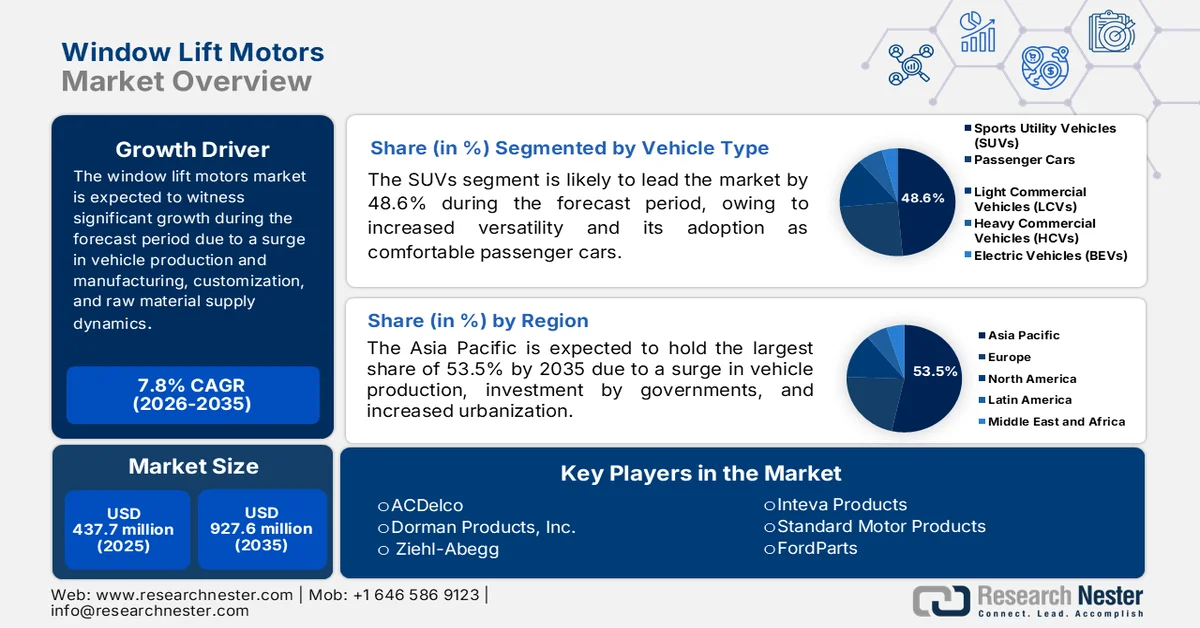
The global window lift motors market is readily shaped by different foundational factors, such as supply chain configuration, precise coordination, an increase in vehicles, the demand for sustained replacement, expansion in e-commerce platforms, raw material expenses, and a shift in consumer preferences for vehicle retrofitting and personalization. According to official statistics published by the IEA Organization in May 2026, international electric car sales are projected to reach 23 million and account for nearly 30% of overall vehicle sales by the end of 2026. Besides, as of 2025, electric car sales surged by 20% to 20 million. Meanwhile, across 40 countries, electric cars catered to 10% of the latest car purchases, with China-based automakers supplying 60% of electric cars globally. Likewise, North America and Europe automakers are responsible for each of 15% of the sales, thereby enhancing the window lift motors market demand.
2024 Cars Global Export and Import Analysis
|
Countries/Components |
Export (USD) |
Import (USD) |
|
Germany |
169.0 billion |
69.8 billion |
|
Japan |
116.0 billion |
- |
|
China |
90.3 billion |
- |
|
U.S. |
- |
216.0 billion |
|
UK |
- |
54.5 billion |
|
Global Trade Valuation |
973.0 billion |
|
|
Global Trade Share |
4.2% |
|
|
Product Complexity |
0.7 |
|
Source: OEC
Furthermore, the integration of self-diagnostic and predictive failure alerts, the suitable development of application-based motor platforms, the emergence of gesture and voice-controlled window operation, and the adoption of 48-volt electrical architectures in window systems are a few trends that are responsible for fueling the window lift motors market globally. As stated in an article published by the International Journal of Science, Engineering, and Technology in June 2025, through digitalized addiction and automobile technology, more than 10 million electric vehicles were sold as of 2023. Based on this growth, the forecast is further predicted to range between 50% and 60% of the industry penetration across the majority of economies by the end of 2030. Simultaneously, vehicle updates and software presently cater to 30% to 40% of overall vehicle differentiation, thus positively impacting the window lift motors market growth.
Key Window Lift Motors Market Insights Summary:
Regional Highlights:
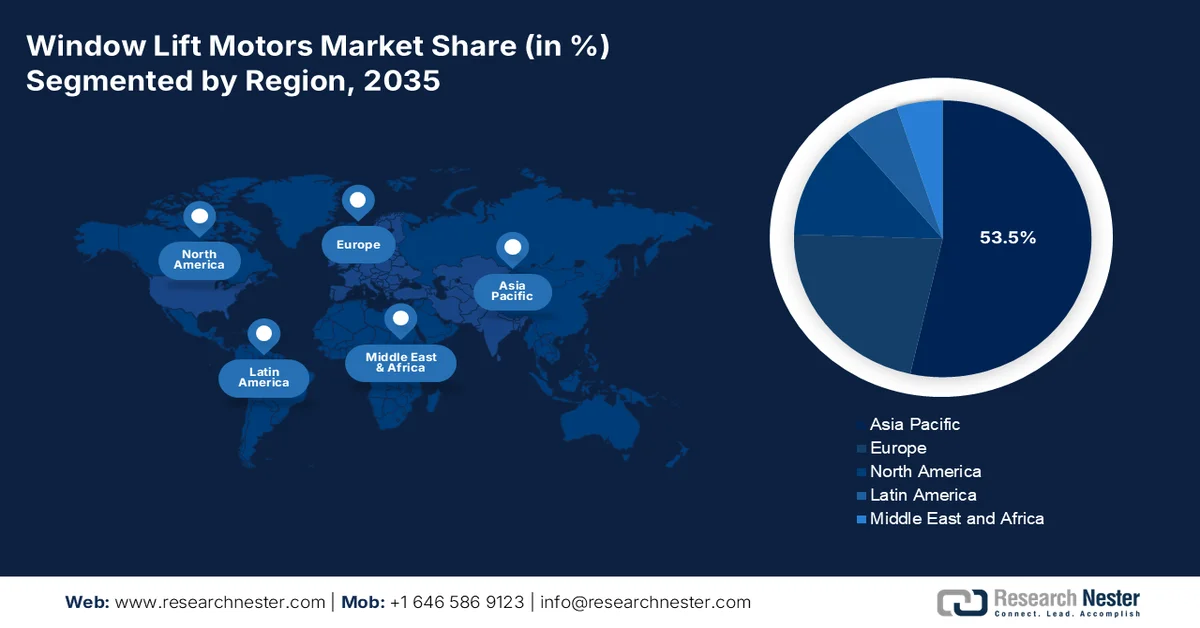
- During 2026–2035, the window lift motors market in Asia Pacific is anticipated to secure a 53.5% share by 2035, stimulated by rapid urbanization, rising vehicle production, growing demand for comfort features, supportive EV policies, increasing disposable incomes, and the transition toward smart automotive solutions
- North America is expected to emerge as the fastest-growing regional landscape in the forecast period for window lift motors, advancing through increasing consumer preference for advanced vehicle features, rapid electrification, stringent safety regulations, and a strong aftermarket ecosystem
Segment Insights:
- The SUVs segment in the window lift motors market is projected to account for a 48.6% share by 2035, underpinned by unmatched versatility combining off-road ruggedness with passenger vehicle comfort
- The brushed DC motor segment is poised to capture the second-largest share during 2026–2035, energized by affordability, simple control systems, higher starting torque, and compatibility with direct DC power operation
Key Growth Trends:
- Rapid expansion in fleet services and mobility
- Increased demand for retrofitting
Major Challenges:
- Stringent safety and noise regulations
- Technical complexity from lightweighting and door integration
Key Players: Bosch (Germany), Brose Fahrzeugteile SE & Co. KG (Germany), Denso Corporation (Japan), Mitsuba Corp. (Japan), Mabuchi Motor Co., Ltd. (Japan), HI-LEX Corporation (Japan), Johnson Electric (Hong Kong), Valeo (France), Antolin (Spain), Hella (Germany), Kuster (Germany), Inteva Products (U.S.), Standard Motor Products (U.S.), FordParts (U.S.), ACDelco (U.S.), Dorman Products, Inc. (U.S.), DY Auto (South Korea), Ningbo Hengte Automobile Parts Co., Ltd. (China), Ningbo Jingcheng Motor Co., Ltd. (China), NANTONG LIANKE AUTOMOBILE PARTS CO., LTD. (China), OKI (Japan), Ziehl-Abegg (Germany).
Global Window Lift Motors Market Forecast and Regional Outlook:
Market Size & Growth Projections:
- 2025 Market Size: USD 437.7 million
- 2026 Market Size: USD 471.8 million
- Projected Market Size: USD 927.6 million by 2035
- Growth Forecasts: 7.8% CAGR (2026-2035)
Key Regional Dynamics:
- Largest Region: Asia Pacific (53.5% Share by 2035)
- Fastest Growing Region: North America
- Dominating Countries: Japan, Germany, China, United States, South Korea
- Emerging Countries: South Korea, Vietnam, Brazil, Mexico, Indonesia
Last updated on : 21 May, 2026
Window Lift Motors Market - Growth Drivers and Challenges
Growth Drivers
- Rapid expansion in fleet services and mobility: The increased proliferation of ride-sharing platforms, corporate vehicle fleets, and car rental services has led to a distinctive demand source for the window lift motors market globally. According to official statistics published by the UNCTAD Organization in 2024, the worldwide fleet increased at a yearly rate of 3.4% as of 2023, demonstrating a rise from 3.2% in 2022, along with the overall fleet capacity reaching nearly 2.4 billion weight tons. On the other hand, based on the 2025 IEA Organization report, the fleet of electric vehicles is expected to reach 250 million by 2030, which is 4-times as many electric vehicles sold in 2024. Besides, over 90% of these fleets accounted for electric cars, which readily denotes an optimistic outlook for the market growth.
- Increased demand for retrofitting: A substantial portion of the active vehicle fleet continues to operate across emerging economies, such as Latin America, Africa, and Southeast Asia, which is also proliferating the window lift motors market demand. As stated in an article published by the UNECE Organization in October 2024, the electric vehicle retrofitting industry is significantly valued at USD 65.9 billion as of 2023, and is further anticipated to reach USD 125.3 billion by the end of 2032. Besides, in terms of economy, the Asia Pacific accounts for 62.5% of automotive electric retrofitting powertrains, which is followed by 17.3% in Europe, 10.7% in North America, 4% in Latin America, and 2.1% in the Middle East and Africa. Therefore, with this increased exposure in retrofitting, there is a huge growth opportunity for the market globally.
Automotive Electric Vehicle Retrofitting Industrial Size, 2021-2030
|
Year |
Industrial Size (USD Billion) |
|
2021 |
61.8 |
|
2022 |
65.9 |
|
2023 |
70.5 |
|
2024 |
75.5 |
|
2025 |
81.0 |
|
2026 |
86.9 |
|
2027 |
93.3 |
|
2028 |
100.3 |
|
2029 |
107.9 |
|
2030 |
116.3 |
Source: ENECE Organization
Challenges
- Stringent safety and noise regulations: The presence of regulatory bodies globally has imposed increasingly strict requirements for the window lift motors market. Based on this, mandates demand anti-pinch systems with very rapid response times, pressuring motor manufacturers to integrate Hall-effect sensors or optical encoders directly onto the motor shaft. Similarly, interior noise standards now limit window motor operational noise to very low decibel levels in electric vehicles and moderately low levels in ICE vehicles. Therefore, meeting both requirements simultaneously, such as fast response and near-silent operation, requires brushless direct current (DC) motors with sinusoidal commutation and precision-molded polymer gears. However, brushless motors cost significantly more than conventional brushed units, which limits the market expansion.
- Technical complexity from lightweighting and door integration: Modern vehicle architectures demand increasingly lighter and more integrated window lift systems. A typical door module now combines the window motor, regulator, control unit, speaker, and wiring harness into a single compact assembly. This requires motor housings to shift from steel to high-performance polymers while maintaining adequate torque output. Besides, polymer housings have launched thermal expansion mismatches, leading to gear binding in extreme climate conditions. Furthermore, integrated brushless motors with embedded electronics need to pass high-pressure water and dust ingress testing, which adds sealing and potting complexity and cost, thereby restricting the window lift motors market's upliftment.
Window Lift Motors Market Size and Forecast:
| Report Attribute | Details |
|---|---|
|
Base Year |
2025 |
|
Forecast Year |
2026-2035 |
|
CAGR |
7.8% |
|
Base Year Market Size (2025) |
USD 437.7 million |
|
Forecast Year Market Size (2035) |
USD 927.6 million |
|
Regional Scope |
|
Window Lift Motors Market Segmentation:
Vehicle Type Segment Analysis
Based on the vehicle type, the SUVs segment is anticipated to account for the largest share of 48.6% in the window lift motors market by the end of 2035. The segment’s upliftment is primarily attributed to its importance due to its unmatched versatility, which is combined with the ruggedness of off-roaders, as well as comfort for passenger cars. According to official statistics published by the IEA Organization in February 2023, despite supply chain risks and increased inflation, there has been a surge in global SUV sales by almost 3% as of 2022. Additionally, this particular vehicle type catered to nearly 46% of worldwide car sales, with growth in India, the U.S., and Europe. Besides, there has also been an upsurge in electric SUVs, constituting for almost 16% of overall sales in the same year. Simultaneously, more than 400 electric car models are readily available, of which nearly 55% are SUVs, thus enhancing the segment’s demand globally.
SUV Car Sales Analysis, 2012-2022
|
Year |
Conventional SUVs (Million) |
Electric SUVs (Million) |
||
|
Advanced Economies |
Emerging and Developing Economies |
Advanced Economies |
Emerging and Developing Economies |
|
|
2012 |
6.7 |
7.6 |
- |
- |
|
2013 |
7.3 |
9.1 |
- |
- |
|
2014 |
8.8 |
10.0 |
- |
- |
|
2015 |
10.3 |
11.5 |
0.1 |
- |
|
2016 |
11.9 |
14.7 |
0.1 |
0.1 |
|
2017 |
13.5 |
16.0 |
0.1 |
0.2 |
|
2018 |
15.7 |
14.8 |
0.2 |
0.4 |
|
2019 |
16.4 |
14.6 |
0.2 |
0.4 |
|
2020 |
14.0 |
15.0 |
0.7 |
0.5 |
|
2021 |
14.5 |
15.7 |
1.7 |
1.4 |
|
2022 |
13.8 |
15.1 |
2.5 |
3.0 |
Source: IEA Organization
Motor Type Segment Analysis
During the forecast period, the brushed DC motor segment, which is part of the motor type, is projected to grab the second-largest share in the window lift motors market. The segment’s growth is effectively driven by its necessity for affordability, simple control systems, and increased starting torque, along with direct operation from a DC-based power source without complex external electronics requirements. Additionally, this segment remains the most widely adopted motor type for window lift applications across the global automotive industry. Its enduring popularity stems from a combination of straightforward electromechanical design, mature manufacturing processes, and cost-effective production at scale. In a brushed DC motor, electrical current flows through stationary carbon brushes that contact a rotating commutator, generating the magnetic field required to turn the motor shaft.
Sales Channel Segment Analysis
The OEM sub-segment in the sales channel segment is expected to account for the third-largest share in the window lift motors market by the end of the stipulated timeline. The sub-segment’s development is highly propelled since it represents the primary route to market for window lift motors manufacturers, encompassing direct supply agreements with automotive original equipment manufacturers for installation during vehicle production. In this particular channel, tier-1 and tier-2 suppliers engage in long-term contracts spanning multiple vehicle model generations, requiring rigorous qualification processes, just-in-time delivery capabilities, and adherence to automotive quality standards. Moreover, OEM relationships are characterized by high-volume, predictable orders but come with significant pricing pressure, as automakers continuously negotiate cost reductions year over year.
Our in-depth analysis of the window lift motors market includes the following segments:
|
Segment |
Subsegments |
|
Vehicle Type |
|
|
Motor Type |
|
|
|
|
Mechanism Type |
|
|
Door Position |
|
|
Vehicle Class |
|

Vishnu Nair
Head - Global Business DevelopmentCustomize this report to your requirements — connect with our consultant for personalized insights and options.
Window Lift Motors Market - Regional Analysis
APAC Market Insights
The Asia Pacific in the window lift motors market is anticipated to grab the highest share of 53.5% by the end of 2035. The market’s upliftment in the region is primarily attributed to rapid urbanization, a rise in vehicle production, an increase in the consumer demand for comfort features, government policies for promoting the electric vehicle adoption, a rise in disposable incomes, and a sudden shift towards smart automotive solutions. For instance, as per the August 2025 Science Publishing Group article, the industrial unit sales for passenger cars, particularly in Cambodia, have successfully reached 1,060 vehicles, which amounted to USD 23.9 million as of 2025. In addition, the country comprises 6 automotive assembly sectors as of 2024, which is projected to increase in the upcoming years through investment opportunities, which is bolstering the window lift motors market in the overall region.
The window lift motors market in China is growing significantly, owing to the massive automotive production base, strong government reforms for the electric vehicle adoption, the existence of subsidy programs for escalating the electric vehicle penetration, automotive technology upgradation, and domestic manufacturing capabilities. According to official statistics published by the China Organization in May 2026, new-energy vehicles (NEVs) significantly accounted for 53.2% of overall new car sales in April, demonstrating a rise from 47.3% in 2024. Additionally, in the first 4 months of 2026, NEV sales in the country effectively reached 4.3 million units, while overall auto exports increased by 61.5% to 3.1 million units, and NEV exports doubled to 1.3 million units. Therefore, with a continuous increase in production, there is a huge growth opportunity for the market in the country.
The aspects of safety regulations, artificial intelligence (AI) integration, electric vehicle policy push, the availability of aftermarket retrofit kits, material advancements, and the presence of a connected vehicle ecosystem are certain factors that are responsible for bolstering the window lift motors market in Japan. The industry’s upliftment in the country amounted to USD 441.8 million as of 2025, which is further predicted to be worth USD 467.5 million by 2026 and USD reach USD 715 million by 2035. As per an article published by the ITA in June 2023, the passenger electric vehicle industry in the country has effectively set record sales, with 58,813 battery electric vehicles sold as of 2022, indicating 2.7-times increased sales in comparison to 2021. Besides, the battery electric vehicle ratio surged to 1.7% in 2022, easily exceeding 0.6% in 2021. In addition, the sales of these particular vehicles in the country are expected to boost and become 100% environment-friendly vehicles by the end of 2035, thus positively impacting the market growth and exposure.
Japan Vehicle Export Analysis, 2025
|
Categories |
Approximate Units |
|
New Vehicle Exports |
3.9 million to 4.0 million |
|
Utilized Vehicle Exports |
1.7 million |
|
Overall Vehicle Exports |
5.6 million |
Source: TradeImex
North America Market Insights
North America in the window lift motors market is expected to emerge as the fastest-growing region during the forecast period. The market’s development in the region is highly propelled by a rise in consumer inclination to advanced vehicle features, rapid electrification, strict and safety regulations, and a strong aftermarket ecosystem, which is supported by conventional auto parts retailers and e-commerce platforms. According to official statistics published by the Federal Reserve Bank of Chicago in December 2022, electric vehicle sales, especially in the U.S., totaled 1,434,637, which consisted of 459,474 battery electric vehicle sales, followed by 799,046 hybrid electric vehicles, and 176,117 plug-in hybrid electric vehicles. Based on these sales, the Biden administration has successfully set an objective for electric vehicles to account for 50% of the newest vehicles purchased in the U.S. by the end of 2030.
The window lift motors market is gaining increased traction in the U.S., owing to the dominance in pickup and SUV trucks, the 24-volt motor integration, which is highly driven by last-mile and e-commerce delivery, the robust aftermarket replacement demand for vehicle parc driving, and the smart motor adoption, along with body control systems. The country readily possesses a massive in-use vehicle parc that exceeds millions of units, and is eventually developing a suitable recurring need for window lift motors out of OEM installations. Besides, replacement cycles in the country are highly driven by regulatory failures, motor wear, heat exposure, and electrical faults. Moreover, there have been fluctuations in the yearly vehicle miles travelled in the U.S., but at present it is continuously growing, which is proliferating the window lift motors market expansion.
Annual Travelled Vehicle Miles in the U.S., 2015-2025
|
Year |
Vehicle Miles (Trillion) |
|
2015 |
3.0 |
|
2016 |
3.1 |
|
2017 |
3.1 |
|
2018 |
3.2 |
|
2019 |
3.2 |
|
2020 |
3.2 |
|
2021 |
2.8 |
|
2022 |
3.1 |
|
2023 |
3.2 |
|
2024 |
3.2 |
|
2025 |
3.2 |
Source: Department of Energy
The increase in the demand for luxury vehicles with innovative window motor technology, a rise in disposable income that is fueling expenditure on automotive upgradation, an increase in the focus on passenger comfort and convenience features, and electric vehicle adoption driving technological upgradation are a few trends that are boosting the window lift motors market in Canada. As per an article published by the ITA in April 2026, the automotive aftermarket yearly retail valuation in the country is expected to reach USD 9 billion by the end of 2030. Meanwhile, domestic imports of automotive components and parts totaled USD 18.5 billion, demonstrating an increase by an estimated 19.7%. Moreover, the country’s regulatory environment for the automotive industry is also harmonized, which is equivalent to the U.S., with more than 90% road-safety regulations, which is driving the market development.
Automotive Industry Analysis in Canada, 2022-2025
|
Components (USD Million) |
2022 |
2023 |
2024 |
2025 |
|
Overall Localized Production |
63,163 |
77,109 |
69,213 |
65,872 |
|
Overall Exports |
48,524 |
60,875 |
55,770 |
51,069 |
|
Overall Imports |
79,920 |
89,430 |
88,307 |
85,132 |
|
Imports from the U.S. |
51,143 |
51,902 |
50,606 |
45,545 |
|
Overall Industry Size |
94,560 |
105,664 |
101,750 |
99,934 |
|
Exchange Rates |
1.3 |
1.34 |
1.36 |
1.4 |
Source: ITA
Europe Market Insights
Europe in the window lift motors market is projected to witness suitable growth and expansion by the end of 2035. The market’s growth in the region is highly fueled by a robust automotive manufacturing base, premium vehicle production, strict regulatory environment, strong climate policies, an increase in electric vehicle adoption, and the demand for energy-efficient brushless window lift motors. According to official statistics published by the Jacques Delors Institute in January 2025, the automotive industry in the region accounts for 13 million employment opportunities or 7% of overall regional employment, along with 2.4 million people employed in the manufacturing sector. Besides, the presence of industrial suppliers and OEMs in the industry substantially contributes to domestic research and development-based investment, accounting for 14% as of 2022, thereby bolstering the window lift motors market exposure in the region.
Automotive Production Landscape in Europe, 2025
|
Countries |
Internal Combustion Energy |
Electric Vehicle |
Engine |
Transmission |
|
Sweden |
1 |
- |
1 |
- |
|
Finland |
1 |
- |
- |
- |
|
Russia |
22 |
1 |
8 |
5 |
|
UK |
21 |
4 |
10 |
5 |
|
Germany |
34 |
17 |
16 |
11 |
|
Netherlands |
2 |
- |
1 |
- |
Source: Jacques Delors Institute
The window lift motors market in Germany is gaining increased exposure, owing to the presence of automakers, motors with advanced features, generous funding provision for automotive technology innovation and electric vehicle charging infrastructure, supply chains for motor components, extensive research into lightweight motor materials, and stringent adherence to regional emission regulations. As stated in an article published by the Federal Ministry for Economic Affairs and Energy in 2026, a purchase grant is significantly paid for the newest vehicles, amounting to USD 4,635.1 for non-hybrid electric cars and USD 3,476.3 for plug-in hybrid cars. This particular grant is paid towards the commercialization of cars, with a price list of USD 69,523.8, with the overall funding amounting to USD 1.3 billion, which is positively boosting the market in the country.
The automotive manufacturing industry undergoing suitable transformation, along with an increase in investments for electric vehicle production infrastructures, the government’s zero-emission vehicle mandate, funds for domestic supply chain development, and an increase in motor technologies are certain trends that are enhancing the window lift motors market in the UK. As per the September 2023 UK Government article, 80% of the latest cars and 70% of the newest vans are increasingly sold in Great Britain, which are effectively set to be zero emission by the end of 2030, and further projected to increase to 100% by 2035. Moreover, the government is backing the sale of electric vehicles by offering more than USD 2.6 billion as a generous investment for supporting growth and high-skilled employment opportunities, which in turn is driving the window lift motors market development in the nation.
Key Window Lift Motors Market Players:
- Bosch (Germany)
- Brose Fahrzeugteile SE & Co. KG (Germany)
- Denso Corporation (Japan)
- Mitsuba Corp. (Japan)
- Mabuchi Motor Co., Ltd. (Japan)
- HI-LEX Corporation (Japan)
- Johnson Electric (Hong Kong)
- Valeo (France)
- Antolin (Spain)
- Hella (Germany)
- Kuster (Germany)
- Inteva Products (U.S.)
- Standard Motor Products (U.S.)
- FordParts (U.S.)
- ACDelco (U.S.)
- Dorman Products, Inc. (U.S.)
- DY Auto (South Korea)
- Ningbo Hengte Automobile Parts Co., Ltd. (China)
- Ningbo Jingcheng Motor Co., Ltd. (China)
- NANTONG LIANKE AUTOMOBILE PARTS CO., LTD. (China)
- OKI (Japan)
- Ziehl-Abegg (Germany)
- Company Overview
- Business Strategy
- Key Product Offerings
- Financial Performance
- Key Performance Indicators
- Risk Analysis
- Recent Development
- Bosch is a prominent supplier of window lift motors, leveraging its deep expertise in automotive mechatronics and electric drive systems. The company focuses on integrating window lift motors with centralized electronic control units to enhance vehicle comfort and safety.
- Brose Fahrzeugteile SE & Co. KG specializes in complete door module systems, wherein window lift motors are seamlessly integrated with regulators and control electronics. The company's engineering strength lies in optimizing motor performance for lightweight, quiet, and durable window operation.
- Denso Corporation manufactures window lift motors that emphasize thermal durability and consistent torque delivery across extreme temperature ranges. The company applies its extensive experience in compact electric motor design to meet the packaging constraints of modern vehicle doors.
- Mitsuba Corp. focuses on producing brush-type and brushless window lift motors with a reputation for operational smoothness and long service life. The company maintains strong supply relationships with Japanese and global automakers for volume production.
- Mabuchi Motor Co., Ltd. is known for its high-volume manufacturing capabilities in small DC motors, including those used in power window systems. The company prioritizes cost-efficient production and miniaturization without compromising basic reliability standards.
Here is a list of key players operating in the global window lift motors market:
The window lift motors market is dominated by a mix of established German and Japan-based tier-1 suppliers, including Bosch, Brose, Denso, and Mitsuba, alongside a growing number of cost-competitive China-specific manufacturers. Strategic initiatives among key players focus on developing smart motors with integrated anti-pinch technology and electronics to meet rising safety regulations. Companies are also forming joint ventures and long-term supply contracts with global automakers to secure volumes. Besides, in September 2025, Ziehl-Abegg introduced the high-performance synchronous lift motor that easily operates without the need for rare earth magnets and without compromising power output, thereby making it suitable for boosting the window lift motors industry globally.
Corporate Landscape of the Window Lift Motors Market:
Recent Developments
- In July 2024, OKI signed an agreement for transferring its precision small-scale motor business to MABUCHI MOTOR, CO., LTD. for developing, manufacturing, and commercializing generous stepping motors, along with different application-based products and dedicated actuators for meeting consumer requirements.
- In December 2023, Brose and HASCO successfully renewed the contract of their joint venture, Shanghai Brose Automotive Components Co., Ltd., for another 25 years, with the intention of expanding its economic presence and ensuring suitable collaboration for uplifting the automotive industry in China.
- Report ID: 8578
- Published Date: May 21, 2026
- Report Format: PDF, PPT
- Explore a preview of key market trends and insights
- Review sample data tables and segment breakdowns
- Experience the quality of our visual data representations
- Evaluate our report structure and research methodology
- Get a glimpse of competitive landscape analysis
- Understand how regional forecasts are presented
- Assess the depth of company profiling and benchmarking
- Preview how actionable insights can support your strategy
Explore real data and analysis
Frequently Asked Questions (FAQ)
About this Report
Connect with our Expert


Report, 2026-2035



Copyright @ 2026 Research Nester. All Rights Reserved.
