Forklift Market Outlook:
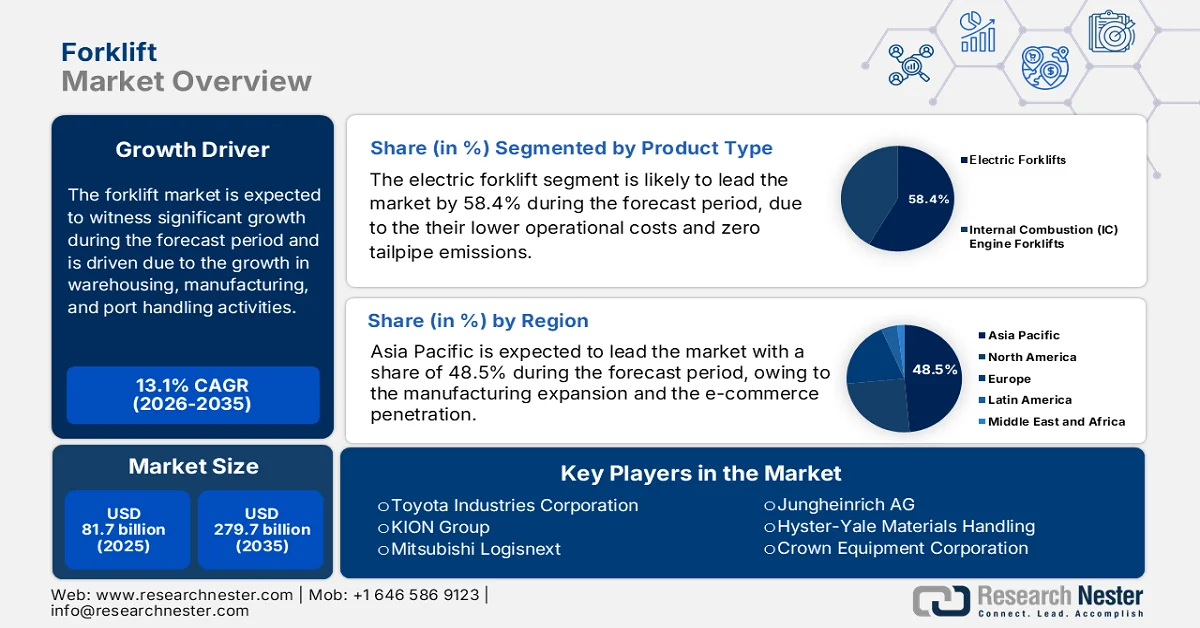
Forklift Market size was valued at USD 81.7 billion in 2025 and is projected to reach USD 279.7 billion by the end of 2035, rising at a CAGR of 13.1% during the forecast period, i.e., 2026-2035. In 2026, the industry size of forklift is assessed at USD 92.4 billion.
The forklift market is supported by the sustained growth in warehousing, manufacturing, and port handling activities, underpinned by the industrial production and trade expansion. According to the U.S. Census Bureau, March 2026 data, the U.S. manufacturing goods trade reached USD 110.142 million in December 2025, reflecting a continued material handling demand across factory and distribution environments. On the other hand, the U.S. Department of Transportation's 2023 data depicts that the freight shipments across all modes reached over 55.5 million tons, reinforcing the need for efficient intra-logistics equipment, such as forklifts, to manage high cargo volumes. Additionally, Eurostat indicates that the EU recorded tons of goods handled in ports annually, highlighting consistent equipment utilization in maritime logistics.
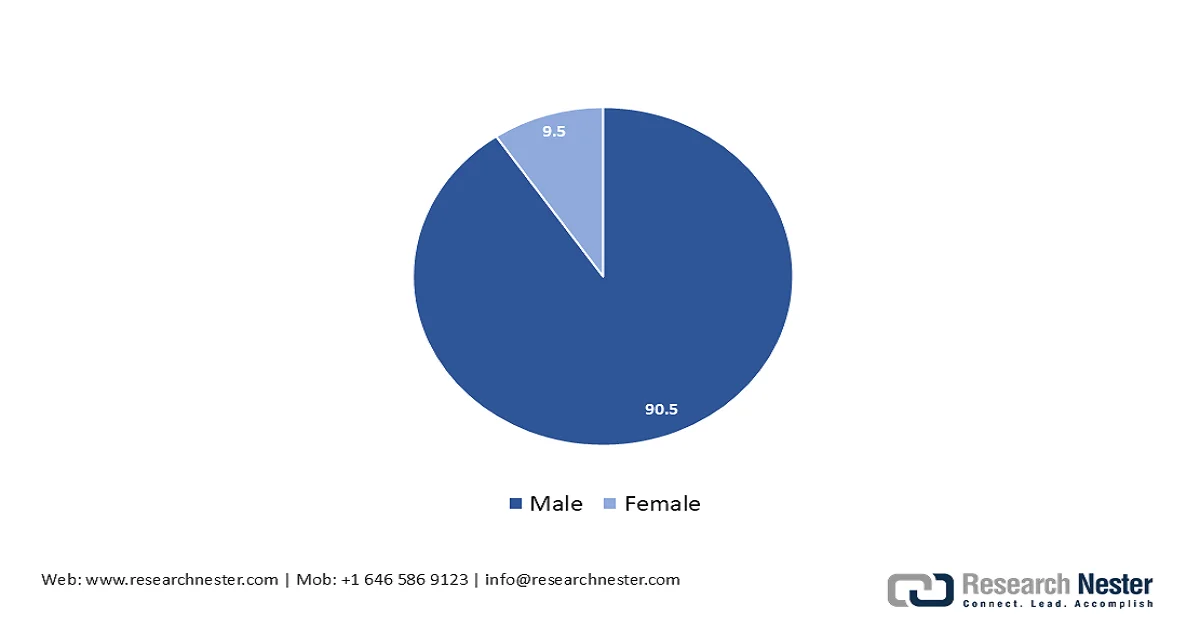
Moreover, the electrification and workplace safety compliance are shaping the procurement decisions across industrial buyers. The U.S. Department of Energy notes that electric industrial equipment adoption is increasing due to the energy efficiency targets and emissions reduction mandates, mainly in indoor warehouse operations. Further, the occupational safety regulations also play a vital role. The forklift-related incidents accounted for 40,513 cases involving lost workdays, job restrictions, transfers, and fatalities highlight the operational risks associated with the material handling equipment based on MHEDA June 2024 data. These data are prompting stricter compliance with the occupational safety regulations and increased investment in operator training and advanced safety features for forklift fleets. Additionally, the 9.5% share of female fatalities underscores the need for more inclusive safety design and workforce-specific training programs across the industrial environments.
Gender-wise Forklift Incidents (2024)
Source: MHEDA June 2024
Key Forklift Market Insights Summary:
Regional Highlights:
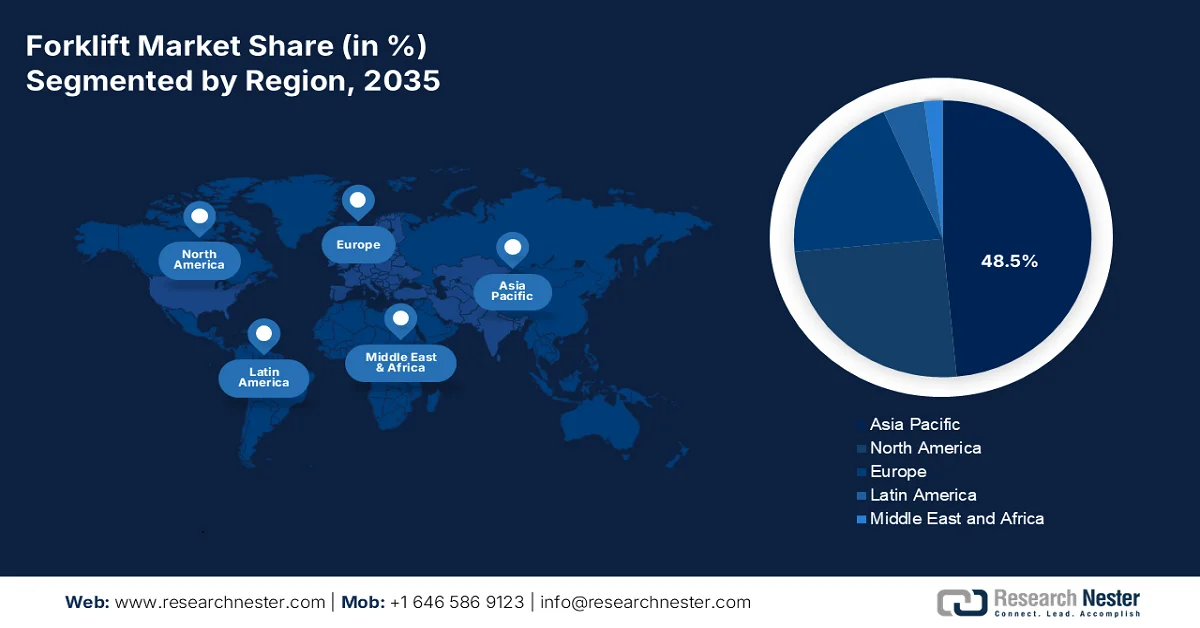
- Asia Pacific forklift market is projected to hold a 48.5% revenue share by 2035, underpinned by expanding manufacturing activities, rising e-commerce penetration, and strong government infrastructure investments
- North America is anticipated to witness the fastest growth in the market with a CAGR of 5.8% during 2026–2035, fueled by accelerating warehouse expansion, increasing e-commerce logistics demand, and fleet electrification mandates
Segment Insights:
- Electric forklifts sub-segment in the forklift market is expected to account for a 58.4% share by 2035, propelled by lower operational costs and zero tailpipe emissions
- Below 5 tons sub-segment is set to dominate the market over 2026–2035, supported by widespread adoption across warehouses and logistics centers alongside cost-efficient fleet expansion needs
Key Growth Trends:
- Public infrastructure investments
- Occupational safety regulations
Major Challenges:
- Technology complexity of automation integration
- Supply chain bottlenecks for lithium batteries
Key Players: Toyota Industries Corporation (Japan), KION Group (Germany), Mitsubishi Logisnext (Japan), Jungheinrich AG (Germany), Hyster-Yale Materials Handling (U.S.), Crown Equipment Corporation (U.S.), Anhui Heli Co., Ltd. (China), Hangcha Group Co., Ltd. (China), Doosan Corporation (South Korea), Clark Material Handling Company (U.S.), Komatsu Ltd. (Japan), Hyundai Construction Equipment (South Korea), Manitou BF (France), EP Equipment (China), Tailift Group (China), Godrej & Boyce Manufacturing (India), Combilift (Ireland), Hubtex Maschinenbau (Germany), LMPG (China), Bobcat (U.S.), CSI Brazil (Brazil).
Global Forklift Market Forecast and Regional Outlook:
Market Size & Growth Projections:
- 2025 Market Size: USD 81.7 billion
- 2026 Market Size: USD 92.4 billion
- Projected Market Size: USD 279.7 billion by 2035
- Growth Forecasts: 13.1% CAGR (2026-2035)
Key Regional Dynamics:
- Largest Region: Asia Pacific (48.5% Share by 2035)
- Fastest Growing Region: North America
- Dominating Countries: China, United States, Germany, Japan, India
- Emerging Countries: Vietnam, Indonesia, Mexico, Brazil, Malaysia
Last updated on : 31 March, 2026
Forklift Market - Growth Drivers and Challenges
Growth Drivers
- Public infrastructure investments: The key driver for the forklift market is the infrastructure expansion by the government. According to the CFR September 2023 data, the U.S. Infrastructure Investment and Jobs Act allocates over USD 550 billion toward transport and logistics upgrades, including port modernization and intermodal hubs that require material handling equipment. Further, the PM Gati Shakti National Master Plan integrates multimodal logistics infrastructure to reduce the costs of surging warehouse and cargo handling capacity expansion. These initiatives directly translate into increased forklift deployment across construction logistics, cargo yards, and distribution parks. The scale and continuity of such spending provide long-term procurement visibility for OEMs and fleet operators, particularly in emerging economies prioritizing supply chain efficiency.
- Occupational safety regulations: Workforce safety enforcement is a vital factor for shaping the forklift market demand, mainly for advanced models with integrated safety systems. As per the MHEDA June 2024 data, nearly 85 forklift-related fatalities occur annually in the U.S., with thousands of injury cases. These figures have led to strict compliance requirements, including operator certification and equipment safety standards. Governments and regulatory bodies are pushing for safer workplace environments, driving the demand for forklifts equipped with sensors, stability controls, and automation-assisted handling. Companies are upgrading their fleets to meet compliance norms and reduce liability risks, making safety-driven replacement cycles a consistent market driver.
Percentage of Fatalities Rate in Industries with Forklift Operation
|
Industry |
Percentage |
|
Trade, Transport and Utilities |
50.7 |
|
Manufacturing |
25.4 |
|
Construction |
18.3 |
|
Professional and Business Services |
5.6 |
Source: MHEDA June 2024
- Active e-commerce growth: Government initiatives promoting digital economies and e-commerce are boosting the forklift demand via warehouse expansion. Moreover, the policies supporting the digital trade, MSMEs, and logistics digitization are increasing the order volumes and the inventory turnover. For example, the digital commerce in India pushed under the government-backed initiatives is surging the warehousing demand alongside the logistics modernization. further the increased parcel volumes require efficient material handling within fulfillment centers, where forklifts play a vital role in pallet movement and storage optimization. As governments continue to formalize and expand digital trade ecosystems, the downstream impact on warehouse infrastructure sustains long-term forklift demand.
Challenges
- Technology complexity of automation integration: As the market shifts toward automated guided vehicles and smart warehousing solutions, the new players in the forklift market face significant technological barriers in developing autonomous forklift capabilities. The integration of IoT AI and modular systems requires substantial engineering expertise and R&D investment. Moreover, the customers increasingly demand telematics-enabled fleet management solutions that provide predictive maintenance. Moreover, the high integration costs of autonomous systems further limit adoption and market accessibility.
- Supply chain bottlenecks for lithium batteries: Manufacturers face critical supply chain challenges in securing lithium-ion battery components, which are essential for modern electric forklifts. The price volatility and limited availability of raw materials such as lithium and cobalt create unpredictable production costs and delivery delays. This bottleneck is mainly challenging for new players who lack long-term supplier relationships or the purchasing power of established players. Though the market is set to grow, the supply chain limitations continue to restrict production scaling, potentially delaying the market entry and increasing the operational uncertainty for manufacturers.
Forklift Market Size and Forecast:
| Report Attribute | Details |
|---|---|
|
Base Year |
2025 |
|
Forecast Year |
2026-2035 |
|
CAGR |
13.1% |
|
Base Year Market Size (2025) |
USD 81.7 billion |
|
Forecast Year Market Size (2035) |
USD 279.7 billion |
|
Regional Scope |
|
Forklift Market Segmentation:
Product Type Segment Analysis
Under the product type segment, the electric forklifts sub segment are dominating and is projected to hold the share value of 58.4% by the end of 2035 in the forklift market. The segment is driven by their lower operational costs and zero tailpipe emissions. These units are favored in indoor warehousing and manufacturing environments where air quality and noise reduction are critical. According to the Grants Go Business September 2025 data, the funding scheme mandates that the electric forklifts must demonstrate lower energy consumption than the diesel equivalents and operate solely on the grid electricity, aligning with emissions reduction goals. Moreover, the financial support is structured via direct purchase, hire purchase, or lease options, offering up to 70% support for SMEs and 30% for non-SMEs for businesses operating within the maritime sector.
Tonnage Capacity Segment Analysis
Within the tonnage capacity, the sub-segment below 5 tons is leading in the forklift market. This dominance is driven by the global nature of these units across small to medium-sized warehouses, retail distribution centers, and light manufacturing facilities where standard pallet handling and racking operations are prevalent. The versatility and lower capital expenditure associated with forklifts below 5 tons make them a preferred choice for fleet expansion in the rapidly growing logistics sector. Moreover, the industrial sector energy consumption for material handling and logistics activities increased, reflecting the expanded deployment of compact energy-dense forklift fleets in this capacity range to meet surging e-commerce throughput demands.
Power Source Segment Analysis
In the power source segment, the lithium-ion battery sub-segment is fueling the market as the leading sub-segment by revenue. This transition is fueled by the superior energy density, opportunity charging capabilities, and longer lifecycle of lithium-ion compared to traditional lead-acid batteries, allowing forklifts to operate continuously without battery swaps. Enterprises favor lithium-ion for its ability to reduce the downtime and total cost of ownership, mainly in high-intensity distribution centers. According to the PIB December 2025 data, nearly 15,370 tons of lithium-ion battery waste were recycled according to the battery waste management rules in 2022, underscoring the growing emphasis on sustainable circular economy practices that further enhance the environmental viability of lithium-ion forklifts in industrial fleets.
Our in-depth analysis of the forklift market includes the following segments:
|
Segment |
Subsegments |
|
Product Type |
|
|
Power Source |
|
|
Technology |
|
|
Class |
|
|
Application |
|
|
End user |
|
|
Tonnage Capacity |
|

Vishnu Nair
Head - Global Business DevelopmentCustomize this report to your requirements — connect with our consultant for personalized insights and options.
Forklift Market - Regional Analysis
APAC Market Insights
The forklift market in Asia Pacific is the largest and is projected to hold the regional revenue share of 48.5% by the end of 2035. The region is driven by the manufacturing expansion, the e-commerce penetration, and the government-led infrastructure investments. China’s Ministry of Industry and Information Technology reported that industrial vehicle production is rising. Further, the supply chain diversification trends are stimulating the manufacturing growth with the corresponding logistics infrastructure development. Government initiatives such as India’s Production Linked Incentive Scheme and Malaysia’s National Investment Aspirations are attracting foreign direct investment in manufacturing facilities, generating the sustained forklift demand. Moreover, the electrification momentum is strong with Japan’s Ministry of Economy, Trade and Industry targeting electric forklift penetration in government-subsidized industrial projects.
The expanding logistics infrastructure, industrial growth, and policy-led supply chain modernization are shaping the forklift market in India. According to the PIB September 2025 data, logistics costs in India account for 13% to 14% of GDP, significantly higher than global benchmarks, prompting government initiatives such as the PM Gati Shakti National Master Plan to improve the multimodal connectivity and warehouse efficiency. Besides, the government has allocated over 80% of the infrastructure spending under the National Infrastructure Pipeline to strengthen transport industrial corridors and logistics parks, all of which require material handling equipment, based on IBEF November 2025 data. The rapid expansion of e-commerce and organized retail is also accelerating warehouse development, therefore supporting steady demand growth in India.
The large-scale industrial output, export-driven logistics, and sustained government investment in infrastructure and supply chain efficiency are shaping the forklift market in China. According to the People’s Republic of China, February 2024 data, the logistics sector contributes over 14.4% of national GDP, reflecting the scale of logistics activity across the country. China’s position as the world’s largest manufacturing hub continues to drive high volumes of internal material movement across factories and industrial parks. Further, the government-led infrastructure expansion, including continued investment in ports, rail freight corridors, and logistics hubs, is strengthening cargo handling capacity and equipment demand. These factors collectively support sustained demand for forklifts across manufacturing, warehousing, and port operations.
North America Market Insights
North America is projected to emerge as the fastest-growing region in the forklift market and is projected to expand at a CAGR of 5.8% during the assessed period, 2026 to 2035. The region is driven by the warehouse capacity expansion, e-commerce logistics demand, and fleet electrification mandates. The U.S. BLS data indicate that warehousing and storage employment has increased, reflecting the sustained facility expansion. Moreover, the OSHA enforcement of powered industrial truck safety standards increases the replacement cycles. The EPA GHG Reporting Program pushes the Scope 1 emissions reduction, favoring electric forklifts. Government infrastructure investments generate heavy-duty forklift demand. Canada aligns with similar trends via provincial emissions reduction targets and industrial decarbonization funding.
The stable labor high operator base, and increasing regulatory oversight are shaping the forklift market in the U.S. According to the Bureau of Labor Statistics, August 2025 data, employment of material moving machine operators is projected to grow by 1% from 2024 to 2034, with approximately 83,200 annual job openings primarily driven by replacement needs, indicating consistent baseline demand for forklift operations. Moreover, the OSHA July 2025 data indicates that there are an estimated 4.5 million forklift operators across more than 300 industries, highlighting widespread dependence on the material handling equipment. At the same time, safety concerns are influencing procurement patterns. 67 forklift-related workplace fatalities were reported in 2023, while OSHA issued over 2,400 citations and USD 8 million in penalties in FY2024 under the Powered Industrial Truck Standard. These factors are pushing companies toward safer, compliant, and technologically enhanced forklift fleets.
The labor availability and wage dynamics are driving the forklift market in Canada. As of November 2025, Government of Canada data shows that the prevailing wages for forklift truck operators range from USD 16.55 per hour (low) to USD 30.29 per hour (high), with a median of USD 22.00 per hour, indicating a moderate and rising labor cost environment. These wage levels, combined with the ongoing labor shortages in the warehousing and distribution sectors, are prompting businesses to optimize workforce productivity via increased reliance on efficient forklift fleets and, in some cases, semi-automated solutions. Further, the higher wage bands in key industrial regions are also pushing companies to invest in operator training, safety compliance, and telematics-enabled fleet management to reduce downtime and improve output per operator.
Europe Market Insights
The forklift market in Europe is undergoing a structural transformation driven by the stringent emissions regulations, industrial automation adoption, and logistics network modernization. The European Commission’s Green Deal Industrial Plan mandates zero-emission material handling equipment across public sector facilities, stimulating the electric forklift penetration. Moreover, the industrial equipment accounts for a significant share of urban particulate matter emissions, prompting cities to implement low-emission zones that restrict internal combustion forklifts in warehouse districts. Labor shortages are driving the adoption of automated guided vehicles and telematics-enabled fleet management systems. Government infrastructure investments under the recovery and resilience facility allocated across member states include funding for logistics hub modernization and port electrification.
The performance and expansion of the freight and logistics sector, which forms a core part of national supply chains, is fueling the forklift market in the UK. According to the Government of the UK, July 2023 data, the sector contributes USD 161 billion in gross value added via over 200,000 enterprises, while broader logistics activities account for up to USD 237 billion annually, representing around 12% of the UK non-financial GVA. With 2.7 million people employed, the logistics sector remains one of the largest employment sectors, driving consistent demand for material handling equipment across warehouses, distribution centers, ports, and intermodal hubs. The high volume of the daily deliveries and reliance on the multimodal freight networks necessitate efficient cargo handling at transfer points, where forklifts play a central operational role. These data show a rising demand for market expansion and growth.
The scale and economic contribution of its logistics and storage sector, which forms a critical backbone for industrial and trade activities, is the forklift market in Germany. According to the sachverstaendigenrat-wirtschaft 2024 data, the transport and storage sector accounted for 4.9% of Germany’s gross value added, closely aligned with the EU average of 5.2%, indicating a well-established and mature logistics ecosystem. Germany’s position as a leading manufacturing hub in Europe further amplifies demand for forklifts across automotive machinery and industrial goods sectors. Additionally, the country’s extensive network of distribution centers and intermodal logistics hubs continues to support consistent equipment utilization, while ongoing efficiency and automation initiatives are expected to drive gradual adoption of advanced and electric forklift fleets.
Key Forklift Market Players:
- Toyota Industries Corporation (Japan)
- KION Group (Germany)
- Mitsubishi Logisnext (Japan)
- Jungheinrich AG (Germany)
- Hyster-Yale Materials Handling (U.S.)
- Crown Equipment Corporation (U.S.)
- Anhui Heli Co., Ltd. (China)
- Hangcha Group Co., Ltd. (China)
- Doosan Corporation (South Korea)
- Clark Material Handling Company (U.S.)
- Komatsu Ltd. (Japan)
- Hyundai Construction Equipment (South Korea)
- Manitou BF (France)
- EP Equipment (China)
- Tailift Group (China)
- Godrej & Boyce Manufacturing (India)
- Combilift (Ireland)
- Hubtex Maschinenbau (Germany)
- LMPG (China)
- Bobcat (U.S.)
- CSI Brazil (Brazil)
- Company Overview
- Business Strategy
- Key Product Offerings
- Financial Performance
- Key Performance Indicators
- Risk Analysis
- Recent Development
- Regional Presence
- SWOT Analysis
- Toyota Industries Corporation maintains its dominance in the global forklift market via a strategic focus on integrated automation and energy diversification. The company has significantly advanced its position by adopting autonomous mobile robot technology and lithium-ion battery systems across its material handling portfolio. In 2024, the company made a net sale of USD 25.55 billion.
- KION Group has established itself as a European powerhouse in the global forklift market via aggressive digitalization and software-driven solutions. The company has significantly advanced its offerings by adopting cloud-based fleet management platforms and predictive analytics across its Linde STILL and Dematic brands. In 2024, the company made a revenue of USD 12,423.5 million.
- Mitsubishi Logisnext uses its Japanese engineering heritage to deliver comprehensive solutions in the global forklift market. The company has significantly advanced its product ecosystem by adopting modular electric forklift platforms and integrated warehouse automation systems. This advancement ensures flexible scalability for the customers transitioning from manual operations to fully automated material handling.
- Jungheinrich AG has carved a distinct leadership position in the global forklift market by prioritizing lithium-ion technology and sustainable intralogistics. The company has advanced its competitive edge by adopting a fully electrified product portfolio combined with advanced energy management systems.
- Hyster-Yale Materials Handling remains a formidable force in the global forklift market via its focus on heavy-duty applications and alternative fuel innovations. The company has significantly advanced its market relevance by adopting hydrogen fuel cell technology and ruggedized forklift designs customized for demanding industries.
Here is a list of key players operating in the global forklift market:
The global forklift market is highly consolidated, dominated by the top players who maintain their leadership via expansive automation solutions and a robust global supply chain. Competition is fierce among the European and U.S. players, such as the KION and Hyster Yale, who are actively pivoting towards the lithium-ion batteries and autonomous mobile robots to meet sustainability demands. The strategic initiatives focus heavily on digitalization, with the key players acquiring software startups to integrate telematics and fleet management systems, aiming to shift from mere equipment sales to comprehensive intralogistics solutions. For example, in May 2025, CSI Brazil announced the acquisition of Forklift Rental Company.
Corporate Landscape of the Forklift Market:
Recent Developments
- In September 2025, LGMG successfully held the first Global Customer Festival in Jinan. During the event, the company held a new product launch ceremony and promoted several innovative aerial work platforms and new forklifts, demonstrating the new momentum of China's manufacturing.
- In January 2025, Bobcat presented two major new developments at LogiMAT 2025 as part of a comprehensive display of the company’s material handling product lines, including diesel and electric forklifts, reach trucks, and warehouse equipment such as pallet trucks and stackers.
- In July 2025, Toyota Material Handling Japan, a division of Toyota Industries Corporation and Fujitsu Limited (Fujitsu), announced a joint development of Japan's first service for evaluating forklift safety in the cloud using AI.
- Report ID: 8490
- Published Date: Mar 31, 2026
- Report Format: PDF, PPT
- Explore a preview of key market trends and insights
- Review sample data tables and segment breakdowns
- Experience the quality of our visual data representations
- Evaluate our report structure and research methodology
- Get a glimpse of competitive landscape analysis
- Understand how regional forecasts are presented
- Assess the depth of company profiling and benchmarking
- Preview how actionable insights can support your strategy
Explore real data and analysis
Frequently Asked Questions (FAQ)
About this Report
Connect with our Expert


Report, 2026-2035



Copyright @ 2026 Research Nester. All Rights Reserved.
