Voluntary Carbon Credit Market Outlook:
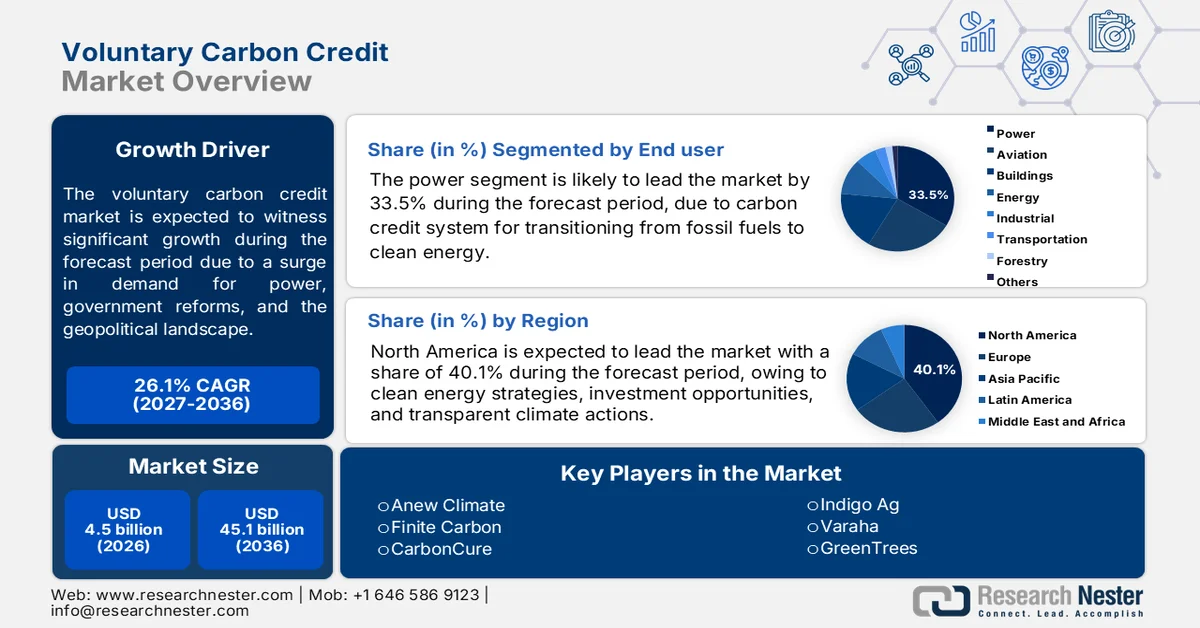
Voluntary Carbon Credit Market size was valued at USD 4.5 billion in 2026 and is projected to exceed USD 45.1 billion by the end of 2036, expanding at over 26.1% CAGR during the forecast period, i.e., 2027-2036. In 2027, the industry size of voluntary carbon credit is estimated at USD 5.6 billion.
The worldwide voluntary carbon credit market is effectively navigating a complicated transition, which is driven by the geopolitical landscape, the presence of environmental policies, and an increase in the demand for power. According to an article published by the IEA Organization in July 2026, the worldwide electricity demand grew by 3.6% in 2026 and further by 3.8% by the end of 2027, indicating an increase from 3% in 2025. In addition, the electricity power consumption is predicted to reach 30,700 TWh by 2027, in comparison to 28,600 TWh as of 2025. Besides, renewable power generation is also set to expand by over 8% in 2026, and is further poised to surge its share of global electricity generation from 33% to 37% by 2027. Therefore, based on this growth in generation, the shipment of electrical energy in terms of exports across different countries is bolstering the voluntary carbon credit market growth and exposure.
Country-Wise Electrical Energy Export-Based Shipment, 2024
|
Country |
Trade Value (USD 1,000) |
Quantity (KW/H) |
|
European Union |
7,930,263.9 |
107,847,000 |
|
France |
6,398,575.0 |
80,989,600 |
|
Germany |
4,852,284.9 |
57,365,300 |
|
Switzerland |
4,446,590.0 |
45,236,500 |
|
Austria |
3,085,052.4 |
39,048,900 |
|
Slovak Republic |
2,541,163.2 |
17,408,200 |
|
Canada |
2,290,804.6 |
35,651,000 |
|
Poland |
2,082,700.3 |
14,198,500 |
|
Spain |
2,071,636.4 |
32,150,800 |
|
Czech Republic |
2,070,454.0 |
18,865,100 |
Source: WITS
Moreover, the rise in portfolio approaches for purchasing renewable energy credits, an intensified focus on high-integrity credits, and an in-depth regional bifurcation are a few trends that are responsible for boosting the voluntary carbon credit market globally. As per a data report published by the IEA Organization in 2025, the global renewable energy capacity is predicted to increase by nearly 4,600 GW by the end of 2030, which indicates double the deployment since the past 5 years. Based on this growth, expansion in distributed solar photovoltaic (PV) and utility-scale represented almost 80% of the worldwide renewable electricity capacity. In this regard, lower module expenses, particularly effective permitting processes and comprehensive social acceptance, are readily driving the escalation in solar PV integration, thus positively enhancing the market upliftment.
Key Voluntary Carbon Credit Market Insights Summary:
Regional Highlights:
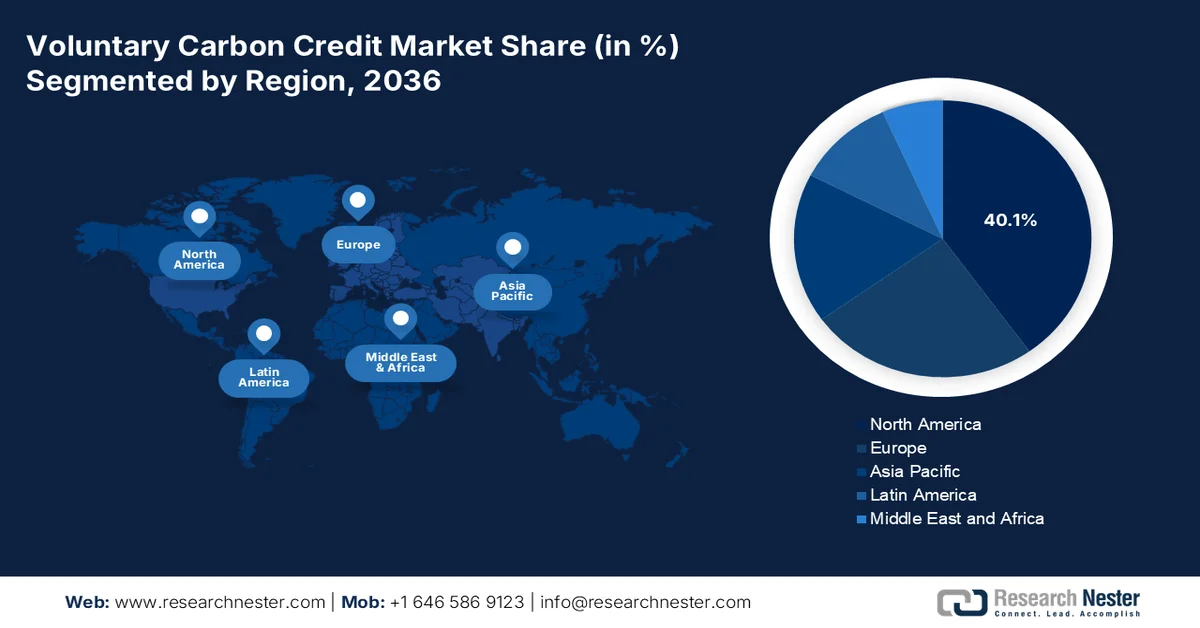
- North America is projected to command a 40.1% share of the voluntary carbon credit market by 2036, supported by clean energy incentives, established carbon registries, investment opportunities, and increasing pressure for transparent climate action
- Asia Pacific is expected to register the fastest growth during the forecast period, driven by regulatory momentum, carbon-tax integration, and increasing research and development in carbon recycling
Segment Insights:
- The power segment is anticipated to secure the largest 33.5% share of the voluntary carbon credit market by 2036, fueled by its central role in transitioning from fossil fuels to clean energy and generating measurable emission reductions for tradable credits
- The removal or sequestration projects sub-segment is projected to capture a suitable share during the forecast period, owing to increasing emphasis on durable carbon dioxide removal through afforestation, reforestation, soil carbon enhancement, and direct air capture with storage
Key Growth Trends:
- Shift in hybrid decarbonization
- Convergence on methane avoidance
Major Challenges:
- The credibility and integrity deficit
- Fragmented and outdated legal and infrastructure frameworks
Key Players: South Pole (Switzerland),3Degrees (U.S.),Climate Impact Partners (UK),Anew Climate (U.S.),Finite Carbon (U.S.),CarbonCure (Canada),Indigo Ag (U.S.),Varaha (India),GreenTrees (U.S.),EcoNetix (Austria).
Global Voluntary Carbon Credit Market Forecast and Regional Outlook:
Market Size & Growth Projections:
- 2026 Market Size: USD 4.5 billion
- 2027 Market Size: USD 5.6 billion
- Projected Market Size: USD 45.1 billion by 2036
- Growth Forecasts: 26.1% CAGR (2027-2036)
Key Regional Dynamics:
- Largest Region: North America (40.1% share by 2036)
- Fastest Growing Region: Asia Pacific
- Dominating Countries: United States, China, India, Germany, United Kingdom
- Emerging Countries: Indonesia, Singapore, Australia, South Korea, Brazil
Last updated on : 4 September, 2026
Voluntary Carbon Credit Market - Growth Drivers and Challenges
Growth Drivers
- Shift in hybrid decarbonization: The aspect of depending on internal operational modifications and effectiveness is ending, and organizations are enabling long-lasting decarbonization objectives. According to an article published by Energy Transition Organization in August 2022, the 2030 decarbonization target in India constitutes decarbonized energy to 50% and further achieve 500 GW of fossil-fuel-free generation capacity by the end of 2030. Besides, in terms of energy utilization, the electricity industry in the country has undergone significant transformation recently. Additionally, the per capita electricity consumption readily stands at 1,208 kWh, with an increase from 559 kWh, thereby making it suitable for driving the voluntary carbon credit market globally.
- Convergence on methane avoidance: Within the voluntary carbon credit market, methane avoidance projects are emerging as a particularly compelling growth driver. Their appeal stems from methane's potent near-term warming impact, which allows these projects to deliver immediate and highly tangible climate benefits. This contrasts with the longer timeframes associated with many removal projects. For buyers, this provides a straightforward and compelling narrative around their climate action. Furthermore, the established and relatively mature methodologies for capturing methane from sources, such as landfills and agricultural operations offer a level of credibility and ease of verification that is highly attractive to risk-conscious corporate buyers.
Challenges
- The credibility and integrity deficit: The voluntary carbon credit market remains hobbled by a profound crisis of trust stemming from the fundamental integrity of its core product, which is the carbon credit. The credibility deficit is rooted in systemic failures, including the systematic overestimation of climate benefits, compromised verification processes, and the failure to prove additionality, the core premise that emission reductions would not have occurred without the project. Besides, scandals, particularly around forest conservation (REDD+) schemes where credits were oversold, have severely undermined buyer confidence, causing the market's value to crash and raising fears of greenwashing that deter corporate participation.
- Fragmented and outdated legal and infrastructure frameworks: The voluntary carbon credit market's infrastructure is increasingly unable to support its ambition, operating under a fragmented and often archaic legal and operational framework. The lack of a shared legal language for carbon credits, with their legal status as property undefined or contested across jurisdictions, creates significant legal uncertainty and undermines cross-border transaction enforceability. This is compounded by a weak and opaque market infrastructure, where most trading occurs through private, over-the-counter broker deals with opaque margins, preventing the formation of reliable price signals that would direct capital to the most effective projects.
Voluntary Carbon Credit Market Size and Forecast:
| Report Attribute | Details |
|---|---|
|
Base Year |
2026 |
|
Forecast Year |
2027-2036 |
|
CAGR |
26.1% |
|
Base Year Market Size (2026) |
USD 4.5 billion |
|
Forecast Year Market Size (2036) |
USD 45.1 billion |
|
Regional Scope |
|
Voluntary Carbon Credit Market Segmentation:
End user Segment Analysis
Based on the end user, the power segment is predicted to account for the highest share of 33.5% in the voluntary carbon credit market by the end of 2036. The segment’s upliftment is highly fueled by its centralized role in the carbon credit system for switching from fossil fuels to clean energy by offering the measurable emission reduction that is required to generate tradable credits. According to the 2025 IEA Organization data report, there was an increase in global electricity demand by 4.3% as of 2024, which is an essential step change from the 25% growth observed in 2023. In addition, the average electricity demand requirement as of 2023 was 2.7%, which accounted for the overall energy growth need during the same period. Besides, electrification has been expanding across different sectors, thereby demonstrating a huge growth opportunity for the segment’s upliftment.
Project Type Segment Analysis
During the forecast period, the removal or sequestration projects sub-segment under the project type segment is projected to garner a suitable share in the voluntary carbon credit market. The sub-segment’s growth is effectively driven by extracting carbon dioxide from the atmosphere and storing it durably, such as afforestation, reforestation, soil carbon enhancement, and direct air capture with storage. These projects are widely regarded as delivering higher environmental integrity because they actively reduce atmospheric concentrations rather than merely avoiding future emissions. However, they face significant barriers including high operational costs, lengthy project maturation timelines, land-use competition, and complex monitoring requirements, thus creating growth opportunities for the sub-segment.
Type of Transaction Segment Analysis
The mixed transactions sub-segment under the type of transaction segment is expected to grab a considerable share in the voluntary carbon credit market by the end of the stipulated timeline. The sub-segment’s development is highly propelled by combining both primary market purchases, where buyers acquire credits directly from project developers, and secondary market trades involving previously issued credits changing hands between intermediaries or end-users. Besides, mixed transactions offer flexibility, allowing buyers to source credits from diverse vintages, geographies, and project types within a single portfolio. However, this complexity introduces opacity around pricing, quality assurance, and chain-of-custody tracking. The lack of standardized exchange mechanisms for such bundled trades often results in higher due diligence costs and prolonged negotiation periods.
Our in-depth analysis of the voluntary carbon credit market includes the following segments:
|
Segment |
Subsegments |
|
End user |
|
|
Project Type |
|
|
Type of Transaction |
|
|
Application Area |
|

Vishnu Nair
Head - Global Business DevelopmentCustomize this report to your requirements — connect with our consultant for personalized insights and options.
Voluntary Carbon Credit Market - Regional Analysis
North America Market Insights
North America voluntary carbon credit market is anticipated to garner the largest share of 40.1% by the end of 2036. The market’s upliftment is primarily attributed to clean energy incentives, generous investment opportunities, established carbon registries, and suitable pressure for transparent climate action. According to an article published by the Department of Energy in January 2025, more than USD 230 billion has been declared as energy manufacturing investment. In addition, over 920 new or expanded energy manufacturing facilities have been established, along with more than 200,000 potential new clean energy employment opportunities. These attributes are initiated by the Biden-Harris Administration’s Investing in America agenda, which is increasingly focused on powering a clean energy manufacturing revolution, thus positively driving the market’s growth in the region.
The voluntary carbon credit market in the U.S. is growing significantly, owing to leadership in land-use and forestry projects, as well as the presence of innovation and technological centers, dominance in the private industry, and suitable support from federal policy. As stated in an article published by the EPA Government in December 2025, the overall carbon sequestration in the Land Use, Land-Use Change, and Forestry (LULUCF) industry gradually decreased by 11%. This is primarily due to a reduction in the rate of net carbon accumulation in forests, along with a surge in carbon dioxide emissions from urbanization. Moreover, apart from episodic events, increased carbon dioxide, methane, and nitrous oxide emissions from forest fires have also occurred in the country, thereby demonstrating an optimistic outlook for the market’s growth.
The presence of provincial policy, robust federal architecture, leadership in durable carbon removal, contributions by corporate buyers, and a focus on high-integrity projects are certain factors for bolstering the voluntary carbon credit market in Canada. As stated in an article published by the Government of Canada in January 2026, the adoption of carbon management technologies has led to the country increasing its climate ambition, with the aim of diminishing greenhouse gas emissions by 40% to 45% by the end of 2030, while also poised to enshrine a commitment and reach net-zero emissions by 2050 into law. Therefore, meeting these objectives needs transforming the way industrial and energy products are readily produced and utilized to almost diminish carbon dioxide pollution for the upcoming 3 decades, thereby creating a positive outlook for the market’s growth.
APAC Market Insights
The Asia Pacific voluntary carbon credit market is expected to emerge as the fastest-growing region during the forecast period. The market’s development in the region is highly propelled by a regulatory momentum, the compliance integration of carbon tax, along with research and development for carbon recycling. According to an article published by AGU Publications in April 2025, the gross domestic product (GDP) growth in South Asia increased the energy demand and its reliance on fossil fuels as the ultimate source of energy. In addition, the region also contributed to 9.3% of worldwide emissions, while India was responsible for 7.3% of emissions. Besides, the significant food demand, land utilization for converting forest land to agricultural land, overgrazing, and agriculture are responsible for enhancing the market’s growth and demand in the overall region.
The voluntary carbon credit market in China is gaining increased traction, owing to the presence of a manufacturing center, an expansion of its carbon market policies beyond compliance, and a focus on national emissions and carbon infrastructure. As stated in an article published by the Center for Research on Energy and Clean Air in March 2026, the country’s international climate pledge is focused on reducing carbon intensity 65% below past levels by the end of 2030. In addition, this particular plan has set a target for lowering carbon dioxide emissions per unit of GDP by 17% from 2026 to 2030. Meanwhile, the nation’s reported yearly carbon intensity optimizations as of 2205 added a reduction of 12.4%, which has put the nation off track from the national Paris commitments, thus positively impacting the market’s development.
The aspects of a rapidly developing economy, robust policy momentum, government support, and ambitious climate objectives are a few trends that are responsible for boosting the voluntary carbon credit market in India. As stated in an article published by the PIB Government in March 2026, the country has committed to lower emissions intensity of its GDP by 47% by the end of 2035 from 2005 levels. Likewise, the country is also focused on achieving 60% cumulative electric power installed capacity from non-fossil fuel-specific energy resources by the end of the same year. Simultaneously, the nation is also poised to create a carbon sink of 3.5 billion to 4.0 billion tons of carbon dioxide equivalent through Forest and Tree Cover by the same year, while national commitments are effectively aligned with the Net-Zero and Viksit Bharat @2047 vision, thus creating an optimistic outlook for the market’s development.
Europe Market Insights
Europe voluntary carbon credit market is predicted to account for a considerable share by the end of the stipulated timeline. The market’s growth in the region is effectively driven by a trusted framework, generous funding for sustainable chemical advancements, domination in the renewable energy segment, and regulatory reforms. According to an article published by the European Environment Agency in April 2026, renewables readily accounted for 25.2% of final energy consumption in the region as of 2204, which is almost 1 percentage point more than in 2023. This particular increase was mainly fueled by wind and solar power, which is followed by heat pumps, thus supporting increased energy independence. Besides, the renewable share is predicted to continue rising and is poised to gain the regional minimum target of 42.5% by the end of 2030. This is heavily required to double average deployment rates in comparison to the previous decade and enable a profound transformation of the domestic energy system.
Renewable Energy Source Targets in Europe, 2022-2029
|
Year |
Renewable Energy Source (%) |
|
2022 |
23.0 |
|
2023 |
24.6 |
|
2024 |
25.2 |
|
2025 |
28.1 |
|
2026 |
31.0 |
|
2027 |
33.9 |
|
2028 |
36.8 |
|
2029 |
39.6 |
|
2030 |
42.5 |
Source: European Environment Agency
The voluntary carbon credit market in Germany is gaining increased exposure, owing to industrial leadership in manufacturing and chemicals, the presence of strong energy transition policies, and an increase in decarbonization pressure. For instance, in December 2023, the United Nations Industrial Development Organization (UNIDO) and the Government of the Federal Republic of Germany, in association with the Federal Ministry for Economic Affairs and Climate Action (BMWK), declared global strategies for transforming heavy industries to climate neutrality by the end of 2050. This partnership for a net-zero sector and the global matchmaking platform was effectively signed at the United Nations Climate Change Conference (COP28). In this regard, the country has generously committed to offer USD 26.6 million (EUR 23 million) in funding for these initiatives through the International Climate Initiative (IKI), thus positively contributing to the market upliftment.
The alignment with the European Green Deal, along with rapid renewable energy deployment as well as the existence of robust wind and solar resources, are certain trends that are proliferating the voluntary carbon credit market in Spain. As per a data report published by ITA in July 2024, the overall installed energy capacity in the country increased by 4.9% as of 2022, which reached 119 GW. Besides, in terms of renewable capacity, photovoltaic energy in the country witnessed the greatest increase as of 2022, furthering growth by more than 22% or 4.4 GW. This has readily made PV the third-most notable generation capacity after combined and wind cycle. Based on this, wind has also made significant gains as of 2022, which added 4.9% capacity, thus boosting the market’s development in the nation.
Key Voluntary Carbon Credit Market Players:
- South Pole (Switzerland)
- 3Degrees (U.S.)
- Climate Impact Partners (UK)
- Anew Climate (U.S.)
- Finite Carbon (U.S.)
- CarbonCure (Canada)
- Indigo Ag (U.S.)
- Varaha (India)
- GreenTrees (U.S.)
- EcoNetix (Austria)
- Company Overview
- Business Strategy
- Key Product Offerings
- Financial Performance
- Key Performance Indicators
- Risk Analysis
- Recent Development
- Regional Presence
- South Pole offers comprehensive services ranging from climate consulting to project finance, having channeled finance to over 850 projects globally. Its role as a trusted partner to Fortune 500 companies and governments positions it as a pivotal player in helping clients implement comprehensive decarbonization strategies.
- 3Degrees is a provider of comprehensive clean energy services, including carbon offsets and renewable energy certificates, designed to help organizations meet their greenhouse gas emissions reduction goals. By assisting both organizations and individuals in transitioning to a low-carbon economy, the company operates with a focus on corporate and utility green power and carbon markets.
- Climate Impact Partners develops and delivers high-impact projects that generate credits to help organizations address their unavoidable emissions. The company emphasizes long-term, high-integrity solutions and innovative structures to drive investment into the carbon market.
- Anew Climate leverages both technological and nature-based approaches to generate and market environmental credits across carbon, renewable energy, and emissions markets. The company is actively involved in sourcing and commercializing high-quality credits from projects, such as improved forest management and soil carbon sequestration.
- Finite Carbon specializes in developing high-quality projects under Improved Forest Management methodologies for large landowners. The company manages a portfolio covering millions of acres, connecting buyers directly with premium forest carbon projects through its digital marketplace.
Here is a list of key players operating in the global voluntary carbon credit market:
The voluntary carbon credit market as end-products is consolidated around a core of global project developers, but is also populated by a dynamic group of specialized, regional, and technology-focused firms. Key leaders, such as South Pole and 3Degrees, compete as comprehensive, one-stop shops, offering large, diversified portfolios of credits across multiple project types and geographies to Fortune 500 clients. Besides, in November 2022, Bain & Company formed a tactical partnership with and significantly invested in Sylvera to expand the transparency of carbon sectors. This particular partnership bolstered both the organizations’ credibility and accountability by applying strong proprietary analytics for carbon projects, thus positively enhancing the voluntary carbon credit industry.
Corporate Landscape of the Voluntary Carbon Credit Market:
Recent Developments
- In July 2026, Thryve.Earth declared its first-ever corporate offtake commitments by separating deals with members of Symbiosis Coalition, which is a buyers’ coalition for nature-specific carbon removal.
- In March 2022, the Public Investment Fund proclaimed that 5 notable businesses in Saudi Arabia effectively signed a separate non-binding memorandum of understanding and emerged as the first-ever partners of the MENA regional voluntary carbon credit Market (VCM).
- In January 2022, Anthesis merged with Climate Neutral Group and ensured climate emergency and also enabled the transformational thinking businesses that are required to be adopted for restricting the rise of worldwide temperatures.
- Report ID: 8754
- Published Date: Sep 04, 2026
- Report Format: PDF, PPT
- Explore a preview of key market trends and insights
- Review sample data tables and segment breakdowns
- Experience the quality of our visual data representations
- Evaluate our report structure and research methodology
- Get a glimpse of competitive landscape analysis
- Understand how regional forecasts are presented
- Assess the depth of company profiling and benchmarking
- Preview how actionable insights can support your strategy
Explore real data and analysis
Frequently Asked Questions (FAQ)
About this Report
Connect with our Expert


Report, 2027-2036



Copyright @ 2026 Research Nester. All Rights Reserved.
