Targeted Protein Degradation Market Outlook:
Targeted Protein Degradation Market size was valued at USD 700.1 million in 2025 and is anticipated to cross USD 4.78 billion by the end of 2035, expanding at more than 21.2% CAGR during the forecast period i.e., between 2026-2035. In 2026, the industry size of targeted protein degradation is assessed at USD 848.5 million.
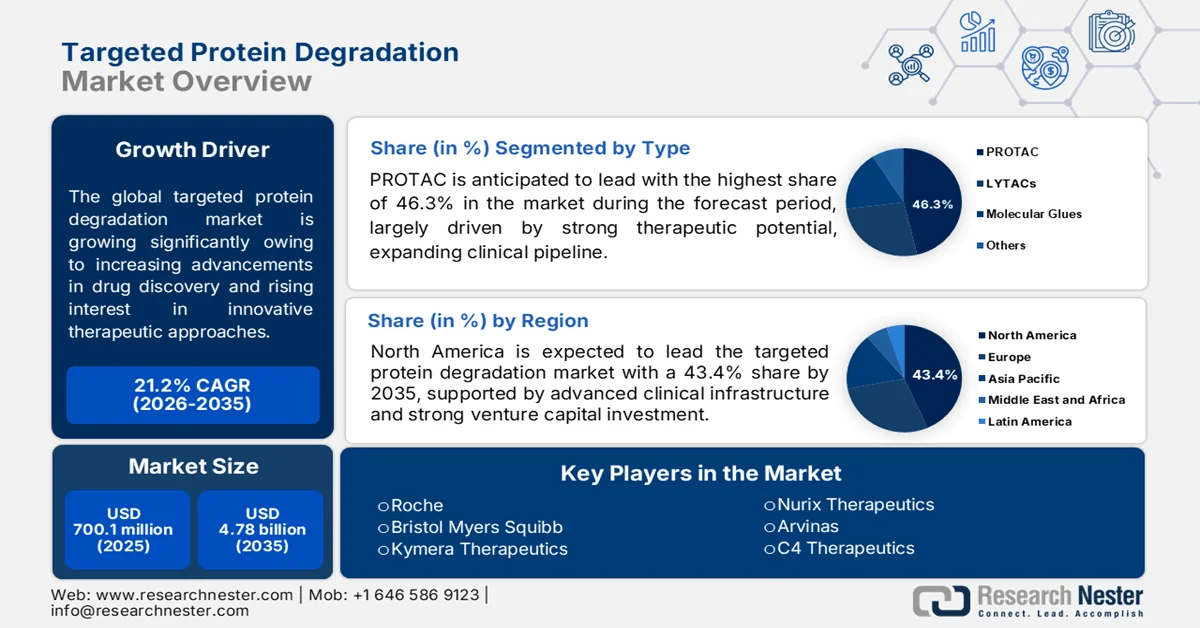
The targeted protein degradation market is growing exponentially, which is due to increasing advancements in drug discovery, rising interest in innovative therapeutic approaches, and expanding research activities focused on addressing complex diseases. Continuous improvements in molecular biology, protein engineering, and clinical development are supporting the emergence of targeted protein degradation as a reliable strategy for next-generation treatments. As per an article published by the National Institutes of Health (NIH) in November 2024, targeted protein degradation is an emerging drug discovery approach that removes disease-causing proteins by using the cell’s natural degradation systems, such as the ubiquitin–proteasome system and lysosomes. The article also mentions that advances in terms of PROTAC design, molecular glues, and lysosome-based strategies are driving new clinical applications.
In parallel, the targeted protein degradation market is driven by the development of novel degradation technologies and growing collaborations between biotechnology and pharmaceutical companies. The market outlook is highly positive as researchers continue to explore new degradation platforms and broaden their potential applications in precision medicine. For instance, in April 2024, Arvinas entered into a global licensing agreement with Novartis for the development and commercialization of ARV-766, which is a PROTAC® androgen receptor protein degrader being developed for prostate cancer treatment. Under this deal, Arvinas will receive a total amount of USD 150 million upfront, with the potential for up to USD 1.01 billion in milestone payments along with tiered royalties.
Key Targeted Protein Degradation Market Insights Summary:
Regional Highlights:
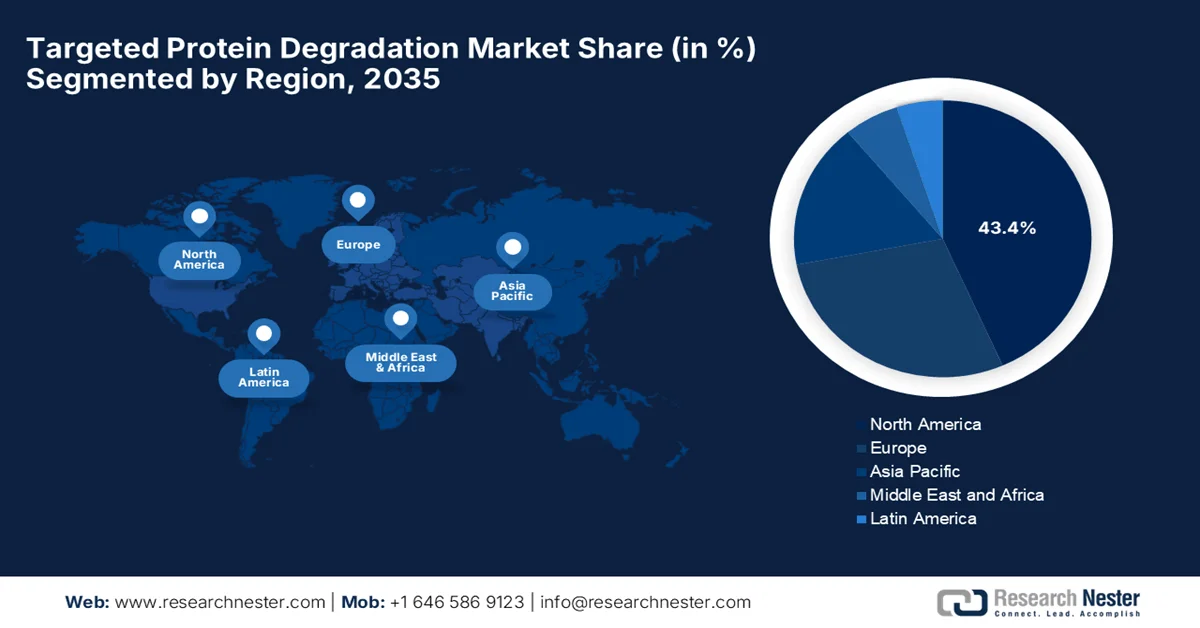
- North America is anticipated to capture 43.4% share by 2035 in the targeted protein degradation market, bolstered by a highly concentrated ecosystem of innovative biotechnology companies, research institutes, and major pharmaceutical giants.
- Europe is projected to witness the fastest growth throughout 2026-2035, fostered by its strong emphasis on translational life sciences and cross-border research ecosystems that facilitate the transition of novel degrader technologies from laboratory research to clinical applications.
Segment Insights:
- PROTAC is anticipated to account for 46.3% share by 2035 in the targeted protein degradation market, underpinned by strong therapeutic potential and an expanding clinical pipeline.
- Therapy Development is projected to secure a noteworthy share during 2026-2035, accelerated by the progressive translation of targeted protein degradation technologies from academic research into clinically validated therapeutic candidates.
Key Growth Trends:
- Expanding the druggable genome
- Expanding beyond oncology
Major Challenges:
- Complex drug development and discovery challenges
- Delivery and pharmacokinetic limitations
Key Players: Roche (Switzerland),Bristol Myers Squibb (U. S.),Kymera Therapeutics (U.S.),Nurix Therapeutics (U.S.),Arvinas (U.S.),C4 Therapeutics (U.S.),Monte Rosa Therapeutics (U.S.).
Global Targeted Protein Degradation Market Forecast and Regional Outlook:
Market Size & Growth Projections:
- 2025 Market Size: USD 700.1 million
- 2026 Market Size: USD 848.5 million
- Projected Market Size: USD 4.78 billion by 2035
- Growth Forecasts: 21.2% CAGR (2026-2035)
Key Regional Dynamics:
- Largest Region: North America (43.4% Share by 2035)
- Fastest Growing Region: Europe
- Dominating Countries: United States, China, Japan, Germany, United Kingdom
- Emerging Countries: South Korea, India, Switzerland, France, Singapore
Last updated on : 5 August, 2026
Targeted Protein Degradation Market - Growth Drivers and Challenges
Growth Drivers
- Expanding the druggable genome: Traditional small-molecule inhibitors fail against most of human proteins due to a lack of deep binding pockets. Targeted protein degradation circumvents this limitation by using transient binding to trigger complete cellular destruction, thus boosting uptake in the global market. For instance, in May 2025, Arvinas and Pfizer released VERITAC-2 trial results evaluating vepdegestrant for ESR1-mutated ER+/HER2− advanced breast cancer. The study showed improved progression-free survival, and it supports the development of vepdegestrant as a potential targeted treatment option for patients who have developed resistance to existing endocrine therapies, thus driving the market globally.
- Expanding beyond oncology: Previously, research was mostly focused on cancer therapies, but now research in the targeted protein degradation market is diversifying. Drug developers are applying degradation platforms with a collective goal to address complex conditions in neurology, immunology, and chronic inflammation. In this context, Kymera Therapeutics in March 2024 reported preclinical findings for its oral STAT6 degrader KT-621 and TYK2 degrader KT-294, which showcased the potential of targeted protein degradation to develop treatments for certain immune-mediated diseases. These programs demonstrated potent target degradation and biologic-like activity in preclinical models, which supports their applicability in conditions such as atopic dermatitis and autoimmune disorders.
Challenges
- Complex drug development and discovery challenges: The targeted protein degradation market faces severe challenges due to the complexity which is associated with designing effective degradation molecules. Developing technologies requires a proper understanding of protein biology, disease pathways, and cellular mechanisms. These degraders need to achieve efficient target binding, recruitment of degradation machinery, and selective protein removal. Most of the potential candidates face issues related to potency, selectivity, pharmacokinetics, and toxicity during development. In addition, identifying suitable disease targets is difficult because not all proteins are easily degradable. Therefore, the presence of a lengthy research process and high development costs create barriers for companies that are attempting to commercialize TPD-based therapies.
- Delivery and pharmacokinetic limitations: This factor also negatively impacts the growth of the targeted protein degradation market. Most of the TPD molecules, especially PROTACs, have large molecular structures that can result in poor solubility, limited absorption, and unfavorable pharmacokinetic properties. Apart from this, achieving sufficient drug concentration at the disease site while minimizing off-target effects remains a major hurdle. Researchers are looking into strategies such as optimized molecular design, nanoparticle delivery systems, and alternative degradation technologies to overcome these limitations. Hence, these challenges may restrict the use of TPD therapies in certain disease areas and slow their transition from laboratory research to clinical application.
Targeted Protein Degradation Market Size and Forecast:
| Report Attribute | Details |
|---|---|
|
Base Year |
2025 |
|
Forecast Year |
2026-2035 |
|
CAGR |
21.2% |
|
Base Year Market Size (2025) |
USD 700.1 million |
|
Forecast Year Market Size (2035) |
USD 4.78 billion |
|
Regional Scope |
|
Targeted Protein Degradation Market Segmentation:
Type Segment Analysis
PROTAC is anticipated to lead with the highest share of 46.3% in the type segment of the targeted protein degradation market globally by 2035. The segment’s dominating position in this industry is largely driven by strong therapeutic potential, expanding clinical pipeline. PROTACs offer a distinct advantage over conventional small-molecule inhibitors by enabling selective degradation of disease-causing proteins. In March 2026, Arvinas reported positive Phase 1 results for ARV-102, which is an investigational PROTAC® degrader based on Ttargeted protein degradation, demonstrating over 50% changes in cerebrospinal fluid LRRK2 protein levels among Parkinson’s disease patients following 28 days of treatment. Besides, this oral therapy also showed improvements in disease-related biomarkers, which include those linked to lysosomal dysfunction and neuroinflammation.
Application Segment Analysis
The therapy development is projected to grow with a noteworthy share during the stipulated timeframe. The segment’s growth is largely attributable to the progressive translation of targeted protein degradation technologies from academic research into clinically validated therapeutic candidates. Biotechnology and pharmaceutical companies are constantly putting effort into developing first-in-class degraders, coupled with advancements in target identification, molecular design, and preclinical validation, which are accelerating the progression of novel therapies for human trials. On the other hand, growing regulatory interest in innovative treatment modalities supports sustained segment expansion in the targeted protein degradation market during the forecast period.
End use Segment Analysis
The pharmaceutical and biotechnology companies segment is projected to witness substantial growth in the targeted protein degradation market. The segment is growing on account of increasing investments in next-generation drug discovery platforms and rising strategic collaborations. Pharmaceutical and biotechnology companies are actively leveraging PROTACs and other degradation-based technologies with the main goal of developing differentiated therapies with the potential to address previously challenging biological targets. In addition, growing licensing agreements and the integration of protein degradation approaches into precision medicine programs are accelerating technology adoption among industry players, thus positioning the segment for explosive growth in the next decade.
Our in-depth analysis of the targeted protein degradation market includes the following segments:
|
Segment |
Subsegments |
|
Type |
|
|
Application |
|
|
End use |
|

Vishnu Nair
Head - Global Business DevelopmentCustomize this report to your requirements — connect with our consultant for personalized insights and options.
Targeted Protein Degradation Market - Regional Analysis
North America Market Insights
North America targeted protein degradation market is anticipated to dominate with a total share of 43.4% during the discussed timeframe. The region’s dominance is largely propelled by a highly concentrated ecosystem of innovative biotechnology companies, research institutes, and major pharmaceutical giants. North America also benefits from mature clinical trial infrastructure and a substantial influx of venture capital funding, which is aimed at advancing next-generation PROTACs and molecular glue platforms. In December 2023, an article published by Lets WINPC stated that researchers are exploring TPD as a reliable approach for treating advanced solid tumors, including pancreatic cancer and lymphoma. It also mentions that a Phase I/II clinical study is analyzing its safety, tolerability, and anti-tumor activity in patients with advanced cancers who have limited treatment options.
The emergence of precision medicine and AI-enabled drug discovery is driving the overall U.S. targeted protein degradation market. The country is witnessing fast-paced commercialization of targeted degradation technologies through licensing agreements, platform partnerships, and the expansion of proprietary degrader libraries by biotechnology companies. In March 2024, C4 Therapeutics entered into a strategic collaboration with Merck KGaA, Darmstadt, in order to discover two targeted protein degradation candidates against critical cancer-driving proteins. Under this particular agreement, C4 Therapeutics will receive a total amount of USD 16 million in upfront payment, with the potential to earn up to USD 740 million in milestone payments, whereas Merck KGaA will lead clinical development and commercialization.
The Canada targeted protein degradation market is gaining enhanced traction, which is facilitated by an advanced biotechnology ecosystem and rising R&D investments from both public and private sectors. In addition, the country's streamlined clinical trial framework and an increasing public healthcare focus on addressing chronic conditions have positioned Canada as a predominant hub for developing precision medicines. In March 2024, researchers from the University of Toronto and Sinai Health developed a TPD screening platform that is capable of identifying proteins that can regulate the stability of other proteins across the entire human proteome. This study uncovered more than 600 potential effector proteins, including several with strong capabilities for protein degradation and stabilization, expanding opportunities for drug discovery and thus suitable for bolstering the country’s market growth.
Europe Market Insights
The Europe targeted protein degradation market is growing at the fastest rate owing to its high emphasis on translational life sciences and cross-border research ecosystems that facilitate the transition of novel degrader technologies from laboratory research to clinical applications. The region is also witnessing integration of targeted protein degradation into precision medicine strategies, particularly for complex diseases with high unmet clinical needs. In this context, Amphista Therapeutics in February 2026 presented new data demonstrating how its Eclipsys® platform is advancing targeted protein degradation through the development of Targeted Glue™ degraders that recruit novel E3 ligases, including DCAF11, DCAF16, and FBXO22. The company also highlighted its first clinical candidate, AMX-883, which is to be indicated for acute myeloid leukemia, along with progress in degrader-antibody conjugates.
The Germany targeted protein degradation market is growing, which is catalyzed by a prominent life sciences ecosystem and its clinical infrastructure. The country's growth is also propelled by proactive federal funding for translational medicine and a strong domestic pipeline focused on oncology and neurodegenerative disorders. For instance, in May 2025, Goethe University Frankfurt stated that its researchers are advancing TPD by harnessing the cell’s natural ubiquitin-proteasome system in order to selectively eliminate disease-causing proteins involved in cancer, neurodegenerative disorders, and infections. Besides, this research was led by scientists including Ivan Đikić and collaborators in the PROXIDRUGS initiative, and thereby it aims to develop innovative therapies by reprogramming the cell’s own protein recycling machinery.
The government’s robust tax incentives along with targeted public funding initiatives that accelerate translational medicine are efficiently powering France targeted protein degradation market. In addition, this supportive environment has attracted significant interest from global pharmaceutical corporations, which fosters a dynamic landscape of high-value research partnerships and clinical trial activities. In January 2026, Enodia Therapeutics secured a total amount of USD 25 million in seed funding to advance its targeted protein degradation platform, which combines proteomics and machine learning to develop small molecules that selectively degrade disease-related proteins at the point of synthesis. The company stated that its SEC61-targeting approach aims to address previously undruggable secreted and membrane proteins in inflammatory, autoimmune, and other diseases.
APAC Market Insights
The Asia Pacific targeted protein degradation market is growing at a considerable rate, driven by expanding healthcare infrastructure and a massive patient population with rising oncology and chronic disease burdens. The regional market is also accelerated by lower manufacturing costs, favorable government incentives, and a growing wave of high-value strategic partnerships between agile local biotech firms and multinational pharmaceutical giants. For instance, in December 2025, Orum Therapeutics secured USD 100 million in funding to advance its degrader-antibody conjugate programs, which is a next-generation approach within targeted protein degradation that combines antibody precision with powerful degrader payloads. The investment will support clinical development of programs such as ORM-1153 and expansion of novel payload technologies, and thus positively benefit the market’s expansion.
A massive volume of domestic clinical trial activity and proactive pipeline expansion are responsibly uplifting the targeted protein degradation market in China. The country’s market is supported by favorable government policies under national healthcare innovation mandates. For instance, in January 2026, researchers from the Institute of Chemistry, China’s Academy of Sciences (ICCAS), developed a novel targeted protein degradation technology which is called supramolecular targeting chimeras that enables precise control of disease-related protein elimination. This approach leverages the cell’s ubiquitin-proteasome system to selectively degrade harmful proteins with improved spatial and temporal accuracy.
India targeted protein degradation market is supported by exceptional expertise in medicinal chemistry. The country benefits from regulatory clarity, combined with a vast, diverse patient population, positioned as a premier international hub for late-stage clinical trials and precision medicine manufacturing, which are suitable for complex oncological and chronic inflammatory conditions. In this context, the article published by Press Information Bureau (PIB) in January 2025 stated that the Advanced Centre for Treatment, Research and Education in Cancer (ACTREC), which is a unit of Tata Memorial Centre under India’s Department of Atomic Energy, is expanding its clinical and research infrastructure to strengthen cancer care services. The expansion includes advanced radiation facilities, cell-based immunotherapy capabilities, and high-performance computing, thus elevating the growth potential of the TPD industry.
Key Targeted Protein Degradation Market Players:
- Roche (Switzerland)
- Bristol Myers Squibb (U. S.)
- Kymera Therapeutics (U.S.)
- Nurix Therapeutics (U.S.)
- Arvinas (U.S.)
- C4 Therapeutics (U.S.)
- Monte Rosa Therapeutics (U.S.)
- TRIMTECH Therapeutics (UK)
- Company Overview
- Business Strategy
- Key Product Offerings
- Financial Performance
- Key Performance Indicators
- Risk Analysis
- Recent Development
- Regional Presence
- SWOT Analysis
- Roche is strengthening its position in the market through strategic collaborations and development programs that are focused on next-generation degrader therapies. The company’s global clinical development expertise and extensive commercialization infrastructure allow it to maintain a leading position in this sector.
- Bristol Myers Squibb is a key pharmaceutical player involved in advancing targeted protein degradation approaches, especially with an intense focus on innovative oncology therapies. The firm proactively made investments in developing novel degradation technologies and integrating protein degradation strategies into its drug discovery pipeline.
- Kymera Therapeutics is yet another leading biotechnology company dedicated exclusively to developing targeted protein degradation therapies. The company is highly focused on creating small-molecule degraders designed to eliminate disease-causing proteins across oncology, immunology, and inflammatory diseases.
- Nurix Therapeutics is a prominent player that is opting for strategic collaborations with global pharmaceutical companies. The firm’s focus on advancing clinical-stage degraders has strengthened its role in the competitive market.
- Arvinas is a pioneer in the targeted protein degradation field and is well recognized for developing PROTAC® protein degrader technology. With advanced clinical programs, the company plays a significant role in shaping the development and commercialization potential of targeted protein degradation medicines.
Here is a list of key players operating in the global market:
The targeted protein degradation market is witnessing intense competition, which is being led by biotechnology and pharmaceutical manufacturers that are developing proprietary degrader-based therapeutics for various indications. The market consists of specialized drug developers with advanced clinical pipelines, whereas emerging biotechnology firms contribute innovation through novel degradation platforms. Apart from this, leading manufacturers are highly focused on developing proprietary discovery platforms, strategic partnerships, and expanding therapeutic applications. In March 2026, C4 Therapeutics initiated a Phase 1b clinical trial evaluating cemsidomide, which is an oral IKZF1/3 degrader, in combination with elranatamab for patients with relapsed/refractory multiple myeloma. This study aims to assess the safety, tolerability, and early efficacy of the combination therapy.
Corporate Landscape of the Market:
Recent Developments
- In June 2026, Nurix Therapeutics and Roche partnered to develop and commercialize bexobrutide (NX-5948), which is a targeted BTK degrader for use in cancer, immunology, and neurological disorders. This collaboration will support clinical expansion across CLL, B-cell malignancies, multiple sclerosis, and chronic spontaneous urticaria.
- In June 2026, TRIMTECH Therapeutics secured an amount of USD 14 million in seed funding, bringing its total seed round to USD 47 million, to advance its TRIMTAC® and TRIMGLUE® targeted protein degradation platforms. Johnson & Johnson Innovation, JJDC, and BGF led the financing round with a main goal to advance TRIMTECH’s CNS drug development programs.
- Report ID: 8725
- Published Date: Aug 05, 2026
- Report Format: PDF, PPT
- Explore a preview of key market trends and insights
- Review sample data tables and segment breakdowns
- Experience the quality of our visual data representations
- Evaluate our report structure and research methodology
- Get a glimpse of competitive landscape analysis
- Understand how regional forecasts are presented
- Assess the depth of company profiling and benchmarking
- Preview how actionable insights can support your strategy
Explore real data and analysis
Frequently Asked Questions (FAQ)
About this Report
Connect with our Expert


Report, 2026-2035



Copyright @ 2026 Research Nester. All Rights Reserved.
