Sugar Reduction Ingredients Market Outlook:
Sugar Reduction Ingredients Market size was over USD 33.7 billion in 2025 and is projected to exceed USD 60.8 billion by the end of 2035, witnessing over 6.1% CAGR during the forecast period i.e., between 2026-2035. In 2026, the industry size of sugar reduction ingredients is estimated at USD 35.7 billion.
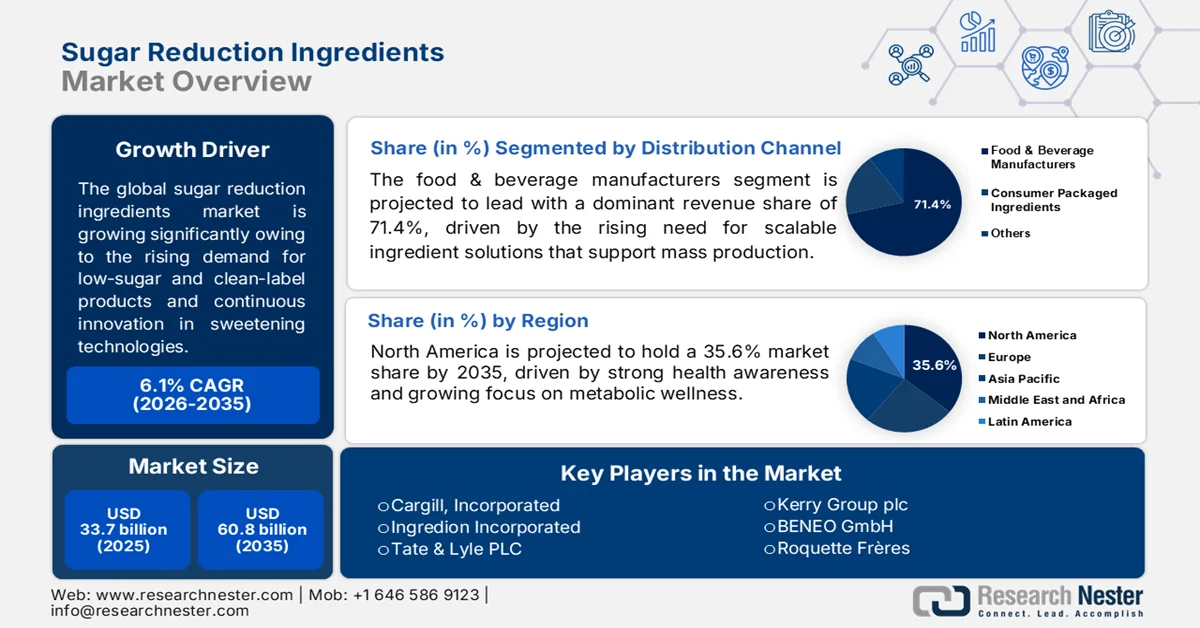
The sugar reduction ingredients market is witnessing stable growth owing to the rising consumer preference for healthier food and beverage options, heightening demand for low-sugar and clean-label products, and continuous innovation in sweetening technologies. Food and beverage manufacturers are opting for ingredients such as stevia, monk fruit, allulose, polyols, and dietary fibers to develop products with improved nutritional profiles. In August 2023, the World Health Organization stated that excessive free sugar consumption contributes to obesity, dental caries, and other noncommunicable diseases, i.e., diabetes and cardiovascular conditions. It recommends that adults and children limit free sugar intake to less than 10% of daily energy intake, with benefits from reducing it below 5%, thus catalyzing the growth potential of the sugar reduction ingredients market.
Furthermore, sugar reduction efforts are expanding as governments introduce public health measures that encourage food and beverage producers to lower sugar content and look into other alternative formulation options, boosting the growth of the sugar reduction ingredients market. Therefore, in November 2024, the PNAS Organization stated that the global sugar sector represents around USD 68 billion in yearly economic activity, with almost 40% of sugar volumes participating in international trade, reflecting its importance across global supply networks. Also, changes in sugar consumption patterns may influence agricultural and ingredient supply chains, and in this context, research is indicating that achieving recommended sugar intake levels could lower the requirement for 483 million tons of sugarcane and 128 million tons of sugar beet, creating opportunities for land recovery, cultivation of alternative crops, and the utilization of sugar resources for applications such as microbial proteins, biofuels, and bioplastics.
Key Sugar Reduction Ingredients Market Insights Summary:
Regional Highlights:
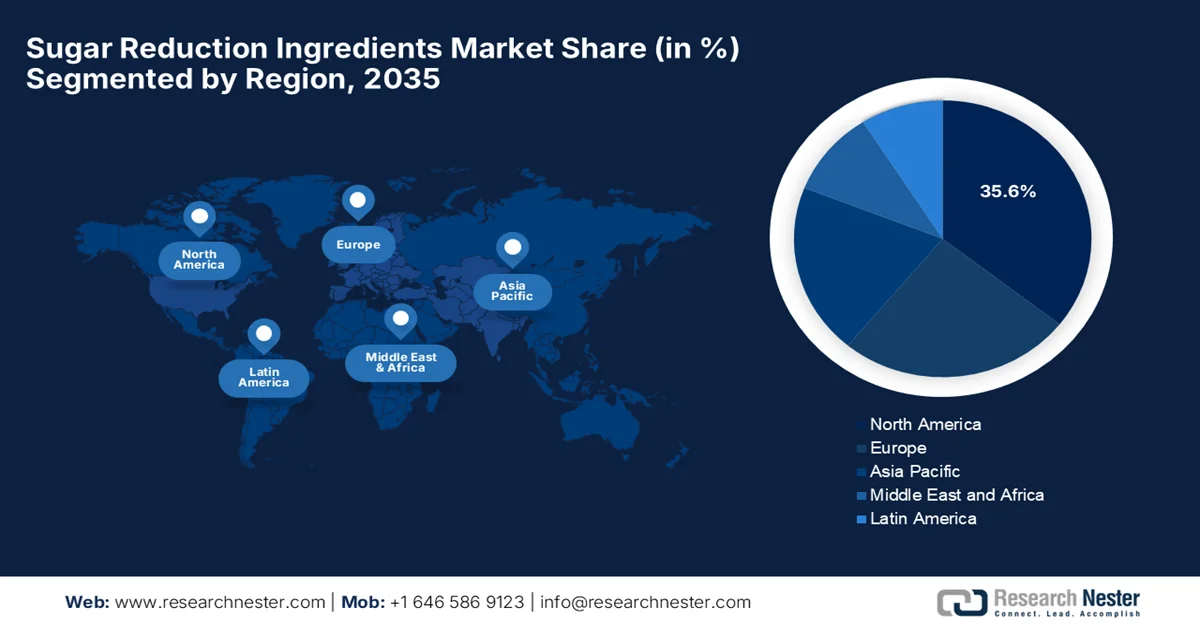
- The sugar reduction ingredients market in North America is projected to command 35.6% of the market during 2026–2035, fueled by high consumer awareness of wellness, stringent nutritional labeling mandates, and rising demand for healthier food reformulation
- Asia Pacific is poised to register the fastest growth in the market throughout 2026-2035, encouraged by shifting consumer preferences toward healthier lifestyles, expanding biotechnology infrastructure, and supportive sugar-reduction initiatives
Segment Insights:
- The food & beverage manufacturers sub-segment is expected to account for 71.4% of the sugar reduction ingredients market during 2026-2035, reinforced by growing demand for efficient and adaptable ingredient solutions for high-volume food and beverage manufacturing
- The traditional sweeteners sub-segment is anticipated to create strong growth opportunities by 2035, aided by the continued adoption of established sweetening solutions such as polyols and naturally derived sweeteners
Key Growth Trends:
- Stringent government regulations
- Clean label ingredient innovation
Major Challenges:
- Consumer perception and acceptance issues
- Formulation complexity across food and beverage applications
Key Players: Cargill, Incorporated (U.S.), Ingredion Incorporated (U.S.), Tate & Lyle PLC (UK), Kerry Group plc (Ireland), BENEO GmbH (Germany), Roquette Frères (France), Sweegen (U.S.), PureCircle (Malaysia), BioHarvest Sciences (Canada), Prodalim (Netherlands), Matsutani Chemical Industry Co., Ltd. (Japan), GLG Life Tech Corporation (Canada).
Global Sugar Reduction Ingredients Market Forecast and Regional Outlook:
Market Size & Growth Projections:
- 2025 Market Size: USD 33.7 billion
- 2026 Market Size: USD 35.7 billion
- Projected Market Size: USD 60.8 billion by 2035
- Growth Forecasts: 6.1% CAGR (2026-2035)
Key Regional Dynamics:
- Largest Region: North America (35.6% share by 2035)
- Fastest Growing Region: Asia Pacific
- Dominating Countries: United States, Germany, China, Japan, France
- Emerging Countries: India, Canada, South Korea, United Kingdom, Singapore
Last updated on : 5 August, 2026
Sugar Reduction Ingredients Market - Growth Drivers and Challenges
Growth Drivers
- Stringent government regulations: Governments in most of the nations are implementing certain health policies in order to reduce sugar consumption and thereby reduce healthcare burdens. Also, the introduction of soda taxes, mandatory front-of-pack nutritional warning labels, and national sugar-reduction targets are compelling manufacturers in the sugar reduction ingredients market to reformulate products. In July 2025, the Obesity Evidence Hub stated that food reformulation can reduce sugar intake by lowering sugar levels in packaged foods and beverages. It also mentioned that government regulations, such as the UK Soft Drink Industry Levy, achieved a 46% reduction in drink sugar content and a 34% decrease in sugary drink purchases, thus indicating that strong policies and monitoring are needed for effective sugar reduction.
- Clean label ingredient innovation: Modern consumers are looking for transparent and natural formulations by rejecting synthetic alternatives in favor of clean-label ingredients. This factor has extensively fueled rapid research and development into plant-based sweeteners such as stevia leaf extracts and monk fruit blends. Apart from this, advancements in production technology have eliminated off-notes, making natural alternatives attractive to clean-label brands. In July 2023, Nestlé developed an enzymatic sugar reduction technology that lowers intrinsic sugars in ingredients such as milk, malt, and fruit juice by up to 30% while maintaining taste and texture without adding sweeteners. It is applied to more than 200,000 tons of cocoa and malt-based beverages, and thus it contributes to the expansion of the sugar reduction ingredients market.
Key Industry Developments Driving the Sugar Reduction Ingredients Market 2024
|
Year |
Company |
Key Development |
Market Opportunity |
|
2024 |
Roquette & Bonumose -Tagatose Agreement |
Development of tagatose, a natural sweetener with sugar-like taste and lower calories. |
Growth opportunity for natural sugar alternatives in food and beverage reformulation. |
|
2024 |
Avansya (dsm-firmenich & Cargill) - EverSweet® |
EFSA/FSA safety opinions for Reb M and Reb D stevia sweeteners. |
Expands demand for high-intensity stevia sweeteners in reduced- and zero-sugar products. |
Source: Company Official Press Releases
Challenges
- Consumer perception and acceptance issues: The demand for reduced-sugar products is booming, but consumer perception is still considered to be a challenge for the sugar reduction ingredients market. Some consumers associate artificial sweeteners with negative health concerns, whereas others remain cautious about highly processed or unfamiliar alternatives. Even naturally derived sweeteners may face challenges which are related to ingredient transparency, sustainability concerns, or unfamiliar labeling terminology. In this context, manufacturers in this field need to focus on balancing sugar reduction goals with consumer preferences for clean-label, natural, and minimally processed products. Also, proper awareness regarding ingredient benefits, safety, and functionality is highly essential to improve acceptance.
- Formulation complexity across food and beverage applications: Sugar plays different roles depending on the product category, which makes sugar reduction technically challenging across different types of applications. A solution that performs well in beverages may not deliver the same functionality in bakery, dairy, or confectionery products due to differences in terms of processing conditions, stability requirements, and desired sensory profiles. Therefore, manufacturers need to combine multiple ingredients, which include sweeteners, fibers, and flavor modifiers, to achieve the desired sugar reduction level. This increases formulation complexity, development time, and production costs, negatively impacting the growth of the sugar reduction ingredients market globally.
Sugar Reduction Ingredients Market Size and Forecast:
| Report Attribute | Details |
|---|---|
|
Base Year |
2025 |
|
Forecast Period |
2026-2035 |
|
CAGR |
6.1% |
|
Base Year Market Size (2025) |
USD 33.7 billion |
|
Forecast Year Market Size (2035) |
USD 60.8 billion |
|
Regional Scope |
|
Sugar Reduction Ingredients Market Segmentation:
Distribution Channel Segment Analysis
The food & beverage manufacturers sub-segment is anticipated to lead the distribution channel, capturing a 71.4% share of total revenue during the forecast period. The segment’s dominance in the sugar reduction ingredients market is supported by the growing demand for efficient and adaptable ingredient solutions that enable high-volume manufacturing across various food and beverage applications. In addition, large manufacturers benefit from established procurement networks and the capability to integrate advanced sweetening systems into existing production processes. In January 2026, ADM announced that it invested a total of USD 26 million in its Erlanger, Kentucky facility to expand reformulation capabilities and support growing demand for healthier food and beverage products. This investment increases production capacity by 40% and helps develop solutions for reducing sugar and thus improving labels.
Technology Segment Analysis
By the end of 2035, the traditional sweeteners subsegment is anticipated to grow with strong opportunities in the sugar reduction ingredients market. The segment’s growth is attributable to continued use of established sweetening solutions such as polyols and naturally derived sweeteners. In addition, their familiarity and compatibility with existing food processing systems positions it for sustained growth. In January 2024, EverSweet® stevia sweetener, developed by Avansya, which is a Cargill and DSM-Firmenich joint venture, received positive safety opinions from EFSA and the UK Food Standards Agency, thereby supporting its use as a sugar-reduction solution. The zero-calorie sweetener enables significant sugar reduction while maintaining taste, with sustainability benefits, thus denoting a wider segment scope.
Application Segment Analysis
The beverages segment is predicted to hold a substantial share in the sugar reduction ingredients market during the stipulated timeframe. The rising demand for low-sugar and reduced-calorie beverage options among health-conscious consumers is boosting the segment’s leadership. Beverage manufacturers are reformulating carbonated drinks, functional beverages, sports drinks, and ready-to-drink products by incorporating sugar reduction ingredients with the main goal of addressing changing dietary preferences and regulatory pressures. In addition, the availability of advanced sweetening solutions that deliver sugar-like taste profiles with fewer calories is allowing companies to launch innovative beverage products.
Our in-depth analysis of the sugar reduction ingredients market includes the following segments:
|
Segment |
Subsegments |
|
Distribution Channel |
|
|
Technology |
|
|
Application |
|
|
Ingredients Type |
|
|
End user |
|

Vishnu Nair
Head - Global Business DevelopmentCustomize this report to your requirements — connect with our consultant for personalized insights and options.
Sugar Reduction Ingredients Market - Regional Analysis
North America Market Insights
North America sugar reduction ingredients market is growing exponentially, capturing the highest revenue share of 35.6% during the discussed timeframe. The region benefits from high consumer awareness of wellness and a strong proactive stance against metabolic health issues. North America is also being influenced by regulatory frameworks, including updated nutritional labeling mandates that clearly isolate added sugars, which encourages manufacturers to reformulate their product portfolios. In April 2026, the Centers for Disease Control and Prevention (CDC) stated that excessive added sugar intake in the U.S. is linked to health problems such as obesity, type 2 diabetes, and heart disease. It also mentioned that average consumption reached 17 teaspoons per day among both children aged 2–19 years and adults aged 20 years or older, thus underscoring the need for efficient solutions.
Continued technological innovation, particularly in precision fermentation, which allows producers to scale bio-identical sweeteners, is positioning the U.S. sugar reduction ingredients market for solid growth. These advanced ingredients fuel widespread penetration across mainstream domestic retail channels, which is structured around functional energy drinks, dairy alternatives, and baked goods. In September 2025, Cargill stated that EverSweet® stevia sweetener was named a finalist in the 2025 Global Good Awards Game-Changing Innovation of the Year category for its sugar-reduction potential. It was produced through precision fermentation, and it provides a sugar-like taste with 96% lower land-use impact, 97% less water use, and 81% fewer greenhouse gas emissions.
The Canada sugar reduction ingredients market is gaining enhanced traction owing to the shifting regulatory landscape, which is accelerating the domestic demand for natural sweeteners. In addition, the market is characterized by profitable collaborations between local food innovators and global ingredient suppliers, facilitating the integration of functional texturizers and rare sugars into staple food categories. In July 2024, the Canada Sugar Institute disclosed that the country’s estimated added sugar consumption has gradually declined over the past two decades, reaching 10.8% of energy intake in 2023. This updated Statistics Canada data suggests that reduced availability of sugary products and changing population factors have influenced national added sugar trends, thus making it suitable for standard market growth.
APAC Market Insights
Asia Pacific sugar reduction ingredients market is expected to grow at a significant rate which is driven by a massive demographic shift toward healthier lifestyles and an escalating middle-class focus on preventing metabolic conditions. In addition, Asia Pacific’s agricultural sector and expanding biotechnology infrastructure are driving localized production and cost efficiencies, leading to rapid ingredient penetration in ready-to-drink teas, dairy products, and convenience snacks. In February 2026, Generation Sans Tabac stated that South Korea proposed introducing a sugar tax to reduce sugar consumption, support public healthcare funding, and prevent noncommunicable diseases. The article also mentioned that almost 80% of surveyed people supported the measure, which follows global trends with 116 countries having implemented sugary drink taxes by 2024.
The government's health-conscious initiatives, which actively discourage excessive sugar consumption to combat rising lifestyle-related health conditions, are driving the sugar reduction ingredients market in China. The country’s market also benefits from continued innovations in functional beverages, ready-to-drink milk teas, and traditional confectionery. Based on government data published in April 2024, Shanghai introduced China’s first Nutri-Grade beverage grading system to rate drinks from A to D based on added sugar, saturated fat, trans fat, and non-sugar sweetener levels. This system aims to improve healthier drink choices, especially as 67% of adults and 90% of school students in Shanghai regularly consume sugar-sweetened beverages.
In India, the sugar reduction ingredients market is growing at a notable rate, which is propelled by an escalating urban health crisis and rising public awareness surrounding the long-term management of lifestyle disorders such as diabetes and obesity. On the other hand, consumer preference for intense sweetness in traditional diets drives ingredient innovation, focusing on high-intensity natural sweeteners such as stevia, along with functional bulk sweeteners. As per an article published by the National Institutes of Health (NIH) in March 2026, India faces rising health risks from increased sugar consumption contributing to dental caries, obesity, diabetes, and cardiovascular diseases. It also mentioned that the diabetes burden in the country surpassed almost 101 million in 2023, thus underscoring the need for stronger sugar reduction policies. Therefore, it proposed measures, i.e., tiered sugar taxes, front-of-package warning labels, marketing restrictions, and school-based interventions, in order to reduce sugar intake and improve public health.
India Other Sugars Export Data 2024: Country-wise Trade Statistics
|
Destination Country |
Export Value (In Million) |
|
Indonesia |
35.90 |
|
U.S. |
17.50 |
|
Vietnam |
8.78 |
|
Kenya |
7.60 |
|
Bangladesh |
7.49 |
|
Nepal |
6.96 |
|
United Arab Emirates |
6.13 |
|
Zambia |
5.65 |
|
Thailand |
5.50 |
|
Philippines |
5.16 |
Source: OEC
Europe Market Insights
The Europe sugar reduction ingredients market is forecasted to witness strong expansion, which is driven by the world's most strict public health policies and the shift away from synthetic sweeteners toward natural, plant-based alternatives. The region’s market dynamics are being reshaped by intense culinary innovation, where advanced texturizers and sugars are blended to maintain premium taste integrity and quality. In August 2024, Roquette introduced four new CLEARAM® TR tapioca starch-based ingredients to help food manufacturers improve product texture and stability across applications such as sauces, dairy products, and bakery items. These plant-derived starches offer benefits such as smooth texture, neutral taste, visual appeal, and gluten-free, allergen-free properties.
A strong focus on clean-label nutrition and rising diabetes and obesity cases is driving the overall sugar reduction ingredients market in Germany. Innovation in the country is especially focused on maintaining strict sensory profiles, making sure that sugar-reduced variants of traditional staple categories are maintained. In July 2026, the Federal Ministry of Agriculture, Food and Regional Identity stated that Germany’s National Reduction and Innovation Strategy for Sugar, Fats, and Salt in Processed Foods aims to improve the nutritional quality of processed foods by encouraging reformulation. Besides, the strategy set targets such as reducing sugar in children’s breakfast cereals by 20% and in soft drinks and sweetened dairy products by 15%, and thus positively contributing to the market’s expansion.
The UK sugar reduction ingredients market is growing remarkably, efficiently propelled by the retail environment and high consumer demand for health-optimized convenience foods. Manufacturers in the country are adopting advanced ingredient combinations to achieve sugar reduction, whereas the government is proactively supporting with suitable sugar reduction initiatives. In November 2025, the country’s government expanded the Soft Drinks Industry Levy by including sugary milk-based and milk-alternative drinks and lowering the sugar threshold from 5g to 4.5g per 100ml. This policy is expected to remove 17 million calories per day from diets and deliver around USD 1.3 billion in long-term health and economic benefits.
UK Sugar Consumption Statistics 2026: Key Data, Trends and Public Health Insights
|
Statistic |
Value |
|
Adult sugar intake vs recommended level |
2× higher |
|
Consumer concern about sugar content |
55% of UK consumers |
|
Shoppers considering low/no added sugar labels |
>25% of UK shoppers |
|
Reduction in soft drink sugar content after levy |
30% decrease |
|
Revenue generated by Soft Drinks Industry Levy |
USD 1.9 billion |
|
Type 2 diabetes cases prevented through soft drink sugar reduction modelling |
300,000 cases over 20 years |
Source: CPD
Key Sugar Reduction Ingredients Market Players:
- Cargill, Incorporated (U.S.)
- Ingredion Incorporated (U.S.)
- Tate & Lyle PLC (UK)
- Kerry Group plc (Ireland)
- BENEO GmbH (Germany)
- Roquette Frères (France)
- Sweegen (U.S.)
- PureCircle (Malaysia)
- BioHarvest Sciences (Canada)
- Prodalim (Netherlands)
- Matsutani Chemical Industry Co., Ltd. (Japan)
- GLG Life Tech Corporation (Canada)
- Company Overview
- Business Strategy
- Key Product Offerings
- Financial Performance
- Key Performance Indicators
- Risk Analysis
- Recent Development
- Regional Presence
- SWOT Analysis
- Cargill, Incorporated is one of the leading players in this market by offering an extensive portfolio of sweeteners, fibers, and texturizing solutions. The company is highly focused on developing reduced-sugar formulations with the help of ingredients such as stevia, erythritol, allulose, and soluble fibers.
- Ingredion Incorporated has captured a prominent position in this industry through its different types of sweeteners, fibers, and specialty carbohydrate solutions. The company offers formulation expertise to food and beverage manufacturers seeking to reduce sugar levels.
- Tate & Lyle PLC is also a leading producer of sugar reduction solutions for the food and beverage industry. The company specializes in continuous investment in research and development, which enables it to deliver innovative ingredient solutions.
- Kerry Group plc is considered to be a key participant in the market which is providing taste and nutrition solutions that enable manufacturers to develop healthier food and beverage products. The firm combines sweetening systems, flavor technologies, and functional ingredients to support sugar reduction.
- BENEO GmbH is identified as a leading functional ingredient manufacturer that specializes in terms of sugar reduction and nutritional enhancement solutions. It differentiates itself through science-backed ingredient development and strong production facilities.
Here is a list of key players operating in the global sugar reduction ingredients market:
In the global sugar reduction ingredients market, competition is led by multinational ingredient manufacturers who are offering portfolios of high-intensity sweeteners, rare sugars, polyols, fibers, and taste modulation technologies. Apart from this, leaders in this market are opting for distinct strategies, i.e., proprietary formulations, application-specific R&D, regulatory expertise, and global manufacturing footprints, whereas regional manufacturers are focused on natural sweeteners and localized product offerings. For instance, BENEO in May 2023 introduced Beneo-scL85, which is a short-chain fructooligosaccharide (scFOS) that provides greater formulation flexibility for reduced-sugar food and beverage applications. This is derived from beet sugar, and the ingredient provides mild sweetness and dietary fiber enrichment.
Corporate Landscape of the Market:
Recent Developments
- In May 2026, Tate & Lyle entered into a collaboration with BioHarvest Sciences with the main goal of advancing the development of plant-based sweetener solutions for food and beverage applications. This collaboration aims to create a wider range of innovative sweetening ingredients that support sugar and calorie reduction.
- In April 2026, Prodalim reported the acquisition of Better Juice, thereby integrating advanced enzymatic technology into its specialty ingredient portfolio to support healthier food and beverage innovation. The acquisition enhances Prodalim’s ability to deliver natural sugar reduction solutions.
- Report ID: 8722
- Published Date: Aug 05, 2026
- Report Format: PDF, PPT
- Explore a preview of key market trends and insights
- Review sample data tables and segment breakdowns
- Experience the quality of our visual data representations
- Evaluate our report structure and research methodology
- Get a glimpse of competitive landscape analysis
- Understand how regional forecasts are presented
- Assess the depth of company profiling and benchmarking
- Preview how actionable insights can support your strategy
Explore real data and analysis
Frequently Asked Questions (FAQ)
About this Report
Connect with our Expert


Report, 2026-2035



Copyright @ 2026 Research Nester. All Rights Reserved.
