Upcycled Food Ingredients Market Outlook:
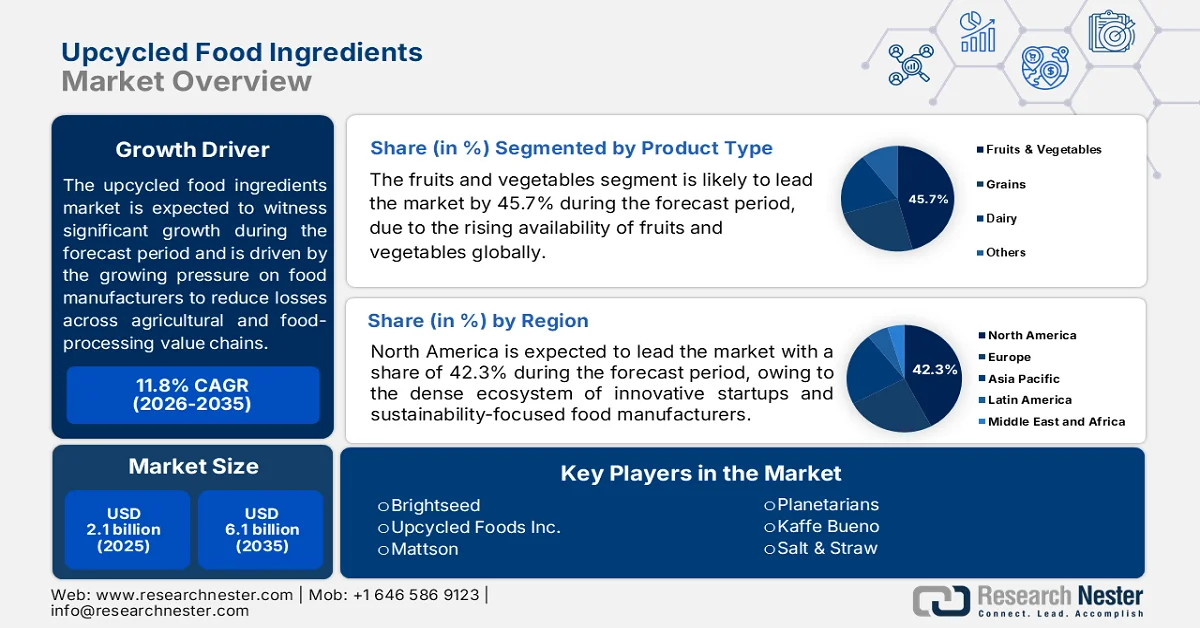
Upcycled Food Ingredients Market size was valued at USD 2.1 billion in 2025 and is predicted to cross USD 6.1 billion by the end of 2035, expanding at more than 11.8% CAGR during the forecast period i.e., between 2026-2035. In 2026, the industry size of upcycled food ingredients is assessed at USD 2.2 billion.
The upcycled food ingredients market is being supported by growing pressure on food manufacturers to reduce losses across agricultural and food-processing value chains. According to the FDA, January 2025 data, food waste accounts for an estimated 30% to 40% of the U.S. food supply, representing a substantial loss of agricultural inputs, labor, water, energy, and transportation resources. The U.S. Environmental Protection Agency (EPA) also identifies food as the single most common material sent to municipal landfills and combustors, highlighting a significant opportunity for ingredient recovery and reuse. From a business perspective, ingredient producers are increasingly evaluating side streams from fruit processing, vegetable preparation, grain milling, dairy production, and beverage manufacturing as alternative raw-material sources that can support resource-efficiency targets and waste-reduction commitments.
Growth prospects are also being strengthened by broader global concerns regarding food security, resource availability, and environmental performance. The United Nations Environment Programme (UNEP) March 2026 data reported that around 19% of food available to consumers at the retail, food-service, and household levels. At the same time, the Food and Agriculture Organization of the United Nations (FAO) September 2024 data estimates that roughly 13% of food produced globally is lost between harvest and retail before reaching consumers. These figures are encouraging governments, food processors, and agricultural stakeholders to prioritize value recovery from existing production streams. For ingredient manufacturers, this creates opportunities to develop scalable supply partnerships with growers, processors, and cooperatives while addressing raw-material efficiency objectives.
Key Upcycled Food Ingredients Market Insights Summary:
Regional Highlights:
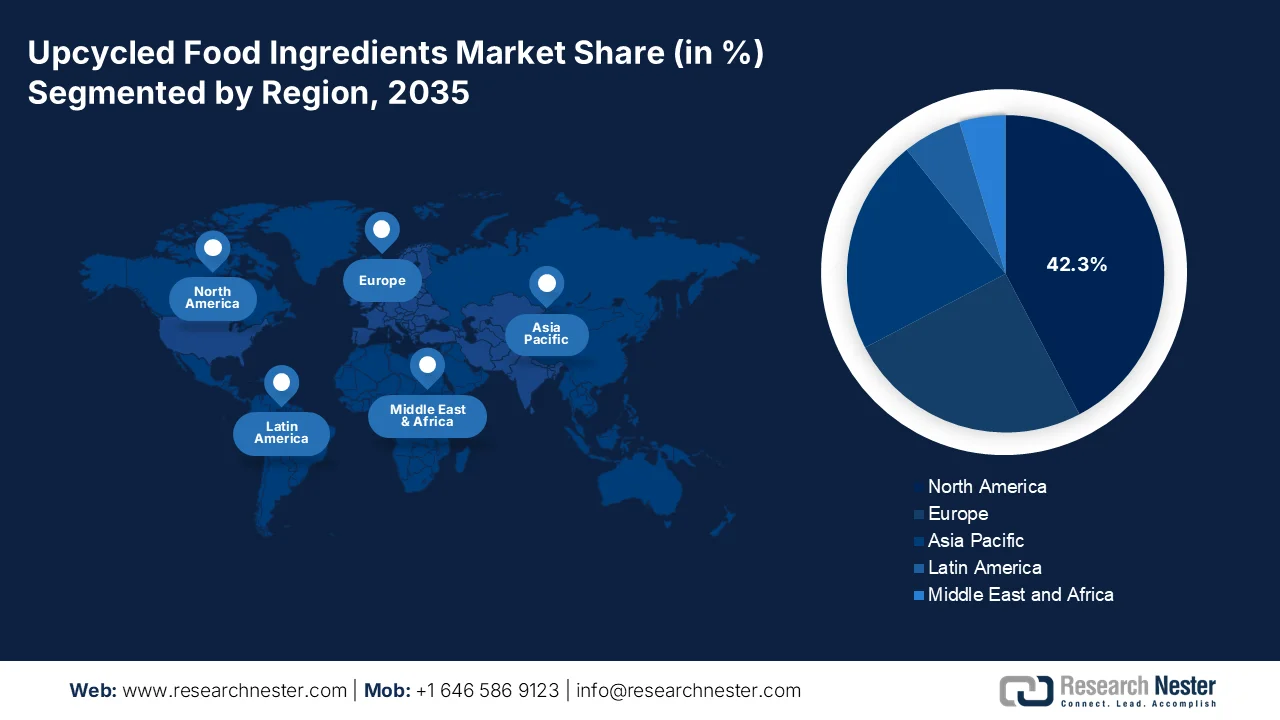
- North America is anticipated to command 42.3% of the upcycled food ingredients market revenue by 2035, bolstered by a strong network of sustainability-focused manufacturers, ingredient suppliers, and innovative startups
- Asia Pacific is set to witness rapid expansion in the market throughout 2026-2035, fueled by extensive agricultural byproduct availability and the advancement of regional food processing industries
Segment Insights:
- Fruits and vegetables are projected to capture 45.7% of the upcycled food ingredients market by 2035, supported by the increasing global availability of fruit and vegetable production
- Powder and flour are expected to lead the form segment during 2026-2035, underpinned by their superior storage stability, logistical efficiency, and formulation versatility
Key Growth Trends:
- Government food waste reduction programs
- Climate and emissions reduction commitments
Major Challenges:
- Supply chain inconsistency
- Technical hurdles in flavor, texture, and functionality
Key Players: Brightseed (U.S.),Upcycled Foods Inc. (U.S.),Mattson (U.S.),Planetarians (U.S.),Kaffe Bueno (Denmark),Salt & Straw (U.S.).
Global Upcycled Food Ingredients Market Forecast and Regional Outlook:
Market Size & Growth Projections:
- 2025 Market Size: USD 2.1 billion
- 2026 Market Size: USD 2.2 billion
- Projected Market Size: USD 6.1 billion by 2035
- Growth Forecasts: 11.8% CAGR (2026-2035)
Key Regional Dynamics:
- Largest Region: North America (42.3% Share by 2035)
- Fastest Growing Region: Asia Pacific
- Dominating Countries: United States, Germany, China, United Kingdom, Canada
- Emerging Countries: India, Indonesia, Malaysia, Brazil, Vietnam
Last updated on : 29 June, 2026
Upcycled Food Ingredients Market - Growth Drivers and Challenges
Growth Drivers
- Government food waste reduction programs: Government investment in food-loss and waste reduction is creating a favorable environment for upcycled food ingredient adoption. In the United States, the USDA and EPA have established national food loss and waste reduction targets and continue funding programs that improve food-system efficiency. The USDA June 2022 announced more than USD 90 million in cooperative agreements and projects supporting food loss and waste prevention, composting, and food recovery infrastructure. Such investments encourage food processors to convert by-products into commercially viable ingredients rather than disposing of them. Companies capable of integrating waste-stream valorization into ingredient production are benefiting from growing institutional support and sustainability procurement requirements.
- Climate and emissions reduction commitments: Food waste reduction is becoming a key climate policy priority, supporting growth in upcycled ingredients. The UNEP March 2024 data Food Waste Index reported that 1.05 billion tonnes of food waste were generated globally in 2022. Governments increasingly recognize that reducing food waste can lower greenhouse-gas emissions associated with production, transportation, and disposal. Upcycled ingredients enable food manufacturers to utilize existing resources more effectively while reducing landfill contributions. Climate-related disclosure requirements and sustainability targets are encouraging processors to improve material efficiency. Companies that incorporate recovered ingredients can strengthen environmental reporting metrics and support customer decarbonization goals.
Challenges
- Supply chain inconsistency: Manufacturers face significant challenges in securing consistent feedstock volumes due to seasonal harvest cycles and fluctuating production schedules at source facilities. Fruit pomace, spent grain, and vegetable peels are generated in irregular quantities, making it difficult to maintain year-round production runs. This unpredictability forces upcyclers to maintain costly buffer inventories or develop multi-source strategies across different geographies.
- Technical hurdles in flavor, texture, and functionality: Upcycled ingredients often carry off-notes, bitterness, or undesirable colors from their original waste streams, complicating formulation work for food manufacturers. Functional properties such as water-holding capacity, emulsification, and gelation frequently deviate from conventional ingredients, requiring extensive R&D to reformulate end-products. Many suppliers lack in-house food science expertise to optimize their ingredients for specific applications.
Upcycled Food Ingredients Market Size and Forecast:
| Report Attribute | Details |
|---|---|
|
Base Year |
2025 |
|
Forecast Year |
2026-2035 |
|
CAGR |
11.8% |
|
Base Year Market Size (2025) |
USD 2.1 billion |
|
Forecast Year Market Size (2035) |
USD 6.1 billion |
|
Regional Scope |
|
Upcycled Food Ingredients Market Segmentation:
Product Type Segment Analysis
Under the product type segment, the fruits and vegetables are dominating and is poised to hold the share value of 45.7% by the end of 2035. The segment is driven by the rising availability of fruits and vegetables globally. According to the MOFPI 2025 data, the global production of fruits reached 933 million tons. This staggering volume ensures a continuous, low-cost feedstock supply for upcyclers, making fruit and vegetable byproducts the most economically viable raw material stream. Furthermore, the high intrinsic value of extracted bioactives—such as citrus flavonoids, tomato lycopene, and apple pectin—in nutraceutical markets, creating a compelling margin arbitrage for ingredient manufacturers. The seasonal diversity of fruit and vegetable processing (citrus in winter, berries in summer, tropical fruits year-round) also provides a staggered, year-round supply calendar, preventing the feedstock bottlenecks that plague single-crop upcycling models.
Form Segment Analysis
Powder and flour represent the dominant form in the upcycled food ingredients market, owing to their unparalleled logistical efficiency and formulation adaptability. Drying and milling transform perishable wet byproducts into stable, ambient-temperature powders with extended shelf life, eliminating expensive cold-chain requirements. This form integrates seamlessly into existing industrial production lines, allowing manufacturers to replace a portion of conventional flours without retooling equipment. The neutral flavor profiles achieved through advanced drying techniques enable high substitution rates in bakery mixes, snacks, meat analogues, and beverage powders. Furthermore, standardized particle sizes ensure consistent functional performance, making powders the preferred B2B format for large-scale food manufacturers seeking risk-free ingredient transitions.
Application Segment Analysis
Bakery and confectionery applications lead the upcycled food ingredients market, driven by the pressing need for cost-stable flour alternatives amid volatile grain markets. According to the Bureau of Labor Statistics (BLS) Producer Price Index (PPI) April 2025 data, wheat prices surged 84.4% and then sharply declined, yet bakery product PPIs continued rising in 35 of 36 months, reflecting persistent labor, energy, and processing costs. This decoupling creates a compelling economic case for upcycled spent grain and pomace flours, which offer predictable pricing and hedge against wheat volatility. Major bakeries now substitute 10–15% of conventional flour with upcycled alternatives, reducing input cost exposure while delivering clean-label, high-fiber products that command premium retail positioning.
Our in-depth analysis of the upcycled food ingredients market includes the following segments:
|
Segment |
Subsegments |
|
Product Type |
|
|
Form |
|
|
Application |
|
|
Source Stream |
|
|
End user Industry |
|
|
Processing Technology |
|

Vishnu Nair
Head - Global Business DevelopmentCustomize this report to your requirements — connect with our consultant for personalized insights and options.
Upcycled Food Ingredients Market - Regional Analysis
North America Market Insights
North America is dominating the upcycled food ingredients market and is projected to hold the regional revenue share of 42.3% by the end of 2035. The region is driven by a dense ecosystem of innovative startups, established ingredient distributors, and sustainability-focused food manufacturers. The region benefits from well-developed agricultural processing industries that generate abundant, accessible byproduct streams, including brewers' spent grain, fruit pomace, and oilseed meals. Strong consumer awareness of food waste issues, coupled with willingness to pay premium prices for certified sustainable products, has accelerated brand adoption. Strategic collaborations between upcyclers and major CPG companies have streamlined supply chains, while federal and state-level waste diversion policies create favorable operating conditions. The presence of industry associations providing certification standards and consumer education further solidifies North America's leadership position in the global upcycled food ingredients market.
The expanding federal investments in food-system efficiency, waste diversion, and domestic processing capacity is shaping the upcycled food ingredients market in the U.S. Food manufacturers are increasingly commercializing by-products from fruit, vegetable, grain, dairy, and beverage processing streams to improve resource utilization and strengthen supply-chain resilience. A key driver is the USDA’s 2025 data Resilient Food Systems Infrastructure (RFSI) program, which provides more than USD 420 million to expand food processing and aggregation capacity across states. In addition, the U.S. EPA 2025 data depicts that nearly USD 1.84 billion is awarded to increase recovery of usable materials. These initiatives are creating favorable conditions for ingredient recovery, processing, and commercialization across the U.S. food industry.
The federal policies focus on reducing food loss and improving resource efficiency across the agri-food sector is shaping the upcycled food ingredients market in Canada. Food processors are increasingly recovering value from crop residues, processing by-products, and surplus food streams to support sustainability objectives and strengthen domestic supply chains. A significant driver is in March 2026 Government of Canada’s Food Waste Reduction Challenge, which committed CAD 20 million to support innovative solutions that divert food waste and maximize food utilization. Additionally, Canada Action 2026 data reported that the agri-food system contributed approximately CAD 150 billion (about 7% of Canada’s GDP), highlighting the scale of raw materials available for value-added ingredient recovery. These initiatives are supporting commercial adoption of upcycled ingredients across Canada's food manufacturing sector.
APAC Market Insights
The Asia Pacific is projected to emerge rapidly during the assessed period, 2026 to 2035 in the upcycled food ingredients market. The region is driven by the immense agricultural output and rapidly evolving food processing sectors. Abundant byproduct streams from rice milling, fruit juicing, oilseed crushing, and seafood processing offer vast, untapped feedstock potential across countries like China, India, Indonesia, and Malaysia. Traditional food cultures that inherently minimize waste, combined with growing middle-class environmental consciousness, are accelerating commercial acceptance. Emerging local startups are partnering with regional food conglomerates to develop value-added ingredients from okara, palm oil residues, and tropical fruit peels. Supportive government policies promoting circular economy frameworks, coupled with increasing export opportunities to Western markets, are attracting investment into regional upcycling infrastructure and technology transfer initiatives.
The raw-material utilization and align with national sustainability and circular-economy priorities is driving the upcycled food ingredients market in India. Growing investments in food processing infrastructure are increasing opportunities to convert agricultural by-products, fruit and vegetable residues, and grain-processing waste into value-added ingredients. A key catalyst is the Pradhan Mantri Kisan SAMPADA Yojana (PMKSY), under which the Government of India approved 165 projects, as per the PIB April 2026 data strengthening processing capacity nationwide. Additionally, the Ministry of Food Processing Industries 2021-2022 reported that India’s food processing sector attracted FDI inflows of about USD 4.99 billion, supporting modernization and ingredient recovery initiatives across the value chain.
The strong food security, resource efficiency, and agricultural modernization initiatives is driving the upcycled food ingredients market in China. Food manufacturers are increasingly utilizing by-products from grain processing, fruit and vegetable production, and beverage manufacturing to improve value recovery and reduce material losses. According to the People’s Republic of China December 2024 data, the total grain output of China reached a record 706.5 million metric tons in 2024, creating substantial volumes of agricultural raw materials and secondary streams suitable for ingredient recovery. In addition, the Ministry of Agriculture and Rural Affairs reported that China’s agricultural product processing industry operating revenue is reflecting the scale of processing activities that can support upcycled ingredient production. These factors are strengthening opportunities for commercial ingredient recovery across China’s food sector.
Europe Market Insights
Europe represents a highly progressive and regulatory-driven upcycled food ingredients market for upcycled food ingredients, underpinned by the EU's ambitious Circular Economy Action Plan and Farm to Fork Strategy. The region benefits from diverse agricultural byproduct streams, including brewers' spent grain, fruit pomace from wine and juice production, and dairy side-streams like whey. Strong consumer demand for sustainable, clean-label products, coupled with stringent waste diversion mandates, has incentivized food manufacturers to integrate upcycled ingredients into mainstream portfolios. Collaborative innovation ecosystems—involving research institutes, food-tech startups, and multinational CPG companies—accelerate commercial scale-up. The EU's novel food regulatory framework, while rigorous, provides clarity and credibility for approved upcycled ingredients. Additionally, retailer-driven sustainability scorecards increasingly favor products incorporating verified upcycled components.
Manufacturers prioritize resource efficiency, circular-economy practices, and food waste reduction across processing operations is driving the upcycled food ingredients market in Germany. The country’s strong food and beverage industry provides a large base of by-products that can be converted into functional ingredients, fibers, and proteins. According to USDA March 2025 data, the food industry generated approximately USD 252.1 billion of food and drinks, highlighting the substantial processing volume available for ingredient recovery. In addition, the German Federal Ministry of Food and Agriculture (BMEL) allocated billion in its federal budget, supporting agriculture, food systems, and sustainability initiatives that encourage efficient use of biological resources. These factors are strengthening commercial opportunities for upcycled ingredients across Germany’s food manufacturing sector.
The upcycled food ingredients market in the UK is developing steadily as food manufacturers seek to reduce waste, improve resource productivity, and meet sustainability targets across supply chains. The country's advanced food processing sector generates significant volumes of by-products that can be transformed into value-added ingredients for food and beverage applications. According to the UK Parliament April 2025 data, the UK food chain contributed approximately £148 billion in gross value added (GVA), demonstrating the scale of the sector supporting ingredient recovery opportunities. Additionally, the Innovate UK Transforming Food Production Challenge has invested million in innovation projects since its launch, supporting technologies that improve food-system efficiency and resource utilization. These developments are encouraging greater adoption of upcycled ingredient solutions across the UK food industry.
Key Upcycled Food Ingredients Market Players:
- Brightseed (U.S.)
- Upcycled Foods Inc. (U.S.)
- Mattson (U.S.)
- Planetarians (U.S.)
- Kaffe Bueno (Denmark)
- Salt & Straw (U.S.)
- Company Overview
- Business Strategy
- Key Product Offerings
- Financial Performance
- Key Performance Indicators
- Risk Analysis
- Recent Development
- Regional Presence
- SWOT Analysis
- Brightseed is a bioscience company that leverages artificial intelligence and its proprietary Forager® platform to discover hidden bioactive compounds in upcycled plant waste, particularly from soy hulls and tomato peels.
- Upcycled Foods Inc. is a trailblazer in converting brewers' spent grain—a major brewing byproduct—into nutrient-dense flours and snack bases. Within the upcycled food ingredients market, the company has adopted a dual strategy: operating its own direct-to-consumer brand.
- Mattson is uniquely positioned as a food innovation and development firm that actively incorporates upcycled ingredients into new product prototypes for major CPG clients. In the upcycled food ingredients market, Mattson's competitive edge lies in its sensory science and formulation expertise, helping brands overcome.
- Planetarians specializes in upcycling defatted sunflower and soybean meal—leftovers from oil pressing—into high-protein, low-cost meat alternatives and bakery fortifiers. Within the Upcycled Food Ingredients Market, the company stands out for its cost-competitive positioning, targeting price-sensitive segments like institutional foodservice and developing markets.
- Kaffe Bueno is a biorefinery company that upcycles spent coffee grounds—one of the world's most abundant organic waste streams—into high-value bioactive oils, antioxidants, and natural preservatives. In the upcycled food ingredients market, they are recognized for their green chemistry approach, utilizing supercritical CO₂ and enzyme-assisted extraction to obtain coffee oil and chlorogenic acid without toxic solvents.
Here is a list of key players operating in the global upcycled food ingredients market:
The upcycled food ingredients market is highly fragmented yet rapidly consolidating, driven by sustainability mandates and circular economy goals. Key players are shifting from niche supply to industrial-scale production, leveraging partnerships with major CPG brands to validate ingredient functionality. Strategic initiatives focus on securing diverse waste streams and investing in novel drying and extraction technologies to preserve nutrition. Companies are also pursuing upcycled certification as a key differentiator, while expanding into high-growth applications like plant-based meat and functional beverages. Vertical integration and cross-regional joint ventures are emerging to manage supply chain resilience and cost parity with conventional ingredients.
Corporate Landscape of the Upcycled Food Ingredients Market:
Recent Developments
- In January 2025, Natural Upcycling announced the acquisition of Ridgefield, CT-based Curbside Compost. The acquisition of Curbside Compost helps deepen Natural Upcycling’s client base in the Connecticut and New York markets.
- In August 2024, Upcycled Foods, Inc. announced the launch of a new line of snack bars, which is designed for delicious and wholesome food to make the world a better place.
- In February 2024, Portland-based based ice cream company Salt & Straw launched an upcycled foods series, incorporating ingredients from Renewal Mill and bread pudding made with stale loaves from restaurants and grocery stores.
- Report ID: 8644
- Published Date: Jun 29, 2026
- Report Format: PDF, PPT
- Explore a preview of key market trends and insights
- Review sample data tables and segment breakdowns
- Experience the quality of our visual data representations
- Evaluate our report structure and research methodology
- Get a glimpse of competitive landscape analysis
- Understand how regional forecasts are presented
- Assess the depth of company profiling and benchmarking
- Preview how actionable insights can support your strategy
Explore real data and analysis
Frequently Asked Questions (FAQ)
About this Report
Connect with our Expert


Report, 2026-2035



Copyright @ 2026 Research Nester. All Rights Reserved.
