Speech Recognition Market Outlook:
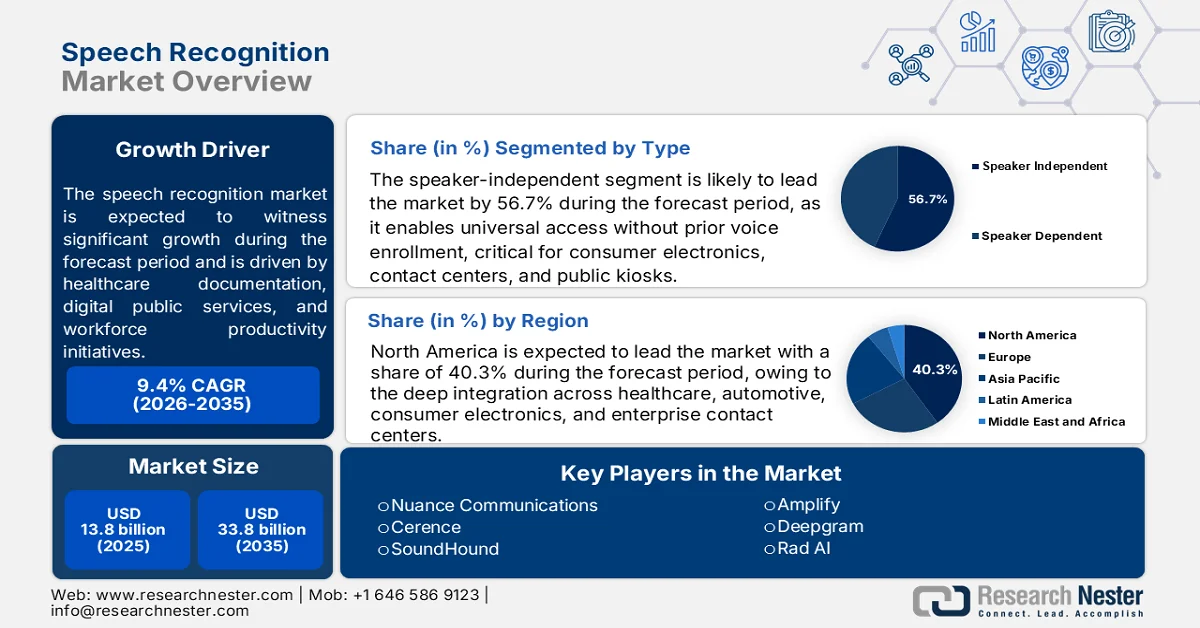
Speech Recognition Market size was valued at USD 13.8 billion in 2025 and is expected to reach USD 33.8 billion by the end of 2035, registering around 9.4% CAGR during the forecast period, i.e., 2026-2035. In 2026, the industry size of speech recognition is estimated at USD 15.1 billion.
The speech recognition market is being supported by long-term demand from accessibility, healthcare documentation, digital public services, and workforce productivity initiatives. According to the World Health Organization (WHO) March 2026 data, more than 430 million people worldwide currently live with disabling hearing loss, and this figure is projected to reach over 700 million by 2050, increasing the need for speech-enabled and voice-assisted communication tools across public and private sectors. Public-sector digital transformation programs are also contributing to adoption. Government agencies are expanding online citizen services and digital records management, creating demand for accurate speech-to-text workflows that can improve documentation efficiency and accessibility compliance.
In the U.S., the NIH September 2024 data reports that approximately 15.5% of U.S. adults experience some degree of hearing difficulty, reinforcing the importance of voice-based interfaces and transcription capabilities in healthcare, education, and government service delivery. In healthcare, speech-enabled clinical documentation is gaining attention as providers seek to reduce administrative workload while maintaining accurate patient records. The growing volume of digital interactions between citizens, businesses, and government institutions continues to create opportunities for speech recognition deployment across multilingual and high-volume communication environments.
Key Speech Recognition Market Insights Summary:
Regional Highlights:
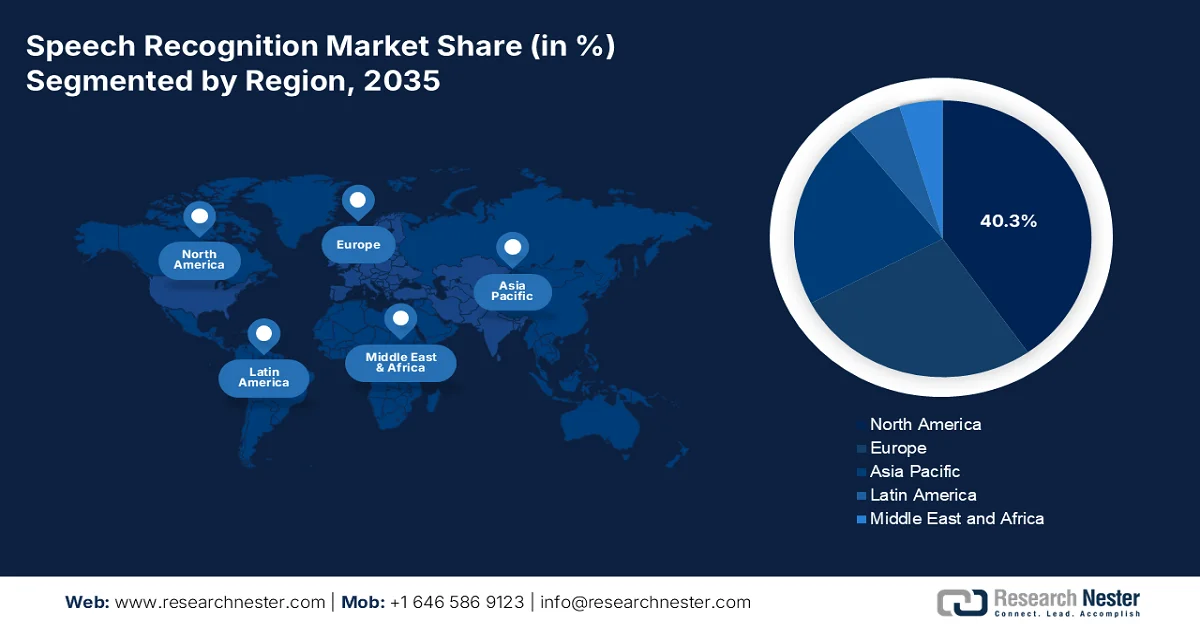
- North America is anticipated to command 40.3% of the speech recognition market revenue by 2035, underpinned by deep integration across healthcare, automotive, consumer electronics, and enterprise contact centers
- Asia Pacific is set to witness the fastest expansion in the throughout 2026-2035, fueled by massive mobile-first populations, rapid urbanization, and aggressive government AI funding across China, Japan, South Korea, India, and Southeast Asia
Segment Insights:
- The speaker independent segment is projected to capture 56.7% of the speech recognition market by 2035, bolstered by its ability to provide universal access without prior voice enrollment across consumer electronics, contact centers, and public kiosks
- By 2035, the automotive application segment is expected to maintain its leading position, catalyzed by growing adoption of voice-enabled systems for hands-free emergency calling, driver fatigue detection, and real-time accident reporting
Key Growth Trends:
- Increasing government investment in AI
- Growth of multilingual public services
Major Challenges:
- High R&D costs and capital intensity
- Data scarcity and annotation challenges
Key Players: Nuance Communications (U.S.), Cerence (U.S.), SoundHound (U.S.), Amplify (U.S.), Deepgram (U.S.), Rad AI (U.S.).
Global Speech Recognition Market Forecast and Regional Outlook:
Market Size & Growth Projections:
- 2025 Market Size: USD 13.8 billion
- 2026 Market Size: USD 15.1 billion
- Projected Market Size: USD 33.8 billion by 2035
- Growth Forecasts: 9.4% CAGR (2026-2035)
Key Regional Dynamics:
- Largest Region: North America (40.3% Share by 2035)
- Fastest Growing Region: Asia Pacific
- Dominating Countries: United States, China, Japan, Germany, United Kingdom
- Emerging Countries: India, South Korea, Singapore, United Arab Emirates, Saudi Arabia
Last updated on : 7 July, 2026
Speech Recognition Market - Growth Drivers and Challenges
Growth Drivers
- Increasing government investment in AI: National AI strategies are accelerating adoption of speech recognition technologies as governments allocate substantial resources to artificial intelligence development. According to ITIF October 2025 data, USD 300 billion in allocated for AI infrastructure. Speech recognition represents a key AI application area supporting multilingual communication, public service automation, and workforce productivity. Countries including Japan, South Korea, Singapore, and the United Kingdom continue expanding AI funding programs that encourage deployment of speech-enabled solutions. Government-supported AI ecosystems are fostering research, procurement, and implementation opportunities across public-sector institutions and regulated industries. These investments are expected to support continued adoption of advanced speech processing technologies over the coming decade.
- Growth of multilingual public services: Governments are expanding multilingual service delivery capabilities to accommodate increasingly diverse populations and international engagement. The European Union 2022 data depicts that the nation recognizes 24 official languages, creating substantial demand for language technologies that support communication across institutions and member states. Speech recognition solutions help government agencies automate multilingual interactions, transcription, translation workflows, and public information dissemination. Immigration services, healthcare systems, judicial institutions, and public service centers increasingly require technologies capable of processing spoken content across multiple languages. Vendors capable of delivering high-accuracy language coverage and regulatory compliance are likely to benefit from growing procurement opportunities within government and public-sector organizations.
Challenges
- High R&D costs and capital intensity: Developing accurate ASR models demands massive investment in computational infrastructure, annotated datasets, and AI talent. Training a single deep learning model can cost millions in GPU cloud expenses. Startups struggle to compete with tech giants that spend billions annually on AI research. Smaller players often rely on open-source models but face challenges in fine-tuning for domain-specific accuracy.
- Data scarcity and annotation challenges: Quality labeled speech data remains scarce, particularly for low-resource languages, dialects, and accented speech. Collecting and transcribing thousands of hours of audio requires substantial human effort and expertise. Privacy regulations further restrict access to sensitive audio data, creating a competitive disadvantage for new entrants lacking established data partnerships.
Speech Recognition Market Size and Forecast:
| Report Attribute | Details |
|---|---|
|
Base Year |
2025 |
|
Forecast Year |
2026-2035 |
|
CAGR |
9.4% |
|
Base Year Market Size (2025) |
USD 13.8 billion |
|
Forecast Year Market Size (2035) |
USD 33.8 billion |
|
Regional Scope |
|
Speech Recognition Market Segmentation:
Type Segment Analysis
Under the type segment, the speaker independent is dominating and is poised to hold the share value of 56.7% by the end of 2035 in speech recognition market. The segment dominates as it enables universal access without prior voice enrollment critical for consumer electronics, contact centers, and public kiosks. The NLM March 2024 study have extended speaker-independent capabilities to challenging multilingual and multispeaker environments, as demonstrated study integrating OpenAI's Whisper with speaker diarization for Mandarin Taiwanese-accented speech. The system achieved a word diarization error rate (WDER) of 6.96% across 46 speakers, with 2.68% in two-speaker and 11.65% in three-speaker scenarios, performance comparable to non-real-time baselines. This convergence of multilingual ASR and real-time diarization represents a significant leap forward for speaker-independent systems in dynamic, real-world applications.
Application Segment Analysis
Within the application segment the automotive sub-segment is leading in the global market by 2035. Speech recognition in vehicles extends beyond navigation and infotainment to safety-critical applications such as hands-free emergency calling, driver fatigue detection via vocal biomarkers, and real-time accident reporting. With 1.3 million annual road fatalities reported by the NLM February 2025 study, voice-enabled IoT systems now collect and transmit crash-related data, engine temperature, vibrations, and driver conditions—to insurers and emergency responders instantly. According to the National Highway Traffic Safety Administration study on distracted driving found that speech-based interfaces reduce cognitive load compared to manual touchscreens, directly improving driver reaction times and lowering accident risks, thereby cementing automotive speech recognition as a pillar of next-generation intelligent transportation systems.
Technology Segment Analysis
End-to-end deep learning dominates the technology segment as it revolutionizes speech recognition by directly mapping raw audio inputs to textual outputs through unified neural architectures, eliminating the need for separate acoustic, pronunciation, and language models. This paradigm simplifies training pipelines, reduces latency, and enhances accuracy in noisy, multilingual, and multispeaker environments. Unlike traditional hybrid systems that propagate errors across independent modules, end-to-end models learn optimal representations holistically, enabling faster adaptation to new domains and accents. Their architectural efficiency supports real-time deployment on edge devices, making them indispensable for automotive voice assistants, healthcare documentation, and consumer electronics, thereby cementing their leadership within the market's technology landscape.
Our in-depth analysis of the speech recognition includes the following segments:
|
Segment |
Subsegments |
|
Type |
|
|
Application |
|
|
Technology |
|
|
Delivery Methods |
|
|
Deployment Mode |
|

Vishnu Nair
Head - Global Business DevelopmentCustomize this report to your requirements — connect with our consultant for personalized insights and options.
Speech Recognition Market - Regional Analysis
North America Market Insights
North America is dominating the speech recognition market and is projected to hold the regional revenue share of 40.3% by the end of 2035. The region is driven by the deep integration across healthcare, automotive, consumer electronics, and enterprise contact centers. The ecosystem benefits from concentrated AI talent, world-class research institutions, and aggressive venture capital funding that fuels continuous model advancements. Enterprises prioritize low-latency, privacy-preserving solutions, accelerating hybrid cloud-edge deployments. The region also leads in multilingual adaptation, addressing diverse immigrant populations and regional dialects. Strategic partnerships between technology giants and vertical specialists dominate competitive dynamics, while open-source model proliferation lowers barriers for niche entrants targeting underserved applications like education accessibility and legal transcription automation.
The rapid growth in artificial intelligence adoption and increasing deployment of voice-enabled technologies across federal agencies and enterprises is shaping the speech recognition market in the U.S. According to the FEDS April 2026 data, 18% of U.S. businesses used AI technologies, demonstrating a significant increase in AI-driven operational tools, including speech recognition applications. Additionally, the Interspeech 2022 data reported that Speech Recognition Evaluation that leading automatic speech recognition systems achieved word error rates below 5% in several benchmark conversational speech tasks, reflecting substantial improvements in recognition accuracy and supporting broader commercial deployment. These advances are encouraging adoption across customer service, government administration, financial services, telecommunications, and automotive sectors, strengthening the U.S. position as a major market for speech recognition technologies.
The expanding digital economy and growing adoption of artificial intelligence technologies is shaping the speech recognition market in Canada. According to Government of Canada November 2025 data, the digital economy accounted for 5.7% of Canada's GDP, highlighting the increasing role of digital technologies across industries and creating favorable conditions for speech-enabled applications. Additionally, the Prime Minister of Canada April 2024 data announced in Budget 2024 that it would provide USD 2.4 billion to support artificial intelligence infrastructure, computing capacity, and AI adoption initiatives. These investments are encouraging the deployment of advanced speech recognition solutions across government services, financial institutions, telecommunications, retail, and enterprise operations. Continued support for AI innovation and digital transformation is expected to strengthen demand for speech recognition technologies throughout the Canadian market.
APAC Market Insights
The Asia Pacific is projected to emerge rapidly during the assessed period, 2026 to 2035 in the market. The region represents the fastest-evolving and most linguistically diverse market, driven by massive mobile-first populations, rapid urbanization, and aggressive government AI funding across China, Japan, South Korea, India, and Southeast Asia. The region faces unique challenges including thousands of languages and dialects, tonal complexities, and accent variability, spurring localized innovation. Automotive voice assistants, smart home devices, and enterprise automation fuel commercial adoption, while healthcare and education sectors expand rapidly. The market also benefits from large-scale voice data availability, accelerating self-supervised learning models that address previously underserved linguistic communities.
The rapid digitalization, increasing AI adoption, and government-backed language technology initiatives is shaping the market in India. According to the PIB August 2024 data, India had over 954.40 million internet subscribers, providing a large user base for voice-enabled applications and digital services. In addition, PIB December 2025 data has depicted that ₹10,371.92 crore (approximately USD 1.25 billion) is allocated to strengthen AI infrastructure, innovation, and deployment across sectors. These developments are accelerating the use of speech recognition technologies in government services, banking, telecommunications, education, and customer support. The growing emphasis on multilingual digital access is further supporting market expansion across urban and rural regions.
The strong growth, supported by large-scale digital infrastructure development and accelerating artificial intelligence adoption is driving the speech recognition market in China. According to the NLM March 2025 data, the country had 1.11 billion internet users, representing one of the world's largest digital populations and creating substantial demand for voice-enabled applications. Additionally, China deployed more 5G base stations, strengthening network capacity for real-time speech processing and cloud-based voice services. These developments are supporting the integration of speech recognition technologies across smart manufacturing, transportation, public services, telecommunications, and consumer digital platforms, positioning China as a key growth market for advanced voice technologies.
Europe Market Insights
Europe's market is shaped by strict data privacy regulations, multilingual diversity, and strong automotive and healthcare verticals. GDPR imposes rigorous consent and data localization requirements, pushing vendors toward on-premise and edge-based deployments. The region's linguistic complexity, spanning Germanic, Romance, Slavic, and Uralic language families, demands highly adaptable multilingual models. Automotive voice assistants thrive due to Europe's leading automotive OEMs, while healthcare digitization accelerates across NHS, French, and German hospital networks. Fragmentation across national regulators increases compliance costs, but the region's commitment to ethical AI and language preservation fosters a distinctive ecosystem emphasizing transparency, fairness, and auditable speech models.
The strong digital transformation agenda and increasing investment in artificial intelligence infrastructure is driving the market in Germany. According to the Federal Statistical Office of Germany (Destatis), Germany enterprises reached a high or very high level of digital intensity, indicating broad deployment of digital technologies that can incorporate speech-enabled solutions. Additionally, the GTAI June 2024 data reported that the German government is investing approximately EUR 1.6 billion in AI initiatives through its national AI strategy, aimed at accelerating AI development and adoption across industries. These investments are encouraging greater use of speech recognition technologies in manufacturing, automotive, financial services, public administration, and enterprise automation applications.
The growing public engagement with artificial intelligence and continued government support for AI development is driving the speech recognition market in the UK. According to the Government of UK January 2026 data, 73% of the public used at least one AI-enabled tool during the previous month in 2025, demonstrating widespread exposure to AI-driven technologies that support speech and language applications. The same report found that 57% of respondents used virtual assistants, highlighting the increasing acceptance of voice-based interfaces in daily activities. In parallel, the UK government has committed significant funding to strengthen national AI capabilities and computing infrastructure. Rising usage of AI-powered assistants, digital services, and enterprise automation platforms is expected to support sustained demand for speech recognition solutions across the UK.
Key Speech Recognition Market Players:
- Nuance Communications (U.S.)
- Cerence (U.S.)
- SoundHound (U.S.)
- Amplify (U.S.)
- Deepgram (U.S.)
- Rad AI (U.S.)
- Company Overview
- Business Strategy
- Key Product Offerings
- Financial Performance
- Key Performance Indicators
- Risk Analysis
- Recent Development
- Regional Presence
- SWOT Analysis
- Nuance Communications is leading the market and has carved a defensive moat through healthcare and enterprise verticals, leveraging decades of clinical vocabulary training and HIPAA-compliant infrastructure.
- Cerence operates exclusively in the automotive vertical within the broader market, powering voice assistants for over million vehicles globally across brands like BMW, Mercedes, and Toyota.
- SoundHound distinguishes itself in the market through its proprietary Houndify platform, which offers independent, white-label voice AI with real-time speech-to-meaning capabilities—bypassing the traditional ASR-to-NLU pipeline by processing intent directly from acoustic signals.
- Amplify focuses on the education technology segment within the market, providing real-time analytics for K-12 literacy, language learning, and special education. Its speech engine is uniquely optimized for children's voices, which have higher pitch variability.
- Deepgram has emerged as a disruptor in the market through its custom-trained, end-to-end deep neural networks that achieve word error rates (WER) lower than legacy engines, particularly for noisy environments, heavy accents, and domain-specific jargon.
Here is a list of key players operating in the global market:
The speech recognition market is fiercely dominated by U.S. tech giants that leverage cloud AI and vast data pools, while Nuance retains healthcare enterprise strength. European players excel in multi-dialect resilience, and Japan’s NEC/Advanced Media focus on Asia tonal accuracy. South Korea’s Naver and Kakao drive hyper-localized Korean AI, while India’s Gnani and Uniphore push vernacular enterprise solutions. Australia’s Appen provides critical training data, and Malaysia’s Duramecho targets Southeast Asian languages. Strategic moves include massive R&D in generative speech AI, acquisitions, open-source model releases, and regional partnerships to capture non-English markets, intensifying price wars and feature differentiation.
Corporate Landscape of the Market:
Recent Developments
- In June 2026, Amplify announced the development of a custom Automatic Speech Recognition (ASR) system designed to power voice-enabled education products. The system converts spoken language into written text, enabling users to interact with educational software using voice commands.
- In April 2026, Deepgram announced the general availability (GA) of Flux Multilingual, expanding its conversational speech recognition model beyond English to support 10 languages, with the ability to automatically detect, understand, and switch languages dynamically within a single conversation in real time.
- In December 2025, Rad AI announced the launch of next-generation speech recognition technology that dramatically improves the speed and accuracy of diagnostic reporting. Integrated into Rad AI Reporting, the new capabilities deliver unprecedented speed and accuracy, setting a new standard for dictation in radiology.
- Report ID: 8662
- Published Date: Jul 07, 2026
- Report Format: PDF, PPT
- Explore a preview of key market trends and insights
- Review sample data tables and segment breakdowns
- Experience the quality of our visual data representations
- Evaluate our report structure and research methodology
- Get a glimpse of competitive landscape analysis
- Understand how regional forecasts are presented
- Assess the depth of company profiling and benchmarking
- Preview how actionable insights can support your strategy
Explore real data and analysis
Frequently Asked Questions (FAQ)
About this Report
Connect with our Expert


Report, 2026-2035



Copyright @ 2026 Research Nester. All Rights Reserved.
