Small Modular Reactor Market Outlook:
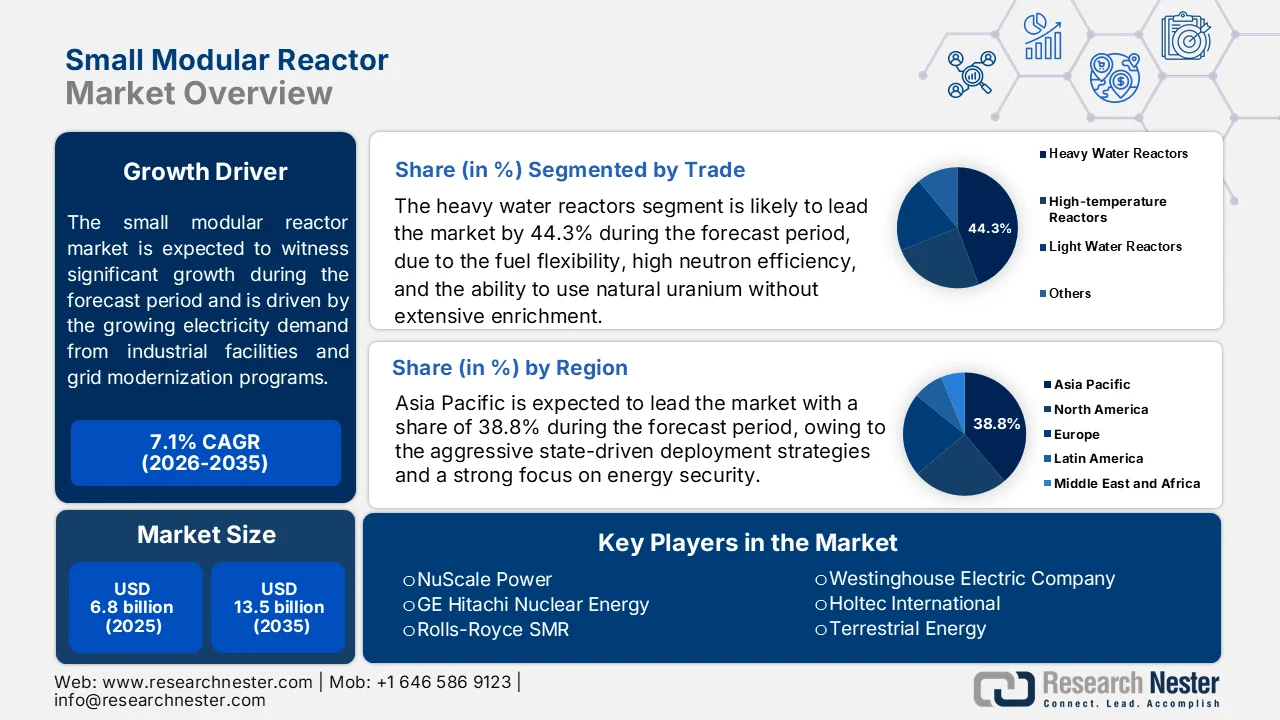
Small Modular Reactor Market size was valued at USD 6.8 billion in 2025 and is projected to account for USD 13.5 billion by 2035, rising at a CAGR of 7.1% during the forecast period, i.e., 2026-2035. In 2026, the industry size of small modular reactor is estimated at USD 7.2 billion.
The small modular reactor market is gaining momentum as governments and utilities seek reliable low-carbon generation capacity that can complement growing electricity demand from industrial facilities, data centers, hydrogen production projects, and grid modernization programs. Market activity is being supported by national energy security strategies, long-term decarbonization targets, and funding programs focused on advanced nuclear deployment. According to the WNN September 2024 data, global nuclear power capacity is projected to expand significantly, with the agency’s high-case outlook estimating worldwide nuclear capacity could reach approximately 950 GW by 2050, compared with about 372 GW in operation at the end of 2023. This long-term expansion outlook is encouraging investments in SMR development, licensing, supply-chain localization, and manufacturing infrastructure.
In the United States, the U.S. Energy Information Administration (EIA) February 2024 data reported that nuclear power generated roughly 775 billion kWh of electricity in 2024, maintaining its position as the country’s largest source of carbon-free electricity generation. Public-sector funding programs across North America, Europe, and Asia-Pacific are supporting reactor demonstration projects, site development, fuel-cycle initiatives, and workforce expansion. Market participants are also benefiting from increased interest among industrial energy users seeking stable power supply and reduced exposure to fuel-price volatility. Procurement strategies increasingly emphasize modular construction approaches, standardized designs, and phased deployment models that can reduce project execution risks while supporting regional energy planning objectives.
Key Small Modular Reactor Market Insights Summary:
Regional Highlights:
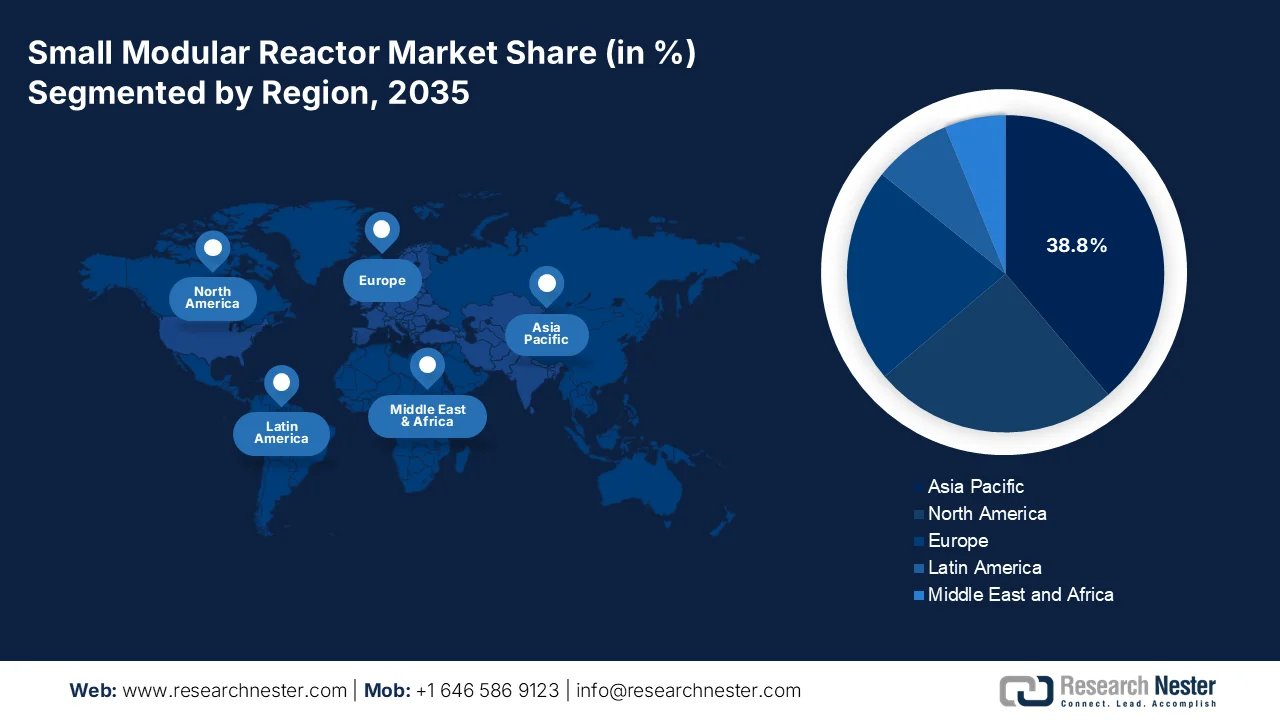
- The Asia Pacific small modular reactor market is anticipated to command 38.8% of regional revenue by 2035, underpinned by aggressive government-led deployment strategies and an intensified focus on energy security
- North America is expected to witness rapid expansion in the market throughout 2026-2035, fueled by regulatory modernization initiatives and substantial government funding programs supporting nuclear decarbonization projects
Segment Insights:
- The Heavy water reactors segment in the small modular reactor market is projected to capture 44.3% of the market share by 2035, propelled by increasing utility preference for fuel flexibility, high neutron efficiency, and the capability to utilize natural uranium without extensive enrichment
- The Power generation segment is expected to maintain its leadership position in the market during 2026-2035, benefiting from rising demand for reliable low-carbon baseload electricity and enhanced grid stability requirements
Key Growth Trends:
- Government funding for first-of-a-kind SMR deployment
- Energy security programs
Major Challenges:
- Regulatory approval complexity
- High upfront capital expenditure
Key Players: NuScale Power (U.S.), GE Hitachi Nuclear Energy (U.S.), Rolls-Royce SMR (UK), Westinghouse Electric Company (U.S.), Holtec International (U.S.), Terrestrial Energy (Canada).
Global Small Modular Reactor Market Forecast and Regional Outlook:
Market Size & Growth Projections:
- 2025 Market Size: USD 6.8 billion
- 2026 Market Size: USD 7.2 billion
- Projected Market Size: USD 13.5 billion by 2035
- Growth Forecasts: 7.1% CAGR (2026-2035)
Key Regional Dynamics:
- Largest Region: Asia Pacific (38.8% share by 2035)
- Fastest Growing Region: North America
- Dominating Countries: United States, China, Canada, Russia, South Korea
- Emerging Countries: India, United Kingdom, France, Japan, United Arab Emirates
Last updated on : 10 September, 2025
Small Modular Reactor Market - Growth Drivers and Challenges
Growth Drivers
- Government funding for first-of-a-kind SMR deployment: Direct government funding is one of the strongest demand drivers for the global SMR market because it reduces early-stage project risks and improves financing conditions. In the United States, the U.S. Department of Energy (DOE) March 2025 data announced up to USD 900 million in funding in 2024 to support the initial domestic deployment of advanced reactor technologies, including SMRs. Such funding helps utilities and industrial operators advance site preparation, licensing activities, engineering work, and supply-chain development. Public investment also encourages private capital participation by improving project bankability and reducing uncertainty around commercialization timelines.
- Energy security programs: Energy security concerns are increasing government support for nuclear capacity additions, benefiting SMR demand globally. The UK Government March 2026 data announced over £300 million for domestic SMR development through Great British Nuclear initiatives. Governments increasingly view SMRs as a strategic asset capable of strengthening national energy independence while reducing exposure to imported fossil fuels. This trend is particularly relevant in regions seeking secure electricity supplies for critical infrastructure, manufacturing operations, and growing digital economies. Energy security policies are encouraging utilities to evaluate diversified generation portfolios that include scalable nuclear assets.
Challenges
- Regulatory approval complexity: Navigating fragmented international regulatory frameworks creates massive delays and costs. Each jurisdiction demands unique safety certifications, stretching timelines and consuming capital. Manufacturers like NuScale spent years securing NRC approval, highlighting the arduous path. This uncertainty deters investment and slows market entry, forcing companies to prioritize specific regions first.
- High upfront capital expenditure: Developing and commercializing new reactor designs requires billions in upfront investment before any revenue is generated. This financial barrier limits participation to large, well-capitalized firms. Startups struggle to secure funding without proven technology, while even established players like GE Hitachi rely on government partnerships to de-risk initial development phases.
Small Modular Reactor Market Size and Forecast:
| Report Attribute | Details |
|---|---|
|
Base Year |
2025 |
|
Forecast Year |
2026-2035 |
|
CAGR |
7.1% |
|
Base Year Market Size (2025) |
USD 6.8 billion |
|
Forecast Year Market Size (2035) |
USD 13.5 billion |
|
Regional Scope |
|
Small Modular Reactor Market Segmentation:
Product Type Segment Analysis
Heavy water reactors are the leading product type segment in the small modular reactor market and is poised to hold the share value of 44.3% by the end of 2035. The segment is driven as the utilities prioritize fuel flexibility, high neutron efficiency, and the ability to use natural uranium without extensive enrichment. Their proven operating history and suitability for countries seeking greater energy security support continued interest in SMR-scale heavy water designs. Government investment in nuclear infrastructure further strengthens market prospects. According to the Canada Energy Regulator August 2025 data, the federal government committed CAD 970 million in financing to Ontario Power Generation in 2024 to support the Darlington New Nuclear Project, including the deployment of SMRs, highlighting growing support for advanced nuclear technologies and reactor development.
Application Segment Analysis
Power generation is the leading application segment in the SMR market, driven by growing demand for reliable, low-carbon baseload electricity and grid stability. Utilities are increasingly evaluating SMRs as replacements for retiring coal-fired assets and as complementary sources for renewable energy integration. Their scalable design and lower upfront capital requirements compared with conventional nuclear plants support wider deployment. According to the U.S. Energy Information Administration (EIA) February 2024, nuclear power generated approximately 18.6% of total U.S. electricity in 2024, highlighting the continued importance of nuclear energy and strengthening the outlook for SMR adoption in electricity generation applications.
Module Segment Analysis
Single-module SMRs lead the module segment because they offer lower initial investment requirements, simplified construction, and greater flexibility for utilities, remote communities, and industrial facilities. Developers often prefer single-module deployment as an entry point before expanding capacity through additional units. This approach helps reduce project risk and accelerates regulatory approval and site development. Government support continues to encourage deployment. The U.S. Department of Energy (DOE) selected projects for funding under programs supporting advanced reactor deployment, with federal support reaching hundreds of millions of dollars, reflecting strong policy commitment to scalable single-module nuclear installations.
Our in-depth analysis of the small modular reactor market includes the following segments:
|
Segment |
Subsegments |
|
Application |
|
|
Product Type |
|
|
Module |
|
|
Technology |
|
|
Power Output |
|

Vishnu Nair
Head - Global Business DevelopmentCustomize this report to your requirements — connect with our consultant for personalized insights and options.
Small Modular Reactor Market - Regional Analysis
APAC Market Insights
The Asia Pacific is dominating the small modular reactor market and is projected to hold the regional revenue share of 38.8% by the end of 2035. The region is characterized by aggressive state-driven deployment strategies and a strong focus on energy security. Nations like China, Russia, and South Korea are leading the charge with active SMR construction projects, viewing this technology as a solution for remote electrification and industrial decarbonization. The competitive landscape is dominated by national champions benefiting from streamlined regulatory pathways and substantial government backing. The region's diverse energy needs—ranging from island grid stability to heavy industry power, create unique opportunities for tailored SMR solutions.
The reliable clean energy capacity to support industrial growth, rising electricity demand, and long-term decarbonization objectives is shaping the small modular reactor market in India. Government policy support for advanced nuclear technologies is expected to create opportunities for future SMR deployment across power generation and industrial applications. The IISD December 2025 data the Government of India announced a Nuclear Energy Mission with an outlay of ₹20,000 crore for the research and development of Small Modular Reactors, as part of the Union Budget. This initiative is expected to strengthen domestic nuclear capabilities, encourage technology development, and support the commercialization of SMRs within India's evolving energy mix.
The broader nuclear expansion strategy, growing electricity demand, and efforts to strengthen energy security while reducing carbon emissions is driving the small modular reactor market in China. Government support for advanced nuclear technologies, combined with a strong domestic manufacturing base, is creating favorable conditions for future SMR deployment in power generation, industrial energy supply, and desalination projects. According to EIA June 2026 data, the country generated approximately 76% of nuclear power, reflecting continued growth in nuclear energy utilization. This expanding nuclear ecosystem is expected to support SMR commercialization and related supply-chain investments across China.
North America Market Insights
North America is projected to emerge rapidly during the assessed period, 2026 to 2035 in the market. The region is driven by the dynamic interplay between aggressive regulatory modernization and robust government funding initiatives. The region, particularly the United States and Canada, serves as a global epicenter for SMR development, driven by the urgent need to decarbonize aging power grids and replace retiring coal and nuclear assets. Manufacturers are navigating a complex landscape of federal loan programs, tax incentives, and streamlined licensing processes designed to accelerate commercial deployment. The competitive environment is intense, with industry heavyweights and innovative startups vying for first-mover status, while simultaneously collaborating with national laboratories to demonstrate reactor safety and operational efficiency.
The long-term federal support aimed at accelerating advanced nuclear deployment is shaping the small modular reactor market in the U.S. Government-backed financing mechanisms have played an important role in improving project viability and attracting private investment. The World Nuclear Association November 2025 data U.S. Department of Energy’s Loan Programs Office, issued a solicitation for USD 12.6 billion in loan guarantees for advanced nuclear energy projects, including small modular reactors, advanced reactors, uprates at existing plants, and nuclear fuel-cycle facilities. This funding framework has helped establish a favorable investment environment for SMR development. Continued policy support, coupled with rising electricity demand and energy security priorities, is strengthening the outlook for SMR deployment across the United States.
The strong federal and provincial backing, an established nuclear industry, and growing demand for clean electricity is shaping the small modular reactors market in Canada. The country is advancing SMR deployment for grid power, industrial applications, and energy security, particularly in provinces with long-term decarbonization goals. A significant milestone was announced by WNN in March 2025 depicting that the Government of Canada confirmed up to CAD 304 million in federal support for Ontario Power Generation’s Darlington New Nuclear Project, which includes Canada’s first grid-scale SMR deployment. Continued public investment, regulatory progress, and supply-chain development are expected to strengthen Canada’s position in the global SMR market.
Europe Market Insights
The European market is defined by a strong policy-driven push towards energy independence and decarbonization, accelerated by geopolitical energy security concerns. The region features a collaborative yet fragmented landscape, with initiatives like the European SMR Pre-Partnership fostering cross-border cooperation among member states. Manufacturers are capitalizing on Europe's mature nuclear infrastructure and skilled workforce, while simultaneously navigating diverse national regulatory regimes that complicate pan-European deployment. The competitive dynamic sees established players like Rolls-Royce SMR competing alongside emerging national champions, all vying for early project commitments. The market is further driven by ambitious climate targets and a collective determination to reduce reliance on external energy sources, positioning the region as a significant growth frontier.
The small modular reactor market in Germany remains at an early stage compared with other major economies, largely due to the country's nuclear phase-out policy. However, German engineering firms, equipment suppliers, and research institutions continue to participate in European advanced nuclear and SMR-related initiatives, creating opportunities within the broader regional supply chain. Energy security and reliable power availability are increasingly important considerations for industrial users. According to the Clean Energy Wire December 2024 data, Germany imported a net 24.9 terawatt-hours (TWh) of electricity in 2024, highlighting ongoing discussions around long-term energy system resilience. These factors are supporting interest in monitoring future SMR developments across Europe.
The government-backed nuclear expansion plans aimed at strengthening energy security, support decarbonization, and ensuring reliable electricity supply small modular reactor market in UK. The country is positioning SMRs as part of its long-term strategy to complement renewable energy and meet growing power demand from industry and digital infrastructure. A significant policy milestone was reached in 2024 when Great British Nuclear selected multiple vendors to progress in the SMR technology competition, supporting future deployment pathways. According to the WNN January 2025 data, nuclear power generated 37.3 TWh of electricity in 2024, demonstrating the continued importance of nuclear energy within the UK's power mix and supporting interest in next-generation reactor technologies.
Key Small Modular Reactor Market Players:
- NuScale Power (U.S.)
- GE Hitachi Nuclear Energy (U.S.)
- Rolls-Royce SMR (UK)
- Westinghouse Electric Company (U.S.)
- Holtec International (U.S.)
- Terrestrial Energy (Canada)
- Company Overview
- Business Strategy
- Key Product Offerings
- Financial Performance
- Key Performance Indicators
- Risk Analysis
- Recent Development
- Regional Presence
- SWOT Analysis
- NuScale Power is a leader in the small modular reactor market, pioneering the first NRC-certified SMR design. Its innovative light-water technology offers scalable, carbon-free energy solutions, positioning the company as a frontrunner in the global race to commercialize advanced nuclear power for diverse end-users.
- GE Hitachi Nuclear Energy holds a significant position in the market with its BWRX-300 design. Leveraging proven boiling-water technology, the company delivers cost-competitive SMR solutions that appeal to utilities seeking reliable, grid-scale decarbonization, strengthening its influence across North American and European energy sectors.
- Rolls-Royce SMR is a major force in the market, distinguished by its factory-built approach. The UK-based consortium focuses on delivering standardized, economically viable SMRs for power and industrial applications, capitalizing on its extensive engineering heritage to drive widespread adoption and energy security.
- Westinghouse Electric Company competes strongly in the market with its AP300 design. Building on decades of large-reactor expertise, the company offers a proven, efficient SMR solution targeting both electricity generation and industrial heat applications, reinforcing its legacy as a trusted nuclear technology provider.
- Holtec International is a niche player in the market, championing the SMR-160 design. The company emphasizes passive safety and modular simplicity, offering a versatile solution for power generation and water desalination, primarily targeting markets requiring compact, deployable nuclear energy systems.
Here is a list of key players operating in the global market:
The global market for finished small modular reactor products is highly consolidated, currently dominated by a handful of established nuclear engineering firms with decades of large-scale reactor experience. These leaders are aggressively pivoting to SMR designs, leveraging their established supply chains and regulatory expertise to secure first-mover advantages in key markets like North America and Europe. The competitive dynamic is defined by a race to certification, where the primary differentiators are reactor technology type and the speed of obtaining regulatory approval from bodies like the NRC. While a few large players hold sway over the majority of announced projects, the landscape is seeing the emergence of specialist firms and national champions funded by government initiatives, fostering a blend of established might and innovative agility in the push for grid-scale and industrial decarbonization.
Corporate Landscape of the Market:
Recent Developments
- In June 2026, the Ontario government announced that GE Vernova Hitachi Nuclear Energy (GVH) and Canadian company Velan Inc. have signed a partnership agreement to explore opportunities to deploy Reactor Integral Isolation Valves (RIIVs) and Containment Isolation Valves (CIVs), critical pieces of safety equipment for BWRX-300 small modular reactor (SMR) projects in Europe.
- In October 2025, the Department of the Army announced the launch of the Janus Program, which is aimed at building microreactors. The Janus Program will build upon Project Pele, a transportable nuclear reactor intended for electricity production. The DOE laboratory, which worked on Project Pele, will also be working on the Janus Program.
- Report ID: 4846
- Published Date: Sep 10, 2025
- Report Format: PDF, PPT
- Explore a preview of key market trends and insights
- Review sample data tables and segment breakdowns
- Experience the quality of our visual data representations
- Evaluate our report structure and research methodology
- Get a glimpse of competitive landscape analysis
- Understand how regional forecasts are presented
- Assess the depth of company profiling and benchmarking
- Preview how actionable insights can support your strategy
Explore real data and analysis
Frequently Asked Questions (FAQ)
About this Report
Connect with our Expert


Report, 2026-2035



Copyright @ 2026 Research Nester. All Rights Reserved.
