Silicone Oil Market Outlook:
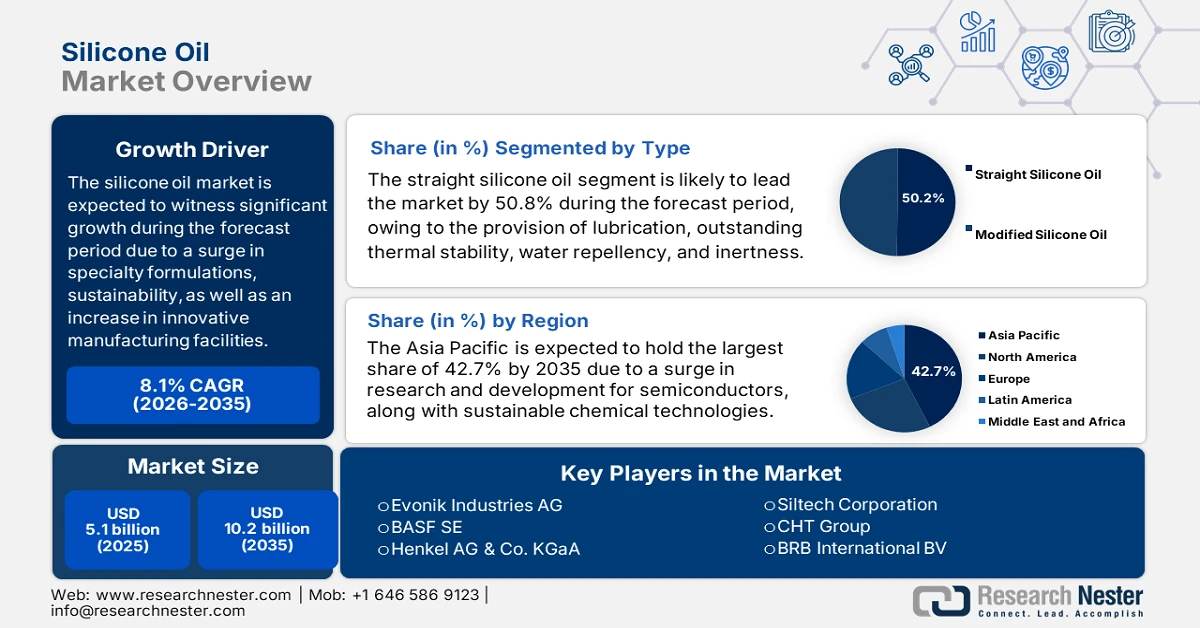
Silicone Oil Market size was over USD 5.1 billion in 2025 and is estimated to reach USD 10.2 billion by the end of 2035, expanding at a CAGR of 8.1% during the forecast timeline, i.e., 2026-2035. In 2026, the industry size of silicone oil is estimated at USD 5.5 billion.
The worldwide silicone oil market is steadily growing, fueled by a rise in the need for electronics, healthcare, automotive, and personal care. The market’s current trends are emphasized on specialty-grade formulations, advanced manufacturing, and sustainability. According to official statistics published by the IEA Organization in November 2025, international car sales readily approached 80 million as of 2024. In addition, there has been recent growth in sales of hybrid and electric cars, which made up nearly 30% of overall sales in the same year. Based on this, China, along with other developing nations, currently caters to more than half of international car sales, denoting a surge by 20%. Besides, with the car production having more than doubled as of 2024, China currently caters to 40% of international car manufacturing capacity, thereby ensuring a huge growth opportunity for the silicone oil market.
Furthermore, green chemistry, sustainability, a rise in the personal care, automotive electrification, pharmaceuticals and healthcare, semiconductors and electronics are other drivers that are also driving the silicone oil market’s growth and demand. As per the 2025 IEA Organization article, electric car sales topped 17 million globally as of 2024, further rising by over 25%, which is suitable for enhancing the market across different regions. Besides, as stated in an article published by the Semiconductors Organization in January 2026, there has the announcement of an increase in international semiconductor industry sales, amounting to USD 75.3 billion as of November 2025, denoting a surge by 29.8% in comparison to November 2024, with a total of USD 58.0 billion, thereby bolstering the market’s upliftment.
Monthly Semiconductor Sales in Different Regions (November 2025)
|
Regions |
Last Month (USD Billion) |
Present Month (USD Billion) |
% Change |
|
America |
23.2 |
23.9 |
3.0 |
|
Europe |
4.8 |
4.9 |
1.2 |
|
Japan |
3.8 |
2.8 |
-0.1 |
|
China |
19.4 |
20.2 |
3.9 |
|
Asia Pacific |
21.2 |
22.3 |
5.0 |
|
Total |
72.7 |
75.2 |
3.5 |
Source: Semiconductors Organization
Key Silicone Oil Market Insights Summary:
Regional Highlights:
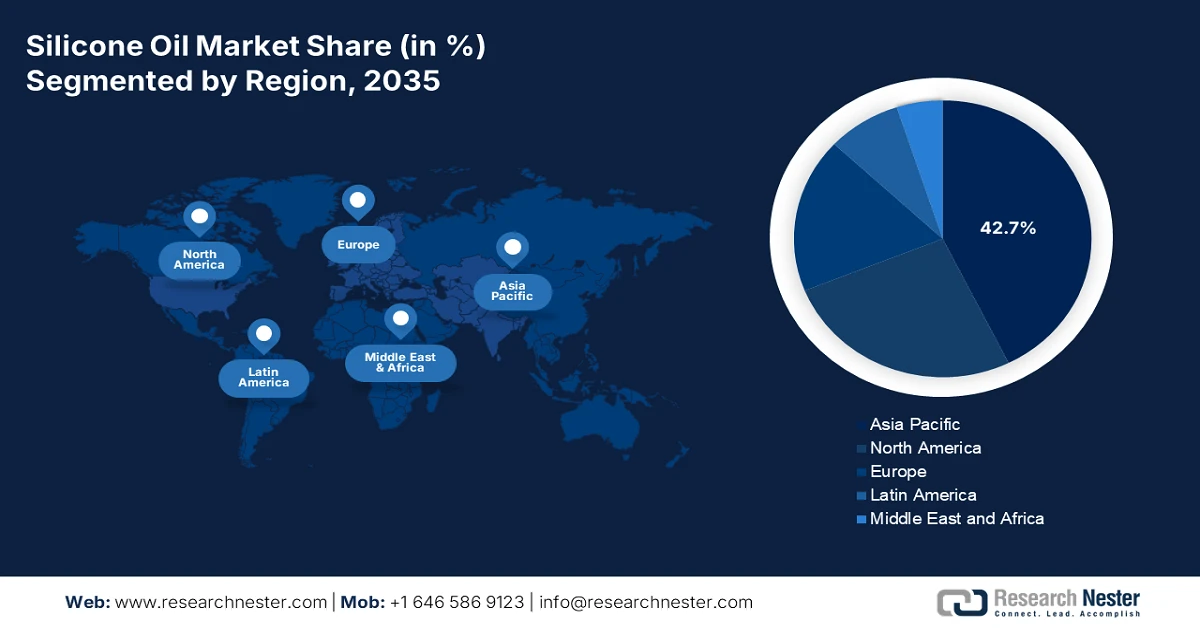
- The Asia Pacific silicone oil market is forecast to command the largest 42.7% share by 2035, bolstered by rising government spending on sustainable chemical technologies, expanding semiconductor R&D, GaAs wafer advancements, and strong foreign direct investment inflows.
- Europe is projected to emerge as the fastest-growing region by 2035, accelerated by strict sustainability regulations and expanding demand across healthcare, personal care, and automotive lubricant applications.
Segment Insights:
- The straight silicone oil sub-segment within the type segment in the silicone oil market is projected to capture a leading 50.8% share by 2035, reinforced by its extensive adoption for inertness, lubrication efficiency, water repellency, and high thermal stability across multiple industries.
- The personal care and home care sub-segment under the application segment is expected to secure the second-highest share by 2035, stimulated by rising disposable incomes, urbanization, and growing consumer inclination toward premium personal and household care products.
Key Growth Trends:
- Rise in cosmetic consumption
- Rise in cosmetic consumption
Major Challenges:
- Raw material price volatility
- Regulatory compliance and environmental restrictions
Key Players: Dow Inc. (U.S.), Wacker Chemie AG (Germany), Shin-Etsu Chemical Co., Ltd. (Japan), Momentive Performance Materials Inc. (U.S.), KCC Corporation (South Korea), Elkem ASA (Norway), Evonik Industries AG (Germany), BASF SE (Germany), Henkel AG & Co. KGaA (Germany), Siltech Corporation (Canada), CHT Group (Germany), BRB International BV (Netherlands), Jiangsu Hongda New Material Co., Ltd. (China), Bluestar Silicones (France), Gelest Inc. (U.S.), PCC Group (Poland), Nusil Technology LLC (U.S.), ChemPoint (U.S.), Indian Oil Corporation Ltd. (India), Petronas Chemicals Group Berhad (Malaysia)
Global Silicone Oil Market Forecast and Regional Outlook:
Market Size & Growth Projections:
- 2025 Market Size: USD 5.1 billion
- 2026 Market Size: USD 5.5 billion
- Projected Market Size: USD 10.2 billion by 2035
- Growth Forecasts: 8.1% CAGR (2026-2035)
Key Regional Dynamics:
- Largest Region: Asia Pacific (42.7% Share by 2035)
- Fastest Growing Region: Europe
- Dominating Countries: United States, China, Germany, Japan, South Korea
- Emerging Countries: India, Brazil, Vietnam, Indonesia, Mexico
Last updated on : 20 January, 2026
Silicone Oil Market - Growth Drivers and Challenges
Growth Drivers
- Rise in cosmetic consumption: The international cosmetics industry is projected to increase by the end of 2030, with the silicone oil market playing a vital role in formulations. According to official statistics published by NLM in December 2024, the cosmetic surgery industry in India grew at 7.4% rate of international aesthetic surgery procedures as of 2023. In addition, the revenue generated by the country’s cosmetic surgery procedure industry was USD 4,198.2 billion in the same year, which is further projected to reach USD 11,567.3 million by the end of 2030. Besides, as per the October 2024 USP Organization data report, the shipment of silicone oil for the route of administration, including intravenous, usually amounts to 150 μg/kg PDMS, denoting suitability for the market’s growth in the cosmetics sector globally.
- Expansion in the automotive industry: The aspect of electric vehicle sales is predicted to deliberately increase, driving the demand for silicone oils in dielectric fluids and lubricants, which is positively impacting the silicone oil market. As per an article published by the IEA Organization in 2025, there has been an increase in the electric car fleet has successfully reached nearly 58 million, which is almost 4% of the overall passenger car fleet. Notably, the international stock of electric cars has displaced more than 1 million barrels per day of oil consumption as of 2024. Besides, there has been an increase in electric car sales in China by 40% YoY as of 2024, further uplifting the country’s share of international electric car sales, which denotes an optimistic outlook for the market’s development.
- Surge in government support: The presence of governmental programs has been suitable for allocating generous funds to readily escalate the silicone oil market’s adoption globally. For instance, as per the July 2025 NITI Aayog article, with a market valuation of an estimated USD 220 billion as of 2023, the chemical sector in India is expected to grow exponentially, reaching almost USD 400 billion to USD 450 billion by the end of 2030, as well as USD 850 billion to USD 1,000 billion by the end of 2040. Besides, the industry’s dynamic development has underscored its potential to play a suitable role in the country’s aspiration of gaining a USD 5 trillion economy. Therefore, with continuous growth, along with governmental support, the market is poised to experience increasing growth.
Challenges
- Raw material price volatility: The production of the silicone oil market depends heavily on siloxane intermediates derived from petrochemicals. Fluctuations in crude oil prices directly affect the cost of raw materials, creating instability in supply chains. For example, geopolitical tensions and OPEC production cuts have historically led to sharp increases in feedstock costs, which ripple through the silicone oil market. Manufacturers face difficulties in maintaining consistent pricing, especially when demand surges in industries like automotive and personal care. This volatility also impacts long-term contracts, as buyers hesitate to commit to fixed pricing. Smaller producers are particularly vulnerable, as they lack the financial resilience to absorb sudden cost increases, thereby creating a negative impact on the market.
- Regulatory compliance and environmental restrictions: The silicone oil market faces increasing regulatory scrutiny, particularly in cosmetics, pharmaceuticals, and industrial applications. Agencies such as the Europe Chemicals Agency (ECHA) and the U.S. Environmental Protection Agency (EPA) enforce strict guidelines on chemical safety, emissions, and waste disposal. Compliance requires significant investment in testing, certification, and reformulation, which raises operational costs. For instance, Europe’s REACH regulation mandates extensive documentation and safety assessments for silicone-based products, slowing down product launches. In healthcare, silicone oils used in ophthalmic solutions must meet stringent biocompatibility standards, requiring costly clinical trials.
Silicone Oil Market Size and Forecast:
| Report Attribute | Details |
|---|---|
|
Base Year |
2025 |
|
Forecast Year |
2026-2035 |
|
CAGR |
8.1% |
|
Base Year Market Size (2025) |
USD 5.1 billion |
|
Forecast Year Market Size (2035) |
USD 10.2 billion |
|
Regional Scope |
|
Silicone Oil Market Segmentation:
Type Segment Analysis
The straight silicone oil sub-segment, which is part of the type segment, is anticipated to hold the highest share of 50.8% in the silicone oil market by the end of 2035. The sub-segment’s upliftment is highly driven by its importance for its inertness, lubrication, water repellency, and exceptional thermal stability, which has made it crucial across cosmetics and healthcare to electronics and automotive. Based on this and as stated in the 2023 WITS Organization article, China is considered the world’s largest exporter of silicone, amounting to USD 1,343,016.8, at a quantity of 563,729,000 kg. This is followed by Norway exporting 729,345.6 for 221,805,000 kg of silicon, along with Brazil supplying 615,282.7 for 183,863,000 kg. Therefore, with continuous supply of silicon, there is a huge growth opportunity for straight silicone oils, which in turn, prevents foaming, create non-stick surfaces, and resists extreme temperatures.
Application Segment Analysis
By the end of the forecast period, the personal care and home care sub-segment, part of the application segment, is projected to garner the second-highest share in the silicone oil market. The sub-segment’s growth is highly fueled by the aspect of silicone oils widely utilized in skin care, hair care, and cosmetic formulations due to their unique properties, smooth texture, water repellency, and ability to form protective films. In hair care, they enhance shine, reduce frizz, and improve manageability, while in skin care, they provide a silky feel and act as emollients. Anti-foam agents in detergents and cleaning products also rely heavily on silicone oils, ensuring efficiency in household applications. Growth in this segment is driven by rising disposable incomes, urbanization, and consumer preference for premium personal care products, particularly in Asia Pacific markets such as China and India.
End use Segment Analysis
The automotive and transportation segment in the end use is expected to account for the third-highest share in the silicone oil market during the stipulated timeline. The segment’s development is extremely propelled by its role, which is particularly critical in electric vehicles, where silicone oils are utilized in battery cooling systems, dielectric fluids for electronics, and advanced lubricants for high-performance drivetrains. The global electric vehicle adoption is accelerating, and significantly boosting silicone oil consumption. Countries such as Germany, China, and the U.S. are generously investing in electric vehicle infrastructure, directly supporting demand for high-performance silicone oils. Additionally, silicone oils are used in shock absorbers and damping systems, improving ride comfort and durability in both passenger and commercial vehicles.
Our in-depth analysis of the silicone oil market includes the following segments:
|
Segment |
Subsegments |
|
Type |
|
|
Application |
|
|
End use |
|
|
Medical Applications |
|
|
Electronics Applications |
|
|
Industrial Applications |
|

Vishnu Nair
Head - Global Business DevelopmentCustomize this report to your requirements — connect with our consultant for personalized insights and options.
Silicone Oil Market - Regional Analysis
APAC Market Insights
The Asia Pacific silicone oil market is anticipated to garner the largest share of 42.7% by the end of 2035. The market’s upliftment in the region is highly fueled by government expenditure on sustainable chemical technologies, an increase in research and development for semiconductors, a surge in GaAs wafer chemical technology, and organizational contributions. According to official statistics published by Invest Korea Organization in 2024, South Korea’s large-scale fine chemicals sector readily ranks in 4th position internationally, taking up almost 5.7% of the international ethylene production. Besides, chemical product exports stood at USD 1.3 billion, which further increased over 35-fold to USD 45.7 billion as of 2023. In addition, the FDI in the chemical materials industry amounted to an estimated USD 53 billion, thus making it suitable for bolstering the market’s exposure in the region.
The silicone oil market in China is growing significantly due to the focus on sustainable chemical production, the presence of administrative and government policies, and the availability of specialty chemicals. As per a data report published by the Energy Transitions Organization in May 2022, the chemical sector in the country effectively accounts for 20% of the overall national industrial emissions, along with 13% of total carbon dioxide emissions. Besides, in terms of a zero-carbon scenario, efficiency optimization, and structural modification, the release of recycling potential tends to contribute to a 49% reduction of primary chemicals, along with the traditional end use by the end of 2050. Besides, the market’s demand in the country is extremely supported by generous investments in innovative silicone oil formulations, as well as a surge in electric vehicle adoption.
The silicone oil market in India is also growing, owing to the adoption of green chemical processes and an increase in its demand, particularly across pharmaceuticals, automotive lubricants, and personal care. As stated in a data report published by the PIB Government in April 2025, the country has successfully emerged as the 4th largest international producer, with a yearly production of almost 6 million vehicles. In addition, the country has nearly 3% modest share in the global automotive component trade, which amounts to an estimated USD 20 billion. In this regard, NITI Aayog’s objective for the domestic automotive industry has been set for 2030, with growth in the production process, amounting to USD 145 billion, and exports tripling from USD 20 billion to USD 60 billion, thus making it suitable for boosting the overall market’s exposure.
Europe Market Insights
Europe silicone oil market is expected to emerge as the fastest-growing region during the forecast period. The market’s development in the region is highly propelled by the enforcement of stringent regional sustainability policies, healthcare applications, personal care, and automotive lubricants. According to official statistics published by the Europe Environment Agency in March 2023, the overall value of chemical sales in the region has successfully reached €3.5 trillion, with Europe emerging as the second-largest chemical producer in terms of sales valuation globally. In addition, the regional production ha shit 271 million tons, while the consumption aspect stood at 289 million tons. Moreover, the valuation of the overall regional chemical sales further increased by 38% from €363 billion to €499 billion. Therefore, with continuous growth in chemicals, the market is poised to grow in the whole region.
Chemical Production Sales Value in Europe (2023)
|
Chemical Type |
Sales % |
|
Consumer Chemicals |
13.5 |
|
Petrochemicals |
26.4 |
|
Specialty Chemicals |
28.3 |
|
Polymers |
18.8 |
|
Basic Inorganics |
13.0% |
Source: Europe Environment Agency
The silicone oil market in Germany is gaining increased traction due to an increase in vehicle production, along with silicone oil utilization in dielectric fluids, damping fluids, and lubricants, particularly for electric vehicle batteries. As per an article published by the Federal Ministry for Economic Affairs and Energy in February 2024, the administrative organization has made the availability of €3.5 billion in funding between 2027 and 2036, particularly for importing green hydrogen, along with its derivatives from different regions. Regarding this, the ultimate vision is to ensure an increased demand for hydrogen for clean energy in the country to foster the decarbonization of the sector, amounting to 95 TWh to 130 TWh yearly by the end of 2030. Therefore, based on the focus on clean energy, the market is gradually gaining more exposure in the country.
The silicone oil market in Poland is also developing, owing to industrial modernization, regional funding by the government, and a rise in the demand for automotive and personal care industries. As per an article published by the Polish Trade Government in October 2025, the chemical industry in the country plays a vital role, readily employing more than 300,000 people, and significantly generating almost 20% of the added value of industrial processing. Moreover, the production of chemicals and chemical products readily accounts for 5% of sold production, effectively ranking in the 7th position among overall processing industries. Besides, as of 2023, the country’s chemical industry specializes in customer-based chemicals, constituting for 22% of the production valuation, in comparison to 15% of the regional average, thereby denoting a growth opportunity for the market.
North America Market Insights
North America silicone oil market is projected to witness considerable growth by the end of 2035, owing to an increase in the demand for medical applications, automotive lubricants, and personal care. According to government estimates published by the ITA in 2025, the U.S. has readily exported more than USD 494 billion of chemicals as of 2022, and as one of the leaders in chemical production, more than 13% of international chemicals derive from the U.S. In addition, the sector comprises 14,000 establishments and produces over 70,000 products. Besides, the chemical manufacturing sector in the U.S. directly employed more than 902,300 employees in the middle of 2024, and meanwhile, the overall FDI of the sector amounted to USD 766.7 billion as of 2023. The majority of foreign-owned organizations effectively contributed USD 60.2 billion to exports in the country, thereby making it suitable for uplifting the market’s growth and demand in the whole region.
The silicone oil market in the U.S. is gaining increased exposure due to chemical innovation, advanced manufacturing, electric vehicle adoption, clean energy strategies, safety and green chemistry regulations, along with increased focus on pharmaceuticals and healthcare. As per an article published by the EIA Government in August 2024, there has been an increase in light-duty vehicle sales from 17.8% to 18.7% as of 2024. Additionally, there has been an upsurge in hybrid and electric vehicles, increasing by 30.7% year-over-year (YoY). Specifically, hybrid sales catered to 8.6% of the overall light-duty market, along with an upsurge by 9.6% in the second quarter of 2024. Likewise, sales for plug-in hybrid electric vehicles slightly increased from 1.7% to 2.0% of the total light-duty sector YoY, thus denoting an optimistic outlook for the market’s growth and expansion.
The silicone oil market in Canada is also growing, owing to the aspect of government funding for clean energy chemicals, environmental and sustainability programs, an increase in the growth of industry and automotive, as well as an expansion in healthcare. As stated in an article published by EV Fleets Canada in December 2025, under the Medium- and Heavy-Duty Zero-Emission Vehicles Program (iMHZEV), domestic incentives are significantly capped at USD 200,000 per vehicle. This is readily combined with territorial or provincial incentives, nearly to a maximum of 75% of a vehicle’s Manufacturer’s Suggested Retail Price (MSRP). Besides, organizations have the liberty to claim an enhanced first-year capital cost allowance (CCA) deduction of 55% between 2026 and 2027. Therefore, with an increased focus on automotive management, there is a huge growth opportunity for the silicone oil market in the country.
Key Silicone Oil Market Players:
- Dow Inc. (U.S.)
- Wacker Chemie AG (Germany)
- Shin-Etsu Chemical Co., Ltd. (Japan)
- Momentive Performance Materials Inc. (U.S.)
- KCC Corporation (South Korea)
- Elkem ASA (Norway)
- Evonik Industries AG (Germany)
- BASF SE (Germany)
- Henkel AG & Co. KGaA (Germany)
- Siltech Corporation (Canada)
- CHT Group (Germany)
- BRB International BV (Netherlands)
- Jiangsu Hongda New Material Co., Ltd. (China)
- Bluestar Silicones (France)
- Gelest Inc. (U.S.)
- PCC Group (Poland)
- Nusil Technology LLC (U.S.)
- ChemPoint (U.S.)
- Indian Oil Corporation Ltd. (India)
- Petronas Chemicals Group Berhad (Malaysia)
- Company Overview
- Business Strategy
- Key Product Offerings
- Financial Performance
- Key Performance Indicators
- Risk Analysis
- Recent Development
- Regional Presence
- Dow Inc. is one of the largest global producers of silicone oils, leveraging its advanced chemical research and development and broad distribution network. The company focuses on sustainability-driven innovation, with silicone oils widely used in personal care, automotive, and industrial applications.
- Wacker Chemie AG is a leading European supplier of silicone oils, known for its strong presence in specialty chemicals. The company emphasizes eco-friendly formulations and invests heavily in expanding production capacity to meet rising demand in healthcare and electronics.
- Shin-Etsu Chemical Co., Ltd. is a dominant player in Asia’s silicone oil market, with a strong foothold in electronics and semiconductors. Its silicone oils are widely adopted in dielectric fluids and personal care, supported by Japan’s advanced manufacturing ecosystem.
- Momentive Performance Materials Inc. specializes in high-performance silicone oils tailored for automotive, aerospace, and healthcare industries. The company’s innovation strategy focuses on developing advanced grades of silicone oils that meet stringent regulatory and sustainability requirements.
- KCC Corporation is a major Asia-based producer of silicone oils, with strong integration into construction, automotive, and industrial sectors. The company has expanded its silicone oil portfolio to support South Korea’s growing electronics and electric vehicle industries, aligning with national sustainability goals.
Here is a list of key players operating in the global silicone oil market:
The international silicone oil market is highly competitive, dominated by multinational corporations with strong regional presence. Companies such as Dow, Wacker Chemie, and Shin-Etsu leverage research and development investments, sustainability initiatives, and strategic partnerships to maintain leadership. Asia-based players, including KCC and Petronas Chemicals, are expanding capacity to meet rising demand in automotive and personal care. Europe-specific firms, such as BASF and Evonik, emphasize circular economy practices and eco-friendly formulations. Strategic initiatives include mergers, acquisitions, and expansion into emerging markets. Besides, in December 2025, Stonepeal declared a significant deal to effectively acquire the majority of a controlling interest in Castrol from BP p.l.c. This is readily possible in a transaction valuing the business at an enterprise valuation of an estimated USD 10.1 billion, and BP retained a minority interest of 35% in Castrol, thus bolstering the silicone oil industry globally.
Corporate Landscape of the Silicone Oil Market:
Recent Developments
- In June 2025, Clariant notified the introduction of its latest AddWorks PPA product line, which is the newest generation of PFAS-free polymer processing aids and is also completely free from polysiloxane, silicone, and inorganic materials, further designed for polyolefin extrusion applications.
- In March 2025, Nordmann announced the latest tactical partnership with WACKER, and readily support its distribution and sales activities in the field of solid and liquid silicone rubber throughout Europe.
- In March 2023, Shell successfully acted as the designated partner for Wärtsilä regarding lubricant solutions for all engines. The company is focused on providing Wärtsilä with lubricants for different first fills and suitable solutions for stationary power applications.
- Report ID: 8355
- Published Date: Jan 20, 2026
- Report Format: PDF, PPT
- Explore a preview of key market trends and insights
- Review sample data tables and segment breakdowns
- Experience the quality of our visual data representations
- Evaluate our report structure and research methodology
- Get a glimpse of competitive landscape analysis
- Understand how regional forecasts are presented
- Assess the depth of company profiling and benchmarking
- Preview how actionable insights can support your strategy
Explore real data and analysis
Frequently Asked Questions (FAQ)
About this Report
Connect with our Expert


Report, 2026-2035



Copyright @ 2026 Research Nester. All Rights Reserved.
