Reusable Coffee Cup Market Outlook:
Reusable Coffee Cup Market size was valued at USD 18.4 billion in 2025 and is projected to reach USD 33.23 billion by the end of 2035, rising at a CAGR of 6.1% during the forecast period, i.e., 2026-2035. In 2026, the industry size of reusable coffee cup is evaluated at USD 19.5 billion.
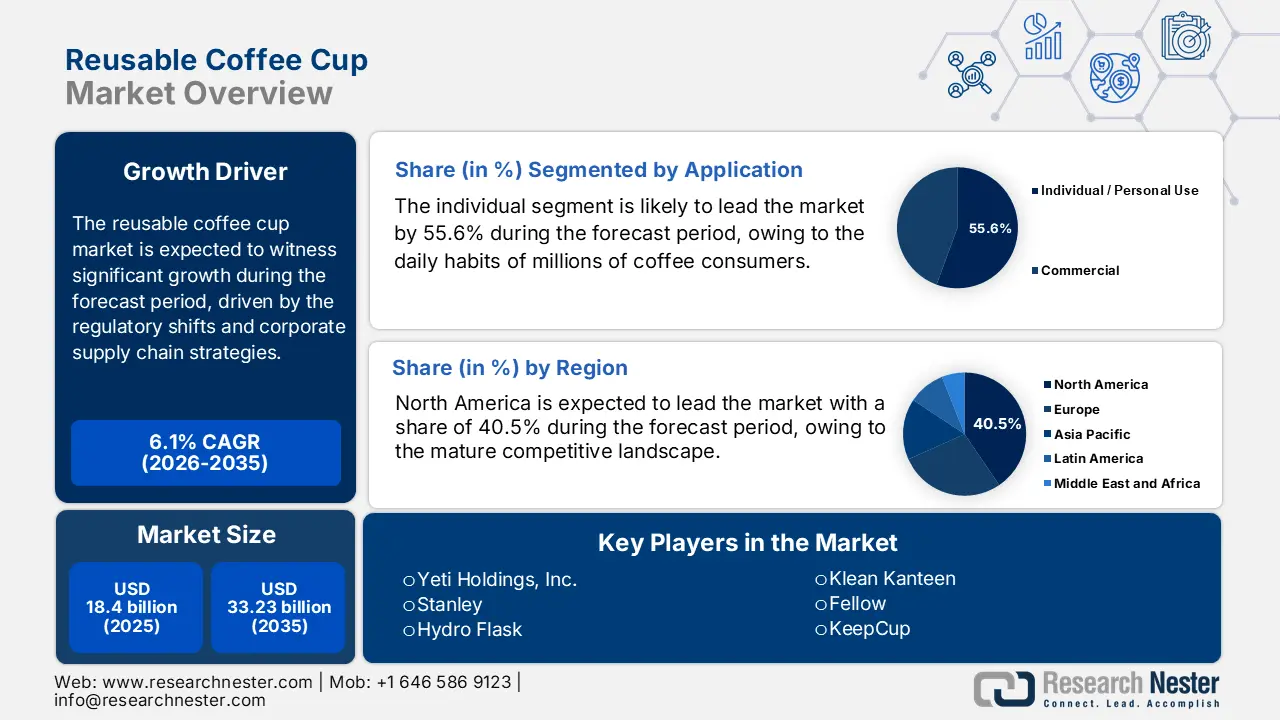
The global reusable coffee cup market is experiencing structural growth and is propelled by the regulatory shifts and corporate supply chain strategies. Governments are implementing strong policies to reduce plastic waste, creating a direct push from single-use alternatives. The U.S. Environmental Protection Agency's data in September 2025 reported that 292.4 million tons of solid waste were generated, including paper and paper-based products. This high volume depicts the potential for reusable alternatives to reduce the disposable costs for businesses, as reusable cups can reduce the landfill contributions when adopted in bulk programs. Major multinationals within the food industry and integrating reusable packaging systems into their core operations to address the objective and satisfy investor and consumer expectations.
The reusable coffee cup market expansion is supported by the economic mechanisms that incentivize the adoption across the business-to-business value chain. Extended Producer Responsibility schemes for packaging, operational in various jurisdictions globally, are fundamentally altering the cost-benefit analysis of packaging choices. These policies transfer the costs of waste management from municipalities to producers, with fees often modulated based on environmental criteria such as reusability. A recent report has indicated that the recycling rate in the U.S. was less than 7 percent initially during 1960 and has reached 32% today. This data has emphasized that many disposable paper and plastic coffee cups are difficult or costly to recycle, based on the U.S. Environmental Protection Agency report in November 2025. Further, the data directly promotes the use of reusable coffee cups as a preferred solution, business-to-business, decreasing waste and reaching sustainability targets in cafés, foodservice operators, workplaces, and public institutions.
Key Reusable Coffee Cup Market Insights Summary:
Regional Insights:
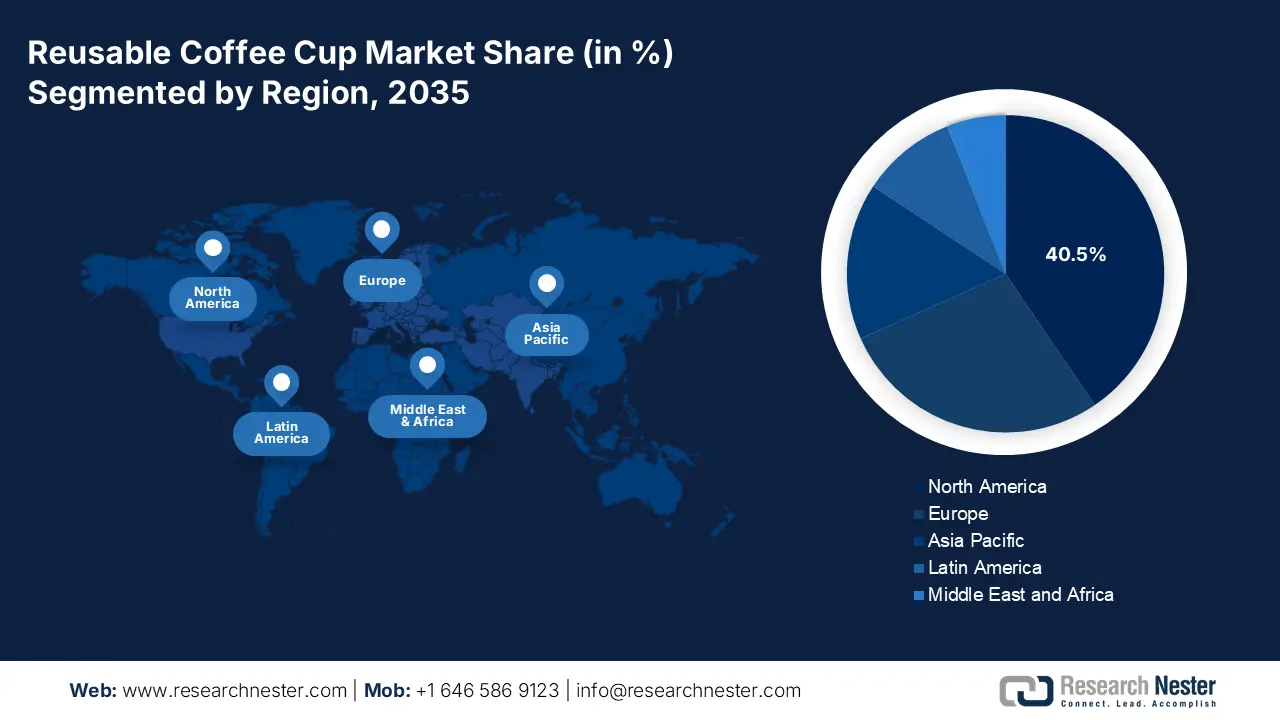
- Across 2026–2035, North America is set to secure a 40.5% share of the reusable coffee cup market, upheld by corporate sustainability mandates and rising regulatory pressure on single-use plastic bans.
- By 2035, Asia Pacific is projected to grow at a 10.2% CAGR, expanding swiftly as regulatory action against plastic pollution accelerates.
Segment Insights:
- During 2026–2035, the individual use segment in the reusable coffee cup market is forecast to command a 55.6% share, sustained by the daily habits of coffee consumers.
- By 2035, the stainless steel material segment is poised to capture a considerable share, supported by its durability and premium functional appeal.
Key Growth Trends:
- Circular economy grants and innovation funding
- Municipal waste management investments and landfills cost pressures
Major Challenges:
- Intense market saturation and brand loyalty
- Logistical hurdles of brick and mortar retail distribution
Key Players: Stanley (a brand of PMI Worldwide) (U.S.), Hydro Flask (U.S.), Chilly's (UK), Zojirushi (Japan), Klean Kanteen (U.S.), Fellow (U.S.), KeepCup (Australia), Frank Green (Australia), rCup (UK), Circular Cup Co. (UK), Ecoffee Cup (Germany), Bodum (Switzerland/Denmark), Stojo (USA), Joco Cups (Australia), Tiger Corporation (Japan), LocknLock (South Korea), Cello (India), Pigeon (Malaysia), Bkr (U.S.).
Global Reusable Coffee Cup Market Forecast and Regional Outlook:
Market Size & Growth Projections:
- 2025 Market Size: USD 18.4 billion
- 2026 Market Size: USD 19.5 billion
- Projected Market Size: USD 33.23 billion by 2035
- Growth Forecasts: 6.1% CAGR (2026-2035)
Key Regional Dynamics:
- Largest Region: North America (40.5% Share by 2035)
- Fastest Growing Region: Asia Pacific
- Dominating Countries: United States, China, Germany, United Kingdom, Australia
- Emerging Countries: India, Indonesia, Brazil, Vietnam, South Korea
Last updated on : 27 November, 2025
Reusable Coffee Cup Market - Growth Drivers and Challenges
Growth Drivers
- Circular economy grants and innovation funding: Government grants are surging the reusable cup innovation from the cup share technology and cleaning systems to material advances. Horizon Europe funds circular economy projects, including reuse models in food services and packaging sector, with multi-year budgets channeled via national agencies and consortia. The EU LIFE Programme in Greece data in May 2022 states that the budget of €5.4 billion is allocated between 2021 and 2027 for financing on waste prevention and reuse pilots that validate operational feasibility of cup systems at city and festival scales. Australia’s Recycling Modernization Fund co co-funded by the federal and state governments, supports the recycling and reuse infrastructure that is often co-located with food service hubs, lowering the operating costs for reusable cup networks.
- Municipal waste management investments and landfills cost pressures: City and regional spending on the waste collection, sorting and landfill diversion raises the marginal cost of single use cup waste streams, incentivizing retailers to adopt reusables. The PIB April 2025 report has indicated that there are nearly 1,61,157 tons per day of municipal waste in a state, indicating the rising demand for prevention programs such as you throw and landfill fee regimes that make single-use disposable items more expensive over time. Further, the SWM component of SBM-U has authorized projects such as waste to energy and waste to biogas totaling Rs. 23549.42 crore, with a central share of Rs. 8662.28 crore and a central share of Rs. 1970.92 crore has been distributed between 2020-21 and 2025-26.
Key Government Investments and Financial Assistance in Municipal Waste Management
|
Year(s) |
Government Program / Ministry |
Investment / Funding Description |
Amount / Scale |
|
2020-2025 |
Swachh Bharat Mission - Urban (Ministry of Housing & Urban Affairs) |
Central Financial Assistance for waste processing facilities (MRFs, composting, C&D waste plants, waste-to-energy plants) |
Rs. 23,549.42 crore approved; Rs. 8,662.28 crore central share released |
|
2023-2025 |
Ministry of Housing & Urban Affairs (MoHUA) |
Budget support to establish 500 new "Waste to Wealth" plants incl. 200 compressed biogas (CBG) plants |
Rs. 50 lakh per district financial assistance; focus on circular economy |
|
2022-2025 |
Central Pollution Control Board (CPCB) |
Administrative approvals and operational funds allocated for solid waste treatment and monitoring programs |
Budget Rs. 113 crores in FY 2024-25 (includes salary, capital, general) |
Source: PIB April 2025, CPCB September 2024
- Extended producer responsibility and compliance spending: Packaging EPR schemes across Europe and other regions drive the producer payments for waste management, promoting brands and foodservice chains to cut the single-use cup volumes. Under the EU Waste Framework Directive, member states set EPR obligations that fund collection and treatment as fees escalate with eco-modulation, companies invest in reuse programs to reduce liabilities. Canada’s transition to full producer responsibility for packaging in several provinces, paired with the federal Single Use Plastics Prohibition Regulations, amplifies the compliance spending that favors the reusable alternatives in cafes and quick service restaurants. This regulatory pressure directly incentivizes brands to partner with or become manufacturers of reusable cup systems to mitigate rising compliance costs.
Challenges
- Intense market saturation and brand loyalty: The reusable coffee cup market is clustered with the prime players who command fierce customer loyalty via prime branding and perceived quality. New entrants must spend significantly on marketing to differentiate themselves, often competing on price, which minimizes the profit margins. For example, Stanley’s success on the tumbler was built on a foundation of decades of brand equity, which is a key obstacle that new companies lack. To overcome this challenge, it is necessary to have a unique value proposition that can sway consumers from the trusted brands they are already satisfied with, making customer acquisition cost a major initial hurdle.
- Logistical hurdles of brick and mortar retail distribution: Securing shelf space in major retailers such as Target or Starbucks is very competitive and are costly, which involves slotting fees, co-op advertising agreements and stringent packing requirements. A new brand may need to sell direct to consumers online for years to build the volume and brand recognition required to attract a major retailers. Frank Green’s strategy of partnering directly with the coffee chains for in-store sales is a successful example of overcoming traditional retail, but such partnerships are difficult to secure and require considerable negotiation and proof of concept.
Reusable Coffee Cup Market Size and Forecast:
| Report Attribute | Details |
|---|---|
|
Base Year |
2025 |
|
Forecast Year |
2026-2035 |
|
CAGR |
6.1% |
|
Base Year Market Size (2025) |
USD 18.4 billion |
|
Forecast Year Market Size (2035) |
USD 33.23 billion |
|
Regional Scope |
|
Reusable Coffee Cup Market Segmentation:
Application Segment Analysis
Under the application segment, individual use dominates the reusable coffee cup market and is expected to hold the share value of 55.6% during the forecast period, 2026 to 2035. The market is driven by the daily habits of millions of coffee consumers. The prime driver of the segment is the personal decision to replace the disposable takeaway cups, motivated by factors such as direct cost savings from café discounts, a trend towards personalization where the cup becomes a lifestyle accessory, and the desire to minimize the environmental footprint. The shift towards reusable coffee cups is significant as the report from the National Oceanic and Atmospheric Administration report has highlighted that single-use plastics and paper cups are a major component of litter, reinforcing individual action. The sheer volume of people making this daily switch makes personal use the fundamental engine of reusable coffee cup market growth.
Material Type Segment Analysis
The stainless steel is leading the material type segment in the reusable coffee cup market and is expected to hold a considerable share value by 2035. The segment is driven by its superior durability, excellent heat retention, and premium perception. This aligns with the consumer shift towards the long-lasting, buy-it-for-life products and key waste reduction strategy. The U.S. Environmental Protection Agency’s September 2025 data depicts that nearly 4.3 million tons of containers and plastics are generated, which includes disposable cups, highlighting the rising demand for durable alternatives. The key players of the reusable coffee cup market, such as Yeti and Hydro Flask, have built their value proposition around double-walled stainless steel vacuum insulation, hence driving consumer preference for its functionality and justifying a higher price point, which directly contributes to their leading revenue share.
Distribution Channel Segment Analysis
By 2035, online retail is expected to lead the distribution channel segment in the reusable coffee cup market. The segment is driven by the unparalleled convenience, vast product selection, and effective direct-to-consumer marketing. The channel allows brands to showcase their entire color ranges and limited editions while social media and influencer campaigns directly fuel the targeted e-commerce sales. The growth is reflected in the government data, the U.S. Census Bureau data in August 2025 depicts that the U.S. e-commerce sales increased by 1.4% from 2025 first quarter to the second quarter, indicating the channel’s robust expansion. Detailed product information, consumer reviews, and subscription models further empower informed at-home purchases, setting the online retail as the fastest growing channel.
Our in-depth analysis of the reusable coffee cup market includes the following segments:
|
Segment |
Subsegments |
|
Material Type |
|
|
Distribution Channel |
|
|
Product Type |
|
|
Application |
|
|
Lid Type |
|

Vishnu Nair
Head - Global Business DevelopmentCustomize this report to your requirements — connect with our consultant for personalized insights and options.
Reusable Coffee Cup Market - Regional Analysis
North America Market Insights
North America is dominating the reusable coffee cup market and is expected to hold the market share of 40.5% during the preferred time line 2026 to 2035. The market is defined by high consumer awareness and a mature competitive landscape. The growth is driven by the corporate sustainability mandates from the major coffee chains and the increasing regulatory pressure on municipal and federal single-use plastic bans. The key trends of the market include the integration of reusable cup systems within the quick service restaurants and a rise of tech-enabled return schemes. Brand differentiation focuses on material innovation, particularly in durable, lightweight composites, and lifestyle-oriented design to foster daily use and brand loyalty. The reusable coffee cup market is further strengthened by the advanced recycling infrastructure and widespread consumer willingness to pay a premium for sustainable, branded products.
The U.S. reusable coffee cup market is being shaped by the regulatory momentum and consumer cost sensitivity. The rising coffee consumption volumes have reinforced demand for the durable cup systems in the food service channels. The consumer price index for coffee is rising steadily, and in January 2024, it reached 128.7, showing the increase in the cost of retail coffee, according to the data published by the U.S. Bureau of Labor Statistics. The trends have further promoted the manufacturers to explore the reusable cup programs to reduce the waste handling expenses and align with sustainability mandates. The public institutions, universities, and transit hubs are increasingly embedding the reuse criteria into contracts in creating the predictable B2B demand clusters. Vendors that integrate washing logistics and standardized cup specifications are positioned to capture growth as compliance costs for single-use packaging escalate across U.S. jurisdictions.
Canada’s reusable coffee cup market is expanding due to the federal plastics regulations and provincial waste management mandates. The Government of Canada data in October 2025 states that nearly 5 million tons of plastic waste are thrown in Canada from our homes and businesses. The Government of Canada’s Single Use Plastics Prohibition Regulation restricts the distribution of Zero Plastic Waste Initiative supports the upstream waste prevention strategies, including the reusable packaging adoption. These measures collectively drive stable growth across university campuses, transit systems, retail chains, and workplace foodservice environments, positioning Canada as one of the strongest North American adopters of reusable coffee cup systems. Federal and provincial procurement guidelines further surge the institutional adoption, increasing the bulk purchasing of reusable coffee cups across public facilities and government-supported programs.
APAC Market Insights
The reusable coffee cup market in Asia Pacific is the fastest-growing market and is expected to grow at a CAGR of 10.2% by 2035. The market is defined by the rapid urbanization, rising consumption of café, and increasing governmental action against plastic pollution. The awareness of waste pollution is rising significantly among consumers in the region, and it is surging quickly, mainly among the youth demographics. The primary driver of the market is the robust national policy, illustrated by India’s ban on specific-use plastics. Further, corporate sustainability pledges from international coffee chains operating in the regions are creating foundational B2B demand. The key trends include the focus on the adoption of affordable, stylish designs and the emergence of local brands catering to regional aesthetic preferences. The market is poised for significant expansion as regulatory pressure intensifies and disposable incomes rise.
The China reusable coffee cup market is a dominant player in the APAC and is propelled by the rapidly expanding urban consumer base. The central government’s push for a circular economy is the primary driver creating a favorable regulatory environment for sustainable products. This is coupled with the massive scaling of domestic coffee chains such as Luchin Coffee that are incorporating sustainability into their operational models. A key trend is the focus on competitively priced mass reusable coffee cup market products to achieve widespread adoption. According to the BOFIT report in February 2024, China’s urban population reached 933 million in 2023, highlighting the immense and growing addressable market for daily-use consumer goods such as reusable cups in metropolitan areas. This demographic is increasing the per capita disposable income and creating a powerful growth engine for market penetration and volume sales.
Robust government regulation against single use plastics are driving India’s reusable coffee cup market. The nationwide ban on identified single use plastic items is effective from July 2022, is the most significant market catalyst pushing the change in consumer and vendor behavior. As per the PIB data in April 2025, the Central Financial Assistance (CFA) under SBM-U 2.0 for Material Recovery Facilities MRFs, composting units, C&D waste plants, and Waste-to-Energy facilities strengthens India’s structured waste management efforts. As municipalities expand these systems, policy focus shifts toward source reduction, increasing the adoption of reusable coffee cups to minimize low-value waste entering SWM infrastructure. Further, the coffee culture in some key areas provides an initial base for the challenges and opportunities that lie in creating an affordable solution for the vast and diverse population.
State-wise Details of CFA
|
States |
No. of projects |
Installed Capacity (in MWeq) |
Total CFA including Service charges (in Rs. Crores) |
|
Andhra Pradesh |
6 |
1.83 |
4.38 |
|
Goa |
1 |
1.00 |
3.03 |
|
Gujarat |
9 |
7.46 |
23.12 |
|
Haryana |
5 |
4.52 |
16.12 |
|
Karnataka |
3 |
5.35 |
14.02 |
|
Madhya Pradesh |
2 |
4.85 |
11.04 |
|
Maharashtra |
7 |
9.58 |
15.77 |
|
Tamil Nadu |
3 |
5.92 |
17.54 |
|
Telangana |
5 |
4.58 |
7.72 |
|
Uttar Pradesh |
8 |
8.63 |
33.40 |
|
Uttarakhand |
1 |
0.09 |
0.20 |
|
Total |
50 |
53.80 |
146.34 |
Source: PIB April 2025
Europe Market Insights
The Europe reusable coffee cup market is expanding rapidly and is driven by the stringent implementation of the EU’s single-use plastics. The regulatory framework has pushed the member states to pass the ban and reduction measures, creating a uniform push away from disposable cups. The primary trend is the rise of standardized tech-enabled deposit return schemes in metropolitan areas and at large café chains that address the convenience barrier for on-the-go consumers. For instance, in Germany, the UK partners with the retailers to create a seamless return infrastructure. Consumer demand is also shaped by a high level of market innovation, such as cups made from recycled coffee grounds or biodegradable composites, moving beyond basic stainless steel and plastic.
Germany is projected to hold the largest revenue share in Europe’s reusable coffee cup market by 2035. The market is driven by the strong packaging laws, mainly the Verpackungsgesetz packaging act, which enforces a robust Extended Producer Responsibility scheme. The law financially incentivizes reusable packaging over single-use options, making it a cost-effective choice for businesses. The Federal Ministry for the Environment notes that the principle of mandatory deposits on disposable beverage containers has successfully shifted consumer behavior, a model now being applied to coffee-to-go systems. According to the IWKOELN data in November 2023, Germany produces nearly 770 tons of takeaway disposable packaging waste every day, thereby demanding a strong reusable framework.
The UK will maintain a dominant position in the reusable coffee cup market and is driven by its own plastic tax and EPR regulations that mirror and in some cases exceed the EU standards. The key growth factor is the high concentration of the major international coffee chains and their corporate sustainability commitments. For example, the UK-based chains have publicly pledged to significantly increase the use of reusable packaging by 2030. Supporting this, the Wrap UK, a government-funded waste advisory body, actively facilitates the UK plastics pact, which is a collaborative initiative that brings together businesses to tackle plastic waste with a specific target to reduce problematic single-use plastic items and promote reusable alternatives, creating a cohesive national drive that fuels market growth.
Key Reusable Coffee Cup Market Players:
- Yeti Holdings, Inc. (U.S.)
- Company Overview
- Business Strategy
- Key Product Offerings
- Financial Performance
- Key Performance Indicators
- Risk Analysis
- Recent Development
- Regional Presence
- SWOT Analysis
- Stanley (a brand of PMI Worldwide) (U.S.)
- Hydro Flask (U.S.)
- Chilly's (UK)
- Zojirushi (Japan)
- Klean Kanteen (U.S.)
- Fellow (U.S.)
- KeepCup (Australia)
- Frank Green (Australia)
- rCup (UK)
- Circular Cup Co. (UK)
- Ecoffee Cup (Germany)
- Bodum (Switzerland/Denmark)
- Stojo (USA)
- Joco Cups (Australia)
- Tiger Corporation (Japan)
- LocknLock (South Korea)
- Cello (India)
- Pigeon (Malaysia)
- Bkr (U.S.)
- Yeti Holdings, Inc. is set to become a dominant player in the competitive reusable coffee cup market by leveraging its reputation for uncompromising durability and superior insulation. Their strategic initiatives focus on premium branding and product performance, marketing their Rambler series as indestructible companions for outdoor adventures.
- Stanley has masterfully revitalized its century-old brand to become a major force in the modern reusable coffee cup market. Its key strategic initiatives have been the viral marketing of its durable, thoughtfully designed products, such as Quencher H2.0 FlowState tumbler, which emphasizes style and functionality. The company combines with retail expansions to experience explosive growth.
- Hydro Flask competes effectively in the reusable coffee cup market and is championing its signature TempShield insulation and a vibrant array of color options. The company’s strategic initiatives are built around a post-generation brand philosophy that appeals to environmentally conscious and active consumers. Hydro Flask emphasizes personalization and a healthy, outdoor lifestyle.
- Zojirushi is leading in the reusable coffee cup market by using its renowned Japan engineering and technology superiority, mainly in heat retention. Their strategic initiatives aim for advanced vacuum insulation technology that keeps beverages hot or cold for exceptionally long periods, a key selling point for commuters and office workers. The company has made a net sale of 87,221 million yen in 2024.
- Chilly’s has revolutionized the reusable coffee cup market by fusing high-performance vacuum insulation with contemporary design-led aesthetics. Their primary strategic initiative has been to position their bottles and cups as fashionable lifestyle accessories available in a refreshed palette of colors. The company launches bottles with of 90% recycled stainless steel.
Here is a list of key players operating in the global reusable coffee cup market:
The reusable coffee cup market is very competitive and is defined by the global brands and agile niche players. The key differentiators include material innovation, such as double-walled stainless steel, glass, and recycled plastics, and advanced design aesthetics and insulation technologies. To lead the market, companies are aggressively pursuing strategic initiatives such as expanding the direct-to-consumer e-commerce channels, forming exclusive partnerships with major coffee chains and retailers, and launching targeted celebrity and influencer collaborations. For example, in March 2024, Duni Group acquired the majority shares in Relevo. Sustainability remains a core marketing pillar with many brands highlighting their circular economy contributions via recycling programs and the use of ethically sourced, non-toxic materials to appeal to the environmentally conscious consumers.
Corporate Landscape of the Reusable Coffee Cup Market:
Recent Developments
- In April 2025, Duni Group has announced that it has acquired Huskee Pty. This acquisition aims to strengthen Duni Group’s food packaging business and to enable circular food & beverage habits for consumers and societies around the world.
- In January 2024, Starbucks became the first national coffee retailer to accept reusable cups for drive-thru and mobile orders. Milestone achieves goal set in 2022 to make it easier for customers to use reusable cups and help Starbucks reduce cup waste sent to landfills.
- Report ID: 2525
- Published Date: Nov 27, 2025
- Report Format: PDF, PPT
- Explore a preview of key market trends and insights
- Review sample data tables and segment breakdowns
- Experience the quality of our visual data representations
- Evaluate our report structure and research methodology
- Get a glimpse of competitive landscape analysis
- Understand how regional forecasts are presented
- Assess the depth of company profiling and benchmarking
- Preview how actionable insights can support your strategy
Explore real data and analysis
Frequently Asked Questions (FAQ)
About this Report
Connect with our Expert


Report, 2026-2035



Copyright @ 2026 Research Nester. All Rights Reserved.
