Capsule Coffee Machine Market Outlook:
Capsule Coffee Machine Market size was valued at USD 2 billion in 2025 and is projected to exceed USD 3.1 billion by the end of 2035, rising at a CAGR of 3.9% during the forecast period, i.e., 2026-2035. In 2026, the industry size of capsule coffee machine is evaluated at USD 2.1 billion.
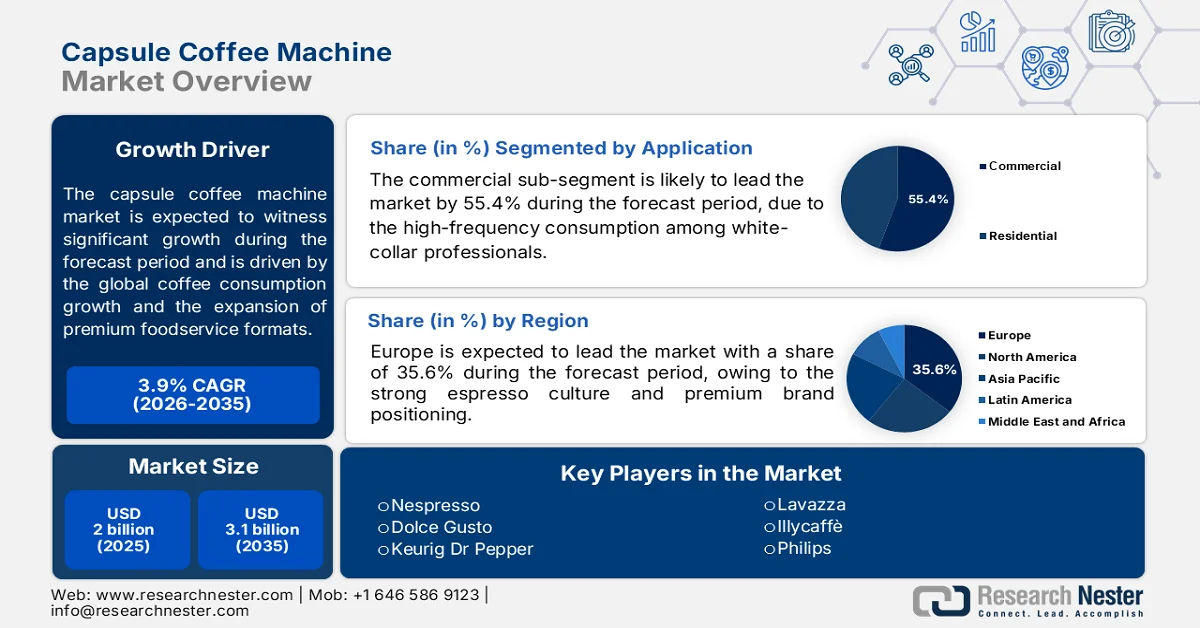
The capsule coffee machine market is benefiting from steady global coffee consumption growth, expansion of premium foodservice formats, and rising demand for portion-controlled brewing systems across offices, hotels, healthcare facilities, and residential environments. According to the ICO Coffee December 2023 data, the global coffee consumption reached 168.2 million bags, reflecting continued growth in both mature and emerging economies. In the U.S., the National Coffee Association reported in April 2024 that 67% of American adults consume coffee daily, exceeding the consumption rate of bottled water. Institutional buyers are increasingly adopting capsule-based systems because they reduce beverage preparation time, standardize serving quality, and lower product waste in workplace and hospitality operations. Demand is also supported by the expansion of the premium workplace amenities and self-service beverage stations in commercial real estate transportation hubs and healthcare facilities.
Summary of the World Coffee Market, 2018-2024
|
|
2018/19 |
2019/20 |
2020/21 |
2021/22 |
2022/23 |
2023/24 |
|
Production |
169.8 |
168.4 |
170.8 |
168.0 |
168.2 |
178.0 |
|
Consumption |
171.2 |
168.6 |
169.9 |
176.6 |
173.1 |
177.0 |
|
Balance |
-1.3 |
-0.2 |
-8.6 |
-4.9 |
1.0 |
0.9 |
Source: ICO Coffee December 2023
European markets continue to play a major role in the capsule coffee machine demand due to the high coffee import volumes, strong café culture, and sustainability-focused procurement standards. Eurostat October 2024 reported that the EU imported 2.7 million tons of coffee from non-EU countries in 2023, valued at roughly USD 12.1 billion, indicating sustained downstream equipment and beverage demand. At the same time, regulatory pressure on packaging waste is influencing purchasing decisions for recyclable and aluminum-compatible capsule systems. The U.S. Department of Agriculture (USDA) also noted continued growth in global coffee production and trade flows supporting long-term supply availability for single-serve coffee formats. Manufacturers are responding through energy-efficient brewing systems, recyclable capsule compatibility, and higher capacity commercial machines designed for office and hospitality operators seeking operational consistency and lower maintenance requirements.
Key Capsule Coffee Machine Market Insights Summary:
Regional Highlights:
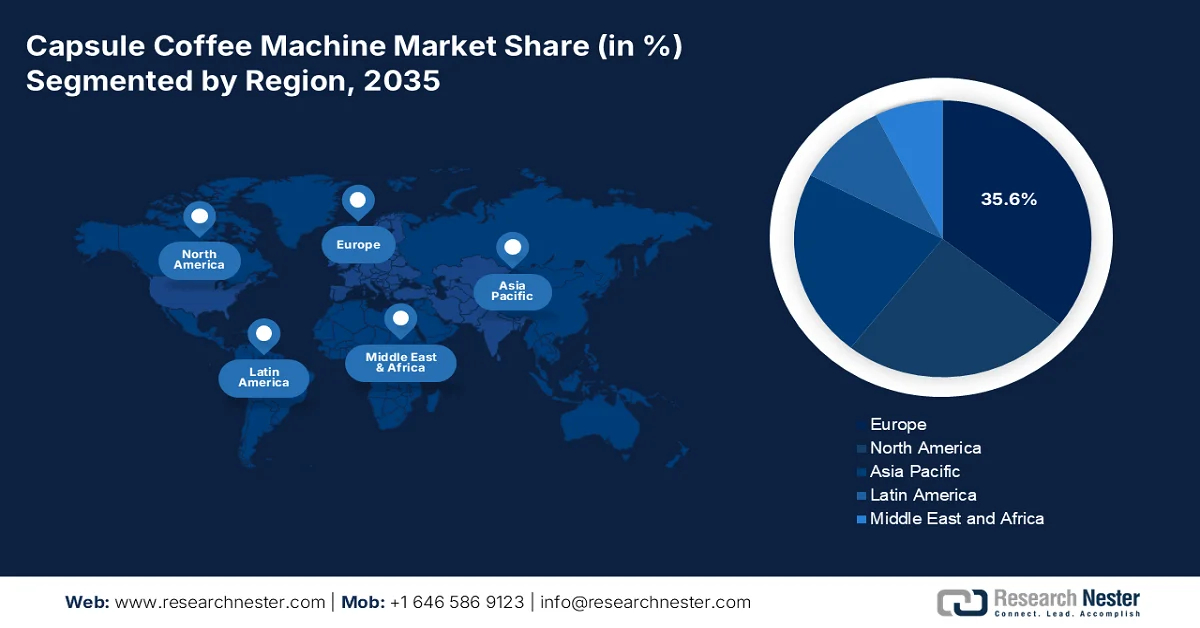
- Europe capsule coffee machine market is projected to capture 35.6% revenue share by 2035, propelled by strong espresso culture and premium brand positioning across Western European countries
- North America market is witnessing substantial expansion throughout 2026-2035, fueled by deep household penetration and strong adoption of single-serve convenience systems in offices and homes
Segment Insights:
- The commercial sub-segment of the capsule coffee machine market is anticipated to account for 55.4% share by 2035, driven by high-frequency coffee consumption among white-collar professionals demanding rapid and low-maintenance brewing solutions
- The closed system machine type segment is expected to maintain a dominant position in the market through 2035, aided by proprietary capsule ecosystems generating recurring revenue streams and premium machine pricing
Key Growth Trends:
- Growth in global coffee consumption
- Adoption of recyclable capsule systems
Major Challenges:
- Intense competition from dominant incumbents
- Retail distribution and channel access exclusivity
Key Players: Nespresso (Switzerland), Dolce Gusto (Switzerland), Keurig Dr Pepper (U.S.), Lavazza (Italy), Illycaffè (Italy), Philips (Netherlands), De’Longhi (Italy), Hamilton Beach (U.S.), Black+Decker (U.S.), Bosch (Germany), Tchibo (Germany), Dualit (United Kingdom), Smarter (U.S.), Cuisinart (U.S.), Panasonic (Japan), Breville (Australia), Groupe SEB (France), Datwyler (Switzerland), Alupak (Sweden), The Cumulus Coffee Company (U.S.).
Global Capsule Coffee Machine Market Forecast and Regional Outlook:
Market Size & Growth Projections:
- 2025 Market Size: USD 2 billion
- 2026 Market Size: USD 2.1 billion
- Projected Market Size: USD 3.1 billion by 2035
- Growth Forecasts: 3.9% CAGR (2026-2035)
Key Regional Dynamics:
- Largest Region: Europe (35.6% Share by 2035)
- Fastest Growing Region: North America
- Dominating Countries: United States, Germany, France, Italy, Switzerland
- Emerging Countries: China, India, Brazil, South Korea, Mexico
Last updated on : 21 May, 2026
Capsule Coffee Machine Market - Growth Drivers and Challenges
Growth Drivers
- Growth in global coffee consumption: Rising consumption of coffee remains one of the strongest drivers for capsule coffee machine demand. Higher consumption volumes are increasing the demand for portion-controlled brewing systems across homes, hotels, hospitals, and transport hubs. The consumption of coffee reached 91,000 tons green bean equivalent in 2023, reflecting a sustained growth, as per the Coffee Board April 2024 report. Capsule systems are benefiting because they provide consistency, lower preparation errors, and support premium beverage customization. Manufacturers are targeting institutional buyers with high-capacity systems compatible with the multiple beverage formats, including espresso, tea, and milk-based drinks. Emerging trends include the recyclable pods, AI-enabled maintenance tracking, and smart inventory monitoring for commercial facilities.
- Adoption of recyclable capsule systems: The environmental regulations are a major driver in the capsule coffee machine market. The European Union’s packaging and circular economy policies are pressuring foodservice operators and appliance manufacturers to reduce single-use plastic waste. According to the European Council, December 2024 data, the EU generated approximately 186.5 kg of packaging waste per person, increasing regulatory focus on recyclable materials. Coffee machine manufacturers are investing in aluminum-compatible systems, biodegradable capsules, and energy-efficient brewing technologies. Government-supported recycling frameworks are also promoting the partnerships between coffee brands and waste management providers. Emerging trends include refillable capsule systems and lifecycle-based product certifications.
Challenges
- Intense competition from dominant incumbents: The capsule coffee machine market is heavily concentrated among a few major players, making it extremely difficult for new entrants to establish meaningful market share. Though the global capsule coffee machine market is set to grow, the premium segments are dominated by established brands. New entrants face problems such as consumers avoiding machines with limited capsule variety, while capsule producers avoid systems without installed machine bases. For context, China's market, though growing, remains dominated by overseas brands like Nespresso and De'Longhi, with domestic brands struggling to gain recognition.
- Retail distribution and channel access exclusivity: New entrants struggle to secure retail shelf space as companies have locked up distribution via exclusive arrangements. Companies sell capsules via their own online boutiques and a telephone orders approach that third-party retailers could not access. Online channels represent a growth in revenue dominated by established brands with Amazon and Alibaba partnerships. New entrants must either accept unfavorable terms or build a direct-to-consumer channel from scratch, requiring substantial marketing investment for meaningful customer acquisition.
Capsule Coffee Machine Market Size and Forecast:
| Report Attribute | Details |
|---|---|
|
Base Year |
2025 |
|
Forecast Year |
2026-2035 |
|
CAGR |
3.9% |
|
Base Year Market Size (2025) |
USD 2 billion |
|
Forecast Year Market Size (2035) |
USD 3.1 billion |
|
Regional Scope |
|
Capsule Coffee Machine Market Segmentation:
Application Segment Analysis
Under the application segment, the commercial sub-segment is leading and is poised to hold the share value of 55.4% by the end of 2035. The capsule coffee machine market is driven by high-frequency consumption among white-collar professionals. According to the NLM November 2024 data, the white-collar office workers 46.2% were reported to be regular coffee drinkers, consuming coffee approximately 3 to 4 times per day. This daily volume creates a significant demand for rapid, consistent, and low-maintenance brewing solutions, precisely what commercial-grade capsule machines deliver. Office coffee service contracts for capsule systems grew rapidly as employers sought to boost productivity and workplace satisfaction. Capsule machines reduce brew time, minimizing the break duration while accommodating high-volume morning and afternoon peaks.
Machine Type Segment Analysis
The closed system machine type dominates the capsule coffee machine market operating on proprietary capsule compatibility that locks consumers into brand specific ecosystems. The closed systems require users to purchase capsules exclusively from the machine manufacturer or licensed partners Nespresso Dolce Gusto and Keurig being prime examples. This model generates predictable recurring revenue streams with a lifetime profit from a single machine. Closed systems command premium pricing due to patented brewing technologies and integrated capsule recognition chips in newer smart machines. Manufacturers invest heavily in patent enforcement and anti-competitive litigation to protect their closed ecosystems. Despite consumer advocacy for open standards closed systems retain market leadership via superior quality consistency and aggressive machine subsidies offset by capsule markups.
Capsule Material Segment Analysis
The aluminum capsule sub-segment continues to dominate the capsule coffee machine market, driven by sustainability advancements. As per the IMD June 2023 data, Nespresso launched coffee capsules using 80% recycled aluminum. This innovation addresses the environmental concerns and preserves aluminum's core benefits, such as superior oxygen barrier, flavor preservation, and infinite recyclability. The shift toward high percentage recycled aluminum reduces primary aluminum demand, lowering carbon footprints significantly. European Commission (.gov) circular economy targets for 2030 specifically encourage recycled content in single-use capsules. Nespresso's move triggers the competitors to accelerate their recycled aluminum roadmaps. As consumers demand both premium coffee and environmental responsibility, recycled-content aluminum capsules are driving the capsule coffee machine market growth.
Our in-depth analysis of the capsule coffee machine market includes the following segments:
|
Segment |
Subsegments |
|
Machine Type |
|
|
Capsule Material |
|
|
Application |
|
|
Distribution Channel |
|
|
Price Range |
|
|
Brewing Technology |
|

Vishnu Nair
Head - Global Business DevelopmentCustomize this report to your requirements — connect with our consultant for personalized insights and options.
Capsule Coffee Machine Market - Regional Analysis
Europe Market Insights
The Europe capsule coffee machine market is the largest and most established region globally and is expected to hold the regional revenue share of 35.6% by the end of 2035. The market is characterized by strong espresso culture and premium brand positioning. Western Europe nations, particularly France, Germany, Italy, and Switzerland, dominate both household penetration and commercial placements. Northern Europe markets demonstrate accelerated adoption of recycled content aluminum capsules in response to strict circular economy regulations. Eastern Europe presents growth potential as disposable incomes rise and Western consumption patterns diffuse. The commercial segment benefits from high office density, extensive hospitality networks, and public sector procurement across EU member states. Consumers favor high-pressure extraction systems producing espresso-style output. Regional market maturity drives replacement cycles, smart machine upgrades, and sustainability-linked procurement criteria.
Large coffee import volumes and high daily consumption support sustained demand for single-serve brewing systems in residential and commercial applications, which is shaping the capsule coffee machine market in Germany. According to the CBI November 2025 data, Germany imported more than 1 million tons of green coffee, equivalent to 16.67 million 60 kg bags, reinforcing its position as Europe’s largest green coffee importer. Around 90% of Germany adults consume coffee, totaling nearly 200 million cups daily, which continues to support demand for convenient and portion-controlled coffee preparation systems such as capsule machines. The country also re-exports nearly one-fifth of imported coffee, strengthening its role in the Europe coffee supply chain. Rising demand for premium quality coffee is promoting manufacturers to introduce advanced capsule systems with energy-efficient and sustainable brewing capabilities.
Germany Green Coffee Imports, 2020-2024
|
Year |
Units (in thousand tonnes) |
|
2020 |
1.011 |
|
2021 |
1.006 |
|
2022 |
1.010 |
|
2023 |
859 |
|
2024 |
1.004 |
Source: CBI November 2025
Rising at home coffee consumption, growth in online appliance retailing, and increasing demand from offices and hospitality operators are driving the capsule coffee machine market in the UK. The OEC 2024 data reported that the UK imported nearly USD 1.36 billion worth of coffee products, reflecting stable demand for coffee products across residential and commercial channels. Further, the Department for Business and Trade noted continued growth in the UK hospitality sector, with foodservice and accommodation businesses increasing their investments in automated beverage preparation equipment to improve operational efficiency. Demand for capsule coffee machines is particularly strong in urban households, co-working offices, and premium hotel environments focused on convenience and consistent beverage quality.
North America Market Insights
The North America capsule coffee machine market remains highly mature, characterized by deep household penetration and a well-established office coffee service channel. The U.S. leads in unit volume, driven by a culture of single-serve convenience and widespread brand recognition of the closed system platforms. Canada follows with a similar consumption pattern, though provincial regulations influence packaging material choices and end-of-life recycling obligations. Commercial demand stems primarily from the corporate offices, healthcare facilities, hospitality venues, and government installations, all seeking consistent output and minimal operator training. Competitive dynamics center on the machine subsidies to capture the recurring capsule revenue alongside sustainability commitments addressing the plastic and aluminum waste.
The steady growth due to rising specialty coffee consumption and increasing adoption of single cup brewing systems in households is shaping the capsule coffee machine market in the U.S. According to the National Coffee Association April 2024 data coffee consumption among U.S. people aged 60+ increased from 67% to 73%, consumption among consumers aged 25 to 39 rose from 67% to 70% in 2024 indicating broader multi-generational demand for convenient brewing solutions. Specialty coffee consumption also expanded significantly, with 57% of U.S. adults consuming specialty coffee weekly, supported by growing demand for espresso-based beverages such as lattes and cappuccinos. In-home preparation trends, single-cup brewers accounted for 28% of daily coffee preparation methods, reinforcing demand for capsule-compatible coffee machines across residential markets.
U.S. Coffee Consumption and Preparation Trends, 2024
|
Category |
Metric / Segment |
2023 |
2024 |
Change |
|
Past-Day Coffee Consumption by Age Group |
Consumers aged 60+ |
67% |
73% |
+9% |
|
|
Consumers aged 25–39 |
67% |
70% |
+4.5% |
|
|
Consumers aged 40–59 |
66% |
69% |
+4.5% |
|
|
Consumers aged 18–24 |
47% |
47% |
No change |
|
Specialty Coffee Consumption |
American adults consuming specialty coffee in past week |
— |
57% |
+7.5% YoY |
|
Espresso-Based Beverage Growth |
Past-week espresso-based beverage consumption |
— |
— |
+10% |
|
Most Popular Espresso-Based Beverages |
Latte consumption |
— |
18% |
— |
|
|
Espresso consumption |
— |
16% |
— |
|
|
Cappuccino consumption |
— |
14% |
— |
|
At-Home Coffee Preparation Methods |
Drip coffee makers |
— |
37% |
— |
|
|
Single-cup brewers |
— |
28% |
— |
|
|
Ready-to-drink coffee |
8% |
15% |
Nearly doubled |
|
|
Espresso machines ranking |
3rd place |
4th place |
Declined ranking |
Source: NCA April 2024
Expanding due to rising coffee consumption, increasing household appliance expenditure, and growth in foodservice activity across urban centers is driving the capsule coffee machine market in Canada. According to Statistics Canada August 2025 data, retail e-commerce sales reached approximately USD 4.2 billion monthly on average in 2024, supporting stronger online sales of premium kitchen appliances and single-serve coffee systems. Coffee remained one of the country’s highest value imported food commodities, with coffee and coffee substitute imports exceeding USD 1.79 billion in 2023, as per the OEC 2024 data, reflecting sustained domestic demand for home and commercial brewing products. Moreover, the food services and drinking place sales supported by recovery in cafés, hotels, and workplace catering operations, where capsule coffee machines are increasingly deployed for portion control and operational efficiency. Demand is also benefiting from growing preference for convenient at-home beverage preparation and energy-efficient appliances among urban consumers and condominium households.
APAC Market Insights
The Asia Pacific is projected to emerge rapidly during the assessed period, 2026 to 2035. The region is driven by the rising urban disposable incomes and Westernization of beverage habits. Japan and South Korea represent mature, quality-sensitive markets with a strong preference for compact design forward machines. China and India present growth opportunities as the coffee consumption displaces tea in metropolitan centers. Australia exhibits premium segment maturity similar to European markets. Distribution channels shift rapidly toward e-commerce, bypassing traditional retail constraints. Commercial adoption in Asia corporate offices and luxury hotels accelerates as employers invest in workplace amenities. Price sensitivity remains higher, prompting manufacturers to introduce the entry-level closed systems and localized capsule flavor profiles.
Rising urban coffee consumption, expansion of e-commerce retail channels, and increasing investment in foodservice infrastructure are shaping the capsule coffee machine market in China. According to the People’s Republic of China, January 2025 data, the country’s online retail sales reached USD 2.16 trillion, supporting stronger digital sales of household appliances and premium beverage equipment. The OEC 2024 data reported that China imported USD 841 million worth of coffee products, reflecting increasing domestic coffee demand across residential and commercial segments. Moreover, the People’s Republic of China, January 2026, stated that national catering revenue exceeded USD 800 billion, supported by café expansion, premium hospitality development, and growth in urban foodservice operations where capsule coffee systems are increasingly used for operational consistency and quick beverage preparation.
The Japan capsule coffee machine market is projected to grow from USD 240.24 million in 2025 to USD 603 million by the end of 2035 at a CAGR of 3.3% during the assessed period. In 2026, the market is expected to reach USD 266.34 million. The nation is driven by the increasing demand for premium at-home beverages, growth in convenience-oriented appliances, and rising café-sector activity. Household spending on electrical appliances and consumer electronics continued to increase during 2024, supporting sales of compact kitchen appliances, including single-serve coffee systems. The OEC 2024 data reported that coffee imports reached USD 1.74 billion in Japan, reflecting stable domestic coffee demand and strong dependence on imported coffee products. Commercial adoption is also rising across the hotel offices and convenience stores where the capsule coffee systems are valued for the consistency, reduced preparation time, and operational efficiency.
Key Capsule Coffee Machine Market Players:
- Nespresso (Switzerland)
- Dolce Gusto (Switzerland)
- Keurig Dr Pepper (U.S.)
- Lavazza (Italy)
- Illycaffè (Italy)
- Philips (Netherlands)
- De’Longhi (Italy)
- Hamilton Beach (U.S.)
- Black+Decker (U.S.)
- Bosch (Germany)
- Tchibo (Germany)
- Dualit (United Kingdom)
- Smarter (U.S.)
- Cuisinart (U.S.)
- Panasonic (Japan)
- Breville (Australia)
- Groupe SEB (France)
- Datwyler (Switzerland)
- Alupak (Sweden)
- The Cumulus Coffee Company (U.S.)
- Company Overview
- Business Strategy
- Key Product Offerings
- Financial Performance
- Key Performance Indicators
- Risk Analysis
- Recent Development
- Regional Presence
- SWOT Analysis
- Nespresso remains the global premium leader in the capsule coffee machine market, driving innovation through boutique retail experiences, high-pressure extraction systems, and a closed-loop aluminum capsule recycling program. The company has strategically expanded into professional and Vertuo lines for the larger cup sizes while investing heavily in sustainable coffee sourcing and electric fleet logistics.
- Dolce Gusto is the top player in the capsule coffee machine market and is the mass premium segment with multi-beverage versatility, offering both coffee and hot chocolate or tea using a centrifugal brewing technology. Strategic initiatives include launching plant-based and cold-brew capsules, expanding into emerging capsule coffee machine markets such as China and Brazil, and partnering with retail chains for machine capsule bundle promotions.
- Keurig Dr Pepper dominates via its proprietary K-Cup ecosystem, leveraging strong retail distribution and brand licensing. Recent strategies focus on the Keurig Plus series for enhanced beverage customization, the recyclable K-Cup pod innovation, and connected brewer technology via the BrewID feature.
- Lavazza differentiates via its Italian espresso heritage and a dual strategy: producing both proprietary and compatible capsules for rival systems. Strategic initiatives include the Lavazza Epicurea smart machine with Wi Fi enabled capsule recognition, strategic partnerships with the appliance makers like De’Longhi, and aggressive expansion into Asia and the Middle East via local roasting facilities.
- Illycaffè focuses on single-origin blends and patented iperEspresso capsules in the capsule coffee machine market using a two-phase extraction process. Key strategic moves include launching the fully automatic X7.1 and Y3.3 machines with IoT connectivity, expanding its Artisti del Caffè subscription model, and forming alliances with hotel chains and airlines for B2B capsule adoption.
Here is a list of key players operating in the global capsule coffee machine market:
The global capsule coffee machine market is highly consolidated, led by Nestlé’s Nespresso and Dolce Gusto brands, which enforce strong patent portfolios and proprietary capsule systems. Keurig Dr Pepper dominates North America with its single-serve K-Cup technology. Competitive intensity is rising as the second-tier players and new players focus on the compatibility and sustainability of launching recyclable or compostable capsules. Strategic initiatives include premiumization, geographical expansion into Asia-Pacific, and subscription-based models for machines and capsules, pressuring smaller brands to differentiate through design or price. For example, in February 2025, Groupe SEB expands its presence in the professional coffee market with the acquisition of the La San Marco family-run business belonging to the Massimo Zanetti Beverage Group, specialized in the production and distribution of professional coffee machines.
Corporate Landscape of the Capsule Coffee Machine Market:
Recent Developments
- In February 2026, Datwyler has announced that it has completed the acquisition of a majority stake in Capsul’in. This acquisition strengthens Datwyler’s position in the fast-growing coffee capsule solutions.
- In October 2024, the creator of the Nespresso capsule, Alupak, announced that it has acquired global supplier ALUCAPS. The capsule market has accelerated since Nespresso lost its patents, with over 400 competitors now in play.
- In September 2024, the Cumulus Coffee Company has announced the launch of the groundbreaking cold coffee machine, and premium coffee capsules are now shipping. The company has set a new standard in the USD 2.59 billion cold coffee market by delivering cold brew, nitro cold brew, and cold espresso at the touch of a button.
- Report ID: 2703
- Published Date: May 21, 2026
- Report Format: PDF, PPT
- Explore a preview of key market trends and insights
- Review sample data tables and segment breakdowns
- Experience the quality of our visual data representations
- Evaluate our report structure and research methodology
- Get a glimpse of competitive landscape analysis
- Understand how regional forecasts are presented
- Assess the depth of company profiling and benchmarking
- Preview how actionable insights can support your strategy
Explore real data and analysis
Frequently Asked Questions (FAQ)
About this Report
Connect with our Expert


Report, 2026-2035



Copyright @ 2026 Research Nester. All Rights Reserved.
