Quantum Dot Display Market Outlook:
Quantum Dot Display Market size was valued at USD 6.1 billion in 2025 and is projected to exceed USD 16.8 billion by the end of 2035, expanding at over 10.7% CAGR during the forecast period i.e., between 2026-2035. In 2026, the industry size of quantum dot display is estimated at USD 6.7 billion.
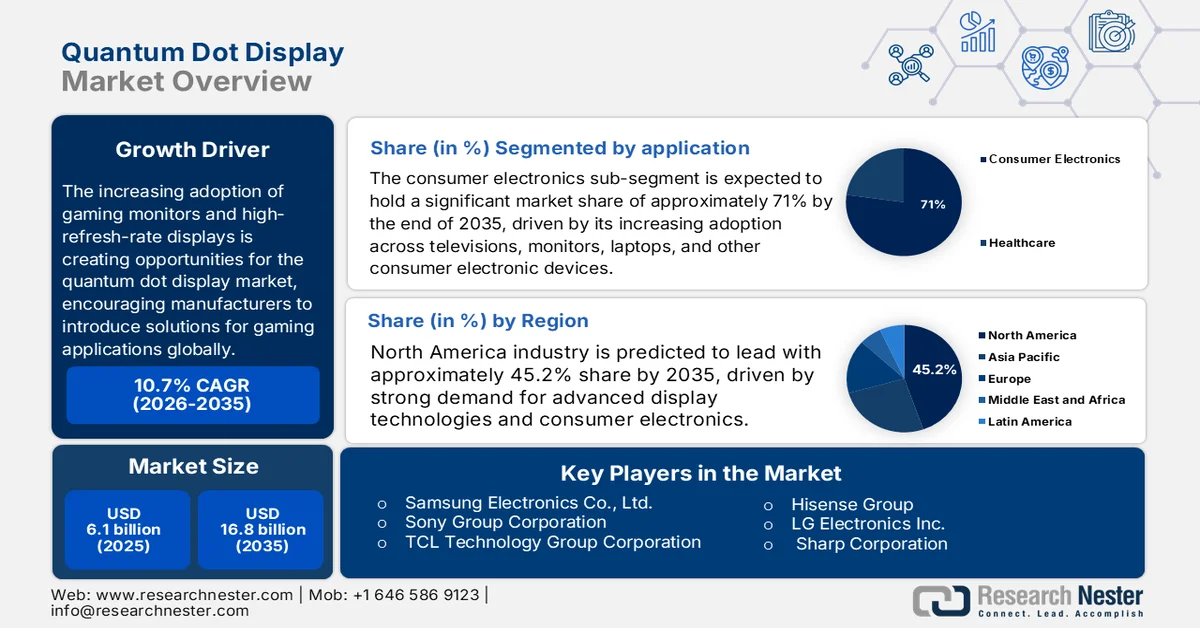
The global quantum dot display market is growing, and its primary reason is due to the increasing need for advanced display technologies in televisions, monitors, and other consumer electronics. This technology enables improved color accuracy, higher brightness levels, and enhanced visual performance, which is one of the reasons it is suitable for premium display applications. Besides this, according to the Consumer Technology Association (CTA), U.S. consumer technology retail revenue is projected to reach USD 537 billion in 2025, which showcases constant consumer spending on advanced electronic devices. The increasing implementation of quantum dot-enabled displays in premium consumer products is expected to help market growth during the forecast period
Furthermore, the development of semiconductor manufacturing is helping the quantum dot display market by improving the availability of components that are used in advanced display systems. Semiconductor technologies help increase the performance and efficiency of quantum dot displays used across televisions, monitors, and other electronic devices. Therefore, according to the Semiconductor Industry Association (SIA), global semiconductor sales reached USD 630.5 billion in 2024, which highlights strong industry development and increasing need for advanced electronic components. The constant progress in semiconductor manufacturing is encouraging display manufacturers to improve quantum dot solutions and expand their application across premium electronic devices during the forecast period.
Key Quantum Dot Display Market Insights Summary:
Regional Highlights:
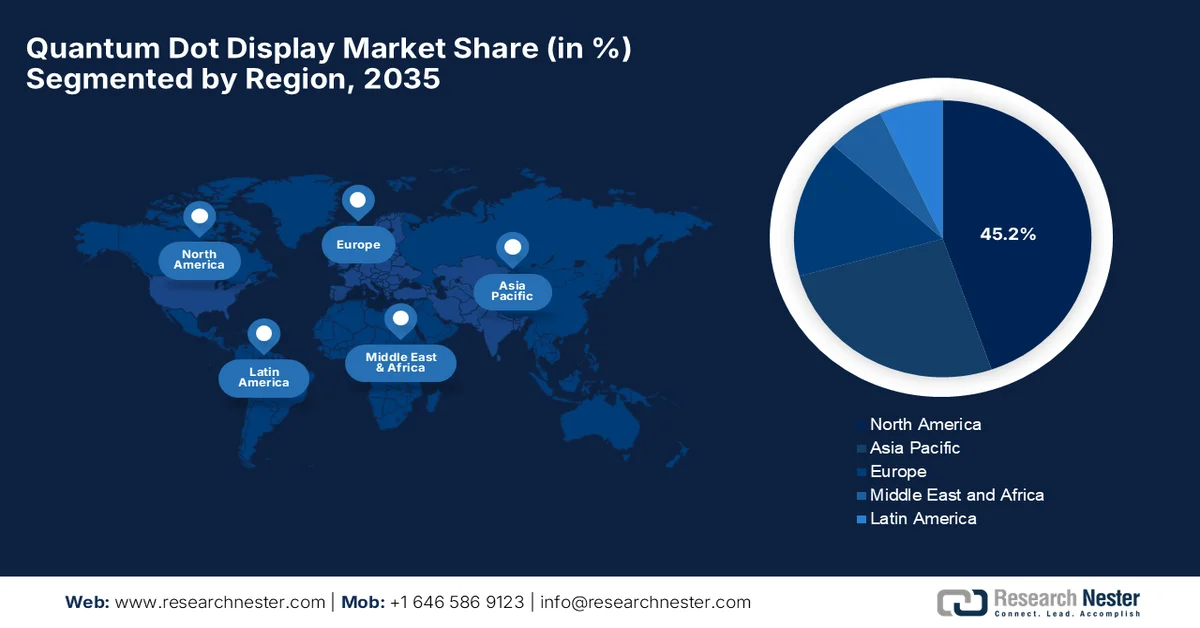
- The North America region is anticipated to account for approximately 45.2% share by 2035 in the quantum dot display market, propelled by the growing need for premium display solutions and the presence of established electronics manufacturers
- The Asia Pacific region is expected to witness notable expansion throughout the 2026-2035 forecast period, supported by the region's strong electronics manufacturing base and continuous expansion of consumer electronics production
Segment Insights:
- The consumer electronics sub-segment is projected to capture approximately 71% share by 2035 in the quantum dot display market, fueled by the rising implementation of quantum dot displays in televisions, monitors, laptops, and other electronic products due to their improved brightness, color accuracy, and viewing quality
- The LED sub-segment is expected to secure a significant position in the 2026-2035 forecast period, supported by the increasing integration of LED-based systems with quantum dot technology in televisions, monitors, and other display products
Key Growth Trends:
- Growth in OLED and advanced display production
- Rising electronics manufacturing
Major Challenges:
- High manufacturing cost
- Alternative technologies
Key Players:Samsung Electronics Co., Ltd., Sony Group Corporation, TCL Technology Group Corporation, Hisense Group, LG Electronics Inc., Sharp Corporation.
Global Quantum Dot Display Market Forecast and Regional Outlook:
Market Size & Growth Projections:
- 2025 Market Size: USD 6.1 billion
- 2026 Market Size: USD 6.7 billion
- Projected Market Size: USD 16.8 billion by 2035
- Growth Forecasts: 10.7% CAGR (2026-2035)
Key Regional Dynamics
- Largest Region: North America (45.2% share by 2035)
- Fastest Growing Region: Asia Pacific
- Dominating Countries: United States, China, Japan, South Korea, Germany
- Emerging Countries: India, Vietnam, Taiwan, Singapore, Malaysia
Last updated on : 5 August, 2026
Quantum Dot Display Market - Growth Drivers and Challenges
Growth Drivers
- Growth in OLED and advanced display production: The quantum dot display market is benefiting from the constant development of the global display industry, where manufacturers are providing more investments in advanced panel technologies to meet the requirements for premium electronic products. Manufacturers are developing advanced display materials to meet the increasing demand for displays with better efficiency and longer operational life. These developments are creating favorable conditions for quantum dot display technologies across televisions, monitors, and other electronic devices. Additionally, according to the Korea Display Industry Association (KDIA), South Korea's display industry recorded exports worth USD 18.747 billion in 2024. The expansion of display manufacturing is anticipated to help the market during the forecast period.
- Rising electronics manufacturing: For the quantum dot display market, the growth of display manufacturing is creating long-term opportunities for the market as manufacturers continue increasing production of televisions, monitors, laptops, and other electronic devices. Growing production capacity is encouraging the implementation of advanced display materials that improve product quality and performance. This is also helping manufacturers enhance the use of quantum dot technology across multiple product categories. Therefore, it is stated by the Ministry of Industry and Information Technology (MIIT) that China's electronic information manufacturing industry recorded a 12% increase in fixed-asset investment in 2024. Rising investment in electronics manufacturing facilities is expected to help the development and commercialization of advanced display technologies, including quantum dot displays, during the forecast period.
- Growth in digital connectivity: The increasing use of connected electronic devices is supporting the need for advanced display technologies across households and businesses. Consumers are implementing connected televisions, monitors, and smart home products that require improved visual performance. This trend is inspiring manufacturers to develop advanced display solutions for a wide range of consumer electronics. Additionally, according to the International Telecommunication Union (ITU), 5.5 billion people were using the Internet in 2024, which represents approximately 68% of the global population. The constant expansion of digital connectivity is expected to grow demand for advanced display technologies, including quantum dot displays, during the forecast period.
Challenges
- High manufacturing cost: The quantum dot display market faces common challenges which is due to higher production costs compared with traditional display technologies. Manufacturers need to manage expenses that are related to materials, production setup, and quality control, which is a factor in increasing the overall cost of quantum dot displays. These higher costs are one of the reasons that challenging to introduce the technology in price-sensitive consumer electronics segments. Additionally, companies need to invest in enhancing production capacity while maintaining product quality. Such cost-related challenges can slow the implementation of quantum dot displays, particularly in mid-range and budget electronic products during the forecast period.
- Alternative technologies: The market faces one more challenge that is due to the availability of alternative display technologies. Many electronics manufacturers provide products that are based on OLED, LCD, and other display technologies that are already well established in the market. These technologies have a strong customer base and are largely used across televisions, monitors, smartphones, and other electronic devices. Therefore, quantum dot display manufacturers need to continuously demonstrate the value of their products to gain wider acknowledgment. The presence of multiple display options can make purchasing decisions more competitive and can limit the speed at which quantum dot display technologies develop across different consumer electronics categories during the forecast period.
Quantum Dot Display Market Size and Forecast:
| Report Attribute | Details |
|---|---|
|
Base Year |
2025 |
|
Forecast Year |
2026-2035 |
|
CAGR |
10.7% |
|
Base Year Market Size (2025) |
USD 6.1 billion |
|
Forecast Year Market Size (2035) |
USD 16.8 billion |
|
Regional Scope |
|
Quantum Dot Display Market Segmentation:
Application Segment Analysis
The consumer electronics sub-segment under the application segment is anticipated to account for the largest share of approximately 71% in the quantum dot display market by the end of 2035. The growth of the sub-segment is attributed to the rising implementation of quantum dot displays in televisions, monitors, laptops, and other electronic products due to their improved brightness, color accuracy, and viewing quality. Display manufacturers are paying attention on premium product development to meet the rising need for advanced visual technologies. Besides this, according to the U.S. National Science Foundation (NSF), quantum dots have developed into a USD 4 billion industry, with applications that include next-generation displays and other advanced technologies. These developments are expected to help the large adoption of quantum dot display technologies during the forecast period.
Component Segment Analysis
The LED sub-segment under the component segment is expected to hold a significant position in the quantum dot display market during the forecast period. Its progress is attributed to the increasing integration of LED-based systems with quantum dot technology in televisions, monitors, and other display products. LED components support improved brightness, better color performance, and enhanced visual quality, making them suitable for advanced display applications. Therefore, according to the U.S. Department of Energy (DOE), a typical 27-inch monitor with an efficient LED model consumes around 29 kWh per year, compared with 72 kWh per year for less efficient models, which highlights the growing attention on energy-efficient display solutions. The growing need for efficient display technologies is expected to encourage further development of LED-based quantum dot display solutions.
Material Segment Analysis
The cadmium-free sub-segment under the material segment is expected to witness notable growth in the quantum dot display market during the forecast period. The sub-segment showcase progress due to the increasing preference for environmentally safer materials and the increasing focus on reducing the use of hazardous substances in electronic products. Manufacturers are investing in cadmium-free quantum dot materials to comply with environmental regulations while maintaining display performance. Additionally, the European Chemicals Agency (ECHA) classifies cadmium and cadmium oxide as substances of great concern under REACH. Meanwhile, manufacturers are paying attention to cadmium-free quantum dot materials to help future display development and meet changing environmental needs.
Our in-depth analysis of the quantum dot display market includes the following segments:
|
Segment |
Subsegments |
|
Application |
|
|
Material |
|
|
Component |
|

Vishnu Nair
Head - Global Business DevelopmentCustomize this report to your requirements — connect with our consultant for personalized insights and options.
Quantum Dot Display Market - Regional Analysis
North America Market Insights
The North America quantum dot display market is anticipated to account for approximately 45.2% share by 2035, which is driven by the growing need for premium display solutions and the presence of established electronics manufacturers. The region is witnessing greater implementation of quantum dot technology among televisions, monitors, and other consumer electronics due to its ability to improve display performance. During the forecast period, some factors that are expected to help the implementation of quantum dot displays include a strong presence of technology companies, continuous product innovation, and growing consumer preference for advanced display devices. Moreover, according to the Federal Highway Administration (FHWA), the United States recorded 284.6 million registered motor vehicles in 2023, which showcases the higher implementation of electronic systems across automotive applications, where high-performance display technologies are gaining importance.
The U.S. quantum dot display market is growing due to increasing investments in semiconductor manufacturing and advanced display technologies. The presence of major semiconductor companies and constant development of next-generation electronic components are helping innovation across the display industry. Besides this, according to the U.S. National Institute of Standards and Technology (NIST), the CHIPS and Science Act of 2022, provides approximately USD 50 billion to strengthen semiconductor manufacturing and research in the United States. The development of domestic semiconductor capabilities is anticipated to support the development of advanced display components and encourage the implementation of quantum dot display technologies.
Increasing digital transformation across Canada is creating new opportunities for the adoption of quantum dot display technologies in consumer and industrial applications. The growing need for premium displays across consumer, industrial, and automotive applications is creating opportunities for advanced display manufacturers. Therefore, according to Innovation, Science and Economic Development Canada (ISED), Canada's ICT sector contributed CAD 131.6 billion to the country's GDP in 2024. The continued growth of the country's digital technology ecosystem is anticipated to support the implementation of quantum dot display technologies during the forecast period.
APAC Market Insights
The Asia Pacific quantum dot display market is anticipated to witness progressive development by the end of the forecast period, due to the support of the region's strong electronics manufacturing base and continuous expansion of consumer electronics production. Countries such as China, Japan, and South Korea continue to strengthen the regional supply chain through large-scale investments in display technologies and semiconductor manufacturing. The increasing need for premium televisions, monitors, and other electronic devices is inspiring manufacturers to increase the adoption of advanced display materials. Furthermore, it is stated by the Japan Automobile Manufacturers Association (JAMA), that Japan produced 8.23 million four-wheeled vehicles in 2024, reflecting the region's strong manufacturing ecosystem that also helps advanced display technologies.
The China quantum dot display market is expanding due to the country's large electronics manufacturing industry and increasing production of advanced consumer electronic products. Display manufacturers are expanding production capacity while semiconductor investments continue to strengthen the supply chain for display components. Additionally, according to the Ministry of Industry and Information Technology (MIIT), China produced 31.282 million automobiles in 2024, which highlights the country's large manufacturing ecosystem, which also helps in the production of advanced electronic components and display technologies. The development of high-tech manufacturing is expected to encourage the implementation of quantum dot display solutions.
Japan remains a key market for quantum dot displays due to its advanced electronics industry and continuous investment in next-generation display technologies. The country's manufacturers are focusing on improving display quality and developing next-generation electronic products for domestic and international markets. Therefore, it is recorded by the Japan Automobile Manufacturers Association (JAMA) that approximately 4.3 trillion yen was invested in research and development during fiscal year 2023 by Japan's automotive manufacturing industry. Continuous investment in advanced technologies is expected to help innovation in display materials and strengthen the adoption of quantum dot display technologies.
Europe Market Insights
The Europe quantum dot display market is expected to witness stable growth during the forecast period, which is supported by the increasing development of advanced display technologies, strong electronics manufacturing capabilities, and constant investment in semiconductor innovation. The region is also encouraging the implementation of energy-efficient electronic products, which is helping in the use of next-generation display materials across consumer and industrial applications. Additionally, according to the European Automobile Manufacturers' Association (ACEA), 14.8 million motor vehicles were manufactured in the European Union in 2023. The region's strong manufacturing ecosystem is anticipated to support the production and use of quantum dot display technologies across multiple industries.
Germany continues to play an important role in the European quantum dot display market through its advanced electronics manufacturing capabilities and continuous development of display technologies. The country is also strengthening semiconductor production and industrial innovation, which creates more opportunities for next-generation display solutions. Therefore, according to the German Federal Statistical Office (Destatis), Germany produced 4.069 million passenger cars in 2024. The country's established industrial base is expected to encourage further development of quantum dot display technologies across multiple applications.
The France quantum dot display market is benefiting from the increasing use of advanced electronic products and rising preference for high-quality display technologies. Manufacturers are introducing improved display solutions to meet changing consumer expectations across televisions, monitors, and other electronic devices. Additionally, according to the French National Institute of Statistics and Economic Studies (INSEE), 89% of people aged 15 years and above used the Internet during the previous three months in 2024. The continued development of the country's digital ecosystem is expected to help drive demand for next-generation display technologies over the forecast period.
Key Quantum Dot Display Market Players:
- Samsung Electronics Co., Ltd. (South Korea)
- Sony Group Corporation (Japan)
- TCL Technology Group Corporation (China)
- Hisense Group (China)
- LG Electronics Inc. (South Korea)
- Sharp Corporation (Japan)
- Company Overview
- Business Strategy
- Key Product Offerings
- Financial Performance
- Key Performance Indicators
- Risk Analysis
- Recent Development
- Regional Presence
- SWOT Analysis
- The Neo QLED and QLED televisions are manufactured by Samsung Electronics Co., Ltd. The company's quantum dot display products are available across its television portfolio.
- LG Electronics Inc. provides QNED televisions that use both Quantum Dot and NanoCell technologies. They offer these products in its smart television portfolio.
- Sony Group Corporation manufactures BRAVIA televisions with quantum dot display technology. The company's display products are available for home entertainment and commercial applications.
- TCL Technology Group Corporation has QD-Mini LED and QLED televisions in its display product range. The company sells these televisions across different consumer electronics markets.
- The Hisense Group provides ULED MiniLED and QLED televisions through its smart TV lineup. Its products include televisions that are available in multiple screen sizes and series.
- Sharp Corporation develops AQUOS XLED and AQUOS QLED televisions for the display market. The company markets these products under its AQUOS television brand.
Here is a list of key players operating in the global quantum dot display market:
The global quantum dot display market is moderately competitive, due to the large influence of product positioning, manufacturing scale, and the ability to commercialize new display technologies. The companies are paying attention to enhancing their presence in the premium display segment while responding to changing needs across televisions, gaming monitors, and commercial displays. Major key players, which include Samsung Electronics, LG Electronics, Sony Group Corporation, TCL Technology Group, Hisense Group, and Sharp Corporation, continue to strengthen their market position through established brand recognition, broad distribution channels, and constant portfolio expansion. As customer needs are changing, companies are paying attention to improving display quality, enhancing their product range, and meeting the needs of both consumer and commercial applications.
Corporate Landscape of the Market:
Recent Developments
- In May 2026, Samsung Electronics Co., Ltd. Display showcased its latest EL-QD technology and QD-OLED displays at the SID Display Week 2026, which add new technologies to its display portfolio.
- In March 2026, Hisense Group announced its 2026 ULED MiniLED TV lineup, introducing the latest U6 and U7 Series televisions with enhanced picture quality, larger screen size options, and improved smart entertainment features. The launch strengthens the company's premium display portfolio and expands its presence in the global quantum dot display market.
- In April 2025, LG Electronics Inc. announced the global launch of its 2025 QNED evo TV lineup. Its new series includes Mini LED technology, AI-powered features, and Dynamic QNED Color, which help the company's development in the premium display market with improved picture quality and smart viewing features.
- Report ID: 8720
- Published Date: Aug 05, 2026
- Report Format: PDF, PPT
- Explore a preview of key market trends and insights
- Review sample data tables and segment breakdowns
- Experience the quality of our visual data representations
- Evaluate our report structure and research methodology
- Get a glimpse of competitive landscape analysis
- Understand how regional forecasts are presented
- Assess the depth of company profiling and benchmarking
- Preview how actionable insights can support your strategy
Explore real data and analysis
Frequently Asked Questions (FAQ)
About this Report
Connect with our Expert


Report, 2026-2035



Copyright @ 2026 Research Nester. All Rights Reserved.
